Wenda Rogerson was a model, actress, and author whose face became one of the most photographed in post-war British fashion. Born with a natural elegance that translated effortlessly to film and print, she first made her mark on stage at the Arts Theatre Club in London. Like many young actresses at the time, the pay was modest, and she supplemented her income with occasional fashion modeling work. That decision changed the course of her life.

It was through modeling that Wenda crossed paths with Norman Parkinson, one of Britain’s most celebrated photographers. He was immediately struck by her beauty and the way the camera responded to her. He began photographing her regularly across a wide range of shoots, and over time, their professional relationship became personal. The two eventually married, and Wenda took his surname — becoming Wenda Parkinson, the name she is remembered by today.


Her film career was brief but notable. She appeared in the 1949 British drama “The Passionate Friends,” directed by David Lean. It was her only film role, but her work in front of Norman’s camera more than made up for a short screen career. Through the late 1940s and throughout the 1950s, she appeared in some of the most prestigious fashion publications of the era, most frequently in the pages of British Vogue.


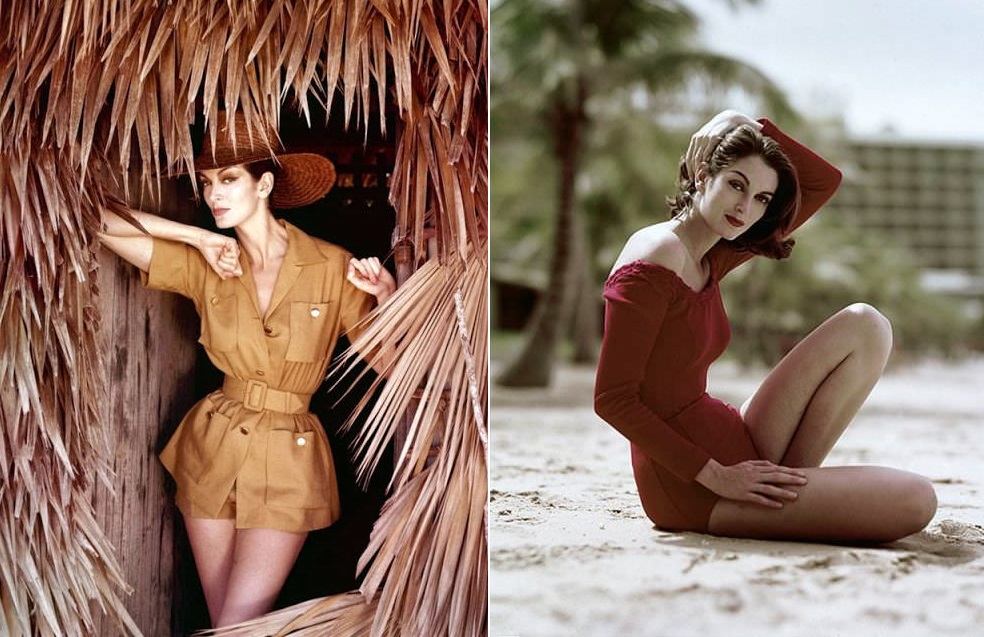
Norman Parkinson had a distinctive approach to fashion photography. Rather than shooting in controlled studio settings, he preferred real locations — city streets, open countryside, foreign destinations, and public spaces. Wenda was his most consistent subject, and the two worked together across shoots in London, Paris, New York, South Africa, Spain, India, and the Caribbean. The results were photographs that felt alive rather than posed.


In 1949, Norman took Wenda to Paris and New York for shoots featuring Christian Dior’s hussar-style velvet-and-wool tailleur, paired with a fox muff — one of the most striking looks of the postwar fashion moment. That same year, she was photographed in Times Square, at a fruit stall in the South of France, and for British Vogue in a taffeta cocktail dress with a silk turban. It was a remarkable amount of ground to cover in a single year.


The early 1950s brought some of the most geographically ambitious work of Wenda’s modeling career. In 1951, Norman took her to South Africa for a series of shoots that placed her in striking contrast to the landscapes around her. One photograph shows her in a grey gabardine dress beside a Hermes aeroplane in Nairobi, Kenya. Another captures her at the Howick Falls in KwaZulu-Natal — a sheer 310-foot drop behind her — wearing fashion that felt almost surreal against such raw scenery.


Back in England, the shoots were no less interesting. Norman placed Wenda in everyday settings that gave his fashion work a grounded, documentary feel. A 1951 shot shows her wearing a cashmere twin-set from Women’s Home Industries while standing in the public bar of the Hobnails Inn in Little Washbourne, Gloucestershire. Another from the same year places her in a tweed suit by Hardy Amies near Rotten Row at Hyde Park Corner. These were fashion photographs, but they also captured the texture of postwar British life.


The designers Wenda wore over the course of her career read like a roll call of mid-century fashion. Christian Dior, Hardy Amies, Norman Hartnell, Molyneux, Aquascutum, and Susan Small all featured across her shoots. She wore a Norman Hartnell gown in 1950 and a Dior look in 1952, moving between couture and ready-to-wear with equal ease. Her versatility made her an ideal model for the changing fashion landscape of the era.


Some of the most memorable photographs from the collection place Wenda in settings that are deliberately unexpected. She appears beside ostriches in South Africa wearing Spectator Sports fashion. She is photographed alongside a De Havilland ‘Vampire’ jet fighter in 1951, dressed in a suit and coat. She sits on a canoe in India in 1956. In each case, the contrast between Wenda’s composure and the environment around her is exactly what makes the image work.


Spain also featured prominently in Norman’s shoots with Wenda. In 1954, the pair traveled to Andalusia for a Vogue assignment that produced several striking images. The region’s strong light, whitewashed architecture, and dramatic landscape gave the photographs a richness that was hard to replicate in a studio. These images from Spain are among some of the most widely recognized from their body of work together.


One of the earliest images in the collection dates to 1942, when Wenda was photographed in front of St Paul’s Cathedral for a feature titled “Country Woman at War.” The image captures a very different mood from the glamorous postwar shoots — London was still a city marked by wartime, and the photograph reflects that. It is a reminder that Wenda’s career began not in the optimism of peacetime fashion but in the harder years that preceded it.


By 1952, Wenda was a regular fixture in Vogue on both sides of the Atlantic. That year she was photographed at a Scottish weaving mill, in Paris alongside another model, and for multiple Vogue features that showcased her range as a subject. She appeared in a Hardy Amies short evening dress for one 1952 shoot, showing that Norman’s lens remained as interested in her as it had been when they first met.


Norman Parkinson’s photographs of Wenda were never purely commercial exercises. Because she was his wife, there was an intimacy in the images that went beyond the typical model-photographer relationship. Some of the most tender photographs in the collection reflect this — including a 1950 shot with their son Simon, which sits quietly among the high-fashion editorial work as a glimpse of the private life behind the public images.


By the mid-1950s, the shoots had taken on a more adventurous geographic scope. Wenda was photographed in Tobago in 1956, in a rickshaw wearing a dress by Roter, and in South Africa again that same year. These trips were part of Norman Parkinson’s broader philosophy — that fashion photography should engage with the world rather than hide from it.


The South Africa shoots of 1951 deserve particular attention for their ambition. Across that single assignment, Norman photographed Wenda at Howick Falls, beside an aeroplane, with ostriches, in a Coolie hat, and in a white hat against the landscape. The sheer variety of images produced from one trip speaks to how productively the two worked together when given space and freedom from a location far removed from London’s fashion world.