Hey There! Before You Go. 😧
Get the best vintage content straight into your inbox!

Don't worry, we don't spam

What Prague looked like in the 1990s – Street Scenes and Everyday Life

The 1990s were one of the most dramatic decades in Prague’s modern history. The city entered the decade still shaking from the Velvet Revolution of 1989, when student protesters flooded the streets after riot police violently broke up a peaceful demonstration. That uprising ended more than four decades of Communist rule and set Prague on a completely new course. What followed was a decade of rapid change — politically, economically, and culturally — that reshaped every corner of the city.

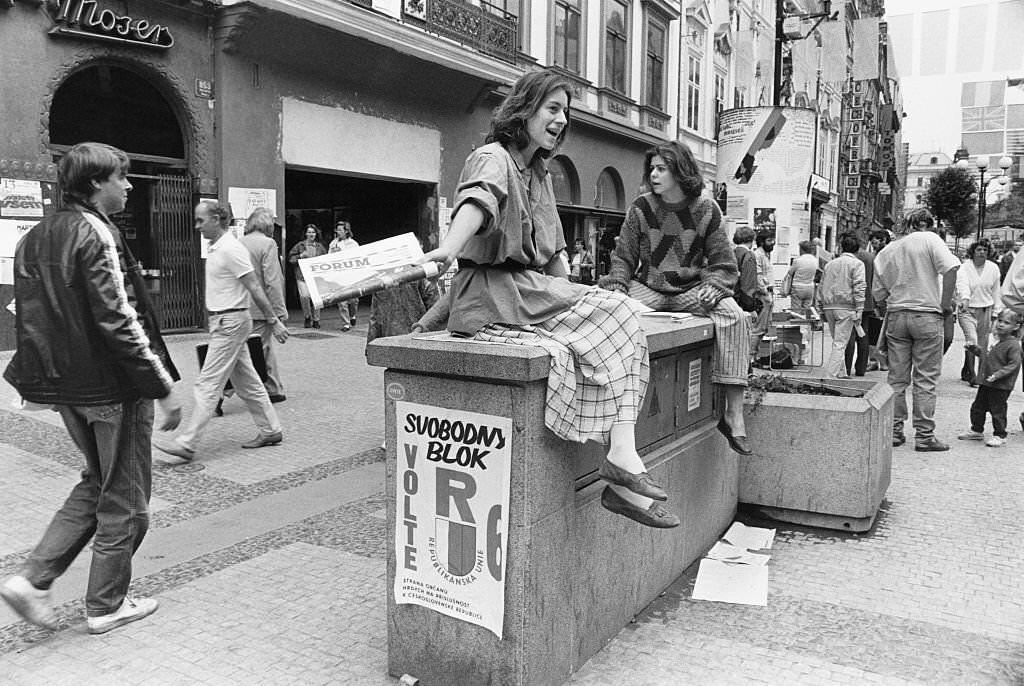
One of the first visible signs of that change came in June 1990, when Czechoslovakia held its first free parliamentary elections since the end of Communist rule. Voters lined up at polling stations across Prague, many of them participating in a free election for the very first time in their lives. Political rallies filled public squares. Newspapers and campaign leaflets were handed out on street corners. The energy was raw and urgent.
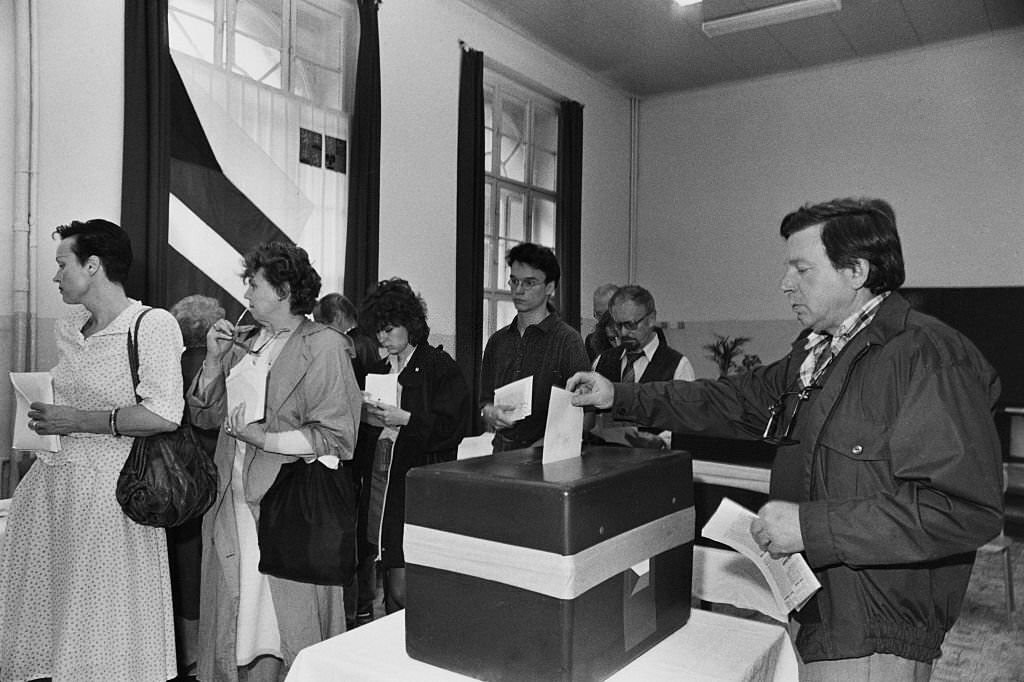
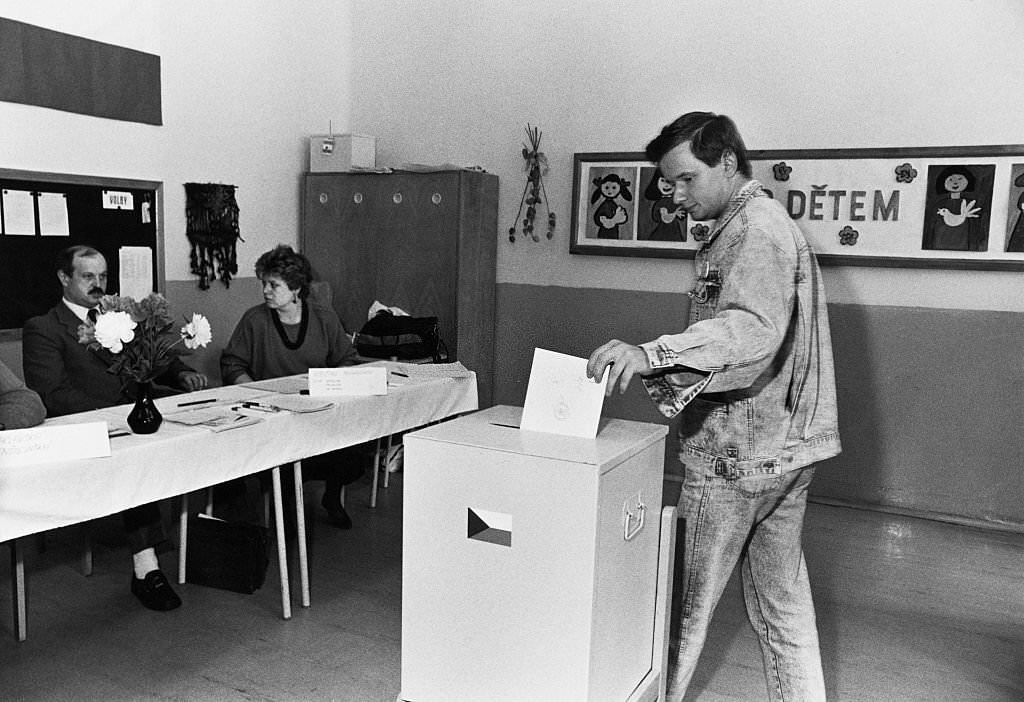
Voting in the parliamentary elections in Prague, 8th June 1990.
Voting in the parliamentary elections in Prague, Czechoslovakia, 7th June 1990.

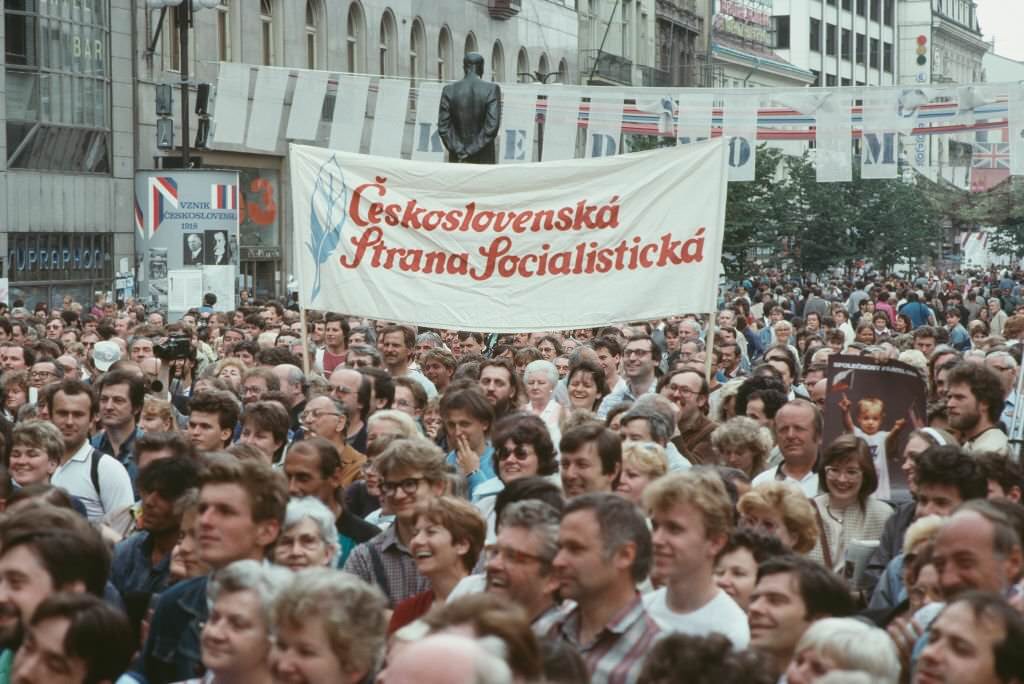
The June 1990 elections drew enormous public engagement. This was the first election in the country since the Communists had taken power, and citizens treated it as a serious moment. Political rallies drew large crowds, and campaign materials circulated widely through the city.
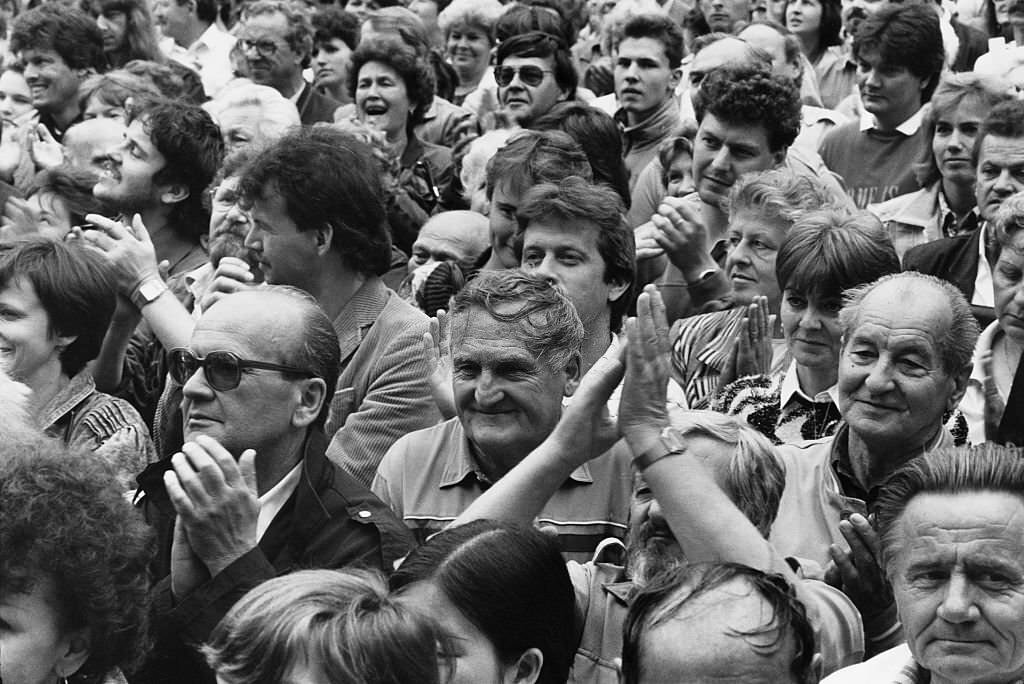
A political rally in Prague, Czechoslovakia, during the first election since the Velvet Revolution, 6th June 1990.
Young women distributing the political newspaper 'Forum' in Prague, Czechoslovakia, 6th June 1990.
Young women distributing the political newspaper ‘Forum’ in Prague, Czechoslovakia, 6th June 1990.
People attending a political rally in Prague, Czech Republic, June 1990.
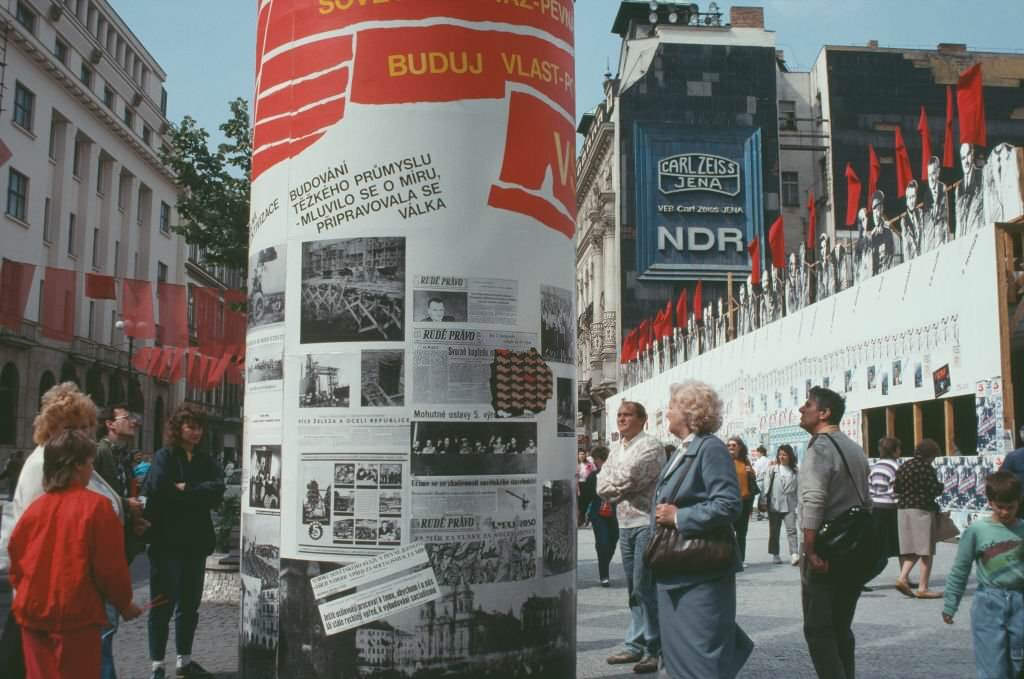
People walking past a column showcasing political handouts, Prague, Czech Republic, June 1990.
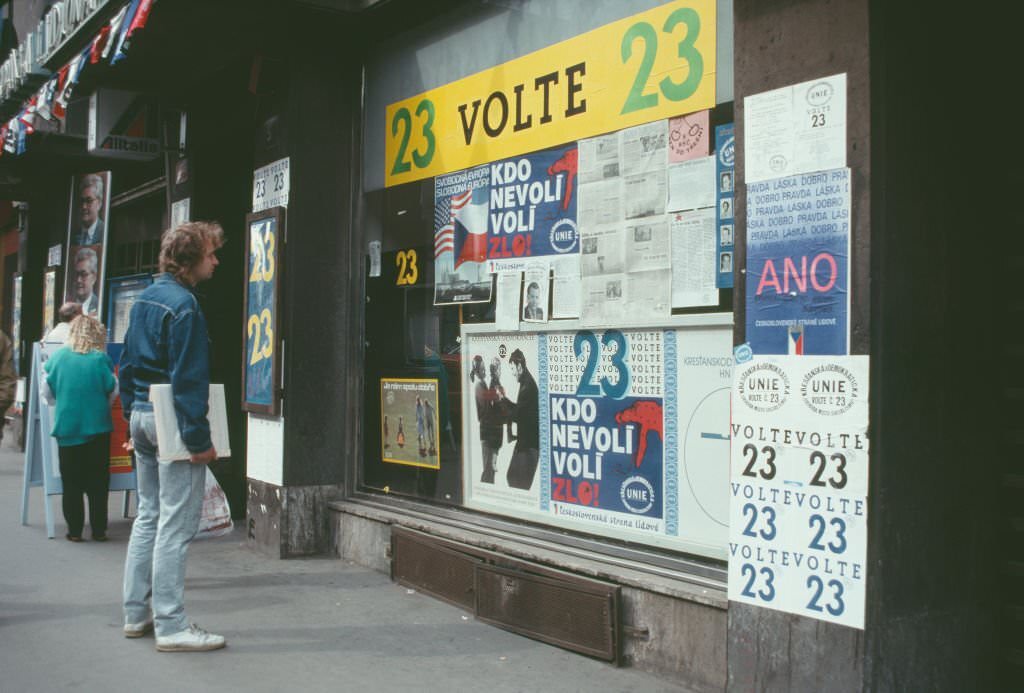
A man watches billboards for a political campaign, Prague, Czech Republic, June 1990.

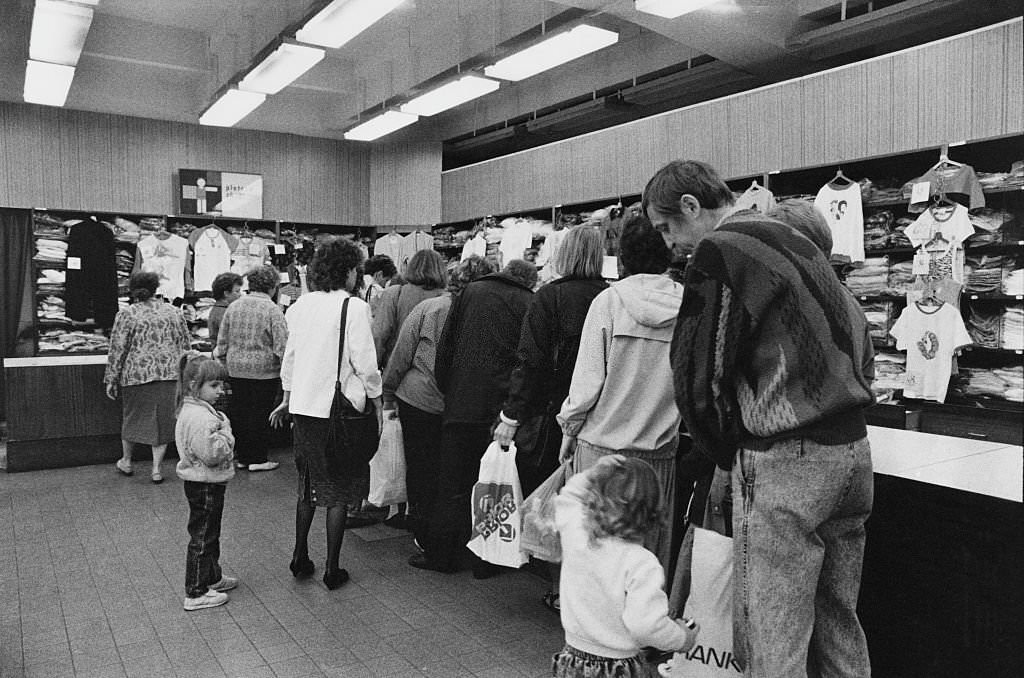
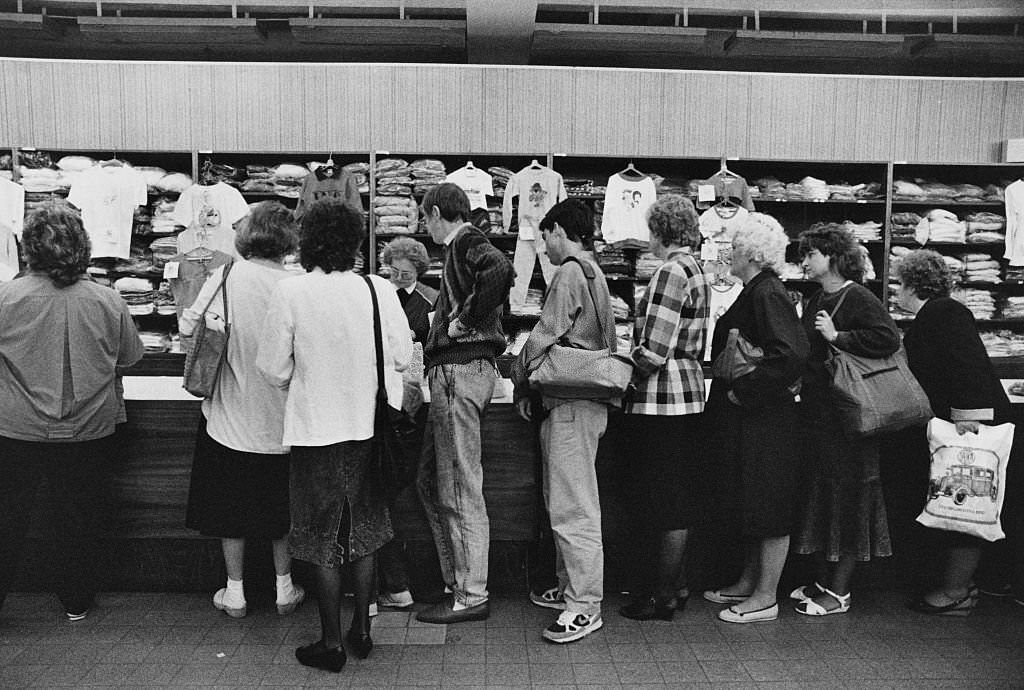
Everyday life in 1990 reflected just how much the Communist era had suppressed ordinary consumer choice. Long queues formed outside clothing stores and at food stalls where basic goods like bananas — once rare or entirely unavailable under the old system — were now appearing for the first time. These queues were not a sign of continued scarcity so much as pent-up demand meeting a newly open market.
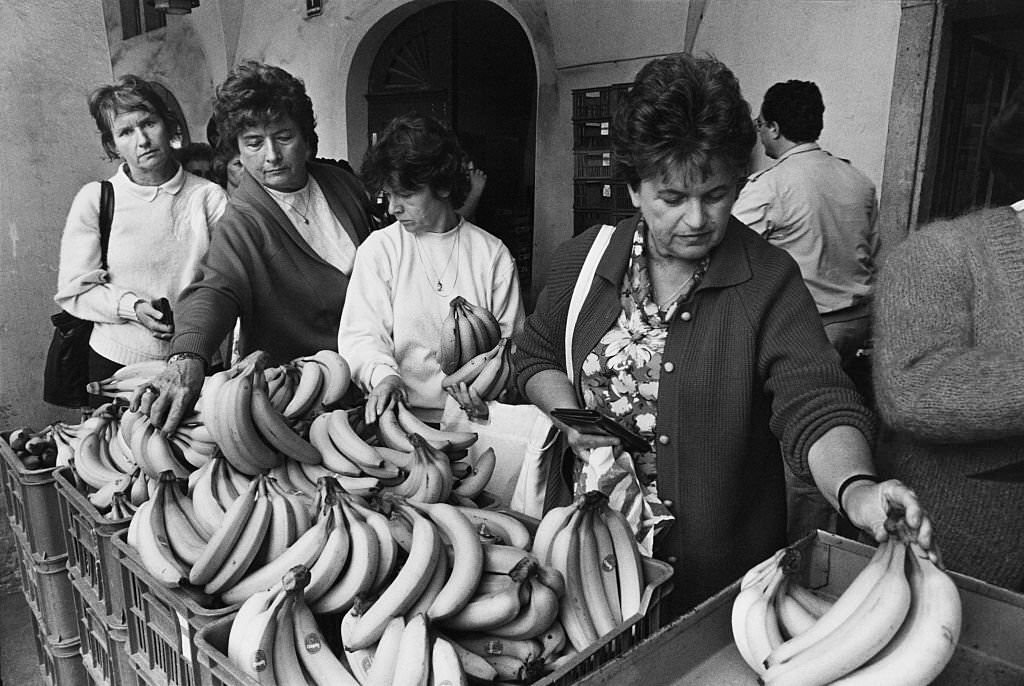
People queuing for bananas in Prague, 7th June 1990.
People queuing at a clothing store in Prague, Czechoslovakia, 5th June 1990.

The streets of Prague in 1990 also told the story of a society processing its past. Communist-era busts of Vladimir Lenin and Klement Gottwald — once symbols of state power — were now being sold as curios on the open market. Soviet troops, stationed in Czechoslovakia since 1968, were withdrawing. The sight of a Soviet soldier carrying a tuba back to his barracks near Prague captured the strange, almost surreal quality of that transition.
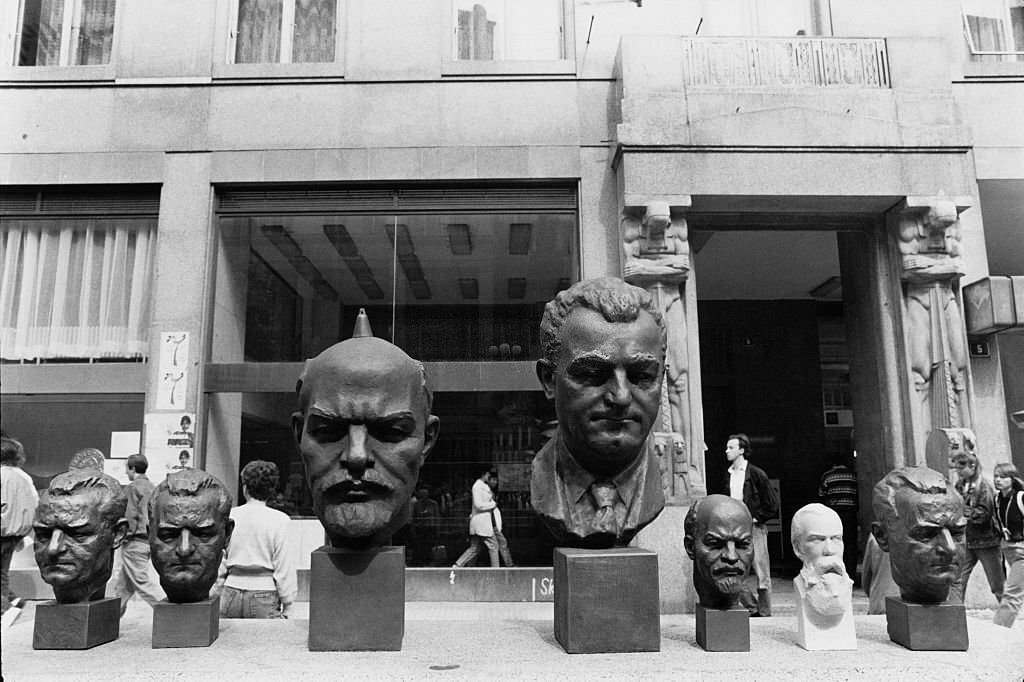
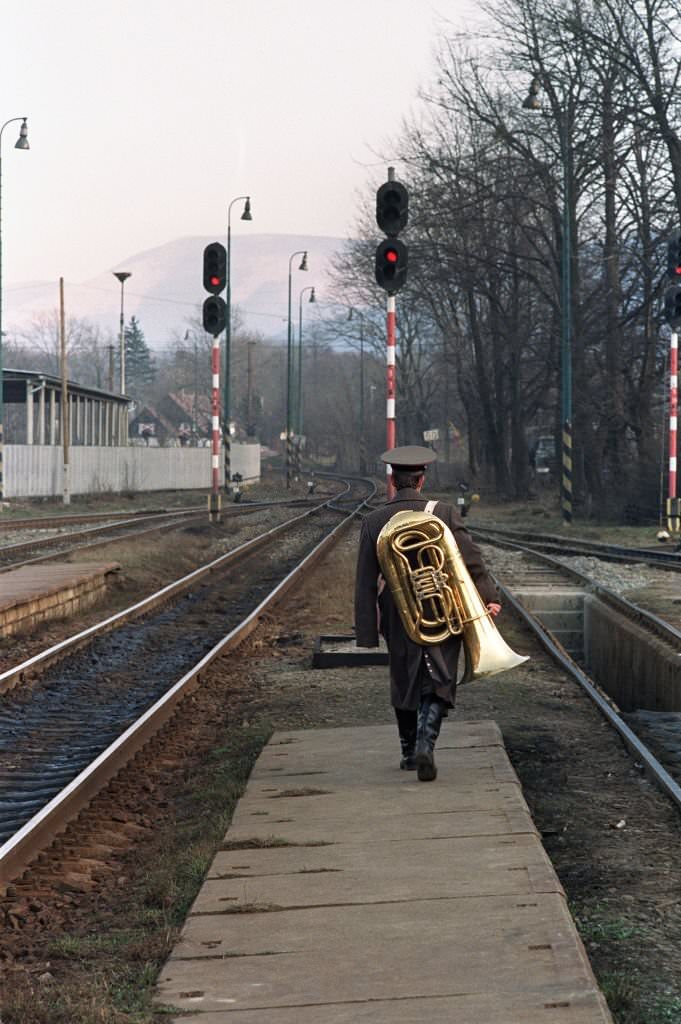
Busts of Communist leaders Vladimir Lenin and Klement Gottwald for sale in Prague, Czechoslovakia, 1990.
A Soviet soldier carrying a tuba returns th his barracks in Frenstat, 350 kilometers east of Prague.

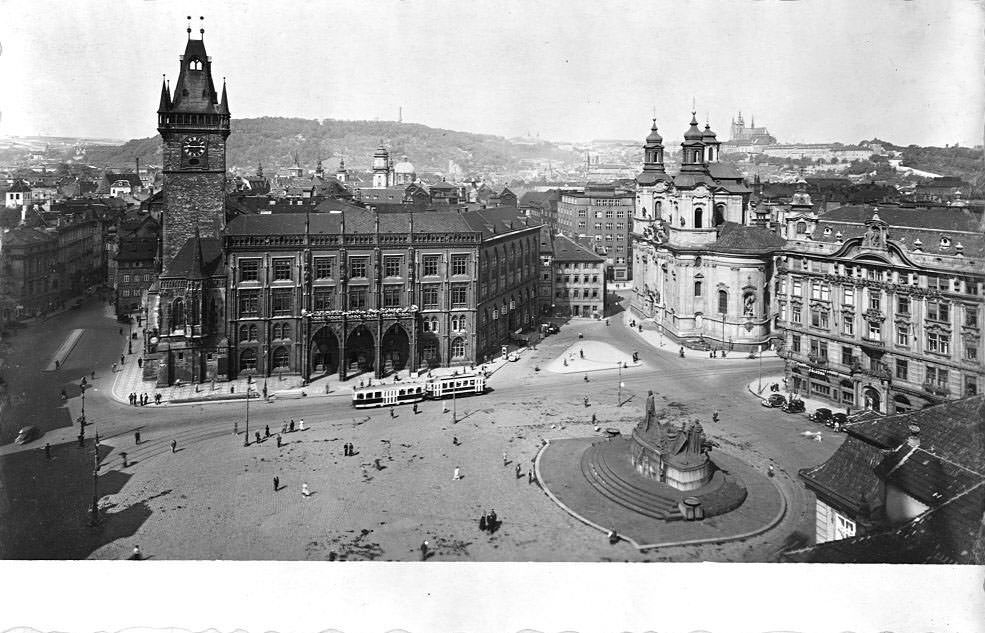
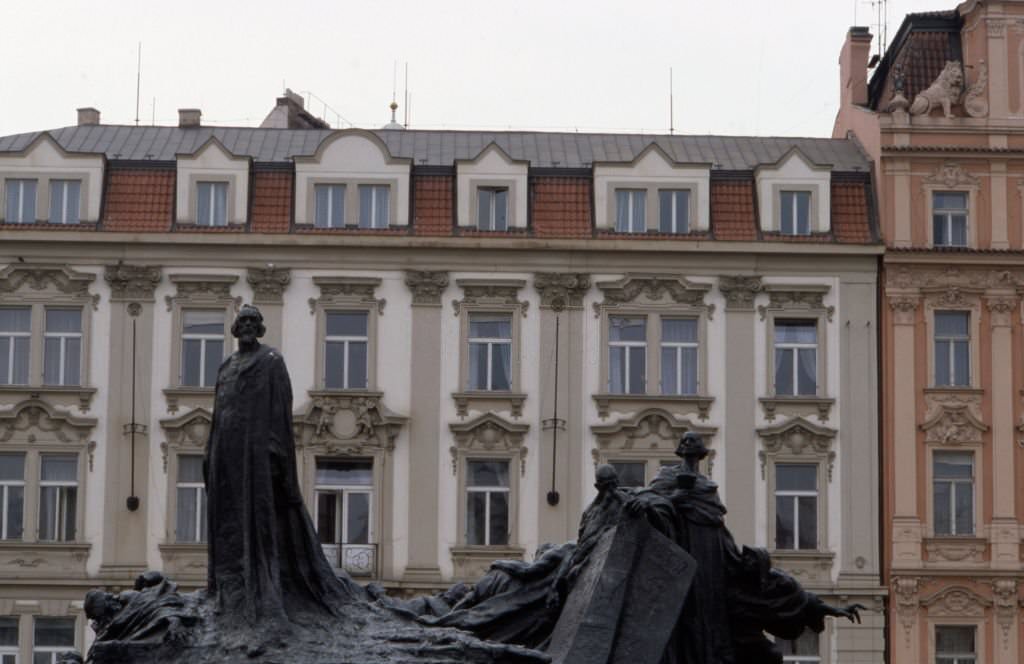
Prague’s historic core — the Old Town Square, Charles Bridge, and the castle district — remained the visual heart of the city throughout all of these changes. In February 1990, the Vltava River and Charles Bridge sat in winter quiet, a stark contrast to the political energy gripping the rest of the country. The Jan Hus monument in Old Town Square, a landmark dating back to 1915, stood as a constant reference point amid the upheaval.
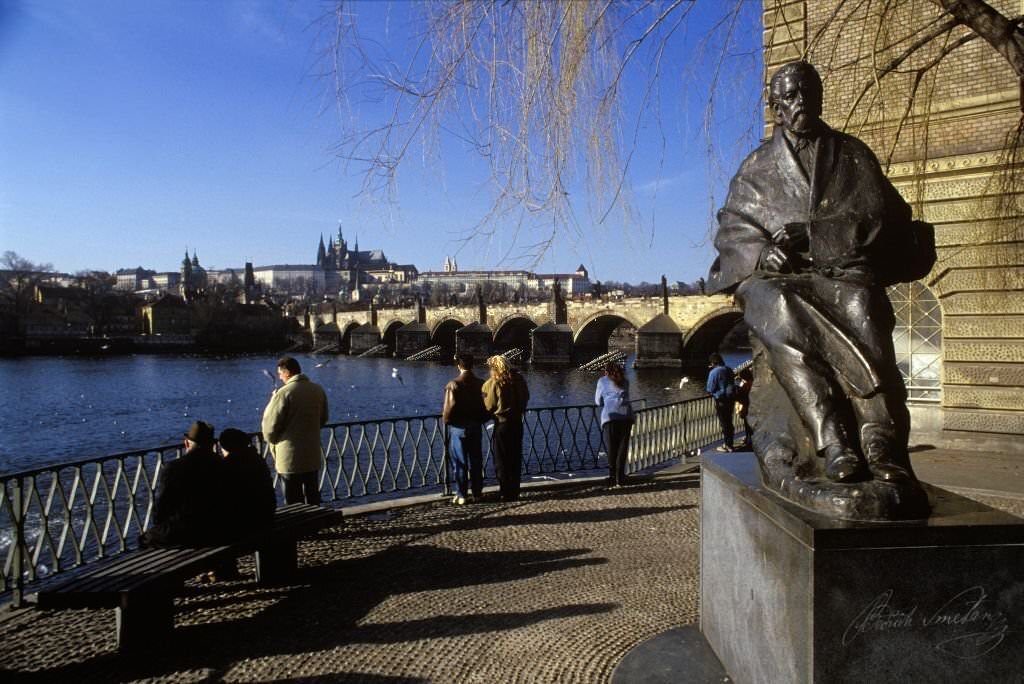
The Moldau River And Charles Bridge In Prague, February 1990.
The monument to Jan Hus in the Old Town Square in Prague, 1990
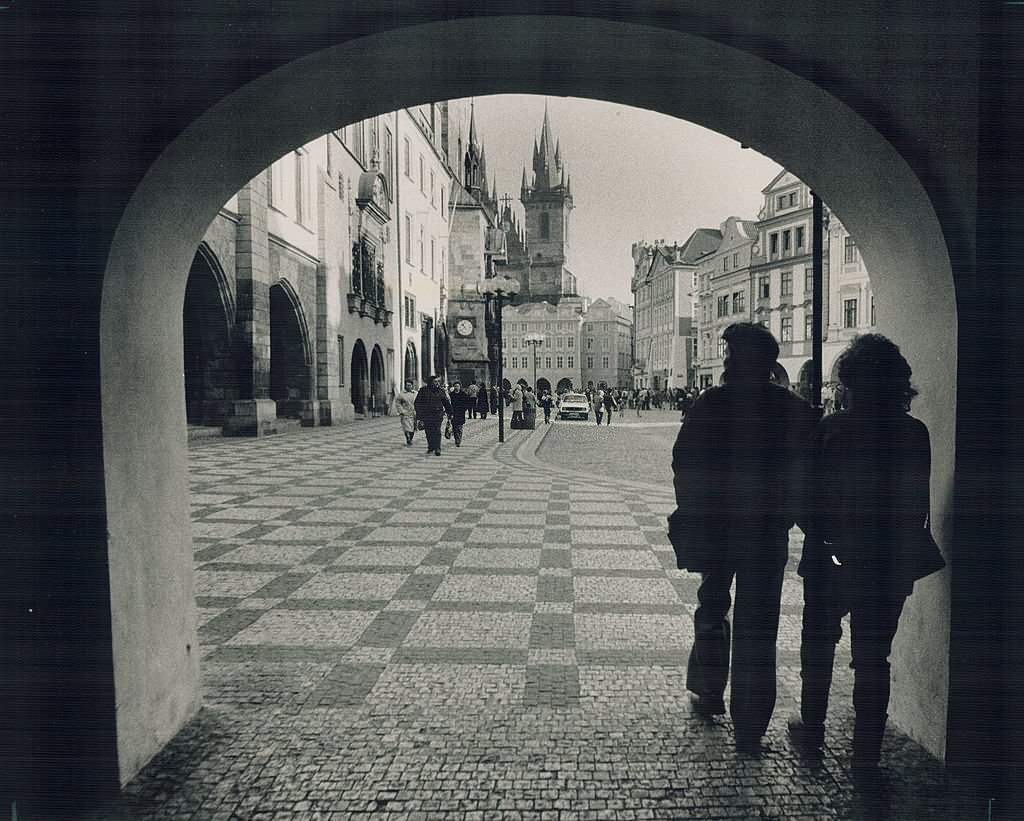
Old Town Square, Prague, 1990
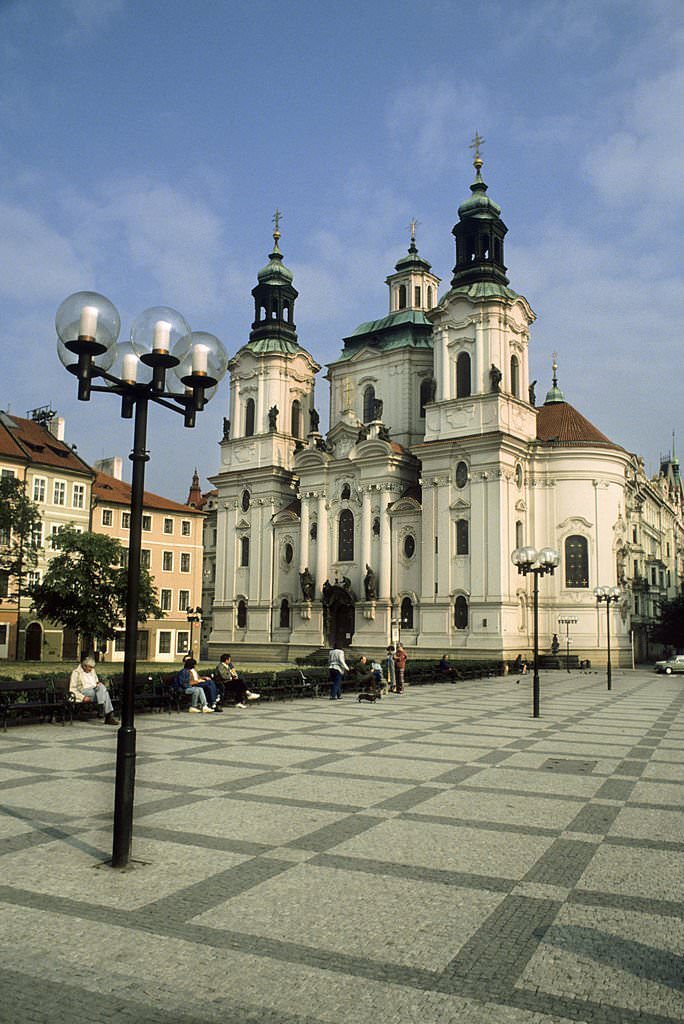
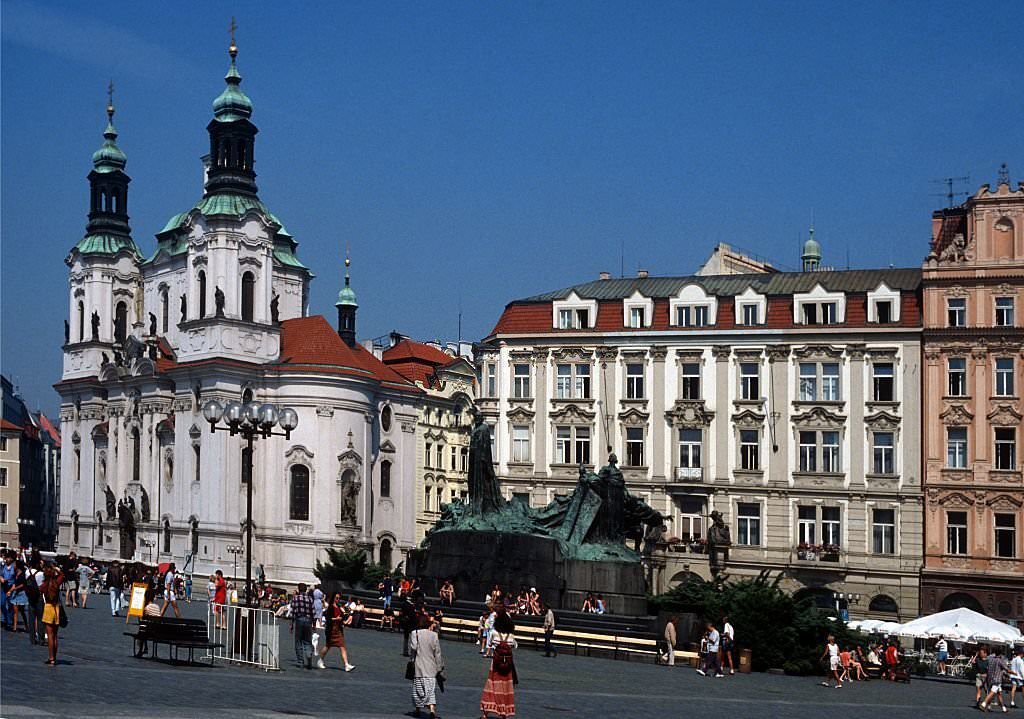
Old Town Square, Saint Nicolas, Prague, 1990
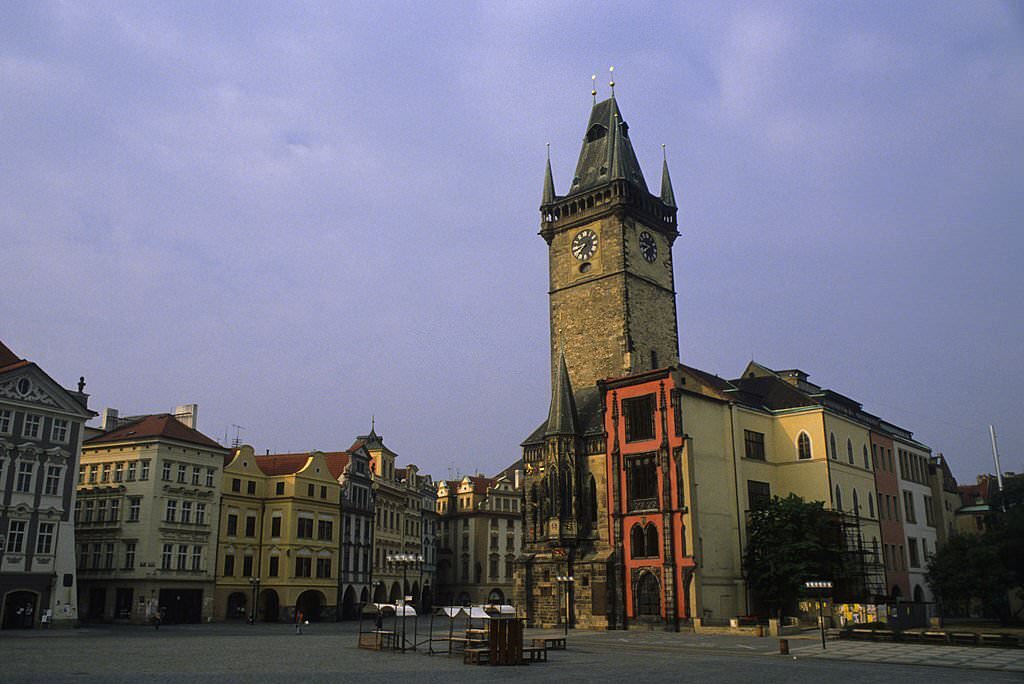
Czech Republic, Prague, Old Town Square (staromestske Namesti), Town Hall, Prague, 1990

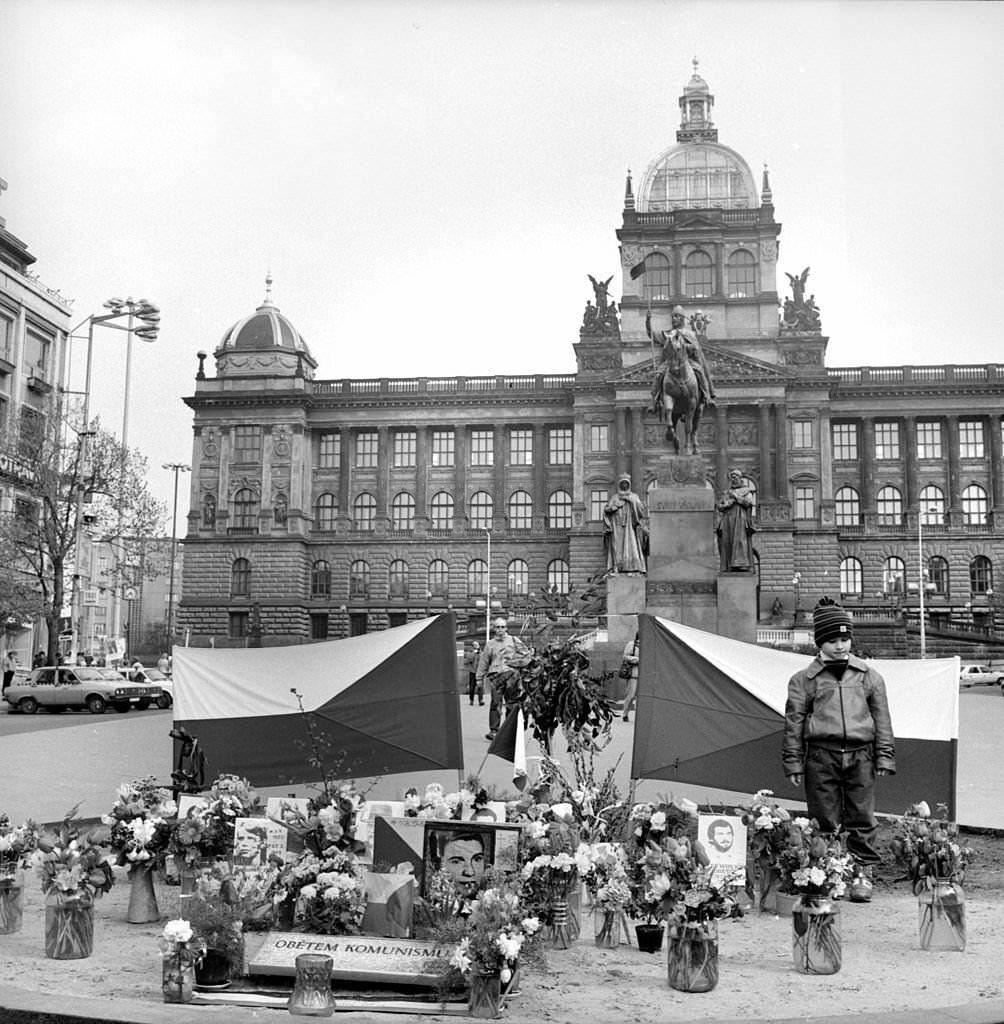
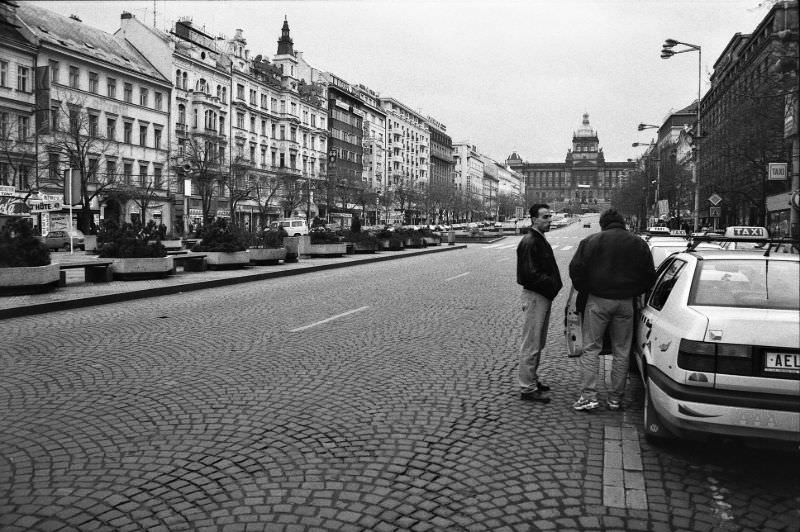
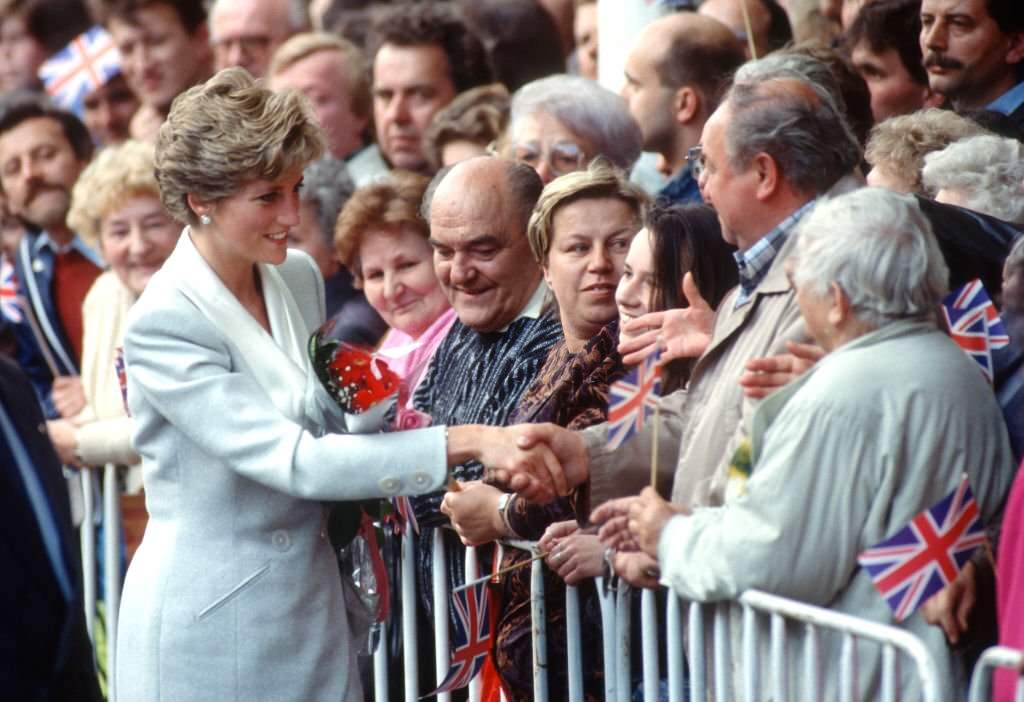
Wenceslas Square had been the epicenter of the Velvet Revolution itself, and in the early 1990s it still carried that weight. Crowds had gathered there to bring down the Communist government, and the square remained a place where the public felt the pulse of the new Czech society. Princess Diana visited and walked through Wenceslas Square in May 1991, shaking hands with well-wishers in a gesture that signaled Prague’s growing openness to the world.
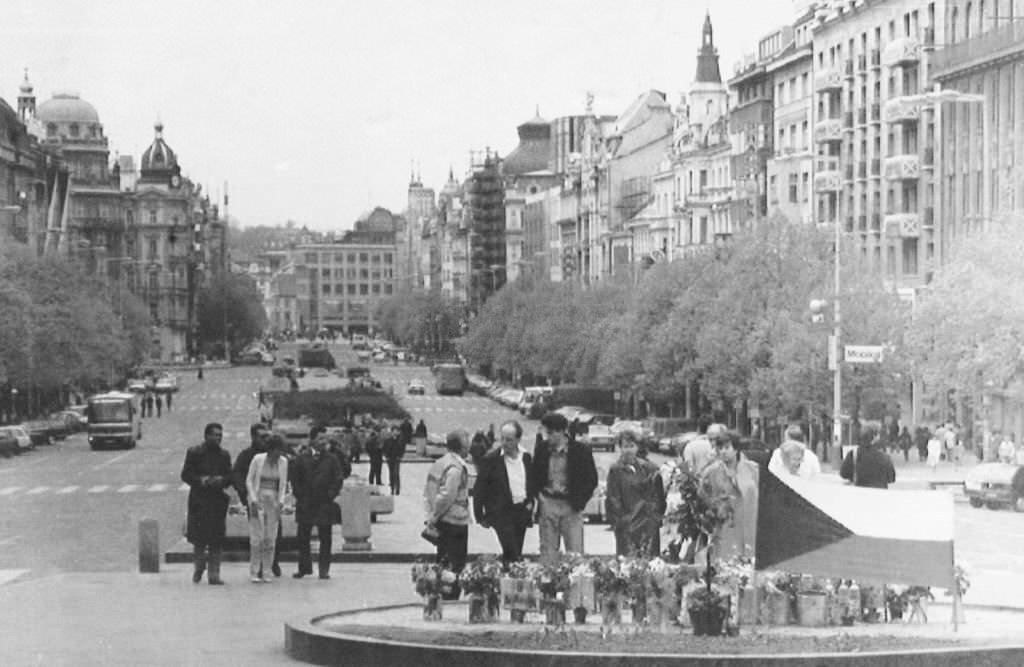
Prague's Wenceslas Square, where the communist government was toppled.
Prague’s Wenceslas Square, where the communist government was toppled.
Diana, Princess of Wales, shakes hands with a well-wisher as she visits Wenceslas Square on May 6, 1991 in Prague.
Venceslas boulevard, Prague, 1991

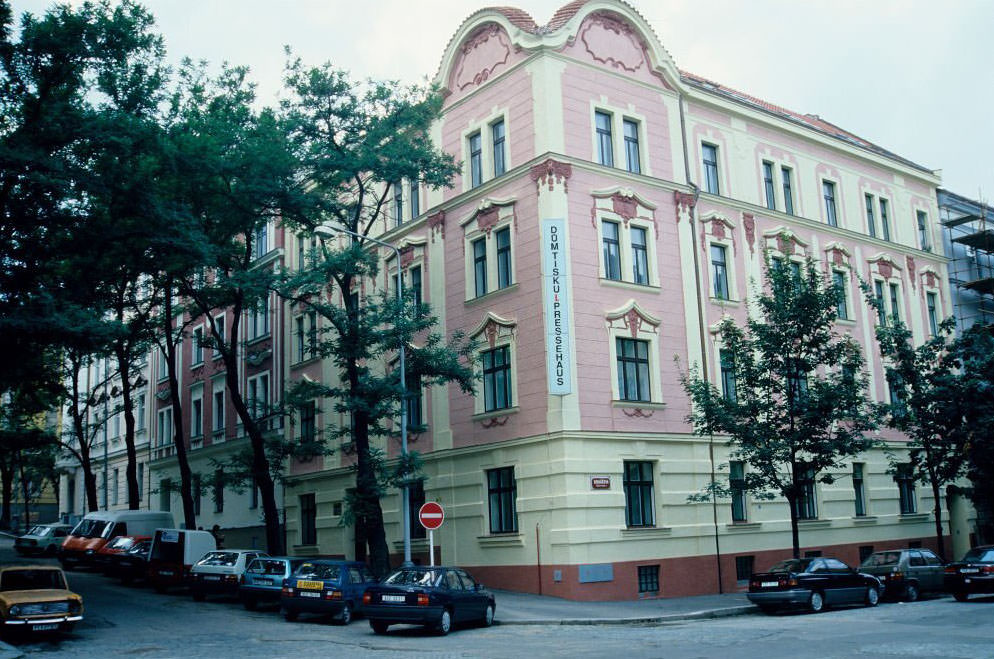
On January 1, 1993, Czechoslovakia peacefully split into two separate countries — the Czech Republic and Slovakia — in what became known as the Velvet Divorce. Prague became the capital of the newly independent Czech Republic. The change was administrative but carried enormous practical weight. New institutions, a new currency, and a new national identity all had to be built from scratch. Foreign press operations, like the Ringier press house, were already establishing themselves in the city, reflecting the influx of international media and business interests.
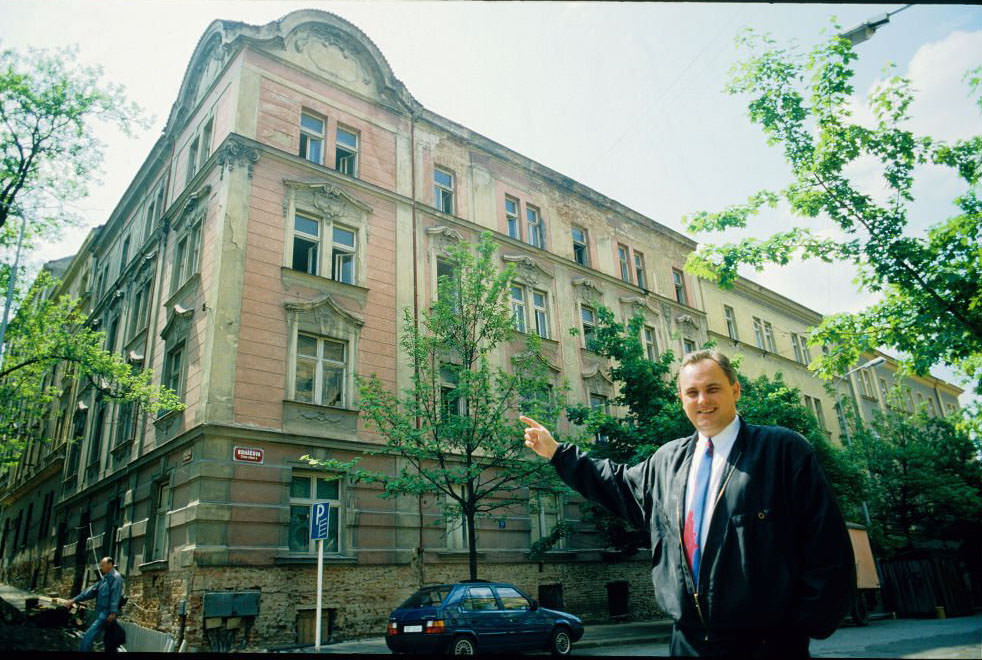
Director Michal Voracek in front of future Ringier Pressehaus in Prag, 1992
Ringier Pressehaus in Prag, 1993

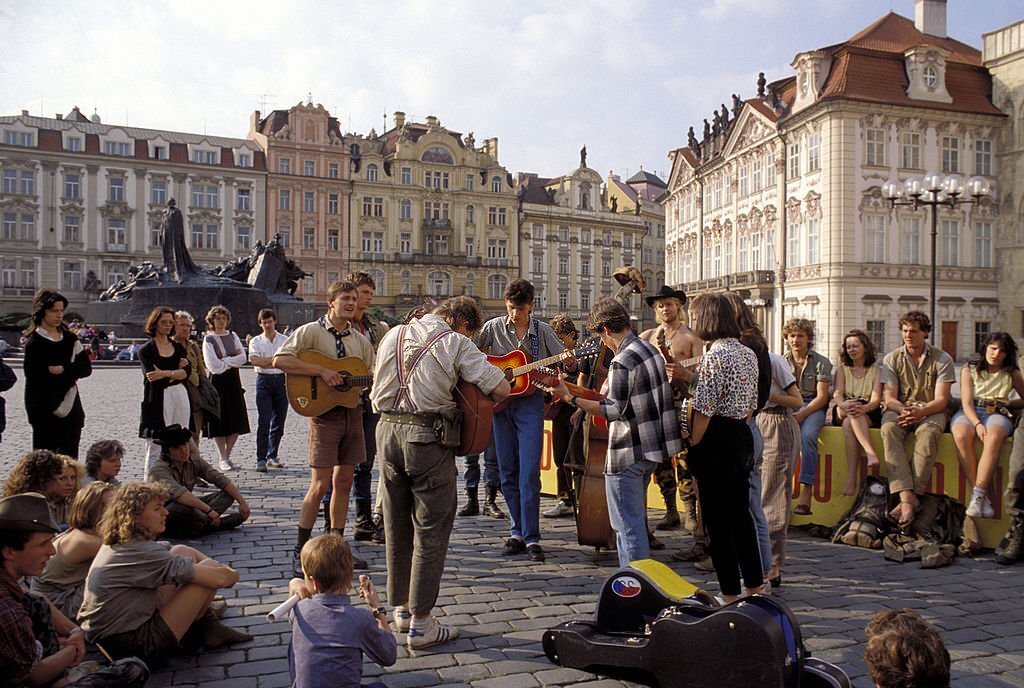
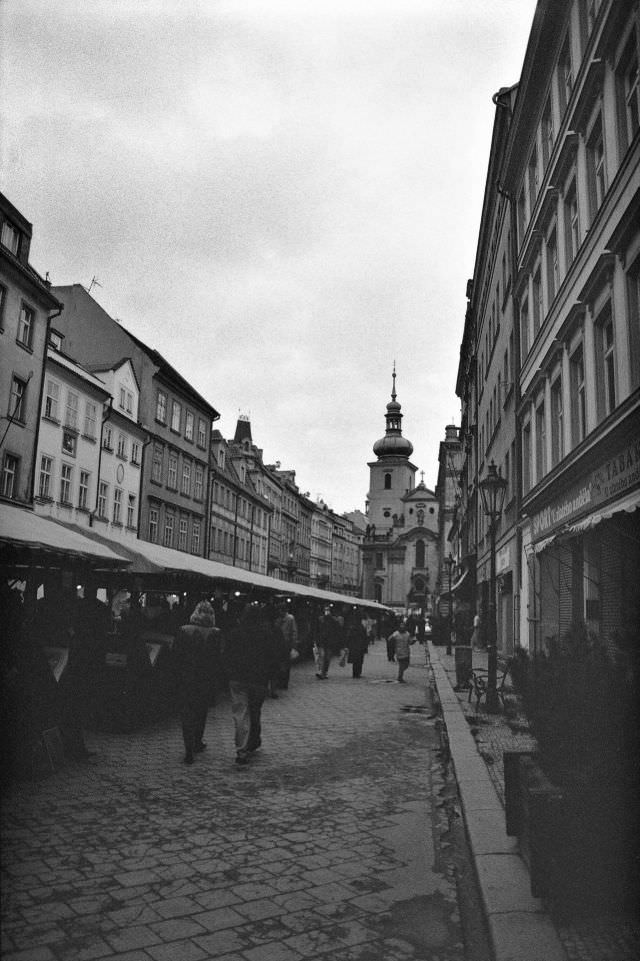
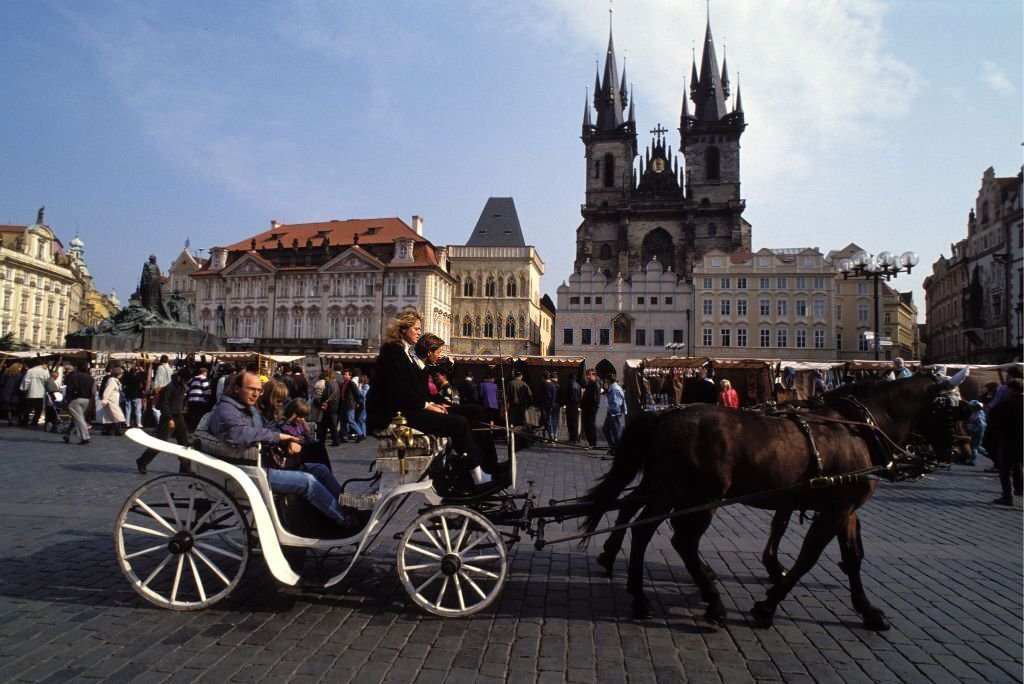
Street life in the early 1990s mixed the old and the new. Street musicians played on Charles Bridge. Horse-drawn carriages moved through Old Town Square alongside trams that had run the same routes for decades. Markets like the Havelské tržiště in the Old Town bustled with vendors. Cobblestone streets and Gothic church spires framed scenes of ordinary daily commerce that looked centuries old but were now playing out in a freshly democratic country.
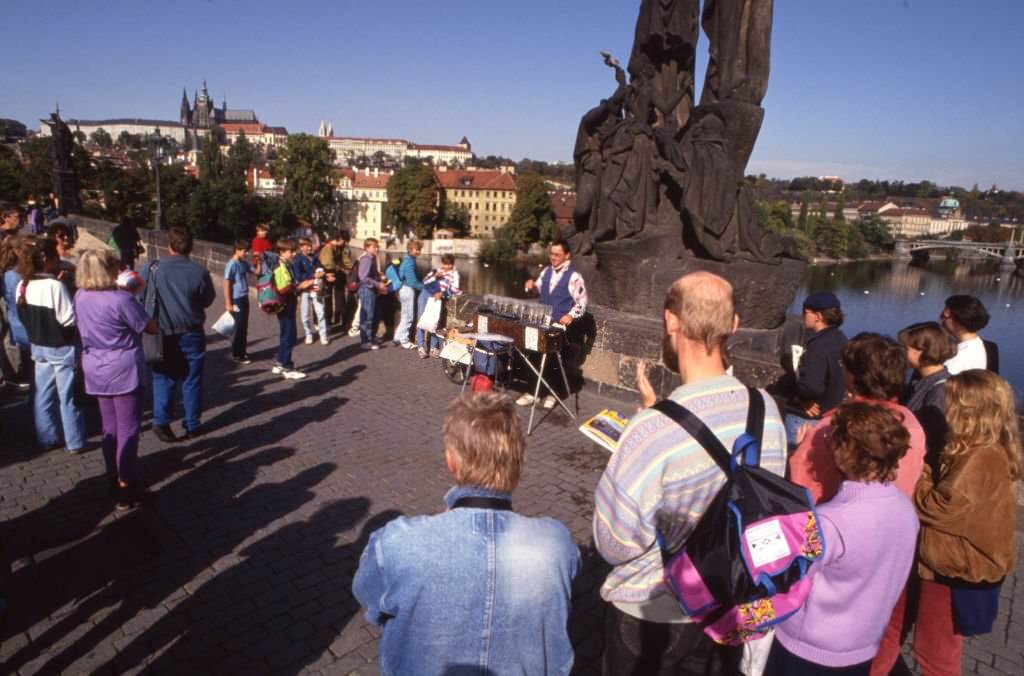
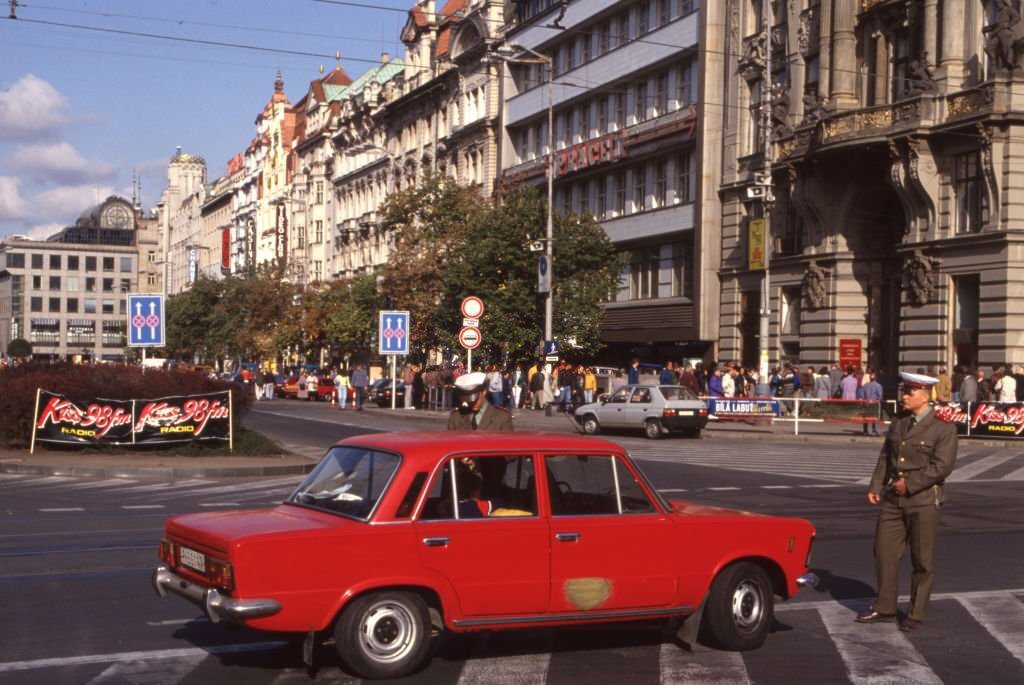
Street musician in Prague, 1992
Wenceslas Square in Prague, 1992
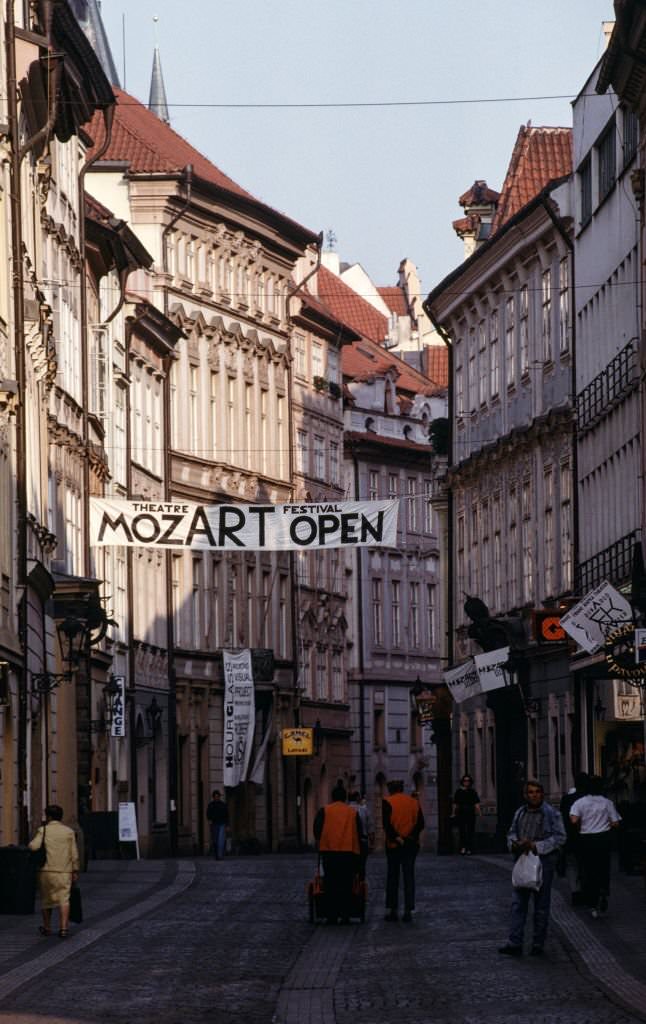
The old town, Prague, 1992
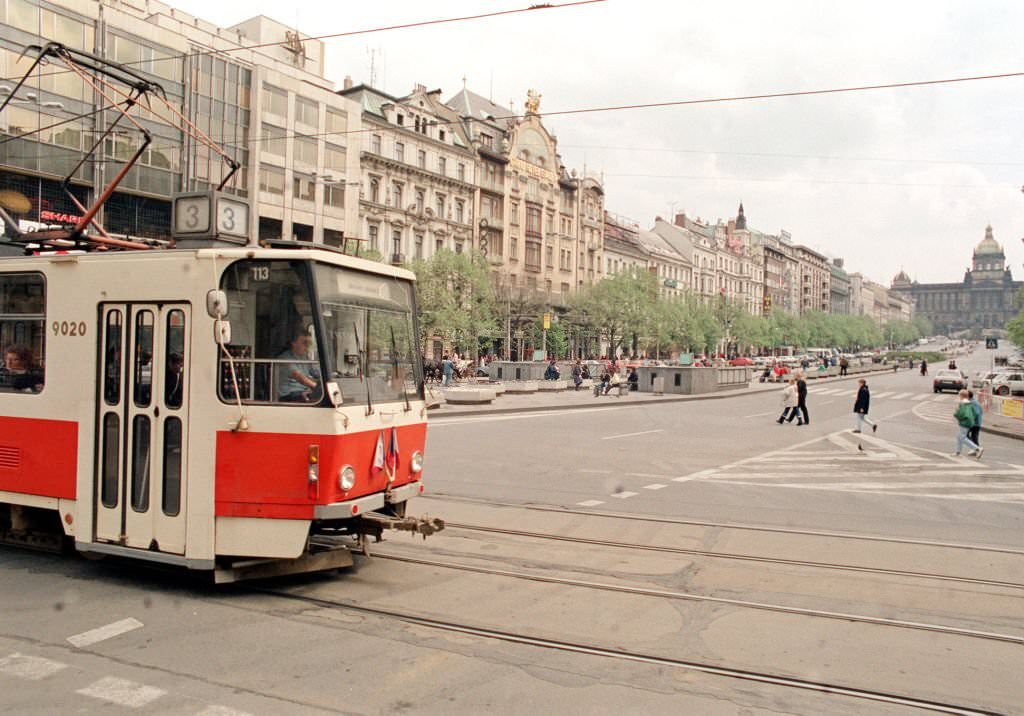
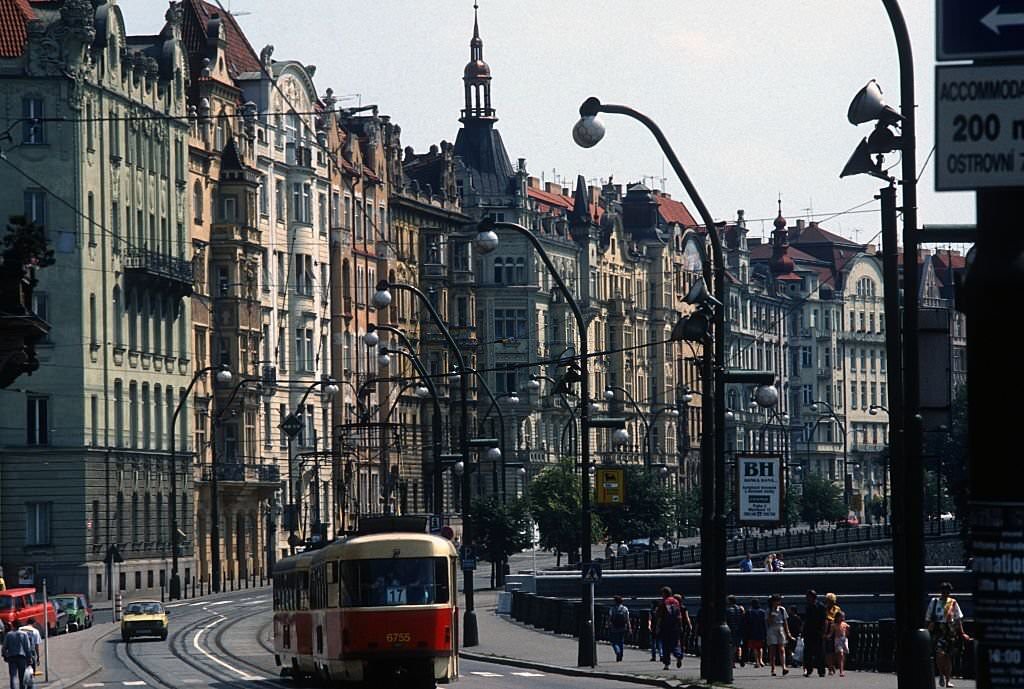
A tram in Prague, 1990s
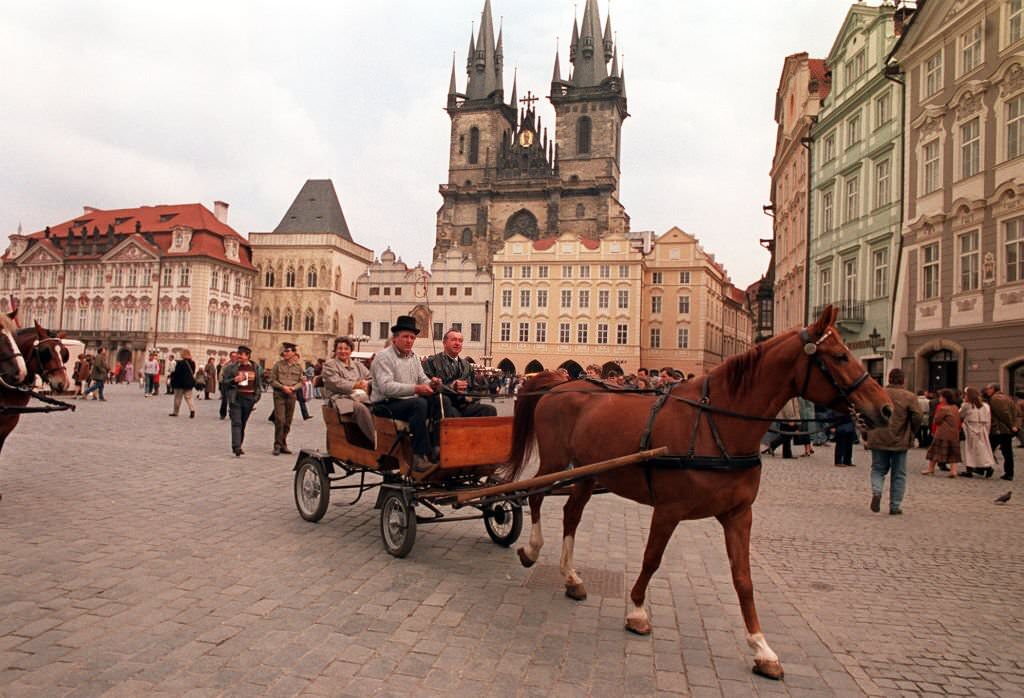
A horse and carriage rides through the Old Town Square in Prague.

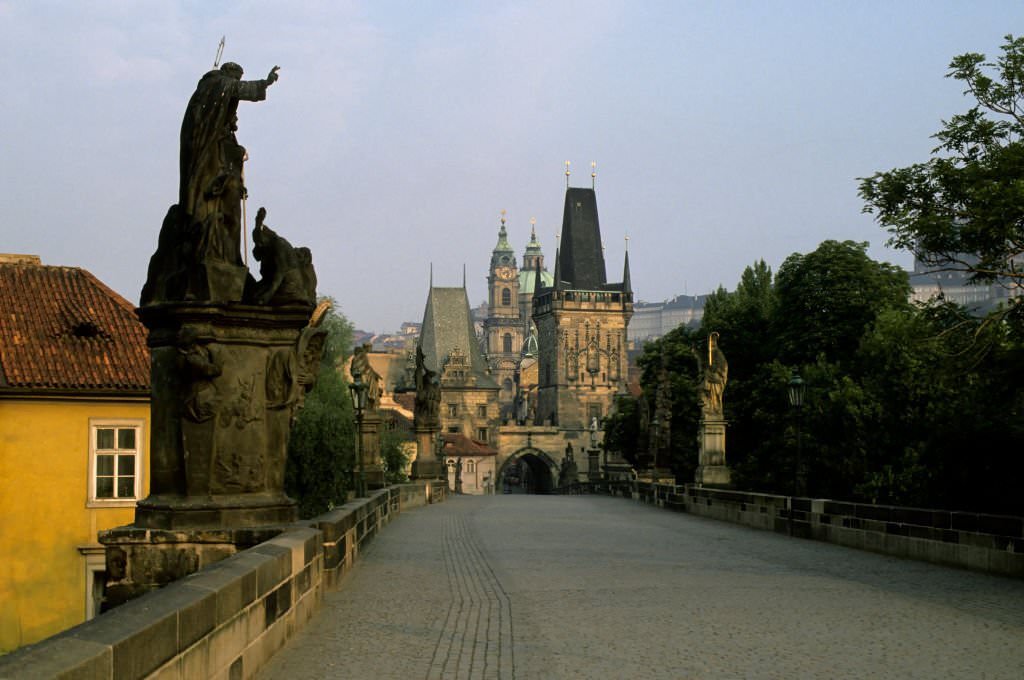
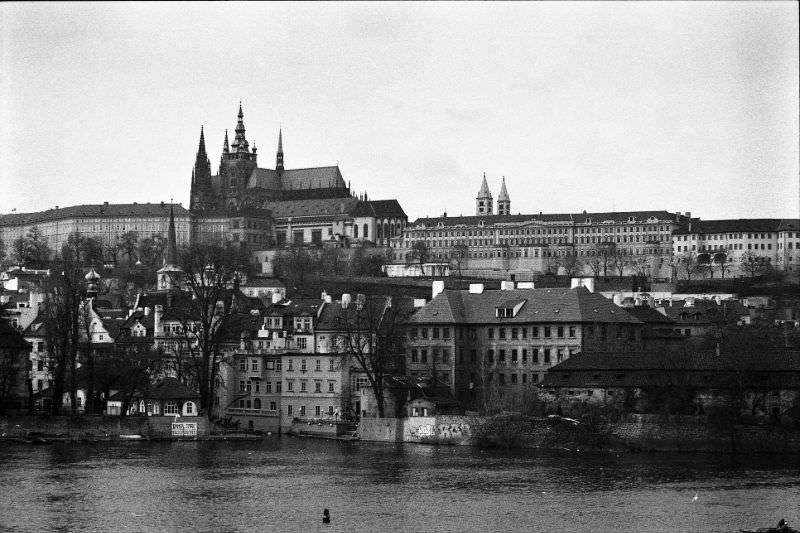
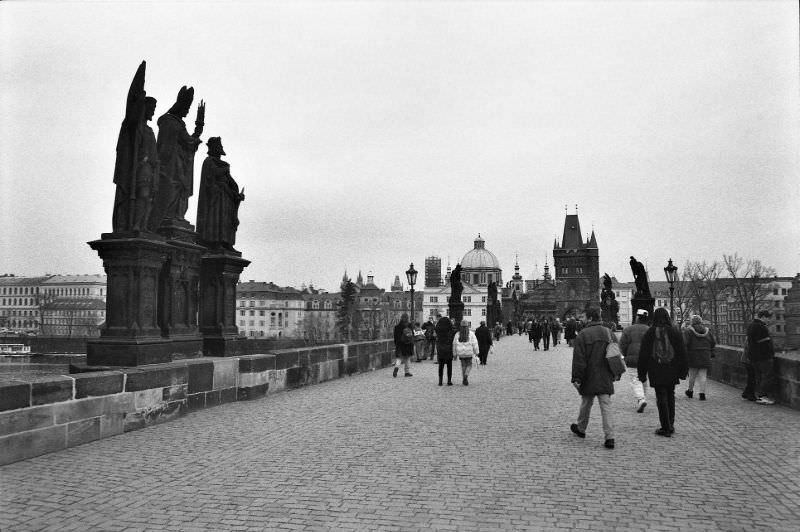
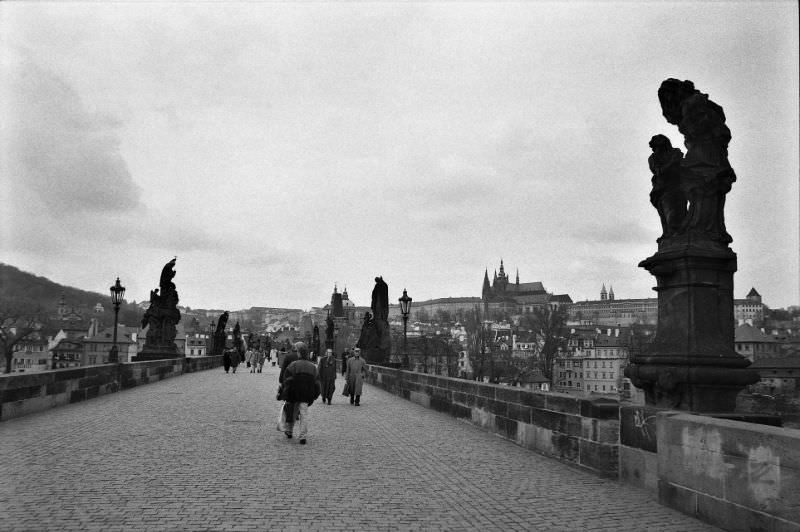
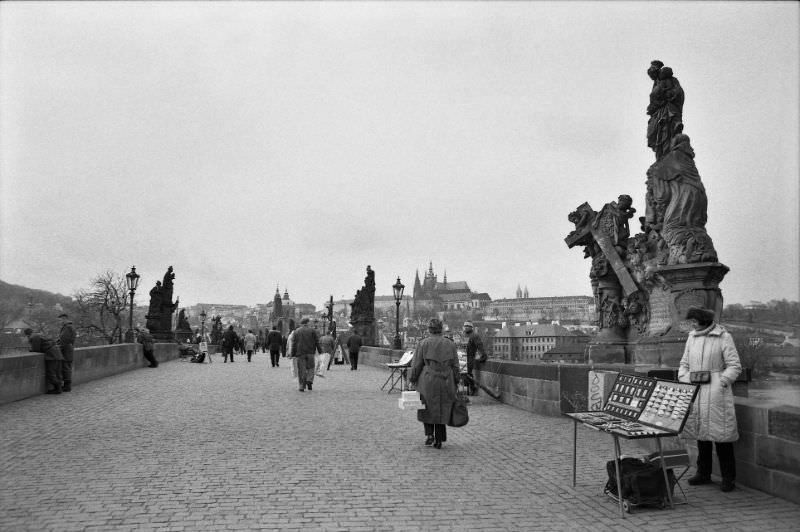
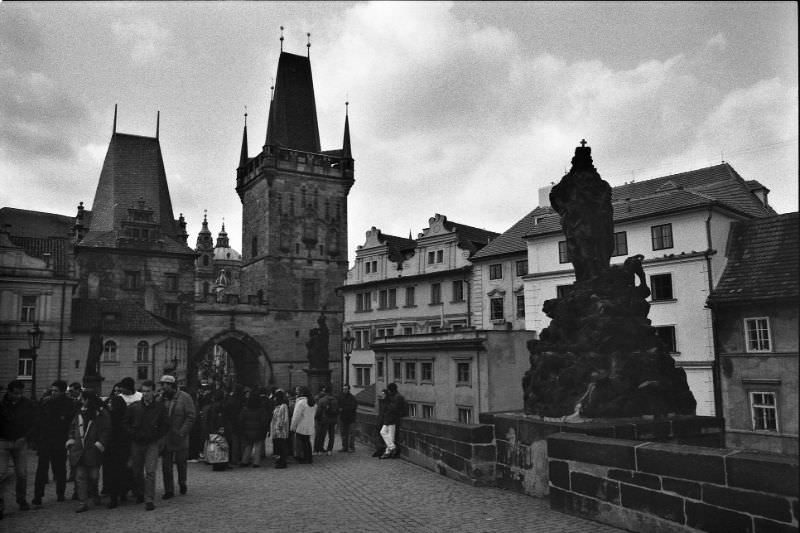
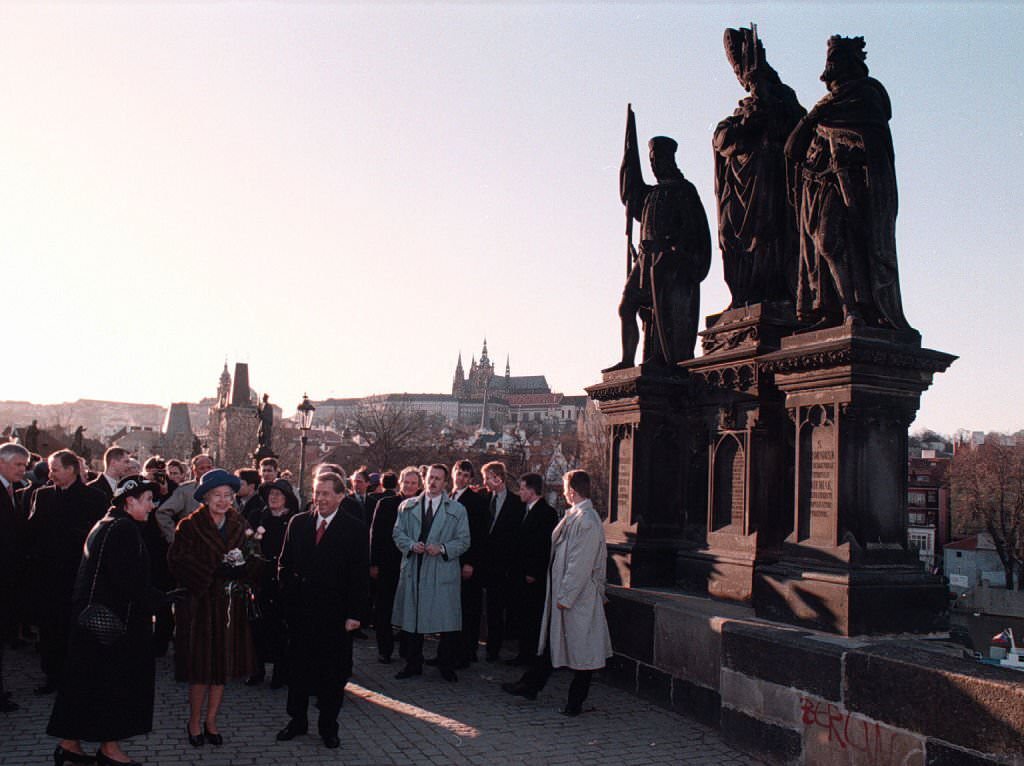
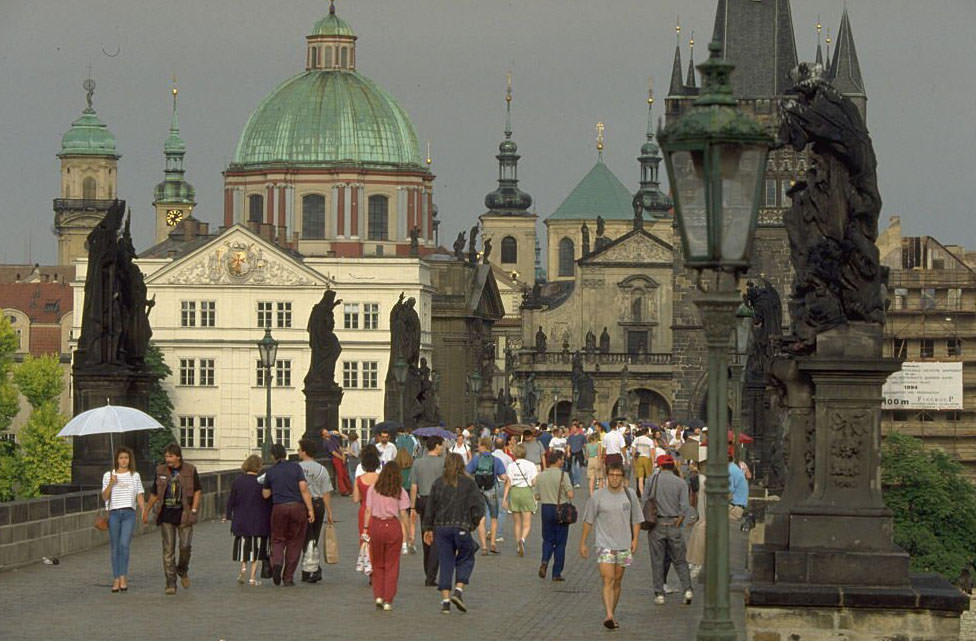
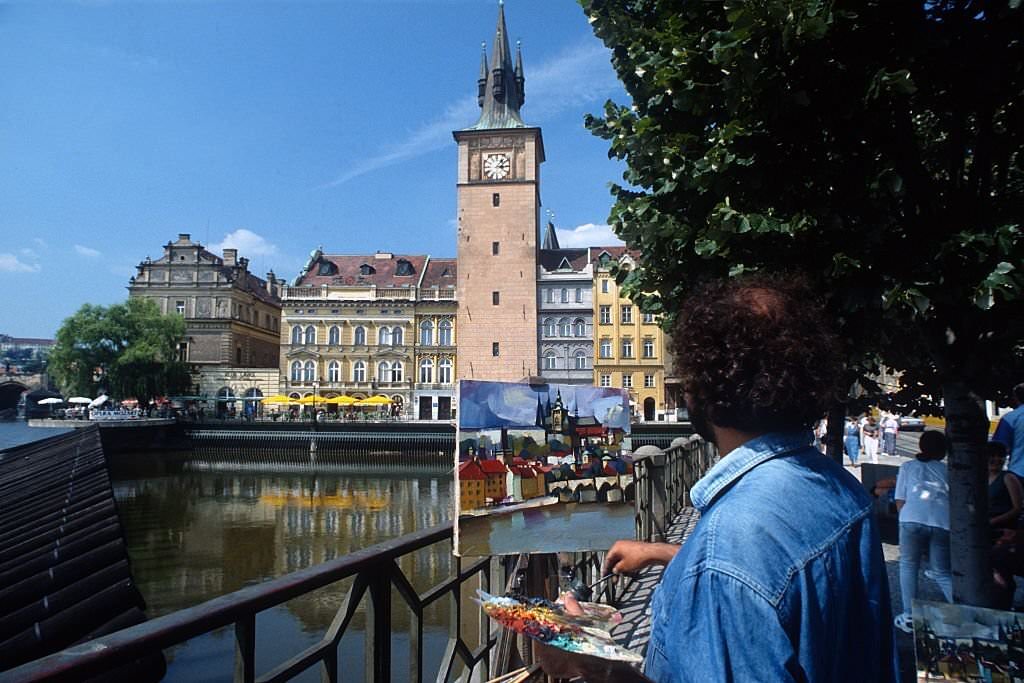
By the mid-1990s, Prague had opened its stock market for the first time since World War II and had begun attracting significant foreign investment. High-rise construction picked up sharply from 1995 onward. Yet the city’s ancient landmarks continued to draw growing numbers of tourists. Charles Bridge, with its row of Baroque statues and views of Prague Castle and St. Vitus Cathedral, became one of the most photographed places in Europe. Painters set up along the Vltava River, and musicians claimed spots on the bridge itself.
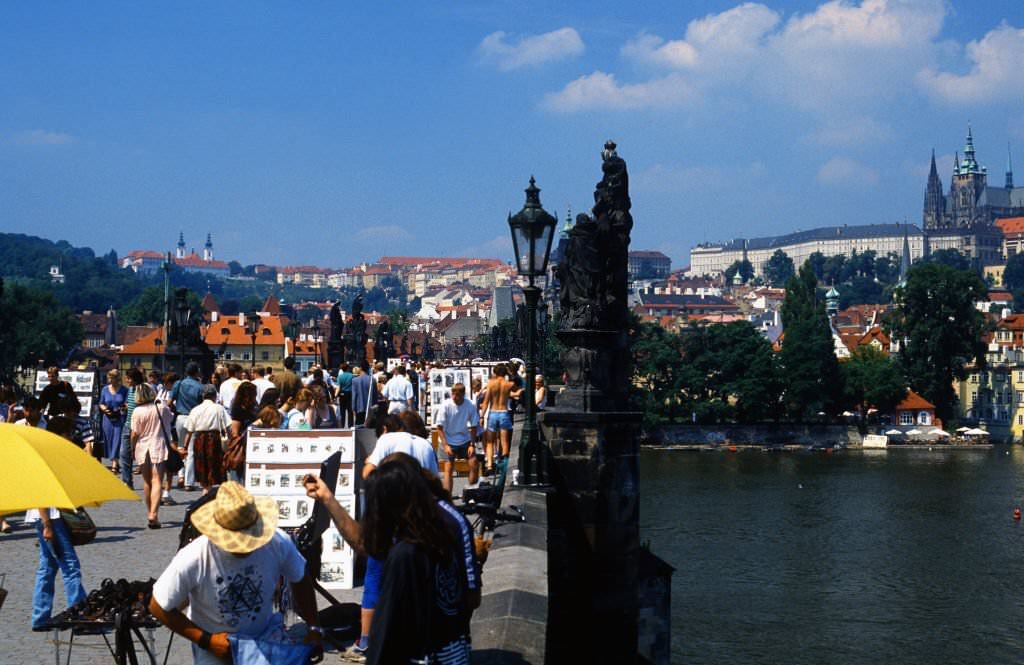
Charles Bridge on July 25, 1995 in Prague, Czech Republic.
Painting by the Vltava River, Prague, 1995.
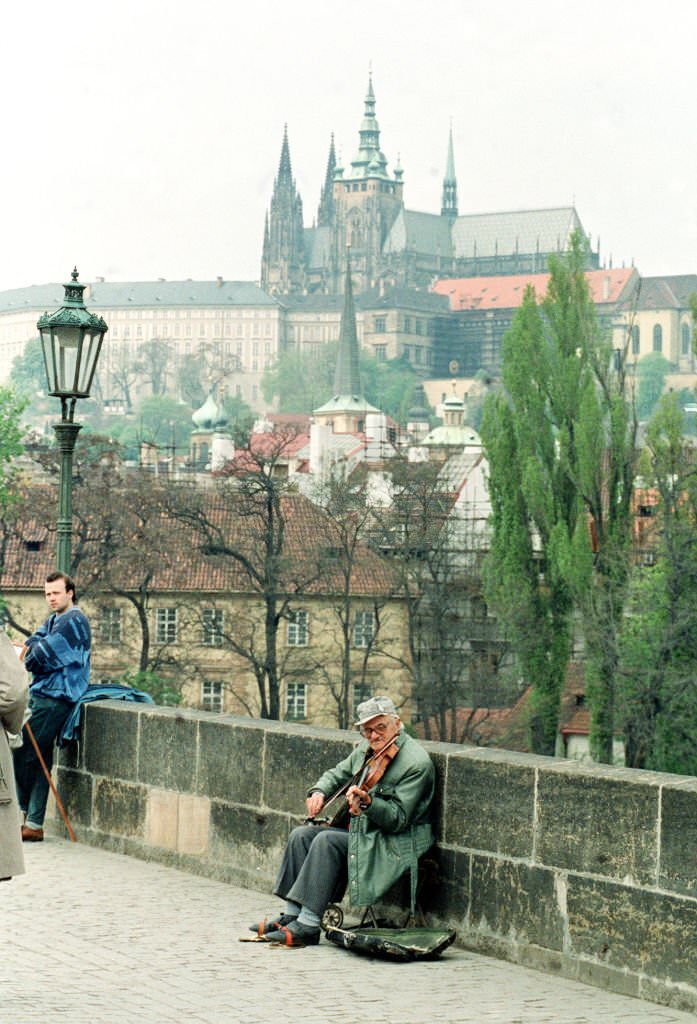
A musician plays on Charles Bridge in Prague in the shadow of the city's castle and St Vitus Cathedral.
A musician plays on Charles Bridge in Prague in the shadow of the city’s castle and St Vitus Cathedral.
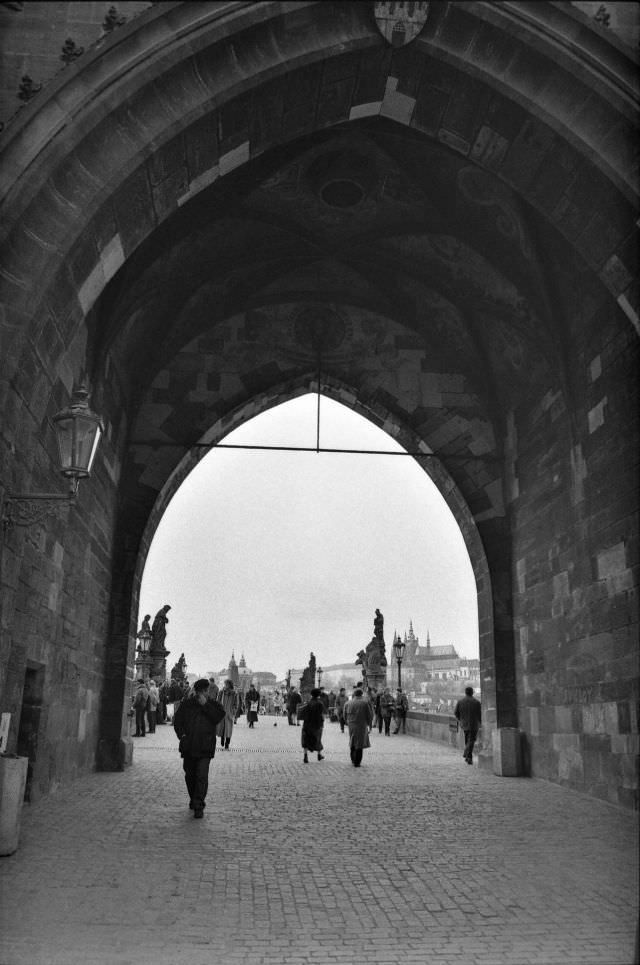
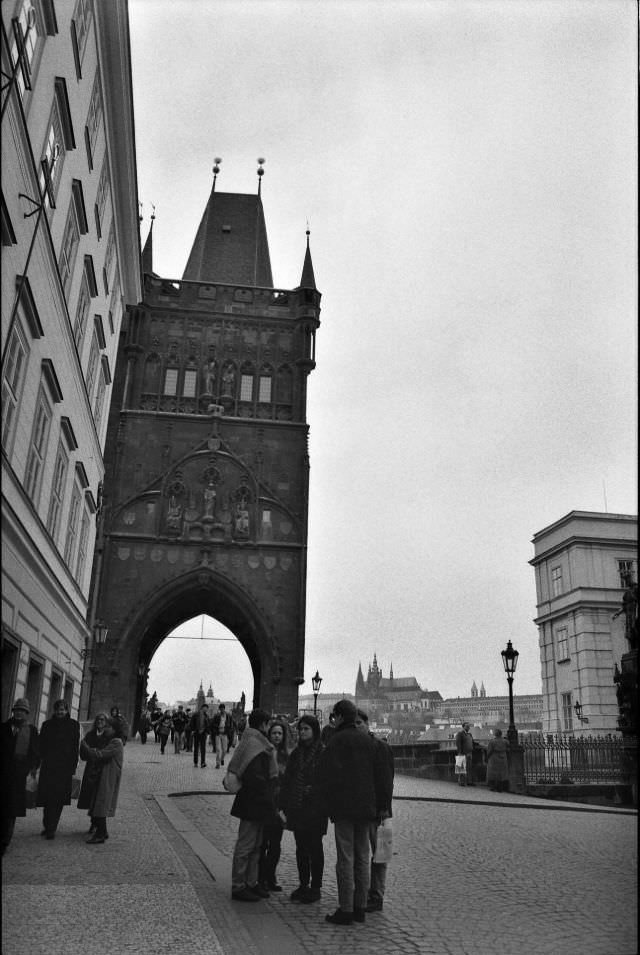
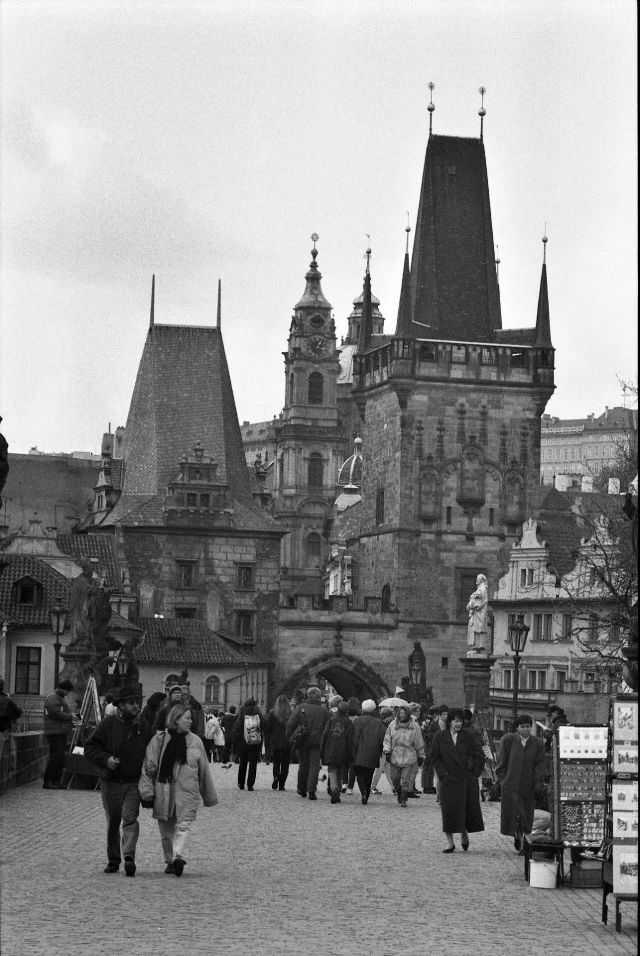
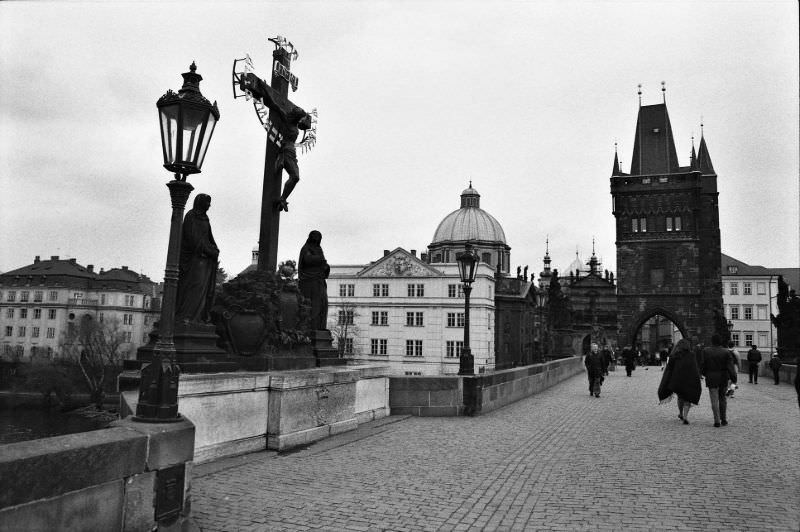
Czech Republic, Prague, Charles Bridge, Mala Strana Bridge Towers.
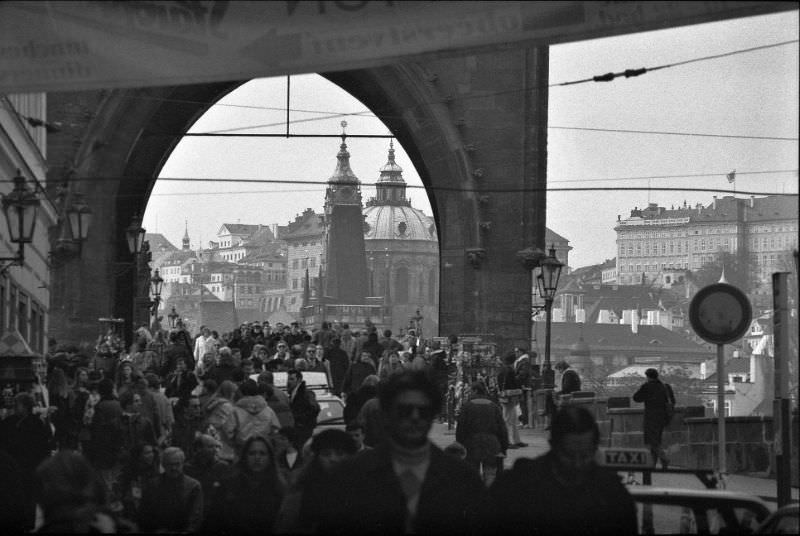
Approaching Charles Bridge, Prague, 1995
Castle from Charles Bridge, Prague, 1995
Castle, Prague, 1995
Charles Bridge, Prague, 1995
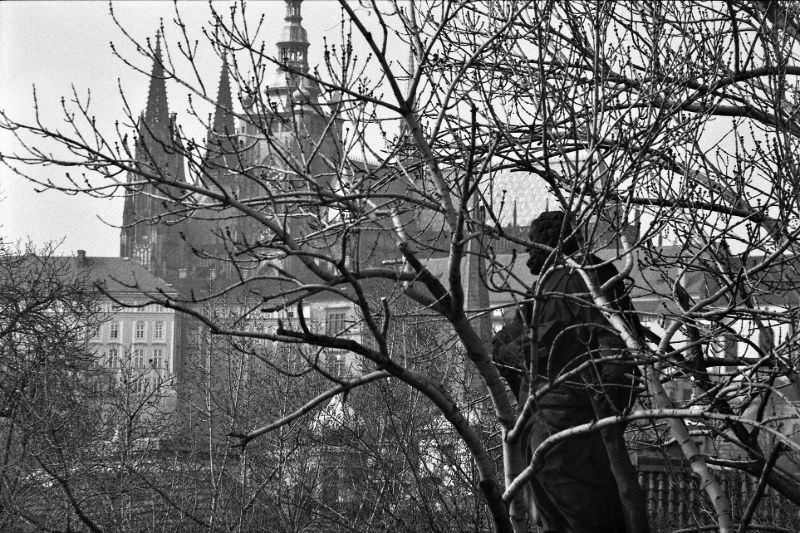
From Charles Bridge, Prague, 1995

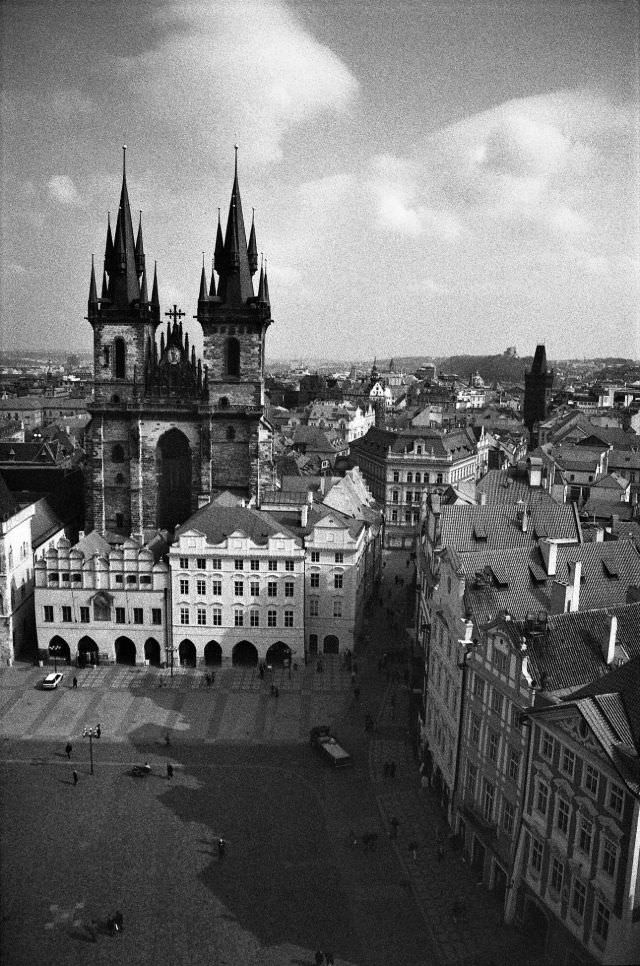
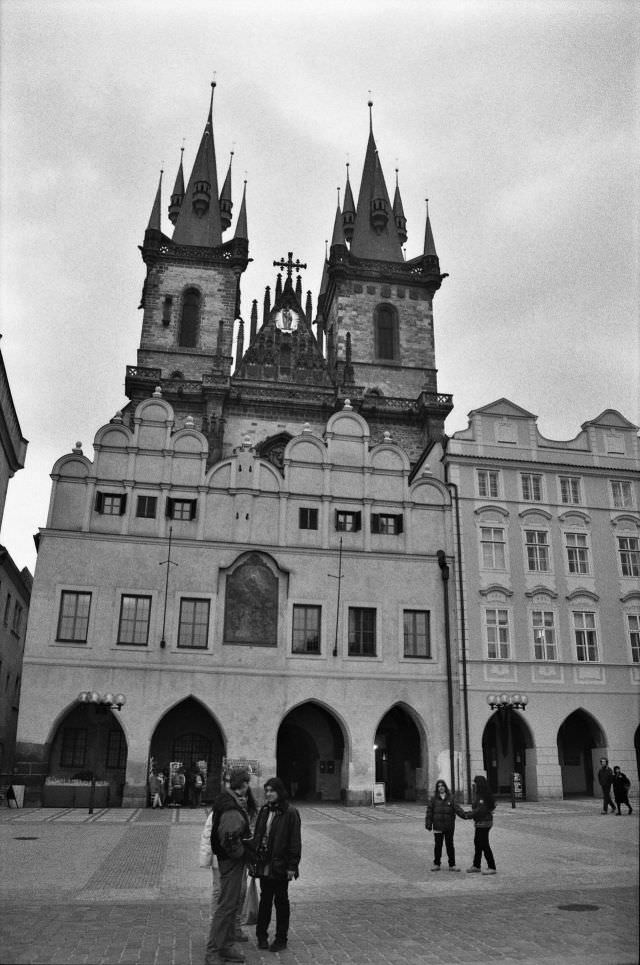
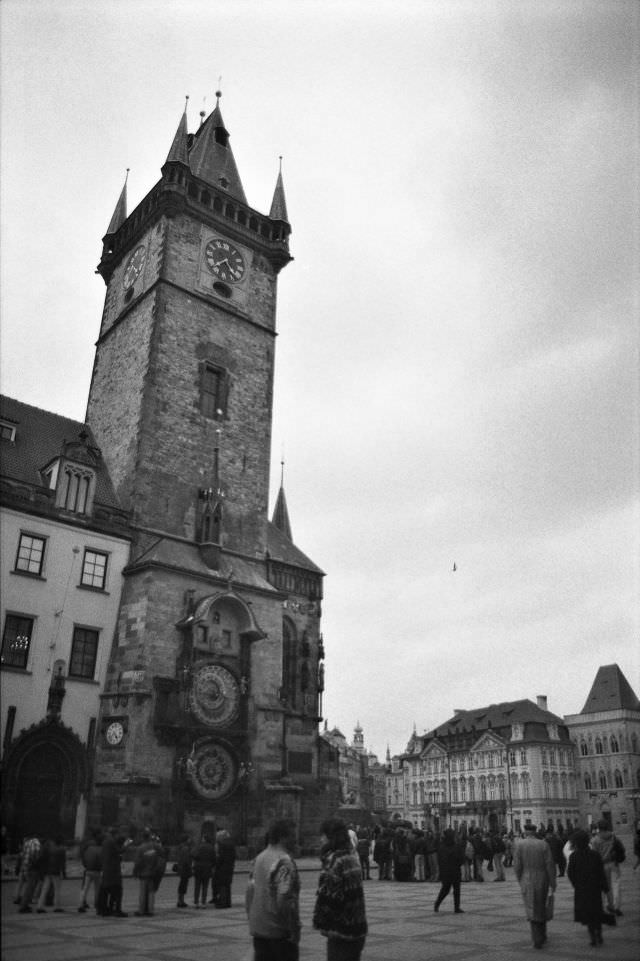
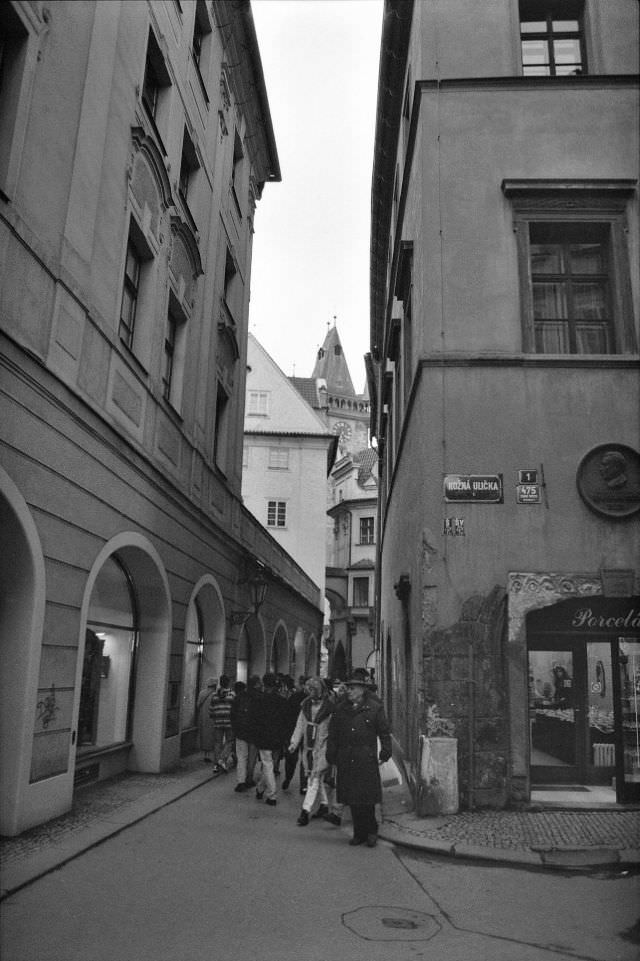
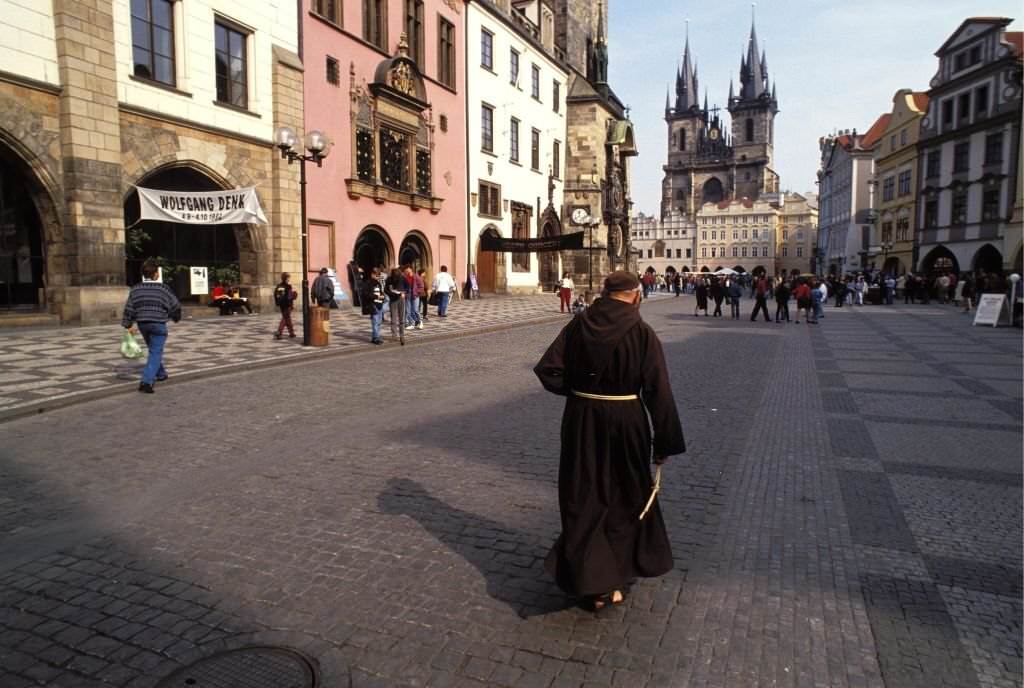
The Old Town Square in 1995 was a busy mix of locals and tourists. The Church of Our Lady before Týn dominated the skyline with its twin Gothic spires. The Astronomical Clock on the Old Town Hall drew crowds every hour. Markets, street vendors, and café tables filled the square below. Nearby streets like Zatecká and Kozná connected the square to a dense network of narrow lanes lined with medieval buildings that had survived centuries of war and political change.
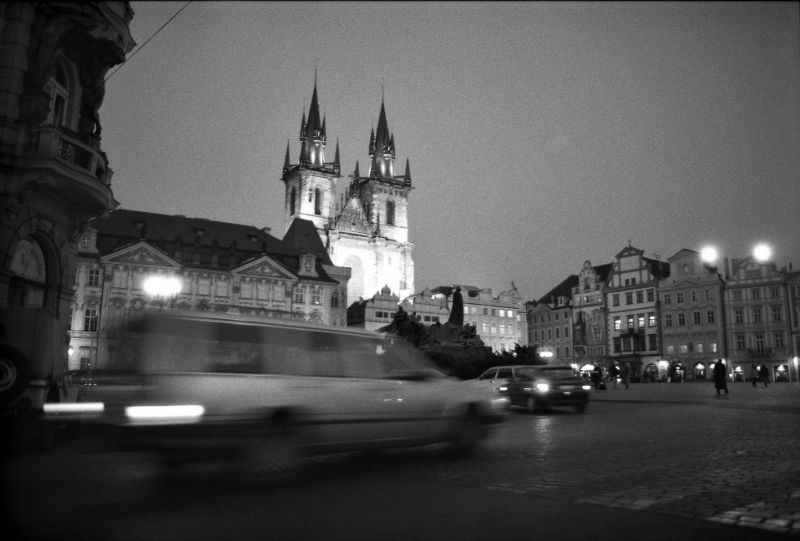
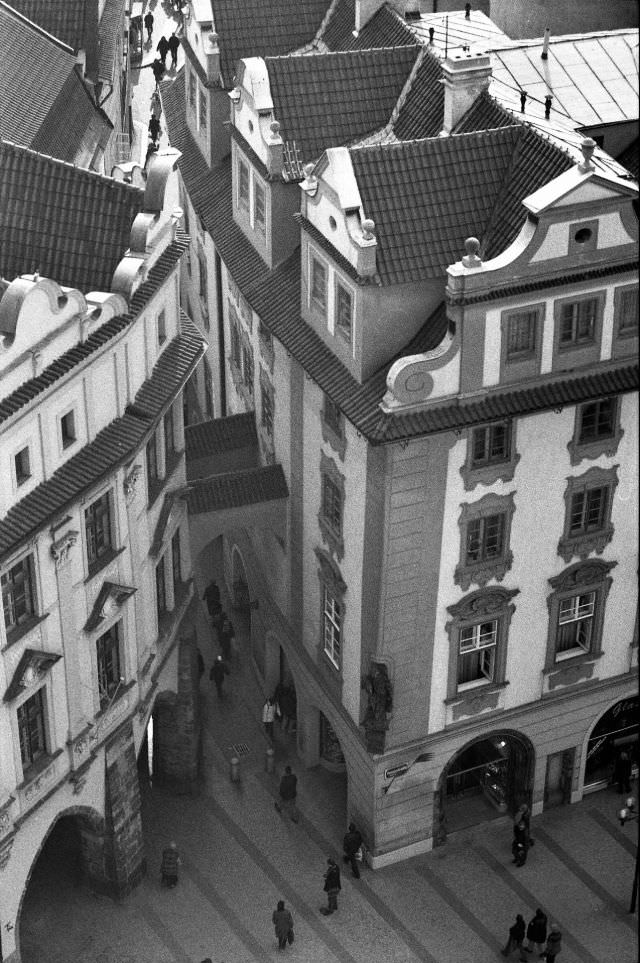
Church of Our Lady before Týn, Old Town Square, Prague, 1995
From the clock tower, Prague, 1995
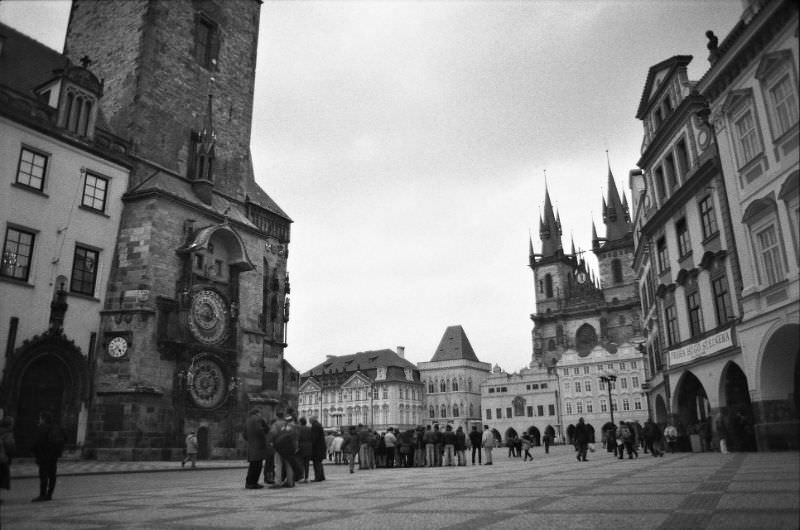
Old Town Square, Prague, 1995
Havelské tržiště market, Old Town, Prague, 1995
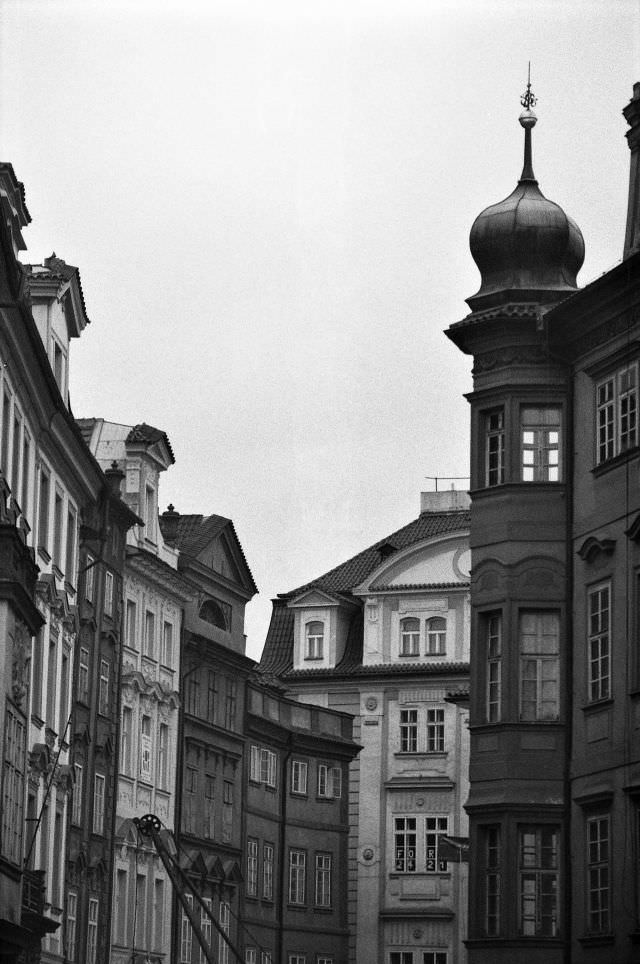
Kožná, Old Town, Prague, 1995
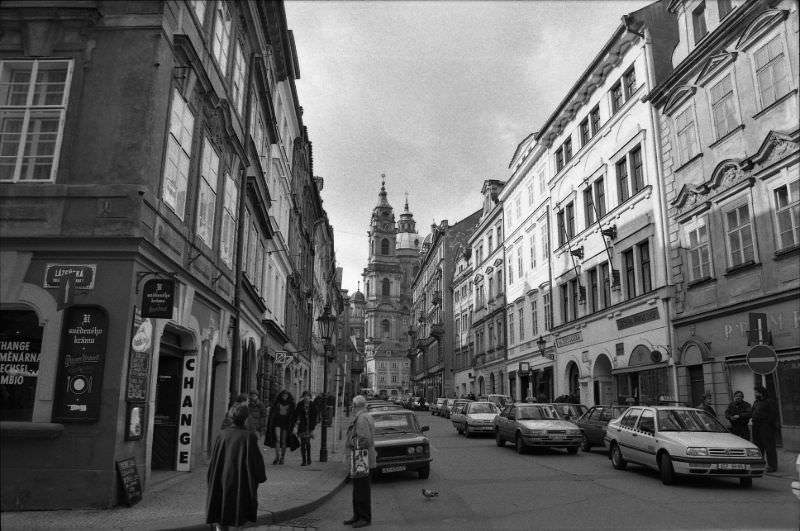
Zatecka Street, Prague, 1990s
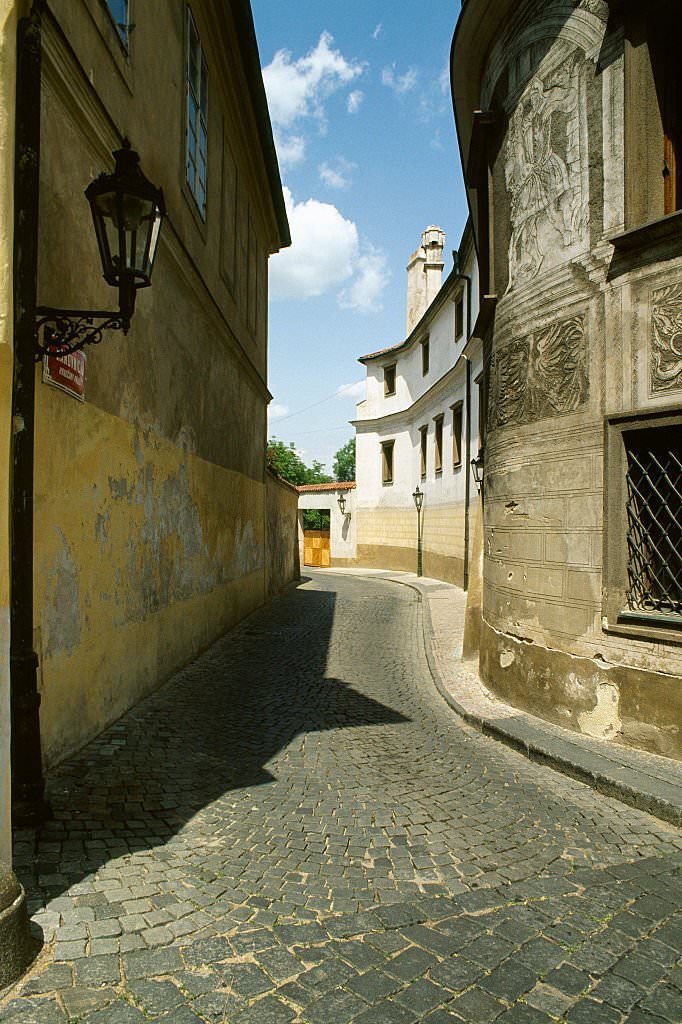
Cobblestone Street in Prague, 1990s

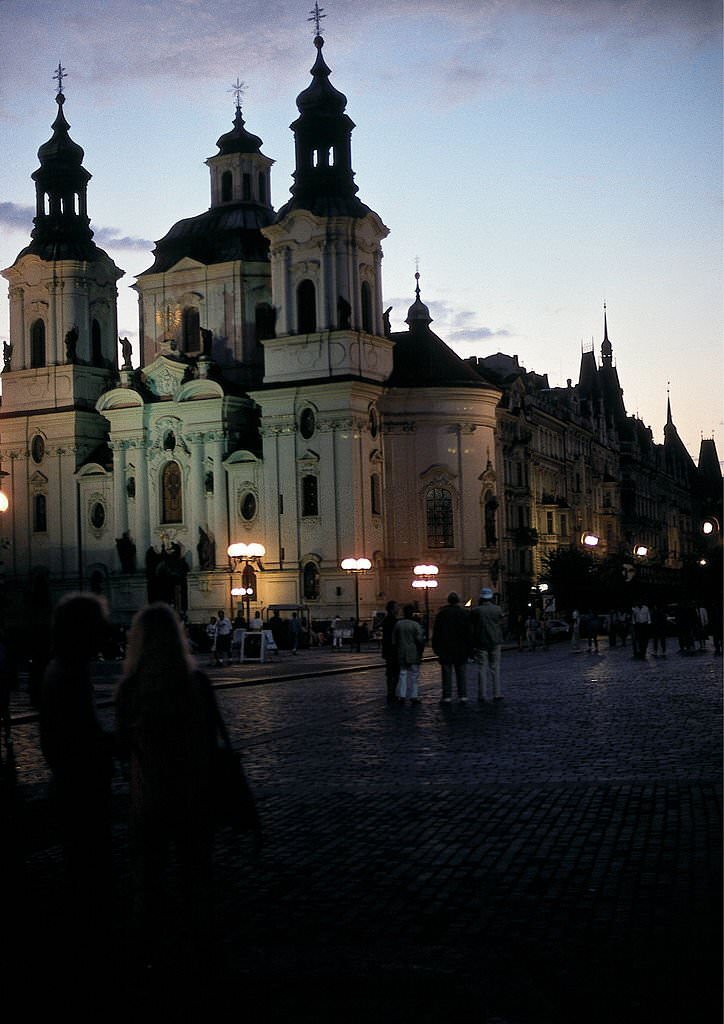
Prague’s churches were among the most striking landmarks visible throughout the decade. The dome of St. Nicholas Church in Malá Strana, designed by the Baroque architect K.I. Dientzenhofer, loomed over the Lesser Town. The Old Town’s own St. Nicholas Church stood in contrast — smaller in scale but equally prominent on the square. St. Vitus Cathedral, visible from Charles Bridge and from across the city, anchored Prague Castle on the hill above the Vltava.
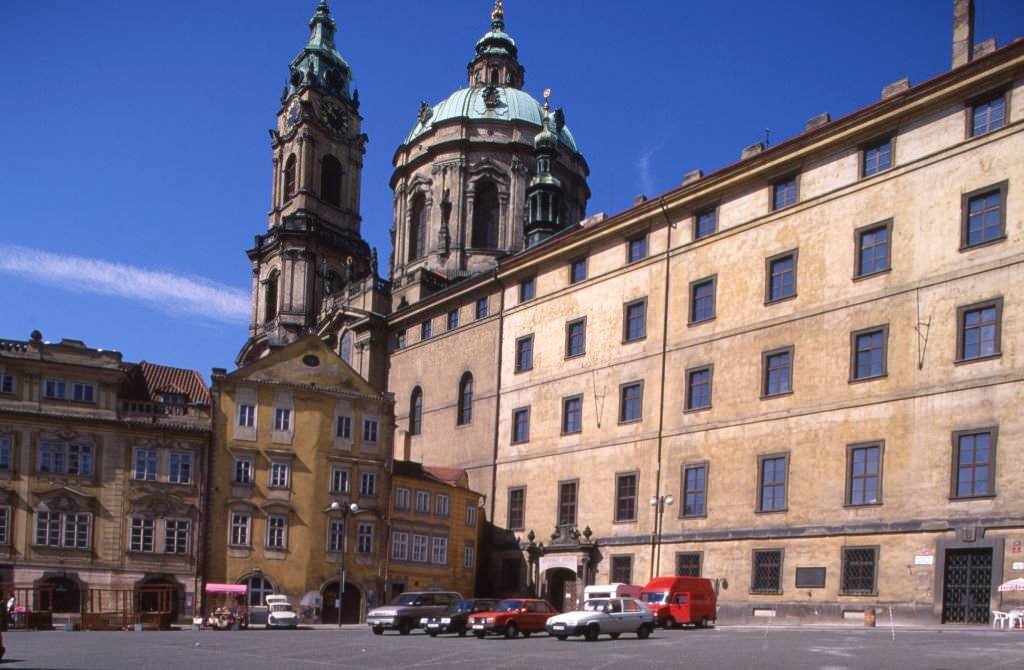
The dome of St. Nicholas Church in Prague, 1994
Church of St. Nicholas designed by famous baroque architect K.I. Dientzenhofer
Old Town St Nicholas Church, Prague, 1995.
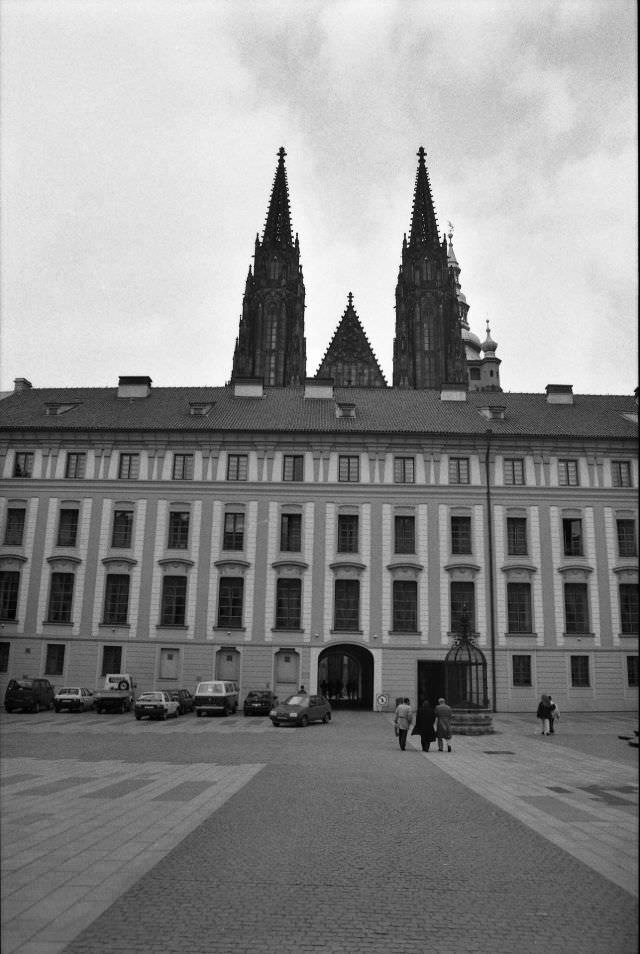
St. Vitus Cathedral, Prague, 1995

The Jewish Quarter of Josefov, with its Old Jewish Cemetery, was another site that drew steady visitor interest throughout the 1990s. The cemetery — one of the oldest surviving Jewish burial grounds in Europe — had layers of graves stacked on top of one another over centuries. Golden Lane on the castle hill, where Franz Kafka once lived, became one of the most visited spots in Hradčany. These places carried deep historical weight and became central to Prague’s identity as a city of memory.
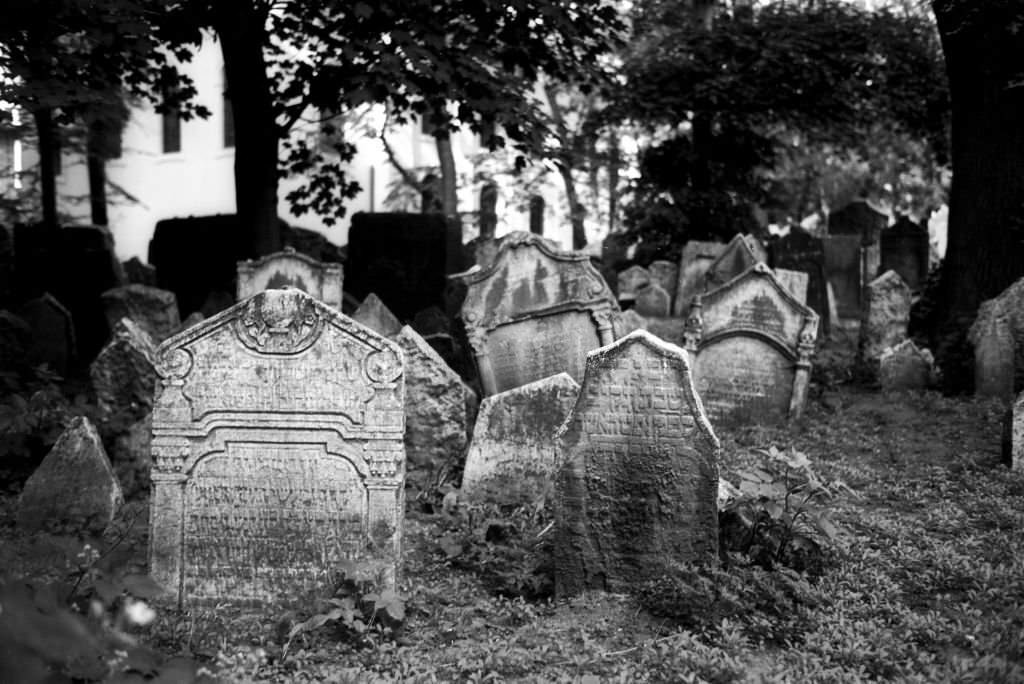
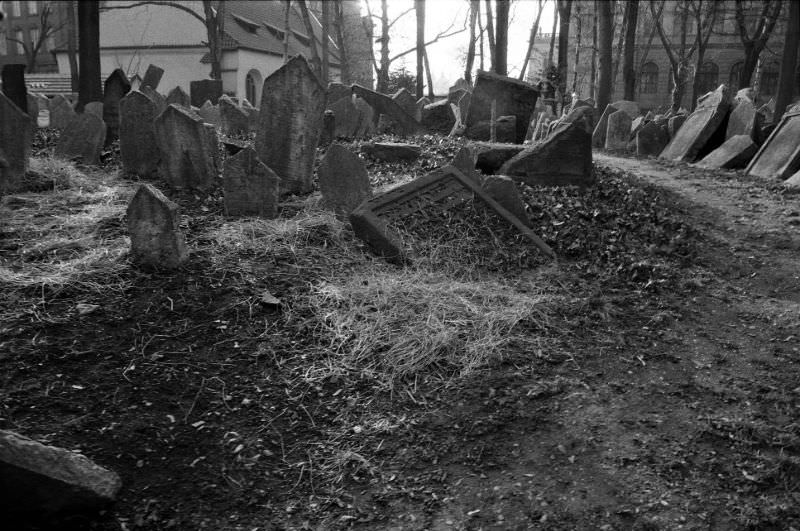
The Old Jewish Cemetery lies in the Josefov, the Jewish Quarter of Prague in the Czech Republic.
Jewish cemetery, Prague, 1995
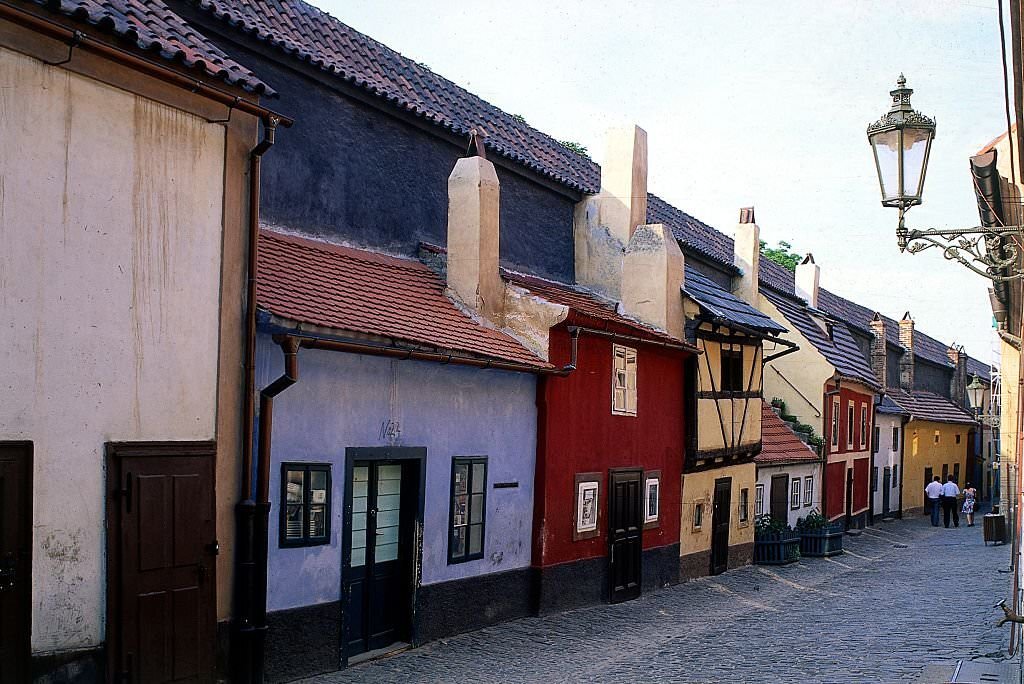
Golden Lane on Hradčany, Kafka House, 1996

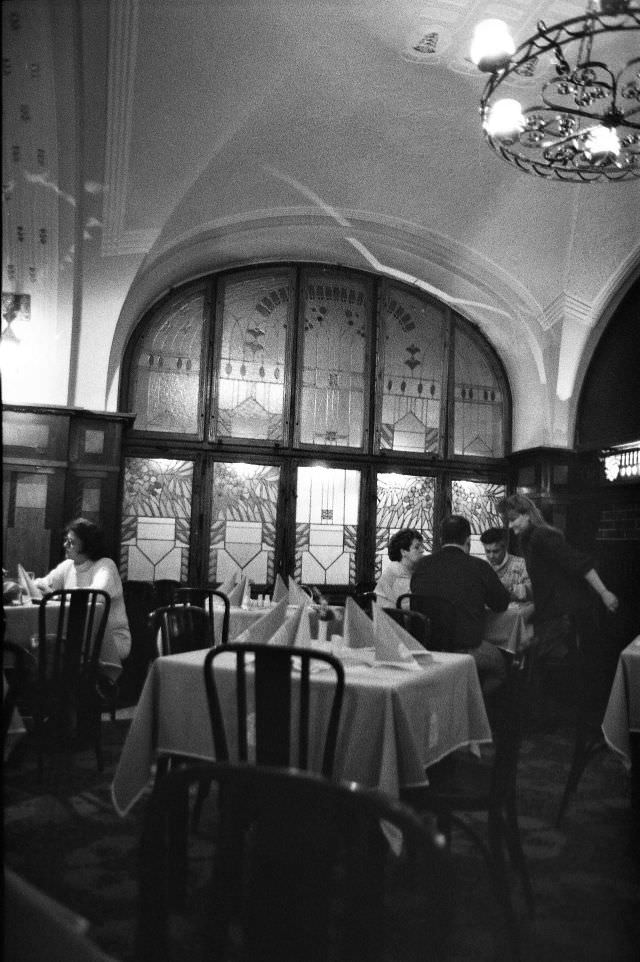
Wenceslas Square in the mid-1990s had transformed from a protest ground into a commercial boulevard. The Grand Hotel Europa, one of the square’s most ornate Art Nouveau buildings, remained a prominent fixture. Its basement restaurant offered a glimpse of pre-war elegance that contrasted with the new fast-food outlets and international shops opening up around it. The square had become the main artery of modern Prague, linking the old city to its new commercial ambitions.
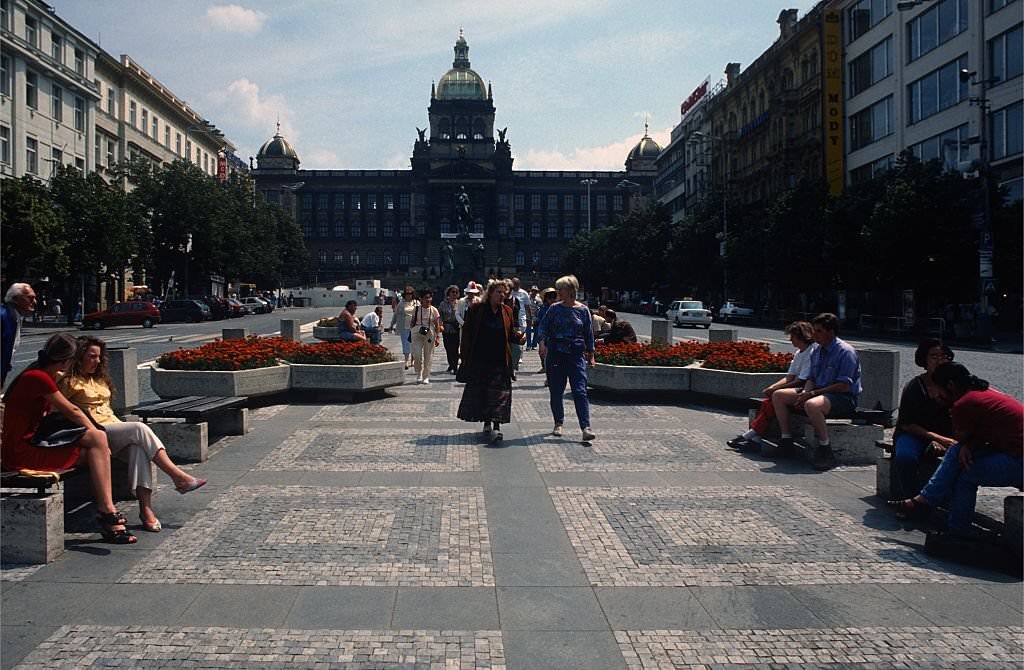
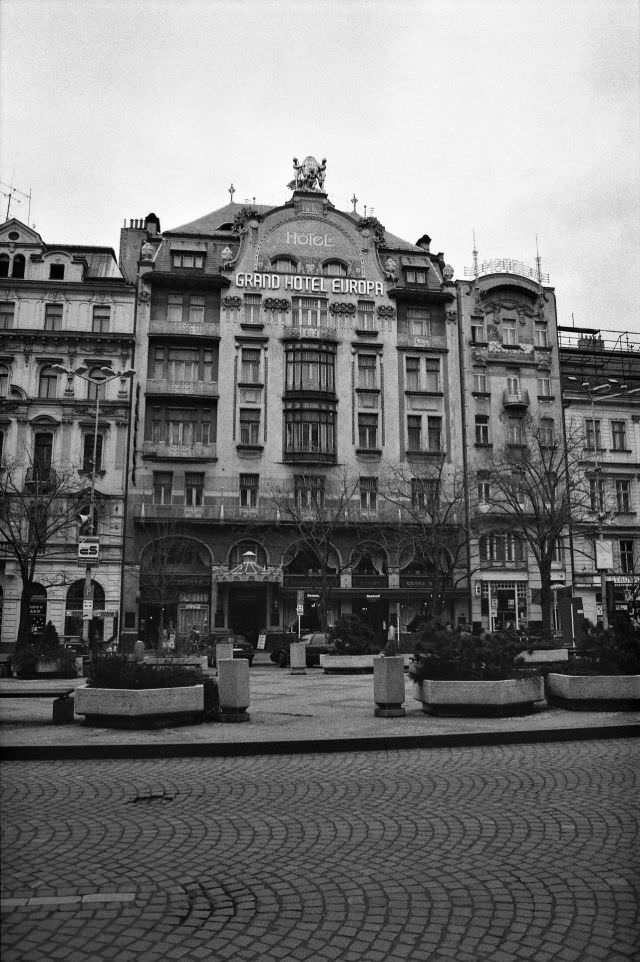
Wenceslas Square, Prague, 1995.
Grand Hotel Europa, Wenceslas Square, Prague, 1995
Basement restaurant, Grand Hotel Europa, Wenceslas Square, Prague, 1995
Wenceslas Square, Prague, 1995

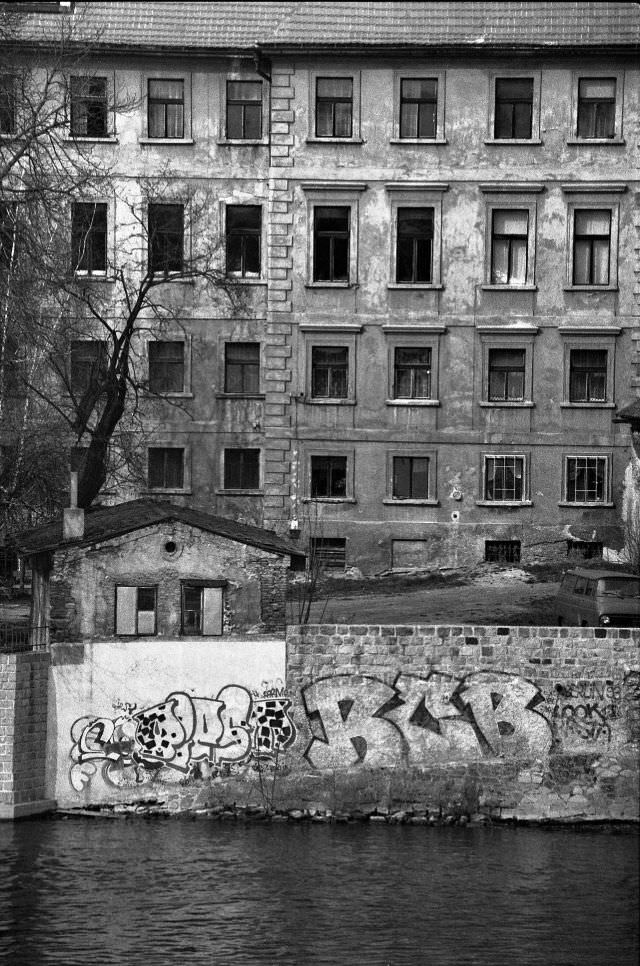
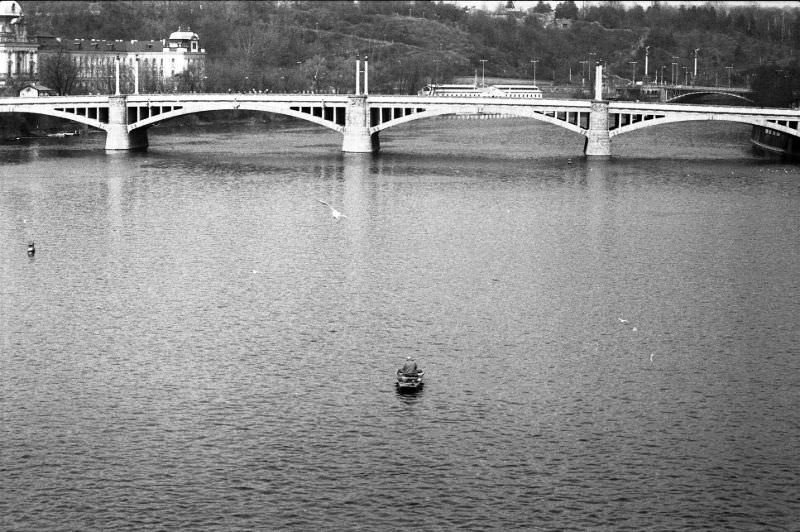
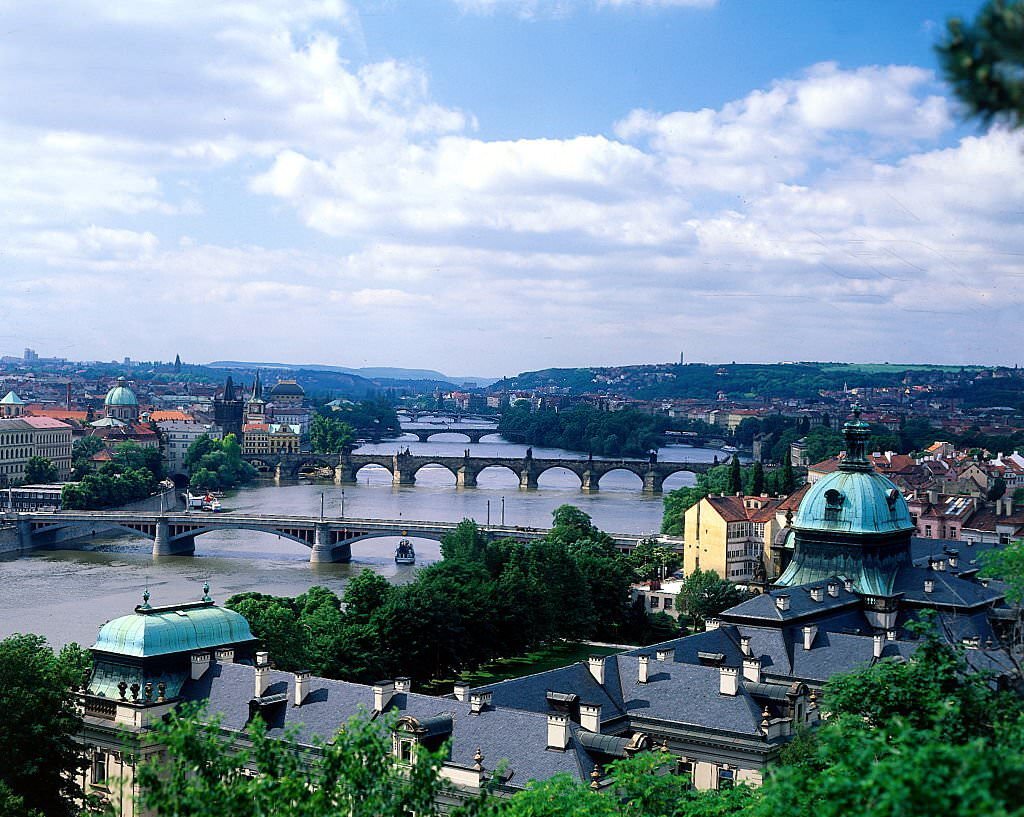
The Vltava River remained the physical spine of Prague throughout the decade. Its banks attracted painters, fishermen, and tourists. Swans moved along its surface while boats navigated the same waters that had defined the city’s geography for a thousand years. The bridges connecting the two banks of the river — Charles Bridge foremost among them — served not just as crossings but as gathering places, stages for musicians, and viewing platforms for the city’s skyline.
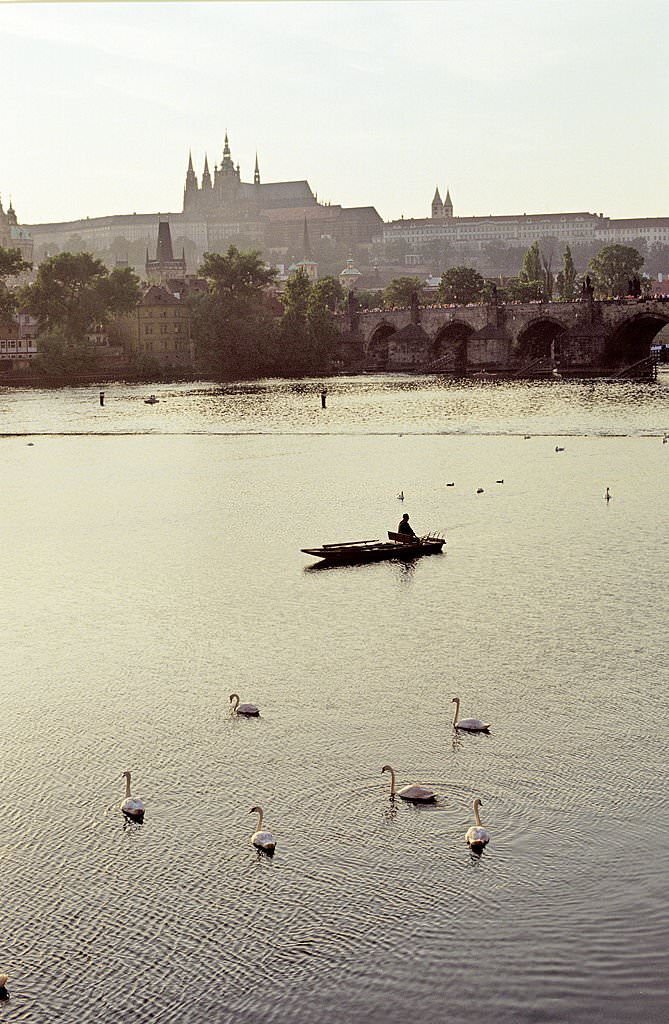
Along the Vltava river on May 14, 1995 in Prague, Czech Republic.
Swans and a fishing boat on the Vltava River, Prague, 1990s
Prague Bridges, 1996
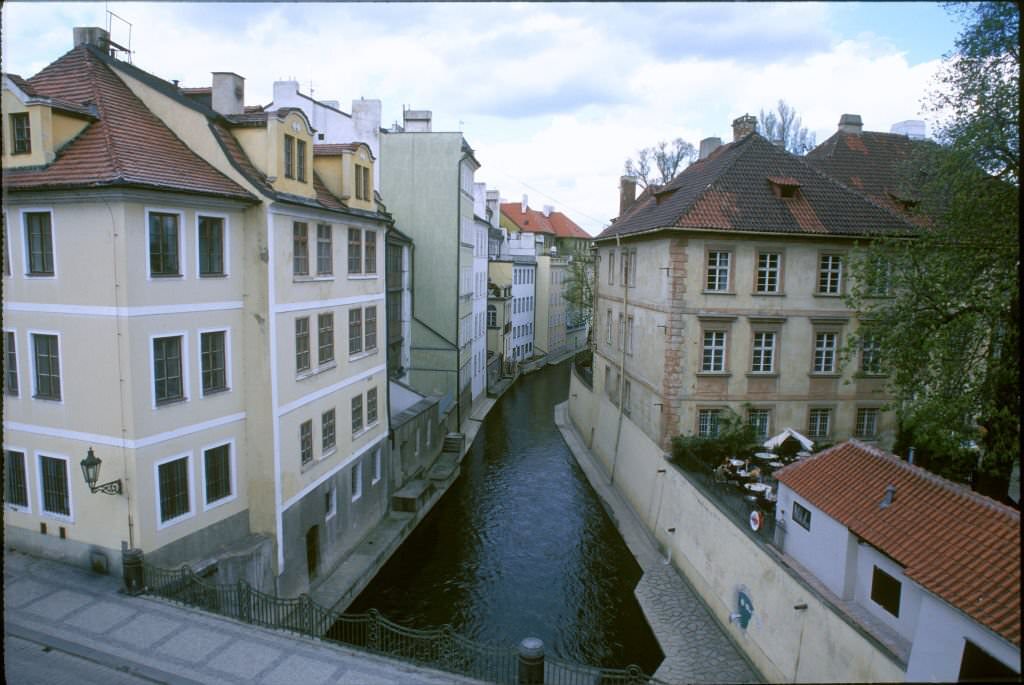
Insel Kampa in Prag, 1998

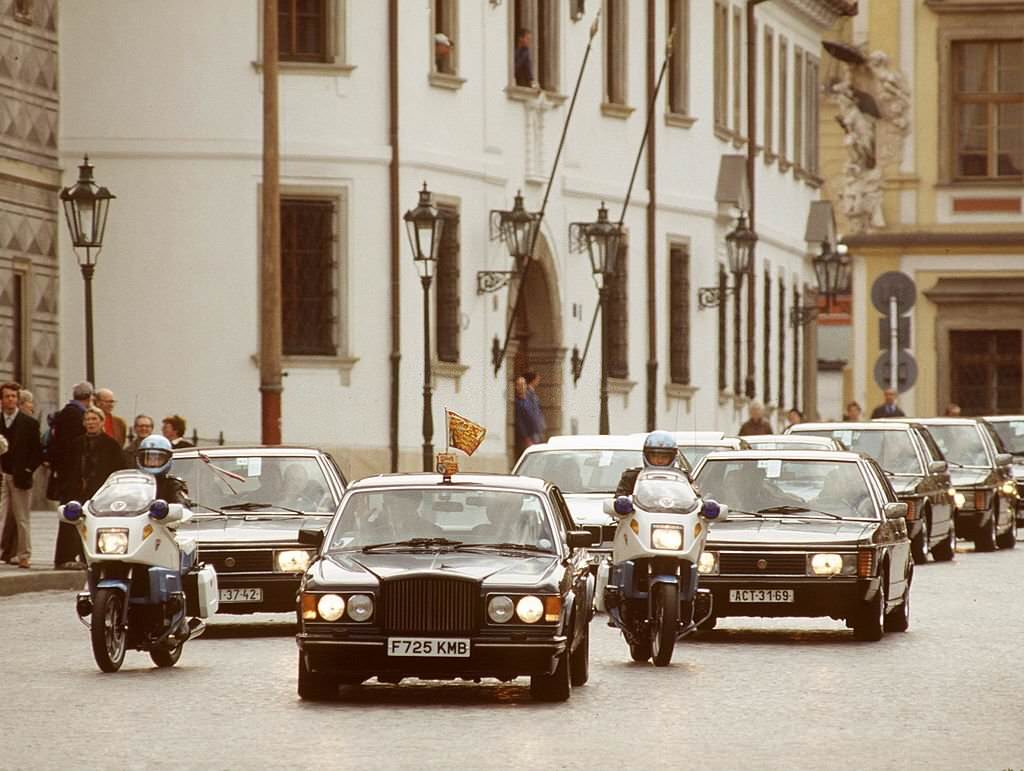
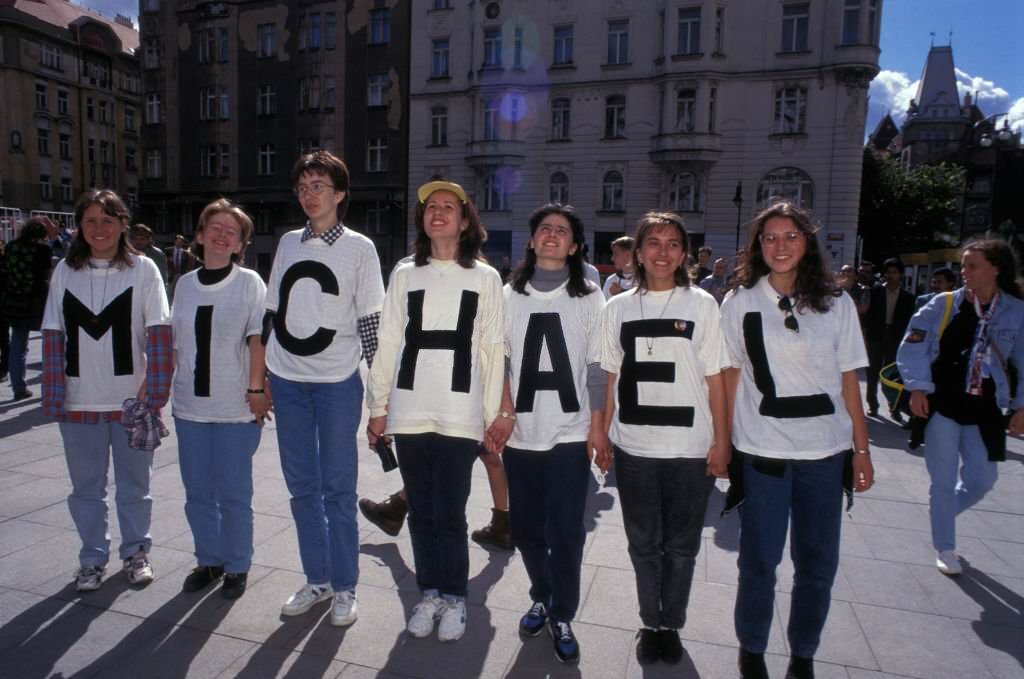
In September 1996, Michael Jackson arrived in Prague ahead of the first concert of his European HIStory World Tour — billed locally as his ‘Kingdom’ tour. His arrival drew massive crowds of fans to the streets of the city. The concert was one of the largest events Prague had ever hosted, and his presence signaled how firmly the Czech capital had entered the global entertainment circuit. Queen Elizabeth II also made a state visit to Prague during the decade, and a royal motorcade moved through the city’s streets in a rare display of diplomatic pageantry.
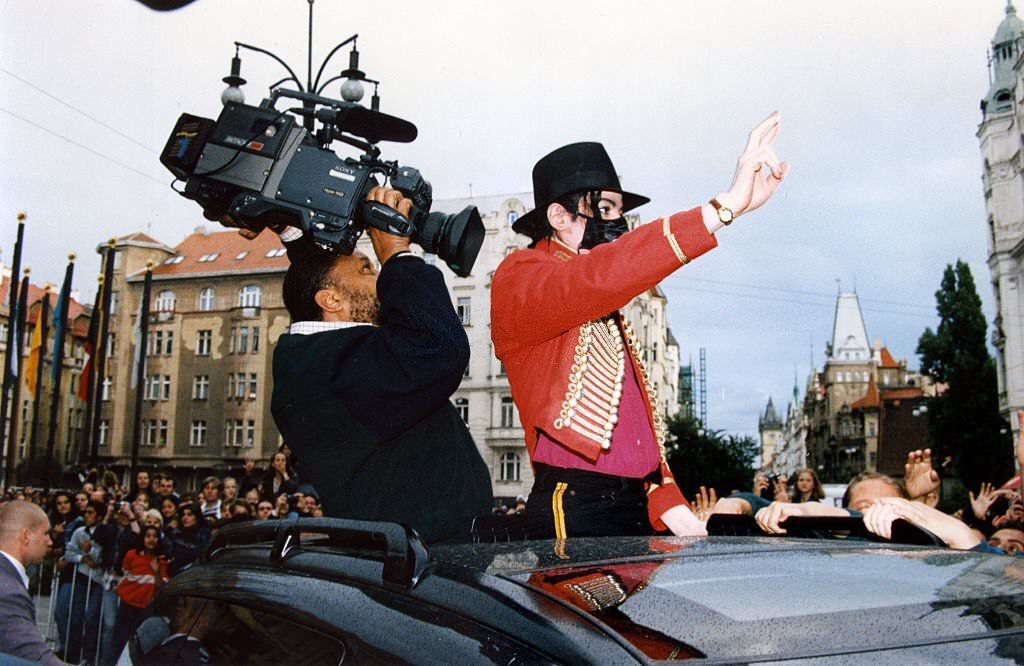
Michael Jackson arrives in Prague days before the first concert of his European 'Kingdom' tour, September 4, 1996, in Prague.
Michael Jackson arrives in Prague days before the first concert of his European ‘Kingdom’ tour, September 4, 1996, in Prague.
Fans of Michael Jackson in Prague in 1996
Queen Elizabeth II State Visit, Prague to the Czech Republic
Royal Motorcade in Prague, 1990s

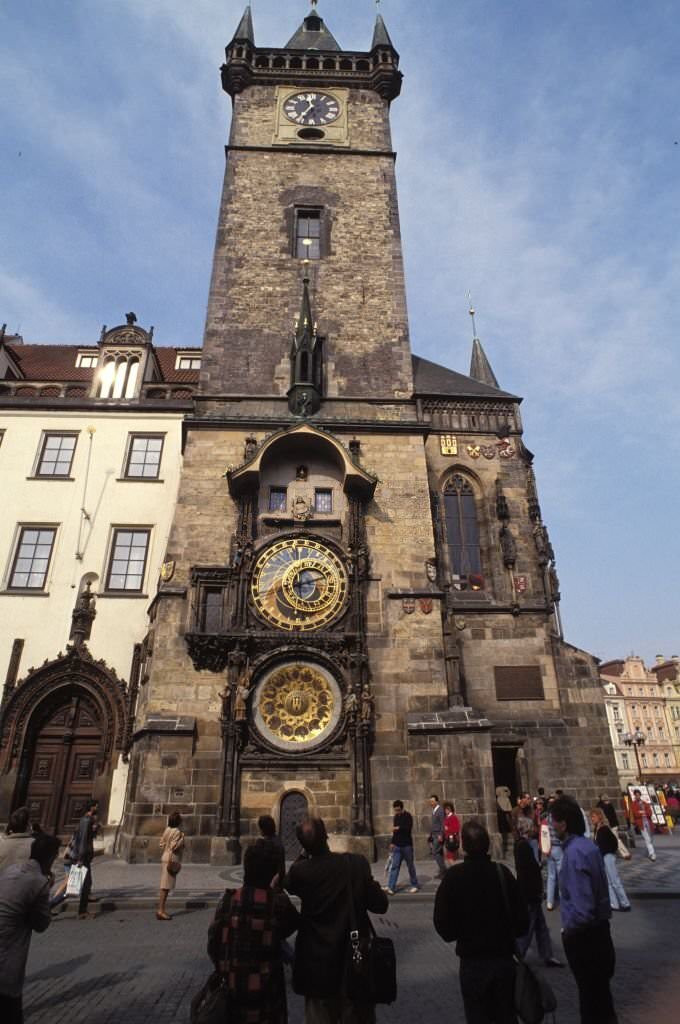
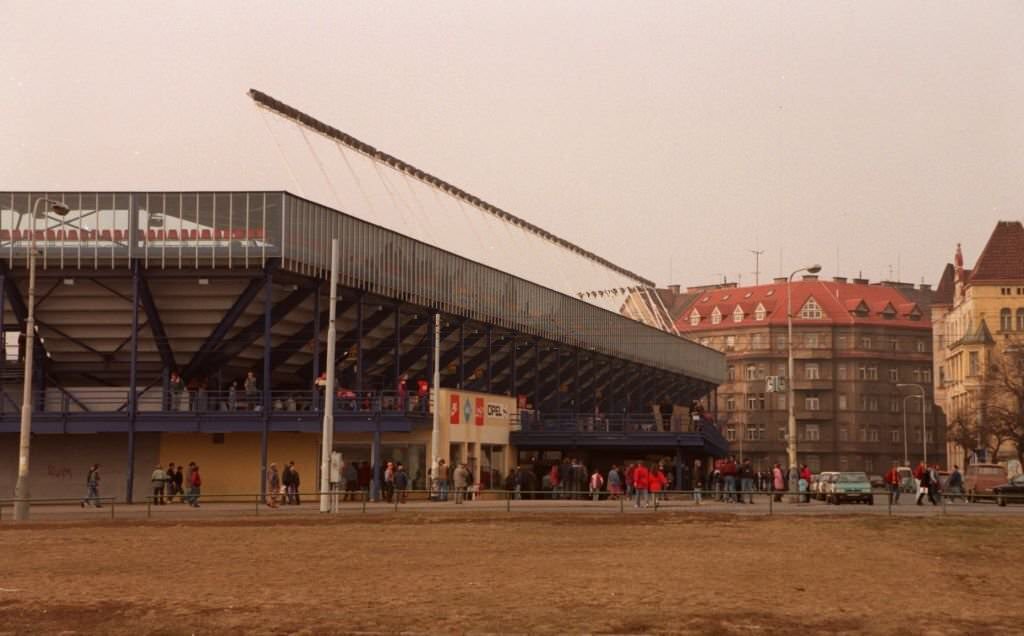
By 1998, the city’s landmarks were drawing visitors year-round. The Astronomical Clock at Old Town Square, first installed in 1410, was one of the most photographed objects in the Czech Republic. Kampa Island along the Vltava had become a quiet retreat from the busier parts of the city. Letná Stadium — home to Sparta Prague — stood as a reminder that ordinary sports culture continued alongside all the architectural and political spectacle.
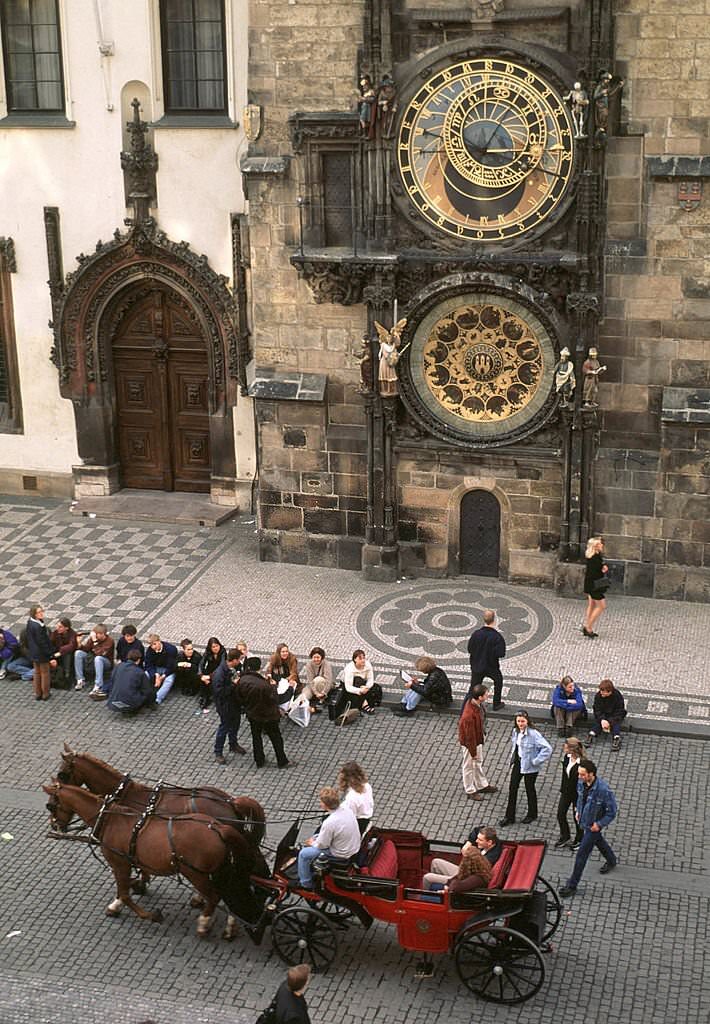
Astronomical Clock at Old Town Square, Prague, 1998
Letna Stadium, home of Sparta Prague, 1990s
Old Town Square in Prague, 1990s
Near the old town square, Prague, 1990s
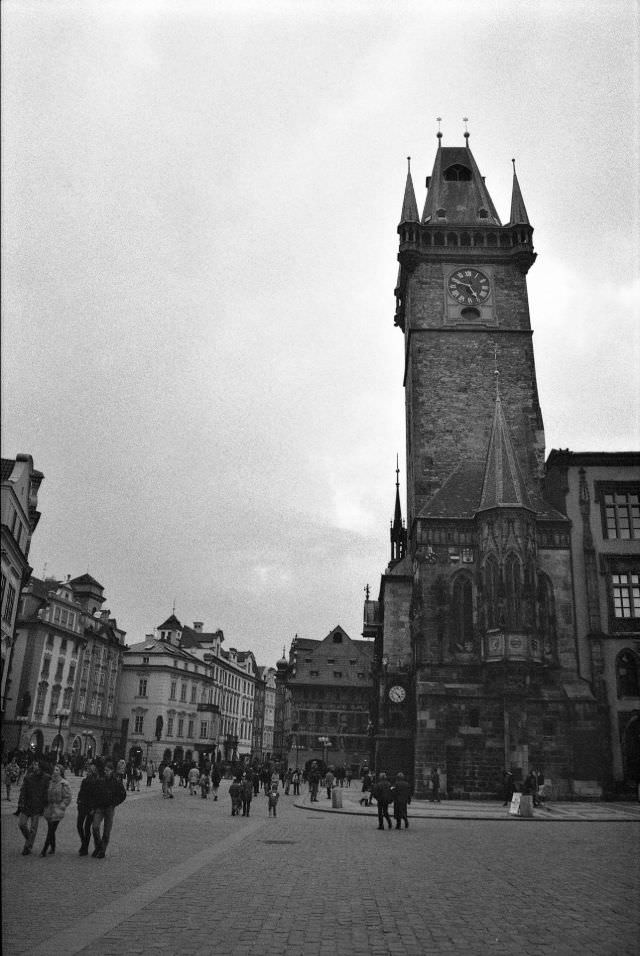
Old town hall, Prague, 1990s
Old town square, Prague, 1990s
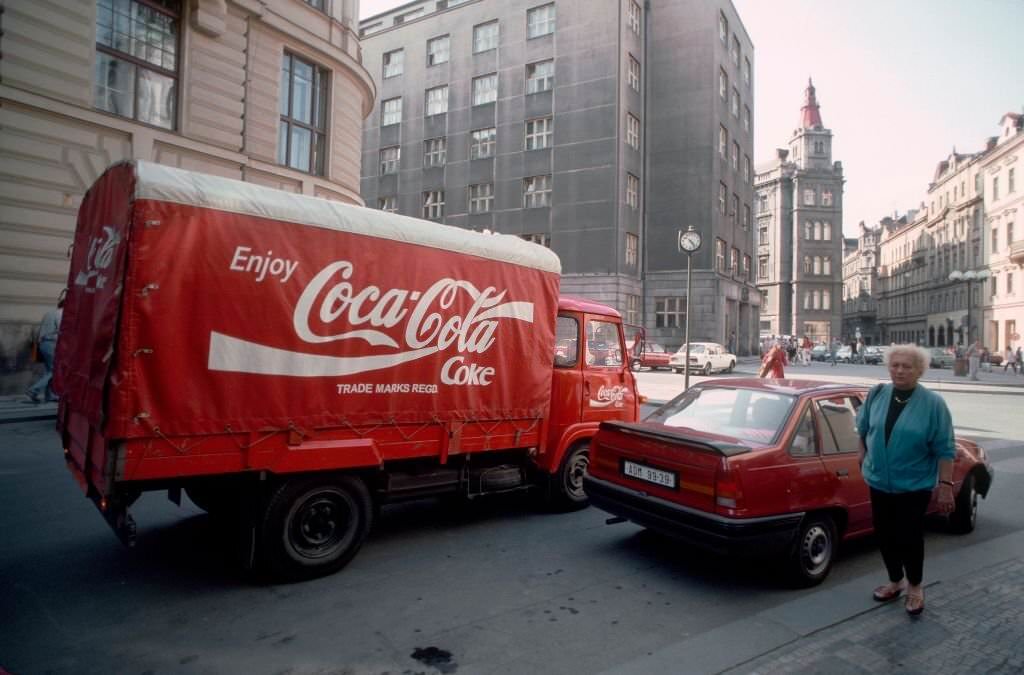
Prague street scenes, 1995
Prague, 1990s
Prague, 1990s
Prague, 1990s
Prague, 1990s

Prague’s social scene in the 1990s was also openly evolving. Public demonstrations reflected a new freedom of expression that had been impossible under Communist rule. Anti-fur rallies drew protesters including models and drag queens who staged visible demonstrations at the town hall. Publications like the political newspaper Forum, which had circulated during the 1990 elections, gave way to a diverse and independent press. The city’s cultural identity was being written in real time, on its streets, in its squares, and in its bars and clubs.
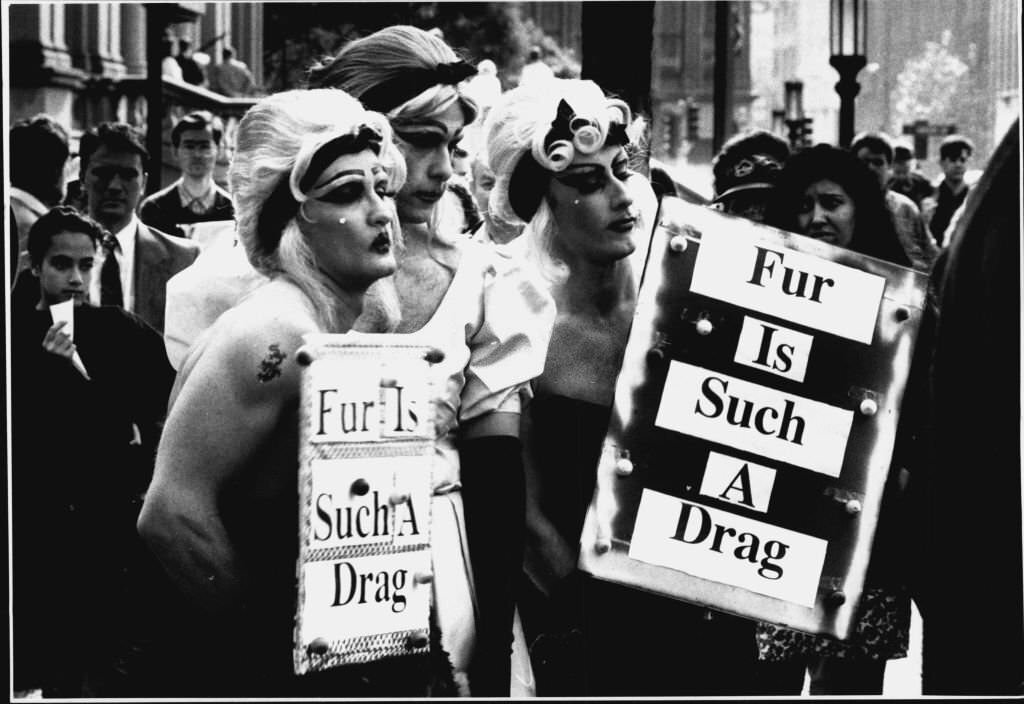
Anti for rally at town hall...eight models wore nothing much and three drag queens turned up to show their disgust.
Anti for rally at town hall…eight models wore nothing much and three drag queens turned up to show their disgust.
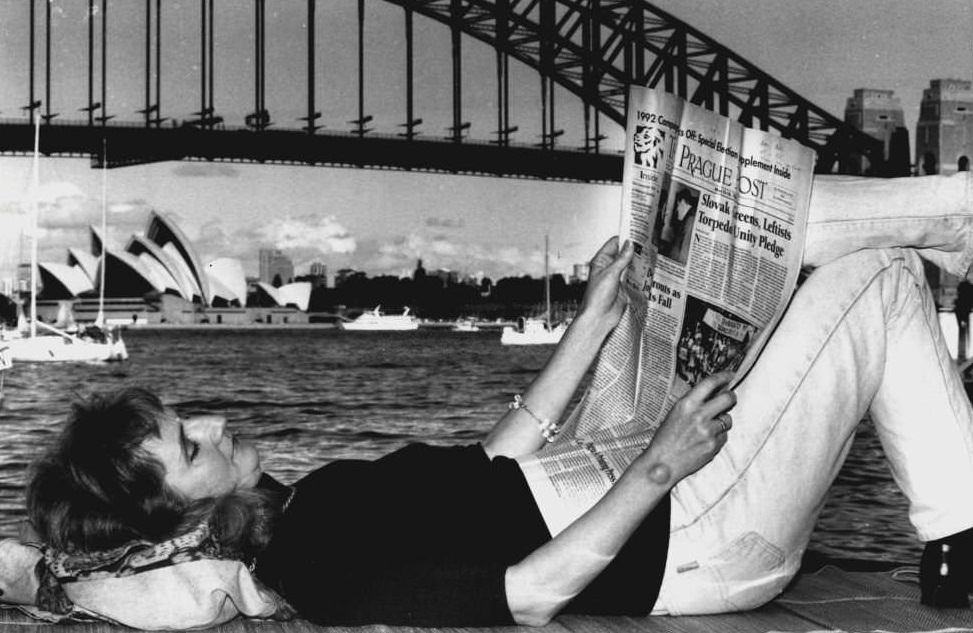
Mr Barbara Chobocky in Prague.
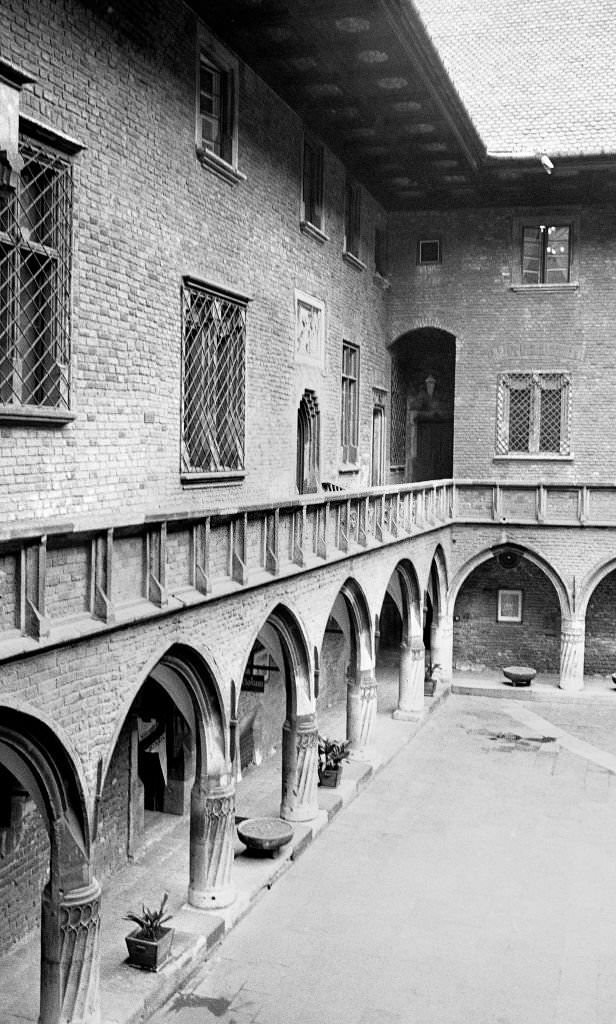
CrThe Jagiellonian University, 1991.
Enjoyed this post? Get new ones in your inbox.

Leave a Comment

Your email address will not be published. Required fields are marked *

Share this Post 🥺

Please take a moment to share this content. Your support is greatly appreciated! 🙌🙏

Share this Post 🥺

Please take a moment to share this content. Your support is greatly appreciated! 🙌🙏
Scroll to Top
 
Hey Friend, Before You Go.. Please like & follow for more interesting content