
Before the subway existed, New York City moved on horse-drawn carriages and streetcars. As the population surged in the late 1800s, those options became dangerously inadequate. Streets were choked. Travel was slow. The city needed something entirely different. In 1869, inventor Alfred Ely Beach built a 312-foot pneumatic tunnel beneath Broadway in Lower Manhattan to prove the concept of underground transit. It impressed curious onlookers but went no further. It would take another three decades before the city committed to building a real subway system.
Planning for a full network began in earnest in 1901. City engineers and transit planners mapped out routes designed to reach the densest neighborhoods of Manhattan and push outward into the other boroughs. The most common construction method was called “cut and cover.” Workers dug open trenches along the streets, laid the tunnel structure and tracks below, then covered everything back up. The approach was effective but enormously disruptive — tearing up entire city blocks for months at a time.
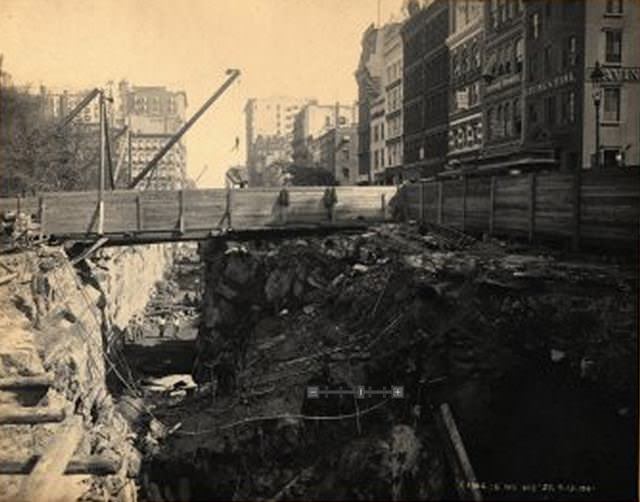
This September 1901 view of the 4th Avenue and 15th Street excavation captures the cut-and-cover method in full force. The open trench drops well below street level, exposing the raw earth and timber bracing that held the city above the workers’ heads. At this stage, construction had only just begun, and scenes like this were playing out across multiple blocks of Manhattan simultaneously.
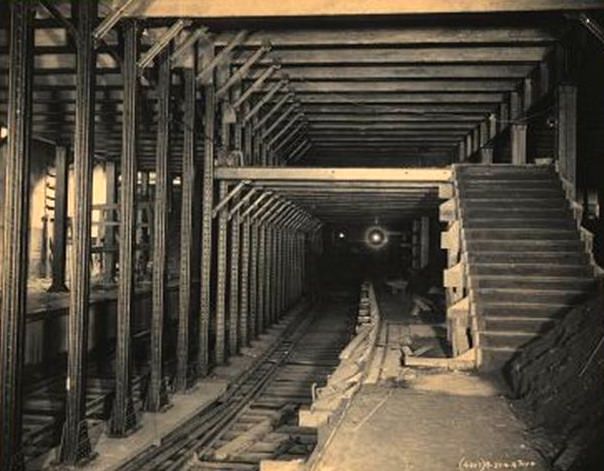
Two years later, the same corridor near 14th Street showed dramatic progress. Concrete pillars stood in place, tracks were being positioned, and stairways were already taking shape leading down to the future platform. This was the Interborough Rapid Transit Company’s network coming to life — better known as the IRT. The IRT was the private company contracted to build and operate New York’s first major subway lines, focusing on serving the heavily populated corridors of Manhattan and the Bronx.
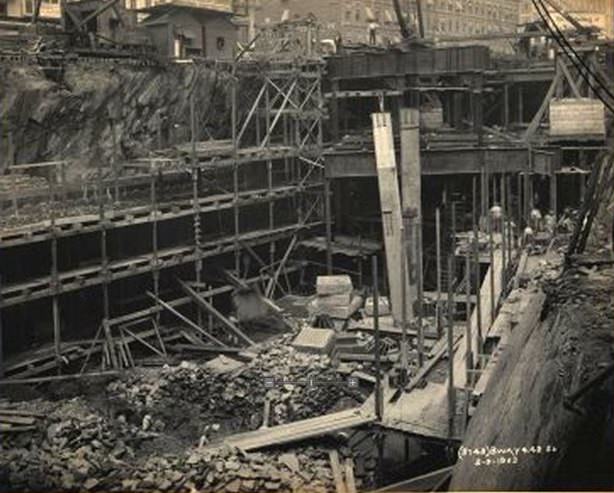
At Broadway and 42nd Street — one of the busiest intersections in the city — construction crews worked through the winter of 1903. Looking down from street level, you can see the depth of the excavation and the organized chaos required to keep the work moving. Above ground, life in Times Square carried on while, just feet below the pavement, men were reshaping the city forever.
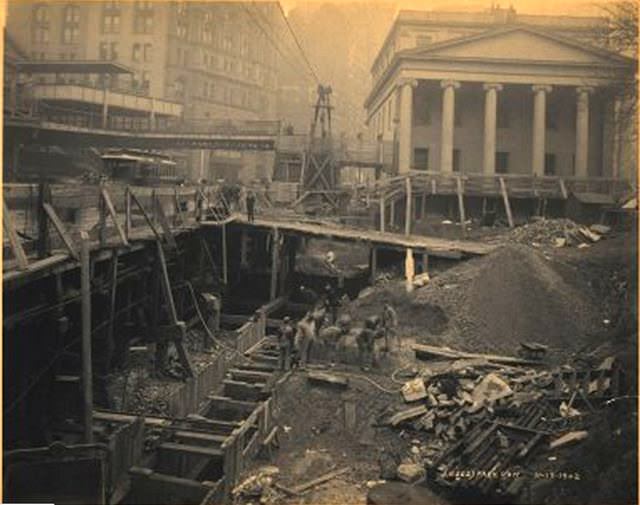
Near City Hall, the contrast between the old and the new was stark. Construction at Park Row in November 1902 placed heavy equipment and open excavations directly alongside the civic heart of the city. The church visible at the right with its classical columns stood unchanged while the ground in front of it was turned completely inside out. On October 27, 1904, this stretch became part of the IRT’s first operating line, running from City Hall to 145th Street — a distance of 9.1 miles. In its first year alone, the line carried more than 40 million passengers.
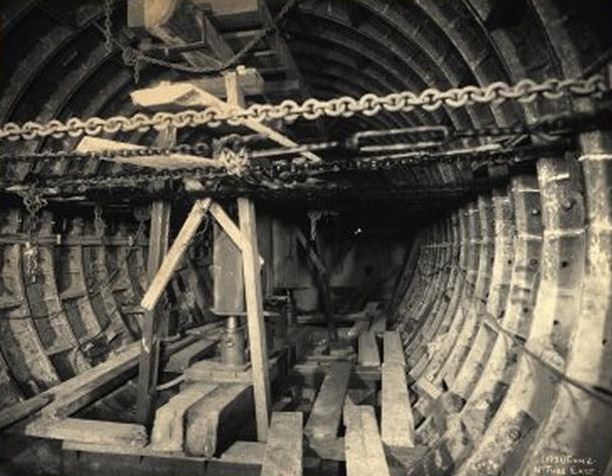
Not all tunnels were built from the surface down. Some sections required deep boring through bedrock, producing the circular tunnel profiles seen in this February 1906 photograph. Chains strung across the interior were used for rigging and support during the construction phase. The men who worked in these enclosed spaces — widely known as “sandhogs” — faced cave-ins, flooding, and explosions. Dynamite and large drilling machines were used alongside hand tools. Safety standards were minimal by modern measures, and deaths on the job were not rare.
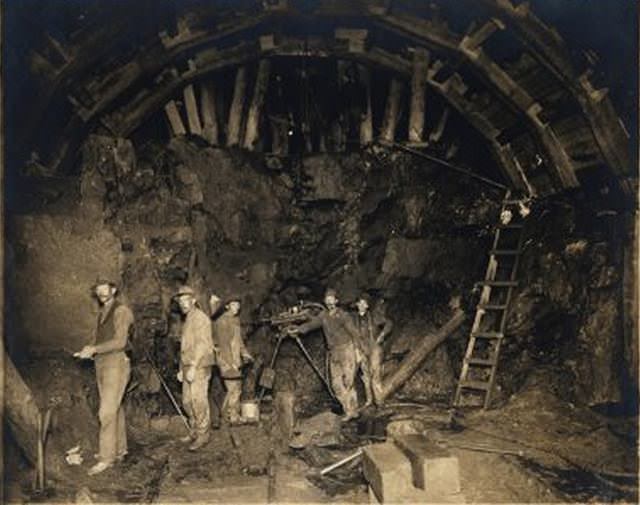
This undated photograph of tunnel laborers pausing to look at the camera puts faces to the workforce that built the system. Thousands of men — many of them recent immigrants — made up the construction crews. They worked long shifts in cramped, poorly lit tunnels filled with dust and noise. The photograph captures a brief still moment in conditions that were relentless and physically punishing.
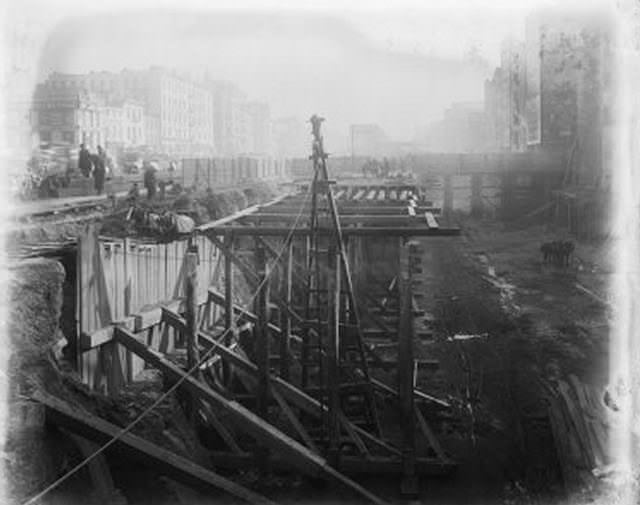
Horse teams were still central to construction logistics well into the twentieth century. At the Essex Street Station excavation in December 1906, horses were used to haul materials and remove debris from the open pit. The contrast between animal power and the scale of industrial construction happening around them is striking. This station sat in the heart of the Lower East Side, one of the most densely populated neighborhoods in the world at that time.
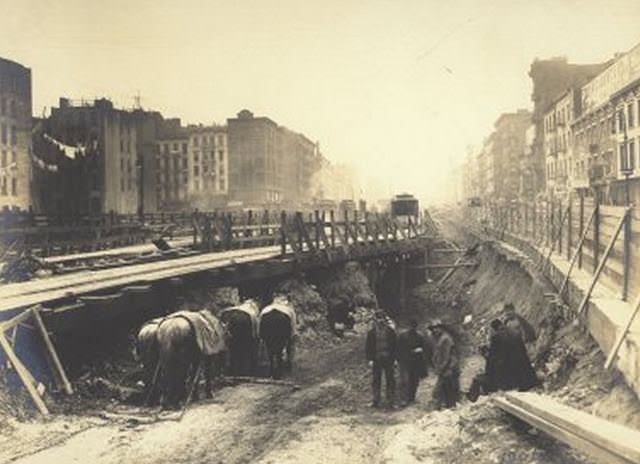
A few blocks away, work on the Delancey Street line opened up the street in similar fashion. The Lower East Side stations were critical connectors for the enormous immigrant population living in the neighborhood. Access to rapid transit meant access to work across the city — a fact that made these stations among the most used from the moment they opened.
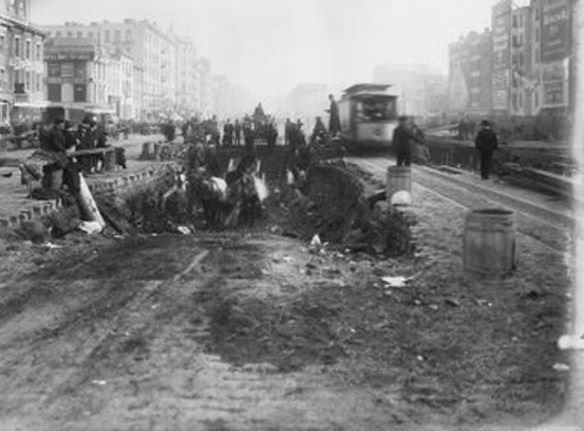
Also photographed on December 13, 1906, this view east from Norfolk Street shows the open structure of a new station taking shape. The exposed steel and timber framework gives a clear sense of how these underground spaces were assembled — built as a kind of below-ground architecture before being buried beneath the city streets.
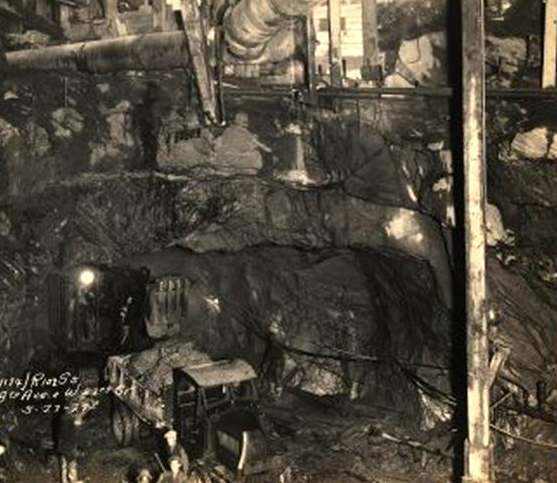
By the mid-1920s, construction had pushed well beyond the original IRT lines. The 8th Avenue corridor was being torn open in 1927 as part of the Independent Subway System — the city-run network known as the IND, which was built to compete with and eventually complement the private IRT and BMT lines. The scale of disruption at 8th Avenue and 52nd Street, seen here in May 1927, shows that two decades after the first line opened, the city was still in heavy construction mode.
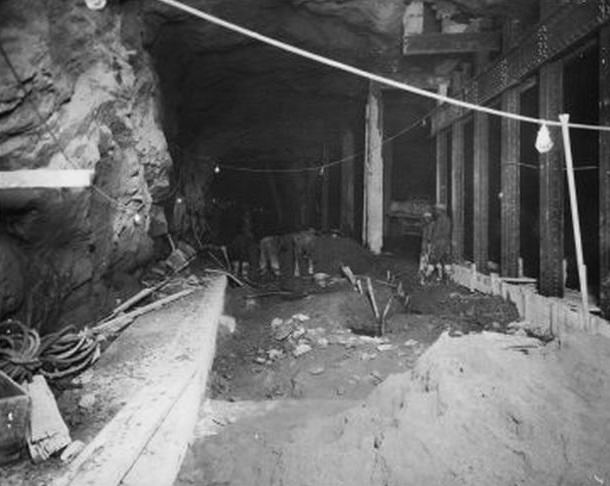
Work on the IND pushed deep into upper Manhattan and the Bronx. In April 1928, crews were boring beneath Broadway between 173rd and 177th Streets. Workers visible in the tunnel’s background give scale to the enormous excavation. This section of the line required precision — the tunnels had to align exactly with planned station positions and grade changes as the route moved northward.
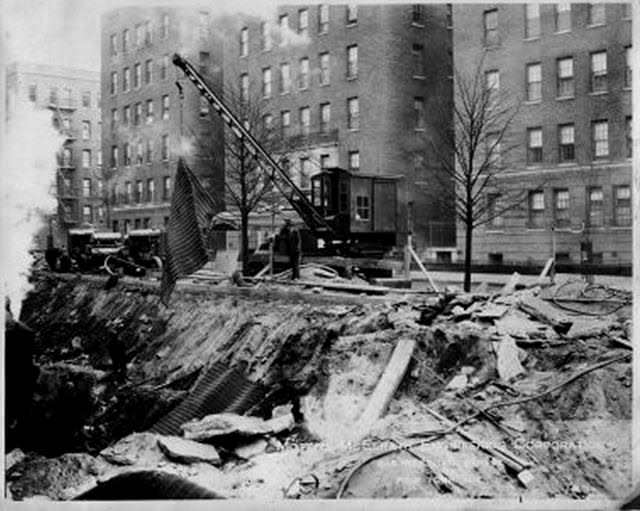
The Grand Concourse in the Bronx was one of the most ambitious sections of the IND buildout. Construction between 175th and 183rd Streets ran from 1928 into 1931, digging beneath one of the Bronx’s grandest boulevards. Connecting the Bronx to Manhattan by subway was a top priority for the city, giving residents direct access to jobs and commerce across the river without relying on elevated lines or bridges.
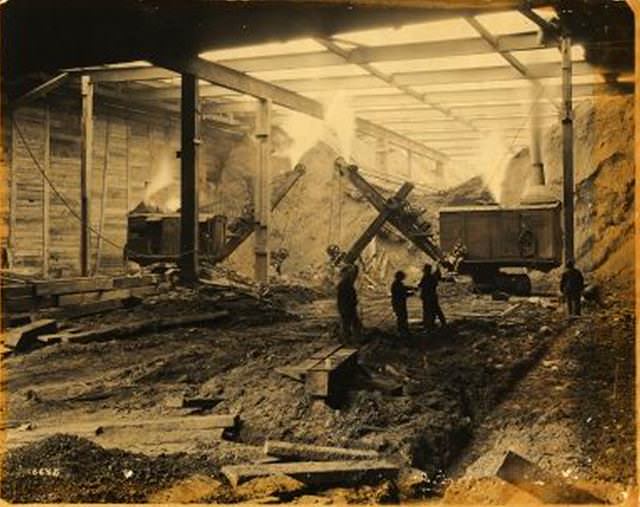
Inside the Bronx construction site in January 1931, cranes and workers filled the cavernous structure. The Great Depression had hit hard by this point, but subway construction did not stop. The city viewed the project as essential — both for the economy and for the residents who depended on public transit to survive financially. Completing these lines meant jobs for construction workers and mobility for the people who needed it most.
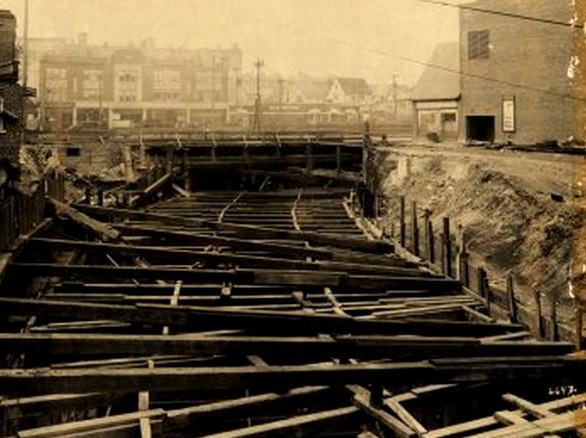
At ground level in January 1931, the construction site presented a scene of heavy machinery, raw materials, and organized labor working through the middle of winter. By the time the major IND projects wrapped up in 1931, New York City had built one of the most extensive rapid transit networks on earth — dug, blasted, and assembled by hand over the course of three decades.