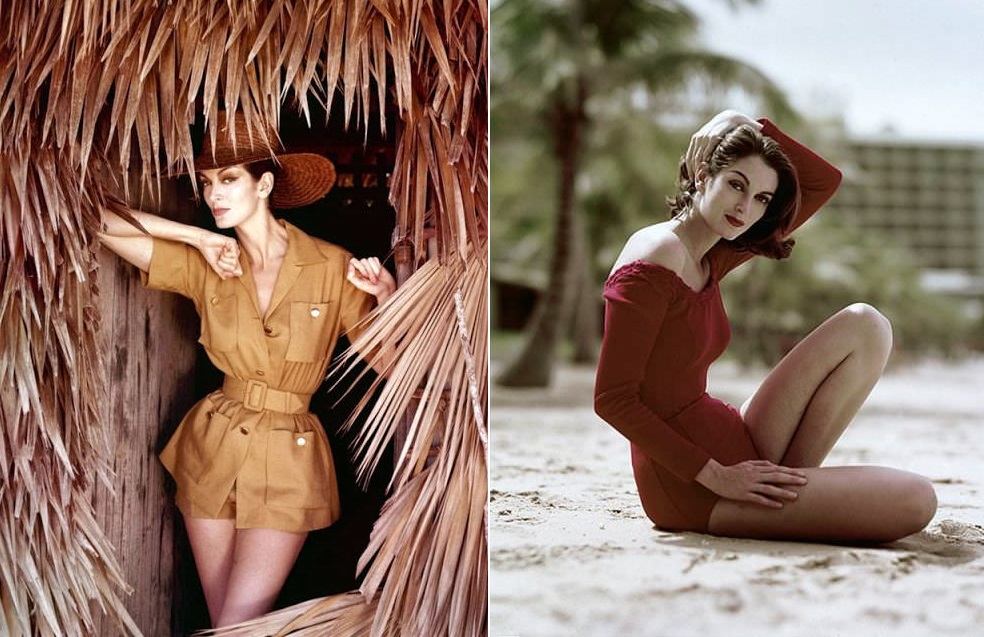
Ivy Nicholson began her modeling career at just sixteen years old, stepping into an industry that was still defining what a supermodel could be. She moved quickly from a newcomer to a sought-after face, landing work with three of the most prestigious fashion publications in the world — Vogue, Elle, and Harper’s Bazaar. Her face appeared not just inside their pages but on their covers, which in the 1950s was one of the highest marks of success a model could achieve.
The bulk of her modeling work unfolded across the 1950s in Paris, the undisputed center of high fashion at the time. She worked directly with the couture houses that defined the era — Christian Dior, Balenciaga, Givenchy, Jacques Fath, Nina Ricci, and many others. These weren’t catalog shoots. They were carefully crafted editorial photographs that documented exactly what Paris fashion looked like season by season. Ivy was a constant presence in that world.

By 1951, Ivy was already being photographed in pieces from the most respected names in the industry. That year alone, she modeled designs by Christian Dior, Jacques Fath, Balenciaga, Lanvin-Castillo, and Jean Dessès, among others. The variety was remarkable — structured wool suits, lace cocktail dresses, embroidered velvet skirts, and elaborately crafted millinery that treated hats as art pieces in their own right.


Hat designers were major figures in 1950s fashion, and Ivy modeled their work with the same attention given to full couture gowns. Milliners like Caroline Reboux, Gilbert Orcel, Rose Valois, and Legroux each brought distinct approaches — from sable caps with silver-embroidered horns to white ermine paired with matching muffs. These accessories weren’t afterthoughts. They were central to how a complete look was presented.


In early 1952, Ivy worked closely with Hubert de Givenchy, whose debut collection had just made waves in Paris. Givenchy’s designs at the time were fresh and unconventional — wide sleeves, exaggerated cuffs, structured coats with dramatic silhouettes. Ivy modeled several key pieces from his February 1952 presentations, including his “Fichu Lampion,” a pleated accessory styled like a Japanese lantern in black and tan paisley.


That same year, Ivy also traveled to Italy for editorial shoots. She was photographed on the Isle of Capri with straw hats by Emilio Pucci, and at Ostia wearing a hand-painted tricot top published in Elle. These location shoots placed high fashion against the backdrop of Italian coastal life, a contrast that gave the images a looser, more relaxed energy than the controlled studio work.


By 1953, Ivy’s editorial presence stretched across multiple publications and several countries. She was photographed in Rome wearing a chiffon evening gown by Irene Galitzine, appeared in Elle in a black velvet cocktail dress by Marc Bohan, and was captured sporting the new “Italian Haircut” created by Marcel — a cut that was being widely discussed in fashion circles at the time. Each shoot documented a specific moment in fashion history.


The year 1954 brought some of the most varied and well-documented shoots of Ivy’s career. Photographer Georges Dambier photographed her for Elle outside the Musée de l’Orangerie in Paris, wearing designs by Jacques Fath. She also appeared in Vogue in April wearing a floral print silk dress copied from an original Givenchy design. That same spring, she modeled for Nouveau Femina in a grey flannel two-piece and a wool overcoat with a sailor collar by Christian Dior.


In 1955, Ivy’s assignments ranged from bridal couture to Vogue Pattern features. Nina Ricci dressed her in a wedding gown of ruffled mousseline with a sheer embroidered bodice and layered tulle train. That same year, Vogue featured her twice in June modeling Paris-made patterns — a pale blue linen dress and jacket by Patou, and a black and white faille dress with short jacket by Paquin. These pattern features brought high couture design to a wider audience of home sewers.


From 1956 onward, Ivy continued shooting in Europe, with Italy providing some of the most visually striking backdrops of her career. She was photographed standing in a gondola in front of Venice’s Ca’ d’Oro in narrow pants and a sweater — a casual, almost cinematic image compared to the formal studio work of earlier years. In Rome, she posed along the Appian Way in an evening gown. These settings turned fashion photography into something closer to visual storytelling.


The later years of the 1950s saw Ivy appearing in Harper’s Bazaar and Vogue in some of the decade’s most dramatic evening wear. A March 1958 Harper’s Bazaar shoot featured her in a white cotton ottoman evening dress with large petal-shaped panels that curved up at the front and swept down at the back — a sculptural design that used fabric the way a sculptor uses clay. That November, Vogue featured her in a crystal green pleated nylon nightgown by Eye-Ful, and a separate shoot showed her wearing a British police oilskin cape repurposed as a skirt.


By 1959, Ivy was still being photographed in Paris, appearing in editorial shoots that captured both her personal style and the broader shifts happening in fashion as the decade closed. A shoot by Kenneth Heilbron that year documented her in Paris with quiet precision, and another featured an evening coiffure by Carita — the famous Parisian salon known for elaborate hairstyling. In 1970, Ivy moved back to Paris, where she painted and guided the careers of her children.