Hey There! Before You Go. 😧
Get the best vintage content straight into your inbox!

Don't worry, we don't spam

Haunting Aftermath Photos of German Soldiers after the D-Day Invasion in WWII

The story of D-Day is most often told through the eyes of the men who stormed the beaches — the Allied soldiers who crossed the English Channel and fought their way onto French soil on June 6, 1944. But the men on the other side of those guns had a story too. The photographs collected here, many taken by Associated Press photographers in the days and weeks after the invasion, document what happened to those men once the fighting stopped or the situation became hopeless. They were captured, transported, processed, and confined. Some were wounded. Some were dead.

One important fact stands out in these images: not every man wearing a German uniform was German. The Wehrmacht and the broader forces under Nazi command included soldiers from across Europe and beyond — Poles, Czechs, Russians, Italians, Turks, Mongolians, and even Japanese fighters appeared among the prisoners taken in Normandy. Some had been conscripted by force and had little choice but to serve. Others fought as willing collaborators. By the time Allied forces swept through the beaches and inland, all of them faced the same outcome: surrender, captivity, or death.

These photographs were the ones the Associated Press was permitted to publish. They show prisoners marching, officers being interrogated, and wounded men being carried on stretchers. The worst of the violence — the bodies, the blood — was largely kept from public view. What remains is still striking, a record of defeat captured in real time.

On the beaches themselves, the first prisoners were taken almost immediately. Canadian and American forces rounded up defenders as early as June 6, marching them away from the shoreline under armed guard. Some of these men looked stunned. Others appeared relieved. A few were badly beaten, having survived the brutal conditions inside coastal gun nests that had been pounded by naval and air bombardment for hours.

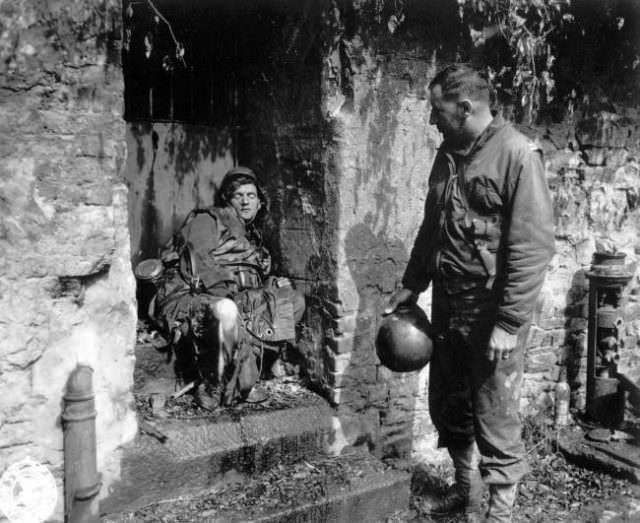
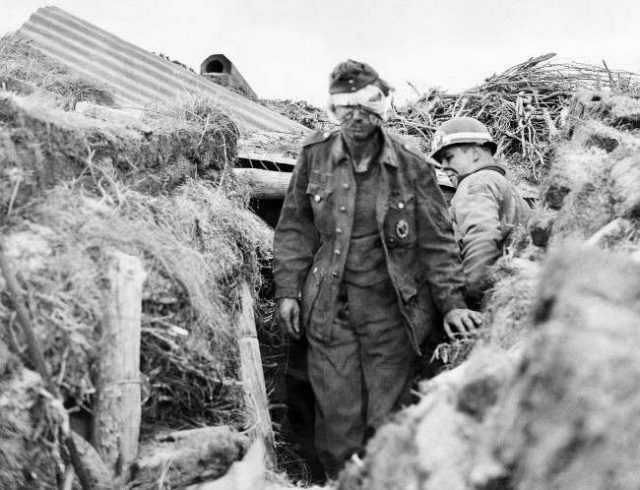
Badly battered German gunner of a gun nest on beach of northern France staggers out of underground nest under watchful eye of a burly U.S. Army M.P. on June 10, 1944.

The gun nests along the Normandy coast had been among the most heavily defended positions on the Atlantic Wall. The men stationed inside them endured relentless bombardment before Allied troops reached them. By June 10, just four days after the initial landings, U.S. Military Police were escorting dazed survivors out of those fortified positions. Some could barely walk.

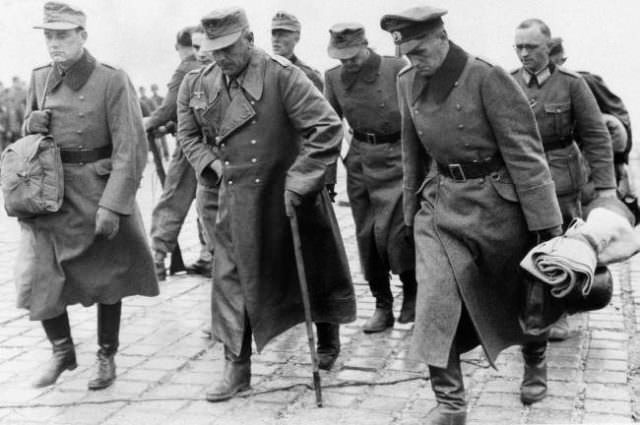
German officers, captured on the beaches of Normandy in France, hang their heads dejectedly as they arrive on June 10, 1944 in England en route to prisoner of war camps.

German officers captured in Normandy were quickly transported across the English Channel to prisoner of war camps in England. Their removal from France served both a practical and symbolic purpose — it stripped the remaining German forces of leadership and demonstrated to the public back in Britain that the invasion was succeeding. The sight of enemy officers arriving in England made headlines.

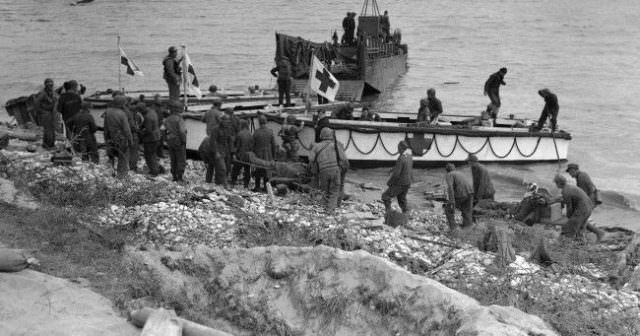
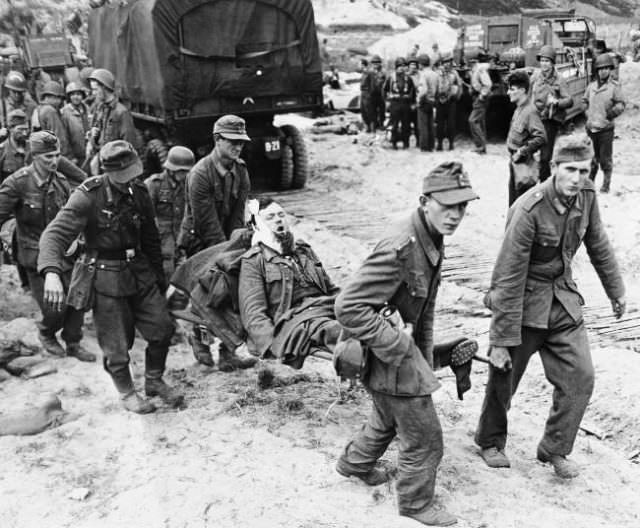
German prisoners help evacuate some of their own wounded, and are seen being put on board Red Cross boats to be taken out to the mother ship, standing by off the beachhead area in Normandy, France on June 10, 1944.

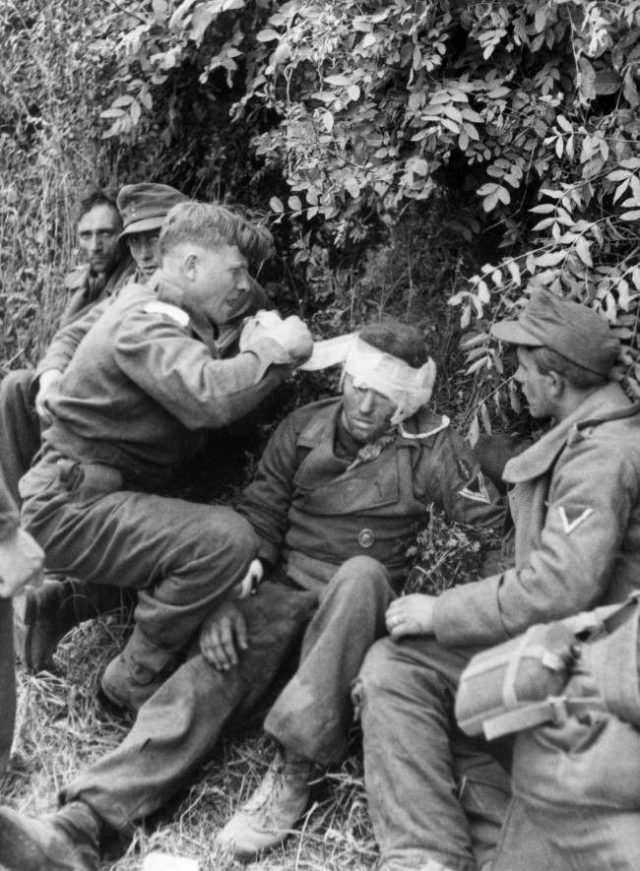
Red Cross vessels were used to transport German wounded out to ships anchored offshore. In several photographs, prisoners are seen carrying their own injured comrades on stretchers to the water’s edge, loading them onto boats headed for medical ships in the English Channel. Allied doctors treated German casualties alongside their own wounded — a standard practice under the Geneva Conventions.

Haunting Aftermath Photos of German Soldiers after the D-Day Invasion in WWII
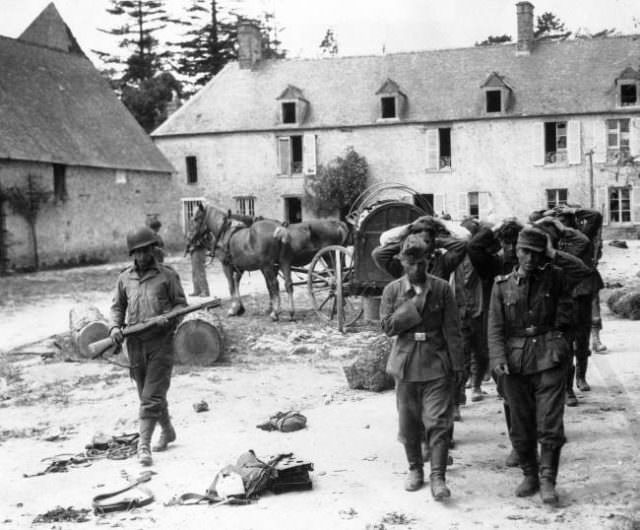
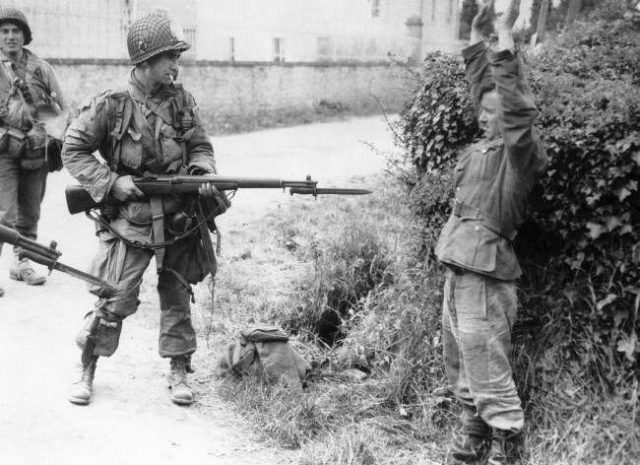
An American paratrooper holds a Nazi prisoner at the point of his bayonet, one of many incidents during the American advance into Normandy, in France, on June 10, 1944.

American paratroopers had dropped behind enemy lines in the early hours of June 6, hours before the beach landings began. By June 10, they were advancing further inland and taking prisoners at bayonet point. The image of a lone paratrooper controlling a prisoner at the end of his bayonet captures the raw, close-quarters nature of the Normandy fighting in its first week.

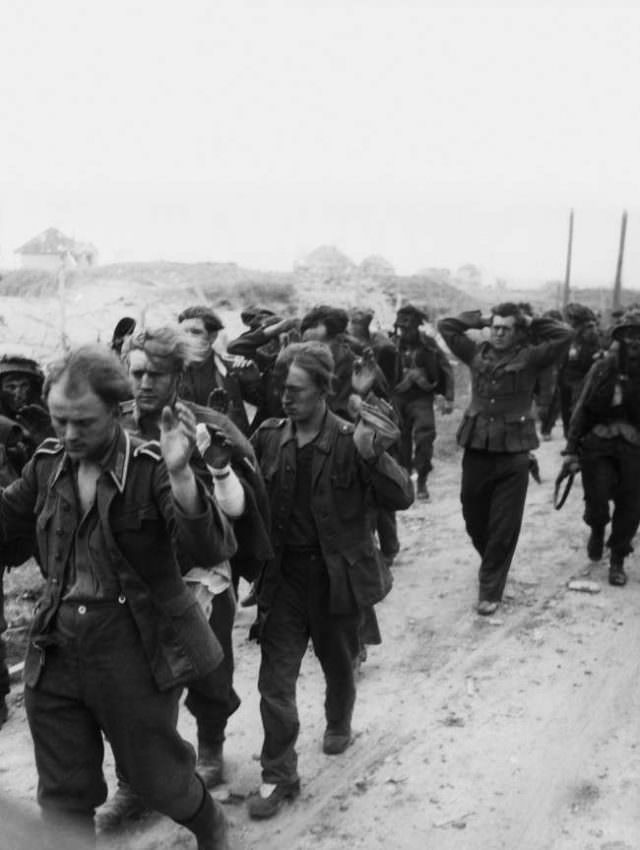
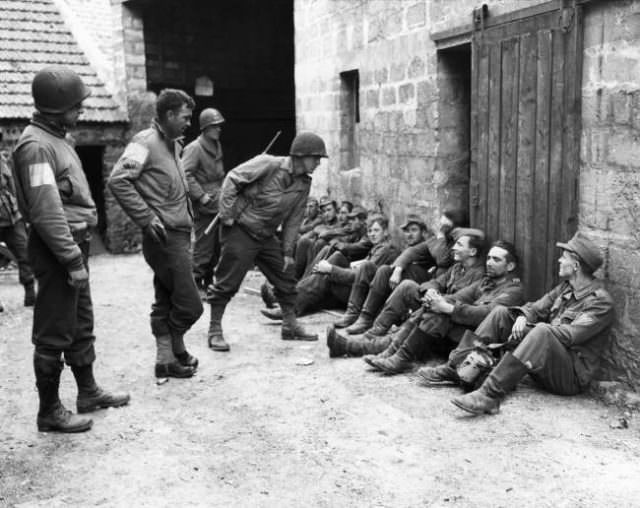
Some of the first German prisoners captured in the invasion of Normandy on June 9, 1944.
Some of the first German soldiers to surrender to the Americans during the battle of the Normandy beaches on June 9, 1944.

The first surrenders came quickly. Some German soldiers chose to give themselves up as soon as they saw that resistance was futile. Others fought until their positions were overrun. Those who surrendered early were marched to holding areas on the beaches, then moved off the coast to free up space for the ongoing Allied buildup. The volume of prisoners grew rapidly in the first 72 hours.

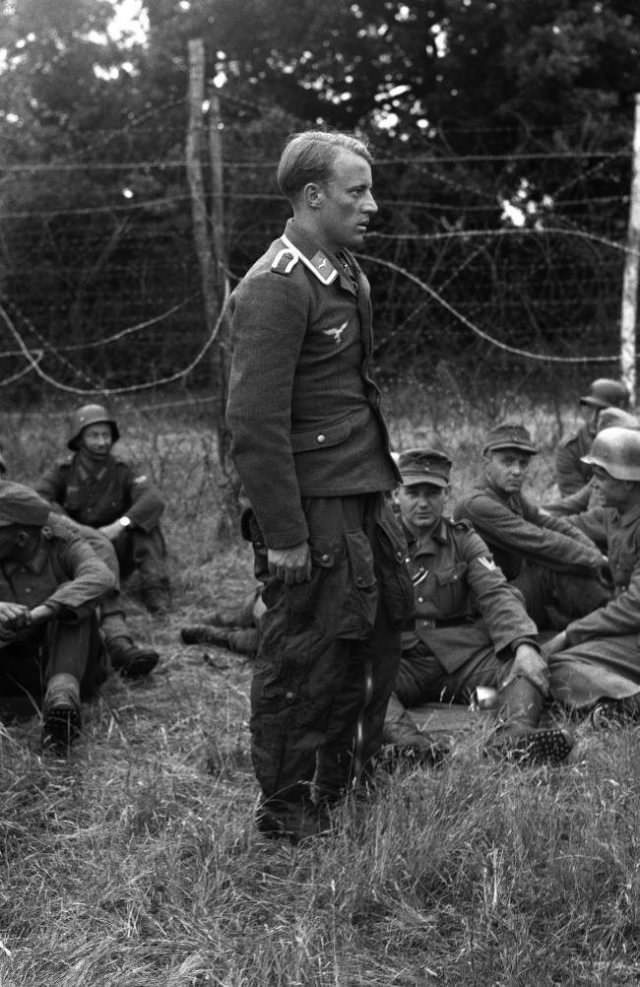
The first Nazi airman to be shot down in the invasion area stands dejected amongst other prisoners at a camp somewhere in England, on June 9, 1944.
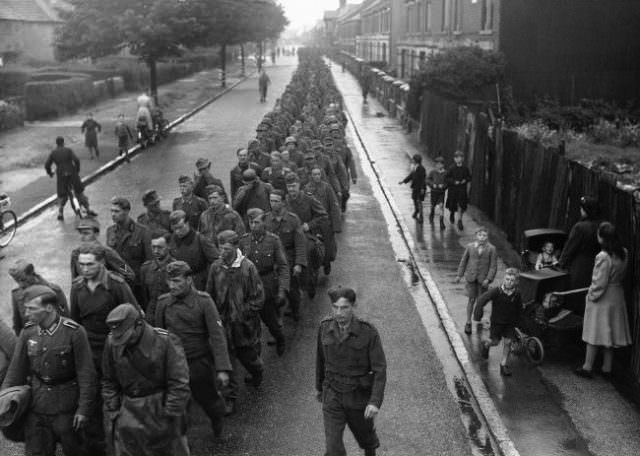
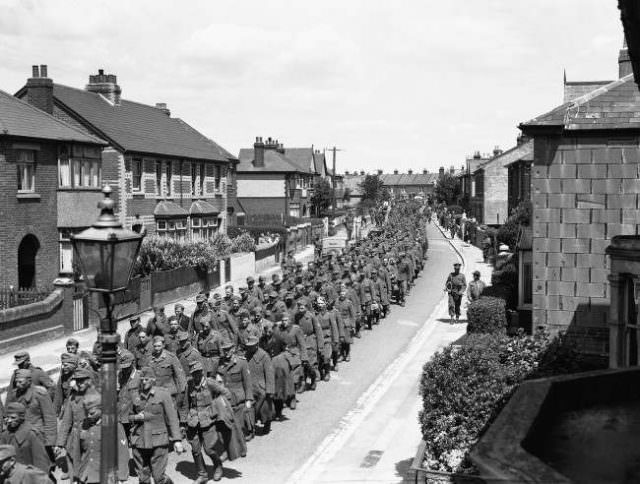
A steady stream of German prisoners is pouring into this country from the battle of Normandy. German prisoners, captured on the beaches of Normandy, march through a street, somewhere in England, on June 9, 1944

By June 9, German prisoners were already arriving in England in large numbers. They were marched through English streets on their way to permanent internment camps. British civilians witnessed columns of enemy soldiers walking through their towns — men who, just days before, had been positioned to repel any Allied crossing of the Channel. The sight was a visible marker of how dramatically the war’s balance had shifted in just a few days.

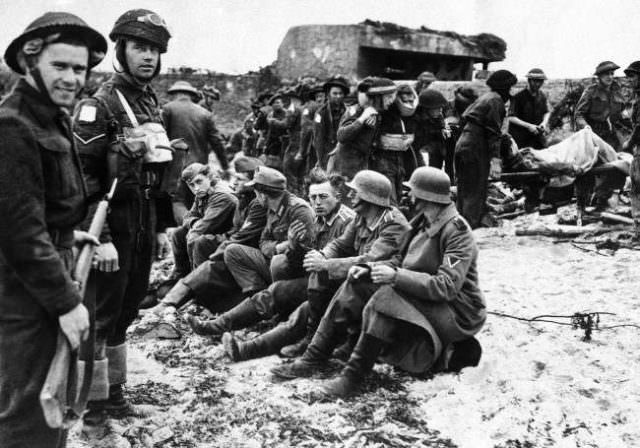
Canadian invasion troops stand guard over the first German prisoners captured during the assault on France by Allied forces on June 6, 1944 along a 100 mile front on the Normandy coast between LeHavre and Cherbourg.
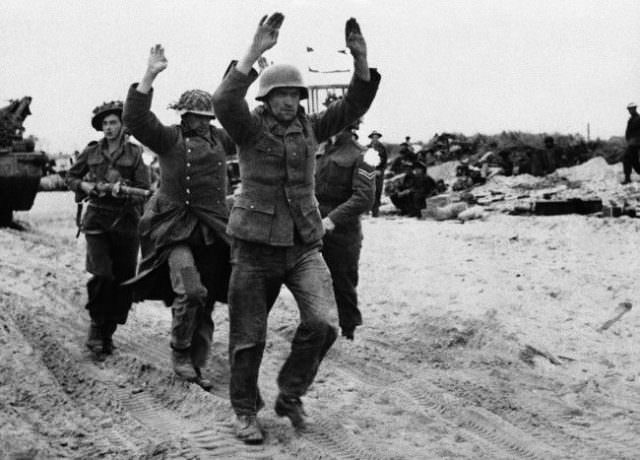
German prisoners of war are led away by Allied forces from Utah Beach, on June 6, 1944, during landing operations at the Normandy coast, France. )

On Utah Beach, prisoners were being led away while the landings were still actively in progress. The beach itself remained a logistics hub — men, vehicles, and supplies were pouring in while prisoners were being moved in the opposite direction. Canadian troops guarded the first captured defenders along a front that stretched nearly 100 miles of coastline.
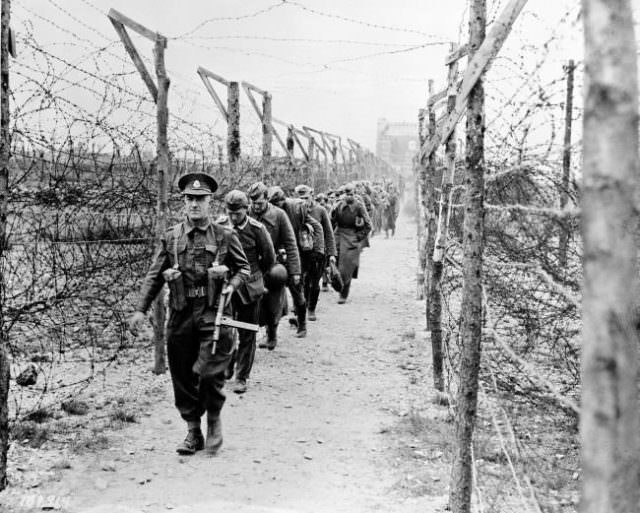
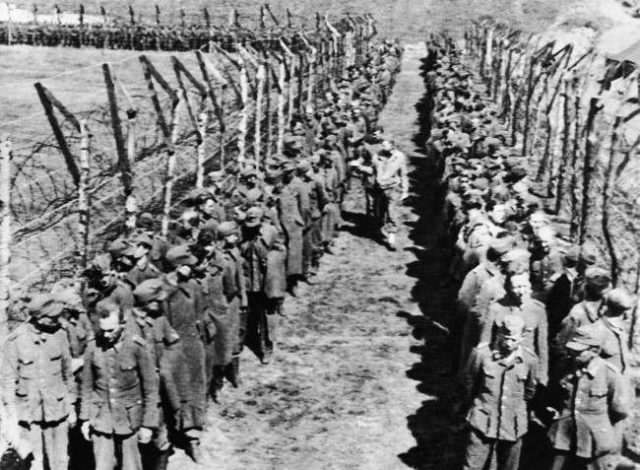
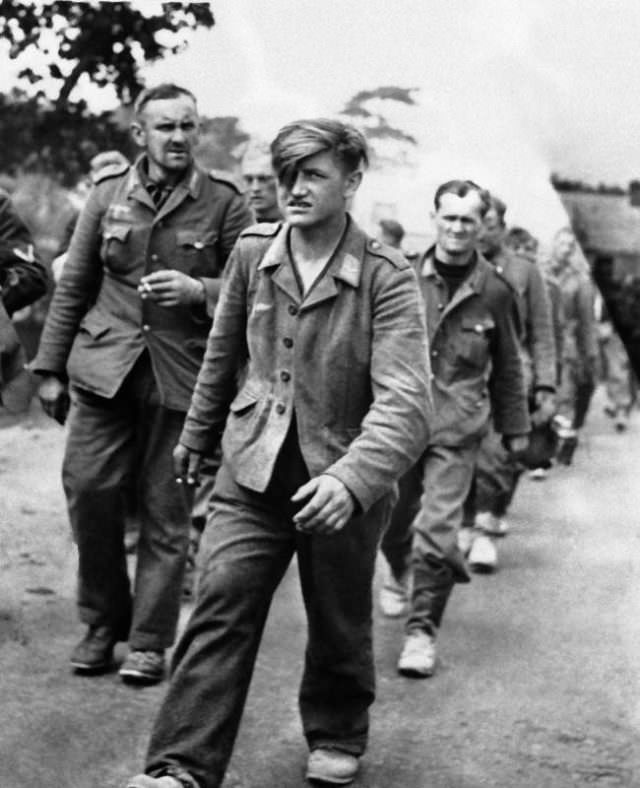
Led by a British soldier, a line of German prisoners of war is marched along a barbed-wire barricaded lane as they arrive at a POW camp somewhere in England, in June 1944
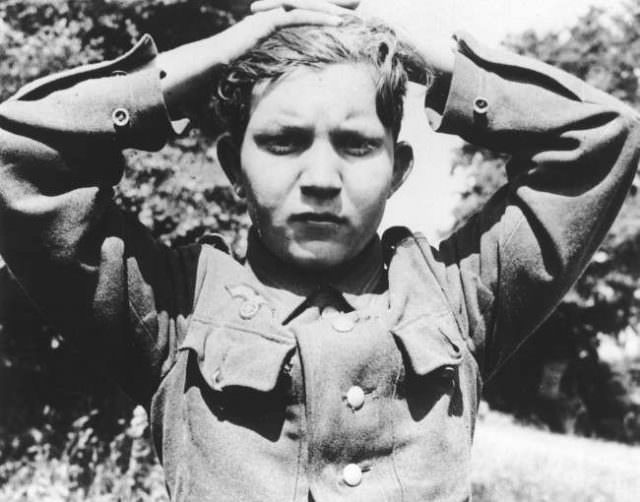
A 16-year old German soldier has his hands clasped over his head as he is taken prisoner with thousands of other Wehrmacht soldiers, at Cherbourg, France, during the Allied Normandy invasion in June 1944

Among the thousands of Wehrmacht soldiers taken prisoner at Cherbourg was a 16-year-old boy, hands raised over his head. By 1944, Germany’s military was pulling from increasingly younger age groups to fill the gaps left by years of catastrophic losses on the Eastern Front and in North Africa. Teenagers were trained and deployed to defend positions against experienced Allied armies. Many did not survive.

A dead German soldier seen in this June 1944 photo

Not every German soldier made it to a prisoner column. The dead were photographed too, though the Associated Press exercised restraint in what it published. A single image of a fallen German soldier represents the tens of thousands who died defending the Atlantic Wall and the positions behind it. The German military suffered massive casualties during the Normandy campaign — killed, wounded, or missing in the weeks following June 6.

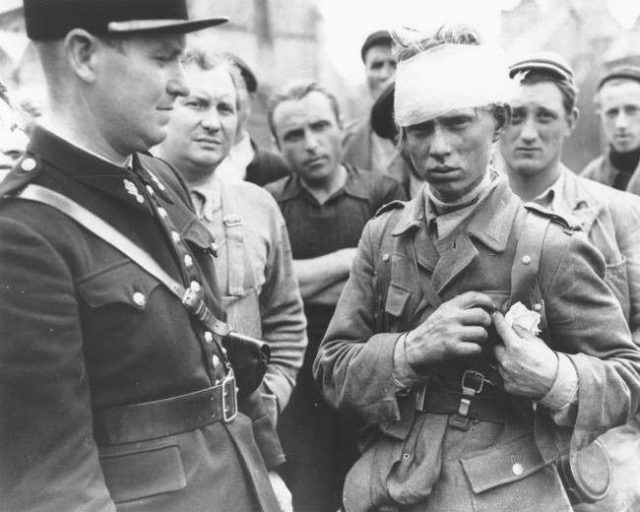
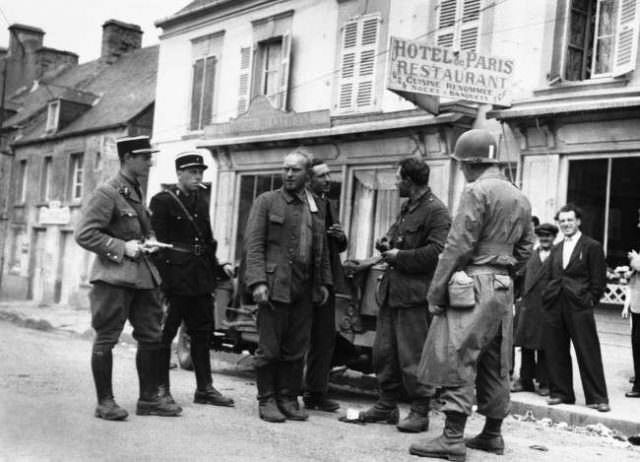
A wounded German soldier who surrendered to the Allied invasion forces, stands surrounded by a crowd of civilians and a French gendarme on the left, in Barneville in the Normandy region, June 1944.
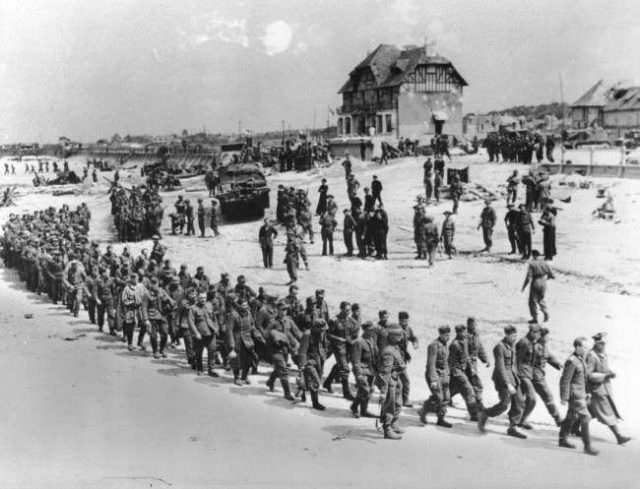
German prisoners of war, captured during the Allied Normandy invasion, are marched to the ships that bring them into captivity in England, in June 1944, at Bernieres-sur-mer, France.

In the town of Barneville on the western side of the Cherbourg peninsula, a wounded German soldier who had surrendered found himself surrounded by French civilians and a local gendarme. The reaction of French civilians to captured German soldiers varied widely depending on the location and the history of that particular occupation. In Normandy, where fighting had been especially destructive, encounters like this one carried significant tension.
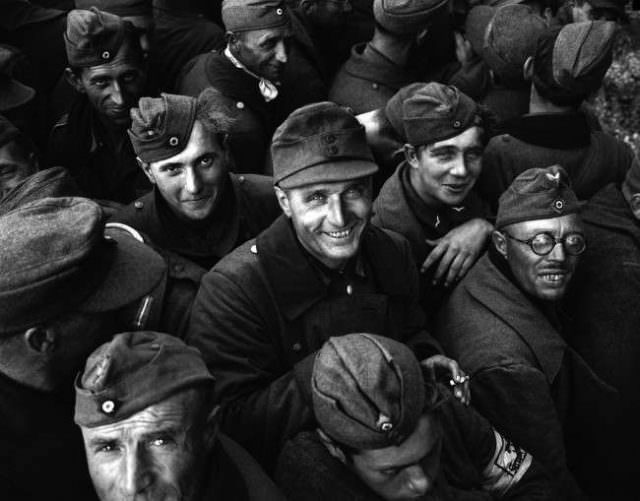
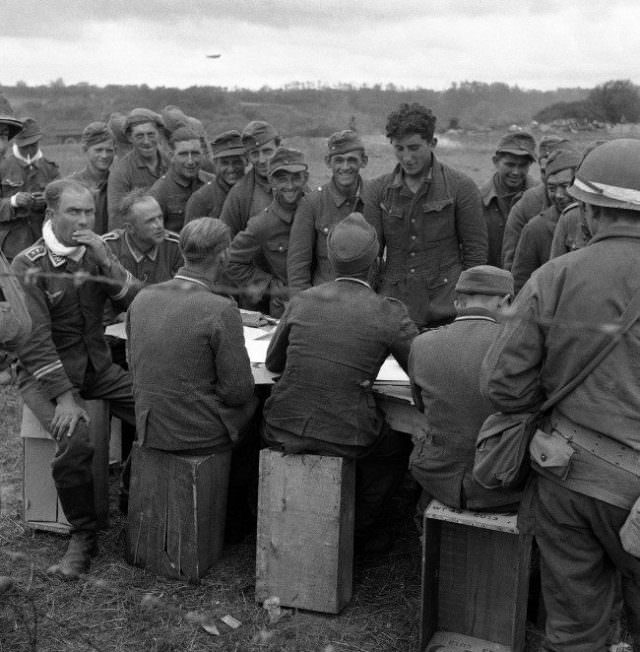
Two long double lines of German prisoners are checked by Allied officers, center, as they stand beside barded wire fences of compound in England, June 12, 1944, after their capture on the Normandy coast of France.
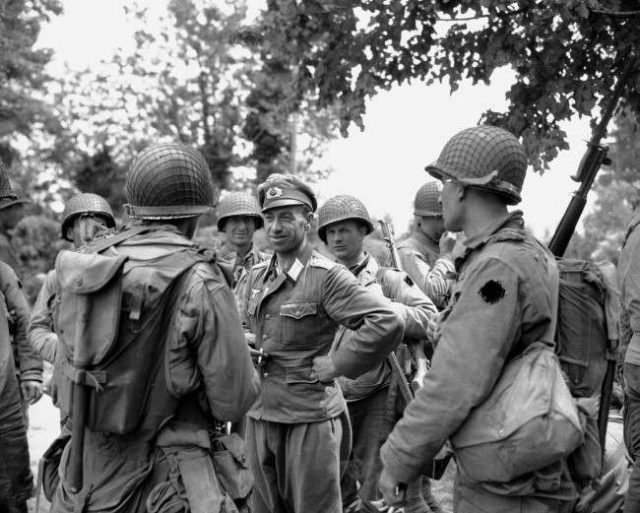
A German officer smiles as he is interrogated by American soldiers who landed on the beaches of Normandy, France on June 12, 1944.

Interrogations began quickly after capture. American soldiers questioned German officers on the beaches and in temporary holding areas, gathering intelligence about troop positions, defensive structures, and command decisions. One photograph shows a German officer smiling during his interrogation on June 12 — an expression that stood out among the mostly grim faces in the prisoner photographs from those days.

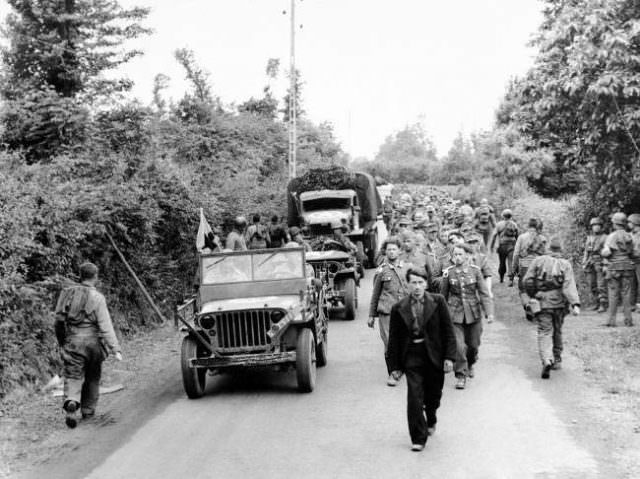
American troops moving up to the front lines, right, pass a long line of German prisoners marching back to a holding camp prior to being shipped out of France, on June 12, 1944.
More than six hundred German prisoners, the largest number yet to reach this country since the opening of the second front, arrived in England on June 12, 1944.

By June 12, more than 600 German prisoners had arrived in England in a single shipment — the largest number since the invasion had opened. On the roads leading away from the front, the scene was a study in contrasts: American troops moving forward toward the fighting passed long columns of German prisoners being marched in the opposite direction toward the coast.

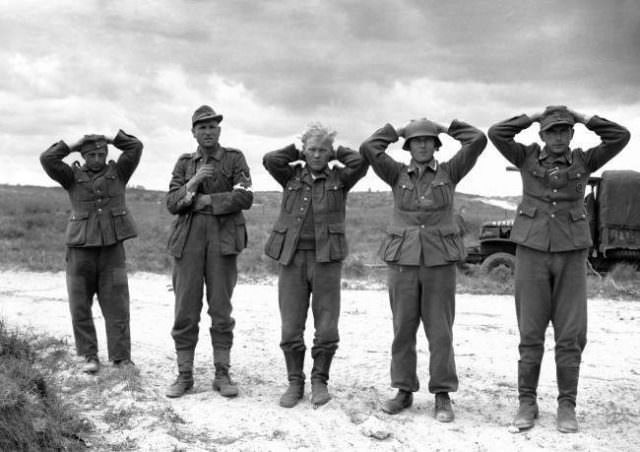
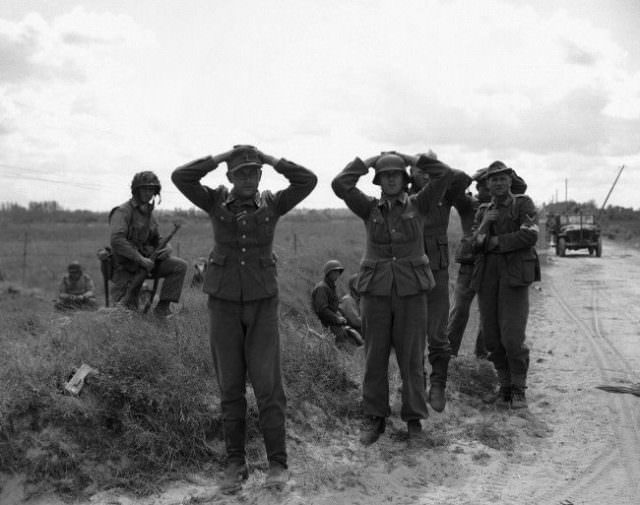
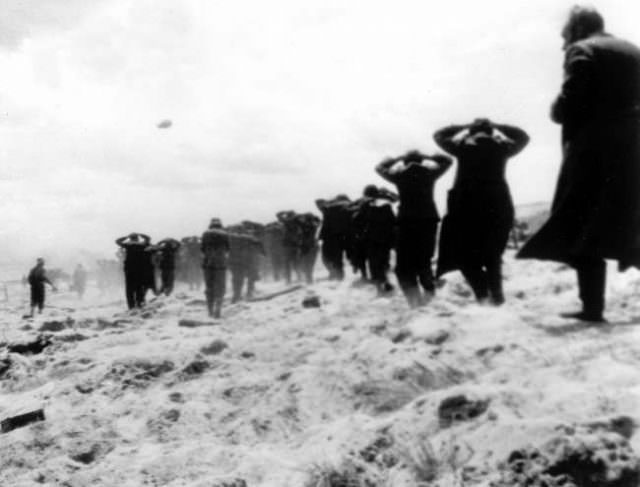
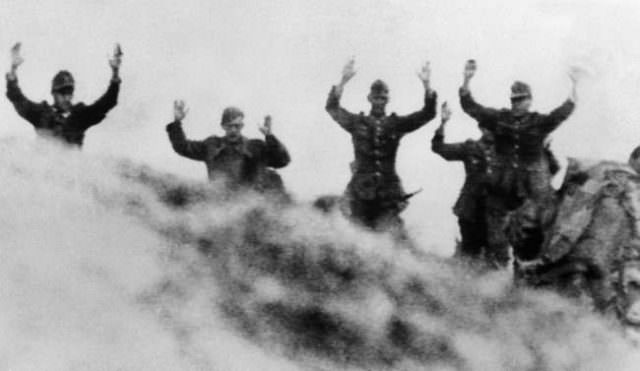
German soldiers, former Herrenvolk, come over the crest of a hill with their hands over their heads in surrender to American troops during the battle for the Norman beachhead in France on June 11, 1944.
First the troops wade ashore from landing craft. Then the gradual development of land operations some of these early stages. German prisoners being marched along beach on June 11, 1944.

The caption on one photograph refers to the surrendering German soldiers as the “former Herrenvolk” — a direct reference to the Nazi ideology of a master race. The term was used pointedly by Allied press to contrast the propaganda of German racial superiority with the reality of mass surrenders on a French beach. The soldiers cresting the hill with their hands raised on June 11 bore no resemblance to the invincible warriors Nazi propaganda had promised.

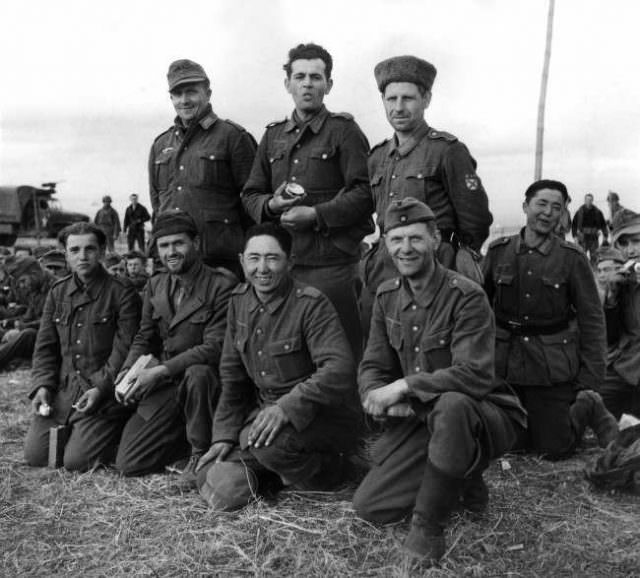
Not all of the GI Army prisoners taken on the battlefields France are stalwart, Blonde Aryans who we born to rule the world.

The diversity of men captured in German uniforms was a recurring theme in the Allied press coverage. The caption on one photograph notes directly that not all prisoners were the “stalwart, blonde Aryans” that Nazi ideology had celebrated. Among those captured were soldiers from across Eastern Europe and Asia, many of whom had been pressed into service in Ost battalions — units formed from Soviet POWs and occupied territories. These men fought under German command, but they were far from the idealized soldiers Nazi propaganda depicted.

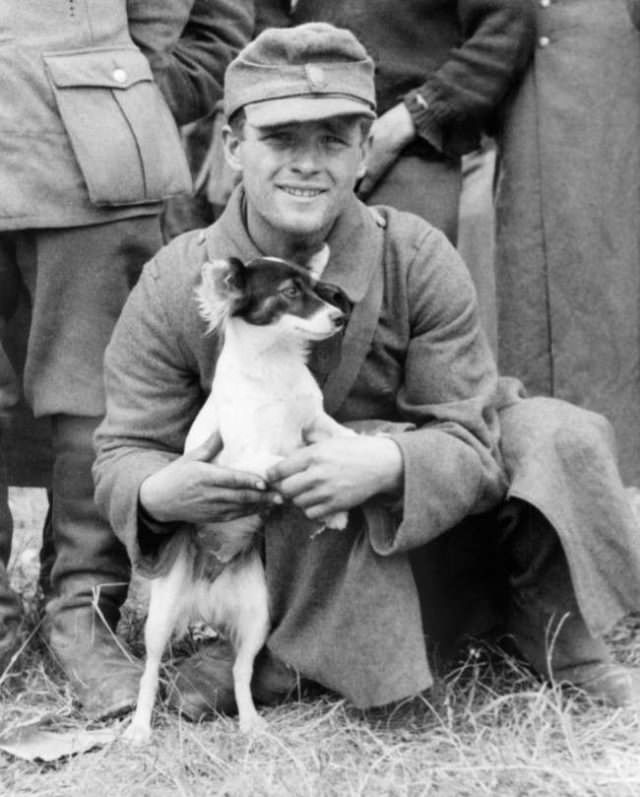
This German soldier managed to keep his mascot dog when he was captured, with other members of his company, by allied troops in the beachhead sector in France on June 15, 1944.
German prisoners of war, in the battle for France, carry a wounded comrade to an evacuation area on the beach where landing craft will speed them out to ships in the English Channel for treatment by Allied doctors on June 15, 1944.

Amid the grim procession of prisoners, one image stands apart: a German soldier who somehow kept his small dog with him through the chaos of capture. He was photographed on June 15 with his company, the dog still at his side. A separate photograph from the same day shows prisoners carrying a wounded comrade on a stretcher toward the beach, where a landing craft would take him out to Allied medical ships.

Two German soldiers surrendered to a solitary American soldier in Barneville, on the west coast of the Cherbourg peninsula, in France, on June 20, 1944.
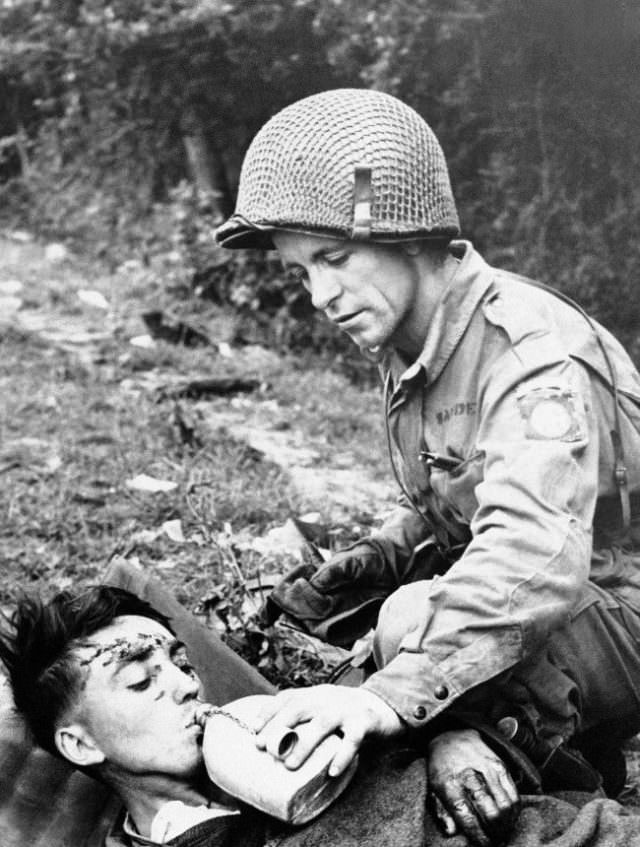
An American soldier gives a drink of water to a wounded German prisoner lying on a stretcher somewhere in the Normandy, France on June 19, 1944, battle area through which the allies advanced.

On June 19, an American soldier gave a drink of water to a wounded German prisoner lying on a stretcher. On June 20, two German soldiers surrendered to a single American soldier in Barneville on the west coast of the Cherbourg peninsula. These scenes were not unusual by that point in the campaign. German resistance in many areas had collapsed, and isolated soldiers were giving themselves up to whoever they encountered first.
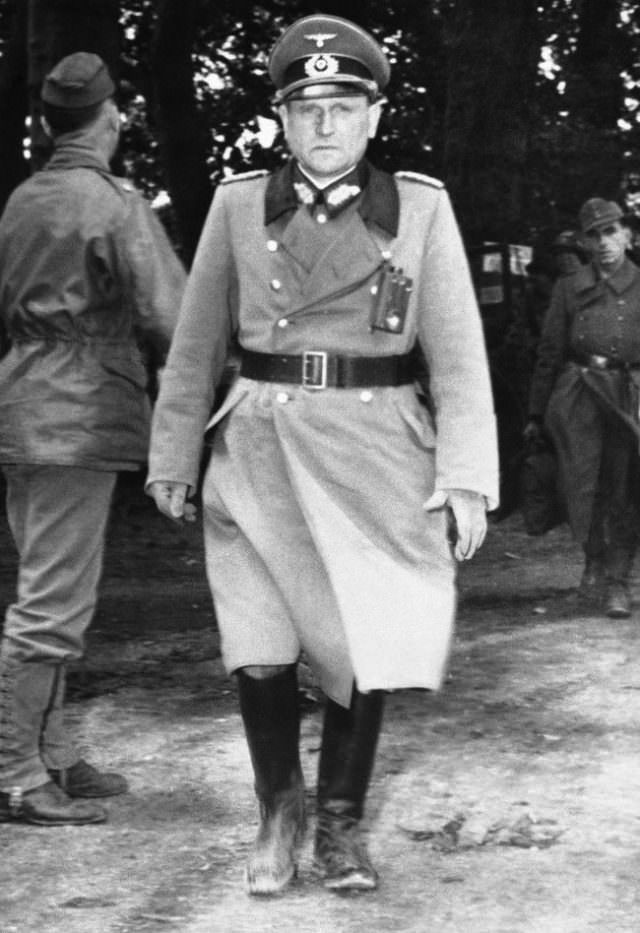
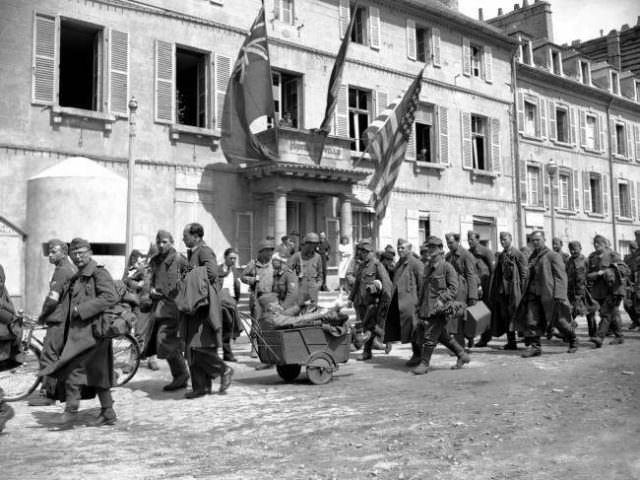
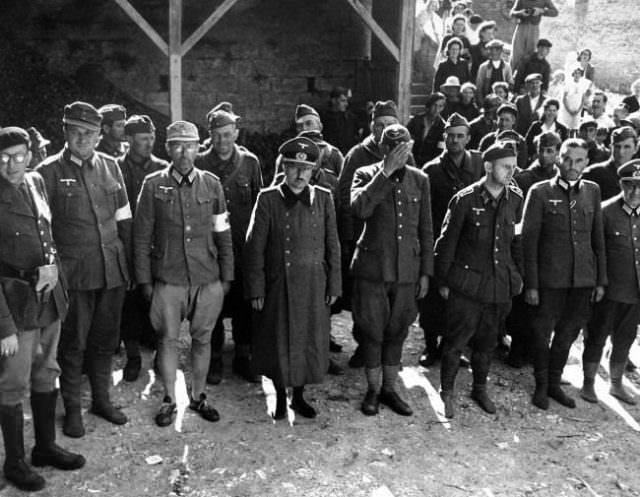
German prisoners captured by the FFI at Maizy sur Oise, France on Sept. 18, 1944 including officers of the Luftwaffe, stand in formation prior to being transferred to a detention area. Many of them are shoeless.
A stretcher bearer attends to a wounded German near the village of Lingevres, France on June 16, 1944, where a fierce battle was fought.

Near the village of Lingevres on June 16, a stretcher bearer attended to a wounded German soldier following fierce close-quarters fighting. Months later, in September 1944, French Forces of the Interior — the FFI, the organized French Resistance — were capturing German prisoners of their own. A photograph from Maizy-sur-Oise on September 18 shows Luftwaffe officers and other soldiers standing in formation before transfer to a detention area. Several are barefoot.

German soldiers, captured by Allied Armies on the Normandy beachheads in France on June 16, 1944, are checked by fellow prisoners.
Three American soldiers, members of an airborne infantry outfit who were captured and held by the Germans near Orglandes, France on June 25, 1944

The prisoner-taking was not entirely one-sided. Three American soldiers from an airborne infantry unit were captured and held by German forces near Orglandes, France on June 25. They appear in one photograph, a reminder that Allied soldiers were taken prisoner too — though in far smaller numbers by that stage of the Normandy campaign. By late June, German forces were being encircled around Cherbourg, and mass surrenders were imminent.

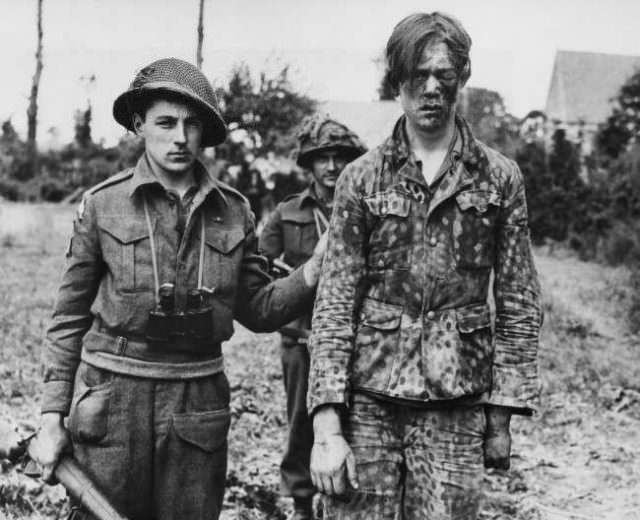
A wounded German prisoner, wearing a camouflages uniform, is escorted to an allied first aid station in France on June 21, 1944
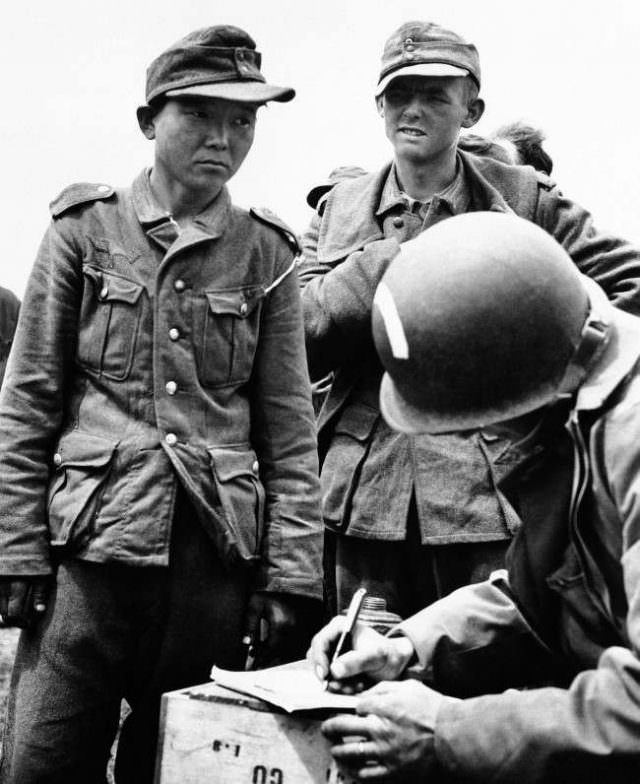
This Japanese, captured while serving in the German army in France on June 21, 1944, gives his name and serial number to an American as he files along with other German prisoners rounded up in the Normandy coast area.

On June 21, a Japanese soldier captured while serving in the German army in France gave his name and serial number to an American soldier processing prisoners in the Normandy area. His presence in a German uniform on a French beach is one of the more striking illustrations of how broadly the Nazi war machine had drawn from occupied and allied populations across the world. He filed through the prisoner line like every other captured soldier, providing his information and moving on.

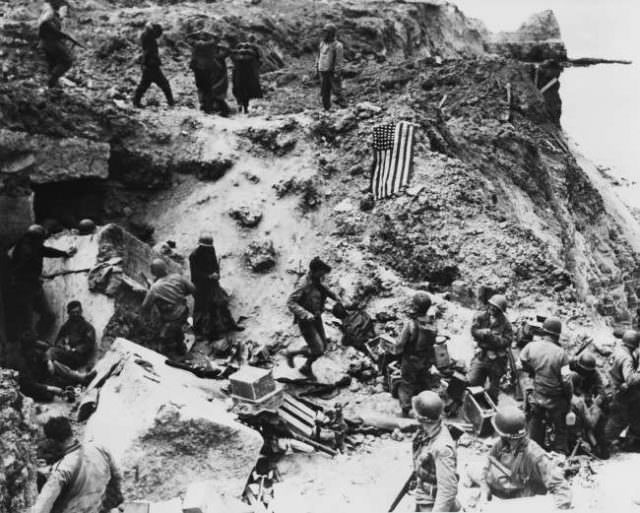
Hands clasped over their heads, a group of German prisoners (top) is herded down a slope on the French coast on June 21, 1944, to a ship to take them to a prison camp, as American command post bustles with activity below.

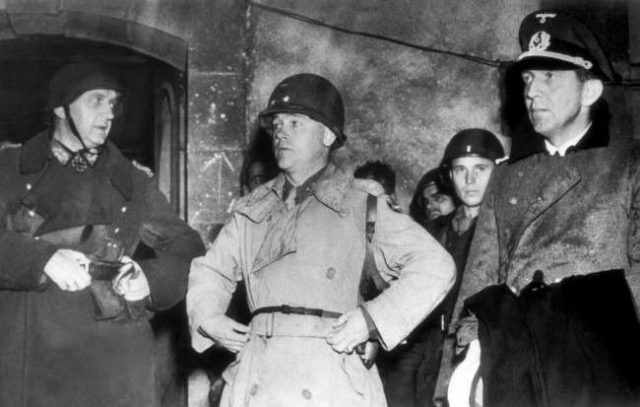
The fall of Cherbourg, the major port city at the tip of the Cherbourg peninsula, marked a decisive moment in the Normandy campaign. General Eisenhower described it as the end of the second phase of the Allied campaign of liberation. The German garrison commander, Lieutenant General Carl Wilhelm von Schlieben, surrendered the city along with Admiral Hennecke, who had commanded the port’s sea defenses.

Commander of the German forces which capitulated at the French port of Cherbourg, France, stand with their conqueror on June 30, 1944, after giving up the fight.
A column of German prisoners, captured in fighting for the outer defenses of Cherbourg are marched to a prisoner of war stockade behind the lines on June 29, 1944.

In the days before Cherbourg’s formal surrender, Allied forces systematically dismantled its outer defenses. Prisoners taken in that fighting were marched to stockades behind the lines. General Major Robert Sattler, deputy commander of Fort du Roule — the massive fortified position overlooking the city — was captured on June 28. Photographs of his capture and of German soldiers filing past Cherbourg’s town hall on their way to internment were published widely.

A study of German prisoners taken by the Americans in their drive on Cherbourg, France on June 28, 1944. The fall of Cherbourg ends what General Eisenhower refers to as the second phase of the campaign of liberation.
General Major Robert Sattler, Deputy German Commander of the Fort Du Roule, at Cherbourg, France on June 28, 1944, after his capture
German prisoners file past the Town Hall at Cherbourg on their way to a stockade on June 28, 1944.

By the time the Cherbourg campaign ended, the scale of German captures across Normandy had grown into the tens of thousands. Men who had been defending fixed positions along the coast for years — in some cases since 1942 — were now prisoners of war in England or in holding camps across liberated France. The Atlantic Wall, the great defensive barrier that Nazi propaganda had called impenetrable, had been broken in a matter of weeks.

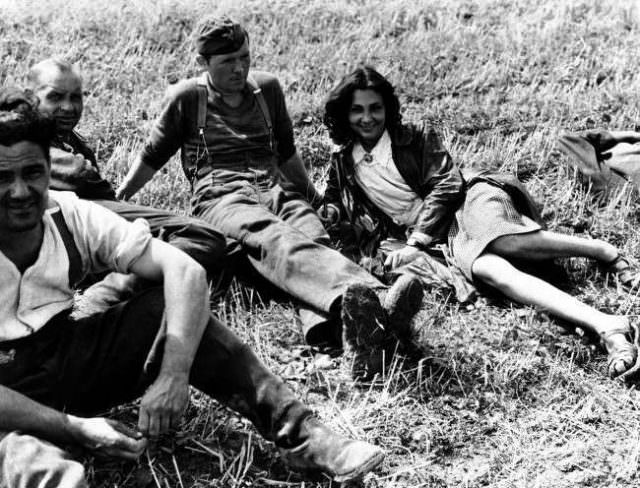
This French girl, who was engaged to a German soldier, refused to leave him even after he was captured and confined in a prisoner of war stockade on August 26, 1944.

One of the most unusual photographs from this period was taken on August 26, 1944. A young French woman, engaged to a German soldier, refused to leave his side even after he was captured and placed in a prisoner of war stockade. Relationships between French civilians and German occupiers were not uncommon during the four years of occupation, and they became deeply complicated in the aftermath of liberation. This photograph, more than almost any other in this collection, shows the human cost of the occupation and its end from a perspective that rarely appears in official wartime records.

Enjoyed this post? Get new ones in your inbox.

Leave a Comment

Your email address will not be published. Required fields are marked *

Share this Post 🥺

Please take a moment to share this content. Your support is greatly appreciated! 🙌🙏

Share this Post 🥺

Please take a moment to share this content. Your support is greatly appreciated! 🙌🙏
Scroll to Top
 
Hey Friend, Before You Go.. Please like & follow for more interesting content