Mario Uger is a photographer, retoucher, and digital artist from Austrian Burgenland. In 2018, he launched a personal project with a clear goal: colorize black-and-white portraits of some of the most well-known figures from the 18th and 19th centuries. The results are striking. Faces that once felt frozen in a distant past suddenly look alive, present, and remarkably human.
Uger explained his motivation plainly. “The reason for doing all of this work was to reduce the felt distance in time a little bit. I love B&W photography, but for some images I think, color is needed and most of B&W photography was done for one reason, there just was no color film!” His work spans scientists, writers, composers, actors, royals, athletes, and soldiers — a wide sweep of history brought into full color.

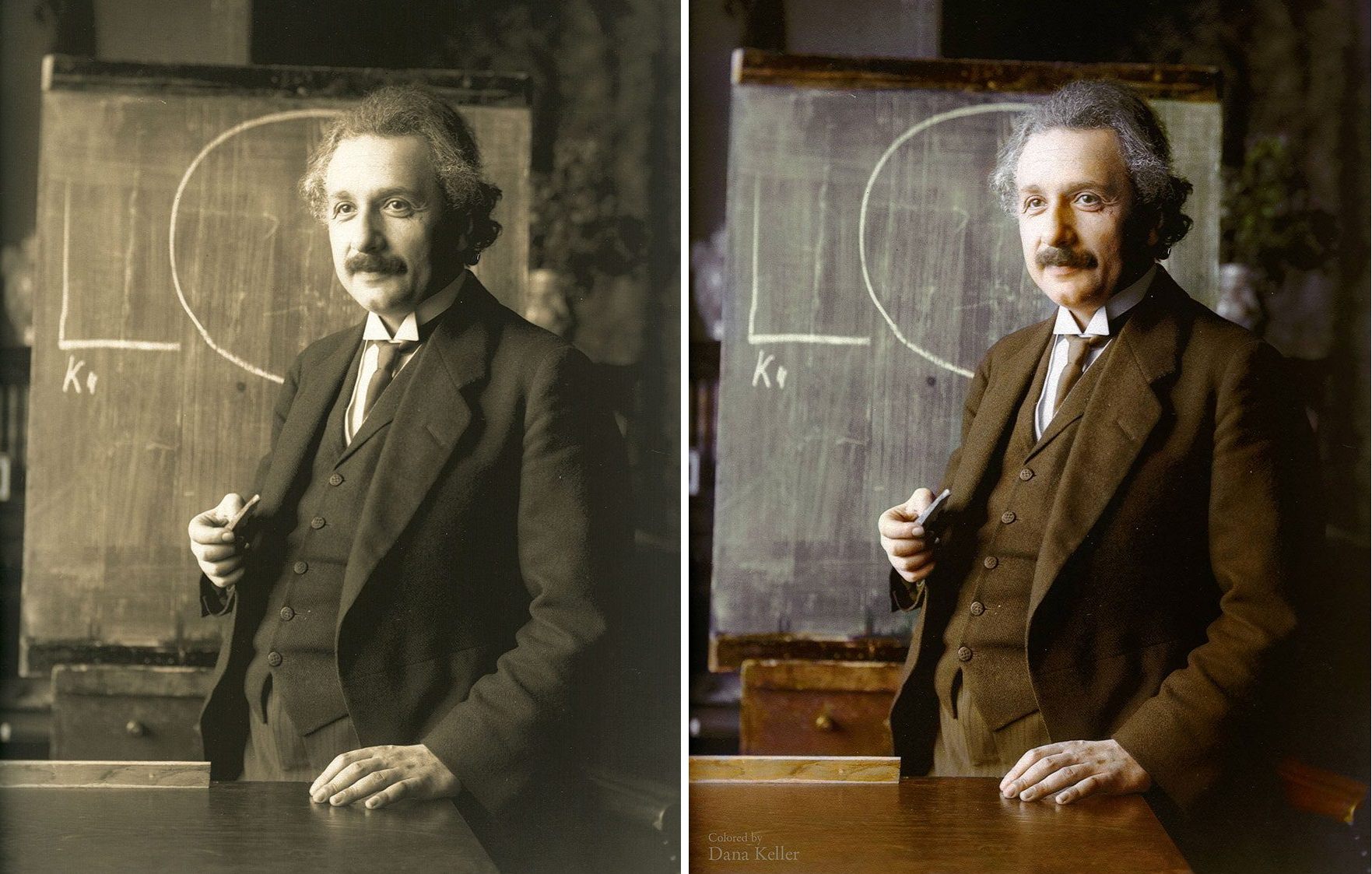
Albert Einstein is one of the most photographed scientists in history, yet his black-and-white images have always carried a sense of remove. Uger’s colorized version changes that. The warm tones of Einstein’s skin and the texture of his clothing make him look less like a textbook icon and more like a person you might pass on the street.


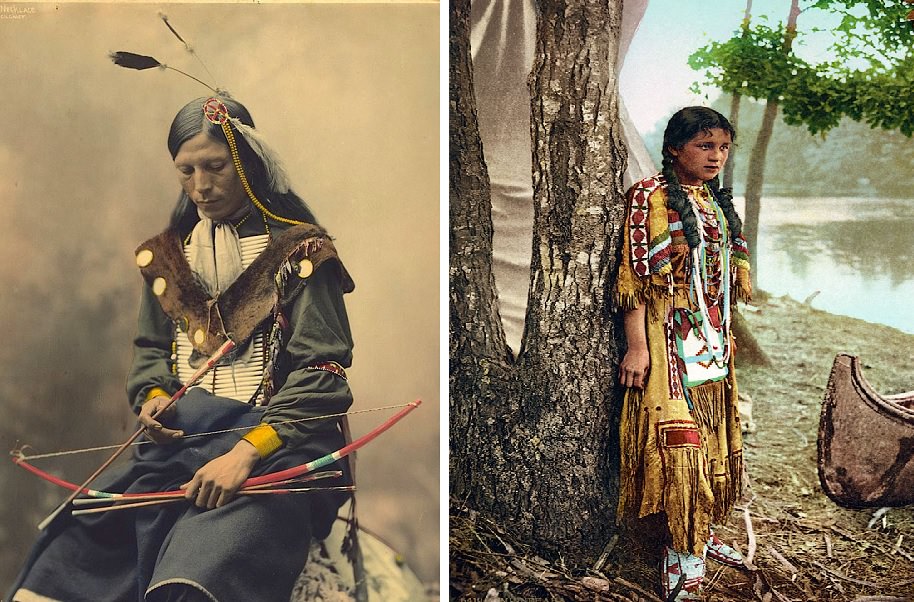
Uger’s project doesn’t focus only on the universally famous. Several portraits feature people who are less widely recognized today, such as Walter Catty Allen from 1900. These lesser-known subjects benefit the most from colorization — without a famous name to anchor them in the imagination, the added color does the heavy lifting of making them feel real.

Maud Wagner, photographed in 1905, was one of America’s first known female tattoo artists. Her heavily tattooed appearance was remarkable for the era, and Uger’s colorization brings out the detail of her tattoos and period clothing in a way that a monochrome image simply cannot.

Grace Kelly appears multiple times throughout Uger’s collection, and it’s easy to see why. Her features translated beautifully into black-and-white photography during her lifetime, and they translate just as well into color. The portraits show different stages and settings of her life, from her acting career to her years as Princess of Monaco.


Classic Hollywood is well represented in the collection. Humphrey Bogart on the set of Casablanca in 1942 looks every bit as composed and sharp as he does in the film itself. Stan Laurel and Oliver Hardy, the comedy duo who defined slapstick for a generation, appear in a 1953 portrait that shows the pair in their later years.


Pablo Picasso and Oscar Wilde were two of the most distinctive personalities of their respective eras. Picasso’s intense gaze and Wilde’s theatrical poise both survive the colorization process intact. If anything, color sharpens the character visible in each man’s face.


Walt Disney in 1931 was still years away from the global entertainment empire he would build. The colorized portrait shows a young man in his late twenties, already deeply focused on his craft. There’s no sign yet of the cultural titan he would become — just a driven young animator with something to prove.

Sophie Scholl was a 21-year-old German student and member of the White Rose resistance movement. She was arrested by the Gestapo in February 1943 for distributing anti-Nazi leaflets at the University of Munich and was executed by guillotine just four days later. Uger’s colorized portrait of her is one of the most quietly powerful in the collection.


Edmund Hillary’s 1953 portrait was taken the same year he and Tenzing Norgay became the first people confirmed to have reached the summit of Mount Everest. The colorized image captures a man at the peak of human achievement, both literally and figuratively.


The collection gives significant space to musicians across different genres and centuries. Tchaikovsky, the Russian composer behind Swan Lake and The Nutcracker, appears in a formal portrait that gains warmth through color. The Andrews Sisters — Patty, Maxene, and LaVerne — were among the best-selling musical acts of the 1940s, and their colorized group portrait radiates the energy they were known for on stage.


Tsar Nicholas II of Russia ruled from 1894 until his forced abdication in 1917. He and his entire family were executed by Bolshevik forces in July 1918. His colorized portrait gives a face to one of history’s most debated monarchs — a man whose decisions contributed directly to the collapse of the Russian Empire.

Mark Twain in 1907 was 72 years old and one of the most recognized writers in the world. His shock of white hair and sharp expression are immediately familiar, and color adds a layer of vitality to a man who spent his final years lecturing, writing, and speaking his mind with characteristic bluntness.


Helen Keller lost both her sight and hearing at 19 months old following an illness. She went on to become the first deaf-blind person to earn a Bachelor of Arts degree and spent decades as a prominent author and political activist. Che Guevara, the Argentine Marxist revolutionary, is one of the most reproduced faces of the 20th century — though usually from a single iconic photograph. Uger’s colorized version adds a different dimension to a face that history has turned into a symbol.


Arthur Conan Doyle, photographed in 1922, created Sherlock Holmes — one of the most enduring fictional characters ever written. The 1962 portrait of Mary Badham and Gregory Peck captures two of the stars of To Kill a Mockingbird, taken the same year the film was released and earned Peck the Academy Award for Best Actor.


Babe Ruth’s 1920 portrait was taken the same year he joined the New York Yankees — the trade that set off decades of dominance for the franchise. His broad face and confident bearing come through clearly in color. Sylvia Sidney and Henry Fonda, photographed together in 1937, were two of Hollywood’s most respected dramatic actors of the era.

Victor Hugo was 74 years old when this portrait was taken in 1876. He had already written Les Misérables and The Hunchback of Notre-Dame, and was in his final decade of life. The colorized version shows an elderly man with a full white beard — still commanding, still present.


Among the more personal entries in the collection are portraits of women photographed in formal settings around the turn of the 20th century. Mrs. F. Colley and Mrs. C.M. Bell, photographed in 1901, are not famous by name, but their colorized portrait carries the same weight as any other in the series. Color restores to ordinary people the same humanity it restores to the celebrated.


Buffalo Bill — William Frederick Cody — was a U.S. Army scout, bison hunter, and showman who became one of the most famous Americans of the late 19th century. His Wild West shows toured across the United States and Europe, drawing enormous crowds. His 1906 portrait in color shows a man in his sixties who had spent a lifetime performing the myth of the American frontier.


The 1933 Laurel and Hardy portrait predates their later appearance in the collection by two decades. At this point, the duo were at the height of their popularity, cranking out short films and features that packed theaters across the country. Their chemistry jumps off the page even in a still image.


Sergei Rachmaninoff, photographed in 1915, was one of the last great composers of the Romantic era. His hands — famously large and technically extraordinary — are not visible in the portrait, but the weight of his musical reputation is somehow present in his expression. Fridtjof Nansen was a Norwegian explorer, scientist, and diplomat who led the first crossing of Greenland on skis in 1888.


Leo Tolstoy in 1897 was nearly 70 and had long since completed both War and Peace and Anna Karenina. His long beard and worn features make him look more like a village elder than a literary giant. Boris Karloff’s 1932 portrait was taken around the time of his breakout role as Frankenstein’s monster — a performance that defined horror cinema for generations.


Marilyn Monroe is one of those rare figures whose image is so well-known that colorization offers less surprise than with most subjects — yet Uger’s rendering still manages to feel fresh. Errol Flynn, the Australian-born Hollywood swashbuckler, appears with the easy confidence that made him one of the biggest stars of the 1930s and 40s.


Henri de Toulouse-Lautrec was a French painter best known for his vivid depictions of Parisian nightlife in Montmartre. The colorized portrait of him is a fitting tribute — an artist who spent his life working in color, finally rendered in it himself. Julie Adams, photographed in 1954, was the actress best known for her role in Creature from the Black Lagoon, released that same year.


Walt Whitman appears twice in the collection — in 1860 and again in 1858. These portraits were taken around the time Leaves of Grass was already in circulation, giving a face to the poet who fundamentally changed American literature. The colorized versions reveal a younger Whitman than the bearded elder most people associate with his name.


Kaiser Wilhelm II was the German Emperor whose militarism and diplomatic failures contributed significantly to the outbreak of World War I. His colorized portrait shows him in full military dress, projecting the imperial authority that defined — and ultimately destroyed — his reign. Mickey Rooney in the 1930s was one of the highest-paid entertainers in Hollywood, a teenage star whose energy seemed to know no limits.


Gioacchino Rossini, photographed in 1856, was one of the most celebrated opera composers of the 19th century. Best known for The Barber of Seville and William Tell, he had been largely retired for decades by the time this portrait was taken, yet remained a beloved figure in European musical circles.

Crown Prince Rudolf of Austria was found dead at his hunting lodge at Mayerling in January 1889 — the same year as this portrait. He died in what is widely accepted as a murder-suicide alongside his companion, Baroness Mary Vetsera. The event shook the Habsburg Empire and remains one of the most discussed royal tragedies of the 19th century.


Tom Morris — known as Old Tom Morris — was a Scottish golfer and course designer who won the Open Championship four times between 1861 and 1867. His 1867 portrait, taken in the same year as his final Open win, shows a man who helped define the sport of golf. Franz Liszt, photographed in 1886 just months before his death, was one of the greatest piano virtuosos in history.


Marlon Brando in 1953 was already reshaping what screen acting could look like, fresh off his Academy Award nomination for A Streetcar Named Desire. Louis Pasteur, photographed in 1890, had by then already developed the germ theory of disease and created vaccines for chicken cholera, anthrax, and rabies. The two men share little in common beyond the era — and yet both portraits carry the unmistakable mark of someone who changed their field forever.


Jascha Heifetz, photographed in 1920 when he was just 19 years old, was already considered one of the finest violinists alive. He had debuted at Carnegie Hall three years earlier at age 16. June Allyson, photographed in 1940 at the start of her career, would go on to become one of MGM’s most popular stars throughout the 1940s and 50s.


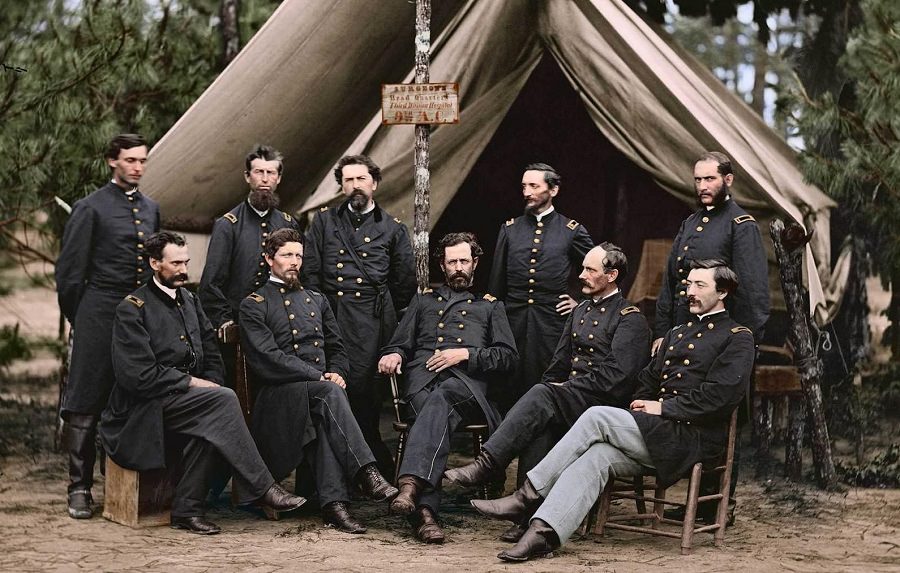
The 1863 portrait labeled as Henry Ford is notable — Ford was born in 1863, making this almost certainly not him as an adult. Whatever the correct identification, the portrait is a compelling piece of mid-19th-century American photography. John L. Burns, also from 1863, was a civilian from Gettysburg, Pennsylvania, who took up a rifle and fought alongside Union soldiers during the Battle of Gettysburg at the age of 70.


Charles Baudelaire in 1853 was 32 years old and still years away from publishing Les Fleurs du Mal, the poetry collection that would define his legacy and get him prosecuted for obscenity. Enrico Caruso, photographed in 1910 at the height of his fame, was the most celebrated operatic tenor of his generation.


Mercer Washington, photographed in 1896, and Admiral David Dixon Porter, photographed in 1860, represent two of the more historically specific figures in the collection. Porter was a decorated U.S. Navy officer who served in both the Mexican-American War and the Civil War, eventually rising to the rank of Admiral of the Navy.


Woodrow Wilson served as the 28th President of the United States from 1913 to 1921 and led the country through World War I. His colorized portrait strips away the formal distance that sepia-toned official photography tends to create, showing a face familiar enough to feel like recent history rather than a distant past.


Martin Van Buren’s 1837 portrait is one of the oldest in the collection. He was photographed the same year he took office as the 8th President of the United States — an early piece of American photographic history that Uger has now rendered in full color. Ed Walsh, photographed in 1911, was one of the dominant pitchers in Major League Baseball during the deadball era.

Grigori Rasputin, photographed in 1910, was already embedded in the Russian imperial court by this point, serving as a spiritual advisor to the Romanov family. His influence over Tsarina Alexandra — particularly regarding the treatment of her hemophiliac son — made him one of the most controversial figures in late tsarist Russia. He was murdered in December 1916 by a group of Russian noblemen.


Gustav Mahler was one of the most important composers and conductors of the late Romantic period. His colorized portrait carries the intensity his music is known for. Evelyn Nesbit, photographed in 1900, was a chorus girl and artist’s model whose involvement in the 1906 murder of architect Stanford White by her husband Harry Thaw became one of the most sensational trials of the early 20th century.

Greta Garbo appears twice to close out the collection, and it’s a fitting choice. The Swedish-born actress was one of the most photographed women of her era, yet she famously avoided public life. Her features — high cheekbones, deep-set eyes, an expression that always suggested something kept private — respond exceptionally well to colorization. The portraits feel less like archival images and more like photographs taken last week.

Uger’s full portfolio, including additional colorized works, can be found at units.at, on Instagram, and on Facebook. The project is ongoing, and each new addition brings another face from history a little closer to the present.