
Cincinnati, Ohio, has one of the longest and richest urban histories in the American Midwest. Settled in 1788 along the northern bank of the Ohio River, it was incorporated as a town in 1809 and officially granted city status in 1819. By the close of the 19th century, it had grown into one of the most dynamic cities in the United States — a hub of industry, commerce, politics, and culture.
The city’s major industries included iron production, meatpacking, cloth manufacturing, and woodworking. Before Prohibition ended the trade, Cincinnati also operated the largest brewing industry in the entire country. These economic engines drew workers and immigrants from across the country and Europe, steadily swelling the city’s population and funding ambitious civic projects.
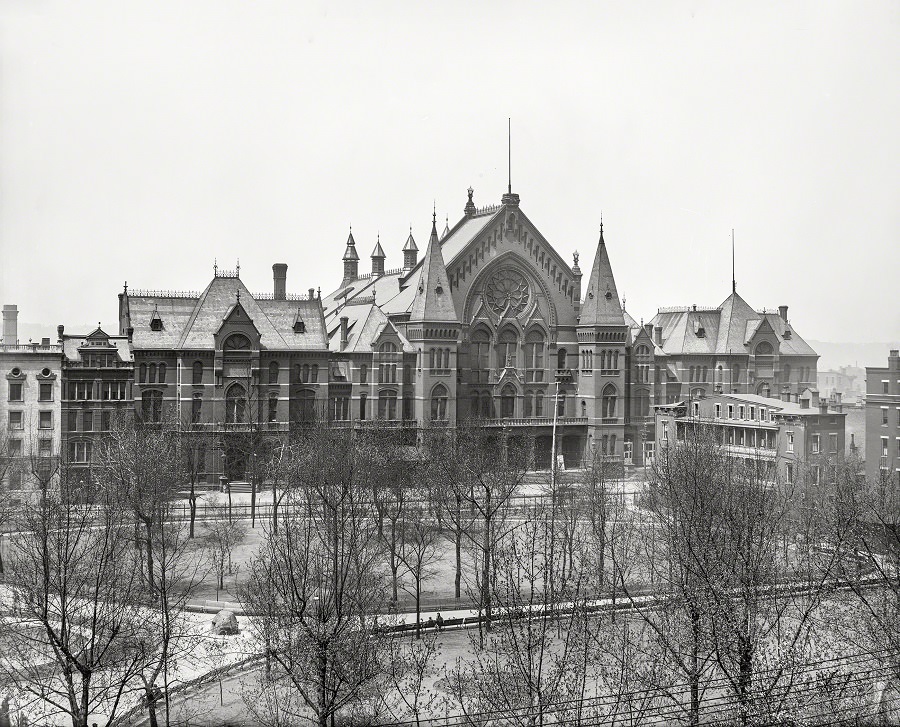
One of Cincinnati’s most celebrated landmarks stood at the heart of the city’s cultural life. Cincinnati Music Hall on Elm Street, completed in 1878, towered over Washington Park with its grand Victorian Gothic architecture. By 1906, the surrounding neighborhood reflected the city’s prosperity — well-maintained streets, electric streetcars, and well-dressed pedestrians going about their daily lives.
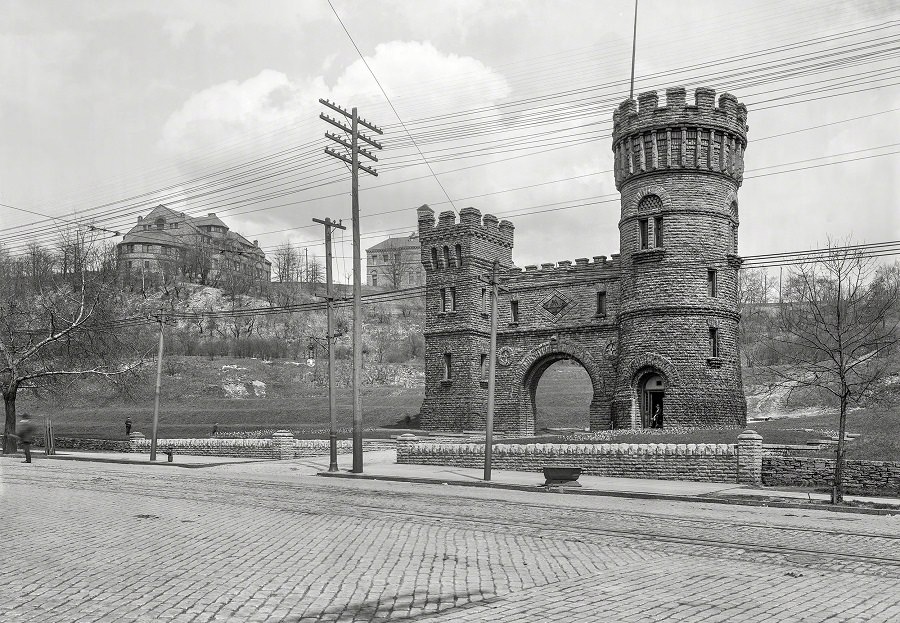
Eden Park, perched on a hillside east of downtown, served as one of Cincinnati’s finest public green spaces. Established in the 1860s on land once belonging to Nicholas Longworth, the park offered residents a place of leisure and natural beauty. Among its notable features was the Elsinore Tower, a castellated stone gatehouse that gave the park’s main entrance a striking medieval character.
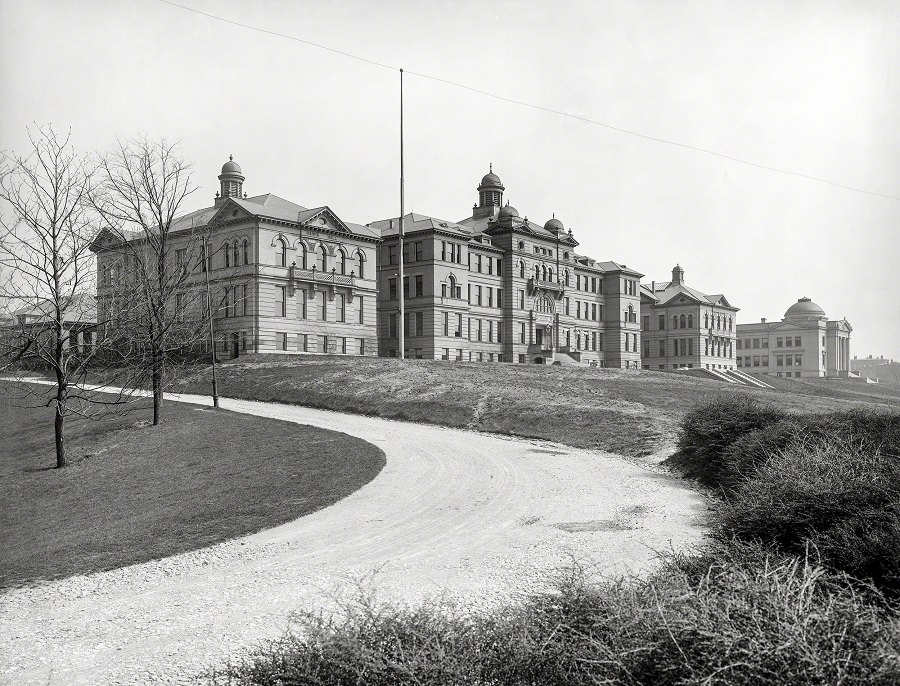
Higher education was expanding rapidly in the city during these years. The University of Cincinnati, one of the oldest municipal universities in the United States, was growing its campus and academic programs at the turn of the century. By 1904, its buildings reflected the institutional ambitions of a city determined to invest in its intellectual future.
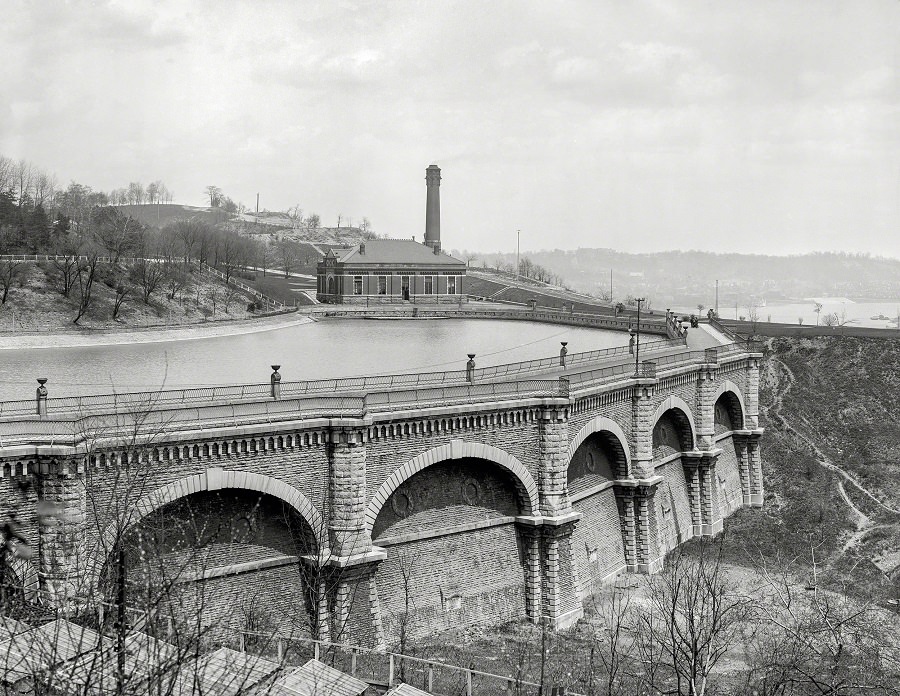
Eden Park also housed critical municipal infrastructure. The reservoir and pumping station located within the park’s grounds supplied clean water to the growing city. These facilities were not hidden away — they were built with architectural care, reflecting the era’s belief that even utilitarian structures deserved dignified design.
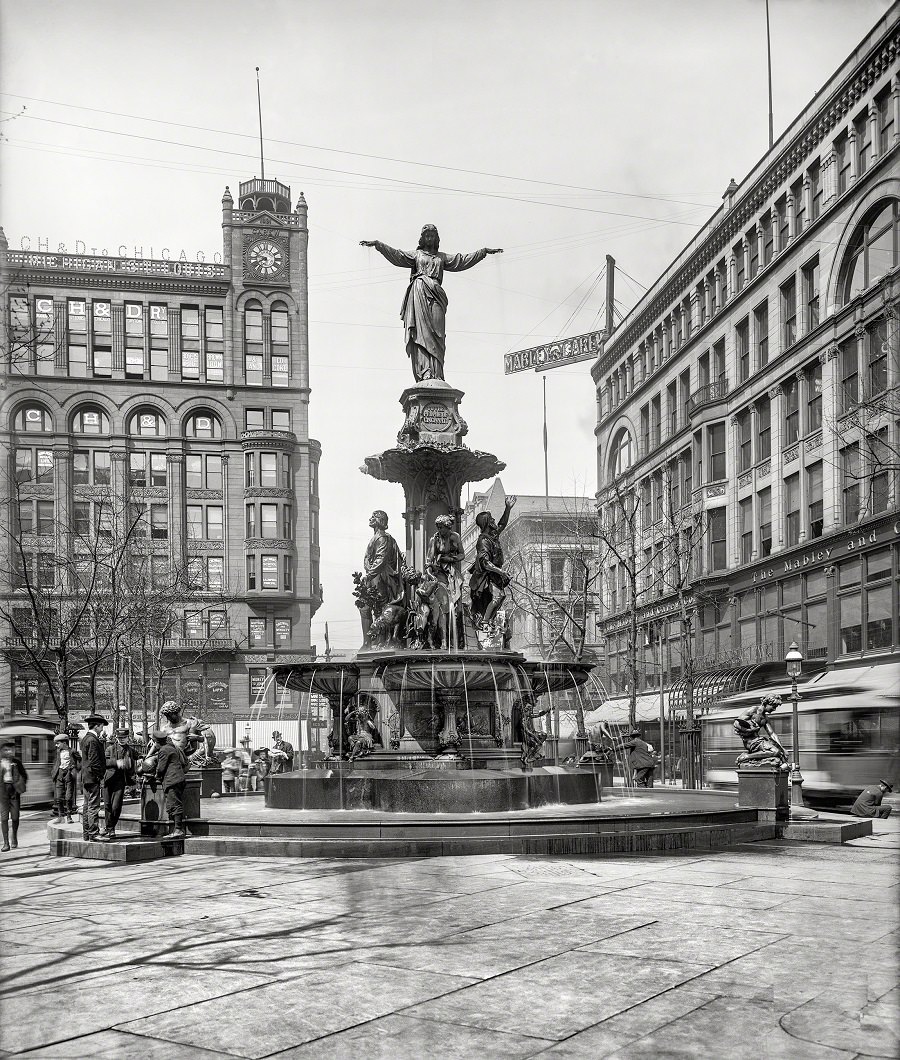
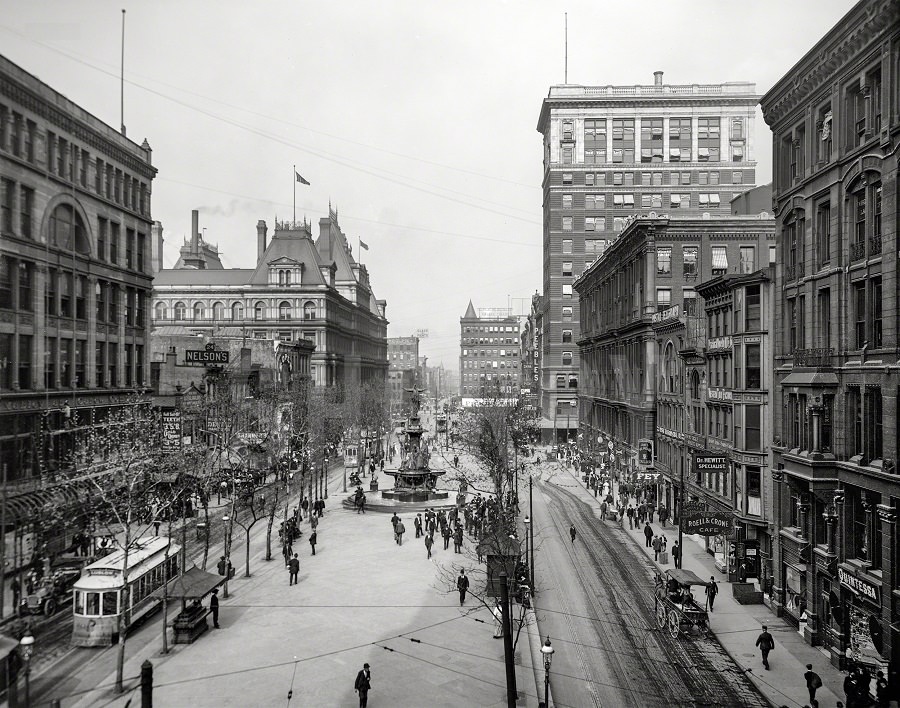
At the geographic and symbolic center of downtown Cincinnati stood the Tyler Davidson Fountain, a beloved public monument. Cast in bronze and unveiled in 1871, the fountain was a gift to the city from businessman Henry Probasco in memory of his business partner. It depicted a large central figure with arms outstretched, water flowing from her hands and from the figures below — a gathering point for citizens and a marker of the city’s civic pride.
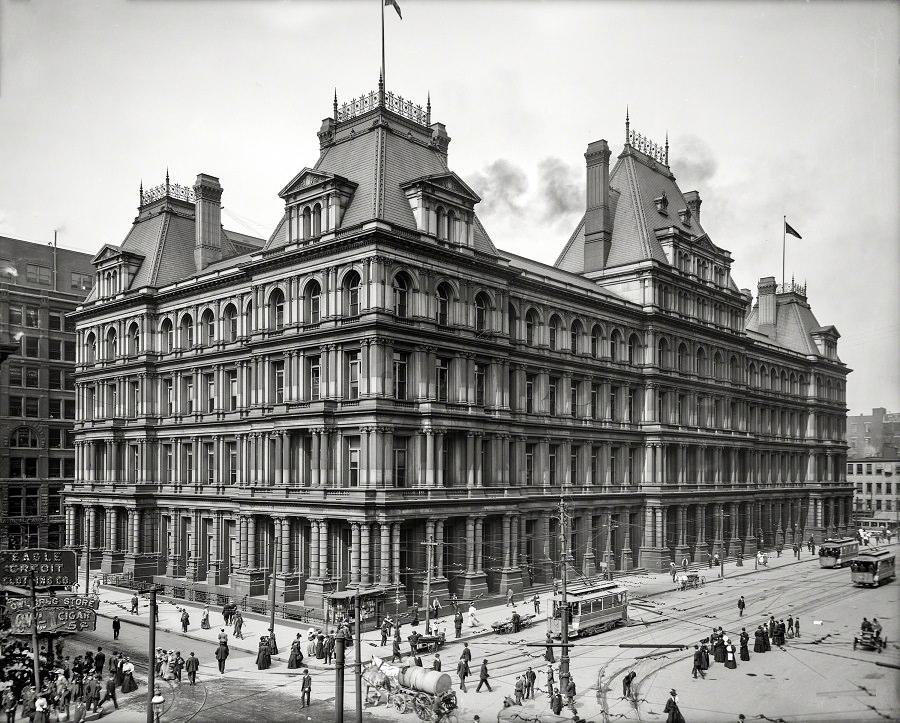
Federal government presence in Cincinnati was anchored by the imposing Federal Building on Fifth Street, which combined the functions of a custom house and post office. Completed in 1885, the building was a statement of federal authority and architectural ambition, constructed in the Richardsonian Romanesque style with heavy stonework and arched windows.
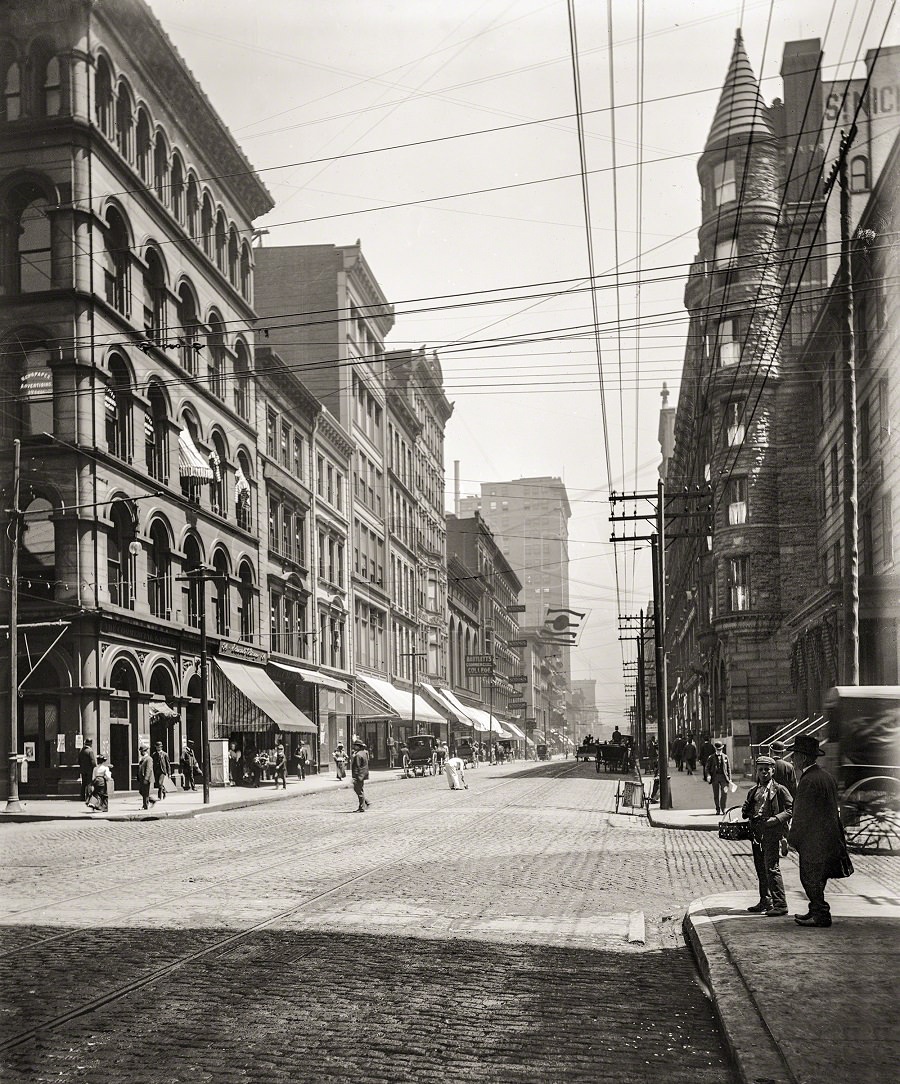
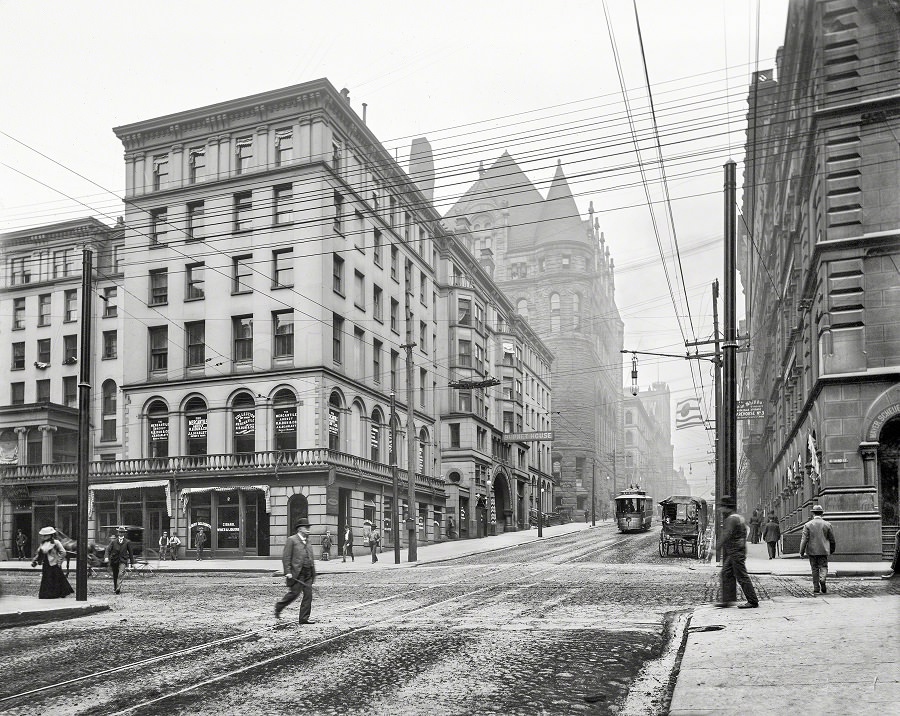
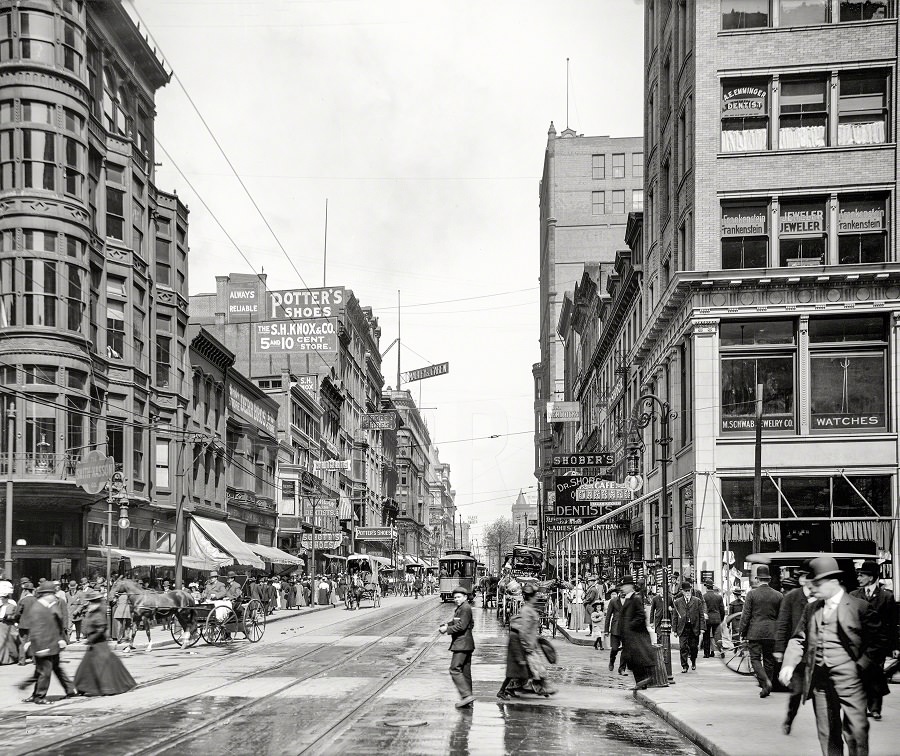
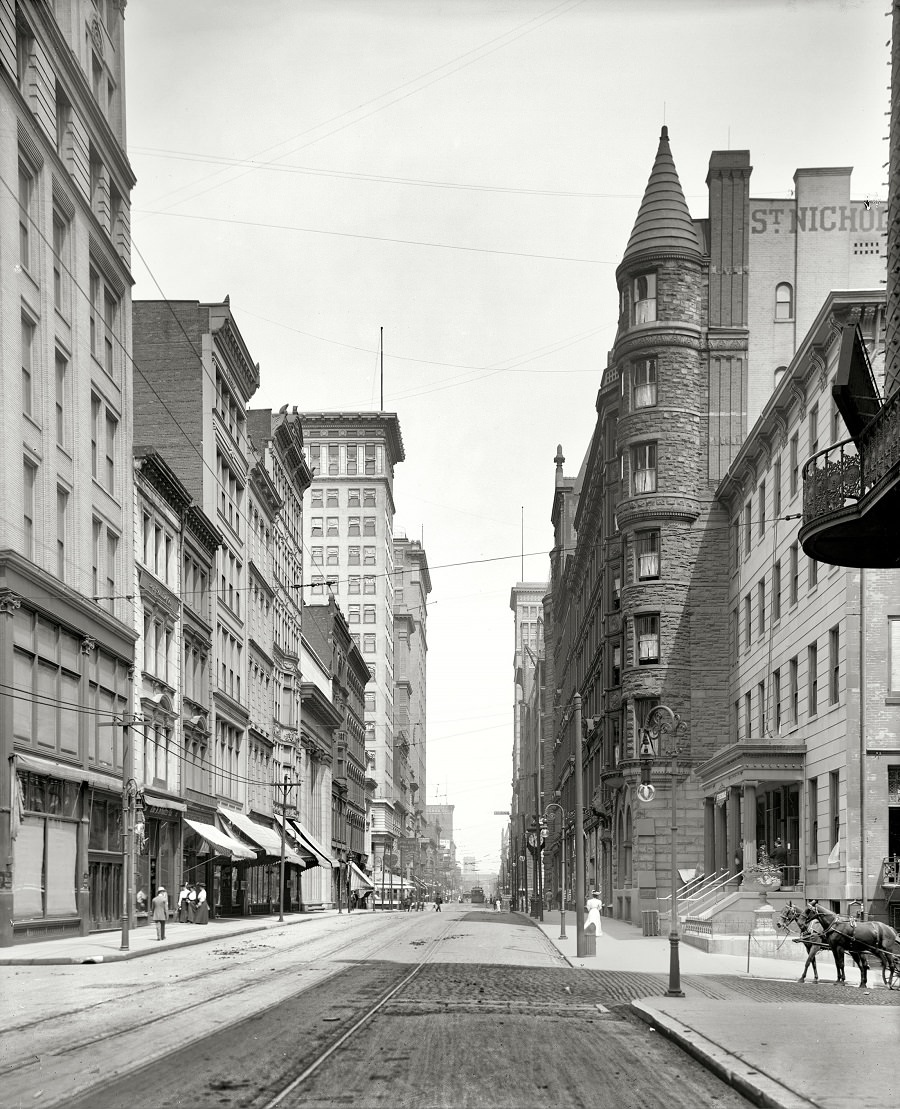
The downtown street grid was bustling and densely built by 1900. Fourth Street was one of Cincinnati’s principal commercial corridors, lined with multi-story buildings, storefronts, and the tracks of the city’s streetcar system. Looking east from Race Street, the street showed a city already fully modernized — electric wires overhead, iron-fronted buildings, and steady foot and carriage traffic.
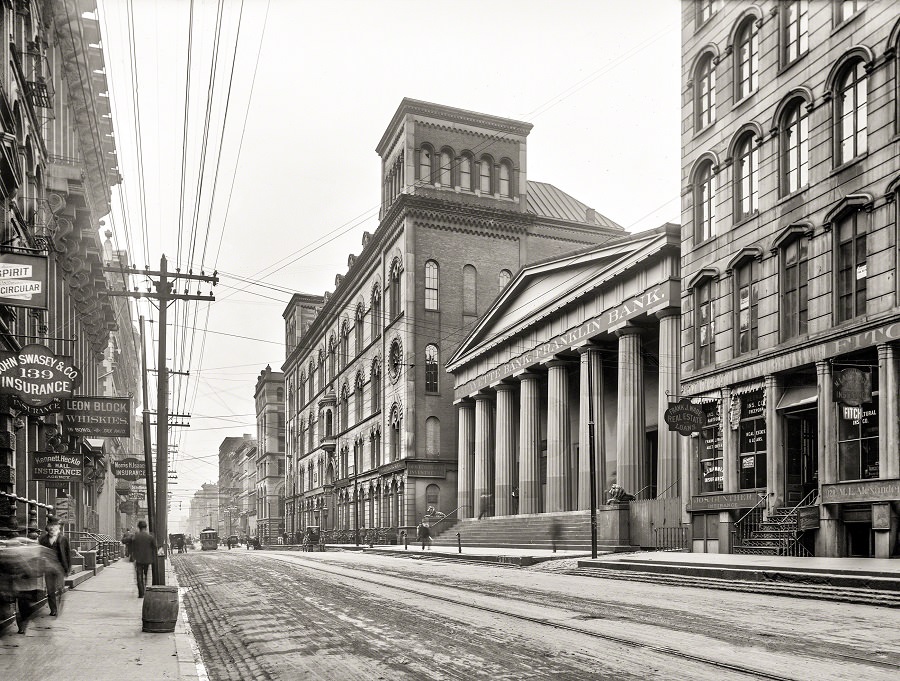
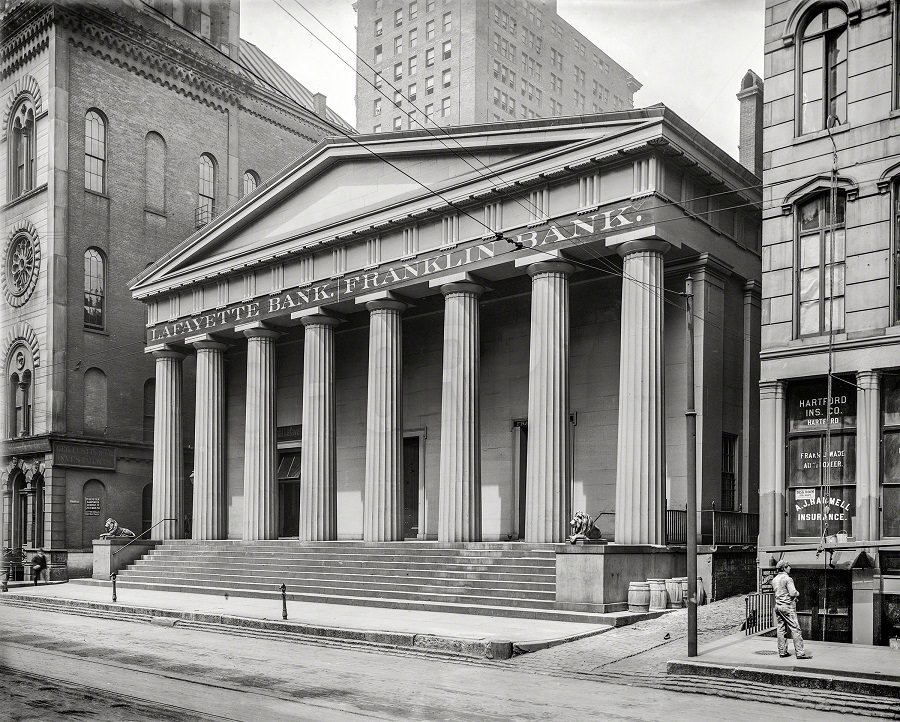
Third Street held some of Cincinnati’s most important financial institutions. The Lafayette and Franklin Banks shared the block with the Masonic Temple, creating a corridor of institutional power. These were not modest structures — they were built to project stability and wealth, with stone facades and ornate detailing that communicated permanence to depositors and business partners alike.
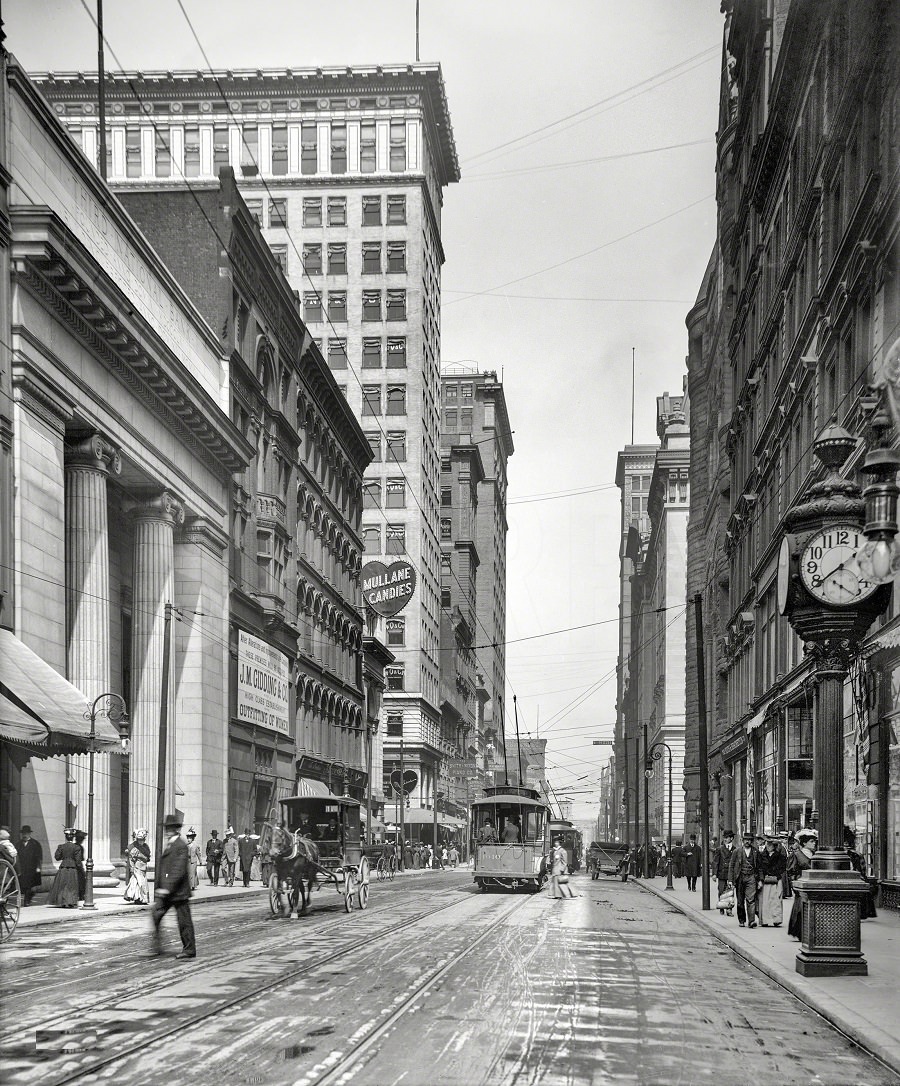
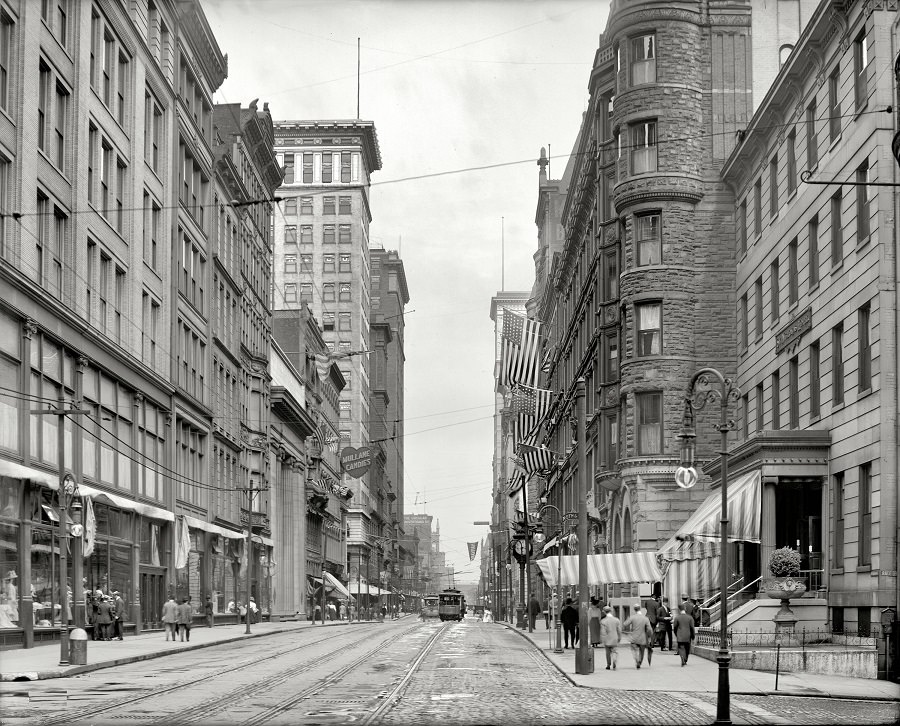
By 1907, Fourth Street west from Main showed a street fully adapted to the electric age. Streetcar lines ran down the center of the road, overhead wires formed a web above the pavement, and the buildings that lined the sidewalks had grown taller with each passing decade. The street was a working artery of commerce and transit.
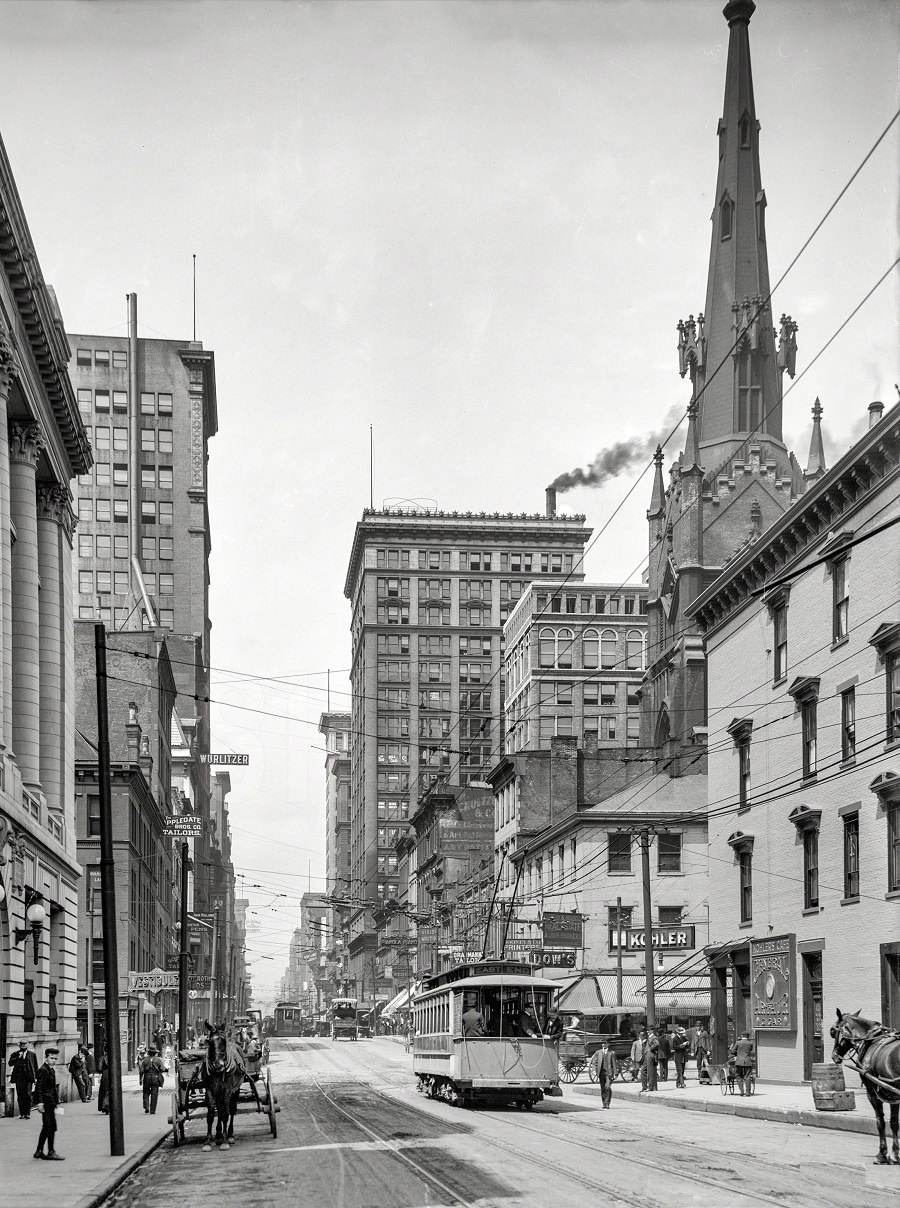
Two of Cincinnati’s most prominent downtown institutions stood side by side — the Burnet House hotel and the Chamber of Commerce building. The Burnet House had been one of the finest hotels in America since its opening in 1850. It had hosted presidents and generals, including Abraham Lincoln. By 1900, both buildings remained anchors of Cincinnati’s commercial and civic identity.
The Lafayette and Franklin Banks on Third Street appeared again in photographs taken around 1905, showing little change from earlier in the decade. The financial district remained stable even as other parts of the city were being rebuilt and expanded. These institutions were among the most trusted in the region.
The hillside neighborhood of Mount Adams offered dramatic views across the Ohio River toward Covington, Kentucky. Photographed from the Kentucky side in 1905, the Cincinnati hillside showed densely packed residential buildings climbing the steep slope, with church spires and institutional rooftops visible above the treeline. The Ohio River separated two states but connected two communities that depended on each other economically.
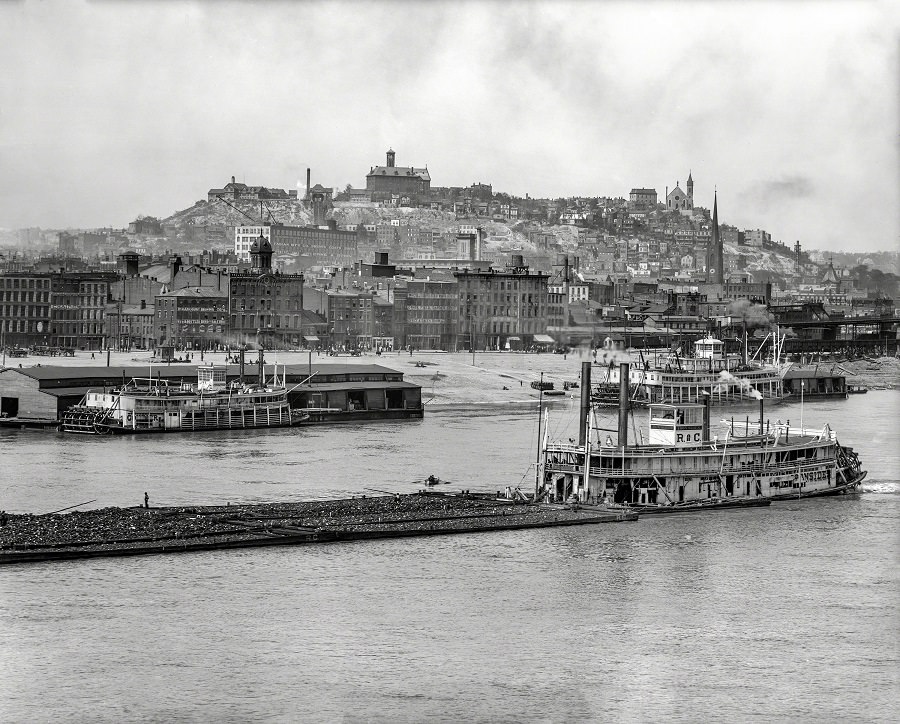
Fort Thomas, just across the river in Kentucky, was a U.S. Army post established in 1887. Though technically outside Cincinnati’s city limits, it was closely tied to the metropolitan area and appeared frequently in local photography of the era. The fort sat on a commanding hilltop and housed a permanent garrison of soldiers.
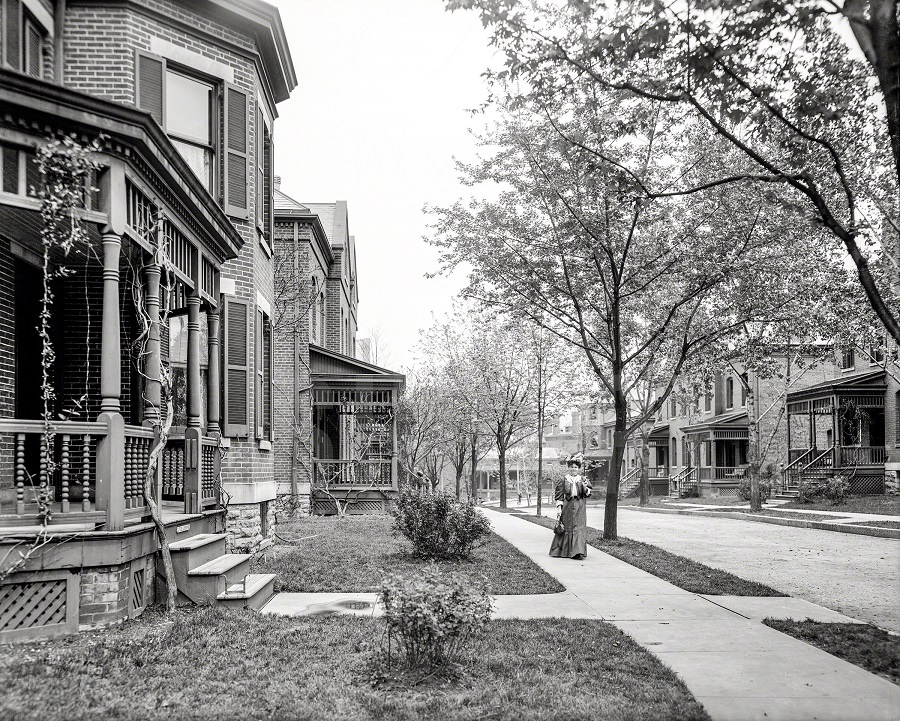
Fifth Street north from Race was another busy commercial block, photographed around 1907 when the streetcar network was at its peak. Shoppers, workers, and vendors shared the sidewalks while cars and horse-drawn vehicles still competed for space on the road. The city was in full transition between horse power and motor power during these years.
Fountain Square, anchored by the Tyler Davidson Fountain, was the social heart of downtown Cincinnati. By 1907 the square was surrounded by tall commercial buildings and served as a meeting point, a transit hub, and a public gathering space. The fountain remained the most recognized landmark in the city.
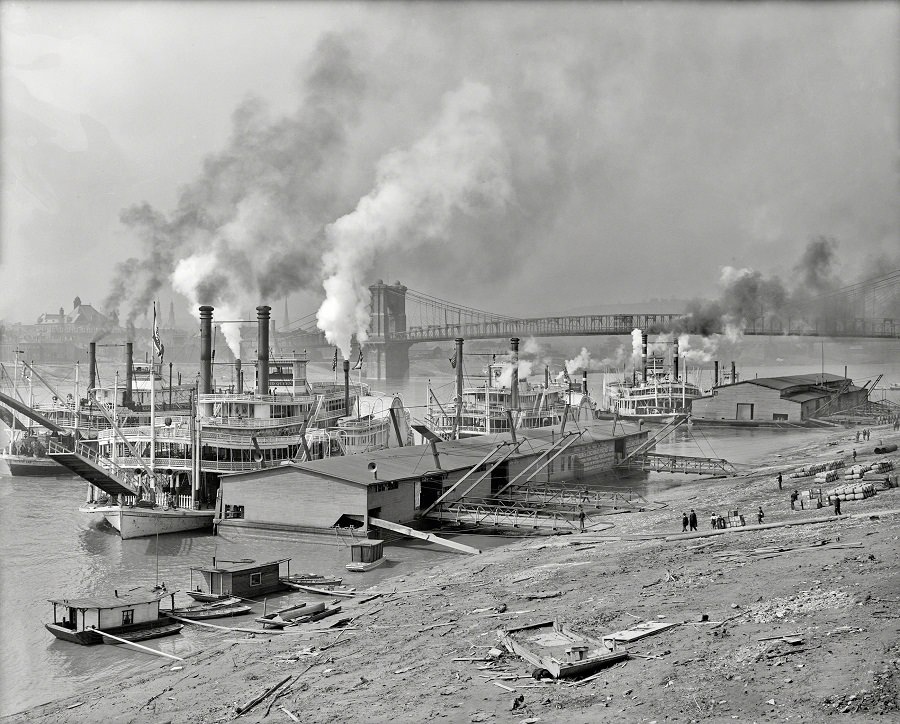
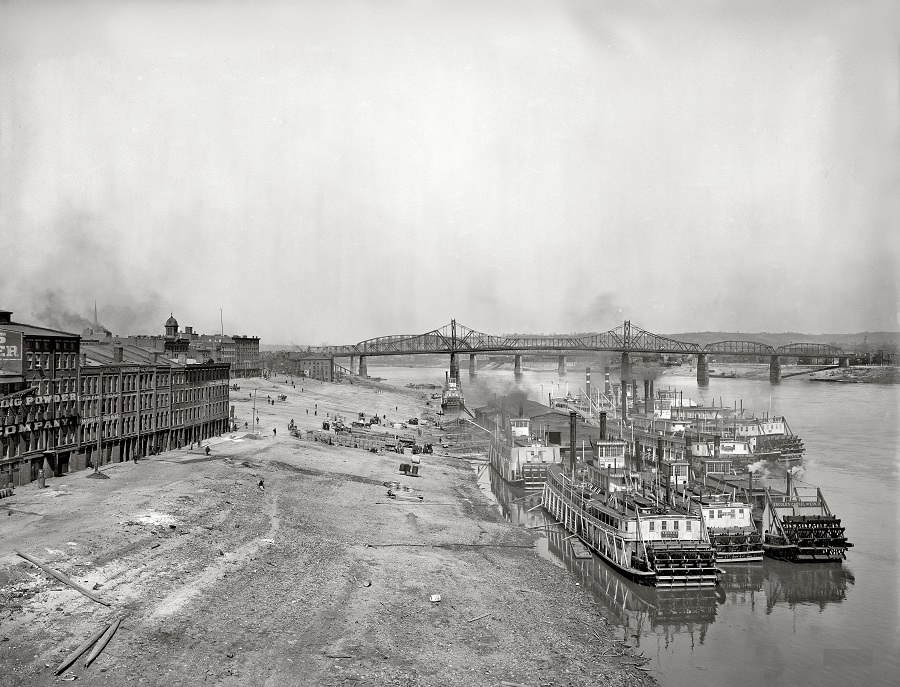
The Ohio River was not just a geographic boundary — it was Cincinnati’s economic lifeline. Steamboat traffic moved goods and passengers along the river continuously, connecting the city to markets up and down the Mississippi system. Photographs from around 1907 captured the river’s busy character, with boats of various sizes working the current and the docks crowded with cargo.
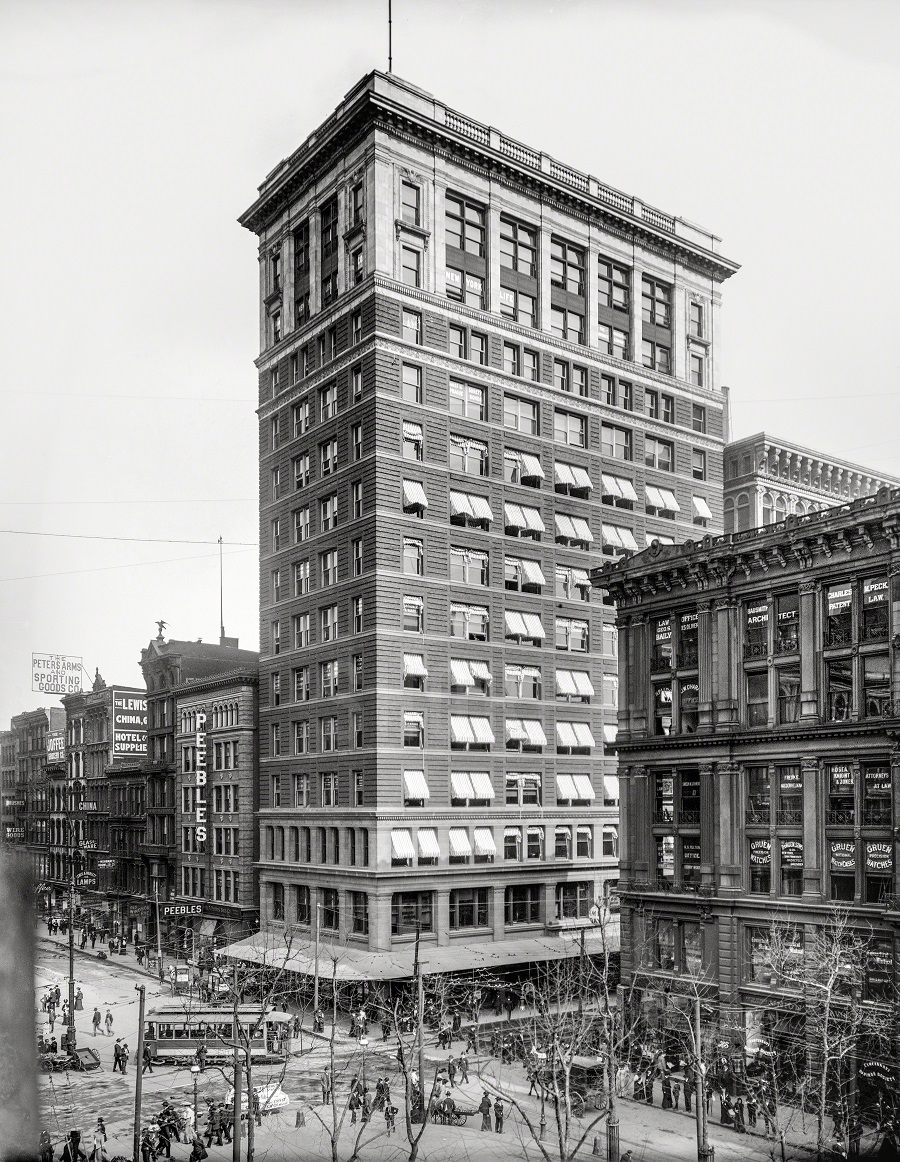
The Traction Building at Walnut and Fifth was one of Cincinnati’s early skyscrapers, completed in 1903. Its construction was a milestone — it became the world’s first reinforced concrete skyscraper, a structural innovation that proved the viability of a building technique that would transform cities worldwide. The building stood as direct evidence of Cincinnati’s place at the forefront of American construction technology.
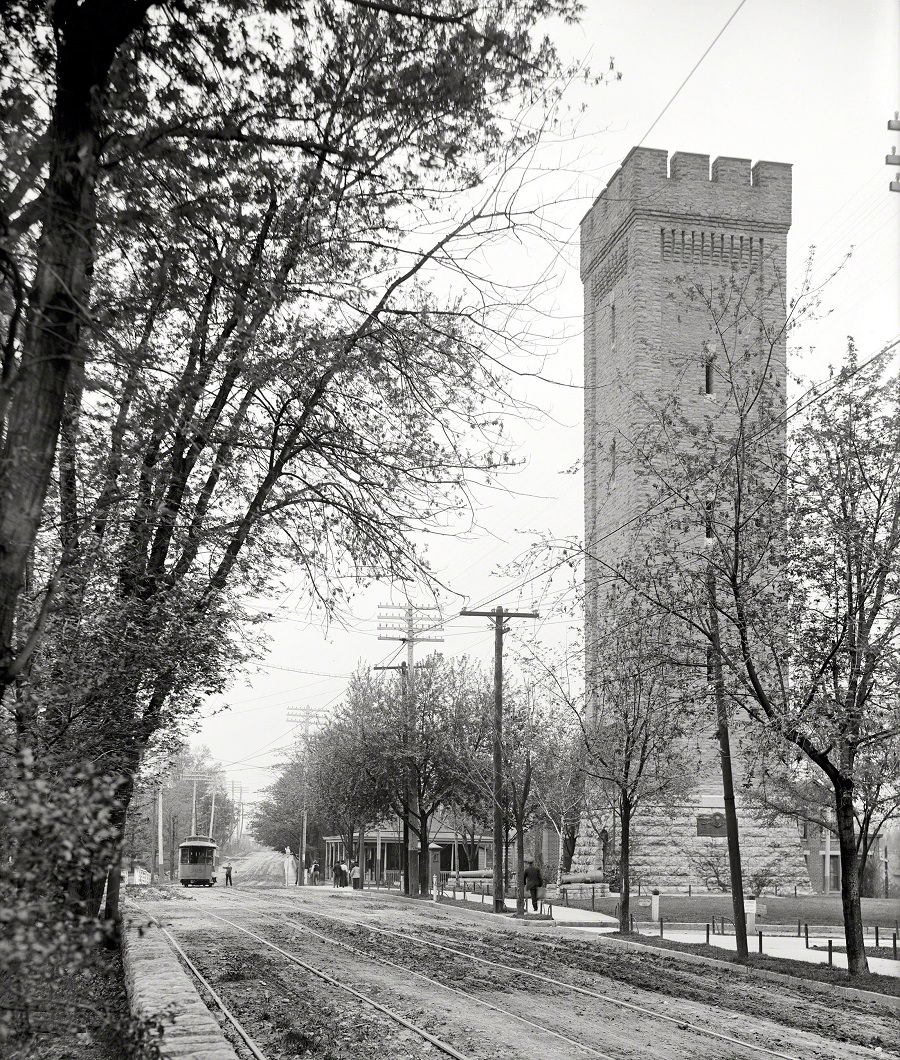
Back at Fort Thomas, the water tower was one of the most visually distinctive structures on the post. Rising above the surrounding buildings, it supplied water to the garrison and became a recognizable silhouette in photographs of the area taken around 1907.
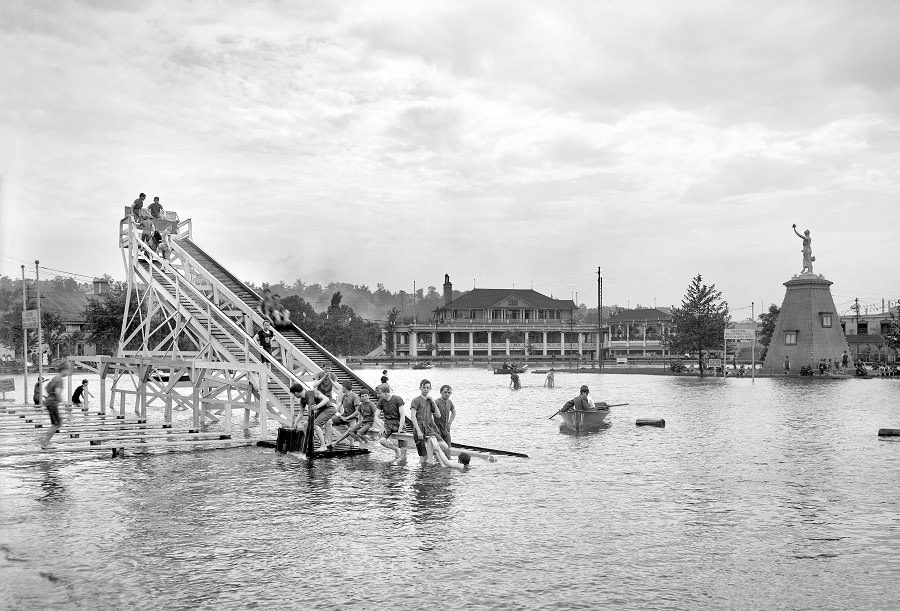
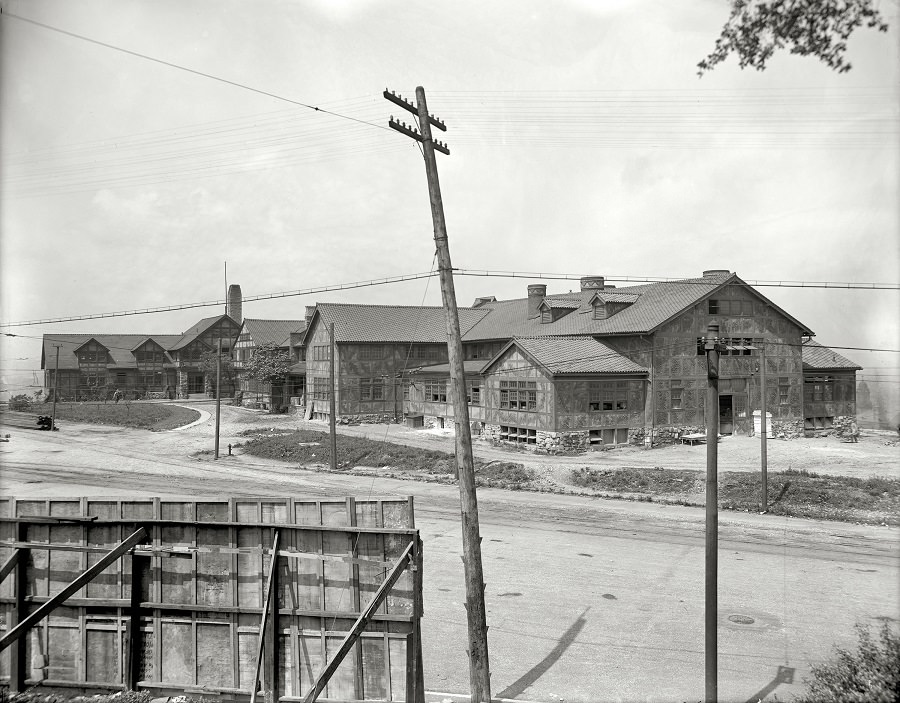
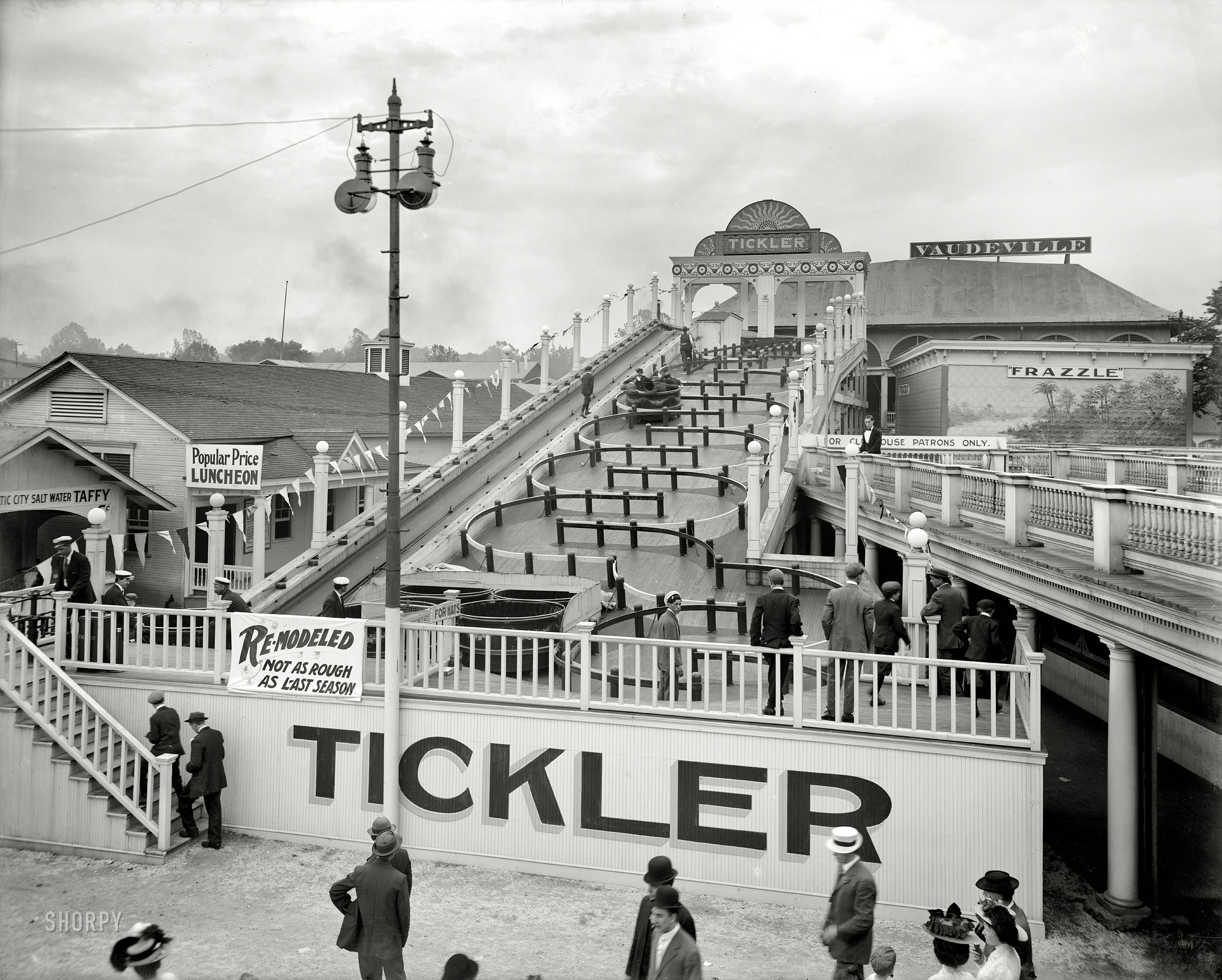
Chester Park was one of Cincinnati’s most popular amusement destinations in the early 1900s. Located in the Norwood area just northeast of the city center, the park offered rides, gardens, a lake, a clubhouse, and various attractions. It drew large crowds from across the metropolitan area and reflected the era’s enthusiasm for organized leisure.
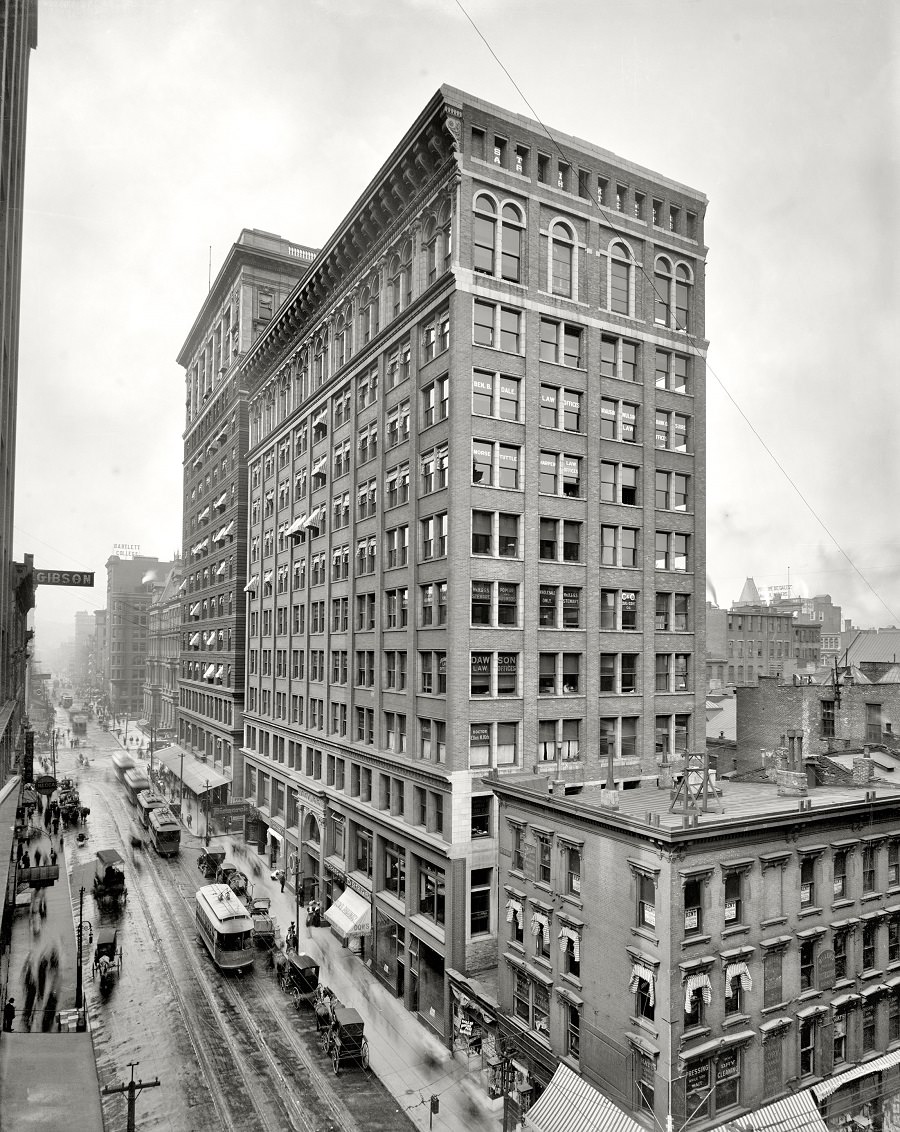
By 1910, Fourth Street had evolved further. Automobiles were becoming more common on streets that had been designed for horses and streetcars. The architecture along the corridor continued to grow upward, with newer, taller buildings replacing older low-rise commercial structures. These photographs record a city in the middle of physical transformation.
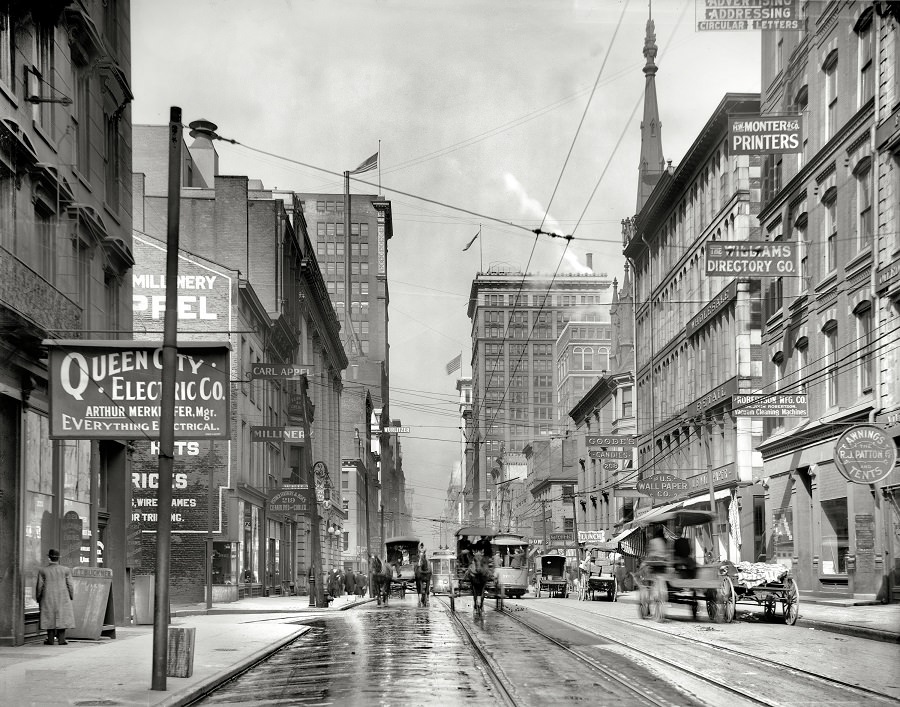
The Ohio River remained a constant in Cincinnati’s story throughout this decade. Captured again around 1906, photographs show the river’s wide, slow-moving current and the industrial activity that lined both banks. Ferries, steamboats, and barges shared the water, and the bridges that spanned it were among the engineering achievements of the previous generation.
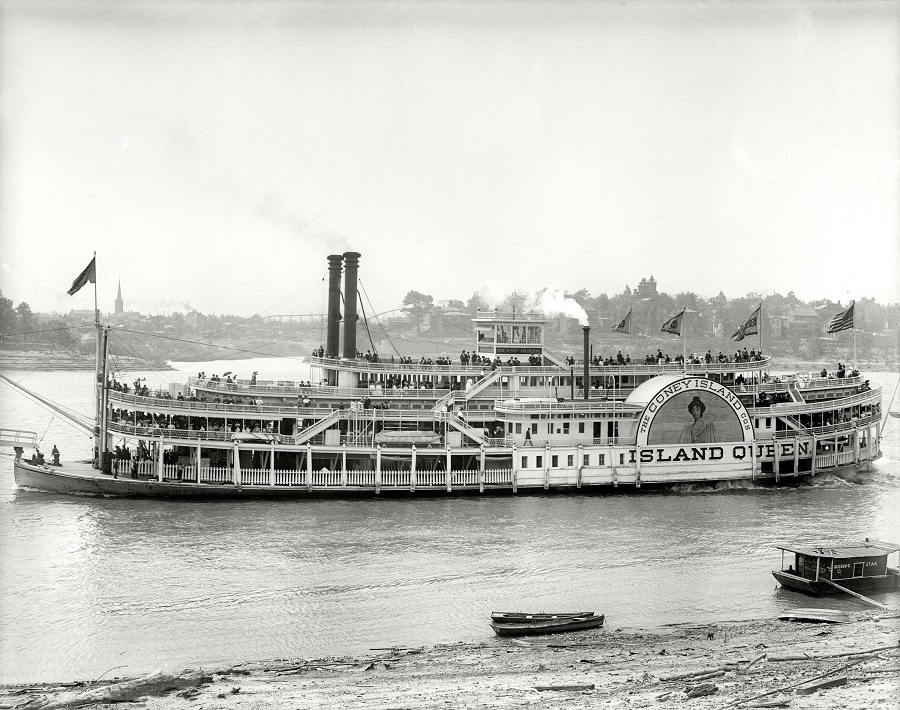
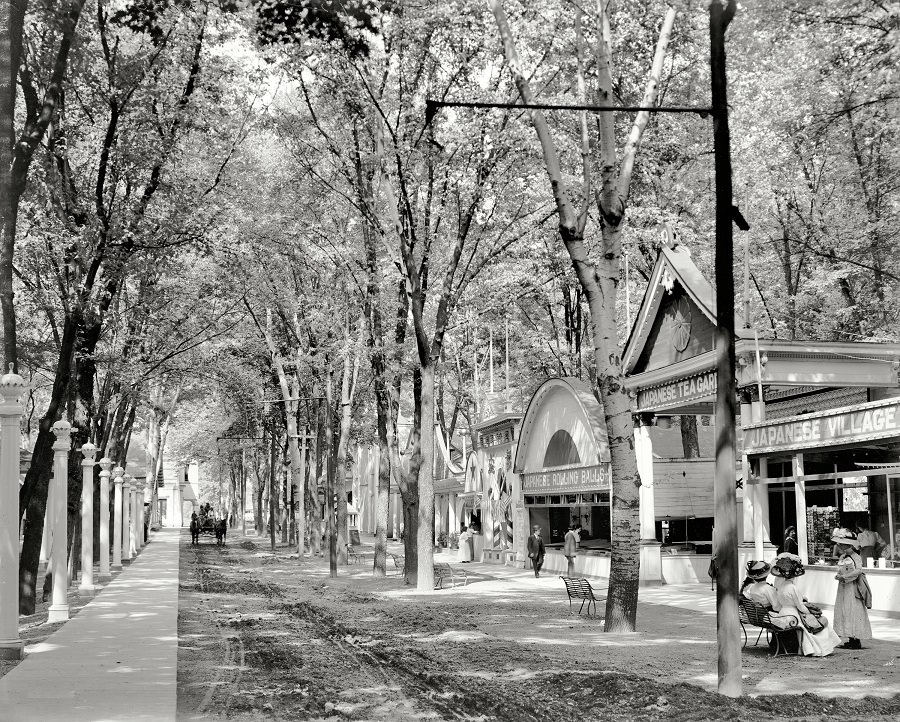
Coney Island on the Ohio River east of the city was Cincinnati’s most famous amusement park. Established in 1886, it offered a midway with games, rides, food stalls, and entertainment acts. Photographs from around 1910 show the midway packed with visitors, the kind of crowd that turned summer afternoons at Coney Island into a defining Cincinnati experience.
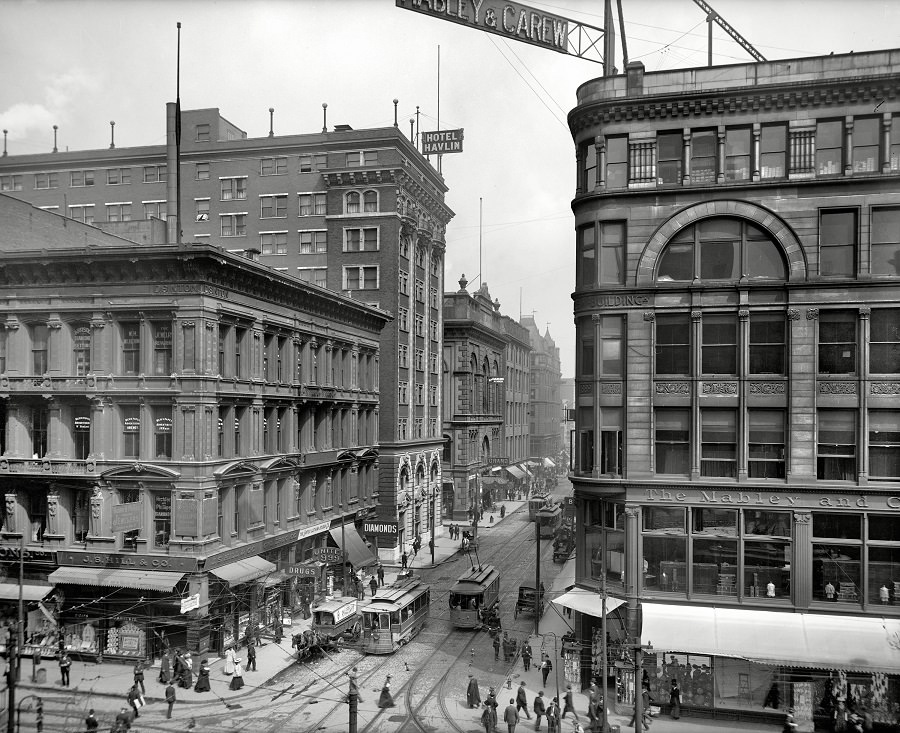
Vine Street at Fifth was one of the busiest intersections in downtown Cincinnati. By 1907 it was lined with tall commercial buildings, and the streetcar tracks running through the intersection handled a constant flow of passengers moving through the city’s core. Signs advertised theaters, hotels, and retailers in the crowded visual landscape of the street.
The Mercantile Library Building on Walnut Street was home to one of the oldest and most respected libraries in the American Midwest. Founded in 1835, the Mercantile Library served the city’s merchant and professional classes, maintaining a large collection of books, periodicals, and reading rooms. By 1910, the building remained an important cultural institution in the city.
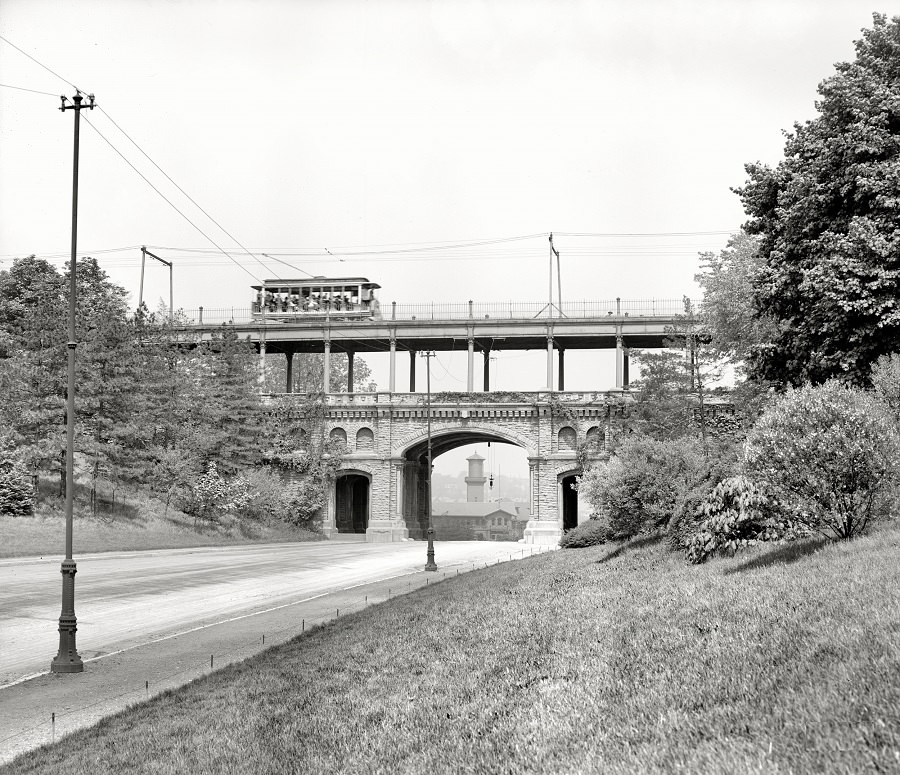
The main entrance to Eden Park was a formal stone gateway that welcomed visitors into the hillside green space overlooking the river. Around 1906, the entrance was flanked by ornamental plantings and iron gates, marking the transition from the urban street grid into one of the city’s most treasured public landscapes.
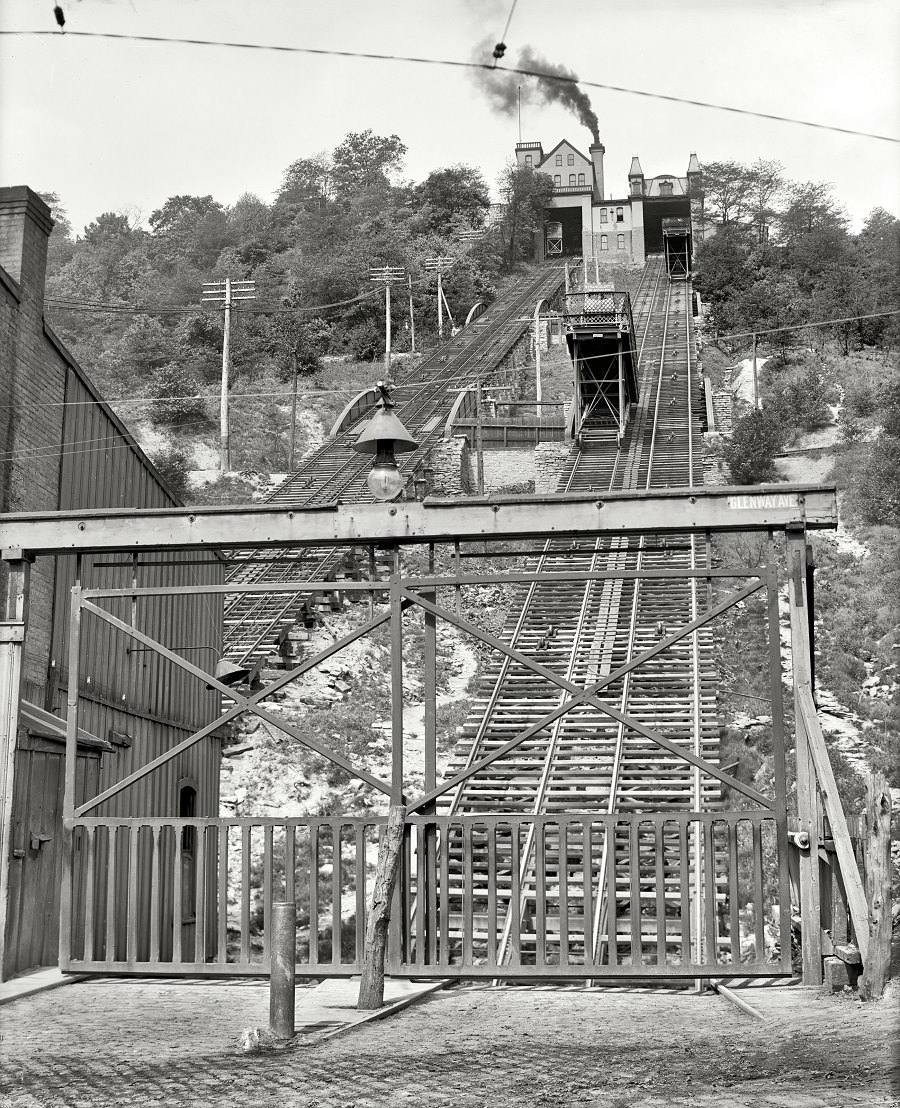
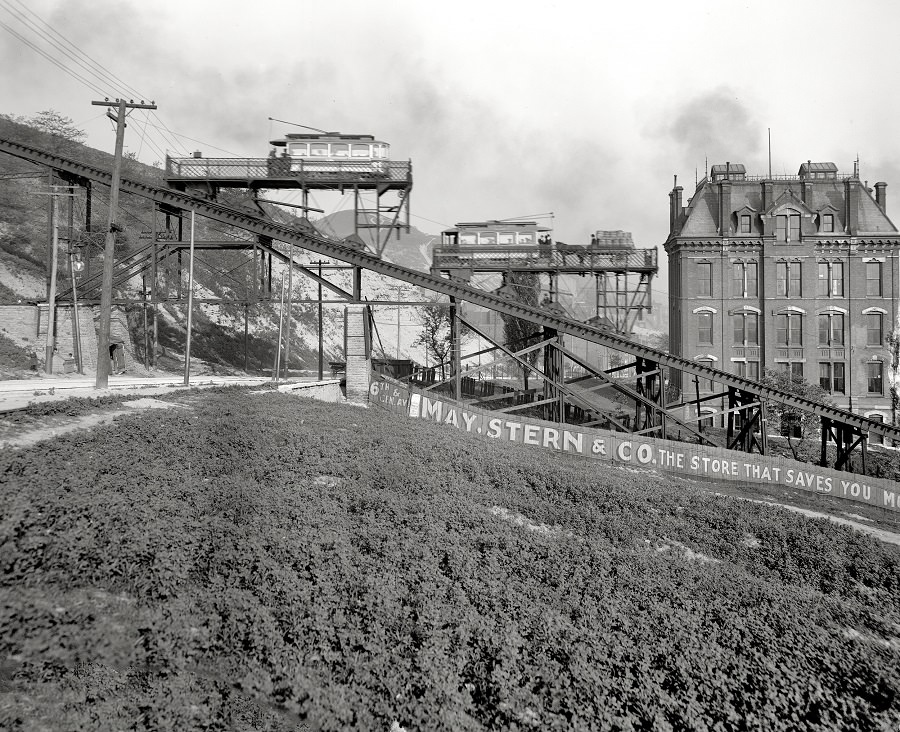
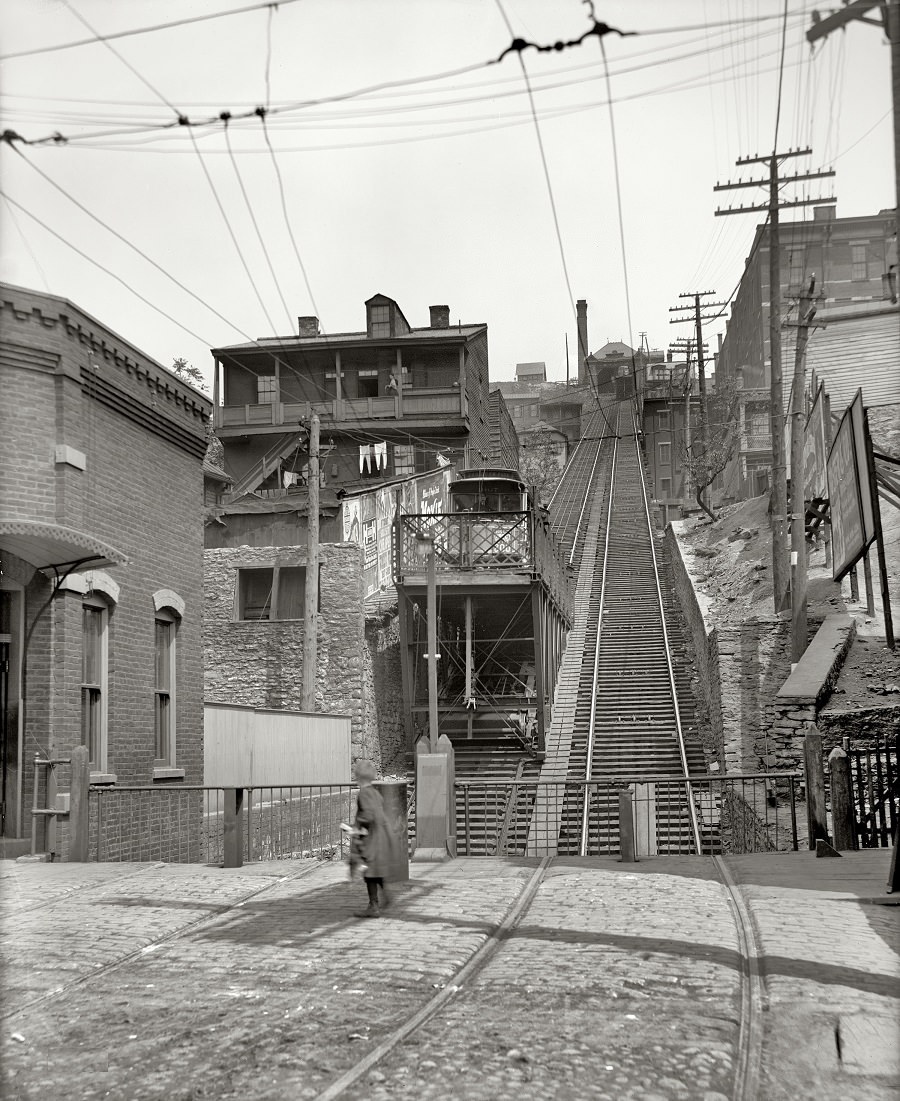
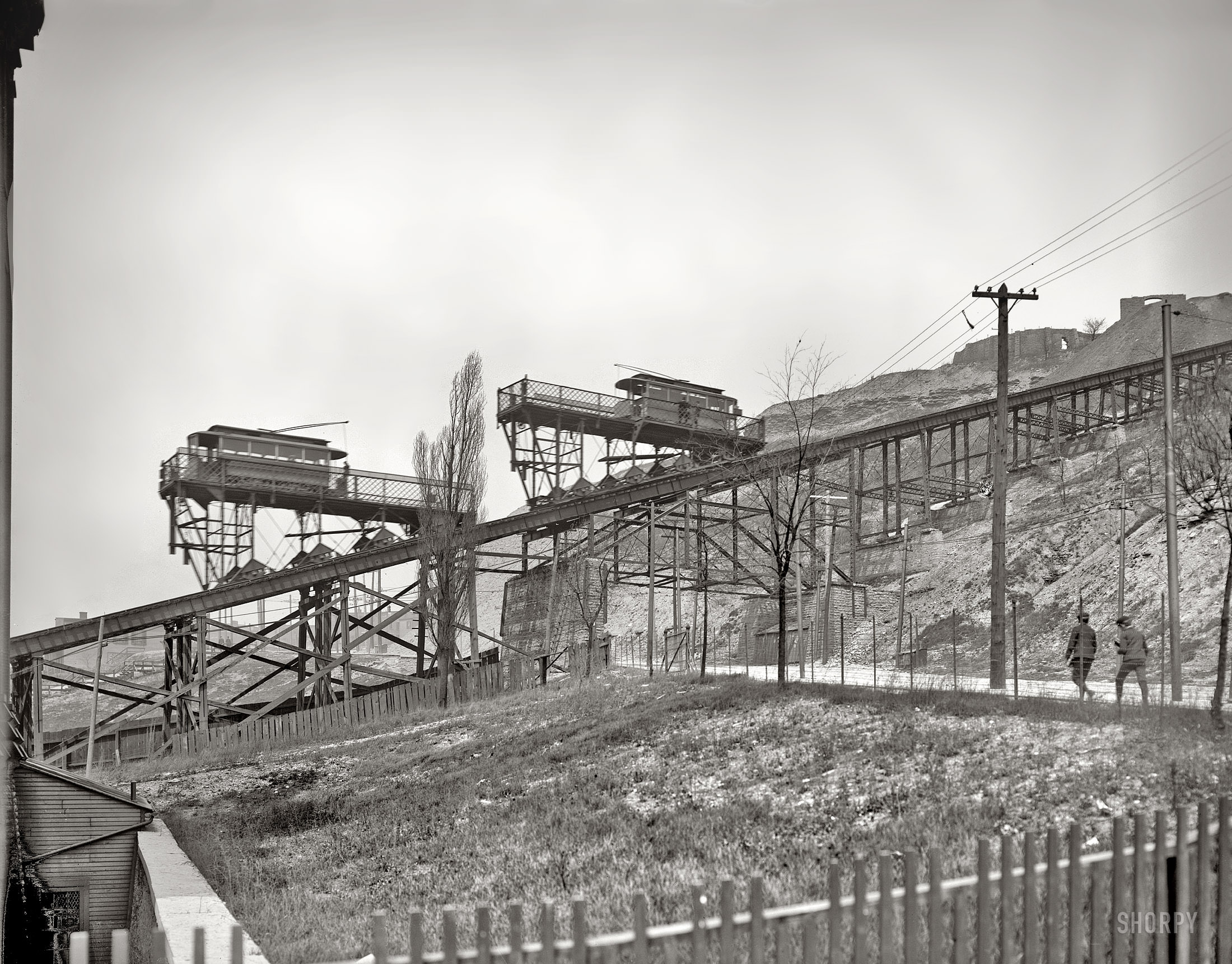
Cincinnati’s topography — a basin surrounded by hills — created a transportation challenge that the city solved with a network of inclined planes, or inclines. These cable-powered ramps carried both passengers and freight up and down the steep hillsides connecting the city’s lower neighborhoods to the heights above. The Price Hill Incline was part of this larger streetcar and freight elevator system, and by 1906 it was a well-established piece of Cincinnati’s transit infrastructure.
The Cincinnati Arcade, photographed in 1910, was an enclosed retail passage that offered shoppers a covered alternative to the open street. Arcades of this type were fashionable commercial developments in early 20th-century American cities, combining multiple storefronts under a single roof with a grand interior passage lit by skylights.
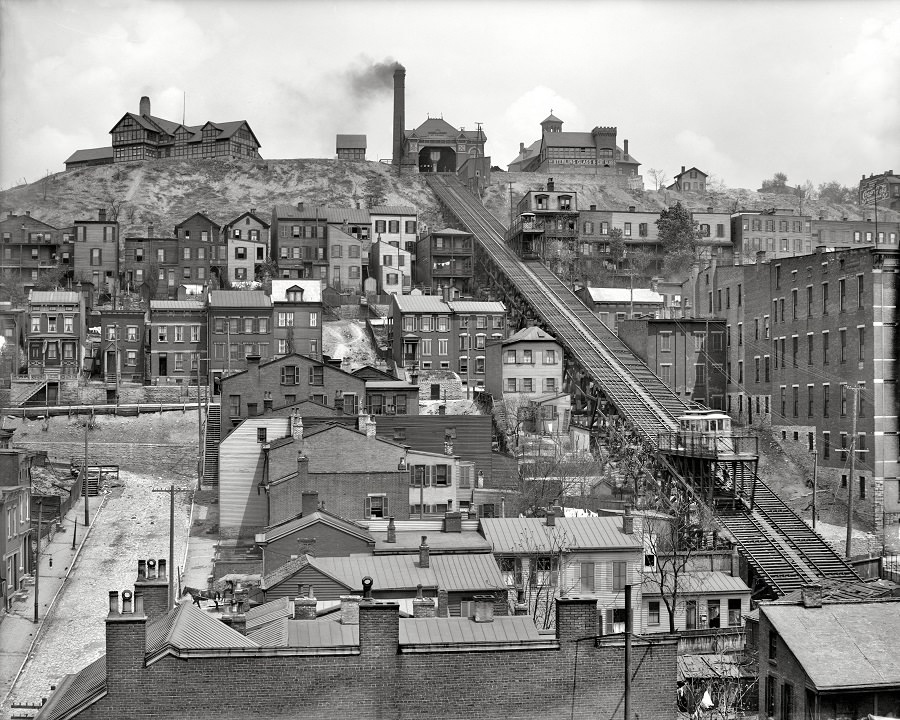
The Mount Adams Incline was one of the most heavily used inclined planes in the city. It connected the river-level streets below to the Mount Adams hilltop neighborhood above, carrying streetcars and pedestrians up a slope that would have been impractical to climb on foot. By 1908, the incline was a daily fixture in the lives of thousands of Cincinnati residents.
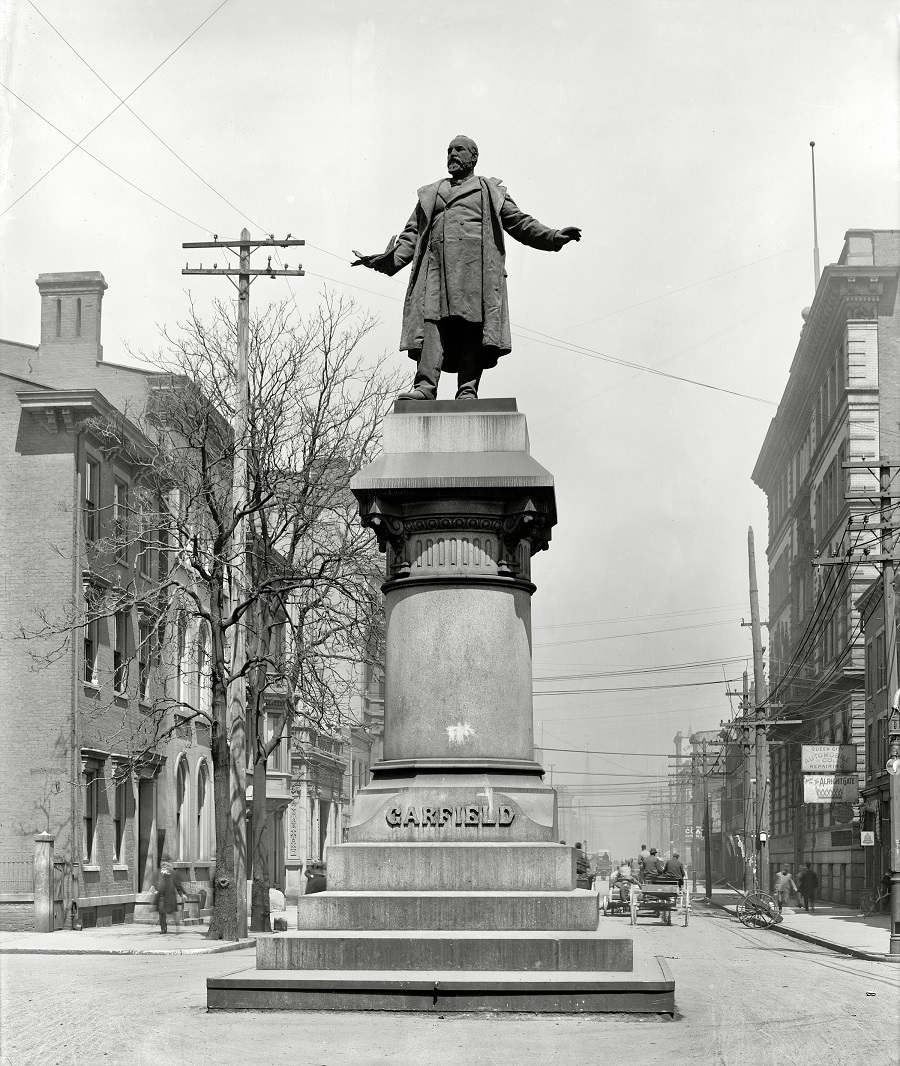
A statue of President James A. Garfield, the 20th President of the United States, stood in Cincinnati as a memorial to the assassinated leader. Garfield had strong ties to Ohio — he was born and raised in the state and served as an Ohio congressman before reaching the presidency. The 1906 photograph shows the statue in its public setting, a permanent fixture in the city’s civic landscape.
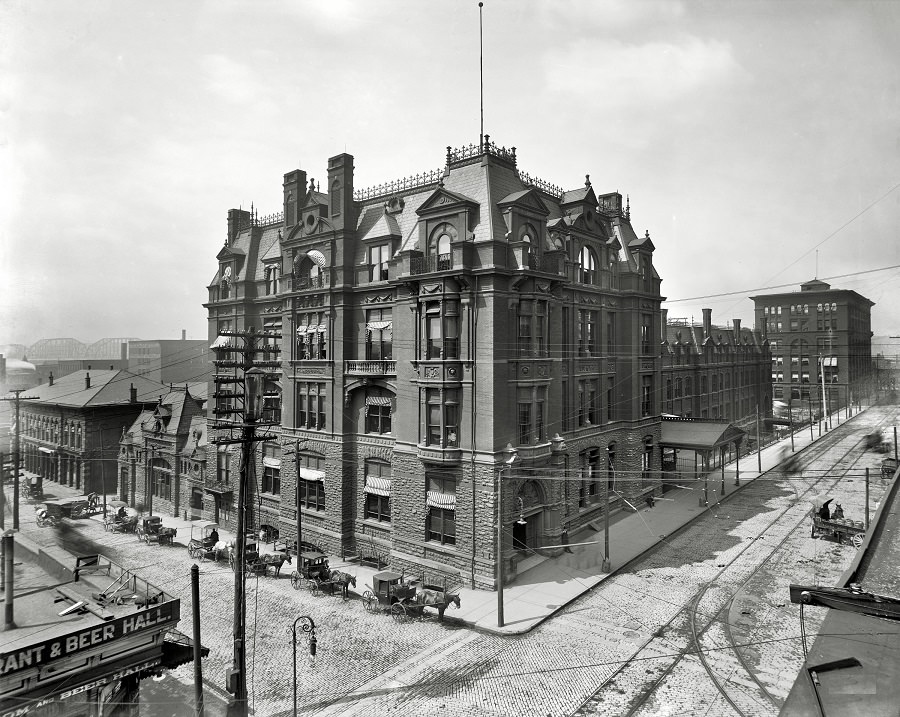
Central Union Station was Cincinnati’s main railroad passenger terminal around 1905. The station handled rail traffic from multiple lines and served as the primary point of arrival and departure for travelers moving through the city. It was a busy, functional building at the center of the city’s rail connections, though it would eventually be replaced by the far grander Union Terminal, which opened in 1933.
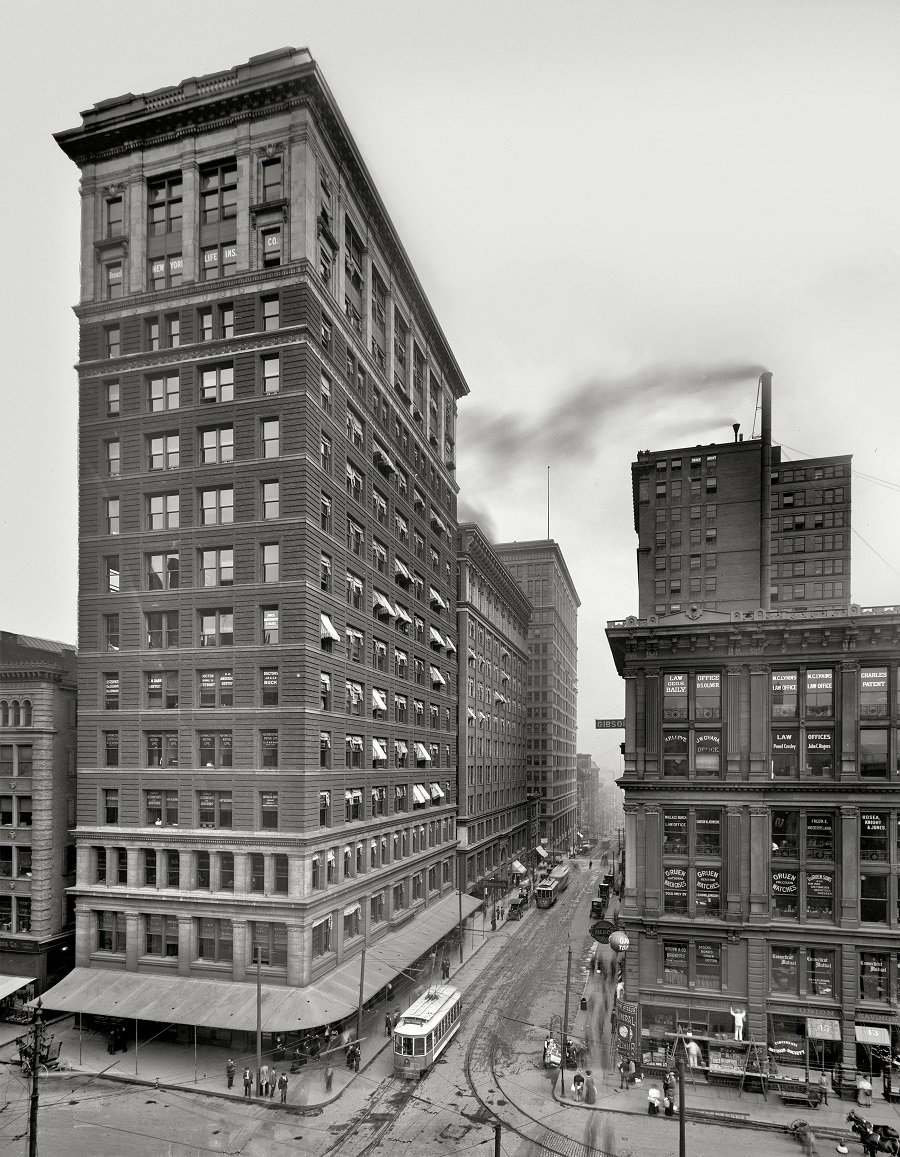
Walnut Street around 1910 was a dense commercial corridor running north from the riverfront through the heart of downtown. Its buildings housed banks, offices, retail shops, and professional firms. The street-level activity of pedestrians, vendors, and delivery wagons made it one of the most animated stretches in the city.
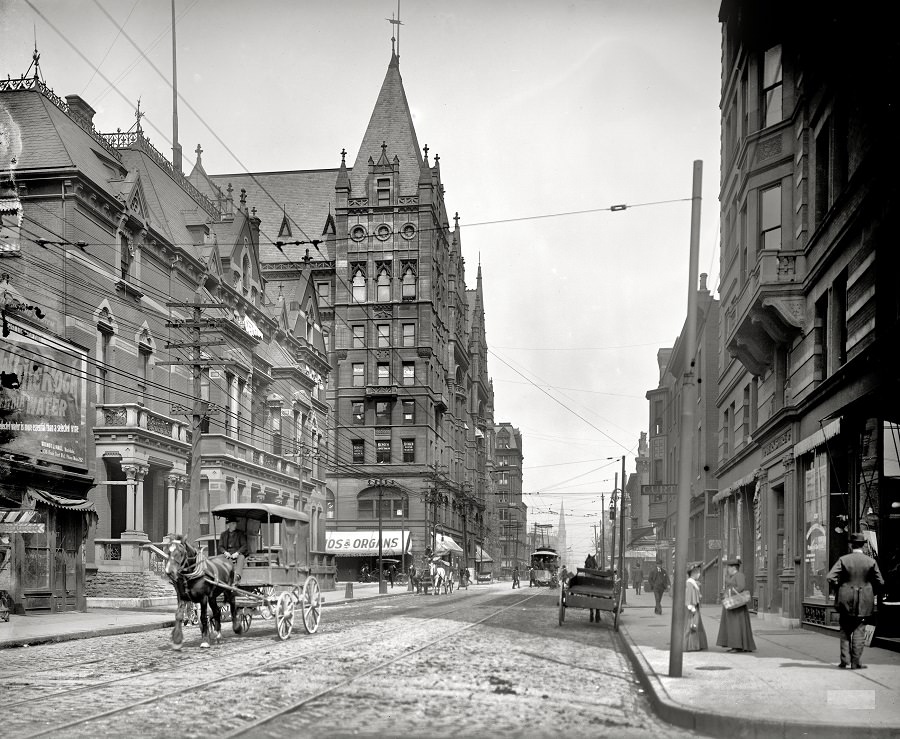
Elm Street in 1905 shows one of the city’s major north-south corridors lined with mixed commercial and residential buildings. The street was already home to Cincinnati Music Hall, making it a culturally significant address in the city. Photographs from this period show a street busy with streetcar traffic and pedestrian activity.
Rookwood Pottery was one of Cincinnati’s most internationally celebrated enterprises. Founded in 1880 by Maria Longworth Nichols, the pottery produced hand-decorated ceramic wares that won awards at world’s fairs and found buyers across the United States and Europe. By 1906, its hilltop studio in Mount Adams was both a working factory and a destination for visitors interested in American decorative arts.
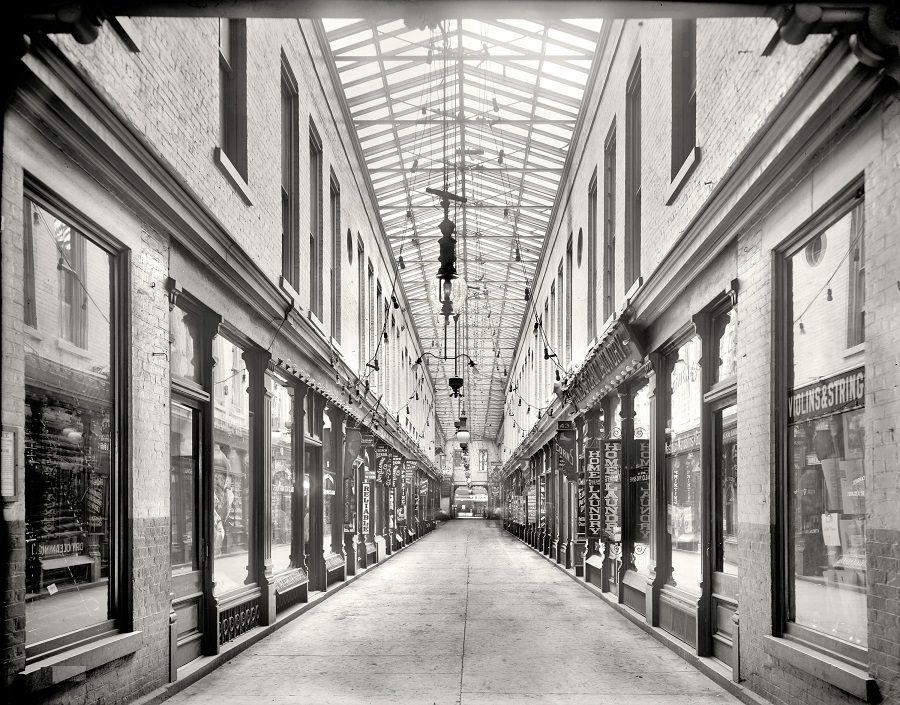
The Arcade on Fifth Street was another of Cincinnati’s covered retail passages, offering an elegant interior shopping experience. Around 1905, the arcade’s interior featured tall ceilings, ornamental ironwork, and a row of storefronts on either side of a central pedestrian corridor — a design that blended commerce with architectural showmanship.
Cincinnati’s hillside inclines were a daily mode of transport for working-class residents who lived on the heights above the basin. Around 1909, photographs captured the experience of riding a trolley up the steep grade, the city spreading out behind and below as passengers climbed toward their hilltop neighborhoods. The inclines were practical solutions to geography, and they gave Cincinnati a transit character unlike almost any other American city.
From the summit of Mount Adams, the full sweep of Cincinnati’s urban landscape was visible. In 1909, photographs taken from this vantage point showed the densely built basin below — church steeples, commercial rooftops, factory smokestacks, and the wide band of the Ohio River beyond. The view illustrated just how much had been built in the century since the city’s founding.
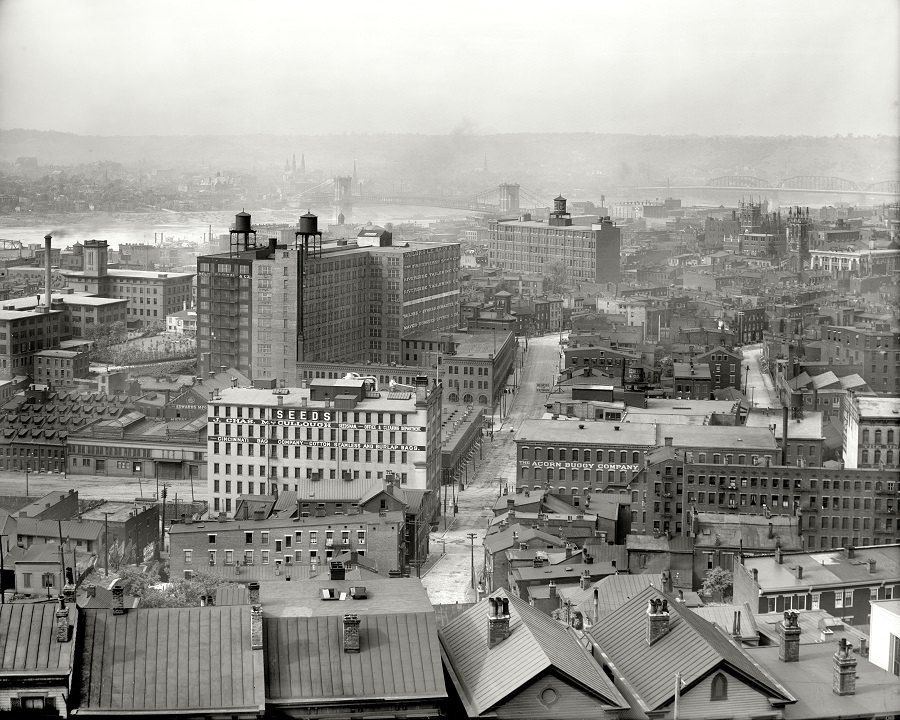
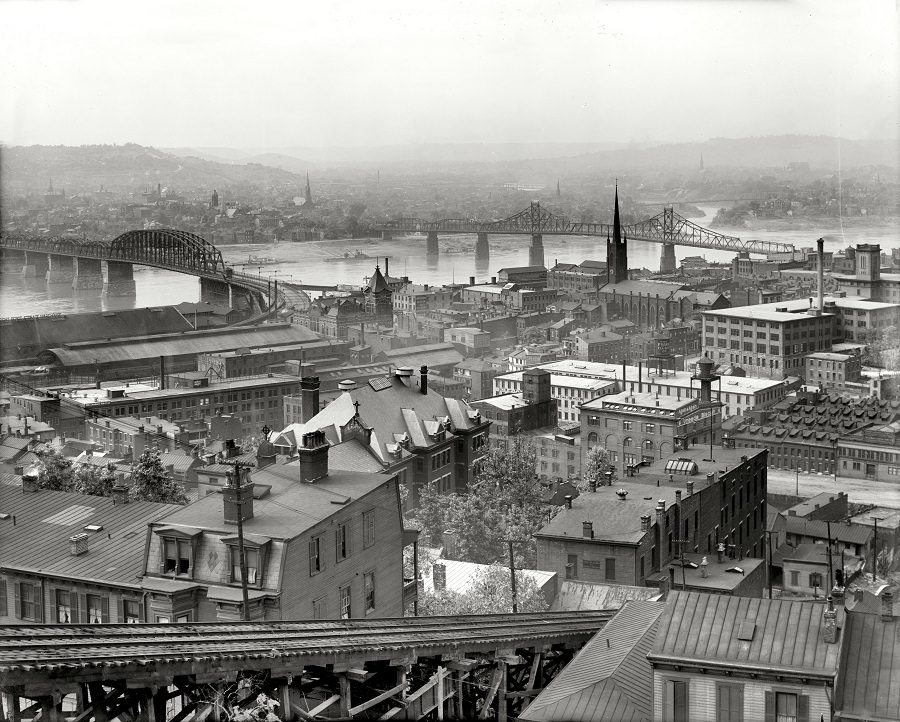
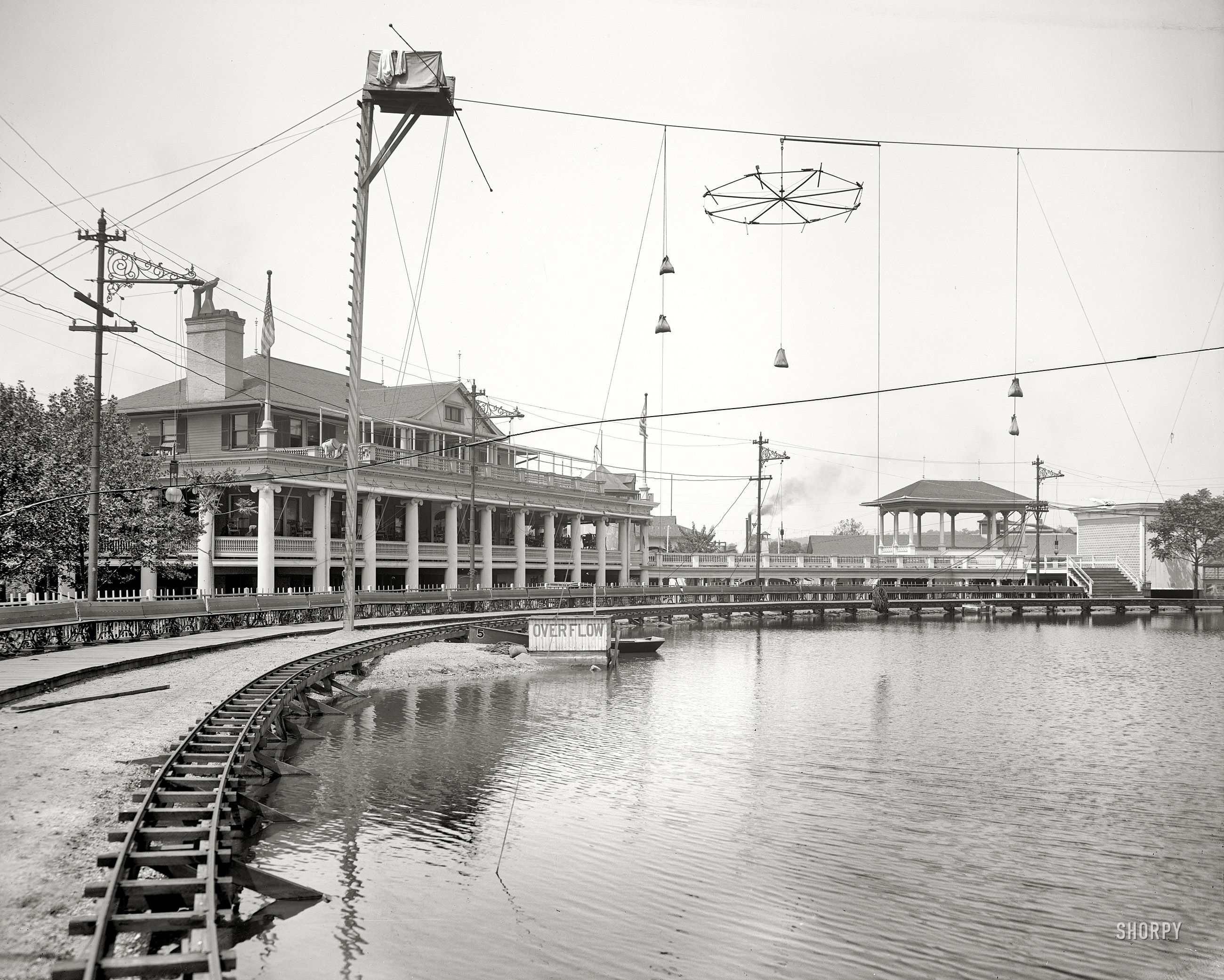
Chester Park’s lake and clubhouse were among the park’s most photographed features. Around 1906, visitors could rent rowboats, stroll along the shore, and use the clubhouse facilities. The park’s management maintained the grounds carefully, and the lake area became a popular backdrop for leisure photographs of Cincinnati families and groups.
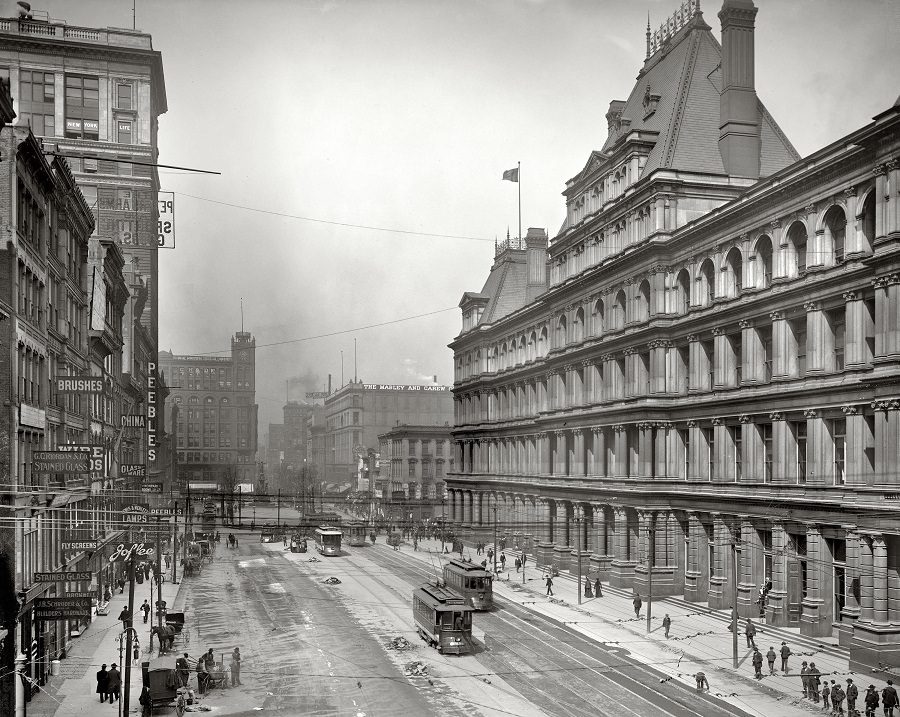
Government Square around 1905 served as a central hub for public transit and civic activity in downtown Cincinnati. Streetcars converged on the square from multiple directions, making it a key transfer point in the city’s transit network. Government buildings and commercial structures surrounded the space, reinforcing its role as the administrative and logistical center of the city.
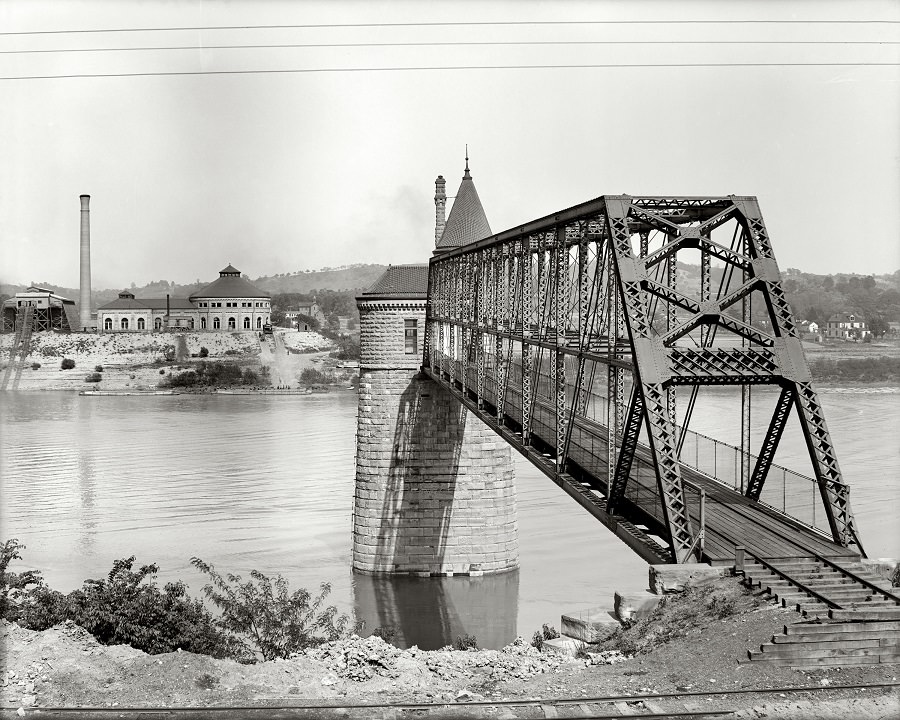
The new pumping plant on the Ohio River, photographed around 1906, was part of Cincinnati’s ongoing investment in water infrastructure. The city drew its water supply from the river and required modern pumping equipment to meet the demands of its growing population. These industrial waterfront facilities were unglamorous but essential to urban life.
The Mount Adams Incline, seen again in an 1906 photograph, shows the mechanism clearly — a cable-driven platform that carried streetcars at an angle up the hillside. At the top, passengers could transfer to surface lines that served the hilltop neighborhoods. The inclines were engineering achievements that made Cincinnati’s difficult terrain livable for tens of thousands of residents.
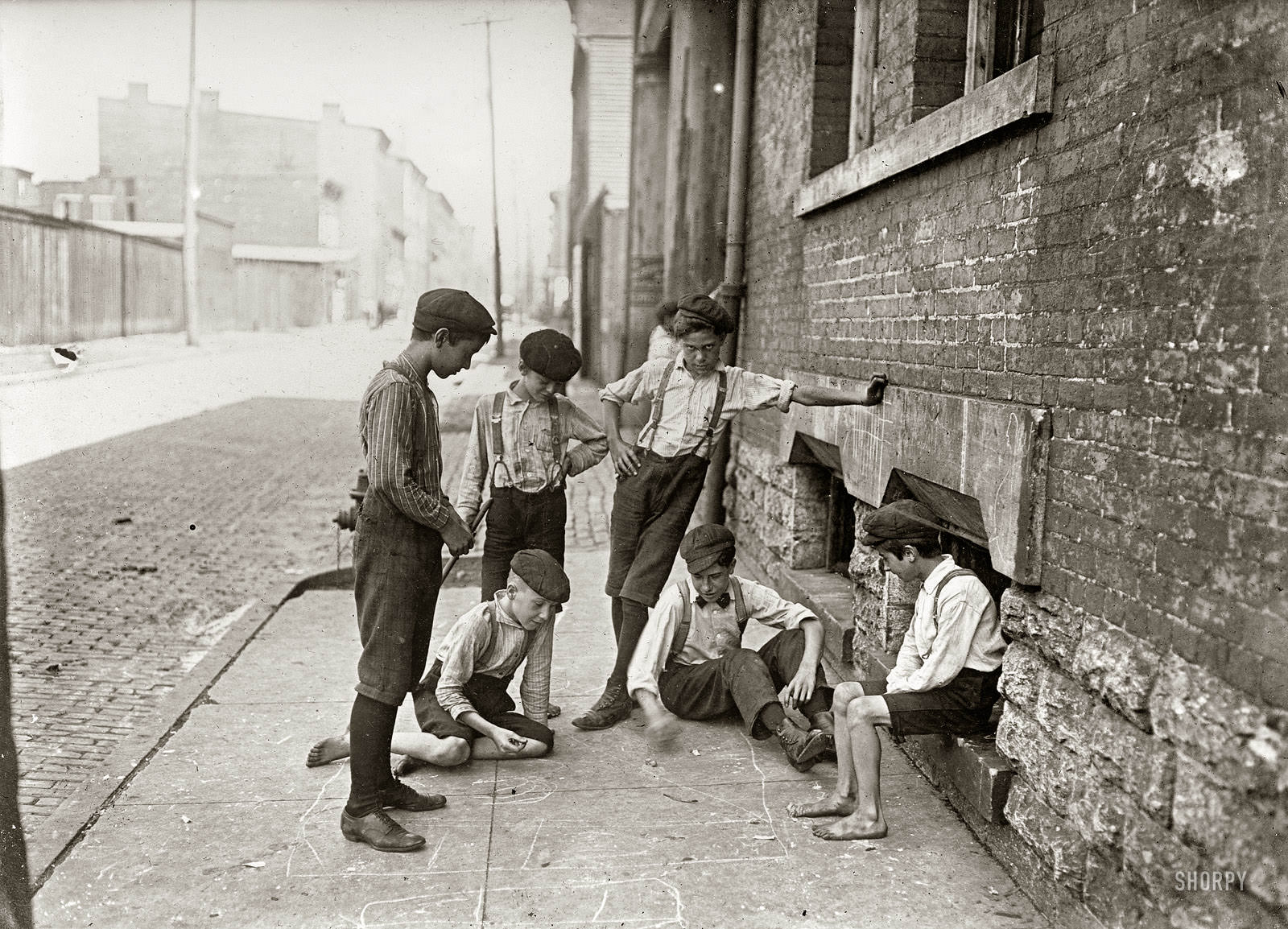
Not all photographs from this era show grand architecture or civic landmarks. In August 1908, photographer Lewis Hine documented working-class and street life in Cincinnati as part of his broader work on child labor and urban poverty. One photograph captured a group of boys playing craps on a Cincinnati street — a glimpse of informal life in the city’s neighborhoods, away from the polished commercial corridors of the downtown.
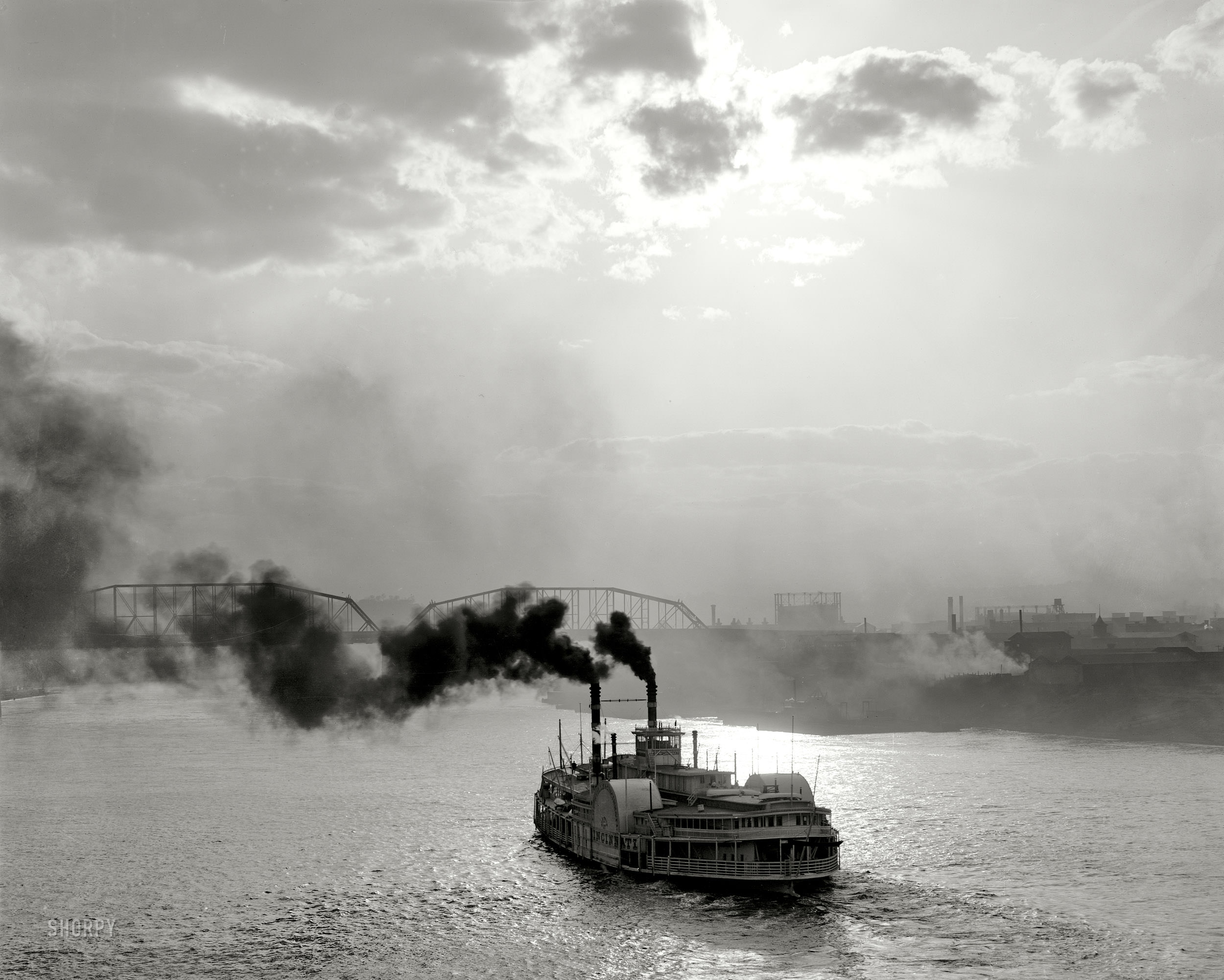
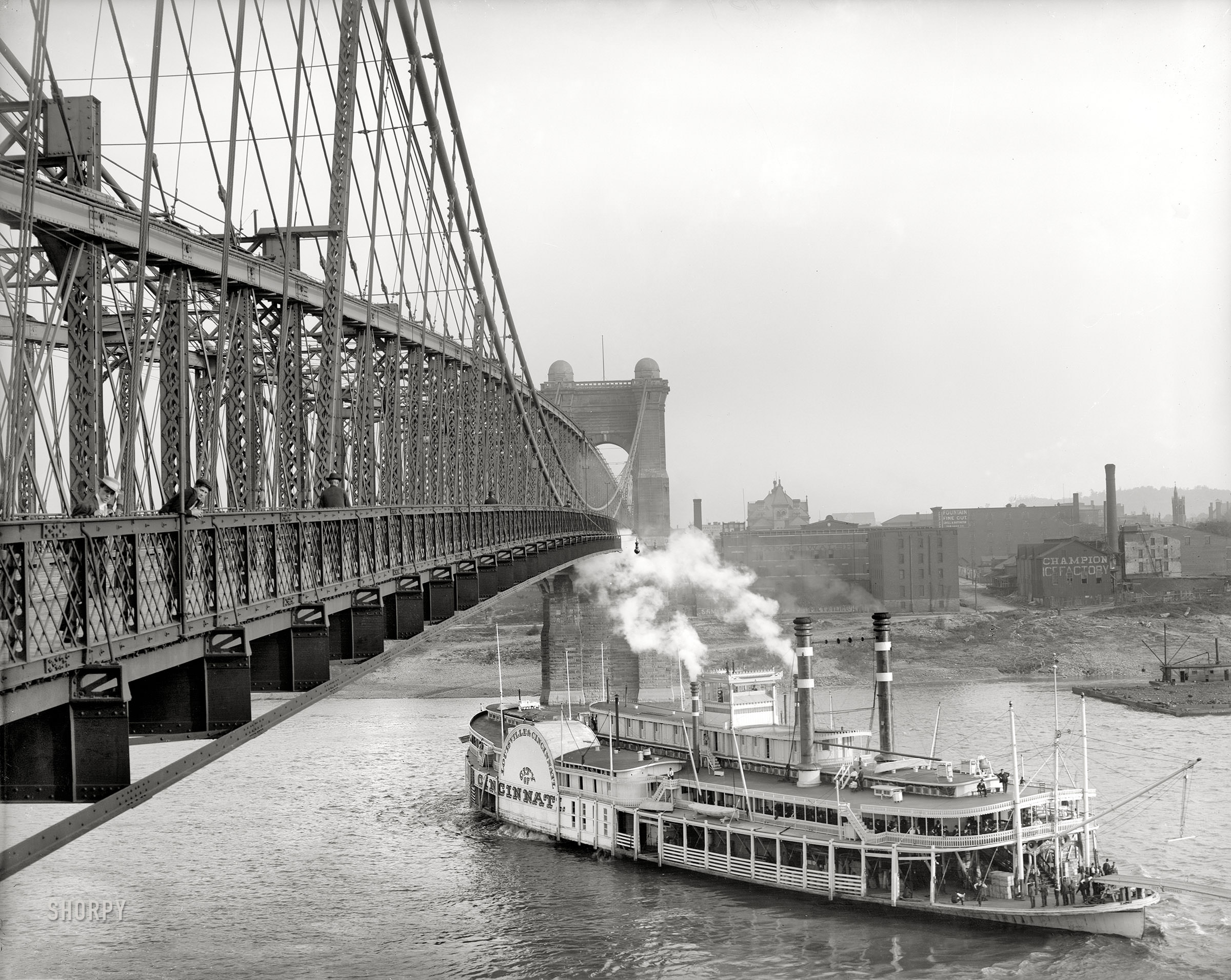
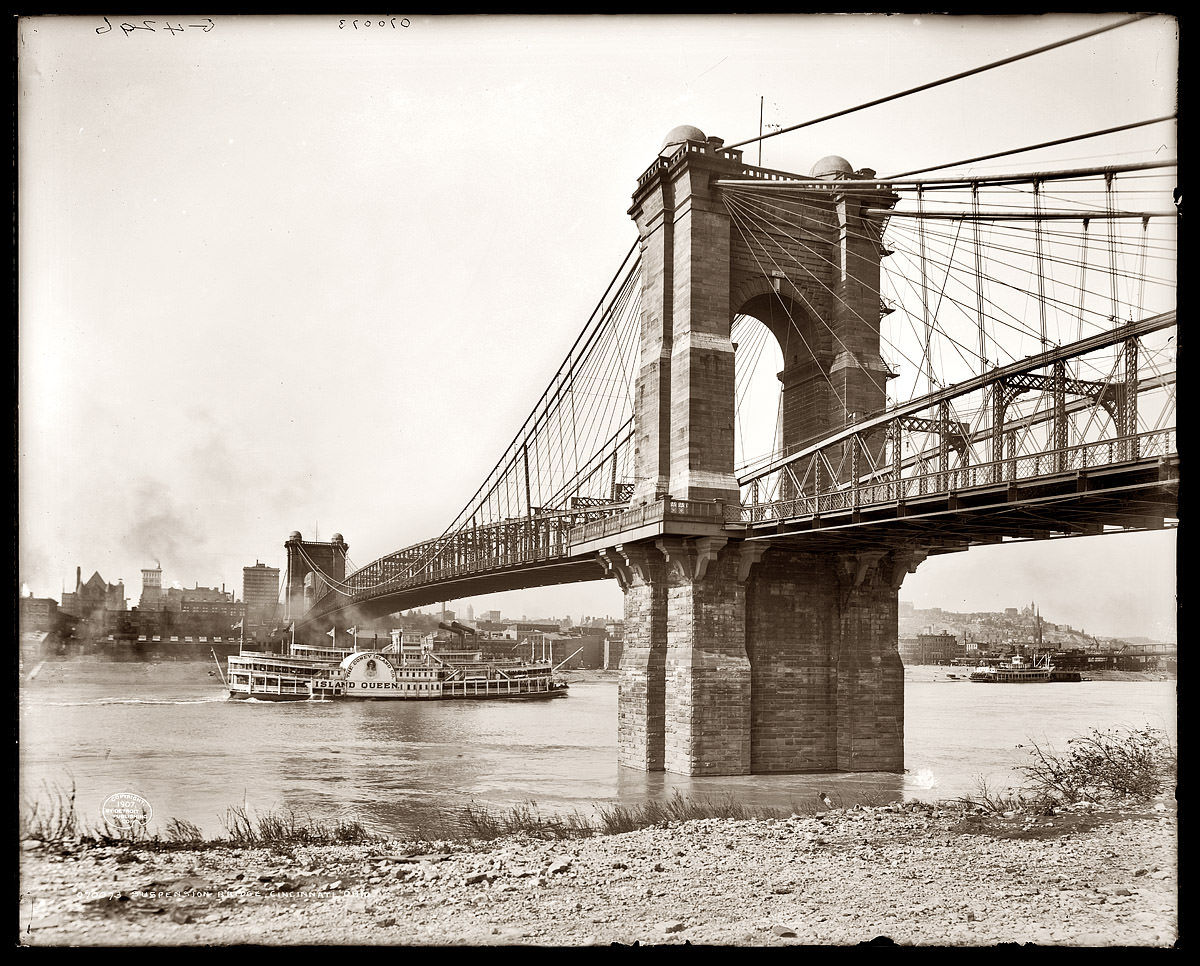
The Ohio River’s role in commerce was most vividly illustrated by the sidewheel steamboats that still worked the water in 1906. A photograph captured the sidewheeler Cincinnati passing beneath the Roebling Suspension Bridge — the bridge that had served as the engineering model for the Brooklyn Bridge. The image placed two generations of American engineering in the same frame: the iron suspension bridge completed in 1866 and the wood-and-steam riverboat that represented an earlier industrial era.
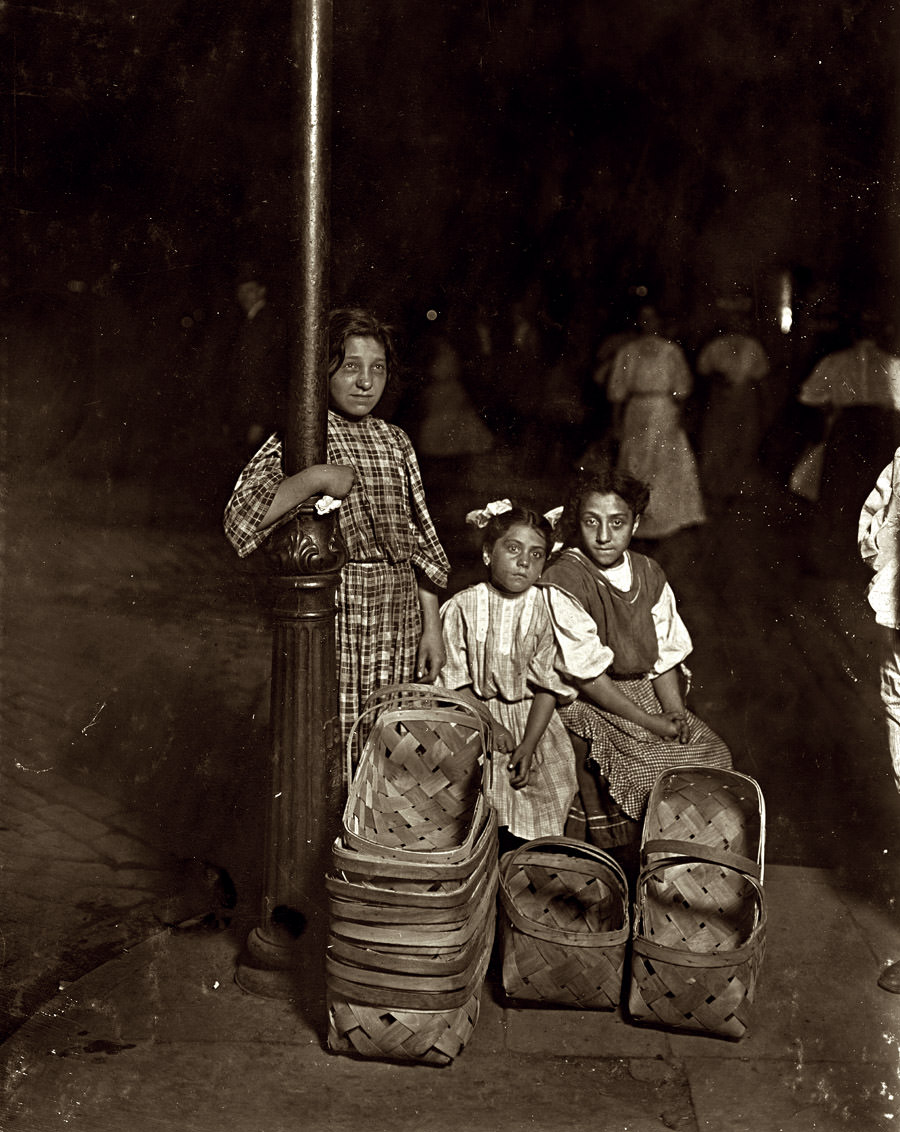
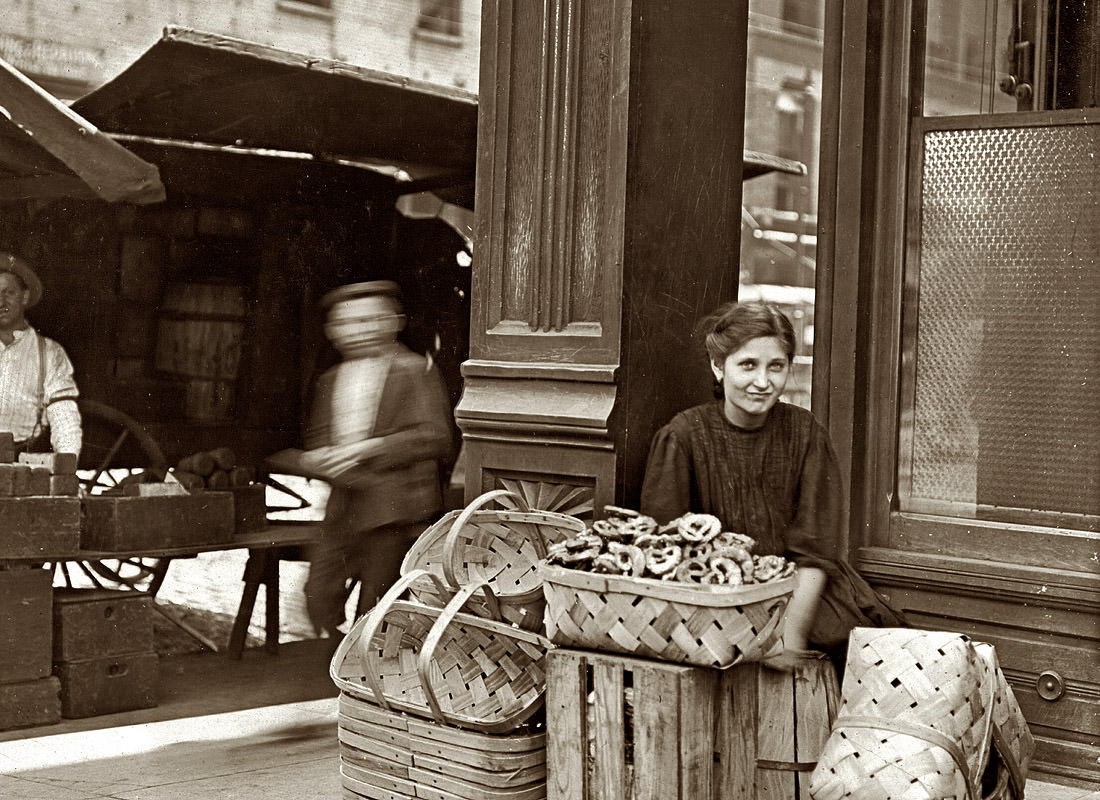
Lewis Hine’s August 1908 work in Cincinnati documented child street vendors in detail. Marie Costa, a basket seller living at 605 Elm Street, was among those he photographed. Children like Costa were a common sight at city markets and street corners, selling goods to supplement family incomes. Hine’s photographs were made with the explicit purpose of documenting child labor conditions for the National Child Labor Committee.
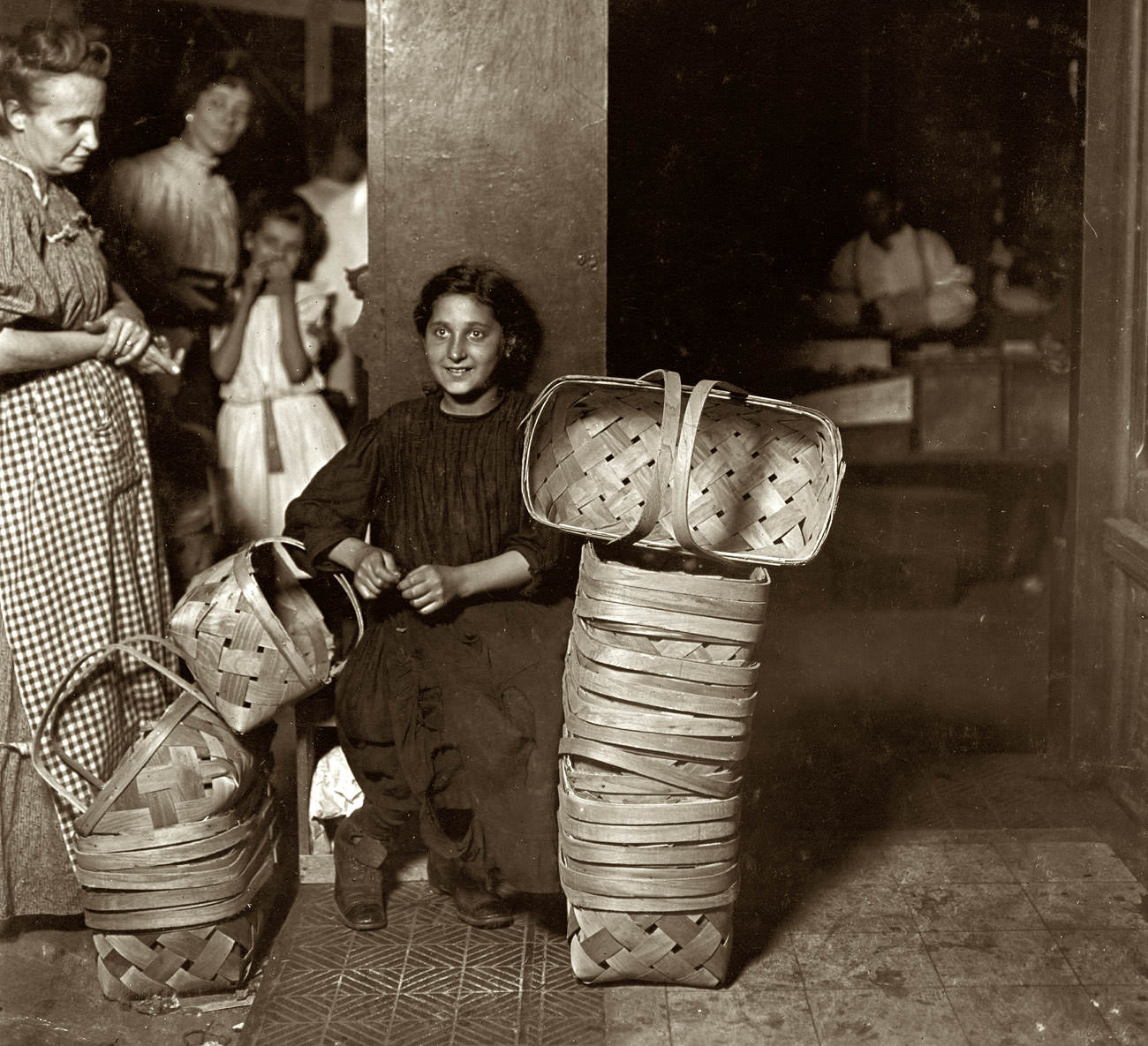
Eleven-year-old Lena Lochiavo was another of Hine’s subjects. She sold baskets at the Sixth Street Market and was photographed both at her selling location and at her home address at 209 West Sixth Street. Her age and occupation were recorded precisely in Hine’s notes — the documentation was intentional, meant to demonstrate to policymakers that young children were working full days in commercial settings.
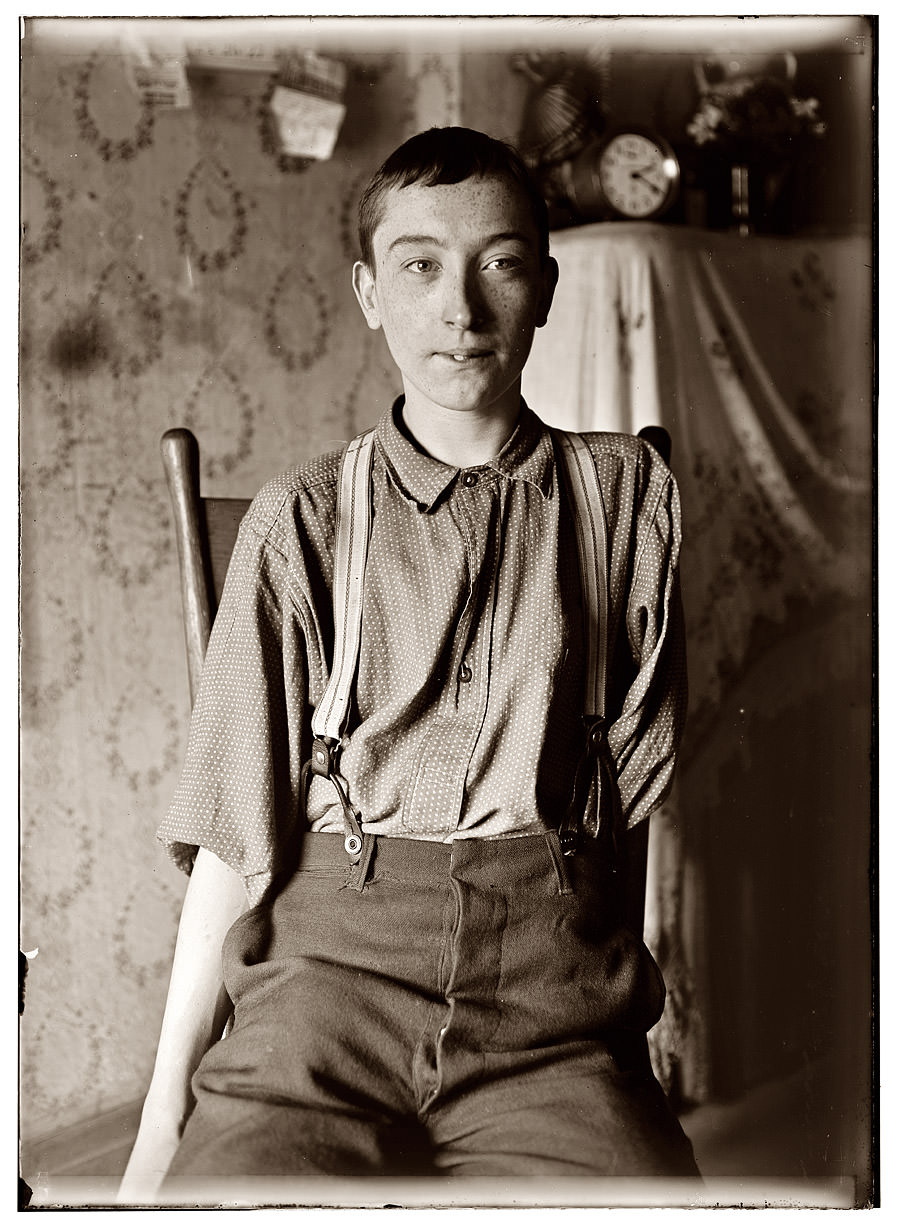
Harry McShane’s case was among the most severe that Hine documented in Cincinnati. McShane, whose address was listed as 134 Broadway, had suffered a serious industrial injury — his arm had been caught in factory machinery and torn off at the shoulder. He was a teenager at the time of the photograph in 1908. Hine’s image of McShane became one of the most widely distributed photographs in the American child labor reform movement.
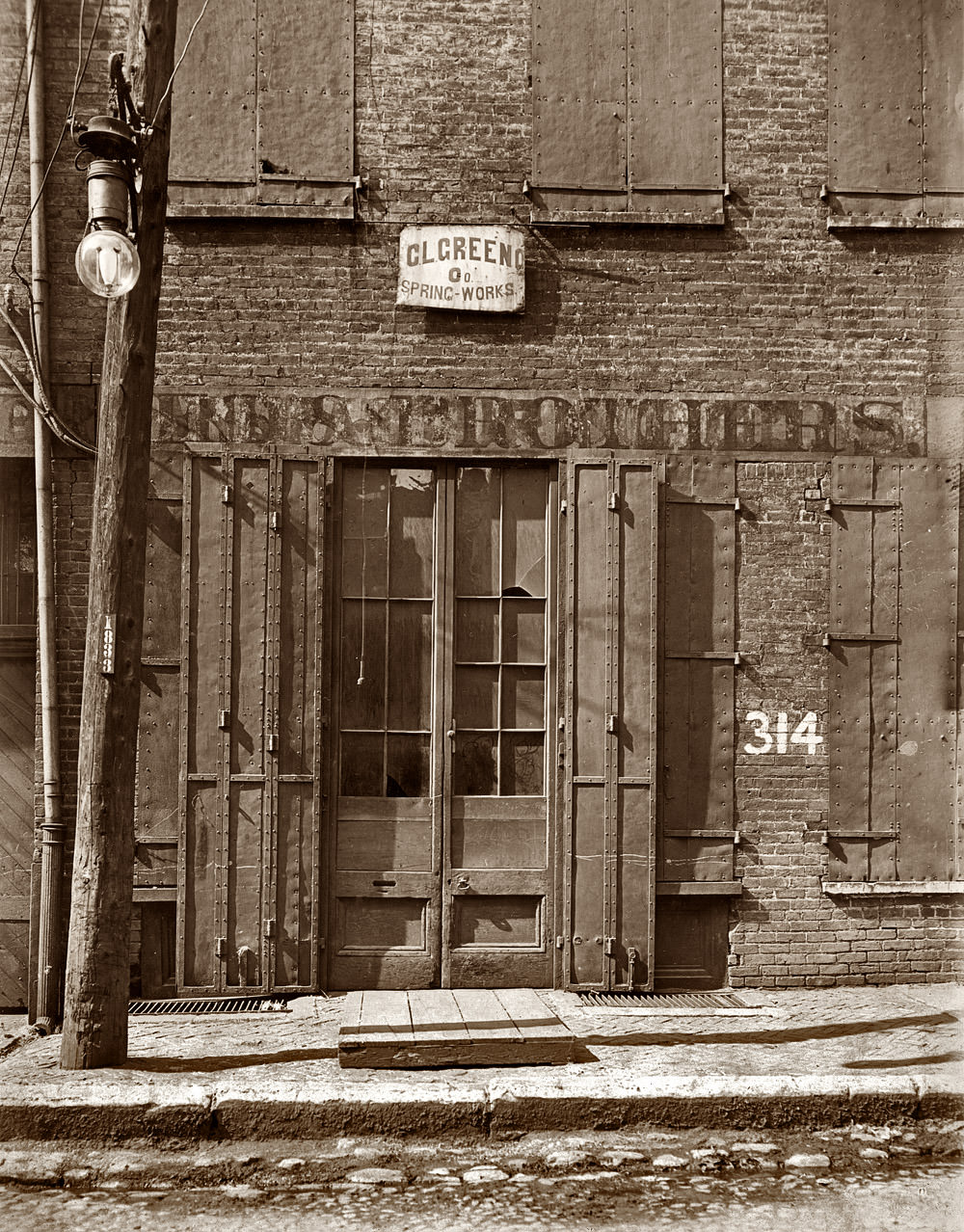
The Greeno Spring Works, photographed in August 1908, was one of the Cincinnati manufacturing facilities where child workers were employed. Hine documented the interior of the workshop to show the conditions in which young workers operated — the machinery, the physical environment, and the ages of the workers present. His documentation of Cincinnati factories contributed to the growing national push for child labor legislation.
Coney Island amusement park in 1907 was already drawing large crowds from Cincinnati and the surrounding region. The park’s location on the Ohio River east of the city made it accessible by steamboat as well as by road and rail. Its attractions ranged from carnival midway games to picnic grounds, making it a destination for families across the economic spectrum.
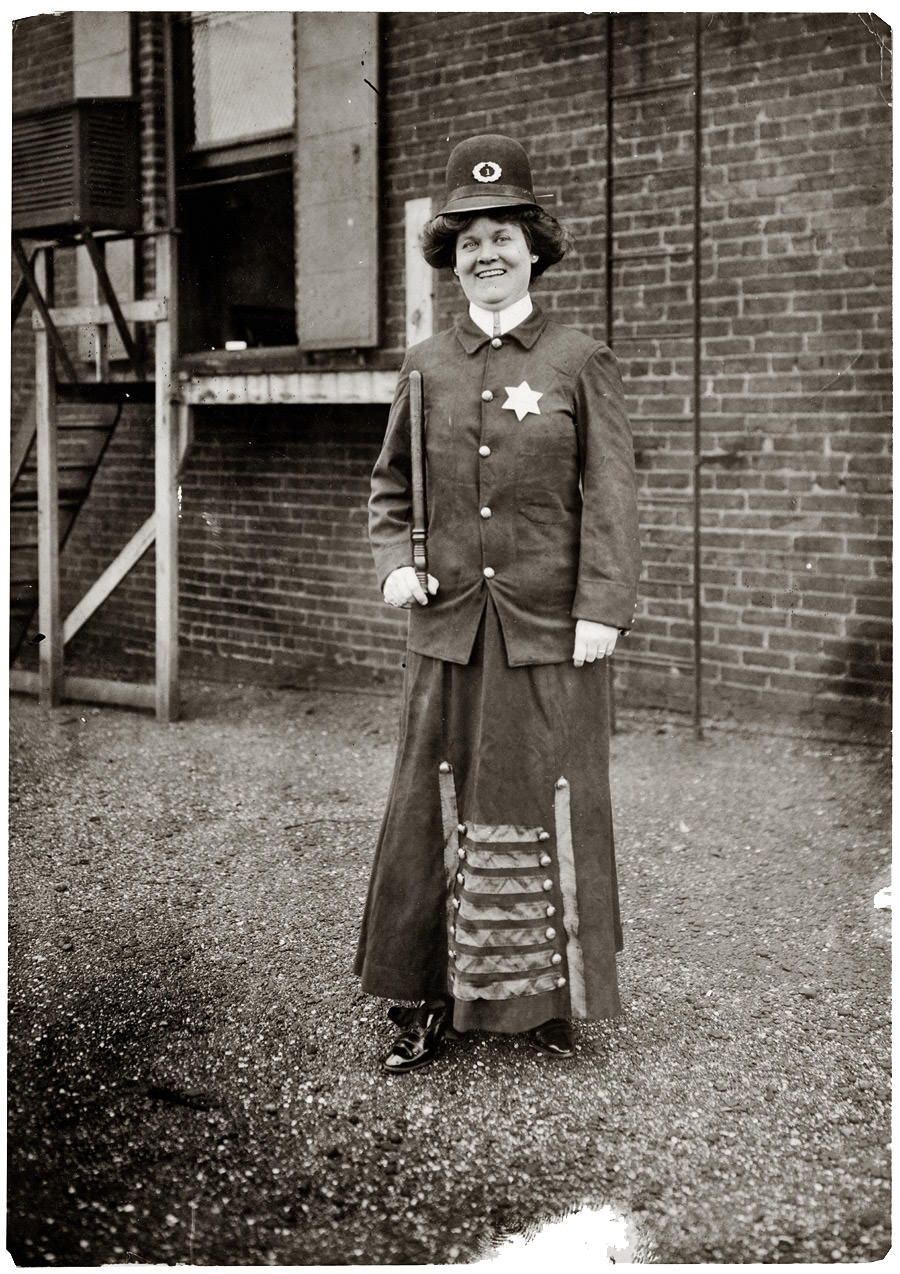
On September 23, 1909, a Cincinnati suffragette was photographed posing in a police uniform to illustrate the concept of women serving as police officers. The image was a deliberate piece of visual argument — women’s suffrage advocates were actively making the case not only for the right to vote but for full civic participation, including in law enforcement roles. The photograph was staged to make a political point at a time when women had neither the vote nor access to most public offices.
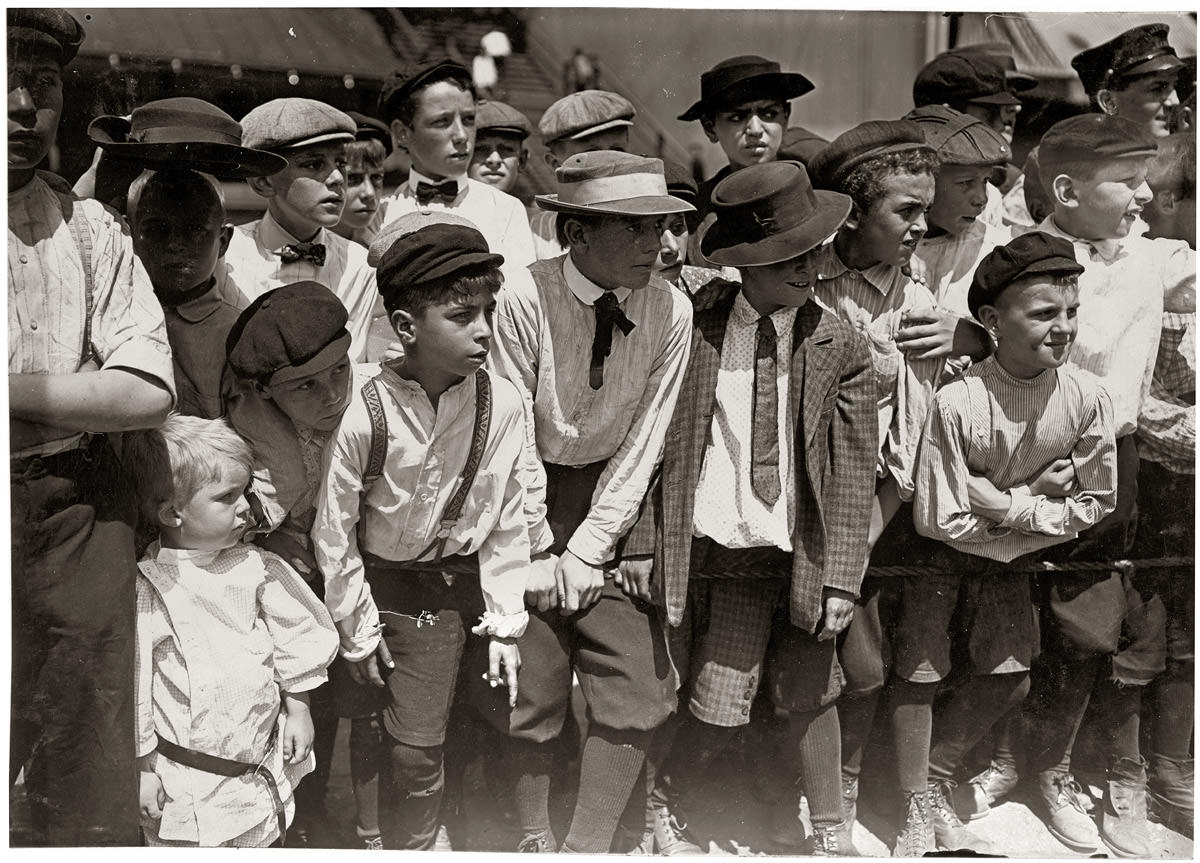
The annual Newsboys’ Picnic was a summer event held for the young boys who sold newspapers on Cincinnati’s streets. In August 1908, Lewis Hine photographed an exciting moment at the picnic — newsboys were a distinct subculture in American cities of this era, working long hours selling papers at street corners and transit stops in all weather. The picnic was one of the few organized events held specifically for their benefit.





This city used to look so much better (aside from the pollution).
Maybe we all head off to Mills cafeteria or Wiggins..lol
The town is now a ghost town after 5 p.m. What a shame.
How did they get around without an 8-lane high-speed highway?
Since then, so many historic houses and streets have been bulldozed for highways and parking. Although we still have a lot of OTR intact, we have lost so much.
These are awesome, thanks for sharing. Still going through them.
Love the ‘Tickler’ ride in Chester Park. ‘Remodeled, not as rough as last season’ lol
I don’t even recall my history of Fort Thomas book talking about a street car line running in front of tower park.
Thanks for posting!