
On April 26, 1986, Reactor No. 4 at the V. I. Lenin Nuclear Power Plant near Chernobyl, Ukraine, exploded, releasing 400 times more radioactive material than the Hiroshima bomb. Igor Kostin, a photographer for the Novosti Press Agency in Kiev, was one of the first people to document the disaster from the air and on the ground in the weeks and years that followed. Due to Soviet censorship, many of his photographs were not published until after the collapse of the Soviet Union in 1991. The images below form one of the most complete visual records of the Chernobyl disaster ever assembled.
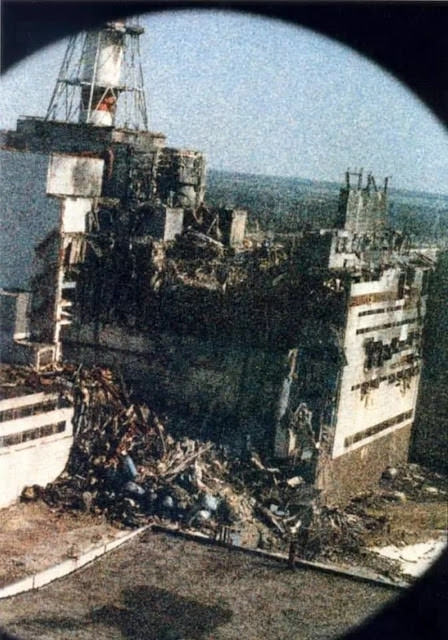
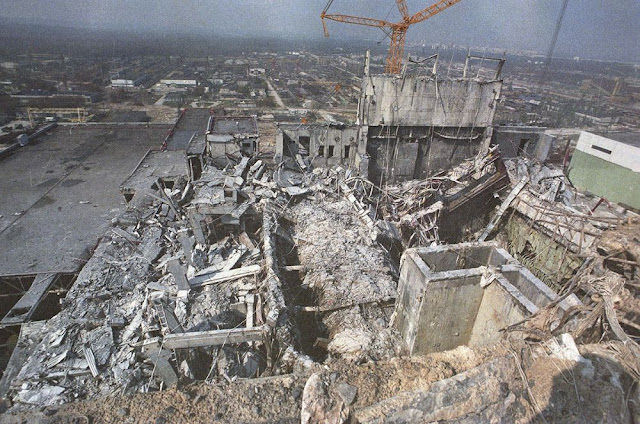
Igor Kostin was a photographer from Kiev who became world famous for his images of the cleanup operation. The image is very noisy because the radiation was destroying the film in his camera. Of all the shots he took on that flight, this is the only one that was not ruined.
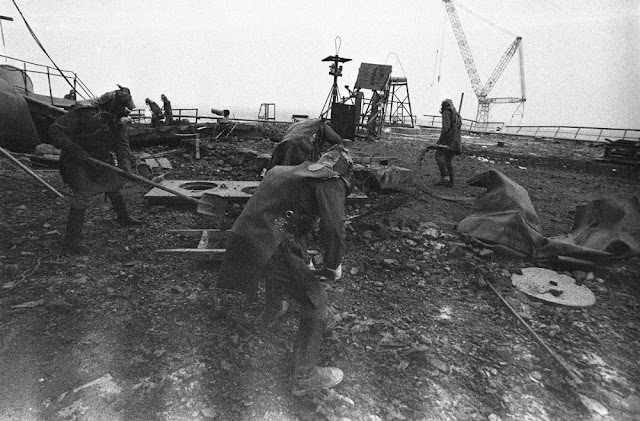
At first, workers tried clearing the radioactive debris from the roof using West German, Japanese, and Russian robots, but the machines could not cope with the extreme radiation levels, so authorities decided to use humans. In some areas, workers could not stay any longer than 40 seconds before the radiation they received reached the maximum authorized dose a human being should receive in his entire life.
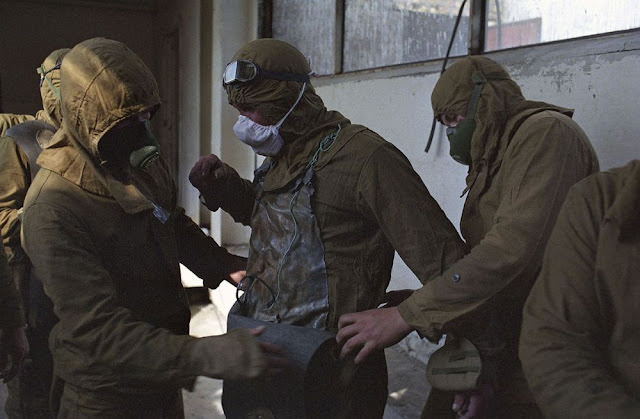
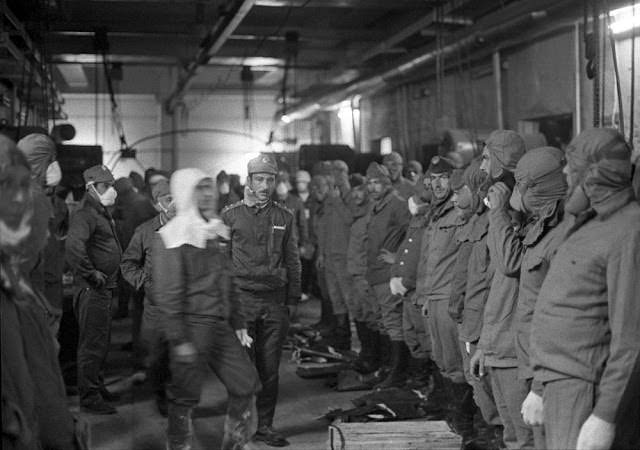
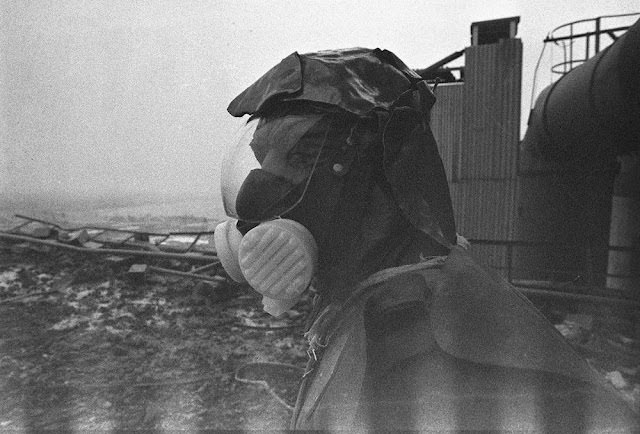
The army did not have adequate uniforms adapted for use in radioactive conditions, so those enlisted to carry out work on the roof and in other highly toxic zones were required to put together their own clothing, made from lead sheets two to four millimeters thick. The sheets were cut to size to make aprons to be worn under cotton work wear, and were designed to cover the body in front and behind, especially to protect the spine and bone marrow.
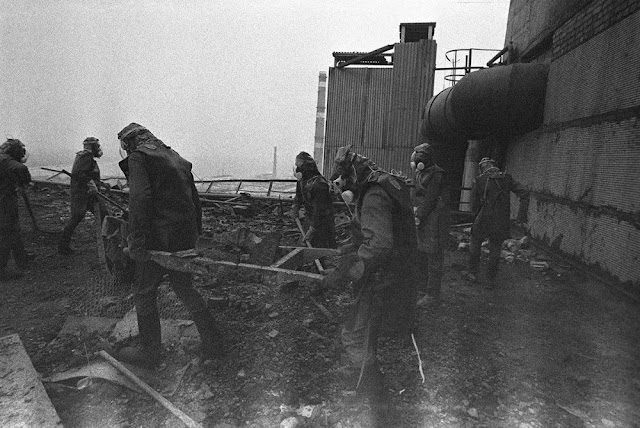
These “biological robots” had only seconds to work — time to position themselves by a pile of debris, lift a shovel load, and throw it among the ruins of reactor No. 4.
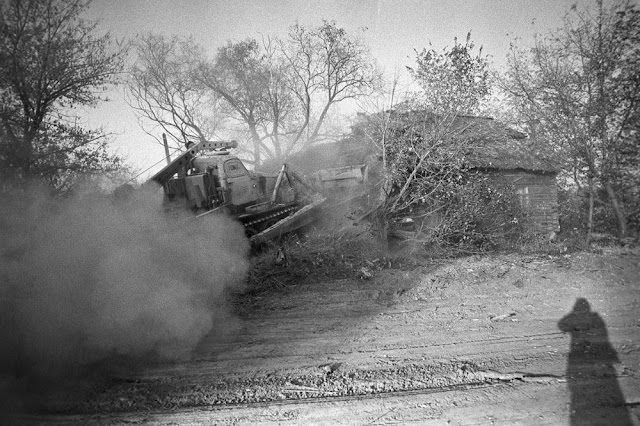
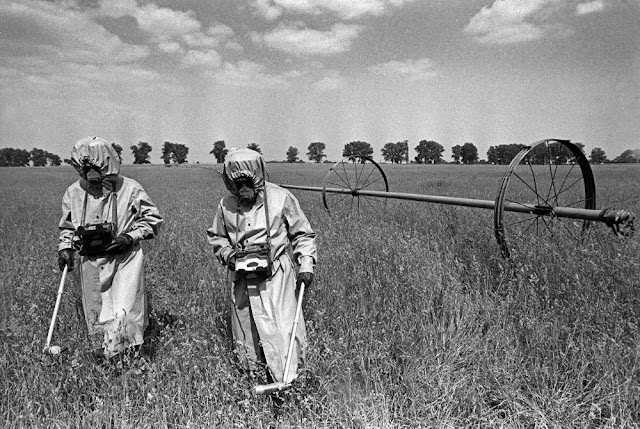
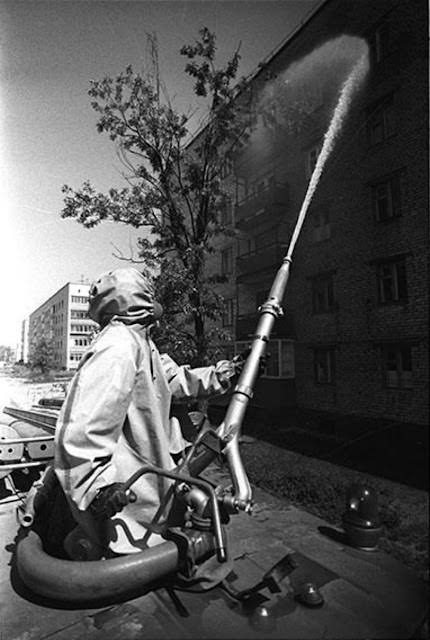
This method was applied to entire villages that were contaminated after the Chernobyl disaster.
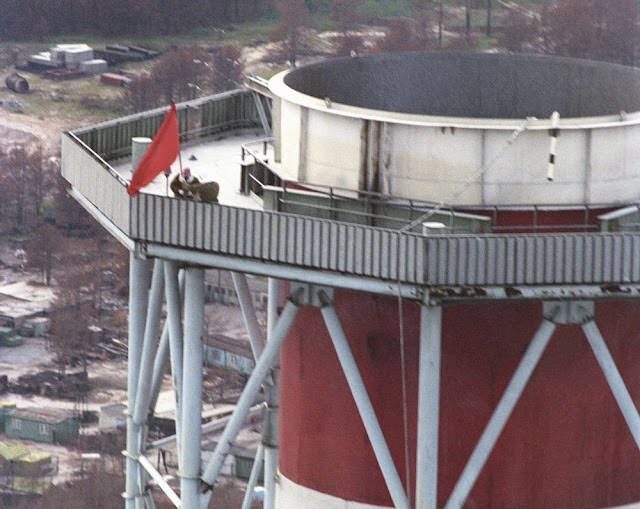
Three men were ordered to post a red flag atop the chimney overlooking the destroyed reactor, reached by climbing 78 meters up a spiral staircase. The flag bearers were sent despite the dangers posed by heavy radiation, and after a group of liquidators had already made two failed attempts by helicopter. Radiation expert Alexander Yourtchenko carried the pole, followed by Valéri Starodoumov with the flag, and Lieutenant Colonel Alexander Sotnikov with the radio. The whole operation was timed to last only 9 minutes, given the high radiation levels. At the end, the trio were rewarded with a bottle of Pepsi — a luxury in 1986 — and a day off.
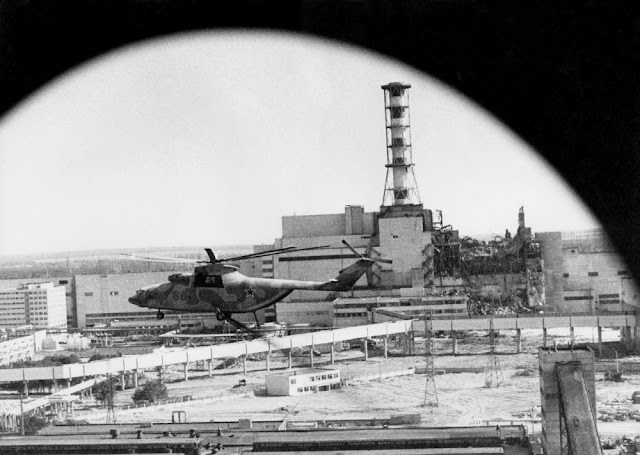
After the explosion, the nuclear power station was covered in radioactive dust. Aircraft and helicopters flew over the site, spraying sticky decontamination fluid that fixed the radiation to the ground. Workers known as liquidators then rolled the dried remains like a carpet and buried the nuclear waste.
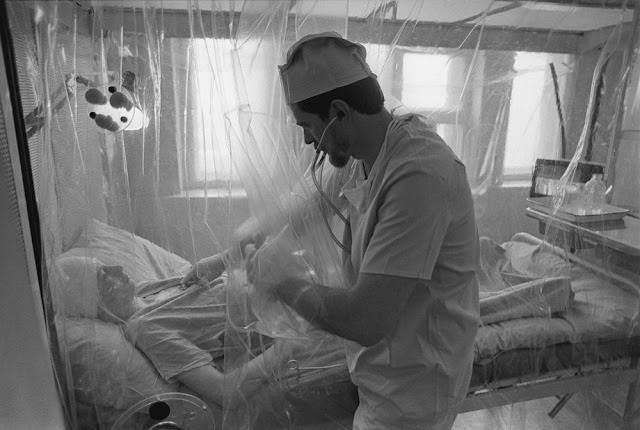
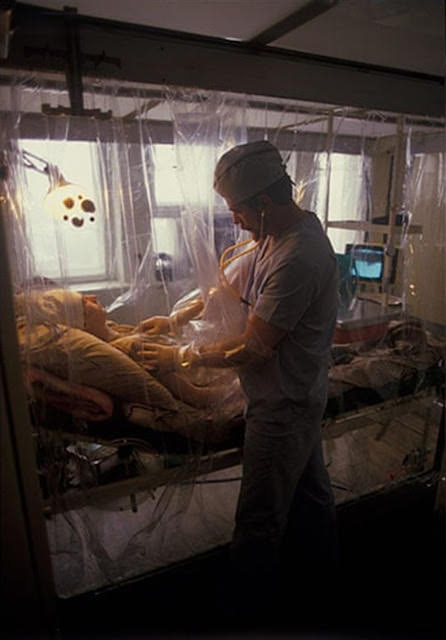
A doctor examines the patient in a sterile room. The examination is carried out in an individual, air-conditioned chamber via specially created openings to avoid direct contact and contamination.
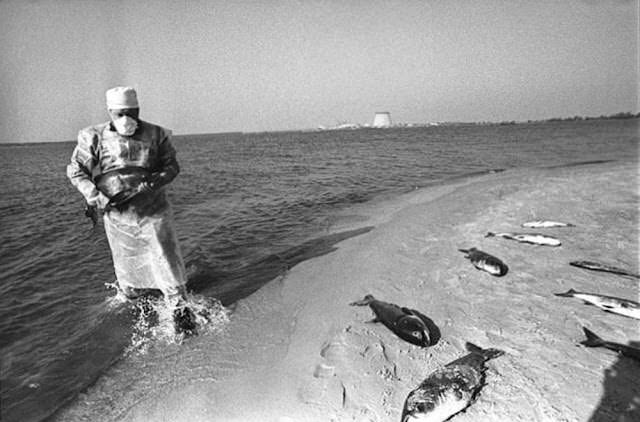
The fish, which died from exposure to radiation, are abnormally large and flabby. They jumped out of the lake where they could be picked up with the bare hands of any passerby.
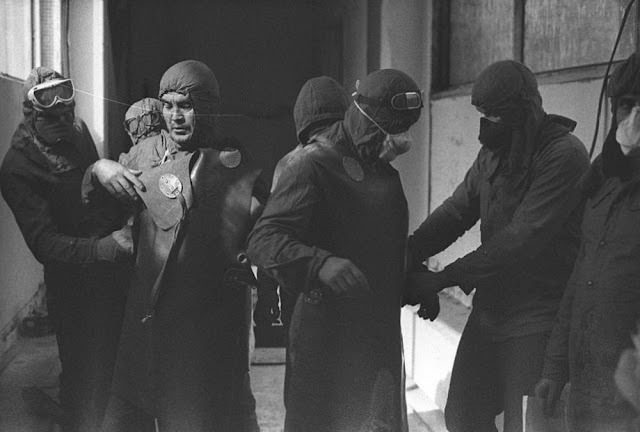
The army did not have adequate uniforms for use in radioactive conditions, so those enlisted had to put together their own clothing made from lead sheets measuring 2–4mm thick. These sheets were cut to size to make aprons covering their bodies in front and behind, especially to protect the spine and bone marrow. “The clever ones also added a vine leaf for extra comfort,” said Kostin.
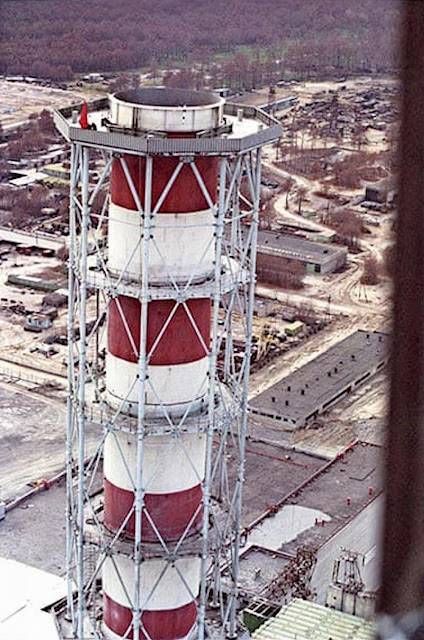
A group of liquidators had already made two failed attempts by helicopter, so the three men had to climb the 78-meter chimney via a spiral staircase, despite the dangerous radiation levels. Radiation expert Alexander Yourtchenko carried the pole, followed by Valéri Starodoumov with the flag, while Lieutenant Colonel Alexander Sotnikov climbed with the radio. The whole operation was timed to last only 9 minutes, given the high radiation levels. At the end, the trio were rewarded with a bottle of Pepsi — a luxury in 1986 — and a day off.
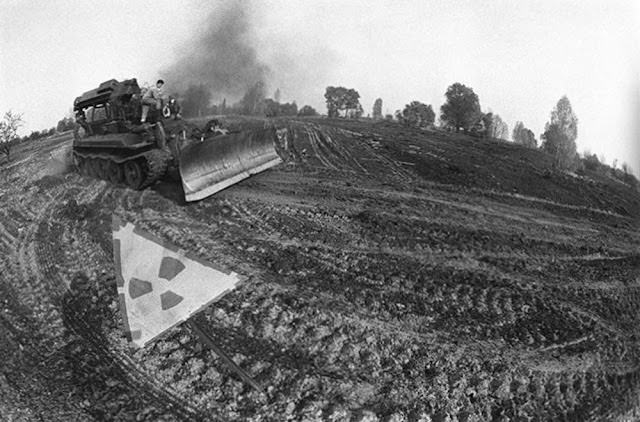
It was located 7km from the Chernobyl reactor that housed the control room and decontamination area in the months after the disaster. A bulldozer would dig a large trench in front of each house before burying the building and covering it with earth and flattening the soil. Entire villages were buried this way.
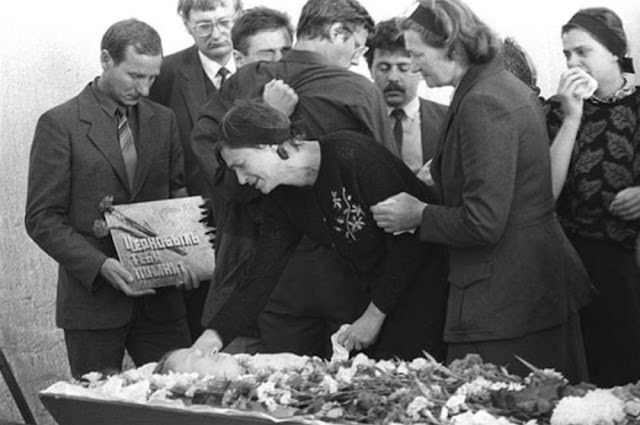
These experts were often referred to as “roof cats.” Goureiéev died as a result of contracting a radiation-related illness.
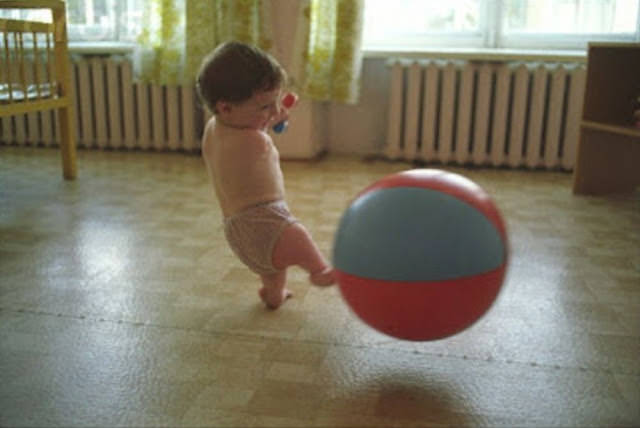
The photo was published in the local Belarus press and the boy was nicknamed “the Chernobyl Child.” It was then printed in the German magazine Stern and became a world-famous image. The child was adopted by a British family, underwent several operations, and is now living a relatively normal life.