On June 13, 1936, thousands of people packed the Blohm+Voss shipyard in Hamburg to watch the launch of the Horst Wessel, a new Nazi naval training vessel. High-ranking party officials attended. Adolf Hitler was there. When the Nazi flag was raised, the crowd lifted their arms in the Sieg Heil salute almost as one body. Almost. One man in the second row stood with his arms crossed firmly over his chest, his expression set, while everyone around him stretched their right arms toward the sky. That man was August Landmesser, and the photograph taken of him that day would eventually travel around the world.
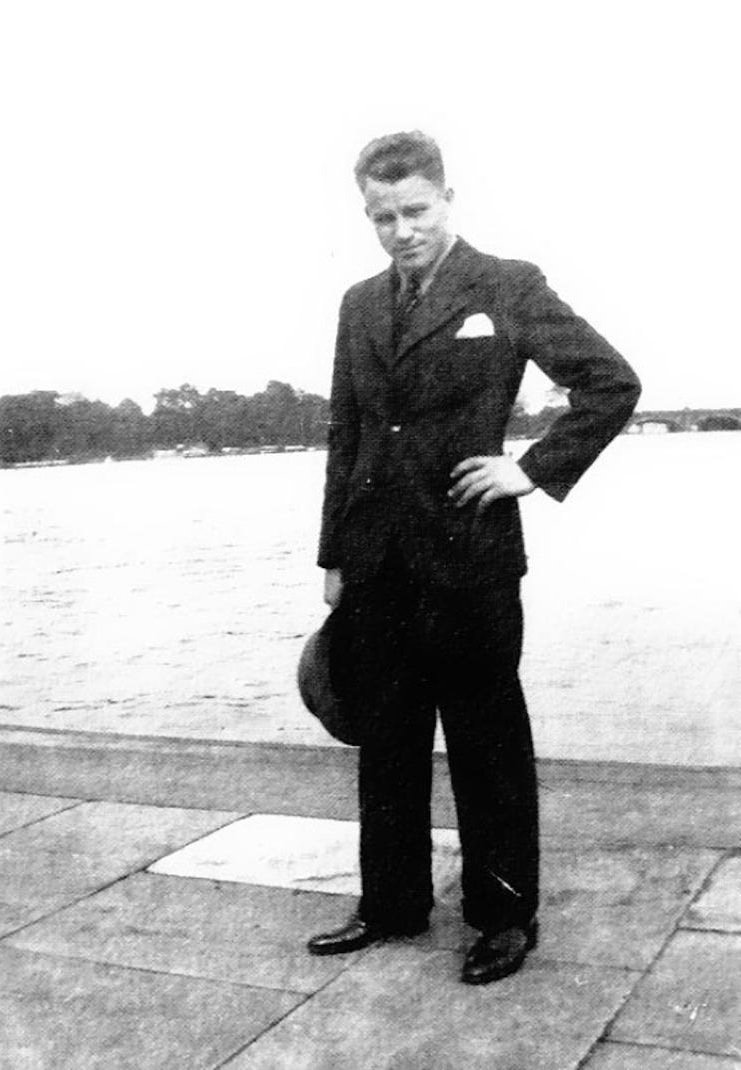
August Landmesser was born on May 24, 1910, in Moorrege, a small town in northern Germany. He grew up as the only child of a working-class family during the unstable years of the Weimar Republic. Economic collapse, mass unemployment, and political chaos defined the era. In 1931, searching for stability, Landmesser joined the National Socialist German Workers’ Party — the Nazi Party. It was a decision that would later put him on a direct collision course with the regime he had signed up to support.
In 1934, Landmesser met Irma Eckler, a young Jewish woman. They fell in love and became engaged in 1935. The timing was dangerous. The Nuremberg Laws, passed in September 1935, made marriage between Jews and non-Jews illegal across Germany. Landmesser’s engagement to Irma was not just socially unacceptable under the new order — it was a criminal act waiting to happen. His membership in the Nazi Party was revoked. He lost his job. Neither of those consequences stopped him.
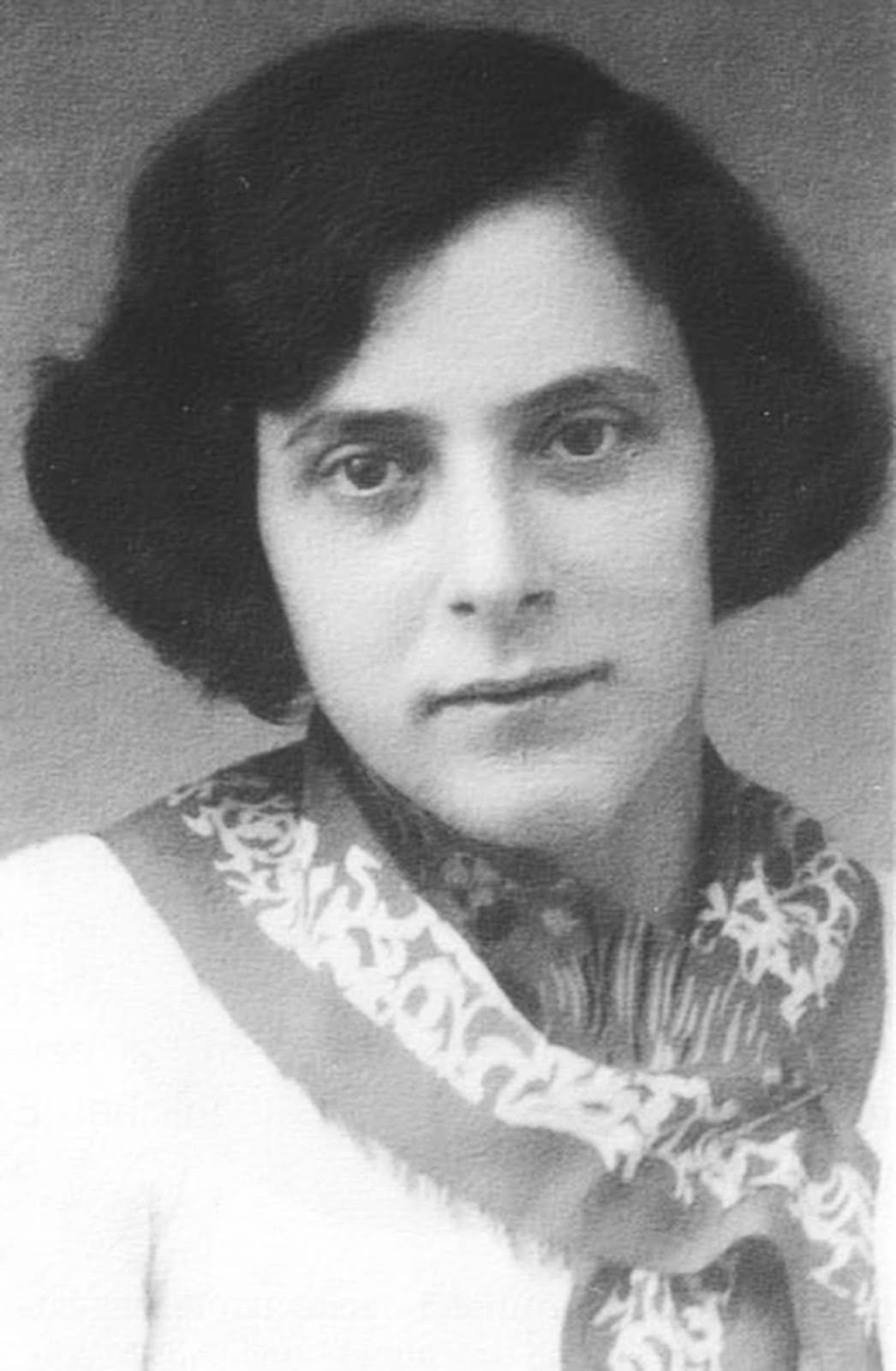
In 1936, the couple formally applied for permission to marry. The application required Landmesser to prove his Aryan descent, a bureaucratic hurdle the regime used to control who could legally form a family. The application was denied. Despite this, Landmesser and Irma continued to live together openly. They had their first daughter, Ingrid, and were expecting a second child when the photograph at the Horst Wessel launch was taken. At that point in June 1936, Landmesser was a man already stripped of his party membership and his job, openly living with a Jewish woman in defiance of the law — and still refusing to raise his arm.
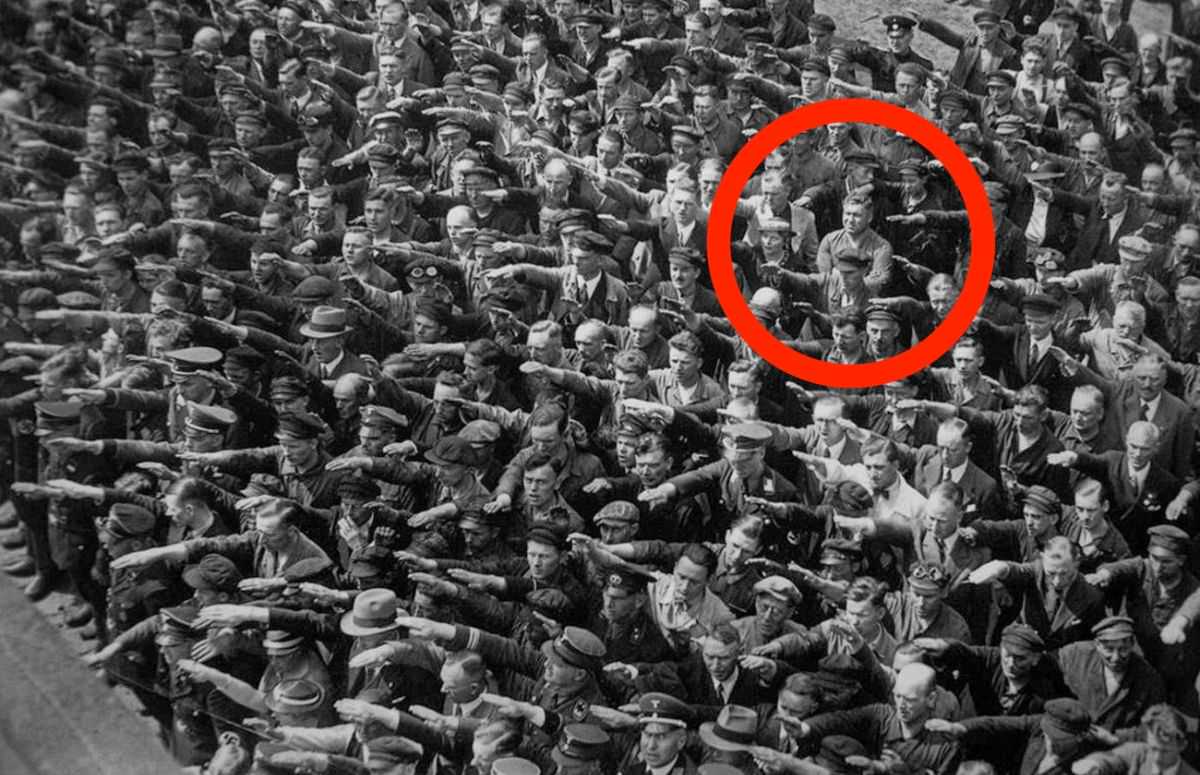
The photograph was taken by an unknown photographer and circulated in various publications, but no one identified the man with his arms crossed for decades. It was not until the 1990s that Landmesser’s daughter, Irene Eckler, came forward and identified him. She had spent years piecing together her parents’ story, and her research confirmed what the image had always suggested: this was a man who had already chosen defiance long before that afternoon at the shipyard.
The consequences that followed were severe. In 1937, Landmesser and Irma attempted to leave Germany for Denmark. The Gestapo arrested them at the border on charges of Rassenschande — a Nazi legal term meaning “dishonoring the race.” Landmesser was tried and acquitted in 1938, but the court ordered him to permanently end his relationship with Irma. He refused. He was arrested again and sentenced to two and a half years in the Börgermoor concentration camp.
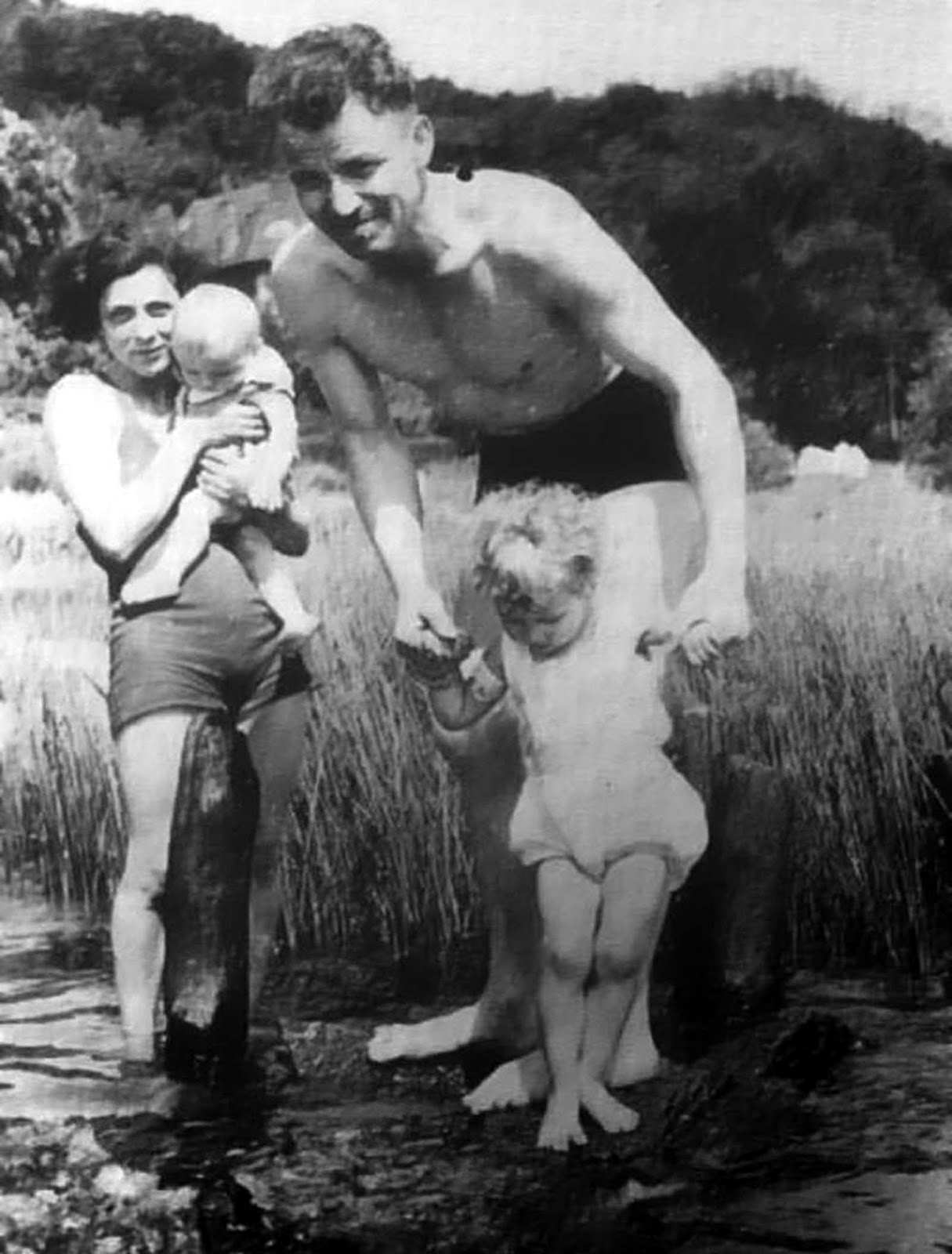
While Landmesser was imprisoned, Irma Eckler — pregnant with their second daughter — was arrested by the Gestapo and sent to Fuhlsbüttel prison. She gave birth to Irene in 1938. The baby was taken from her shortly after and placed in foster care. Irma was then moved through a series of concentration camps before being transported to Ravensbrück. She was killed in early 1942. The exact date and circumstances of her death were never fully documented.
Landmesser was released from Börgermoor in 1941. His freedom lasted only briefly. He was conscripted into the German army and deployed to the Eastern Front. In 1944, he was reported missing in action near Croatia and was presumed dead. Like so much of his story, the precise details of how he died were never established.
Their two daughters, Ingrid and Irene, grew up separated and largely without knowledge of their parents’ full story. Irene Eckler eventually wrote a biography documenting her family’s history, titled The Silent Rebel. Through her research, she not only identified her father in the famous photograph but also reconstructed the paper trail of arrests, trials, and deportations that the Nazi state had left behind. In 1996, the German government posthumously recognized the marriage between August Landmesser and Irma Eckler, granting their daughters legal standing that the Nuremberg Laws had denied them their entire lives.