The 1940s was a decade pulled in two directions. World War II dominated the first half, forcing fabric restrictions and practical dressing across much of the world. Yet fashion did not stop. Women wore knee-length A-line dresses, plaid skirts, and high-waisted pants. Stylish hats and headscarves were everywhere. Nylon lingerie arrived during this decade and quickly pushed silk stockings aside. Despite rationing and wartime limits, designers and their models found ways to make clothing feel elevated, purposeful, and beautiful.

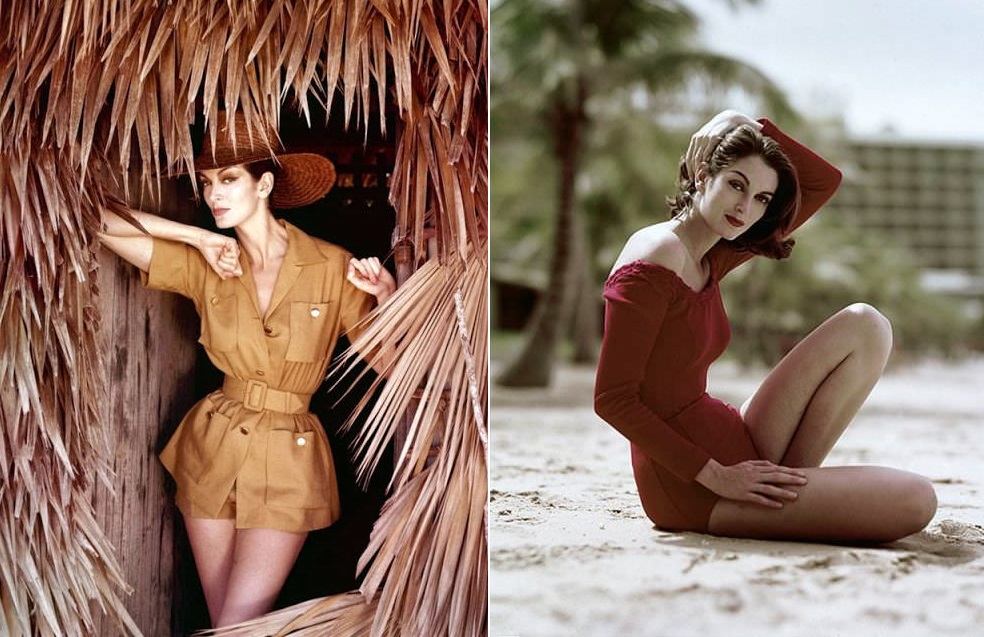
No photographer captured this era of fashion more precisely than Louise Dahl-Wolfe. An American working primarily for Harper’s Bazaar from 1936 through the 1950s, she built a reputation for shooting in natural light and open-air settings. Where many photographers of the time relied on studio setups and artificial lighting, Dahl-Wolfe preferred the outdoors. Her subjects appeared in deserts, foreign cities, seaside locations, and private homes — real environments that gave her images a sense of life and movement that studio shots rarely achieved.

Dahl-Wolfe worked with some of the most recognized names of her time. Her subjects included actresses Mae West and Josephine Baker, writer Eudora Welty, and photographer Cecil Beaton. Her fashion sittings featured the top models of the 1940s, women like Dorian Leigh, Lisa Fonssagrives, Lauren Bacall before her film fame, and Betty Threatt. She photographed them wearing designs by Charles James, Claire McCardell, Christian Dior, Mainbocher, and Pauline Trigère, among many others.


By 1941, the war’s influence on clothing was being felt even in the pages of Harper’s Bazaar. Structured suits, tailored coats, and precise accessories became the dominant look. A brooch at the waist or a carefully chosen hat could transform a plain wartime outfit into something elegant. Designers and editors worked within tight material limits while still producing looks that felt polished and considered.


Dahl-Wolfe’s willingness to photograph in private homes set her apart. Shooting Betty Bond in her own bedroom in Frenchtown, New Jersey, rather than a staged studio, gave the image an authenticity that readers responded to. This approach extended to her outdoor work as well. In January 1942, she traveled to Taliesin West — architect Frank Lloyd Wright’s winter home in Phoenix, Arizona — to photograph model Bijou Barrington in sportswear by Jay Thorpe against the dramatic desert architecture.


Dahl-Wolfe regularly took her camera far from New York. In May 1942, she photographed models Liz Gibbons and Bijou Barrington in the Andes in Peru. These international locations were not just backdrops — they placed American fashion in a global context at a time when international travel was genuinely dangerous.


Among the young women Dahl-Wolfe photographed in 1943 was Betty Bacall — later known to the world as Lauren Bacall — shot in the high-ceilinged living room of the Ritz Tower in New York. At the time, Bacall was a teenage model just beginning her career. Dahl-Wolfe’s Harper’s Bazaar images played a direct role in getting Bacall noticed in Hollywood.


By 1944, American sportswear was coming into its own as a distinct fashion category. Claire McCardell was a leading force in this shift, creating practical yet stylish pieces that suited the realities of wartime life. Dahl-Wolfe photographed McCardell’s designs multiple times throughout the decade, including a fitted tweed suit with a hood that folded down into a turtleneck — a piece that combined function and fashion without sacrificing either.


The final years of the war saw American fashion photography growing increasingly confident. Models like Dorian Leigh and Lisa Fonssagrives were becoming major figures in their own right. Dahl-Wolfe photographed both women together in February 1945, a pairing that put two of the era’s most prominent faces in a single frame. Lauren Bacall — by now a rising film star — also appeared in a 1945 shoot wearing a navy off-shoulder top with a bare midriff and brown shorts, a look that felt modern and relaxed by the standards of the decade.


With the war over, 1946 brought a renewed energy to fashion shoots. Dahl-Wolfe traveled to Brazil to photograph models Betty Bridges and Bobby Monroe at the home of Raimundo Castro-Maia in Tijuca. That same year, she photographed a model in a Lanvin gown and stole at the Hôtel Soubise in Paris — now the site of the Musée des Archives Nationales — a setting that announced fashion’s return to European grandeur.


In 1947, Christian Dior launched his New Look collection, a dramatic shift toward longer skirts, nipped waists, and a fuller silhouette. It was a direct rejection of wartime austerity. Dahl-Wolfe was in Paris to photograph it. Her images of Dior’s redingote, his black wool crêpe New Look coat, and a ball gown shot at the Chateau de Madrid placed her at the center of fashion’s most talked-about moment of the decade.


Dahl-Wolfe also made extensive use of her own New York City studio in 1947, shooting models Natalie Paine and Sandra Payson there in suits and coordinated accessories. These studio sessions showed a different side of her work — controlled, precise, and focused entirely on the clothing itself. A Philip Magone dress paired with a John Frederics hat and matching gloves, or a Roxspun suit accessorized with a Sally Victor hat, demonstrated how accessories in the 1940s were treated as essential parts of a complete look, not afterthoughts.


The late 1940s brought a wider range of silhouettes and occasions into Dahl-Wolfe’s lens. Swimwear shoots grew more inventive. A 1948 sitting showed a Cole of California combination sun dress and bathing suit — the wired-bra top clamped on to leave the back exposed, with swimming trunks worn under the skirt. Other poolside images showed Hollywood-made swimsuits in gold Lastex fabric and pink two-pieces, reflecting the growing postwar market for resort and leisure clothing.


By 1949, Dahl-Wolfe was photographing the full range of postwar fashion — from Christian Dior’s ruby-red silk velvet dinner suit on Betty Threatt to a Norman Norell leopard-print halter top worn over a white silk chiffon skirt. Eveningwear had become more dramatic. An emerald green satin gown by Omar Kiam for Ben Reig, accessorized with Miriam Haskell jewels, appeared in the October 1949 issue. These late-decade images showed how far women’s fashion had traveled since the austerity of 1942.