
In 1943, the United States Coast Guard had a rat problem. Ships crossing the Atlantic were plagued by rodents that chewed through supplies, damaged equipment, and created health hazards for sailors. The solution the Coast Guard landed on was straightforward: recruit a cat. What they did not plan for was that the cat they chose would become an official, card-carrying member of the service.
Herman was a gray street cat living in Baltimore, Maryland. He roamed the city’s busy wartime streets, hunting by instinct and answering to no one. Baltimore in 1943 was a city running at full speed — factories humming, shipyards working around the clock, and families sending sons and husbands off to war. Herman moved through it all, unaware that a Coast Guard scout was about to change the course of his life.
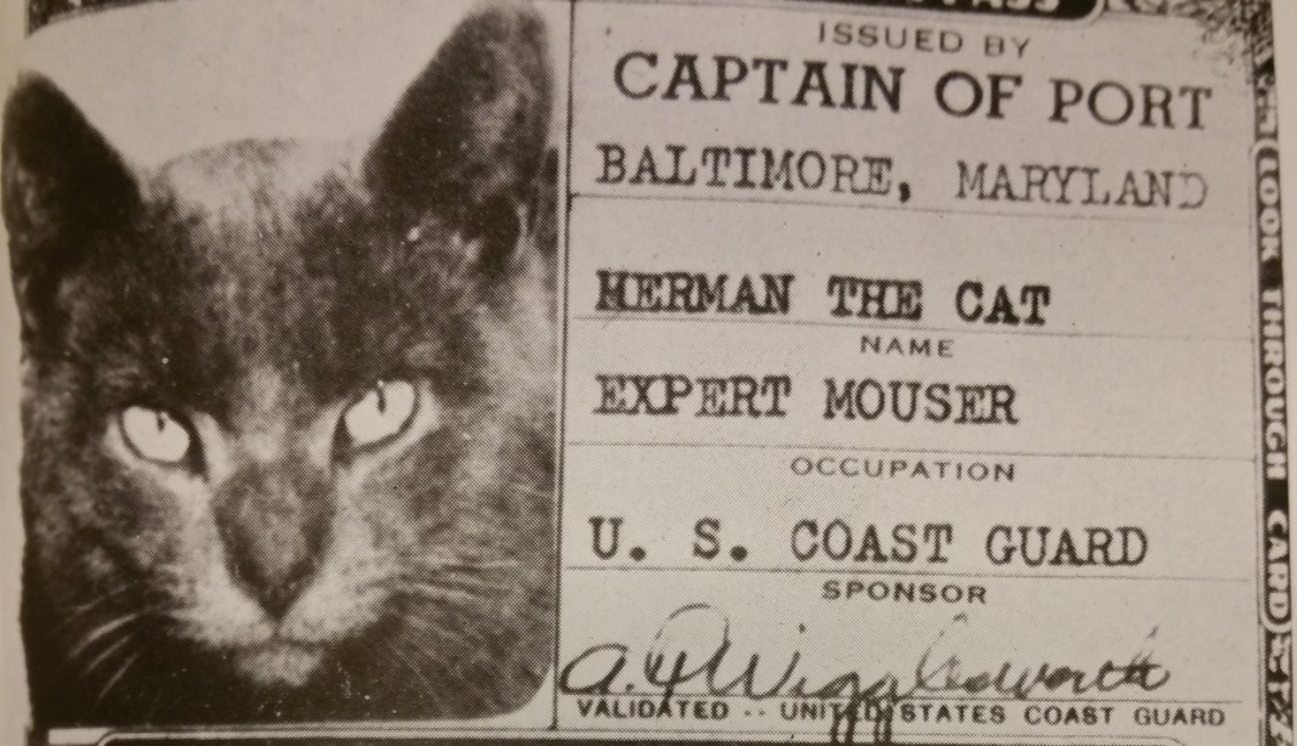
A Coast Guard recruiter spotted Herman during one of his prowling sessions and recognized the makings of what the service would officially call an “Expert Mouser.” Herman was brought aboard and formally inducted into the U.S. Coast Guard. This was not a casual or symbolic gesture. Herman received an official identification card, assigned the serial number 05225058. The card carried no expiration date — Herman’s enlistment was indefinite.
Adjusting to life at sea was a real transition. The ship’s metal corridors, the constant vibration of engines, and the smell of salt water were nothing like the streets of Baltimore. Herman adapted quickly. Cats are territorial by nature, and Herman wasted little time learning the layout of the vessel and establishing his domain. The rats onboard had met their match.
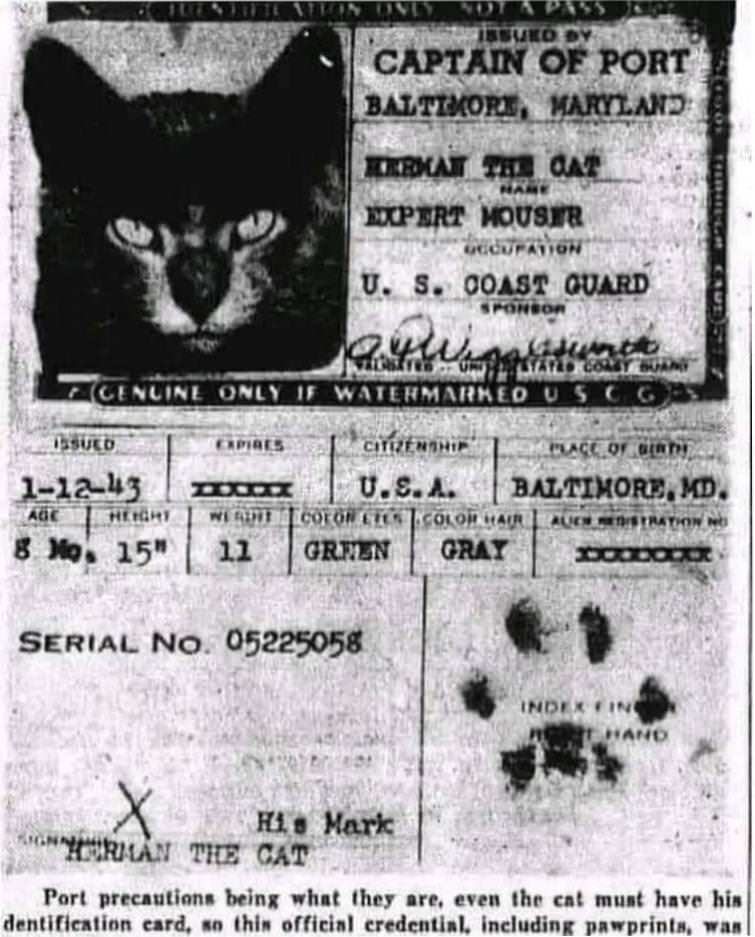
Herman’s job was practical and taken seriously. Rats aboard military vessels were not a minor inconvenience. They gnawed through food stores that sailors depended on for long voyages. They damaged wiring and critical equipment at a time when every piece of gear on a ship mattered. A working mouser was a genuine operational asset, and Herman delivered.
Beyond the rat-catching duties, Herman became a fixture of daily life for the crew. Sailors swapped stories about his nighttime hunts through the lower decks. His presence brought something harder to measure but just as real — a small, breathing piece of normalcy in the middle of a war. Sailors wrote about him in letters home. A gray cat with a serial number and an ID card became a name known on both land and sea.
Herman’s story stands out not just because a cat was given a military ID — though that alone is remarkable — but because the Coast Guard treated his role as a legitimate one. He was not a mascot in the loose, unofficial sense. He was enrolled, documented, and put to work. His ID card was issued with the same process used for human personnel, complete with a serial number that placed him formally within the service’s records.
The wartime Coast Guard operated in some of the most dangerous waters in the world, protecting convoys, conducting search-and-rescue missions, and maintaining coastal defenses. Herman served aboard a vessel that was part of that larger machine. While admirals planned operations and sailors stood watch, a Baltimore street cat patrolled the lower decks, doing exactly the job he was recruited to do — and doing it well enough to earn a permanent place in the ship’s crew.



Awesome!