
By 1900, Denver was no longer the raw, ramshackle camp that gold seekers had thrown together on Colorado’s front range in 1858. Decades had passed since the rush, but the energy it left behind had hardened into something permanent. Streets were paved. Buildings climbed skyward. Entire neighborhoods had taken shape where there had once been nothing but open plain. The people who stayed — and the thousands who came after — built a city with real institutions, real commerce, and real civic ambition. These photographs capture Denver at that exact moment of transformation, when it was becoming something larger than its frontier origins.
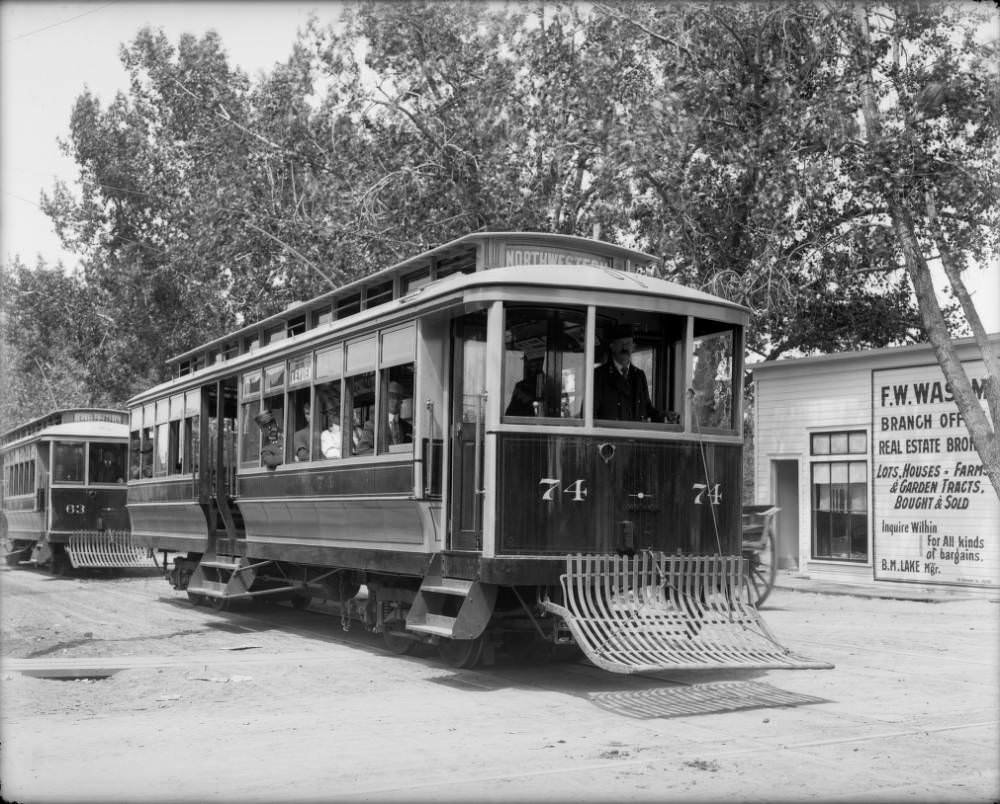
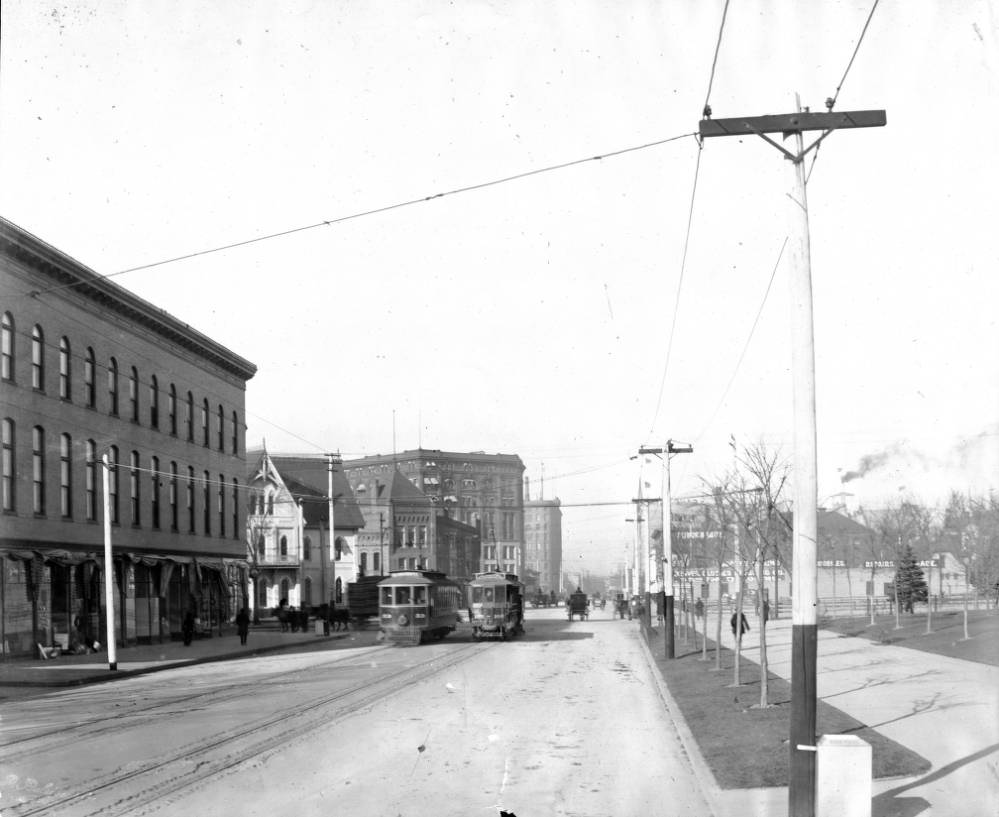
Nothing reshaped Denver’s daily life more visibly than the electric streetcar. The old horse-drawn lines gave way to a humming network of tramway cars that connected neighborhoods across the city. Workers, shoppers, and schoolchildren all relied on the Denver Tramway Company to move through a city that was spreading rapidly outward. New suburbs took root along the lines, and wherever a trolley stopped, businesses and homes followed. The tramway wasn’t just transportation — it was the skeleton around which modern Denver grew.
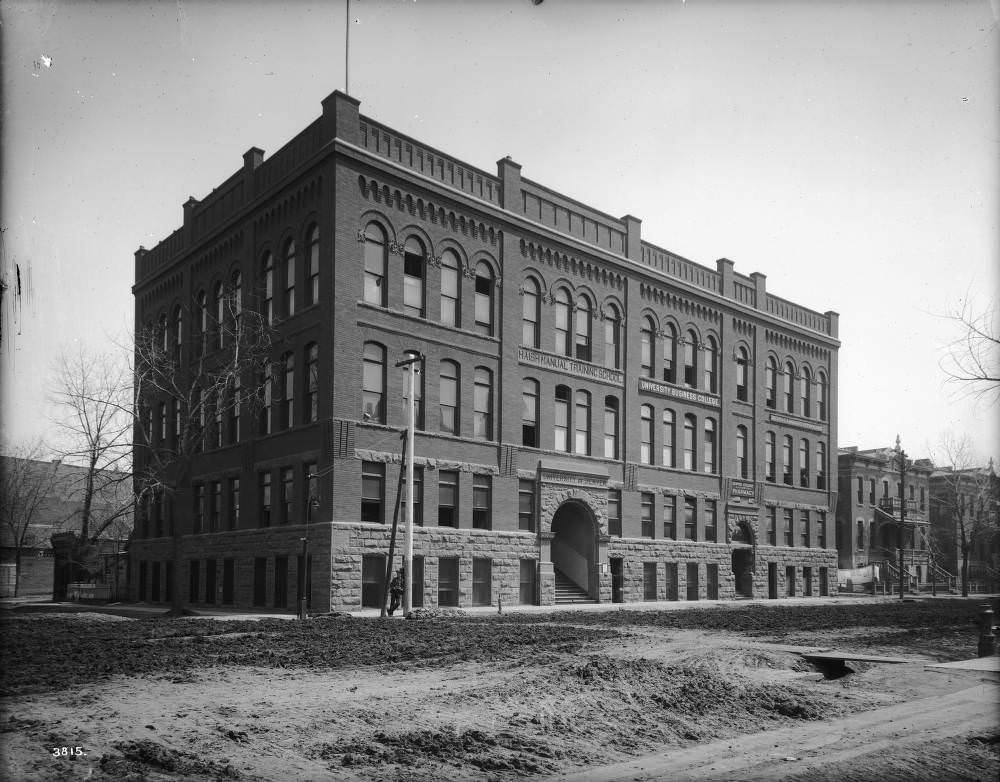
Education was a serious priority in turn-of-the-century Denver. The University of Denver’s Haish Manual Training School reflected a broader belief that practical skills — woodworking, metalwork, sewing — were just as important as academic ones. Schools across the city were being built and expanded, and enrollment was growing as immigrant families settled into established neighborhoods. Denver’s leaders understood that a city’s future depended on what it taught its children, and the buildings they constructed for that purpose were meant to signal permanence and civic pride.
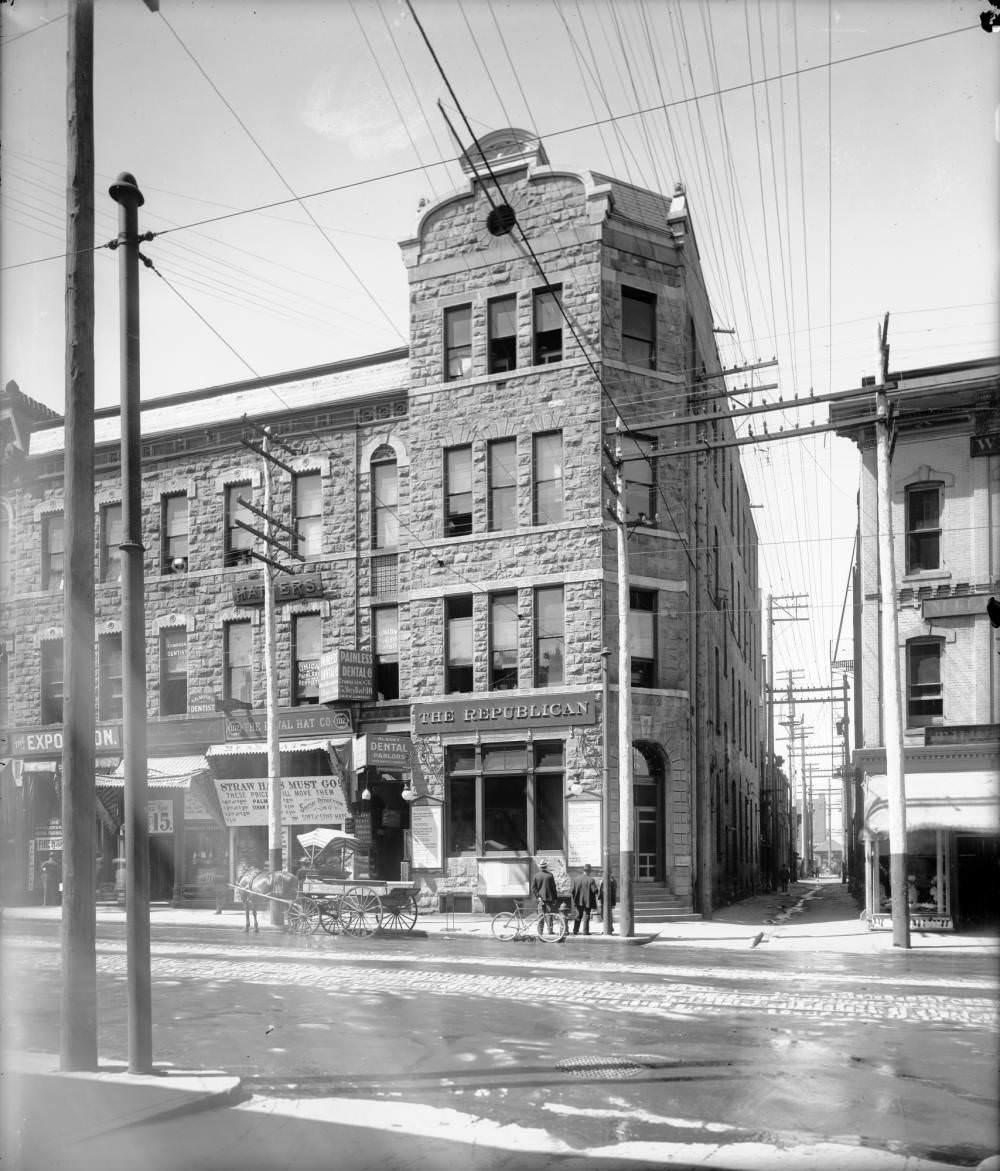
16th Street was Denver’s commercial spine. Newspapers, department stores, hotels, and government offices lined its blocks, and pedestrians filled its sidewalks at all hours. The Denver Republican was one of the city’s major papers, and its building on 16th Street put it squarely in the center of public life. Print journalism shaped how Denverites understood their city, their politics, and the wider world. A walk down 16th Street in 1905 meant passing storefronts advertising everything from dry goods to railway tickets.
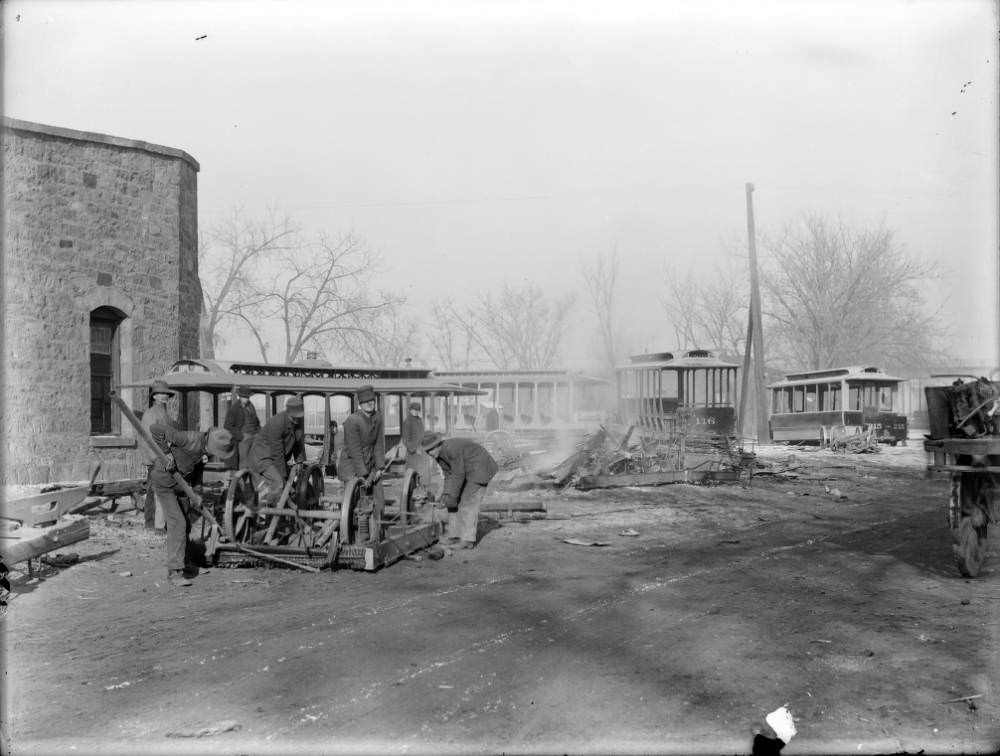
The tramway system was constantly evolving. Older cars were retired and scrapped as newer, larger models replaced them. The Denver Tramway Company operated one of the most extensive urban rail networks in the American West, and keeping it running required a sprawling infrastructure of machine shops, storage yards, power stations, and repair crews. These workers, often unseen by the passengers they served, were essential to the city’s daily rhythm.
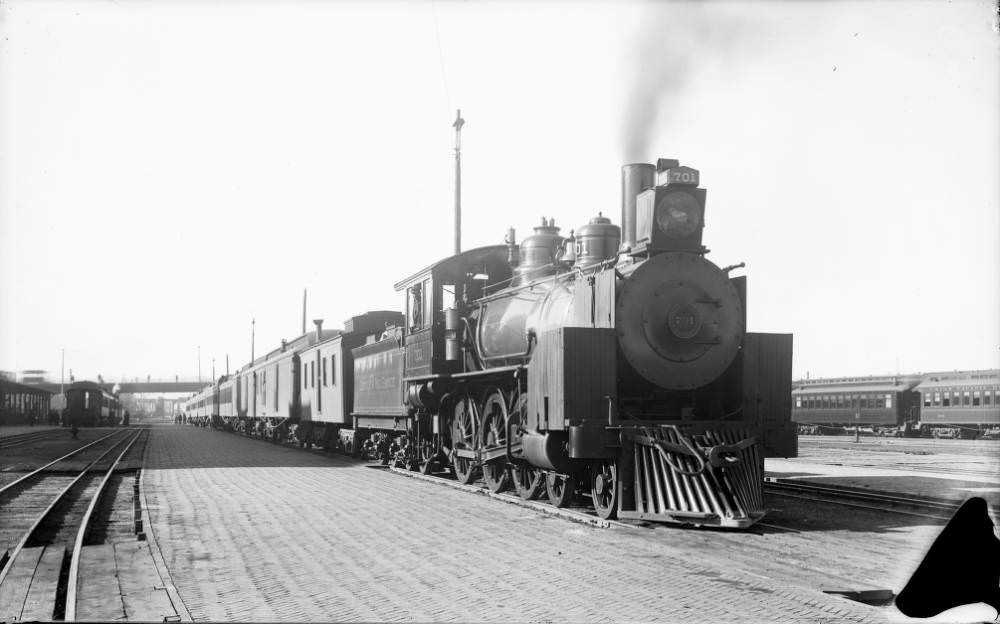
Denver’s Union Station was the gateway to the city. Railroads like the Denver and Rio Grande brought in passengers, freight, coal, and supplies from across the region. The station connected Denver to mining towns in the mountains and markets in the east, making it a vital economic hub. Arriving by train at Union Station and stepping onto 17th Street was many people’s first impression of Denver — and the city made sure that impression was a strong one.
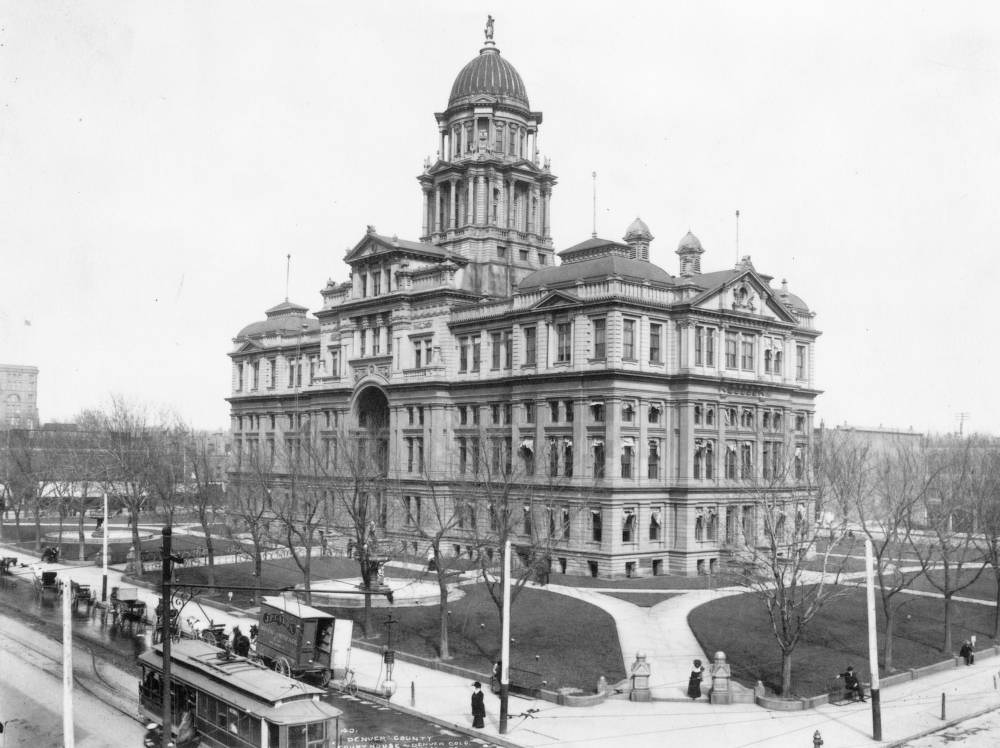
Denver’s civic architecture in the early 1900s was designed to project authority and stability. Courthouses, city halls, and public libraries were built large and built to last. The Denver County Courthouse at 15th and Tremont sat at the heart of civic life, surrounded by the constant motion of streetcars and pedestrians. The city’s leaders were influenced by the “City Beautiful” movement championed by architect Daniel Burnham, which called for grand public spaces, wide boulevards, and imposing civic buildings that would inspire confidence in municipal government.
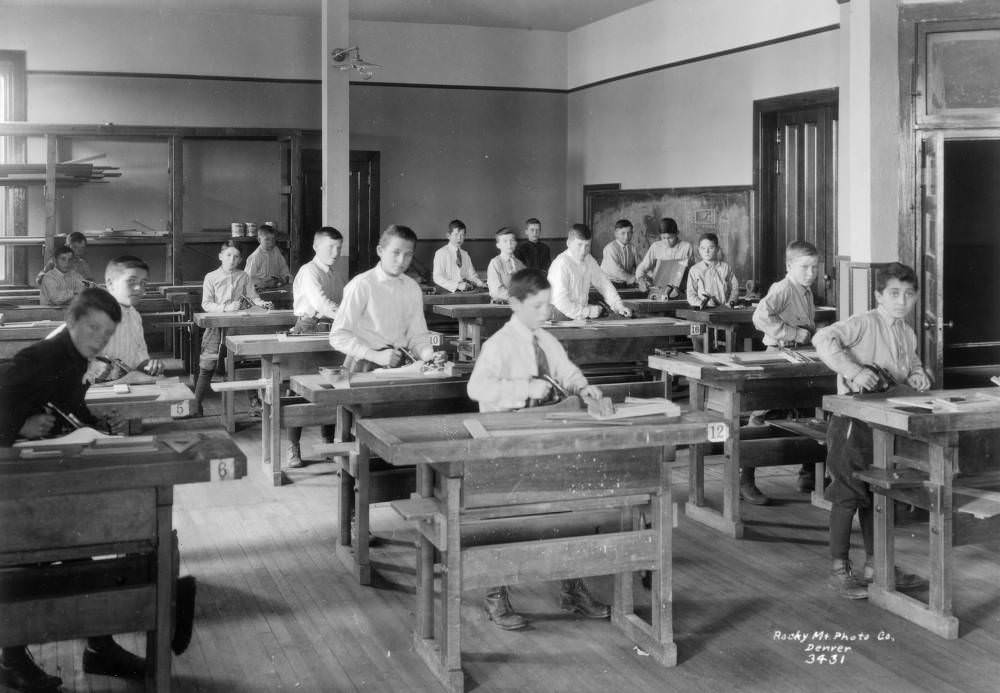
The Denver Orphans’ Home on Albion Street housed children who had lost their parents or been abandoned. Boys were taught woodworking and other manual trades, while girls learned sewing and domestic skills. Life inside the home was structured around work and education. These children occupied a difficult position in Denver society — they were cared for, but always with an eye toward making them self-sufficient as quickly as possible. Institutions like this one were privately funded through donations from Denver’s wealthier residents.
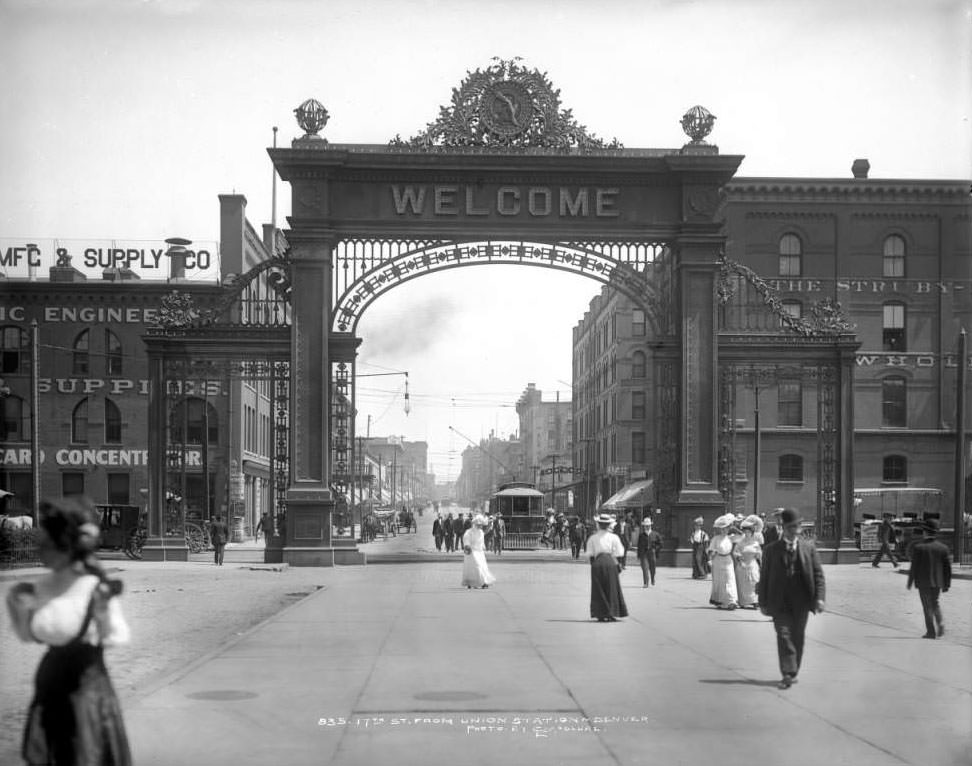
The Welcome Arch at Union Station greeted every traveler who arrived in Denver by rail. Erected in 1906, it spanned 17th Street and bore the words “Welcome” on one side and “Mizpah” — a Hebrew word of farewell — on the other. The arch became one of Denver’s most recognized landmarks, and the view down 17th Street from the station showed a city that had grown confident in its identity. Hotels, banks, and office buildings stretched toward the mountains in the distance.
Denver’s streetcar lines reached beyond the city’s core into surrounding communities. Signs for destinations like Wheat Ridge appeared on tramway cars threading through the western neighborhoods, reminding riders that the system connected not just Denver’s districts but the entire metropolitan region. This expanding reach brought outlying communities into Denver’s economic orbit and accelerated the development of areas that had previously been rural farmland.
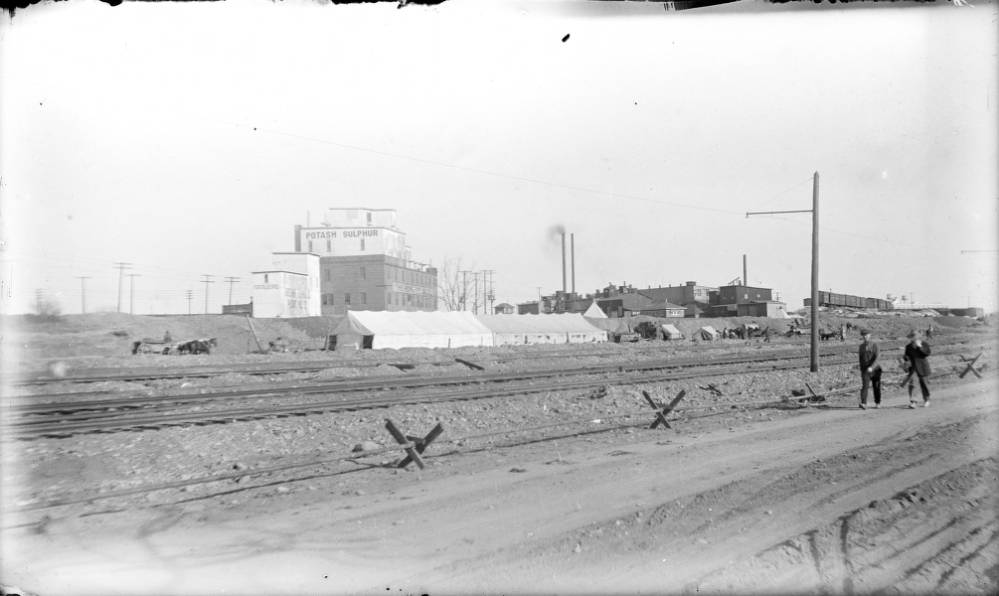
Behind the smooth operation of the trolley lines was a massive physical infrastructure. Storage yards, construction sites, and maintenance facilities occupied large portions of Denver’s industrial zones. The tramway company’s expansion in the early 1900s required constant building — new car barns, new track, new power connections. The construction site at Jason Avenue and Bayaud Street in 1904 was just one of many such projects underway across the city as Denver’s transit network kept pace with its population growth.
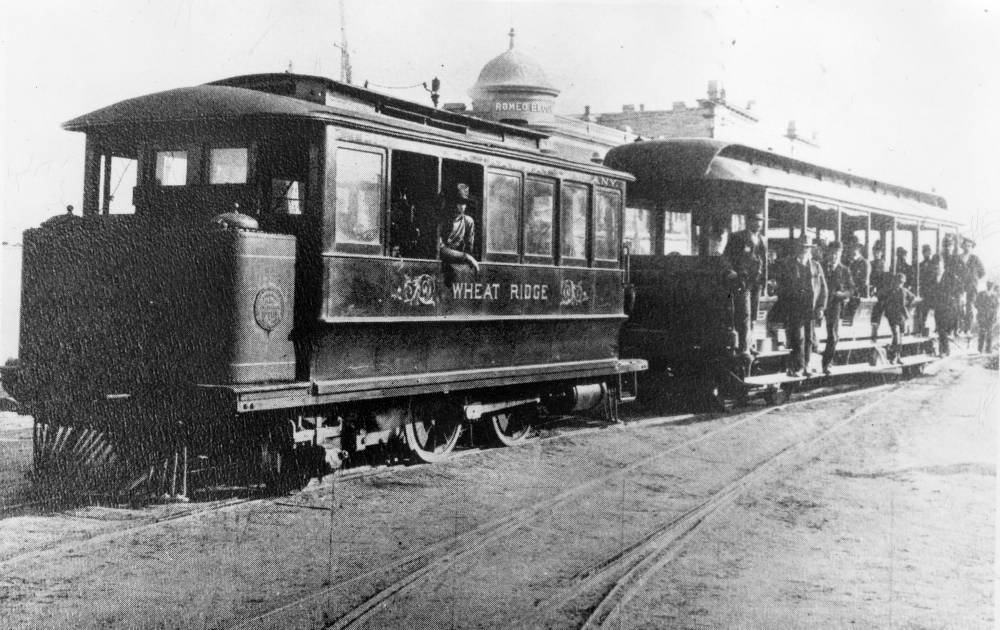
Before the electric trolley dominated Denver’s streets, the city relied on earlier technologies including steam-powered dummy cars — small locomotives designed to look like passenger coaches so as not to spook horses. These transitional vehicles bridged the gap between horse-drawn transit and the fully electric system. By 1900, the steam dummy was largely a relic, displaced by the overhead wire and the electric motor, but photographs of them survive as evidence of how quickly Denver’s transit technology evolved in just a few decades.
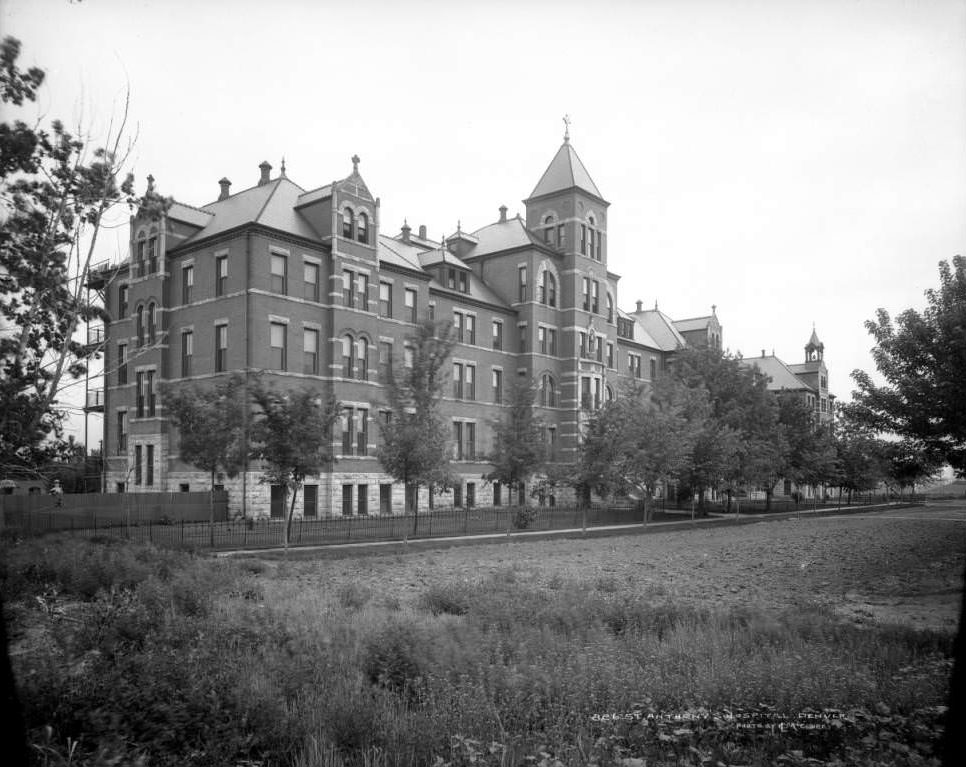
Healthcare in early 1900s Denver was largely organized around religious institutions. Saint Anthony’s Hospital, founded by the Sisters of St. Francis Seraph, was one of the city’s most important medical facilities. Religious orders — Catholic, Protestant, and Jewish — ran hospitals, orphanages, and charitable homes throughout Denver. The city also maintained public health facilities, including Denver General Hospital, which handled the city’s poorest and most vulnerable residents, including patients in the tuberculosis ward.
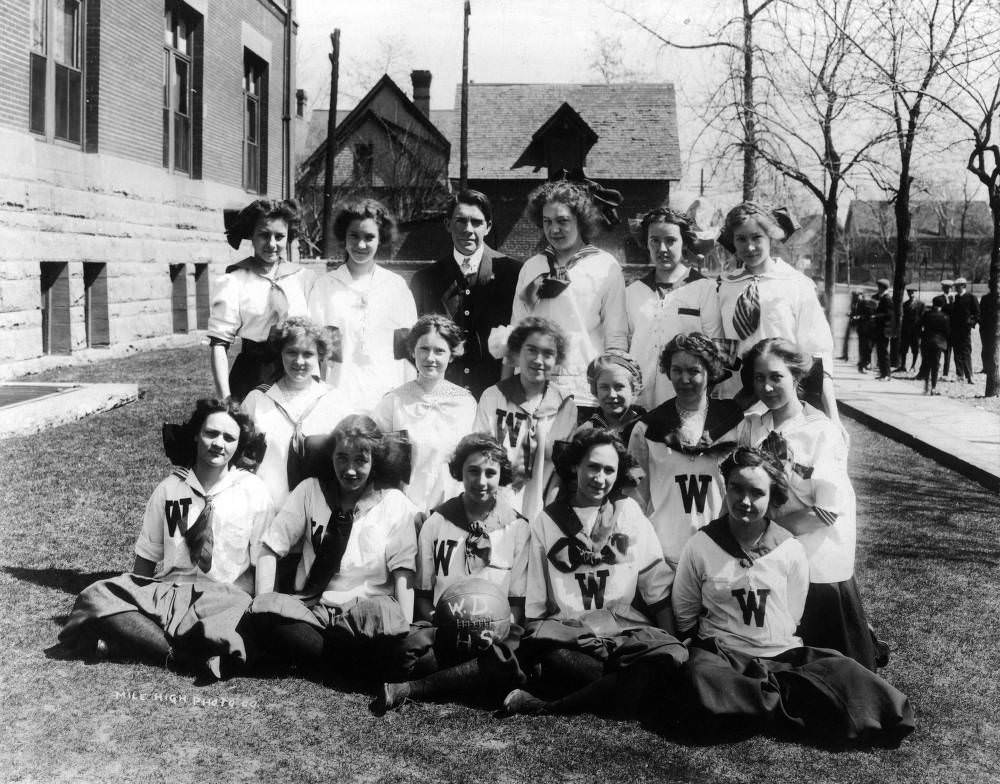
Women’s athletics in Denver were more organized than many people today might expect. By 1908, the women’s basketball team at West Denver High School had uniforms, a coach, and a schedule. Women’s sports in this era were often dismissed or treated as novelties, but teams like this one competed seriously. Margaret “Molly” Brown, one of Denver’s most famous residents of the period, was herself a vocal champion of women’s rights and social reform. Her work — and the energy of women across the city — pushed Denver toward a more inclusive public life.
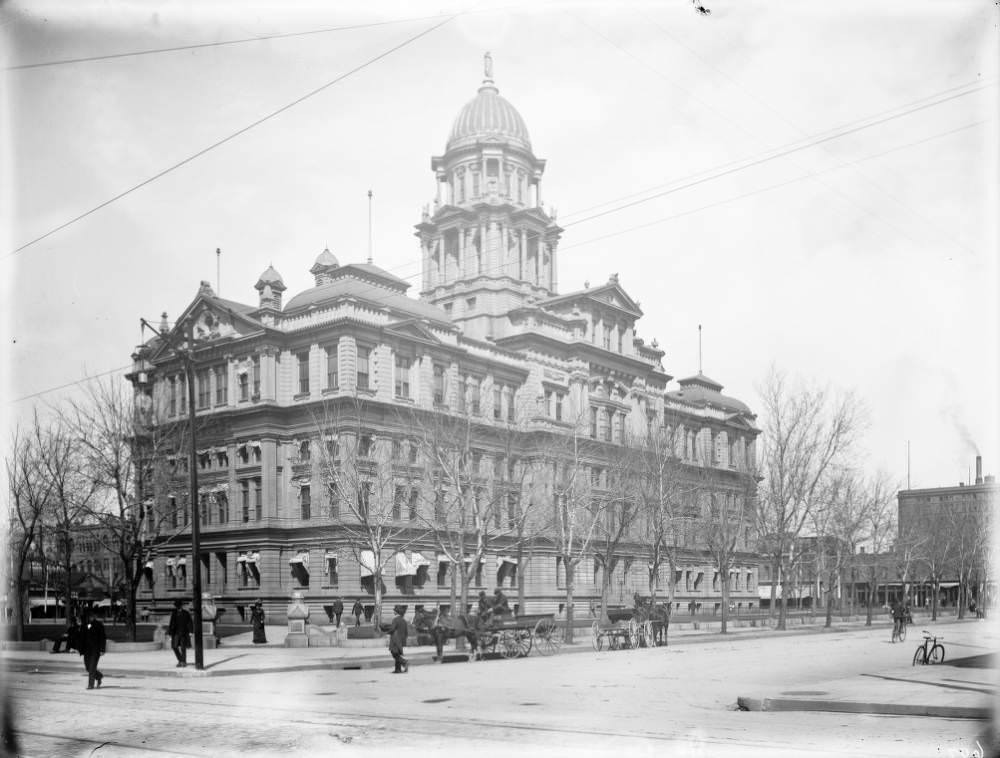
The streets around Denver’s courthouse were a mix of the old and the new. Horse-drawn buggies still shared the road with electric trolleys, and pedestrians navigated a streetscape that was changing faster than most cities of comparable size. Denver had been reorganized as its own county in 1902, separating from Arapahoe County, and the courthouse became the Denver County Courthouse — a symbol of a city asserting its independent identity and governance.
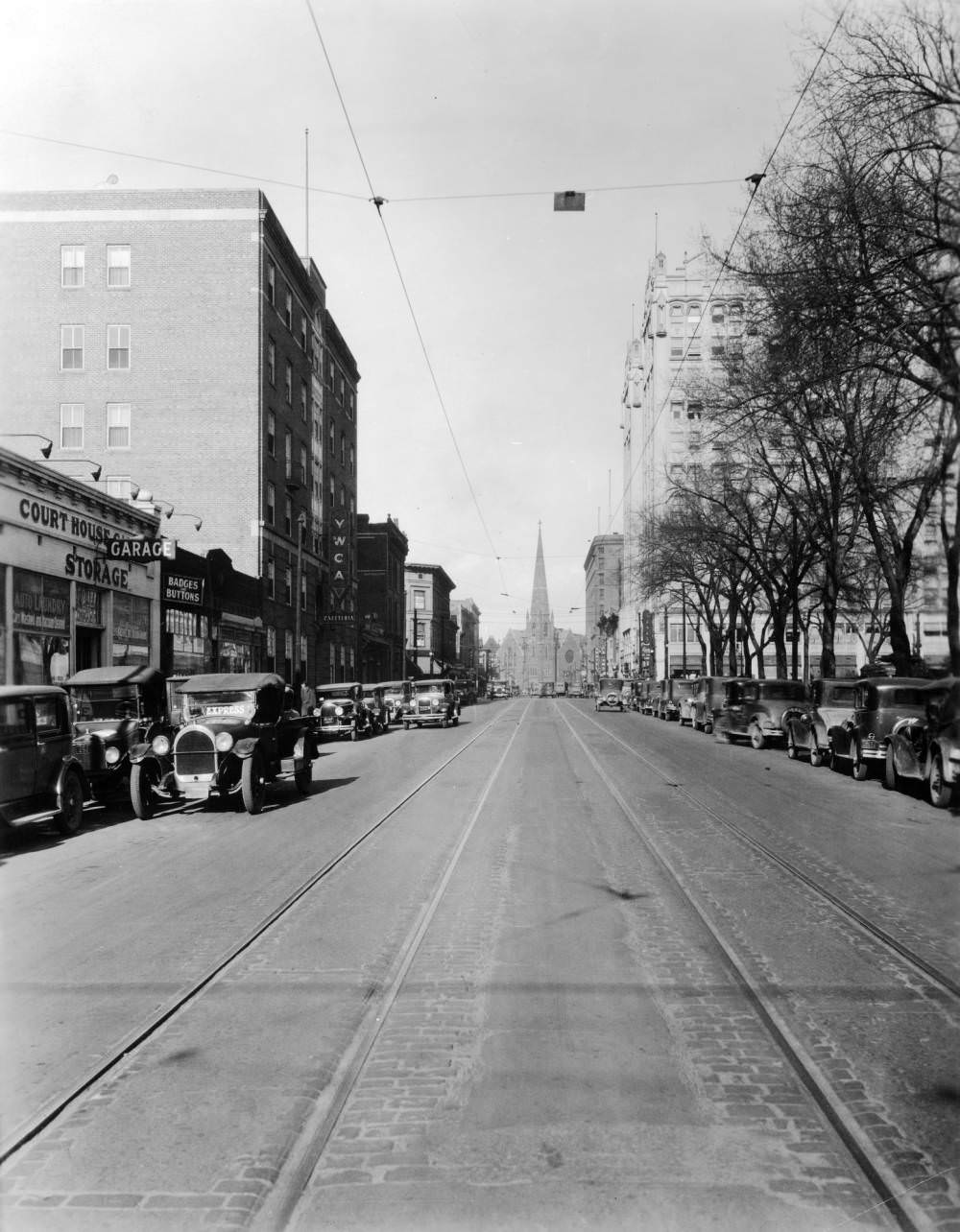
Tremont Street in downtown Denver was dense with institutions. Trinity Methodist Church, one of the city’s most prominent congregations, stood alongside commercial buildings and civic organizations. The YWCA operated nearby, offering housing, employment assistance, and social programs to women who had come to Denver looking for work. The street captured in this photograph shows a city where religious, commercial, and civic life were tightly woven together, all within walking distance of each other.
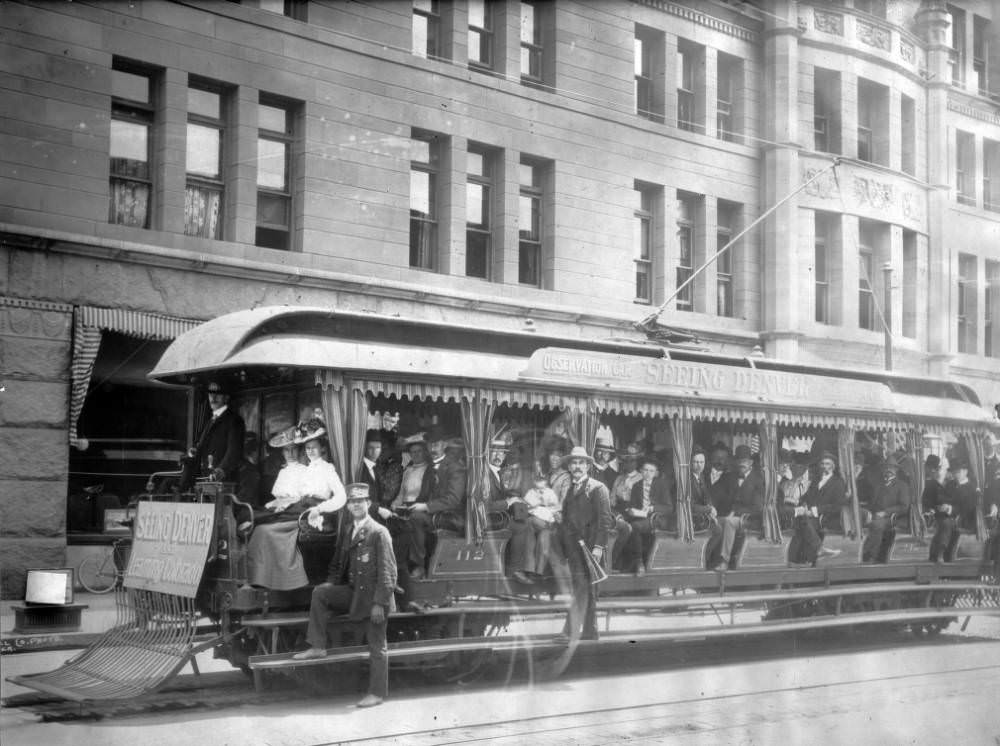
Few buildings in Denver were more celebrated than the Brown Palace Hotel. Opened in 1892 and built in a triangular shape to fit an unusual lot, it featured a soaring atrium interior with cast-iron railings on every floor. By 1905, it was already an institution — the place where wealthy visitors stayed, business deals were made, and Denver’s elite society gathered. A trolley passing in front of the Brown Palace captured the city’s dual nature: a functioning industrial transit system running past one of the finest hotels in the American West.
Colfax Avenue and Broadway was one of Denver’s busiest intersections. The Denver Fire Department’s Engine House No. One stood nearby, its horses and equipment always ready. Fire departments in this era were still transitioning from horse-drawn steam engines to motorized equipment, and Denver was at the front of that change. By 1909, the original Engine House No. One was being dismantled as the department modernized, and photographs from the demolition show stagecoaches and flags marking the end of an era.
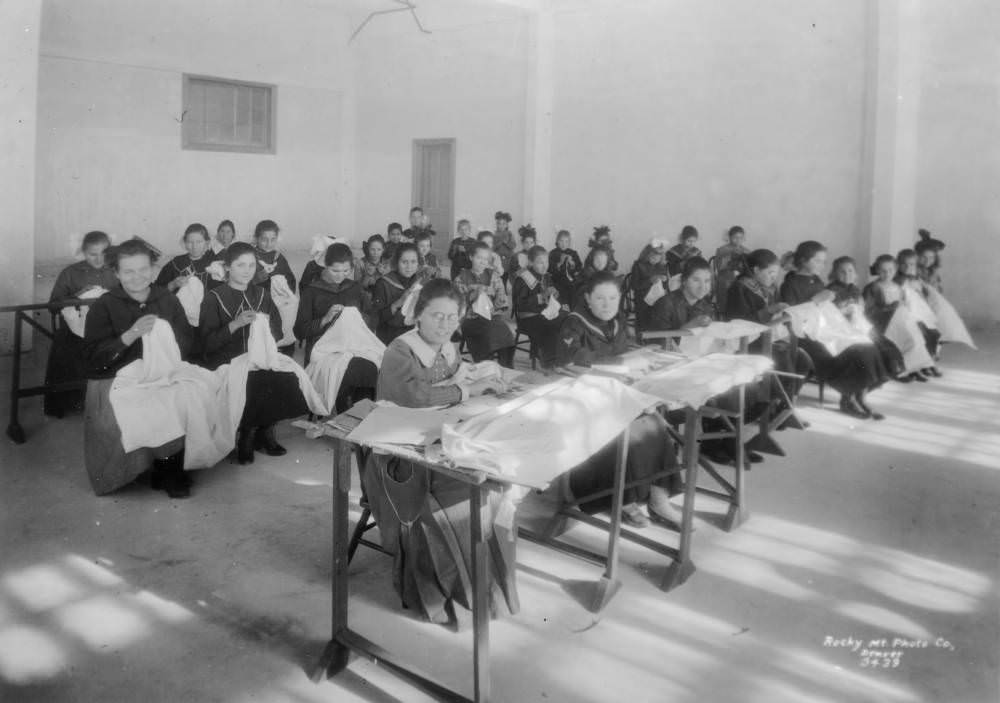
At the Denver Orphans’ Home, girls spent hours each week in sewing classes. The institution trained them in domestic skills that were considered essential for employment or household management in the early 1900s. Life inside the home was regimented — meals, classes, chores, and rest all followed a fixed schedule. The photographs taken inside the home offer a rare look at the interior lives of children who rarely appeared in newspapers or public records.
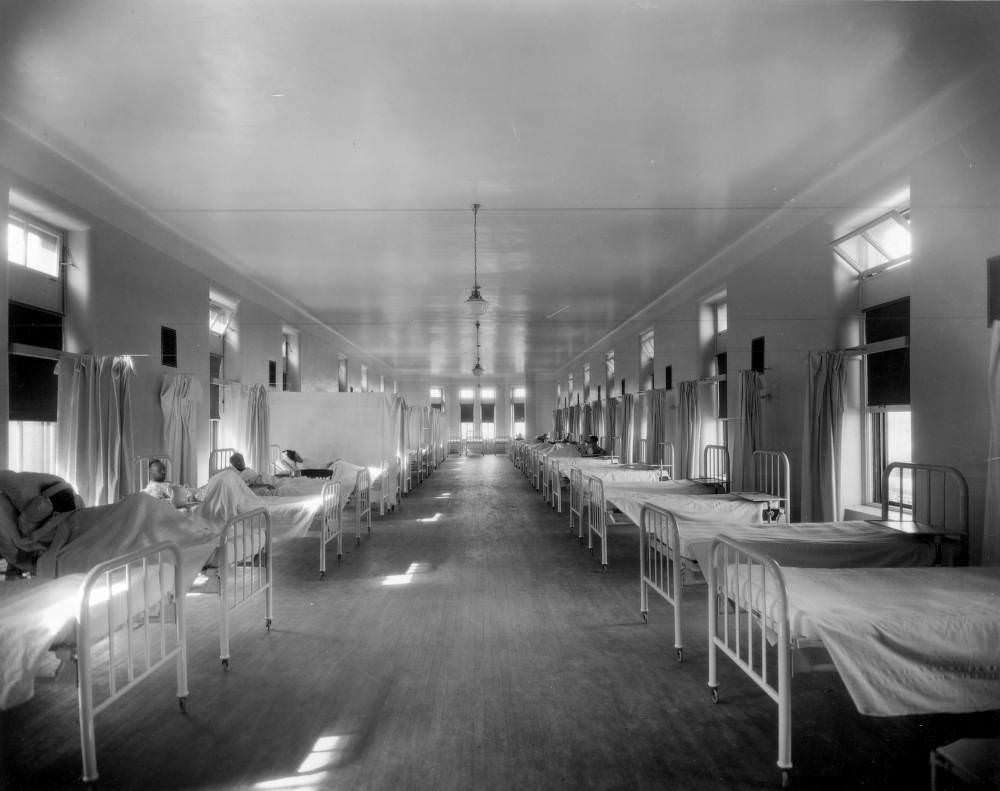
Denver General Hospital served the city’s poor and working-class population. Its wards were large open rooms with rows of beds, separated only by curtains. Patients with everything from injuries to infectious disease were treated here. Denver in the early 1900s had a significant problem with tuberculosis — the dry mountain air had attracted thousands of “health seekers” who came hoping the climate would cure their illness. The hospital’s tuberculosis ward was one of the most heavily used facilities in the building.
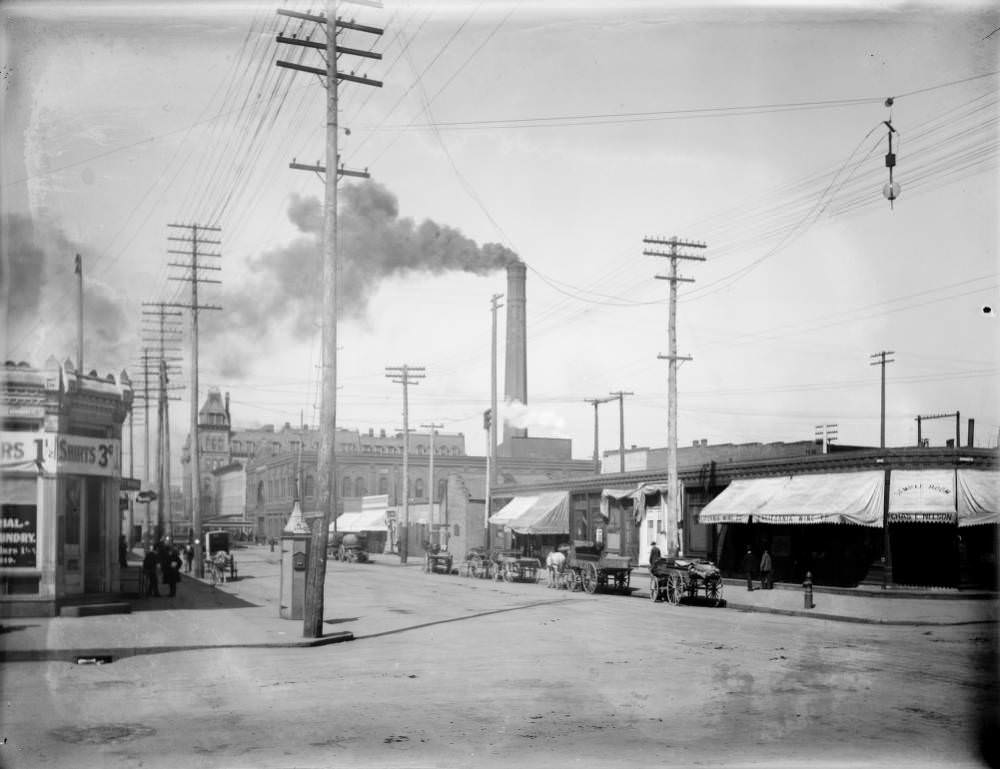
The Denver Cable Car system had preceded the electric trolley, and its power plant infrastructure was still visible on 18th Street in 1900. Cable cars used a continuously moving underground cable gripped by the car to pull it along the track. Denver’s cable system had been an impressive feat of engineering when it opened, but the electric trolley proved cheaper and more flexible. By the early 1900s, the cable infrastructure was being retired, leaving behind buildings like the power plant that would find new uses or eventually be torn down.
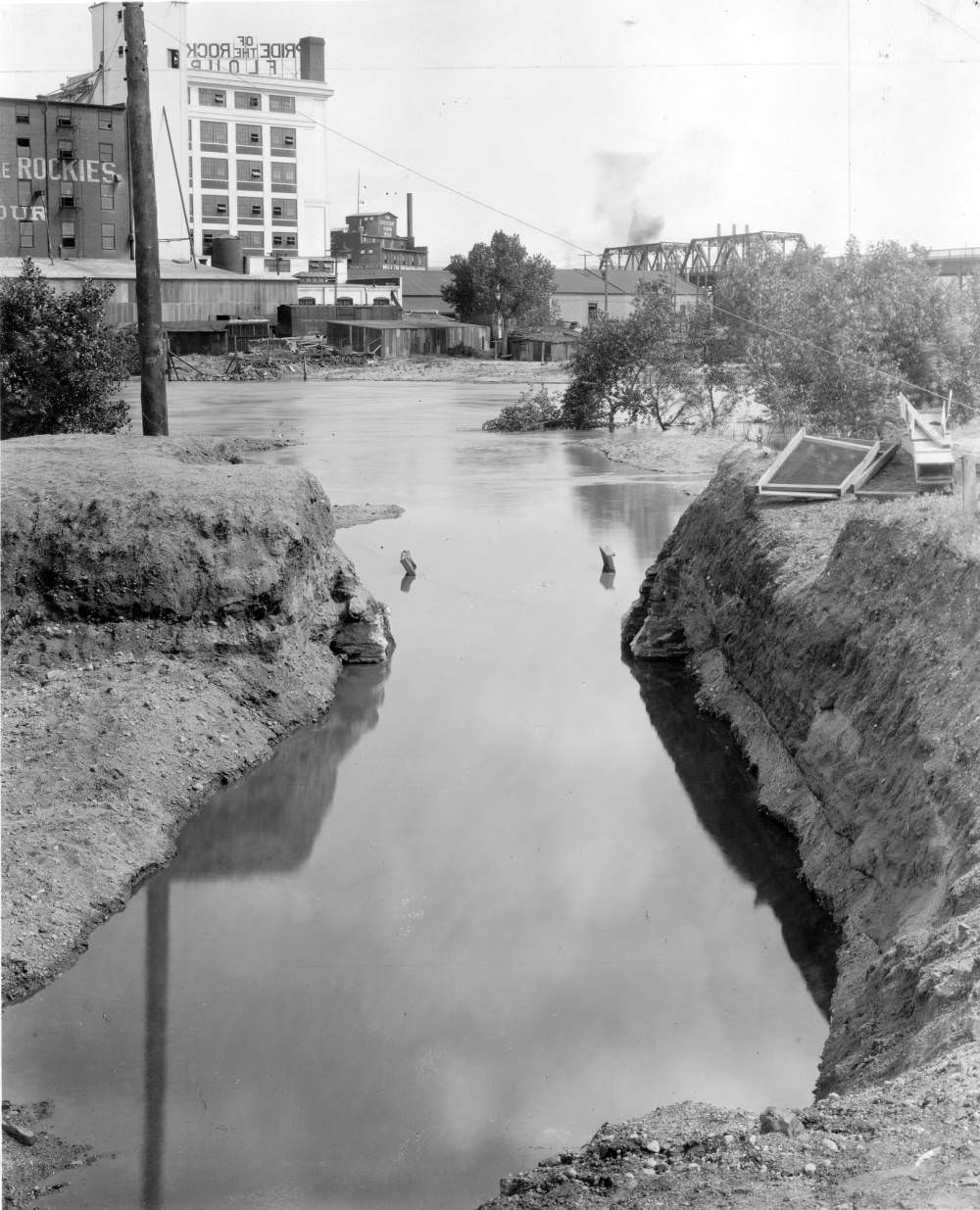
Denver’s industrial zones clustered along the South Platte River, where water access and rail connections made manufacturing practical. The Pride of the Rockies Flour Mill was one of many industrial operations in this corridor. Viaducts like the one at 20th Street carried traffic over the river and the rail yards below. These structures were engineering achievements in their own right, and they reshaped the geography of working-class neighborhoods on the city’s near west side.
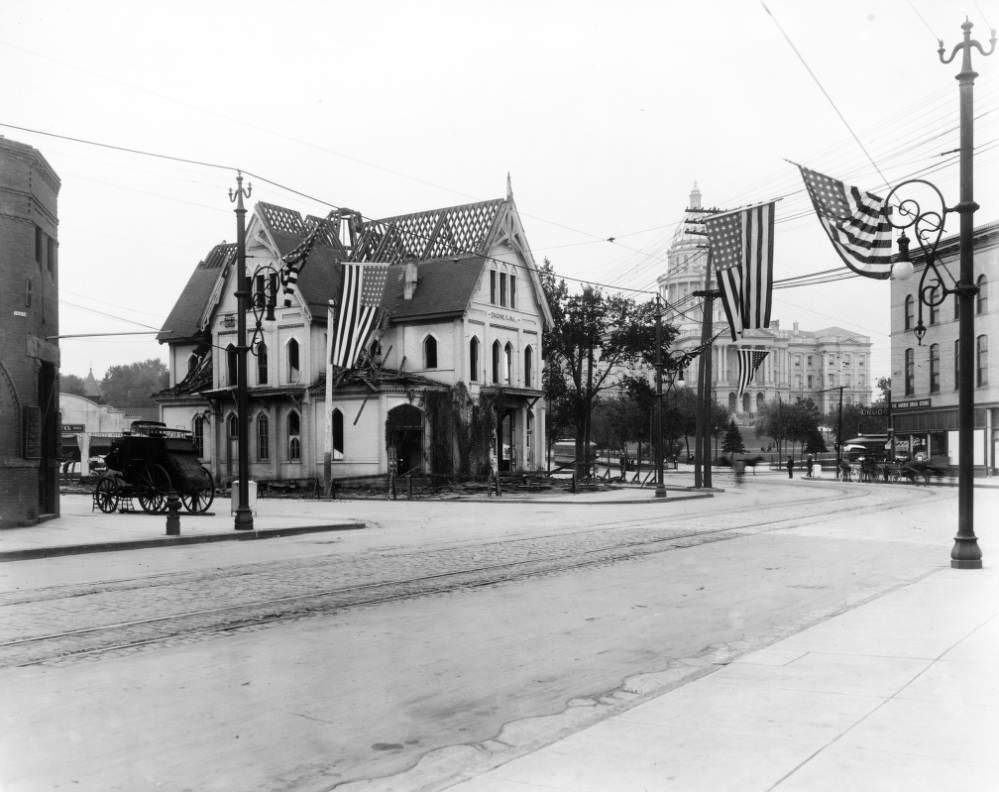
The 1909 demolition of Engine House Number One was a symbolic moment. The building had been central to Denver’s fire protection for years, and its teardown marked a deliberate break with the horse-and-steam era. The stagecoach and flags present during the dismantling suggest the city treated it as a ceremonial occasion — acknowledging the past while clearing space for a more modern future. Denver’s fire department was reorganizing around motorized equipment, and the old engine house simply no longer fit the plan.
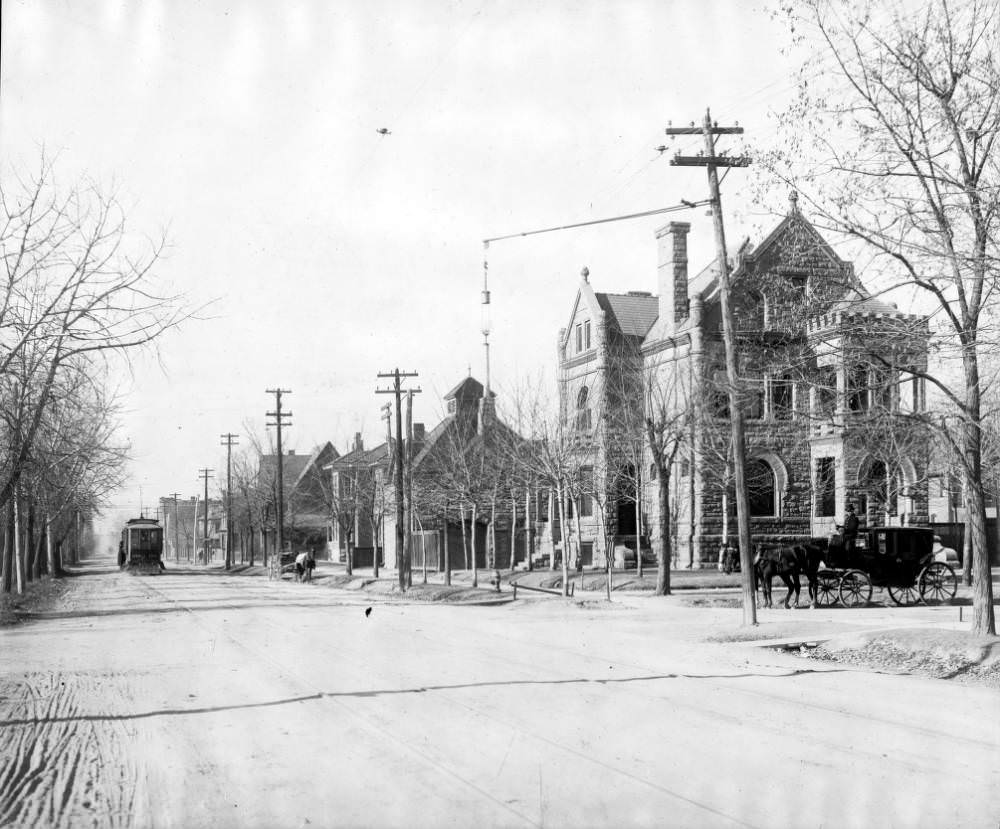
Capitol Hill, Denver’s most fashionable residential neighborhood, was lined with Victorian, Colonial Revival, and Romanesque mansions built by the city’s wealthiest families. The area around 1st Avenue and Grant Street exemplified the architectural ambition of Denver’s nouveaux riches — men and women who had made fortunes in mining, real estate, and commerce and wanted their homes to reflect that status. The simultaneous presence of a horse-drawn coach and a trolley car in the same frame tells the story of a neighborhood in transition.
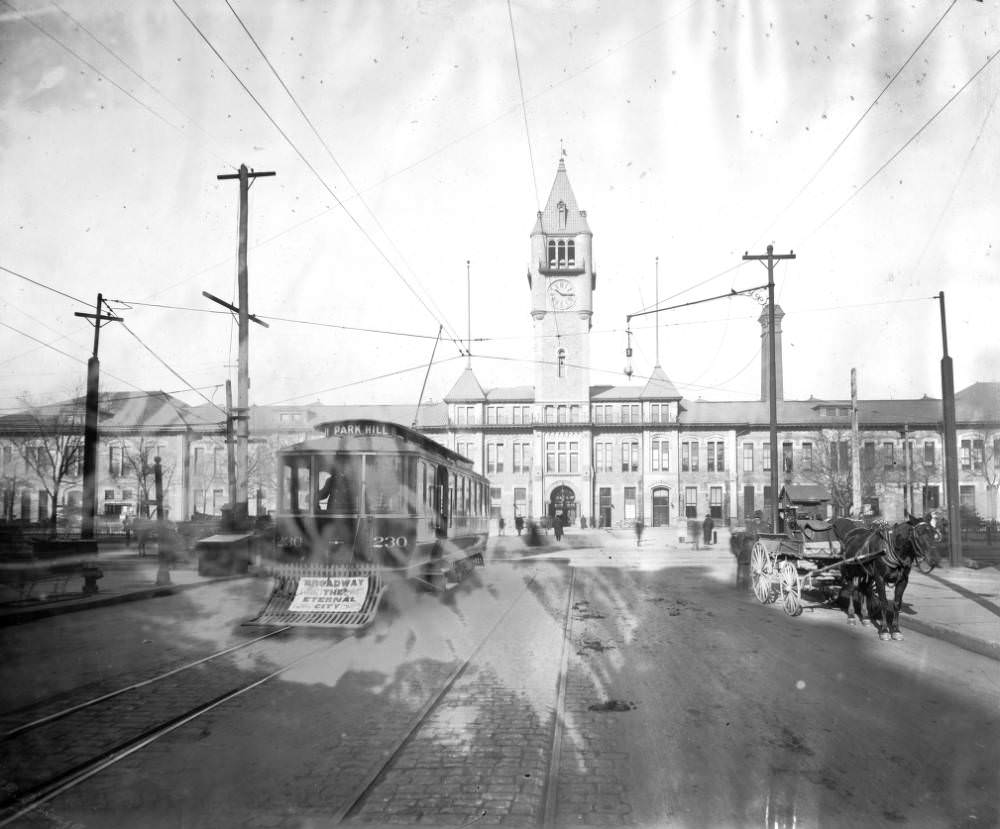
Advertising on trolley cars was standard practice, and the ad for a Broadway play on Tramway No. 230 speaks to Denver’s cultural ambitions. The city had theaters, opera houses, and performance venues by the early 1900s, drawing touring productions from New York and Chicago. Denver residents could see national-caliber entertainment without leaving the city, and the trolley carried them there. Union Station served as both a transit hub and a cultural crossroads, the place where the wider world entered Denver.
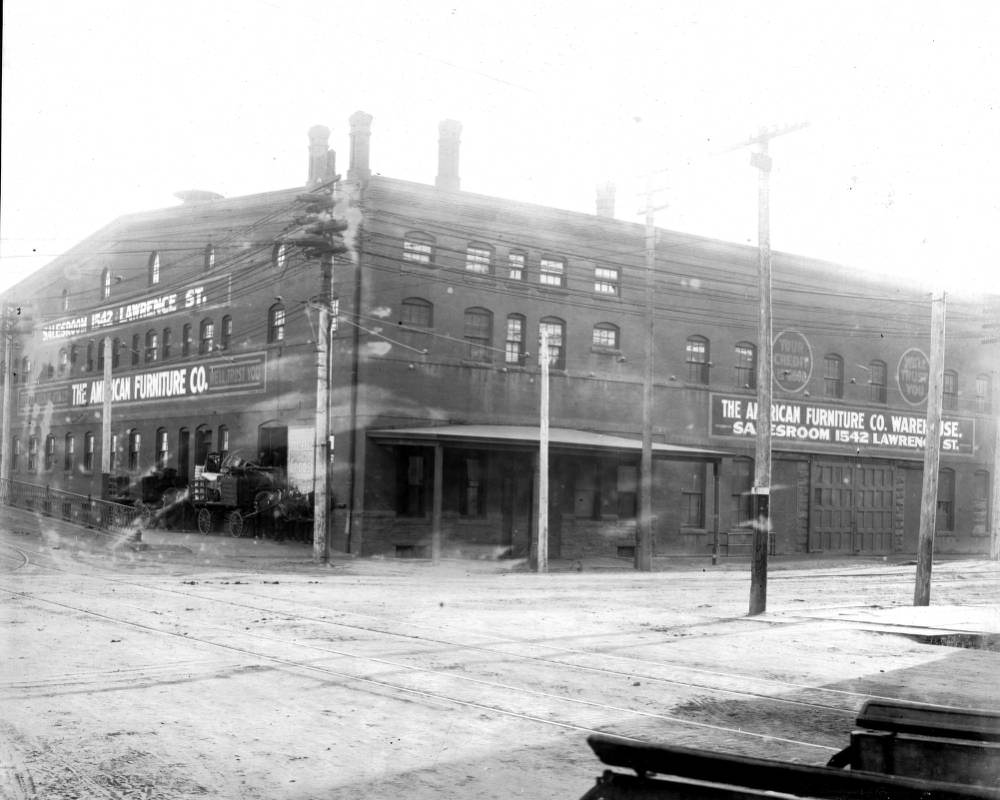
Denver’s commercial districts supported a wide range of businesses beyond the banks and hotels that lined the major streets. Warehouses, supply companies, and wholesale merchants occupied the blocks around Lawrence Street, serving both retail customers and the construction industry feeding a city that was constantly building. Horse-drawn wagons remained the primary means of freight delivery in 1905, even as the first automobiles began appearing on Denver’s streets.
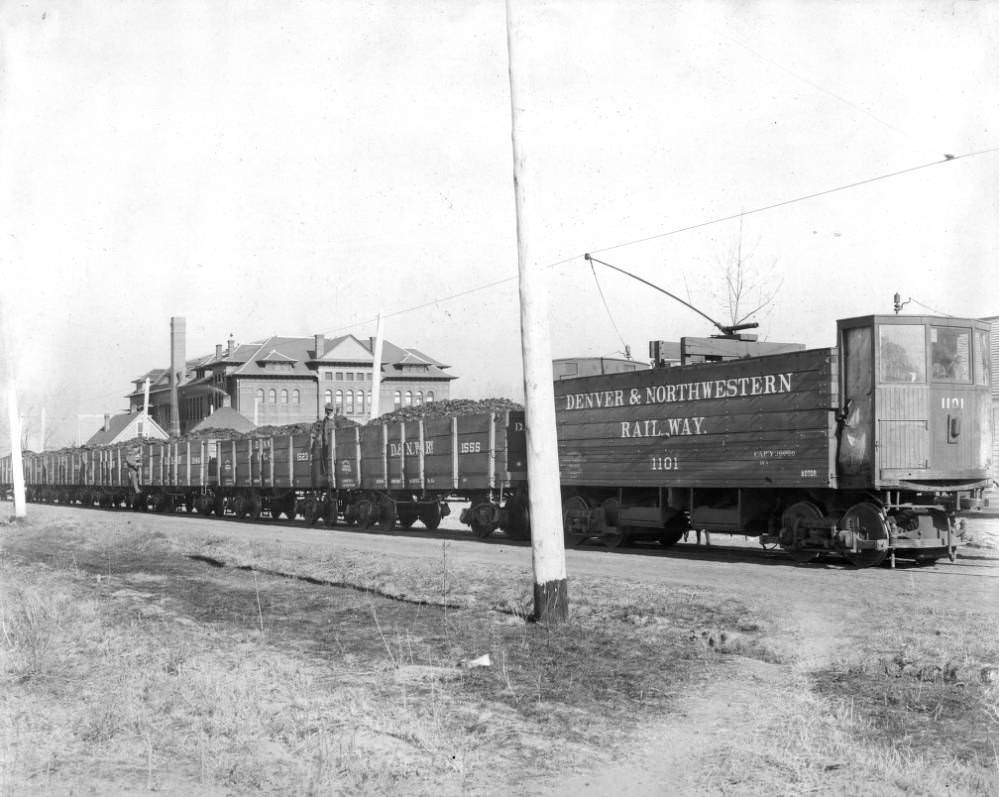
Coal was the fuel that kept Denver running. The Leyden Mine, northwest of the city, supplied coal that heated homes, powered factories, and fueled the Denver Tramway Company’s power stations. The Denver and Northwestern Railway carried the coal into the city, and its cars appeared throughout the western neighborhoods. The proximity of a public school — Alcott — to the coal line was typical of Denver’s working-class districts, where industry and residential life existed side by side.
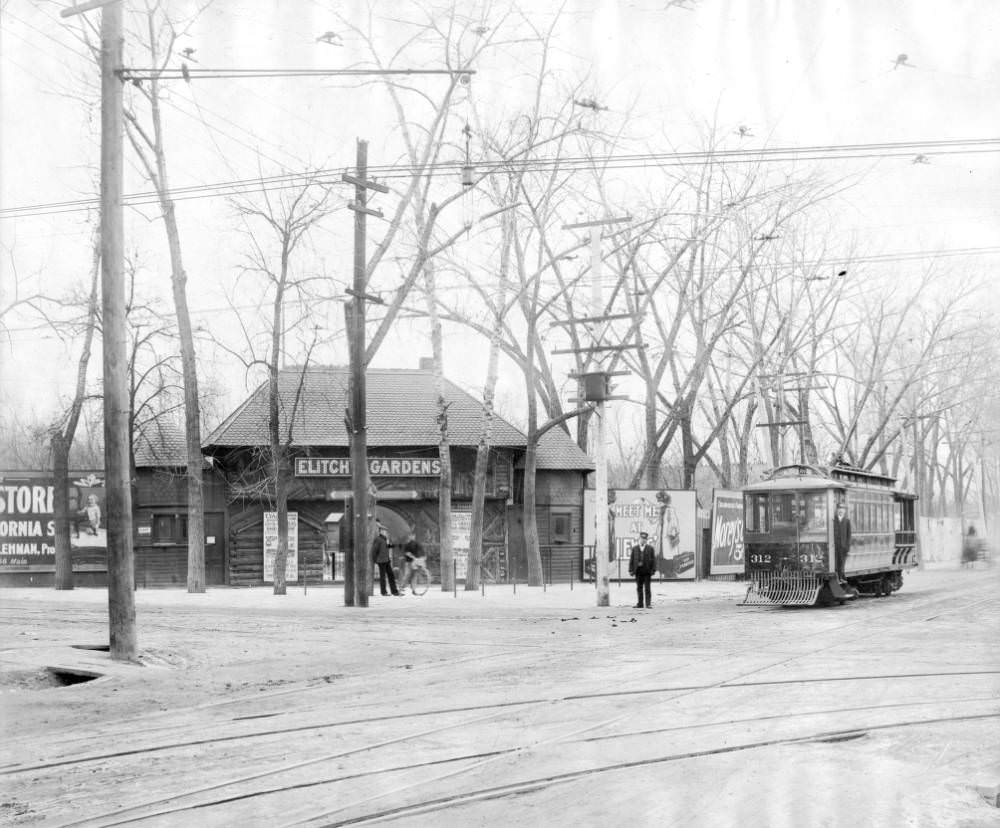
Elitch Gardens, founded in 1890, was Denver’s most popular amusement destination. The Denver Tramway carried crowds to the entrance on West 38th Avenue, where billboards competed for attention on either side of the gate. Elitch’s offered rides, theatrical performances, a zoo, and gardens, making it a destination for families across the city’s social spectrum. The trolley line to Elitch’s was one of the most heavily used routes in the system on summer weekends.
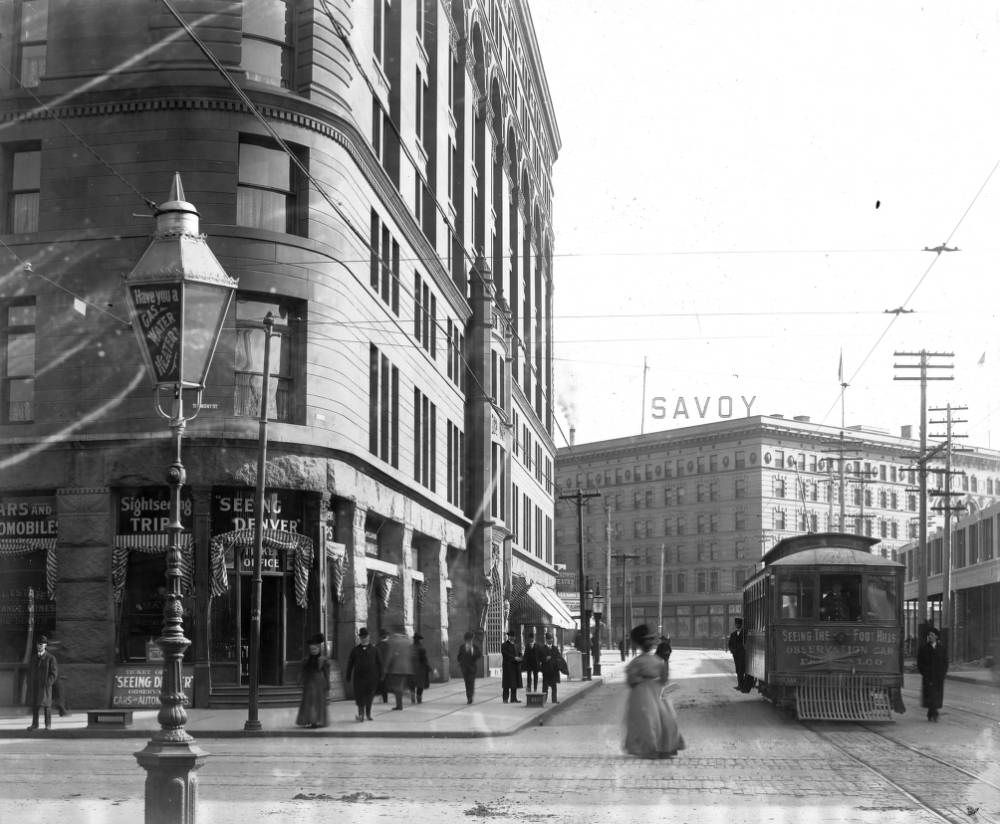
By 1905, the Denver Tramway Company was running sightseeing trolleys for tourists. The “Seeing The Foothills” car on 17th Street offered visitors a guided ride through the city and toward the mountains. Denver had established itself as a tourism destination, drawing visitors who came for the scenery, the dry climate, or simply to see a western city that had grown up so fast. The Brown Palace and Savoy Hotel visible in the background anchored a stretch of 17th Street that catered directly to this traveling class.
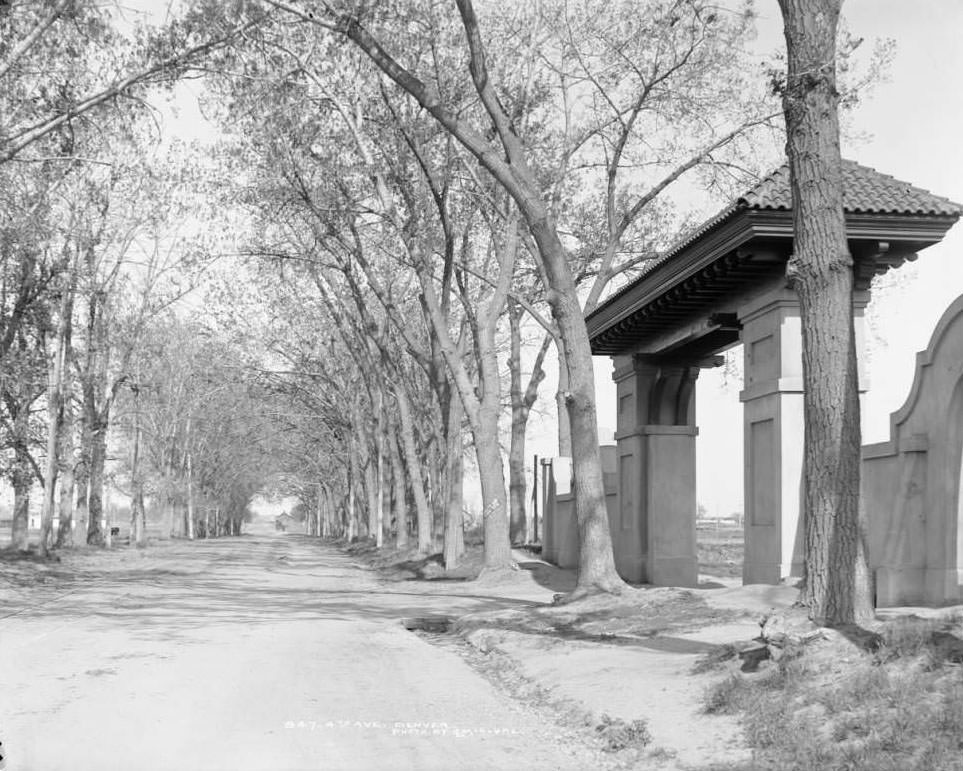
The Denver Country Club neighborhood at the southeast edge of the city represented a different kind of Denver entirely. Its columned gateways and curving streets were designed to suggest exclusivity and permanence. Wealthy families built estates here at a remove from the noise and congestion of the city center. The neighborhood was laid out with deliberate care, its architecture drawn from Colonial Revival and Neoclassical traditions that signaled refinement and old-money stability — even in a city barely 50 years old.
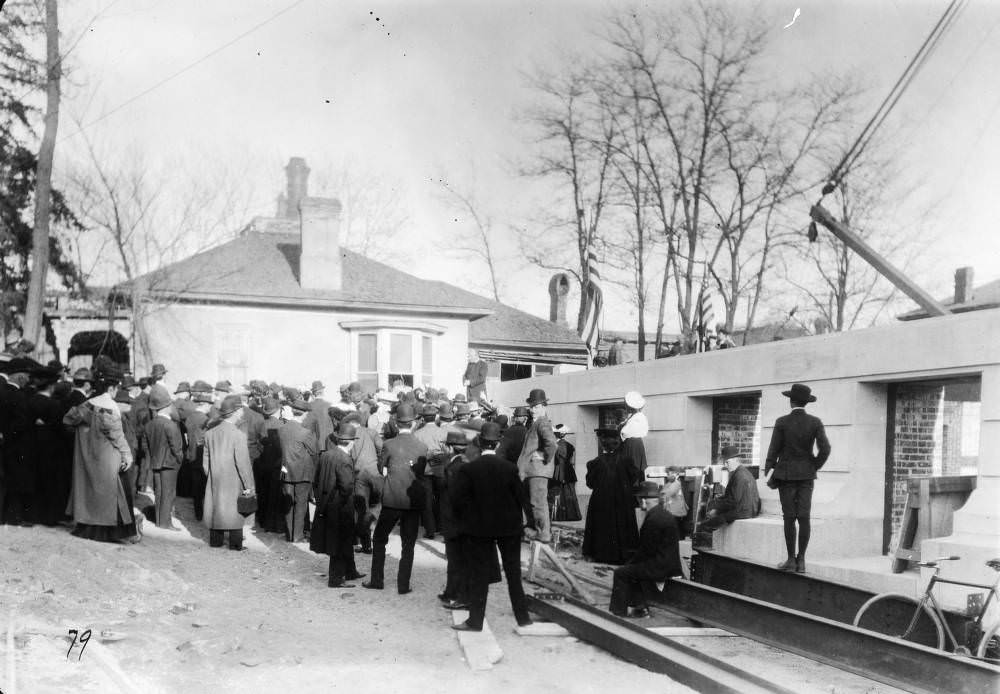
The construction of the Denver Public Library was one of the most celebrated civic events of the decade. Governor Henry Augustus Buchtel presided over the cornerstone ceremony in 1907, with a crowd gathered and a U.S. flag flying behind the podium. Rabbi Friedman gave the invocation. The library, built in the Civic Center area at Colfax Avenue and Bannock Street, was funded in part through a Carnegie grant and represented Denver’s commitment to public education and cultural access. Construction continued through winter, with snow covering the work site at times, before the building opened in 1910.
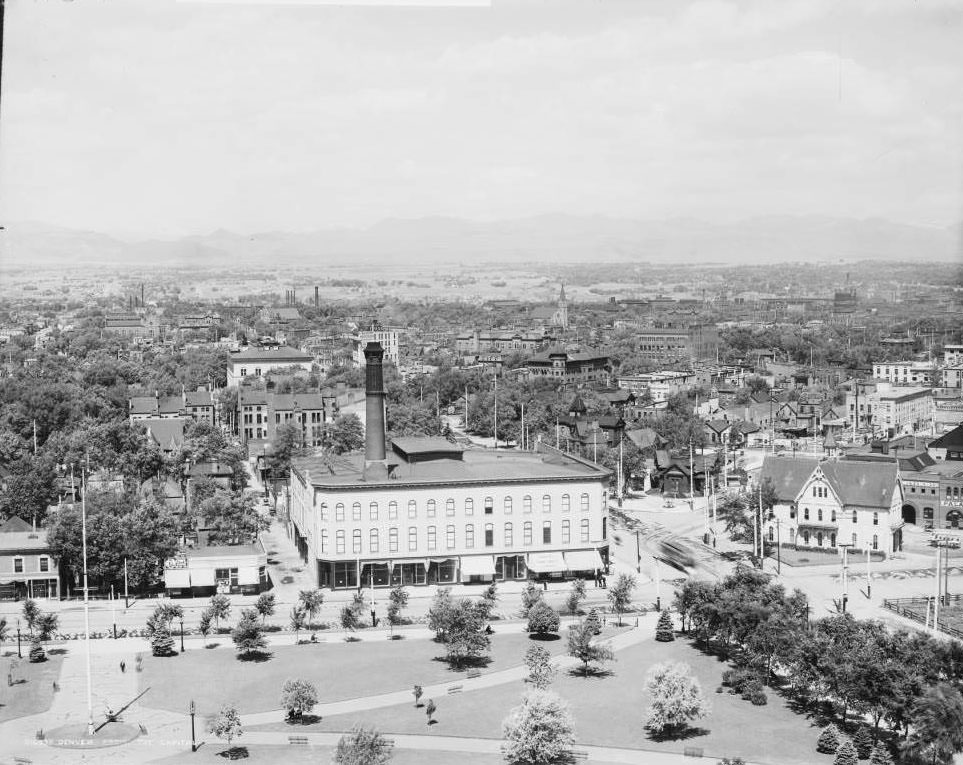
A panoramic view of Denver from the State Capitol in 1907 showed a city that had filled in dramatically over the previous two decades. Engine House No. 1, St. Elizabeth Church, and dozens of commercial and residential buildings stretched toward the horizon. The Capitol itself sat at the high point of Capitol Hill, its gold dome visible from miles away. Denver’s skyline was not yet dominated by tall office buildings, but the density and variety of its built environment showed how thoroughly the city had outgrown its frontier past.
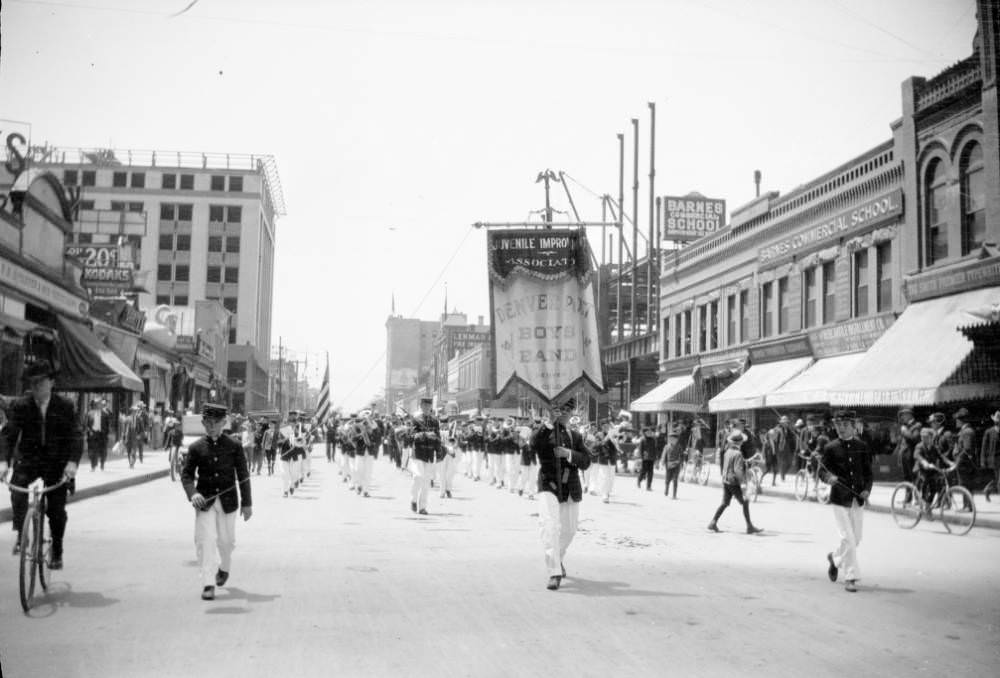
Public parades were a regular feature of Denver life. The Denver Post sponsored a Boys Band through the Juvenile Improvement Association, giving working-class and orphaned boys musical training and a public role in civic celebrations. These parades drew crowds to 17th Street and other major thoroughfares, with spectators lining the sidewalks and leaning from windows above. The bands, the flags, and the marching formations were all part of how Denver expressed its civic identity to itself.
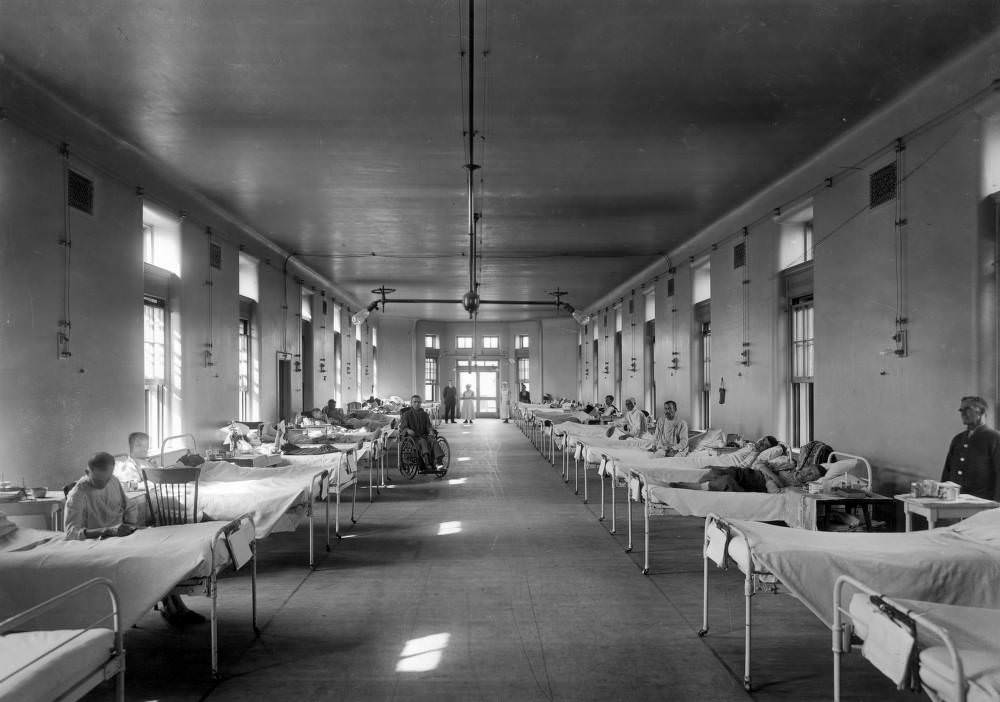
Denver’s tuberculosis problem was severe enough to define the city’s character in this era. Thousands of sick people arrived from the eastern United States each year, drawn by the belief that Colorado’s dry, high-altitude air would cure or slow the disease. Many recovered partially; many others did not. Denver General Hospital’s tuberculosis ward held men at various stages of the illness, watched over by nursing and medical staff. The city built outdoor sleeping porches, tents, and sanitariums to handle the volume of patients that its climate attracted.
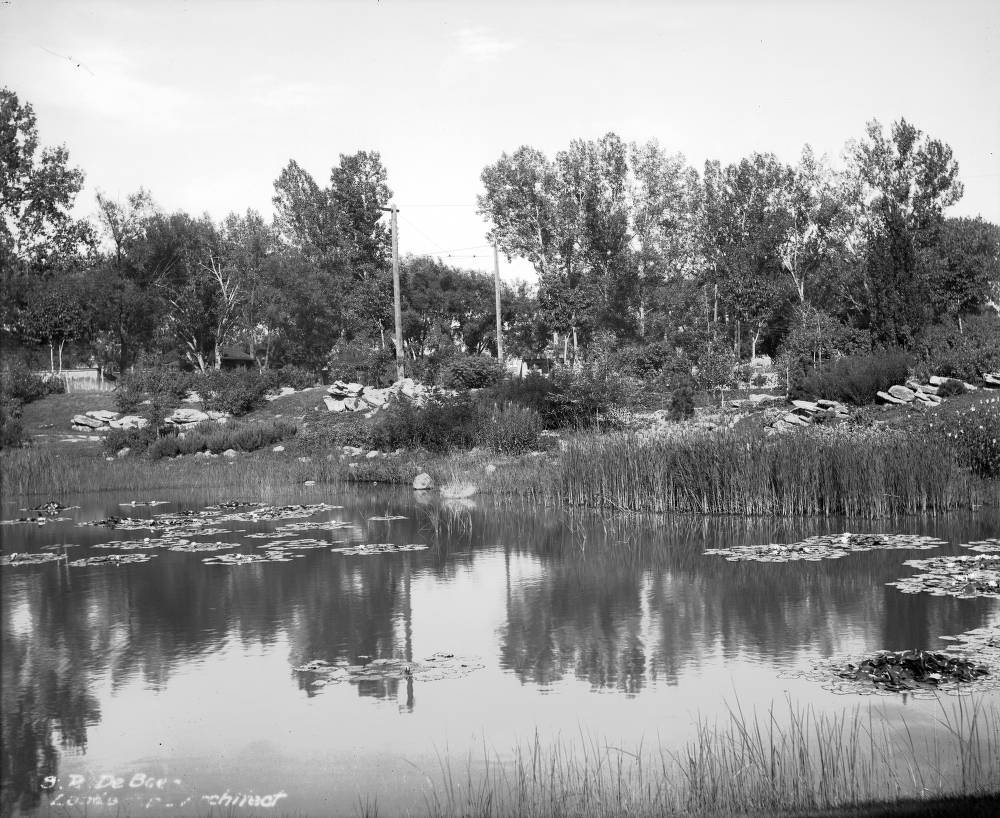
Washington Park on Denver’s south side was one of the city’s great public spaces. Its lily ponds, rock gardens, and tree-lined paths offered residents an escape from the noise of the city center. The park was formally developed in the 1890s and continued to be improved in the early 1900s. Families picnicked on its lawns, women paddled canoes on Smith Lake, and in winter, residents skated on the frozen water. The park was a democratic space — open to all social classes and used heavily by the surrounding neighborhoods.
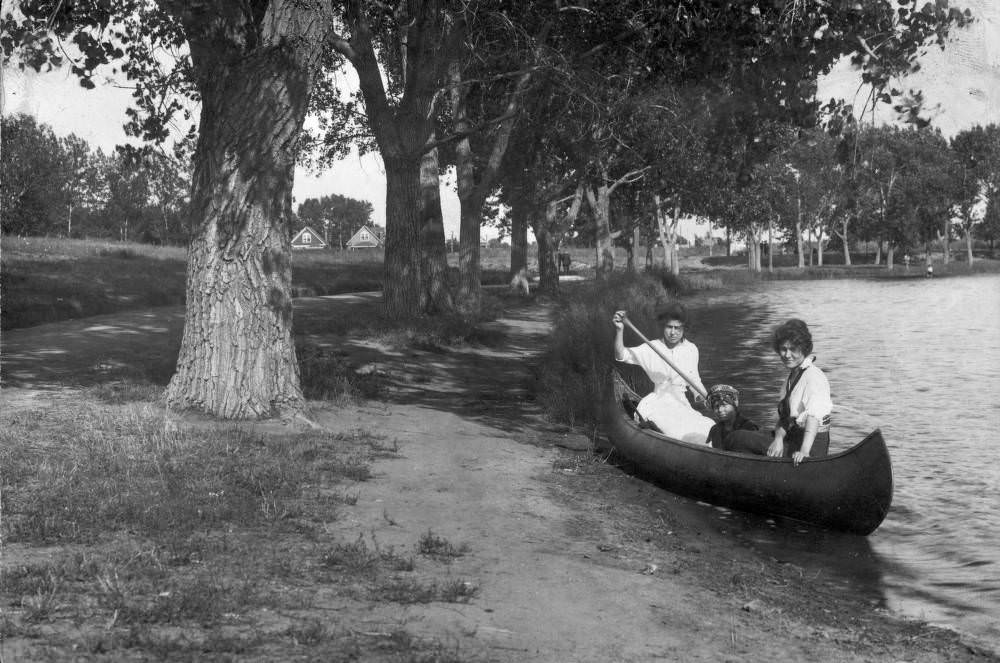
Smith Lake within Washington Park was a hub of recreational activity. In summer, visitors rented canoes and rowboats, and the lake’s banks were lined with picnickers. The presence of women and a young girl in a canoe in 1900 reflects the broader shift in how public leisure was understood — parks were being designed specifically to serve families and encourage outdoor activity as a public health measure. Denver’s park system expanded significantly in this period under the influence of civic planners who believed green space was essential to a healthy city.
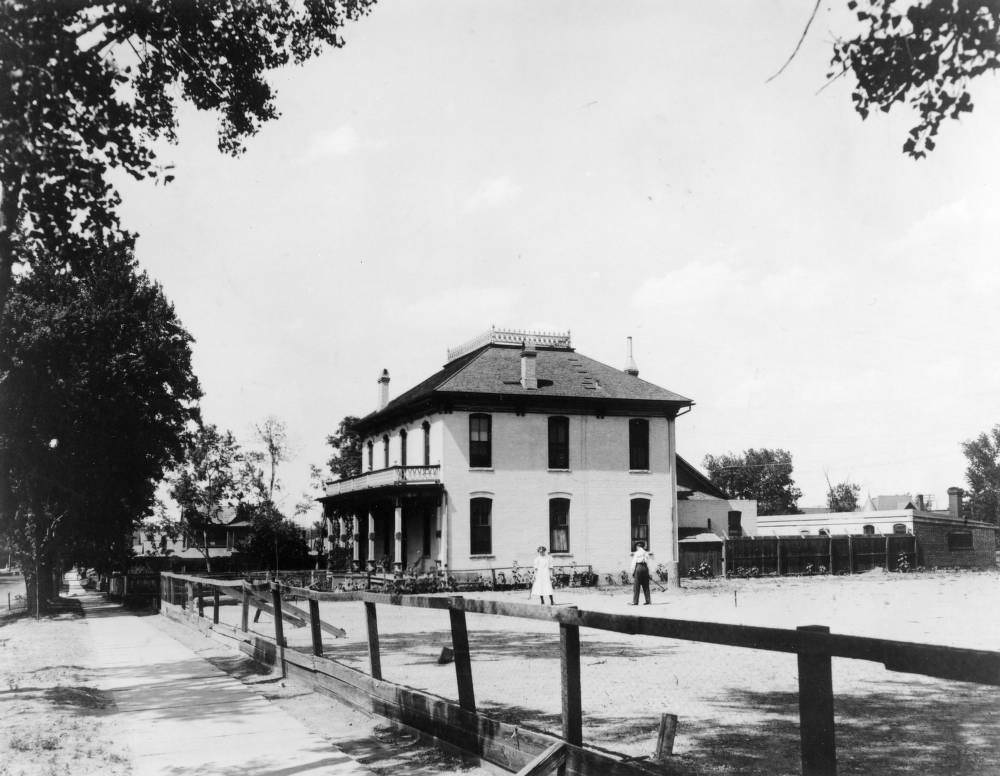
Denver’s Detention Home housed children who had been brought before the juvenile court system — a relatively new institution in 1903. The juvenile court movement sought to rehabilitate young offenders rather than punish them as adults. Children at the Detention Home attended school and were given recreational time, as seen in this photograph of a croquet game. Denver’s Judge Benjamin Lindsey was nationally recognized for his work building the juvenile court system and advocating for children’s welfare.
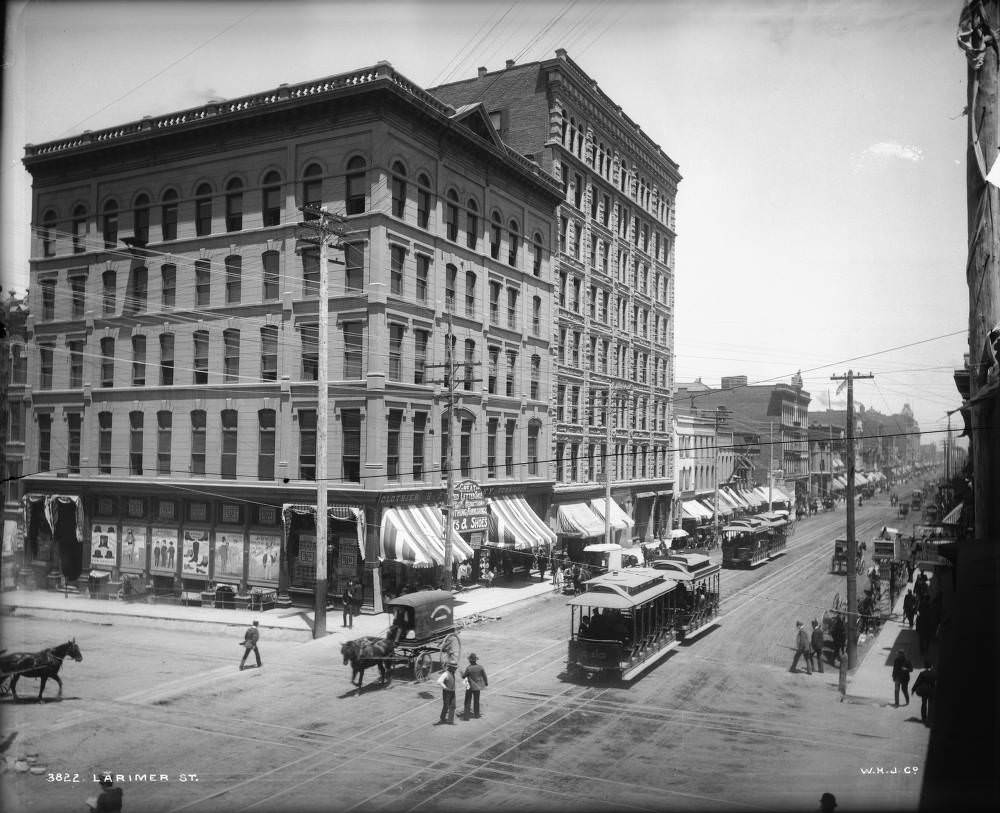
Larimer Street was one of Denver’s oldest commercial corridors. The Pioneer Building, built in the Italianate style, was among several structures on the street that dated from an earlier era of the city’s development. By the early 1900s, Larimer Street’s character was shifting — some of its older buildings were being replaced by newer commercial structures, while others were repurposed for different uses. The street remained active, but the center of Denver’s commercial gravity was moving toward 16th Street and 17th Street.
The Denver City Cable Railway Company’s cable house was a remnant of the city’s earlier transit era. Cable cars had served Denver before the electric trolley made them obsolete, and the infrastructure they left behind — engine houses, cable channels, and terminal buildings — was gradually absorbed or demolished as the tramway company expanded. By 1906, the cable house was largely a historical curiosity, a physical trace of technology that had served the city for only a short window before being surpassed.
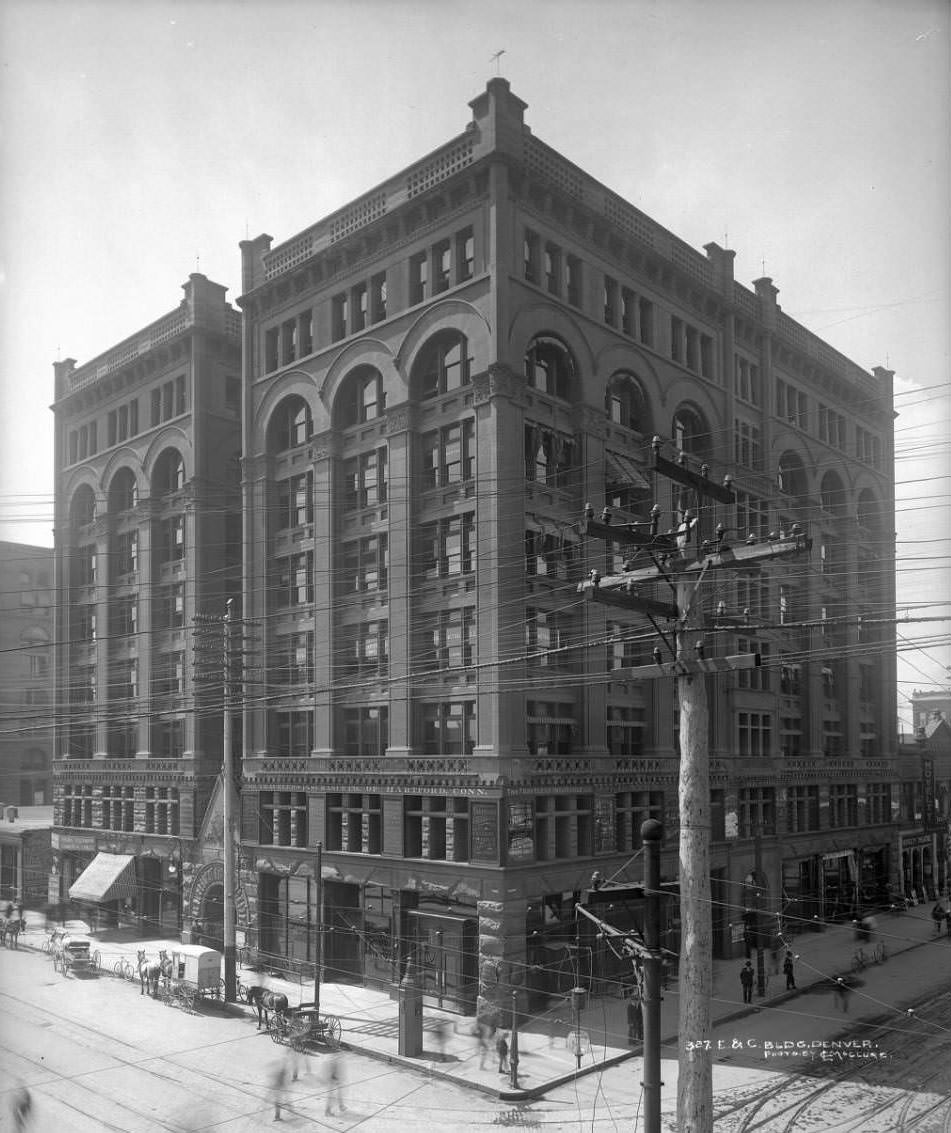
Denver’s commercial real estate market was busy in the early 1900s. Buildings like the Ernest and Cranmer hosted multiple businesses under one roof — offices, retail shops, and service providers crowded into a single address. The Cranmer family was prominent in Denver real estate and civic life, and their name on a building carried social weight. Street-level storefronts advertised their wares with hand-painted signs and window displays, creating a visual density that was characteristic of Denver’s busiest blocks.
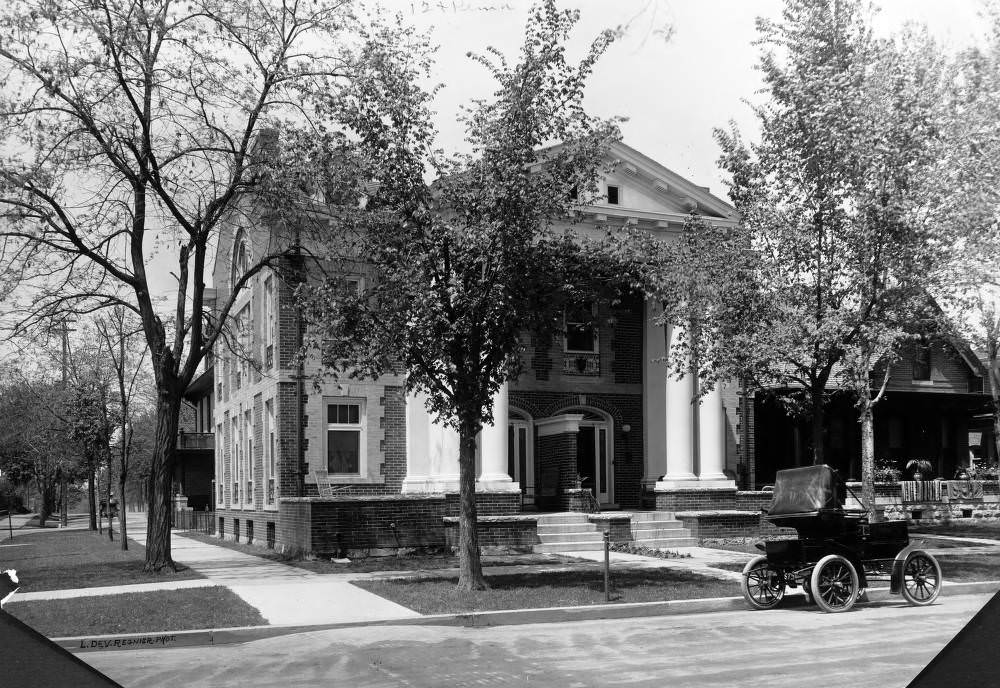
As Denver’s population grew, apartment buildings became an increasingly common housing form. The Colonial Revival-style apartments at 12th and Pennsylvania Streets, with their portico and columns, were built to attract middle-class tenants who wanted the convenience of central-city living without the cost of maintaining a standalone home. Capitol Hill and the surrounding streets saw significant apartment construction in the first decade of the 1900s, reshaping neighborhoods that had previously been dominated by single-family houses.
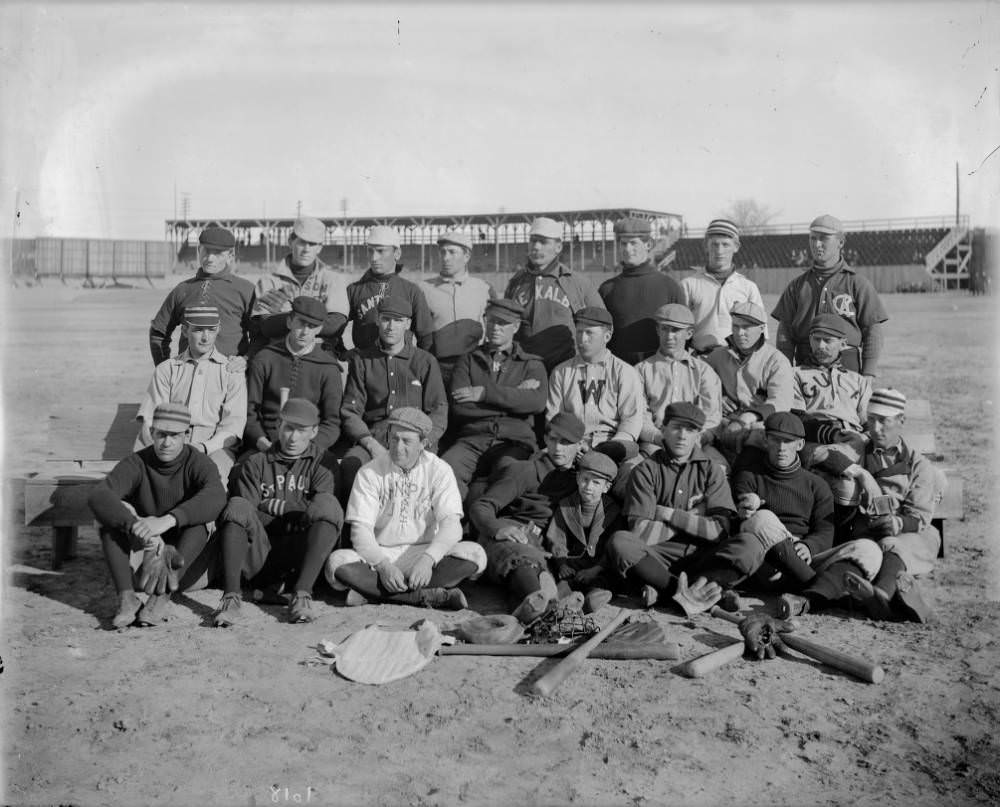
The Denver Bears were a fixture of the city’s sporting culture. Baseball was enormously popular in early 1900s America, and Denver fielded competitive teams that drew crowds from across the metropolitan area. The Bears played in the Western League, competing against teams from other regional cities. For working-class Denverites, a baseball game was one of the most accessible forms of entertainment — cheap, outdoors, and socially inclusive in a way that the opera house or the country club was not.
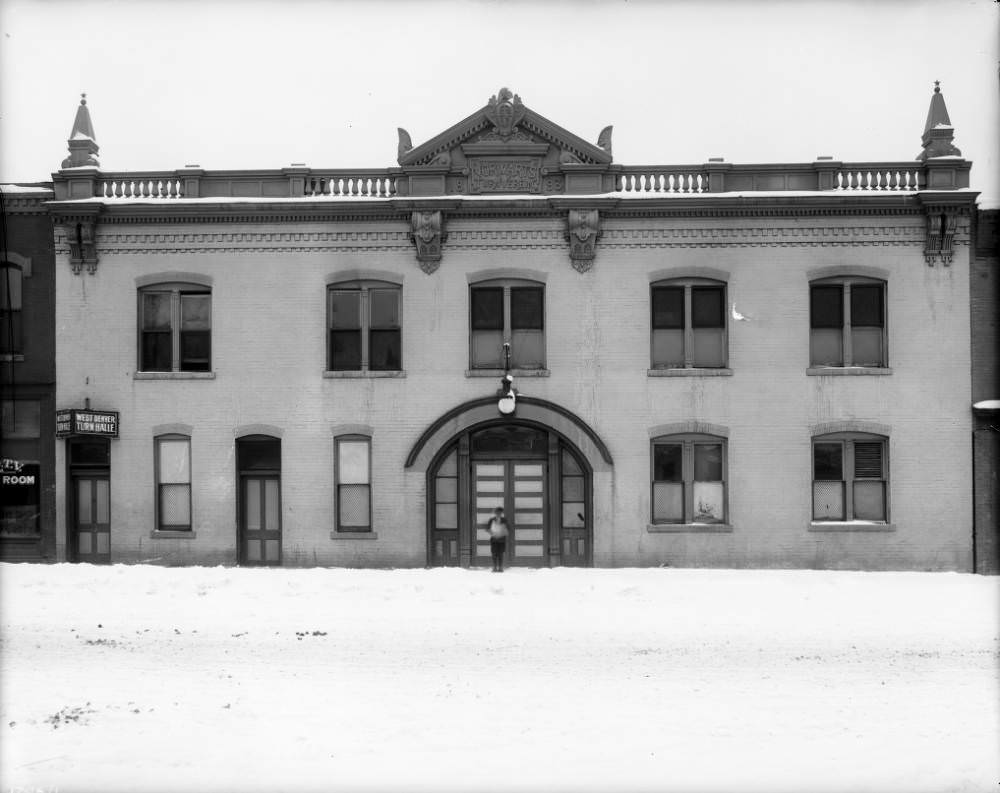
Denver’s German community maintained a strong presence through organizations like the Turnverein, a gymnastics and social club that had roots in the German immigrant experience going back to the mid-19th century. The Turnverein’s meeting hall, with its brick construction and arched entry, was a gathering place for cultural events, athletic competitions, and political discussion. Denver’s immigrant communities — German, Italian, Jewish, and others — built their own institutions while also participating in the city’s broader civic life.
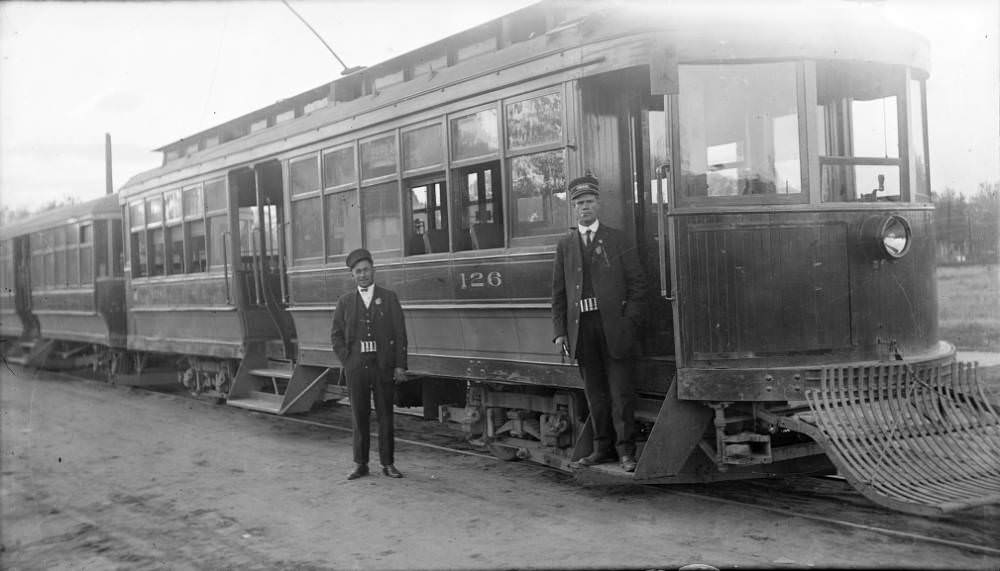
The Denver Tramway Company operated hundreds of cars across a network that reached from Union Station to the farthest residential neighborhoods. Each car had a number and a route designation posted on the front, allowing riders to identify their line at a glance. Conductors collected fares and managed passenger flow, while motormen operated the controls. The cars themselves were built to handle Colorado’s climate — the open platforms were sometimes enclosed with curtains or glass panels in winter to shield riders from the cold.
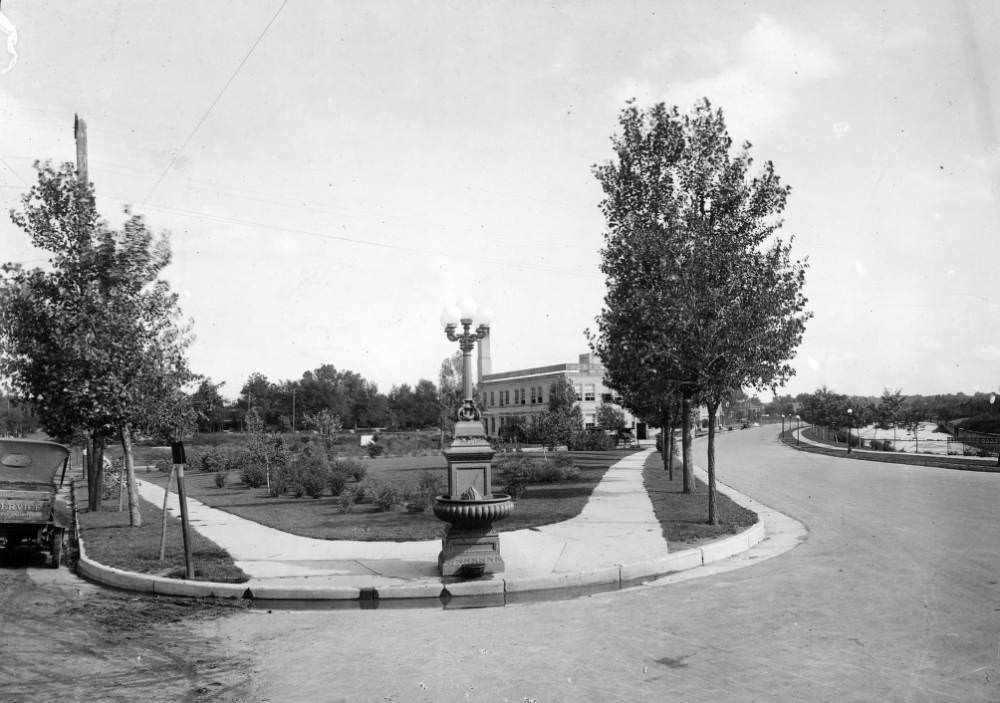
Speer Boulevard was one of the most ambitious urban planning projects in Denver’s history. Named after Mayor Robert Speer, who championed the “City Beautiful” philosophy, the boulevard followed Cherry Creek through the city and was designed with parkways, landscaping, and promenades on both sides. Horse troughs at intersections like Speer and Lincoln served the animals that still pulled wagons and carriages alongside the electric streetcars. The boulevard transformed what had been an irregular creek bank into a formal civic feature.
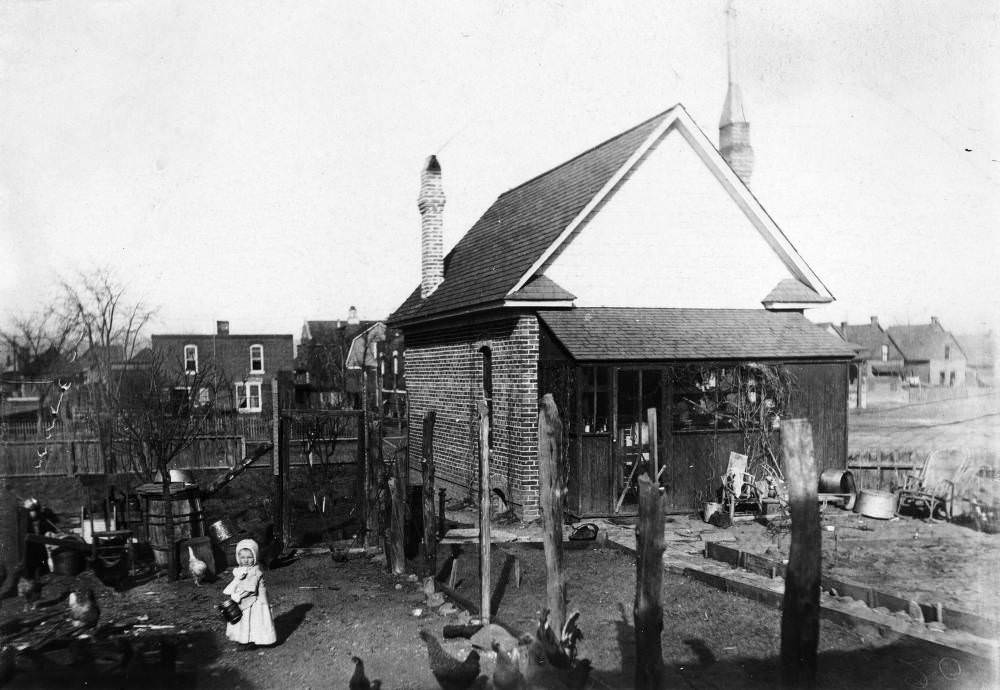
Even within the city limits, many Denver households kept backyard chickens and small vegetable gardens. A girl feeding chickens in the yard at 742 South Emerson Street in 1907 was not unusual — this was a common feature of working- and middle-class residential life in a city that was only one generation removed from a frontier settlement. The yard, the covered porch, and the modest house behind it represent the ordinary Denver that existed alongside the grand hotels and civic monuments.
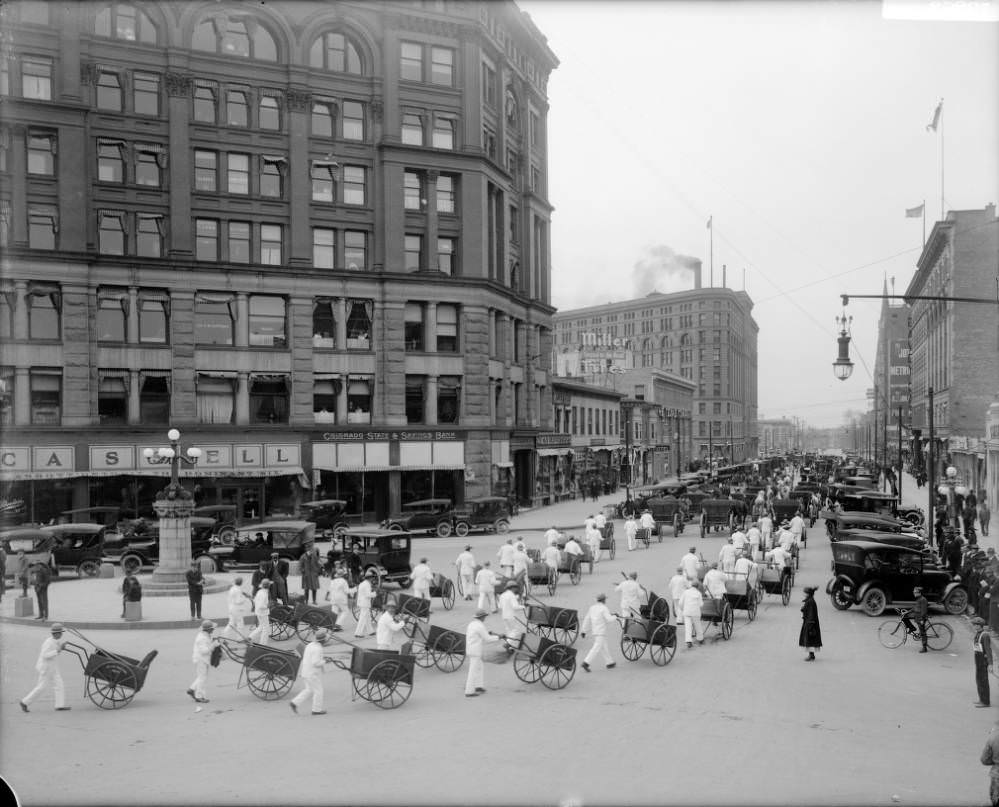
Denver took street cleanliness seriously enough in 1905 to hold a public parade celebrating its sanitation department. The Street Cleaning Parade on Broadway and 16th Streets showed off the city’s flushing machines, sweepers, and sprinkling equipment to an audience of sidewalk spectators. This was not just a display of civic pride — it was a public health message. In an era before germ theory was universally accepted, clean streets were seen as essential to preventing disease outbreaks in densely populated urban areas.
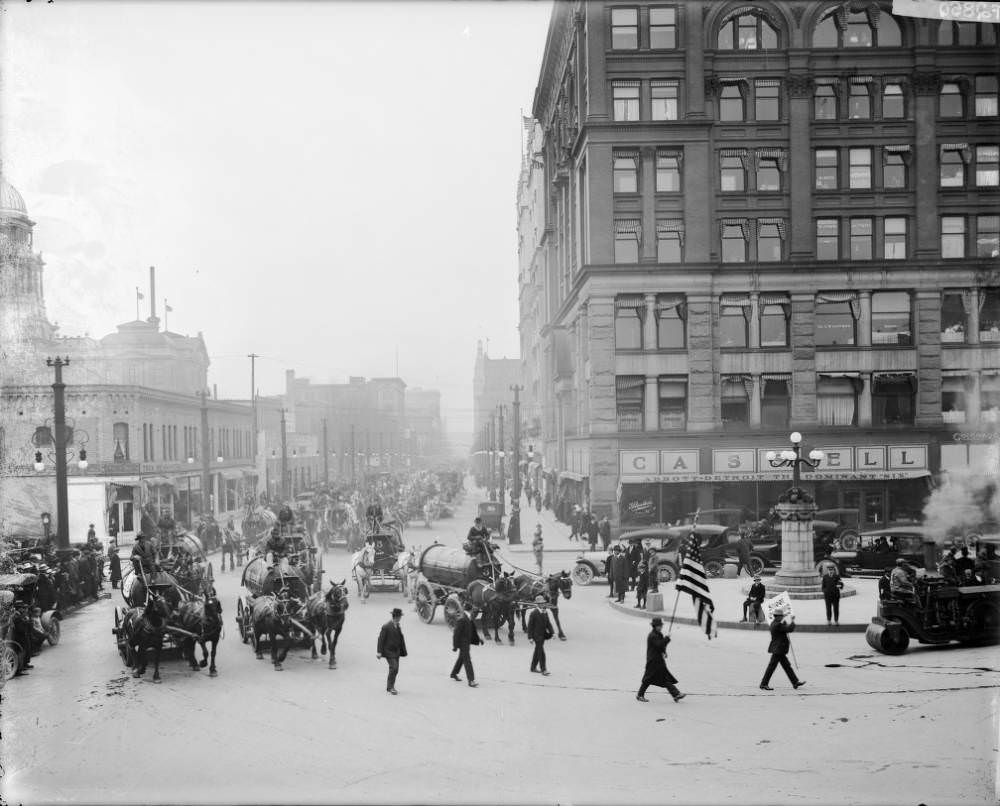
The flushing machines displayed in the 1905 Street Cleaning Parade used pressurized water to wash debris and horse manure from the gutters. Horse traffic was still heavy on Denver’s streets, and the waste it produced was a constant sanitation challenge. The city employed a full Street Sprinkling Department that wetted down unpaved roads to control dust, a serious issue in dry Colorado summers. These machines and their operators represented an early form of the municipal services that residents today take for granted.
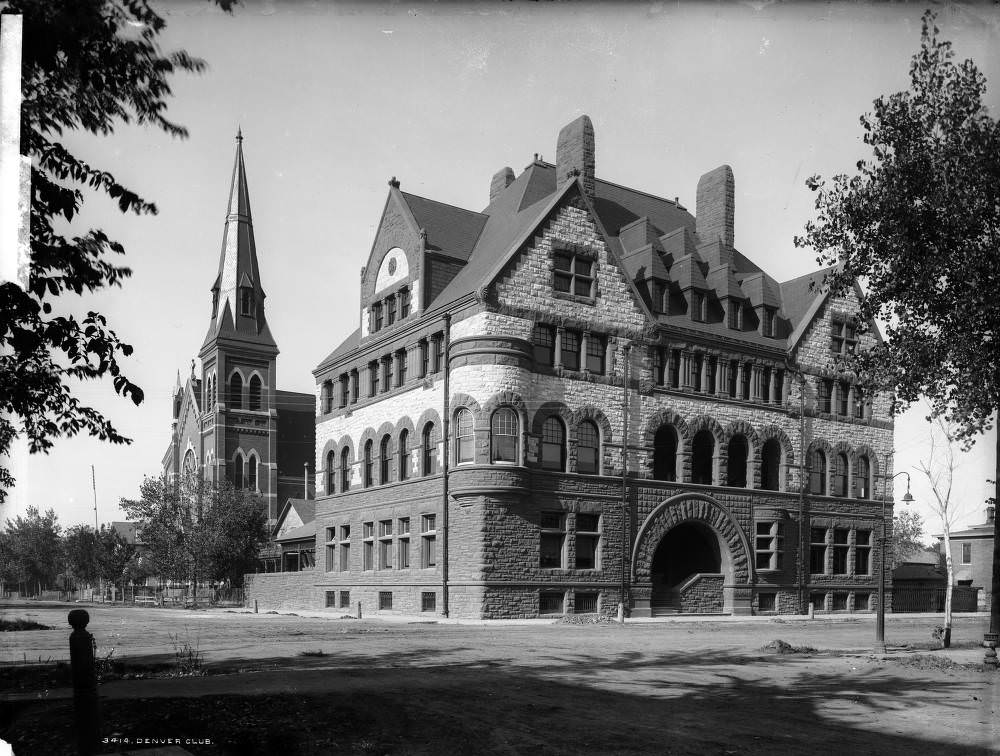
The Denver Club was the gathering place of the city’s business elite. Its Victorian Romanesque building, with its heavy stone construction and arched windows, projected stability and exclusivity. Membership was restricted to Denver’s most prominent men — bankers, lawyers, mining executives, and politicians. Deals were made in the club’s dining rooms and over drinks in its bar. The building itself was a statement of confidence in Denver’s permanence as a major American city.
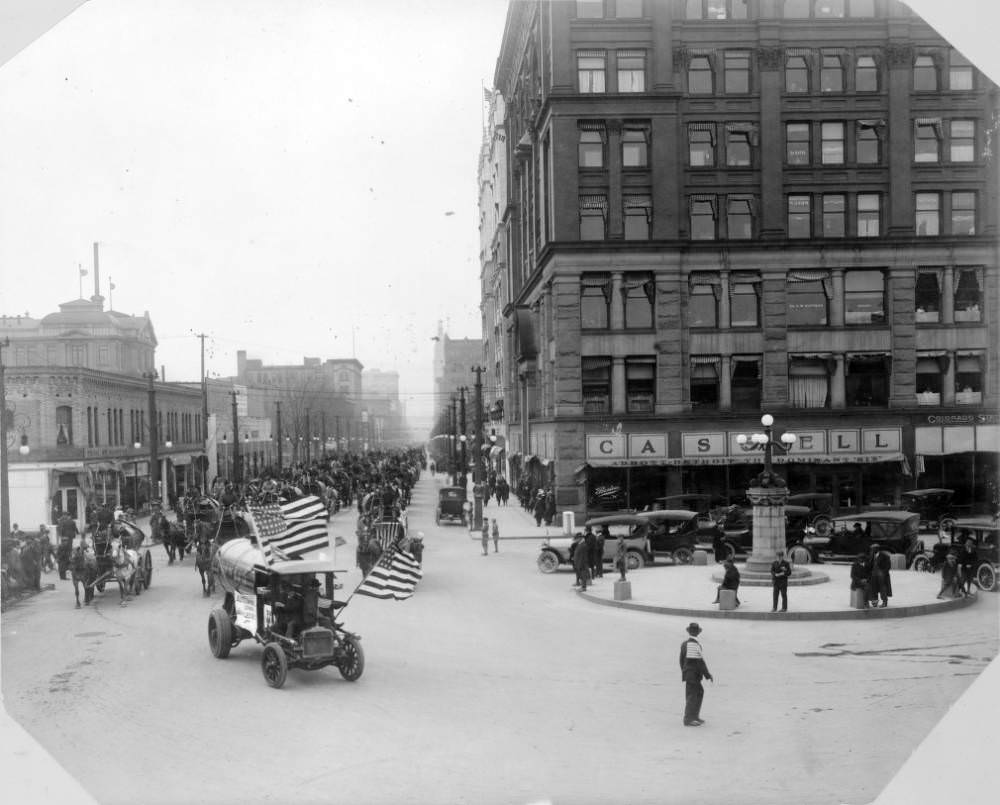
The Street Sprinkling Department’s entry in the 1905 parade showed off tank wagons that distributed water across Denver’s dustier unpaved streets. Dust control was a quality-of-life issue that affected every neighborhood, and the department’s work was visible and tangible in a way that some other city services were not. Denver was also experimenting with motor-powered street oiling equipment by this period, applying oil to road surfaces as a longer-lasting alternative to water sprinkling.
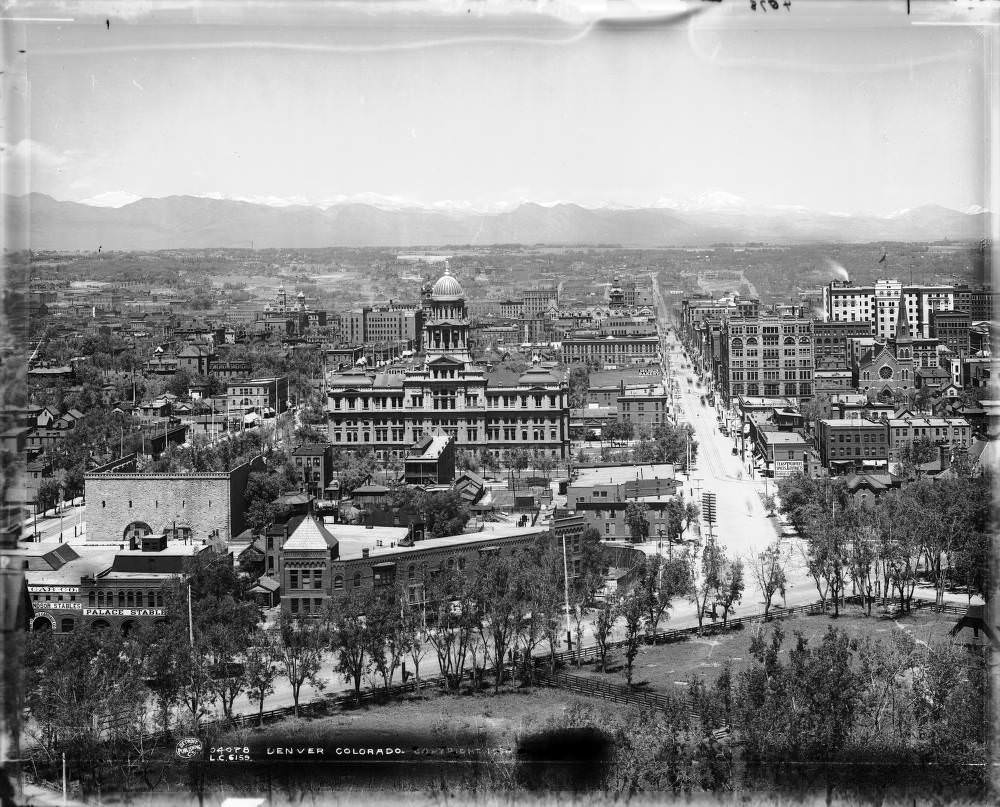
A panoramic view of Denver in the early 1900s captured a city with a recognizable skyline. The Arapahoe County Courthouse, built in 1883, dominated the downtown from its position at 16th and Tremont. It would stand until 1934, when it was razed during a period of civic renewal. Around it, the city spread in every direction — churches, hotels, office buildings, and residential streets reaching toward the mountains to the west and the plains to the east.
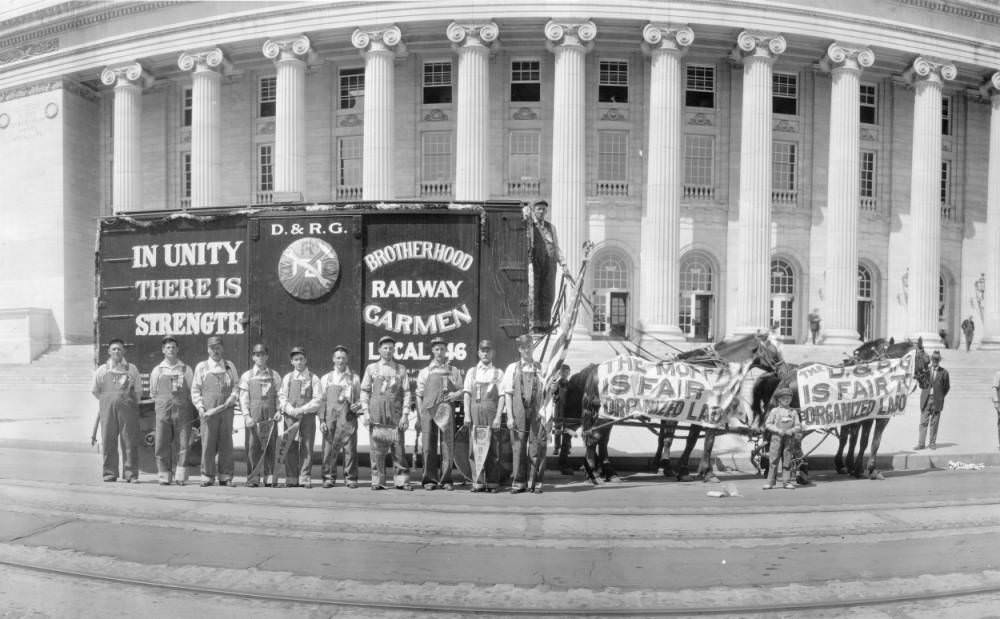
Railroad workers were among Denver’s largest occupational groups. The Denver and Rio Grande, along with the Union Pacific, the Burlington, and several other lines, employed thousands of men as engineers, conductors, brakemen, yard workers, and maintenance crews. These workers and their families lived in neighborhoods close to the rail yards, and their presence shaped the social geography of Denver’s near north and west sides. Posing for a photograph by a boxcar was a common way for workers to document their professional identity.
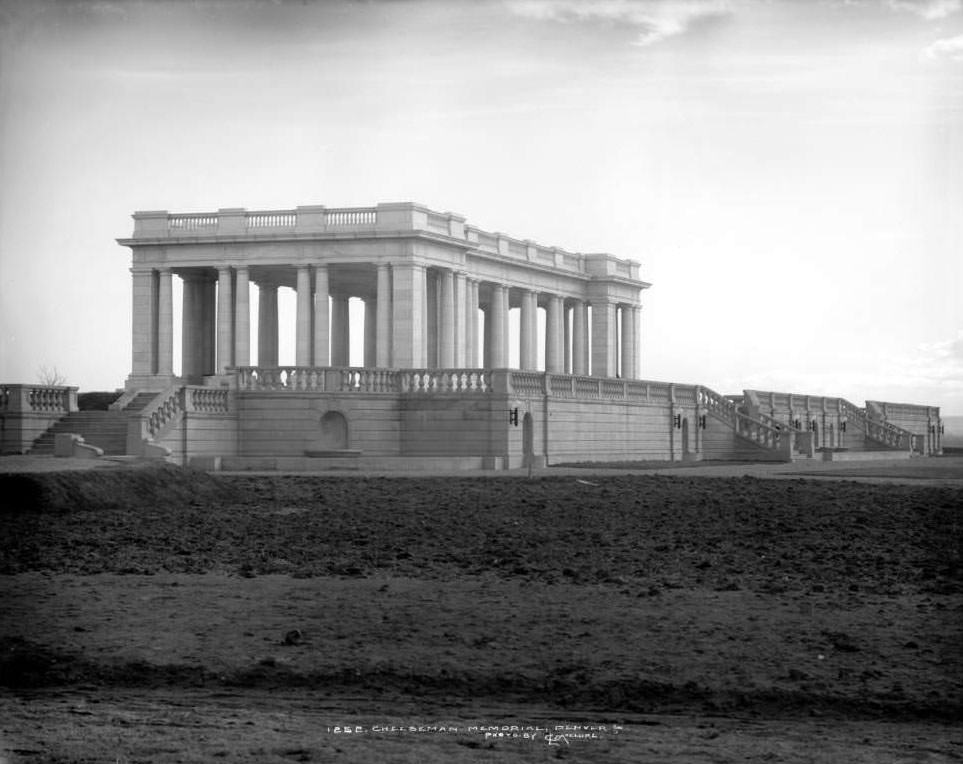
Cheesman Park occupied land that had originally been Denver’s municipal cemetery. The cemetery was gradually cleared in the late 19th century, and the space was converted into a public park in the Capitol Hill neighborhood. The Cheesman Memorial Pavilion, built in 1909, was named for Walter Scott Cheesman, a prominent Denver businessman. Its classical columns and formal design fit the aesthetic of the surrounding neighborhood, which by 1909 was one of Denver’s most prestigious residential addresses.
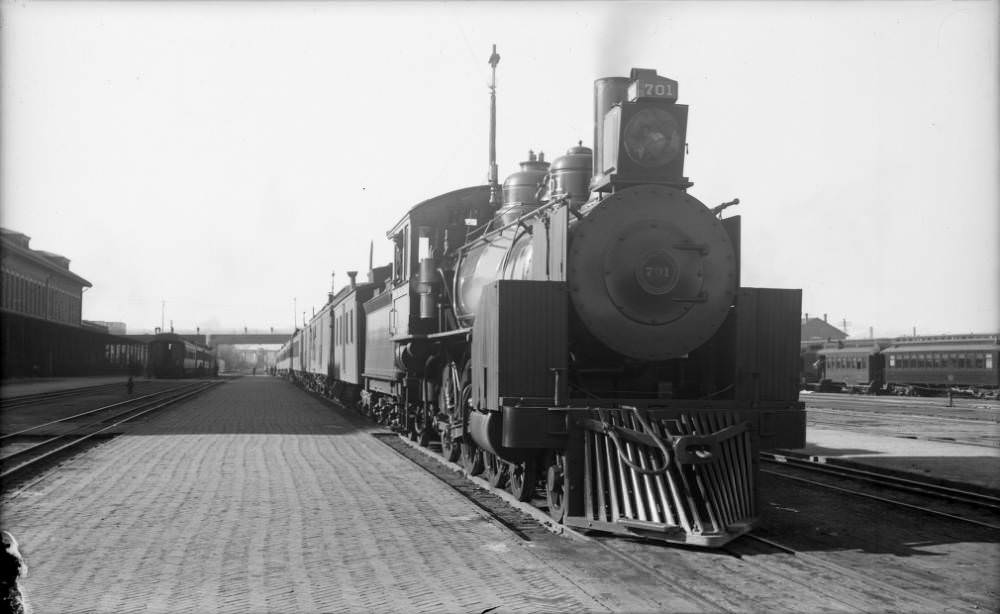
The Denver and Rio Grande Railway was one of the defining institutions of Colorado’s development. Founded by General William Jackson Palmer, the railroad used narrow-gauge track to push into the mountains, reaching mining towns that standard-gauge lines could not serve economically. By the early 1900s, the D&RG was converting many of its lines to standard gauge to compete more effectively with rival railroads, and its engines were a familiar sight at Denver’s Union Station and throughout the regional rail network.
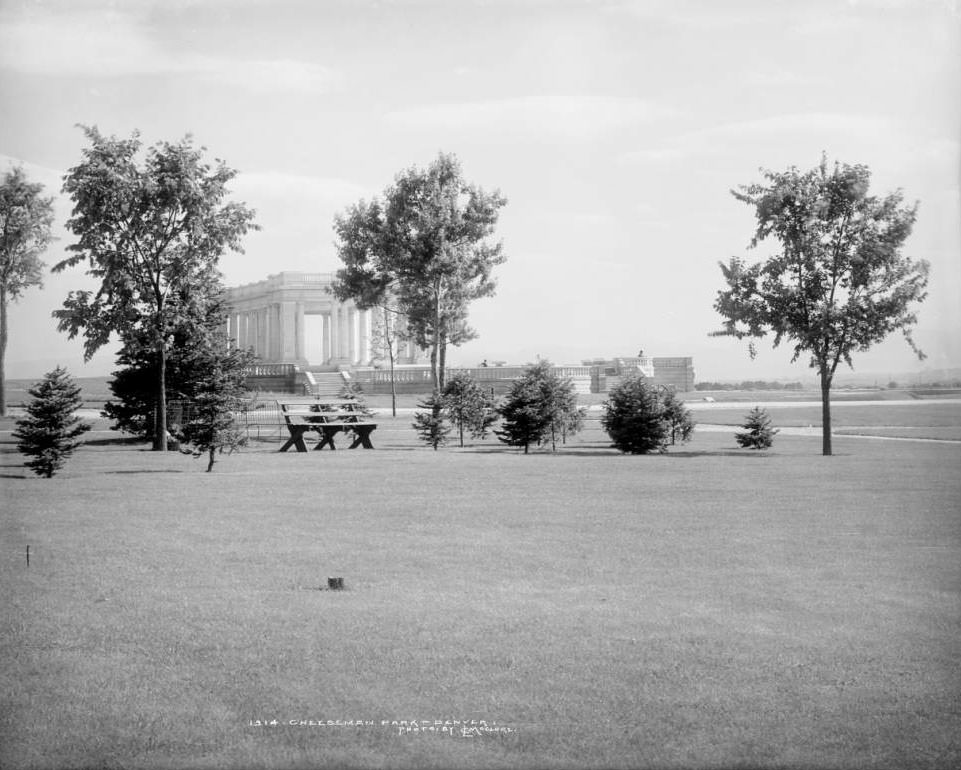
The landscaping around the Cheesman Memorial Pavilion was carefully planned to frame the structure and create a formal park setting. Paths, flower beds, and open lawns surrounded the pavilion, which was used for public gatherings and promenades by Capitol Hill residents. The park offered one of the finest views of the Rocky Mountains from within the city, and its elevated position made it a popular destination on clear days when the peaks were visible from downtown.
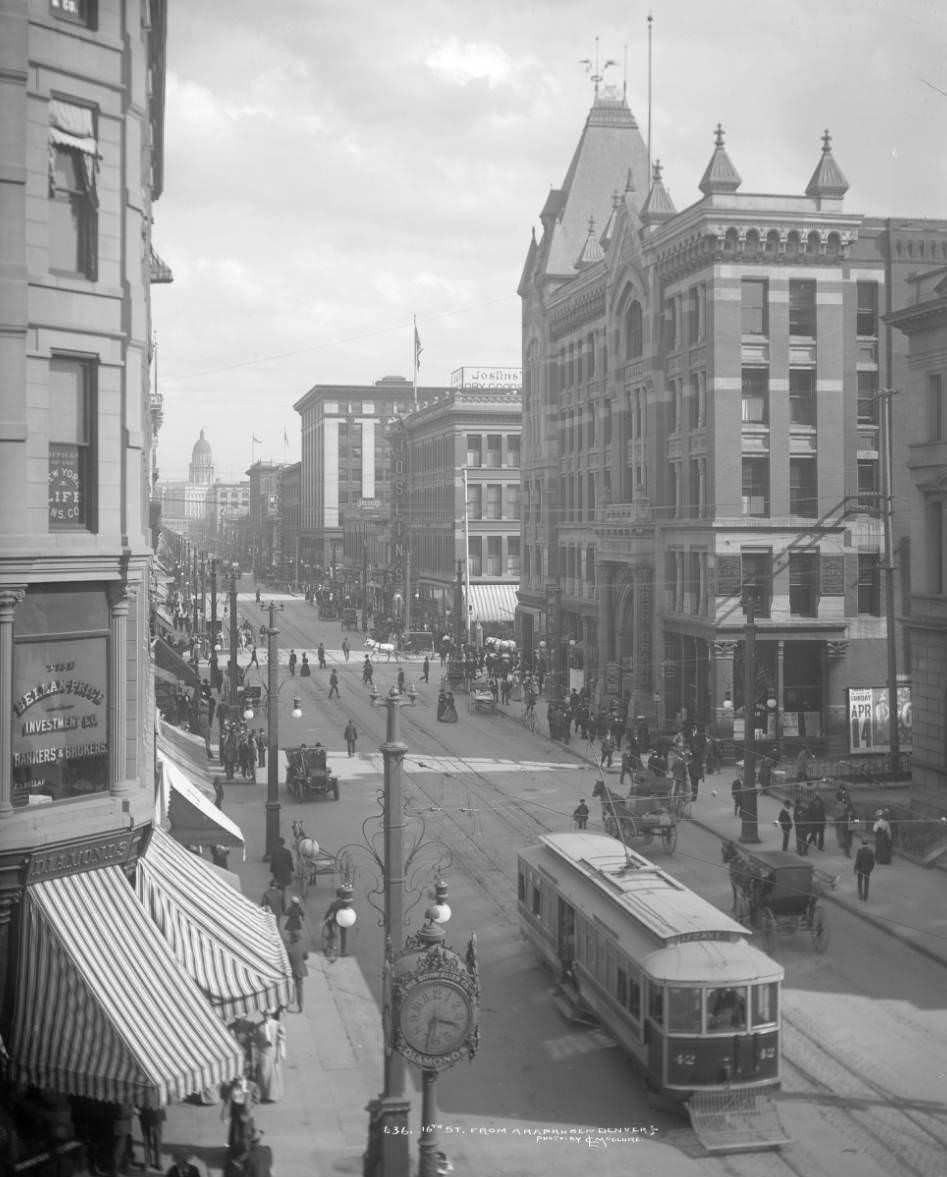
The Tabor Opera House on 16th Street was built by Horace Tabor, the silver magnate who briefly became one of Colorado’s wealthiest men. Though Tabor himself died in poverty in 1899, the opera house that bore his name continued to anchor Denver’s cultural life into the early 1900s. Looking down 16th Street from Arapahoe in 1907, the opera house appeared alongside banks, retailers, and office buildings that had accumulated along Denver’s most important commercial street over several decades of growth.
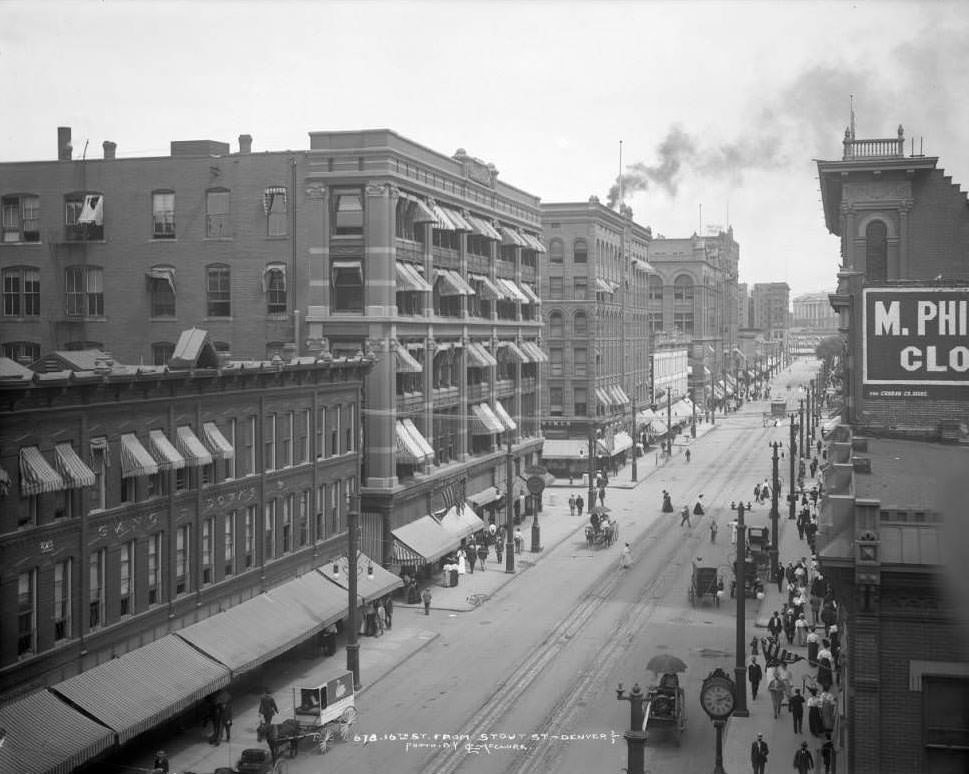
Every block of 16th Street in 1905 was packed with commerce. Viewed from Stout Street, the corridor stretched in both directions past retailers, professional offices, and financial institutions. Signs competed for visibility at street level and on upper floors, advertising everything from dentists and tailors to banks and saloons. The streetcar tracks running down the center of the road carried a constant flow of trolleys, connecting this commercial core to the residential neighborhoods that fed it with customers and workers.
The intersection of 16th and Lawrence Streets was one of the busiest points in Denver’s commercial district. Lawrence Street ran through a section of downtown that included warehouses, business offices, and retail establishments. At night, the intersection took on a different character entirely — the Golden Eagle Dry Goods Store at 16th and Lawrence was photographed in 1901 with its electric lights blazing, an early example of the nighttime commercial lighting that was transforming American cities at the turn of the century.
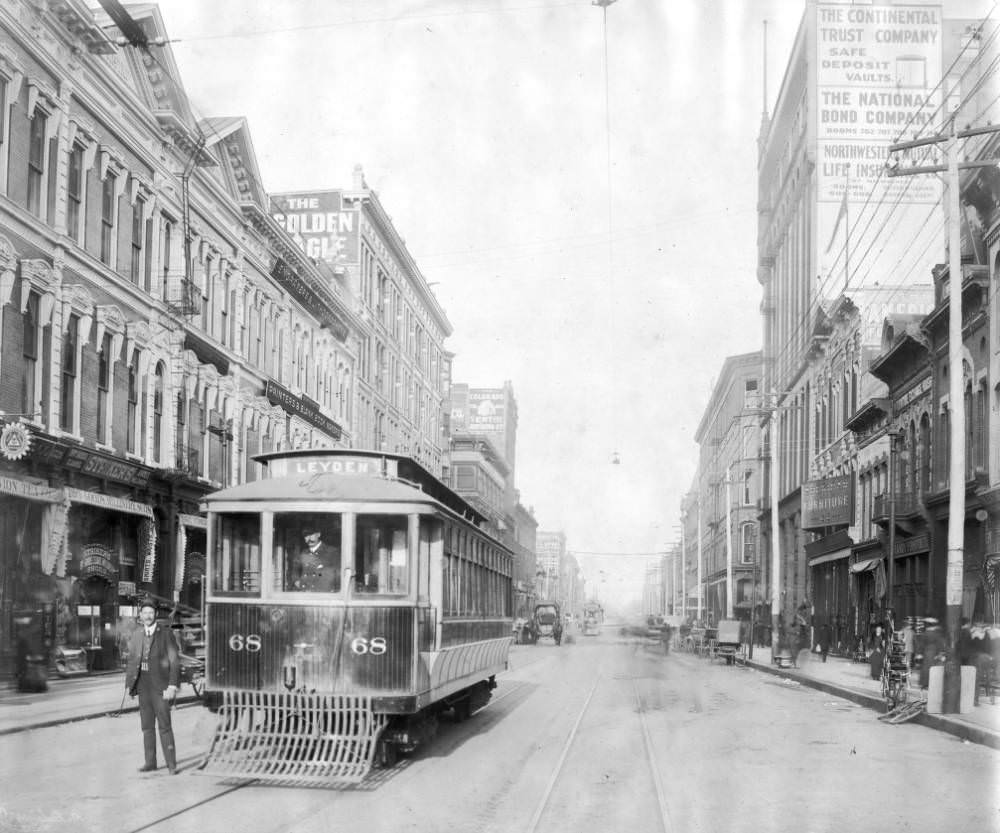
Denver Tramway cars appeared on nearly every major street in the city. Their routes were numbered and color-coded, and regular riders knew their schedules by heart. The cars ran from early morning until late at night, and during peak hours they followed each other closely enough that a missed car meant only a short wait for the next. The tramway company’s dominance over Denver’s transit was so complete that it shaped where people lived, where they shopped, and how they understood the city’s geography.
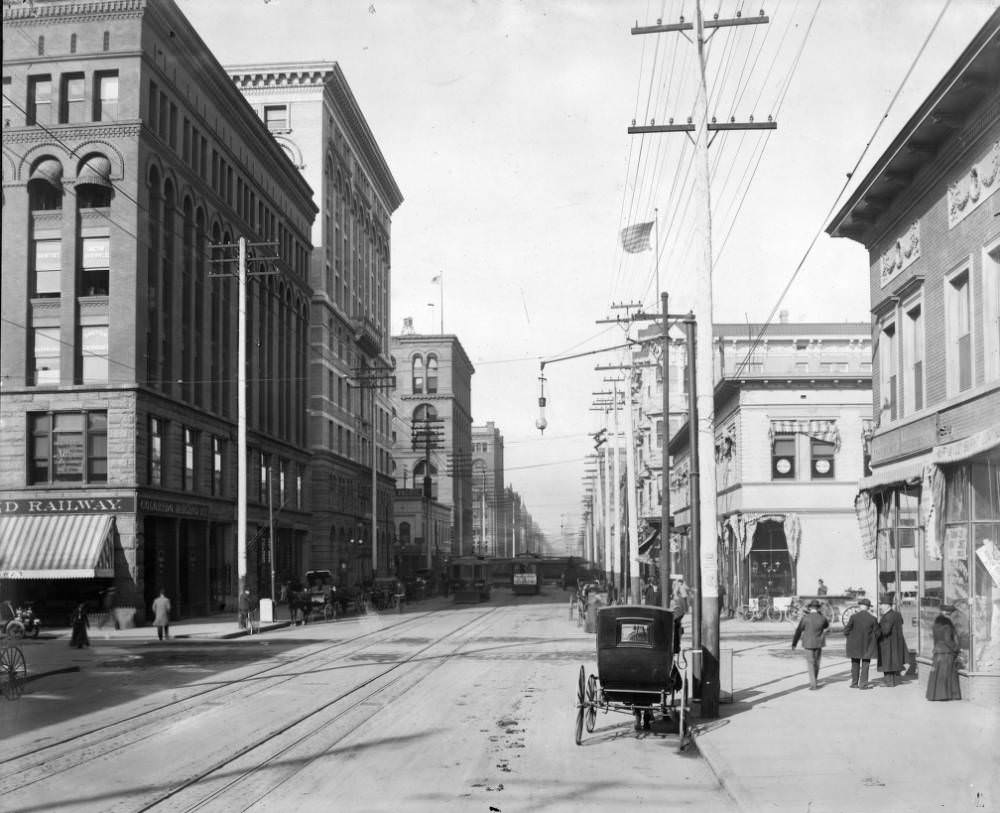
17th Street and California Avenue formed another of downtown Denver’s high-traffic intersections. Multiple trolley lines crossed here, and pedestrians navigated the intersection alongside both streetcars and horse-drawn vehicles. The businesses that lined these corners — cafes, offices, a pharmacy, a hotel — catered to the constant foot traffic the tramway delivered. Denver’s grid layout made intersections like this natural gathering points, and the commercial density that formed around them was a direct result of the transit network.
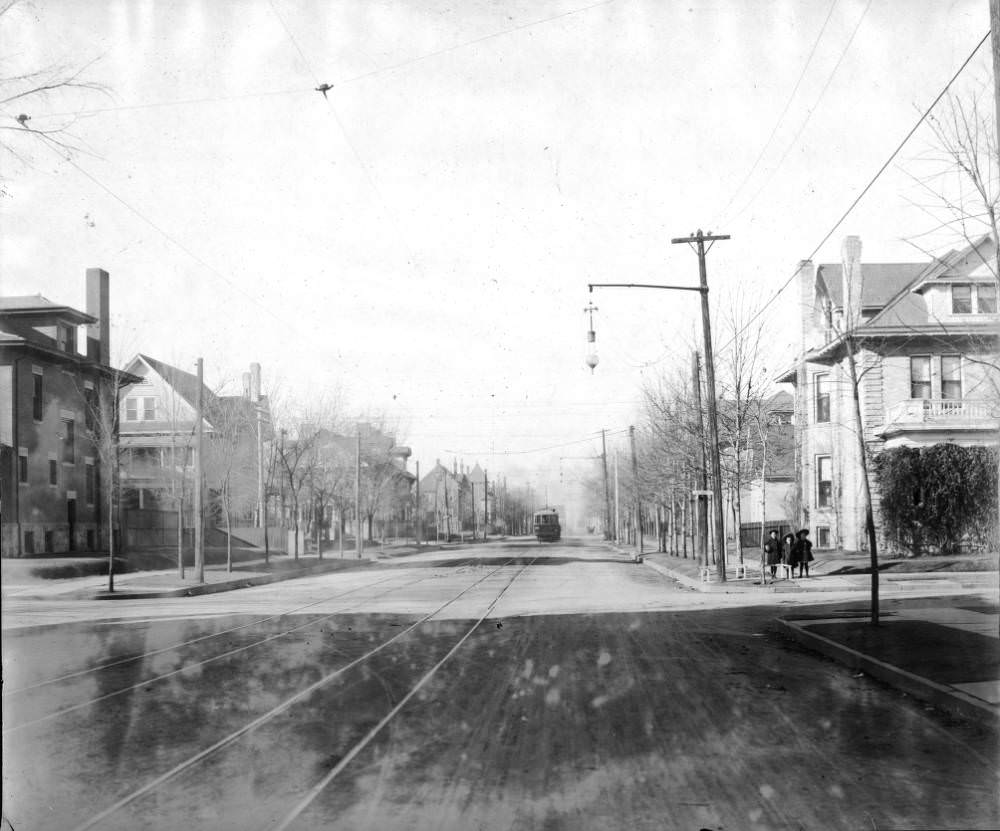
Away from the downtown core, Denver’s residential neighborhoods had their own quieter streetcar stops. Trolley No. 200 on 17th Avenue and Emerson Street served the Capitol Hill area, picking up and dropping off residents throughout the day. Girls standing on the corner waiting for the car, or simply watching it pass, were a common scene in the neighborhoods that had grown up around the tramway routes. The residential 17th Avenue ran through a section of Denver that was dense with apartment buildings and modest single-family homes.
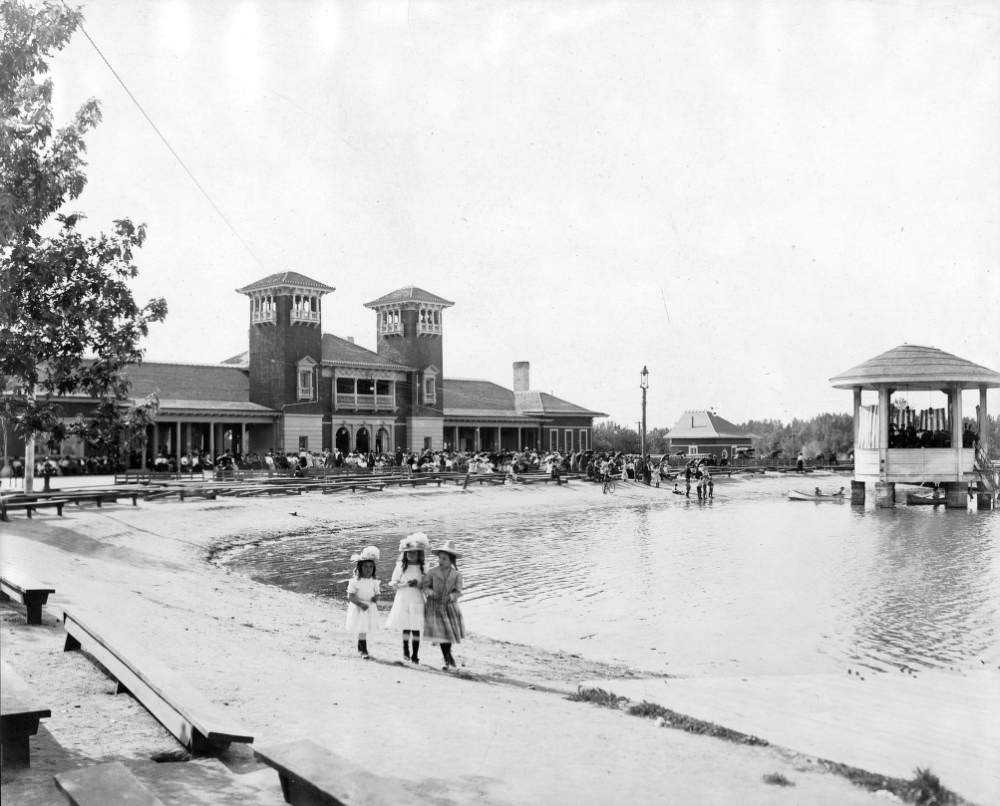
City Park on Denver’s east side was the city’s largest public park and home to the Denver Museum of Natural History and the City Park Zoo. The park’s lake and pavilion were gathering places on weekends, when bands performed and families spread out across the lawns. In 1905, the park was well established, with mature trees lining its paths and the museum building visible from the lake. Photographs from this period show City Park as a genuinely diverse public space, used by Denverites across class and ethnic lines.
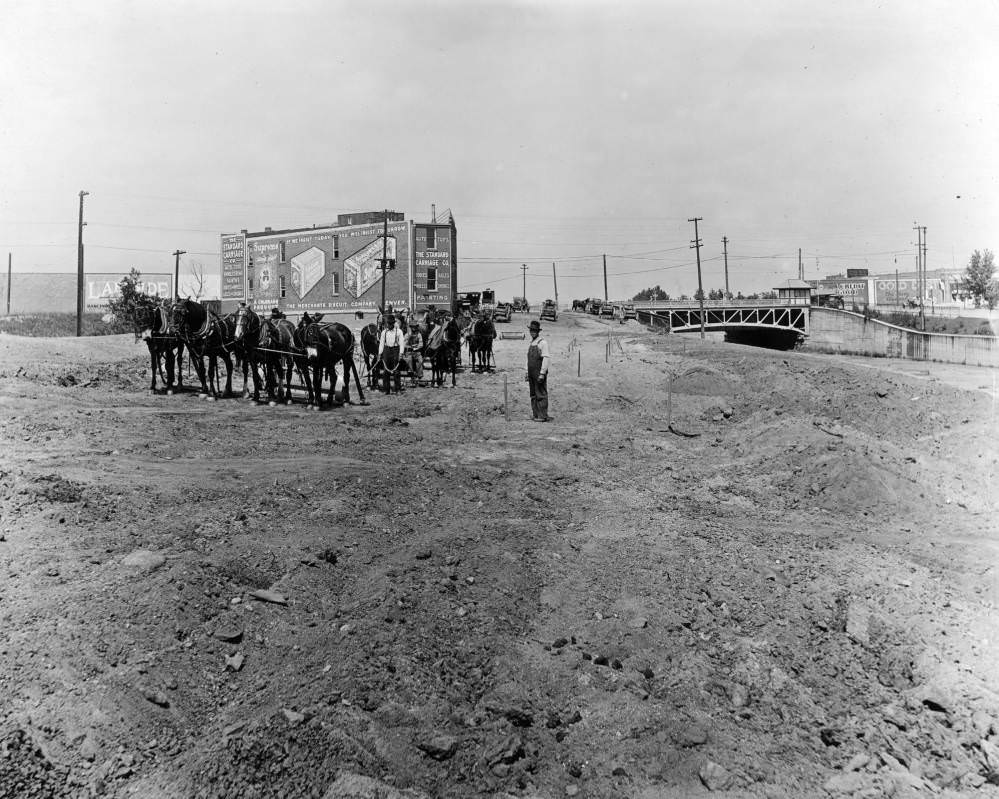
Speer Boulevard’s construction required extensive earthmoving along Cherry Creek. Horse and mule teams pulled grading equipment that shaped the parkway’s foundation, while laborers worked alongside to clear brush and build retaining walls. Mayor Speer’s vision for the boulevard was grand — a Parisian-style promenade that would make Denver’s creek an asset rather than an eyesore. The project took years and involved the coordinated effort of hundreds of workers, most of them recent immigrants working for daily wages.
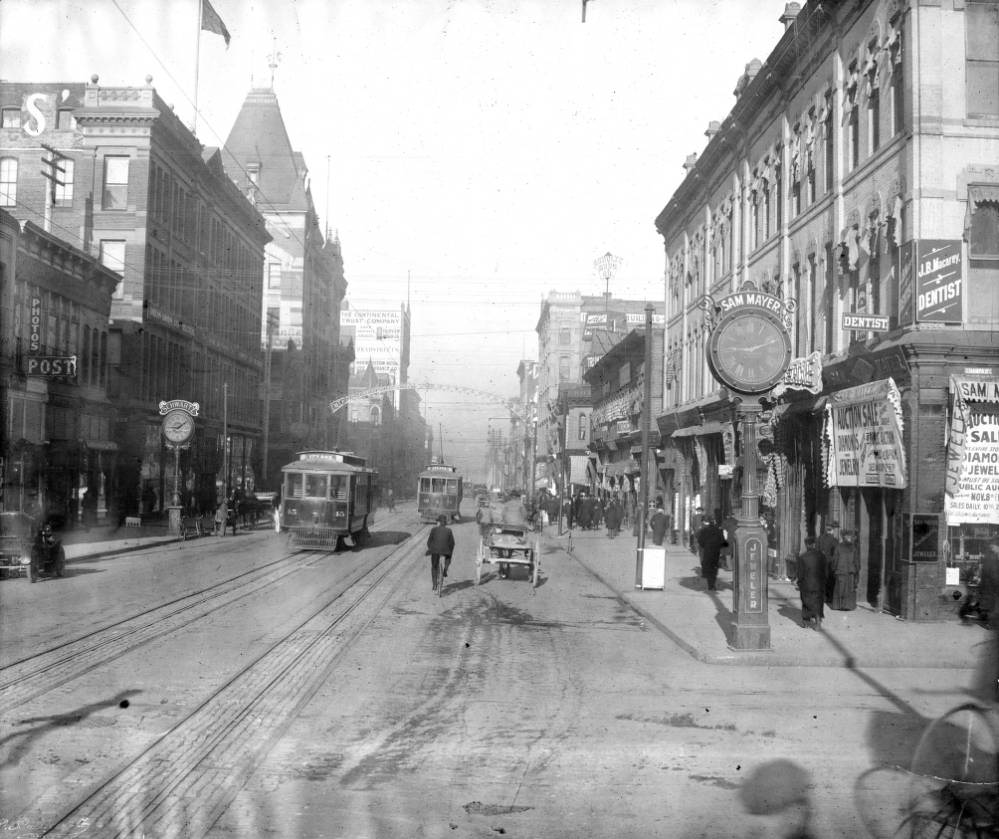
The intersection of 16th and Champa Streets showed multiple trolleys operating simultaneously, a sign of how frequent service had become on Denver’s busiest corridor. Business signs advertised goods and services at eye level and above, competing for the attention of passing streetcar riders. The visual complexity of a busy Denver intersection in 1905 — trolleys, horses, pedestrians, signs, and storefronts all in the same frame — captures the sensory density of urban life at the height of the streetcar era.
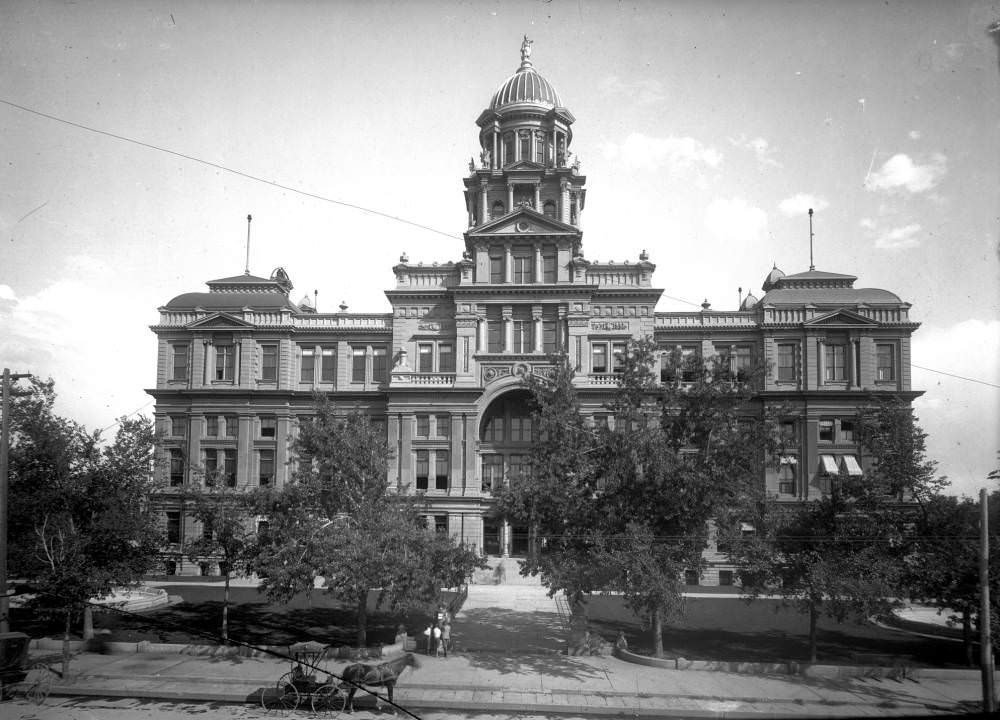
The Arapahoe County Courthouse at 16th and Tremont had been one of Denver’s most imposing buildings since its construction in 1883. By 1902, it had become the Denver County Courthouse following the city’s separation from Arapahoe County. The building stood for another three decades before being demolished in 1934. Photographs from 1902 show it surrounded by the activity of a growing city — streetcars, buggies, and pedestrians moving past a structure that still anchored the civic center of downtown.
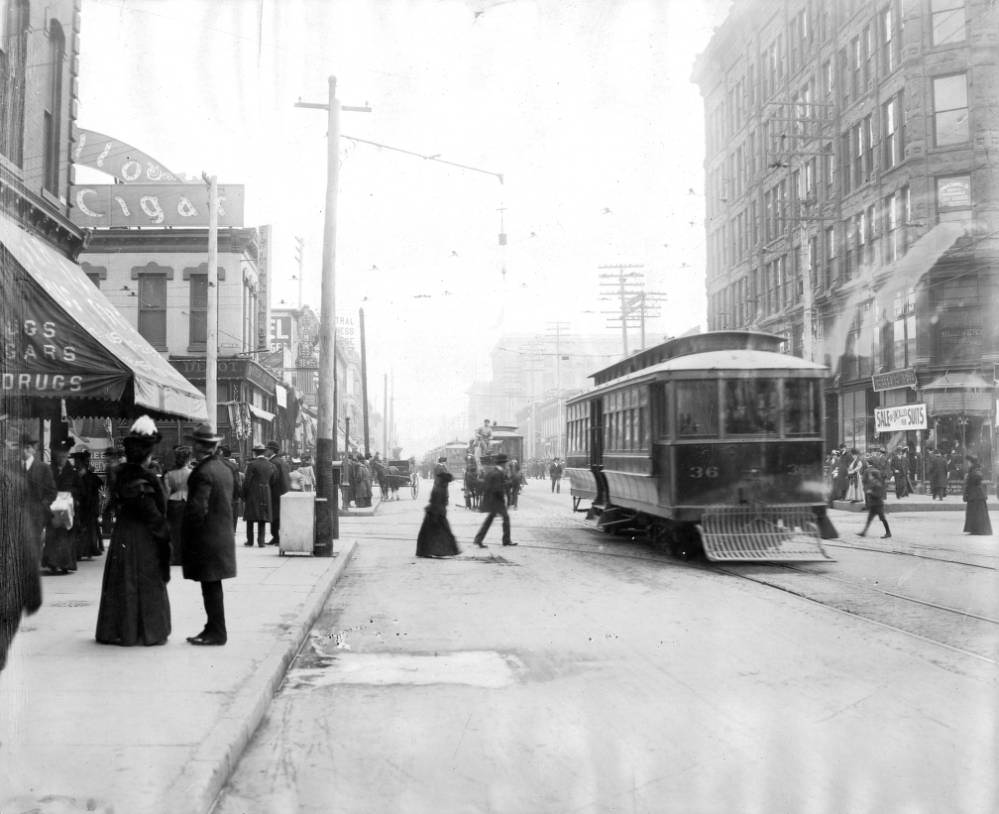
15th Street ran parallel to 16th and served as a secondary commercial corridor in downtown Denver. Trolleys 36 and 333 shared the tracks with pedestrians picking their way across the busy street. The storefronts along 15th Street advertised grocers, clothiers, and professional services, serving a clientele drawn from the nearby office buildings and hotels. The Denver City Tramway’s central loop at 15th and Arapahoe was one of the system’s key transfer points, where riders could switch lines without paying an additional fare.
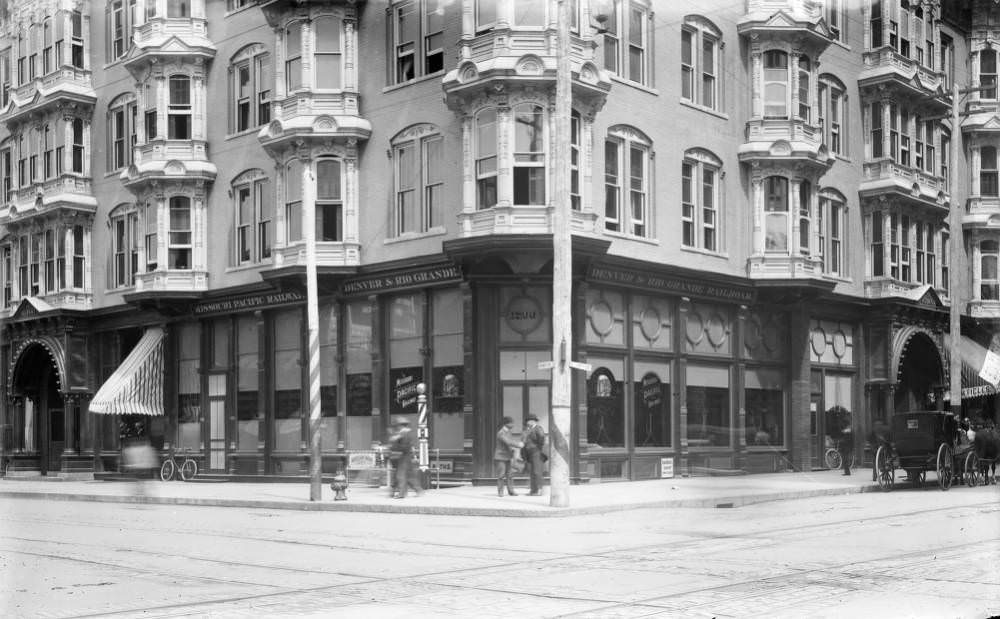
The Albany Hotel was one of Denver’s established downtown landmarks, a gathering place for businessmen, railroad travelers, and political figures. The Denver and Rio Grande maintained a ticket office in the Albany’s lobby, making the hotel a natural hub for rail passengers. Men shaking hands on the sidewalk outside — alongside a barbershop pole and a thicket of railroad advertising signs — presents an image of Denver’s commercial street life as a place where business deals were made as often outdoors as in.
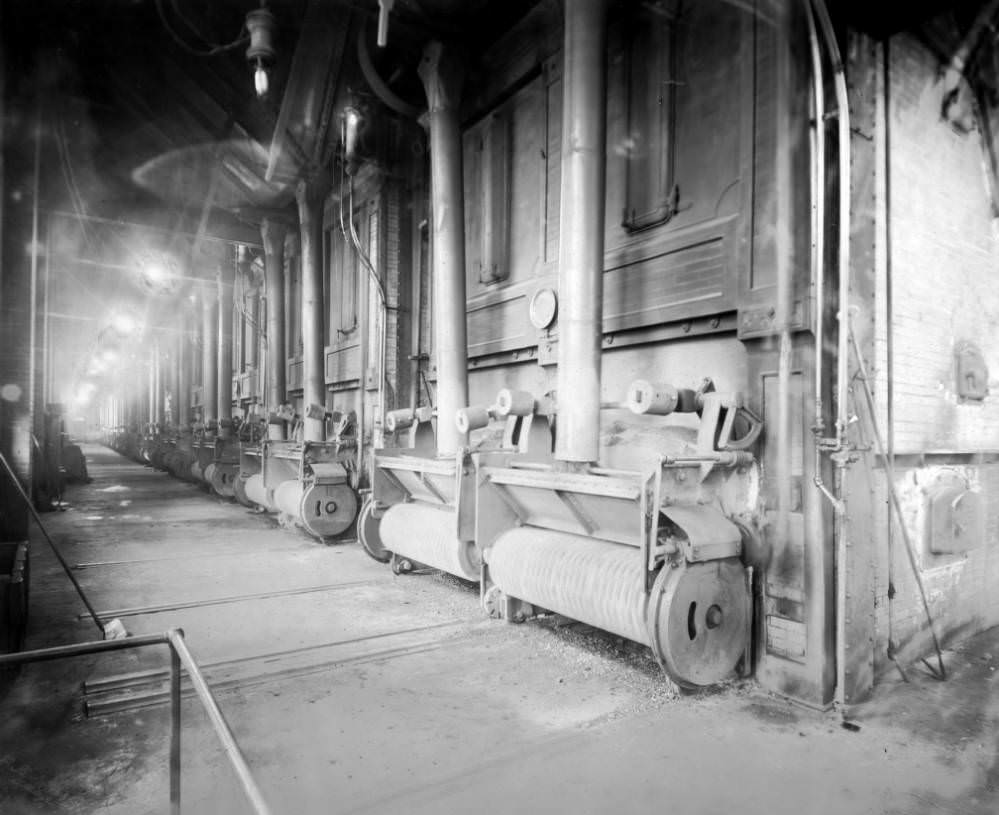
The electric trolley system depended on a massive power station to keep the overhead wires charged. Inside the Denver Tramway Company’s power station in 1905, coal-fired furnaces and generating machinery occupied an enormous building on the banks of the South Platte River. Workers maintained the equipment around the clock, since any failure in the power supply could bring the entire trolley network to a halt. The 14th Street viaduct crossed above the power station and the river, connecting the city’s west side to the downtown.
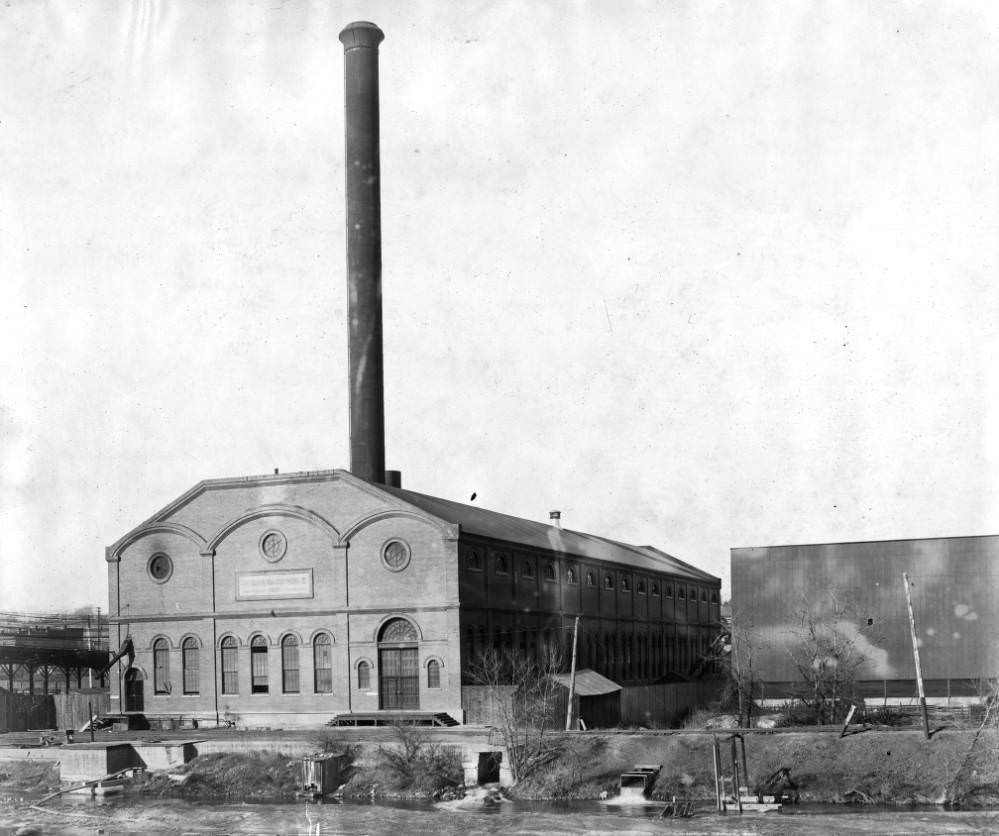
Seen from outside, the Denver Tramway power house on the South Platte River was an industrial landmark. Its tall smokestack and brick construction were visible from much of the surrounding neighborhood, and the smoke it produced was a constant presence in the air of Denver’s west side. The 14th Street viaduct in the background connected the power station’s neighborhood to the downtown, and the river below it was lined with industrial operations that made this corridor one of the noisiest and most productive sections of the city.
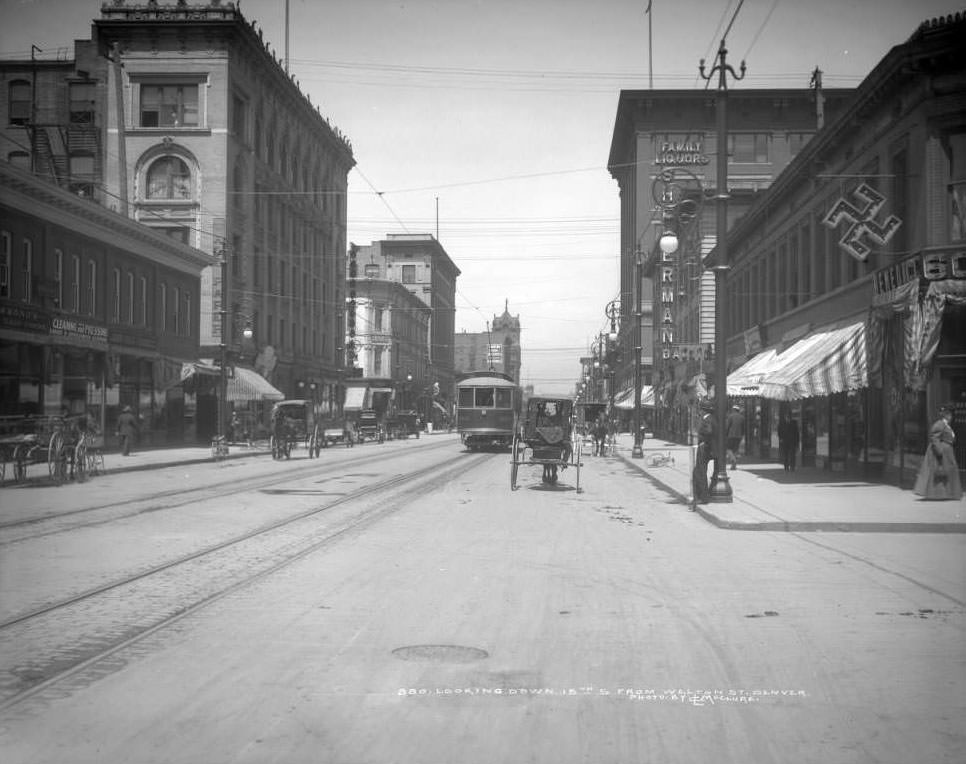
The view down 15th Street from Welton in 1900 showed a street in full transition. Horse-drawn vehicles, electric trolleys, and pedestrians all shared the same pavement, navigating around each other without any formal traffic control. Denver had no traffic lights in 1900 — those were still two decades away — and the management of busy intersections depended entirely on the judgment and courtesy of drivers, riders, and walkers. The mixture of transportation modes visible in this single photograph captures a city caught between two eras.
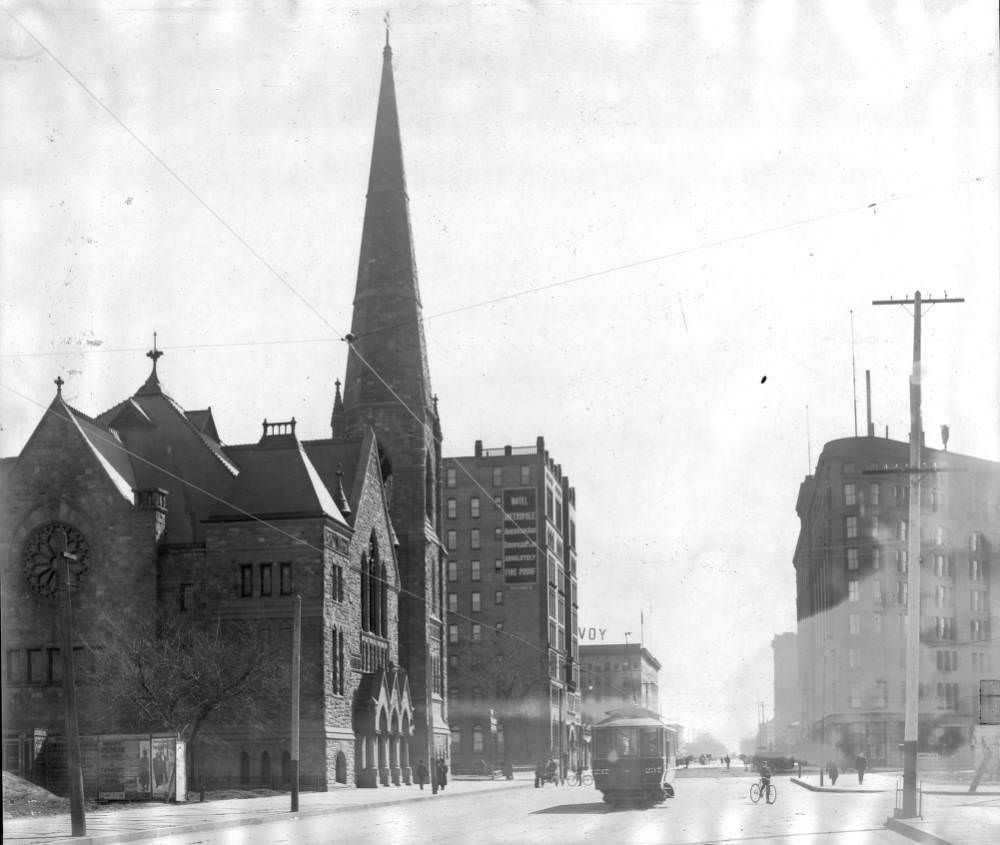
Broadway was one of Denver’s major north-south arteries, running through the city from the downtown to the southern suburbs. Trolley 237 on Broadway in 1905 passed a landscape of billboards, storefronts, and institutional buildings. The route connected downtown Denver to residential neighborhoods to the south, and the corridor around Broadway and Colfax was among the most heavily trafficked in the city. Billboards along Broadway advertised products and services to the thousands of riders who passed each day.
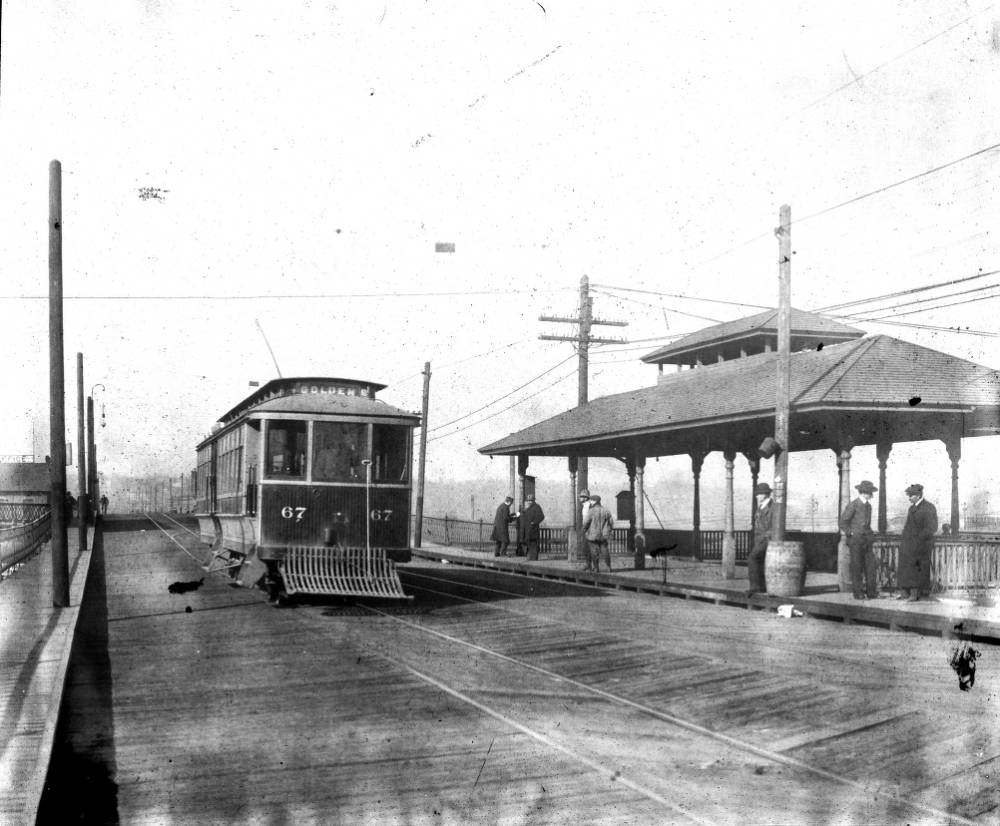
The 16th Street viaduct near Union Station was an elevated section of tramway track that carried trolleys over the rail yards. Trolley No. 67 at the covered stop on the viaduct served passengers arriving and departing by train, connecting the station to the rest of the city’s streetcar network. The covered stop provided shelter from rain and snow, a practical amenity on a route that served large numbers of travelers. Union Station and the surrounding transit infrastructure were the physical heart of Denver’s connectivity.
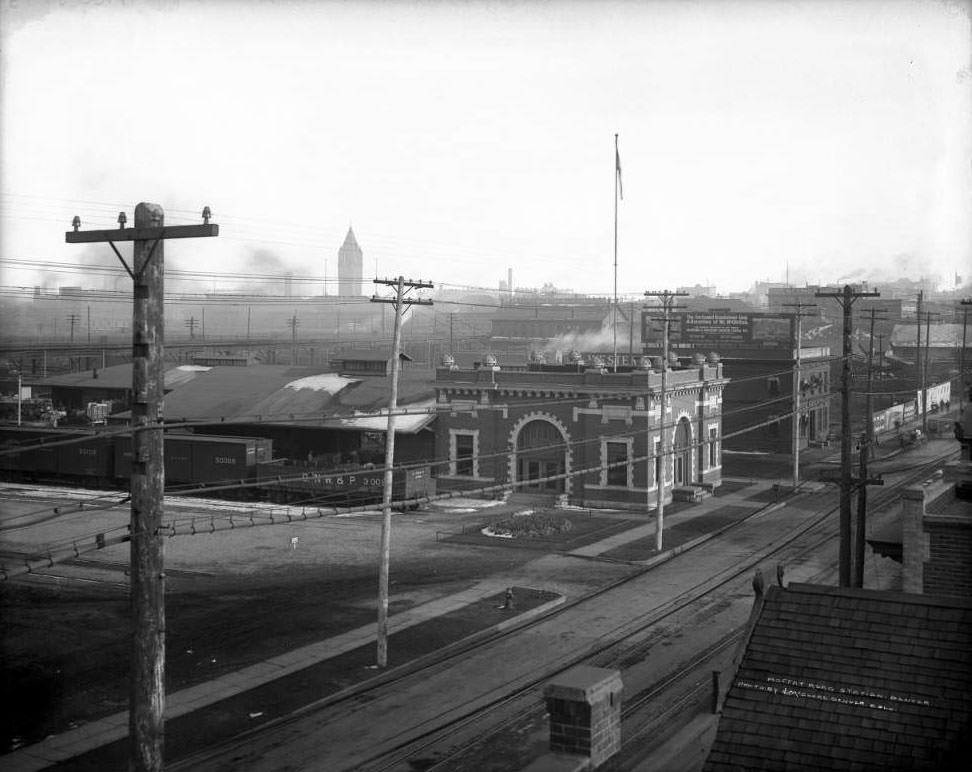
The Moffat Road — formally the Denver, Northwestern and Pacific Railway — was David Moffat’s ambitious project to build a direct rail route from Denver over the Continental Divide to the Western Slope. The Moffat Road Station served as its Denver terminus in 1905. The project was one of the most technically challenging railroad construction efforts in American history, and Moffat spent much of his personal fortune on it. The station’s billboards and parked automobiles show a transit facility that existed at the intersection of the old railroad world and a newer, automobile-influenced one.
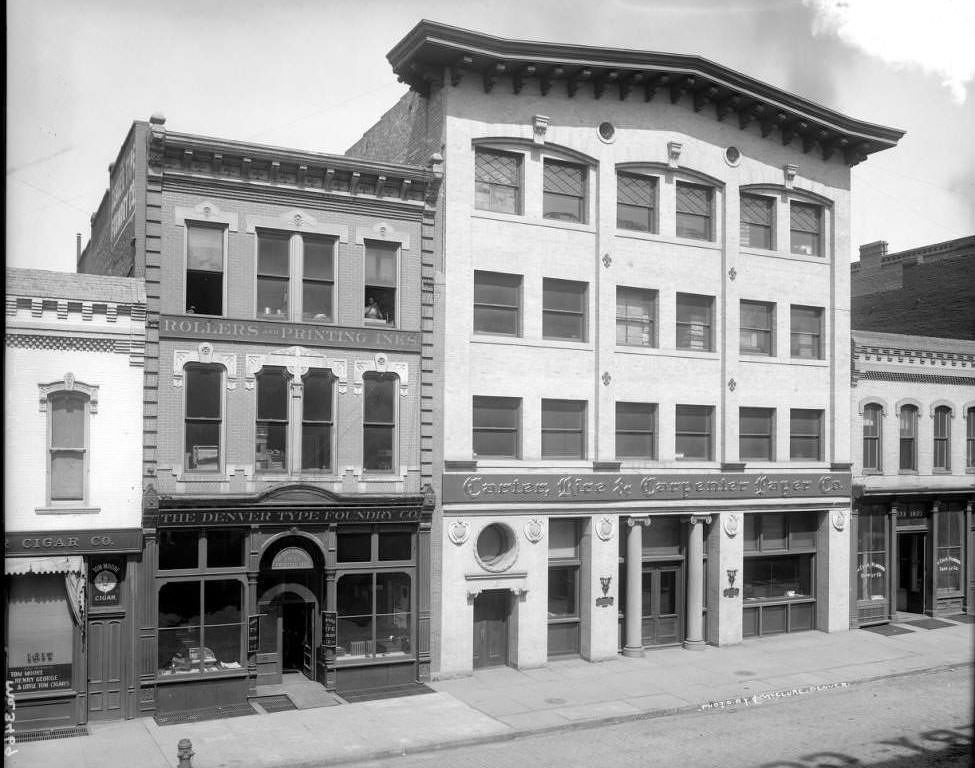
Blake Street ran through the LoDo district just north of Union Station, an area dominated by warehouses, wholesale businesses, and light manufacturing. The signage on Blake Street in 1905 advertised the full range of commerce that supported Denver’s construction boom and commercial growth — hardware, lumber, machinery, and supplies of every kind. The street was less fashionable than 16th or 17th but essential to the functioning of the city’s economy, serving as the supply chain behind Denver’s more visible retail and civic face.
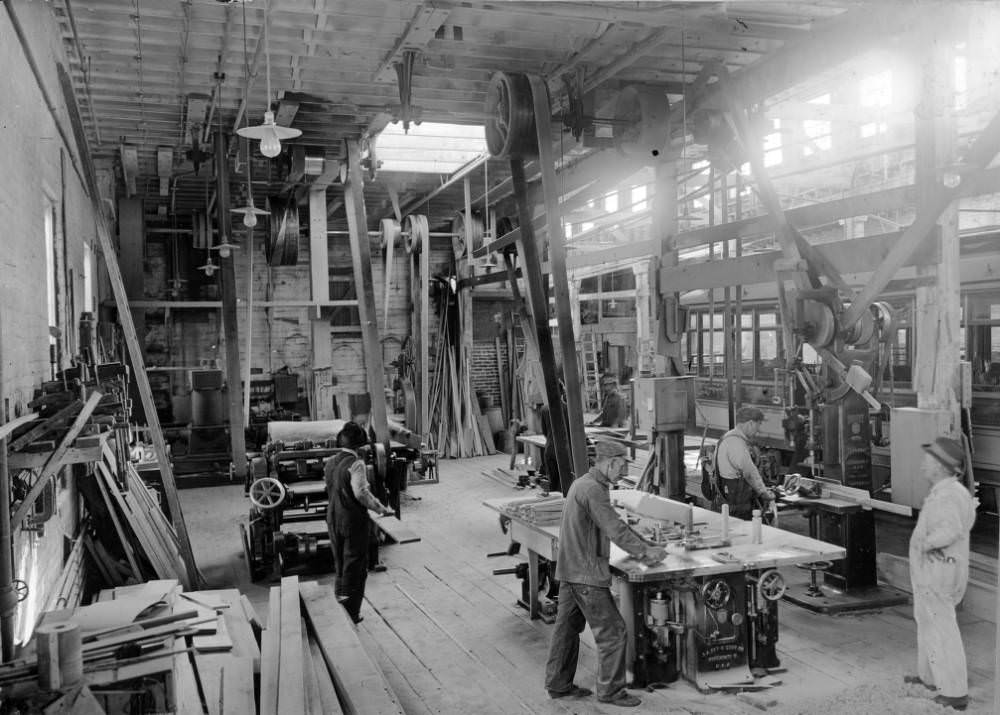
The Denver Tramway Company’s machine shop was where trolley cars were built, repaired, and overhauled. Skilled machinists, carpenters, and electricians worked in the shop, maintaining a fleet of hundreds of cars that operated daily across the city. The work was physical and demanding, and the shop floor was loud with the noise of metal on metal. These workers were largely invisible to the passengers riding above them on the city’s streets, but without their labor the tramway system would have ground to a halt.
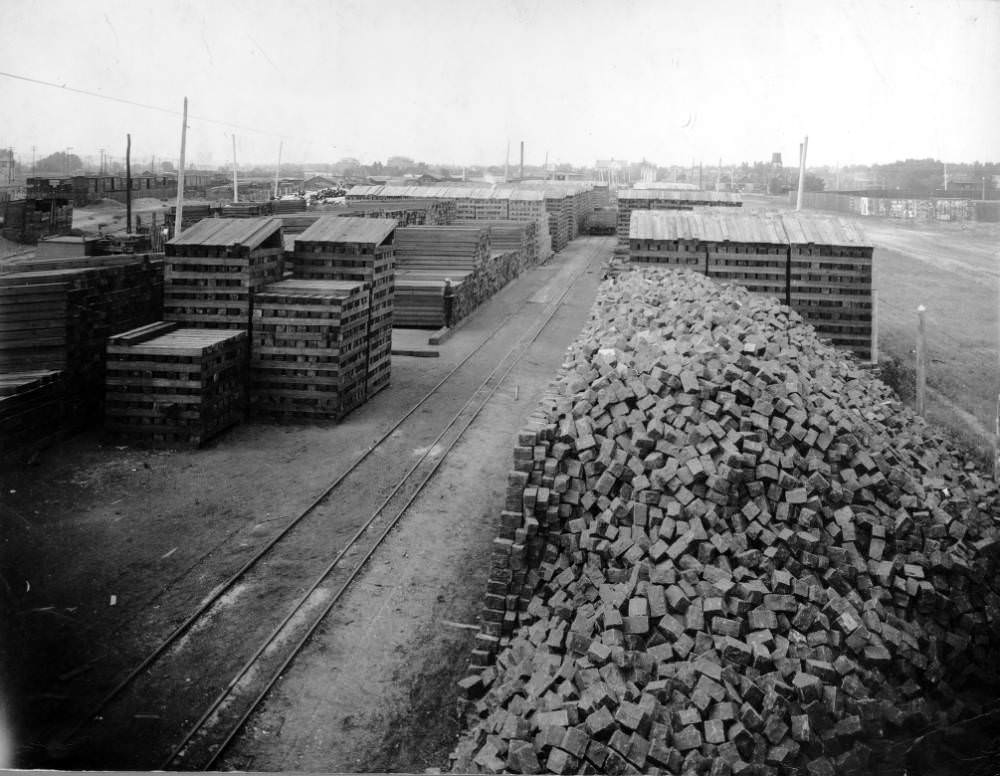
The Denver Tramway Company maintained large supply yards stocked with lumber, stone, steel track, and electrical components. Expanding the network required constant procurement of materials, and the yard served as the staging area for new construction projects across the city. Stacks of lumber visible in the photograph suggest ongoing building activity — new car barns, station shelters, or track infrastructure. The tramway company was, by any measure, one of Denver’s largest and most capital-intensive enterprises.
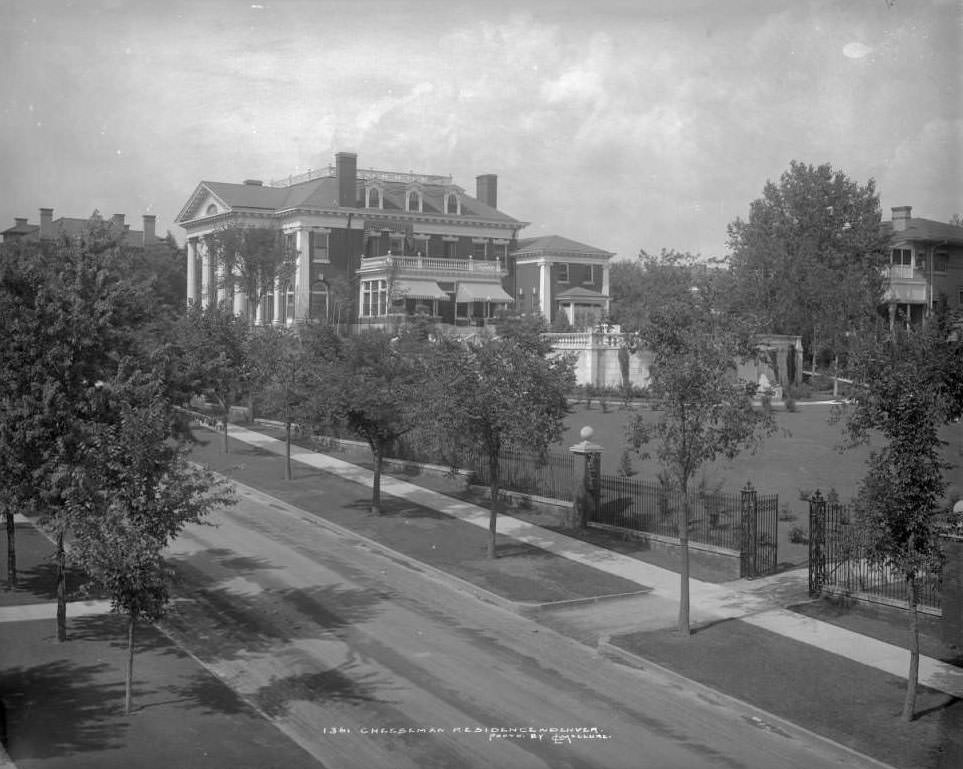
Walter Scott Cheesman’s Capitol Hill residence was one of the grandest private homes in Denver. Built in the Colonial Revival style, it occupied a commanding position in the neighborhood and reflected the wealth Cheesman had accumulated through real estate, banking, and the Denver Union Water Company. After Cheesman’s death in 1907, the home eventually became the Colorado Governor’s Mansion. Its 1908 photograph shows a property in immaculate condition, a monument to the ambitions of Denver’s first generation of serious wealth.
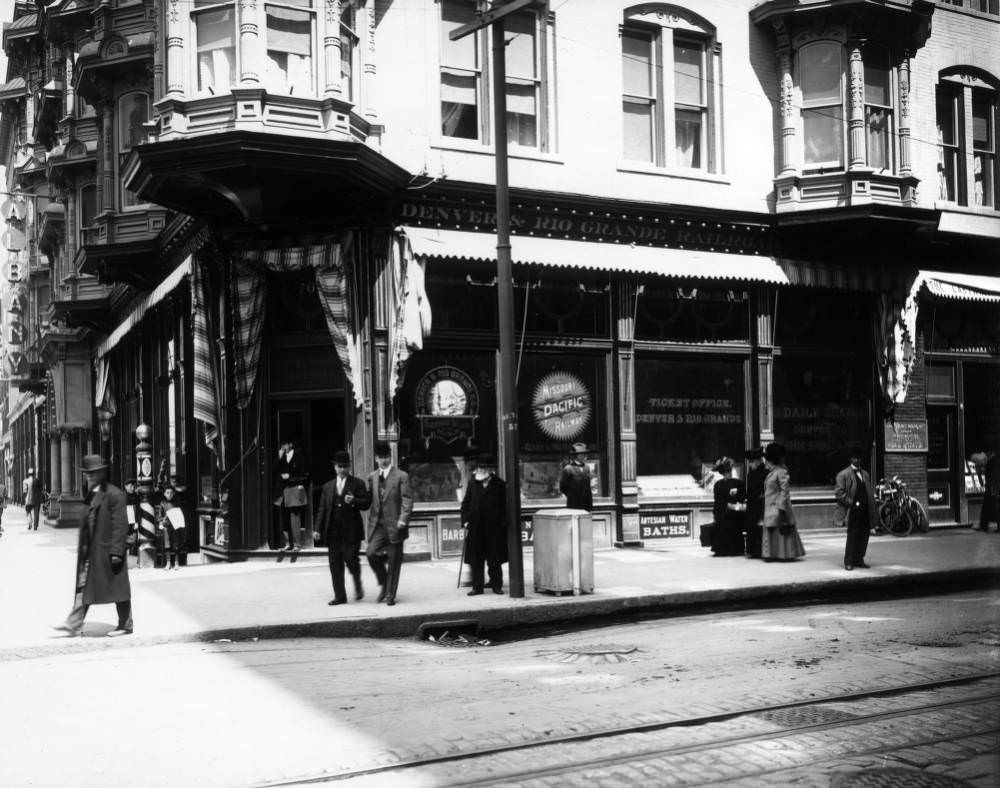
Newsboys — children who sold newspapers on the street — were a fixture of Denver’s commercial sidewalks in the early 1900s. Many of them worked long hours for small wages, and their presence outside hotels and railroad ticket offices was strategic. Travelers and businessmen were prime customers for the latest edition. The Denver Post and the Rocky Mountain News competed fiercely for readers, and their newsboys competed just as fiercely for the best corners. Child labor laws were still weak in Colorado in 1909, and newspaper selling was one of the most common forms of child employment.
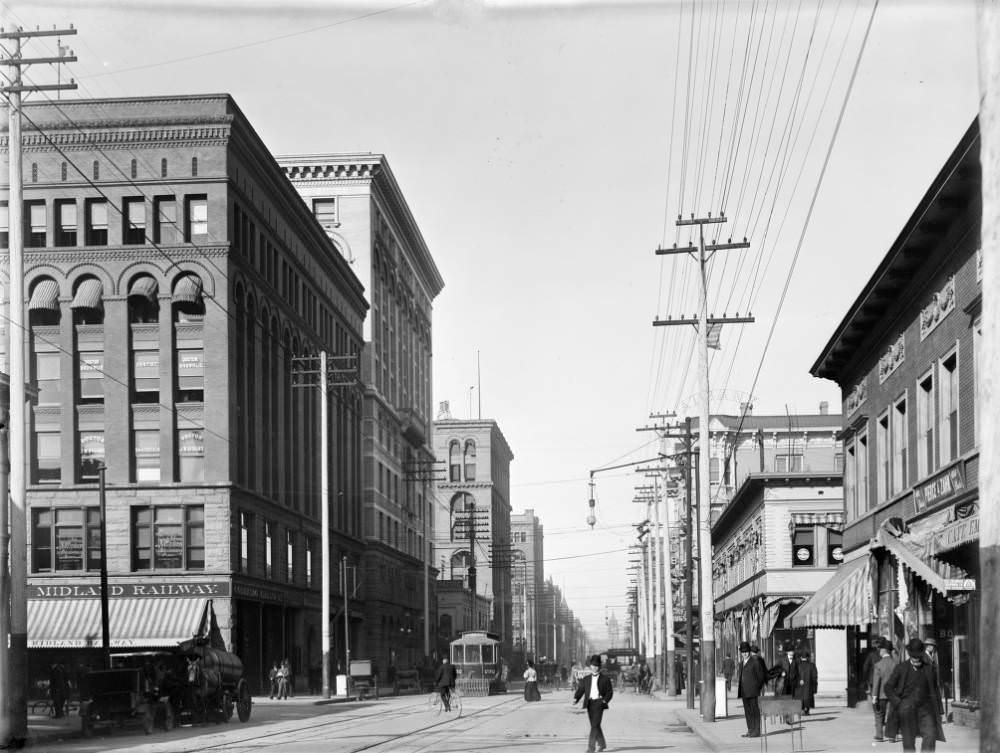
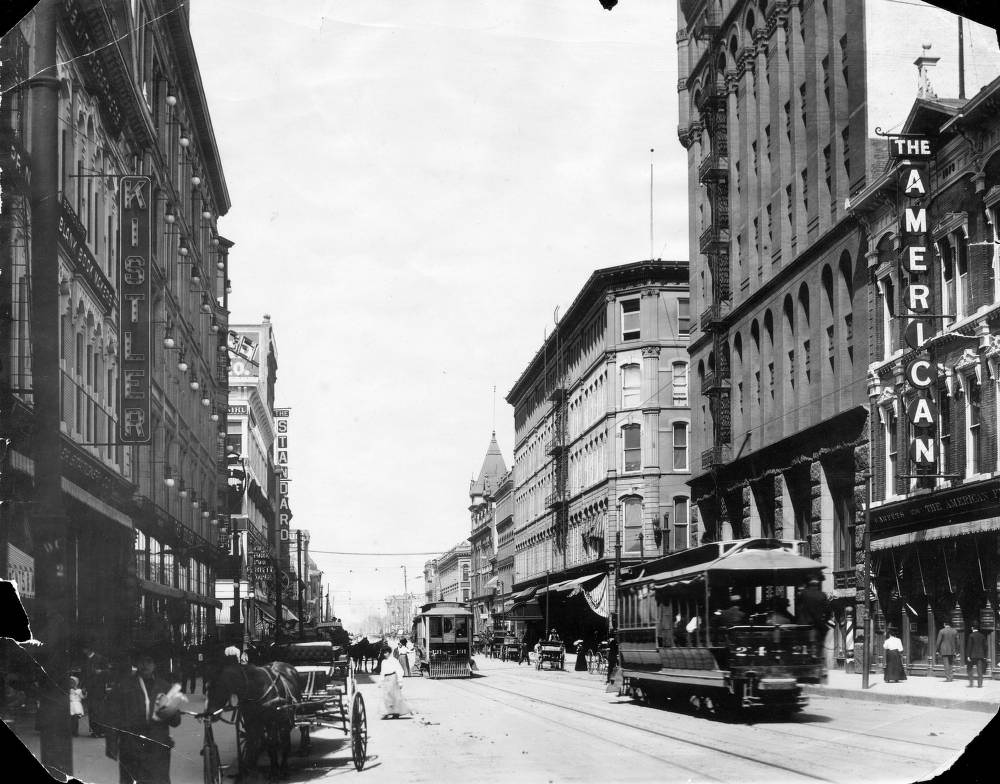
17th Street was Denver’s financial and banking district. Trust companies, investment banks, and the offices of mining corporations lined its blocks. The streetcar that ran down 17th Street carried workers to and from the downtown core, while pedestrians moved along sidewalks past storefronts and office entrances. The street’s character was more formal than 16th, its buildings taller and its tenants more likely to be wearing suits than overalls. By the early 1900s, 17th Street had established itself as the address for Denver’s financial establishment.
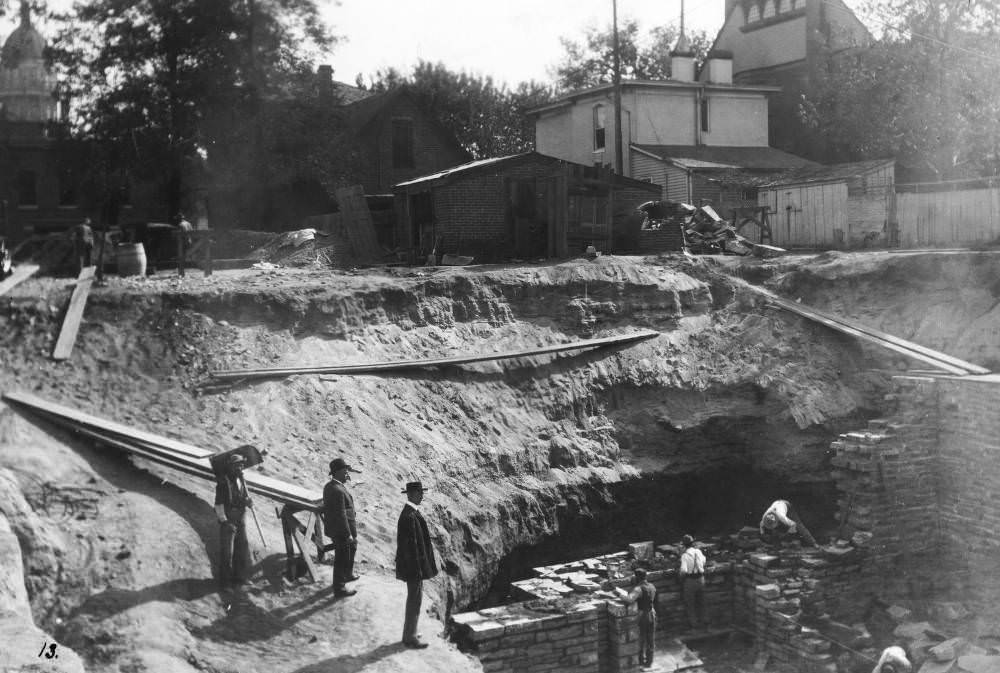
Construction on the Denver Public Library began in 1906 under the supervision of architect Myron Hunt and local contractor John A. McIntyre. The building’s stone walls rose slowly through 1906 and 1907, interrupted at times by Colorado’s harsh winters. Photographs show the construction site covered in snow with the Civic Center neighborhood visible in the background. The project was a major public works undertaking, and Denverites followed its progress closely. A Carnegie grant contributed to the funding, but the city also invested significant municipal resources in the building.
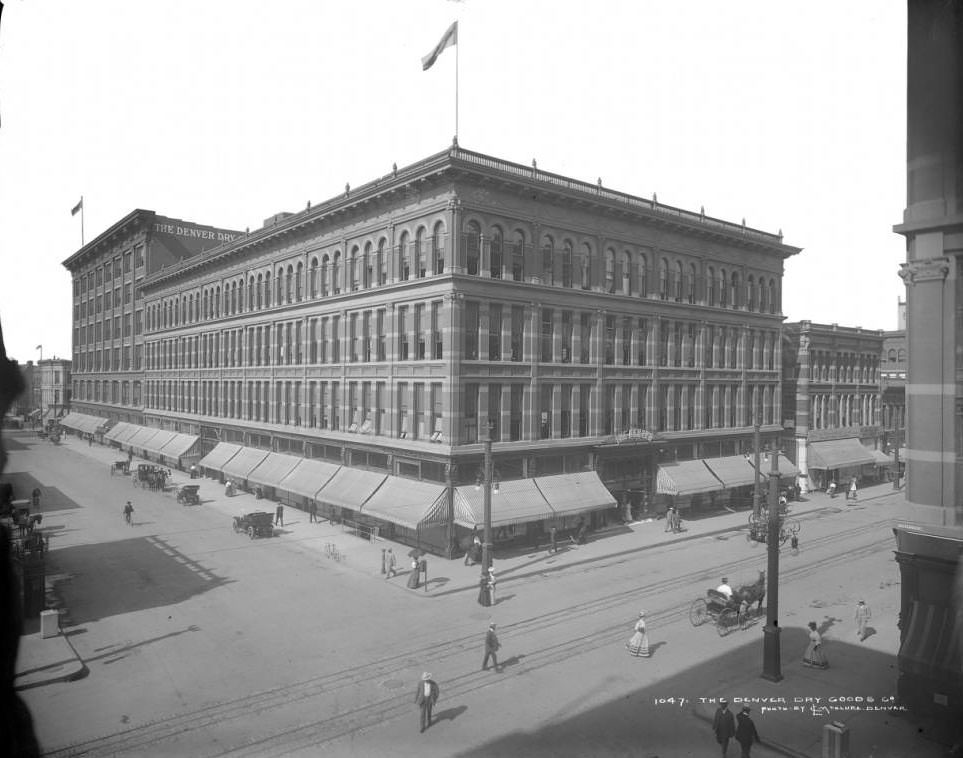
The Denver Dry Goods Company was one of the city’s premier retail establishments. By 1908, early automobiles were beginning to appear on the streets outside its entrance, sharing space with horse-drawn delivery wagons and pedestrians. The automobile’s arrival in Denver was gradual but unmistakable — by the end of the decade, cars were a common enough sight that parking and traffic management were becoming genuine civic concerns. The department store’s elaborate signage and window displays competed for the attention of shoppers arriving by every available means.
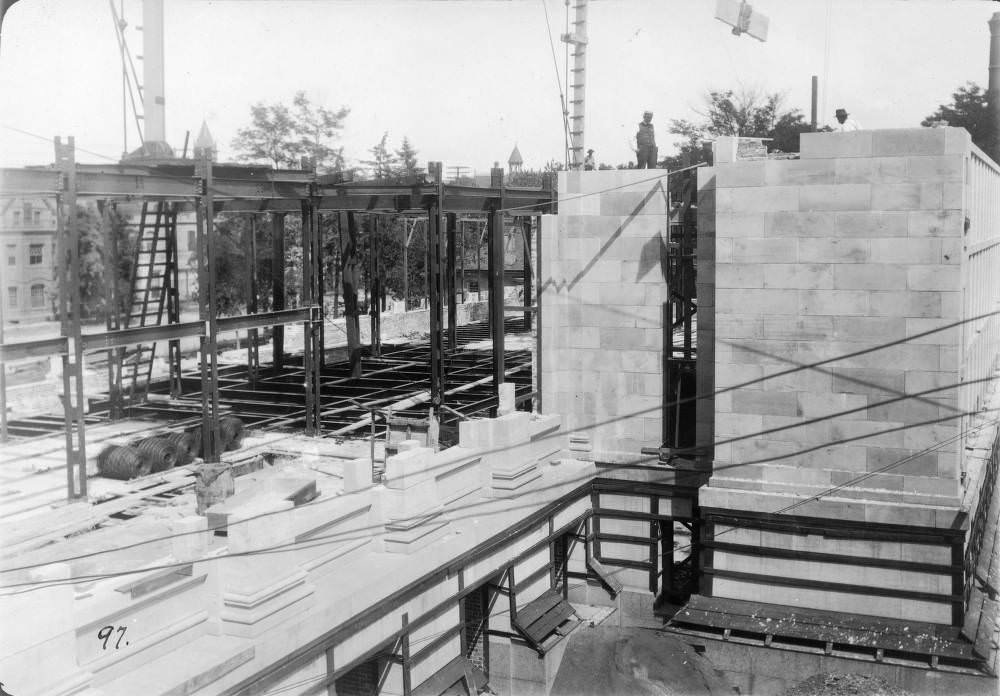
By 1907, the Denver Public Library’s stone entablature and steel structural girders were taking shape. The building combined classical architectural details with the steel-reinforced construction technology of the era. Workers can be seen in photographs from this period navigating the partially built structure. The library’s cornerstone ceremony in 1907 brought together Governor Buchtel, Rabbi Friedman, and a crowd of Denver citizens to mark the project’s official milestone. The completed library opened in 1910 and immediately became one of the city’s most used public buildings.
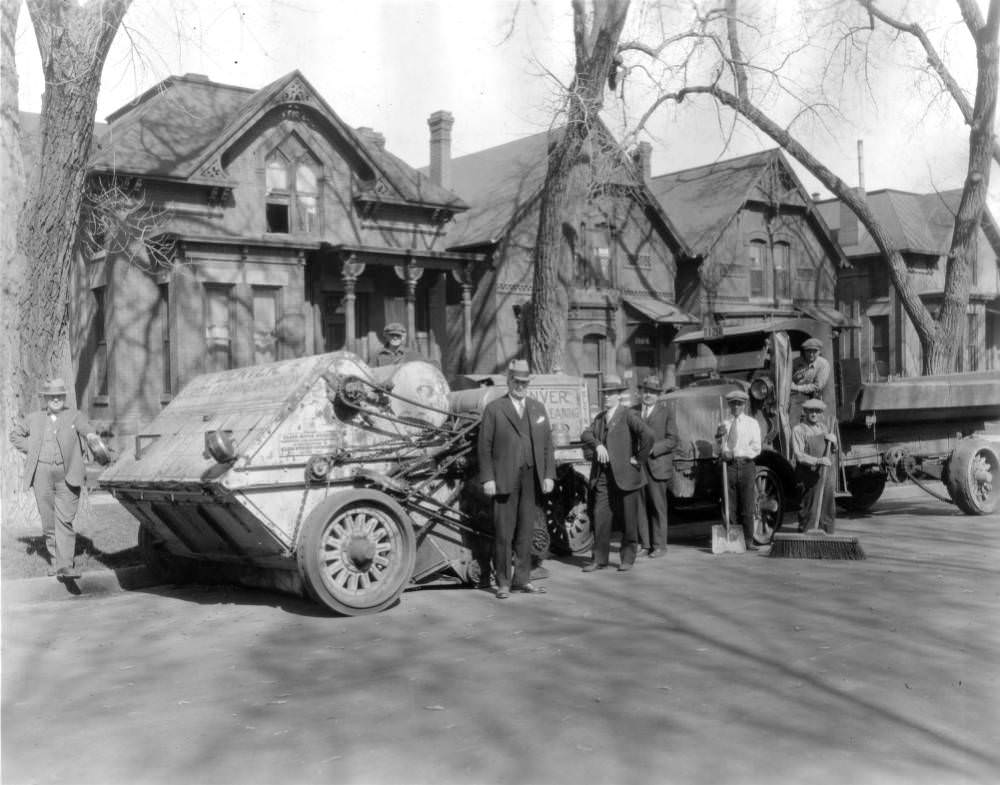
Denver was an early adopter of motorized municipal equipment. The city’s new motor street cleaners and trucks replaced horse-drawn equipment on many routes, offering greater speed and reliability. Men posed proudly with the new machines — they represented a technological step forward that many cities of comparable size had not yet taken. Denver’s investment in modern sanitation technology was part of a broader push by Mayor Speer’s administration to make the city more efficient, cleaner, and more attractive to residents and investors.
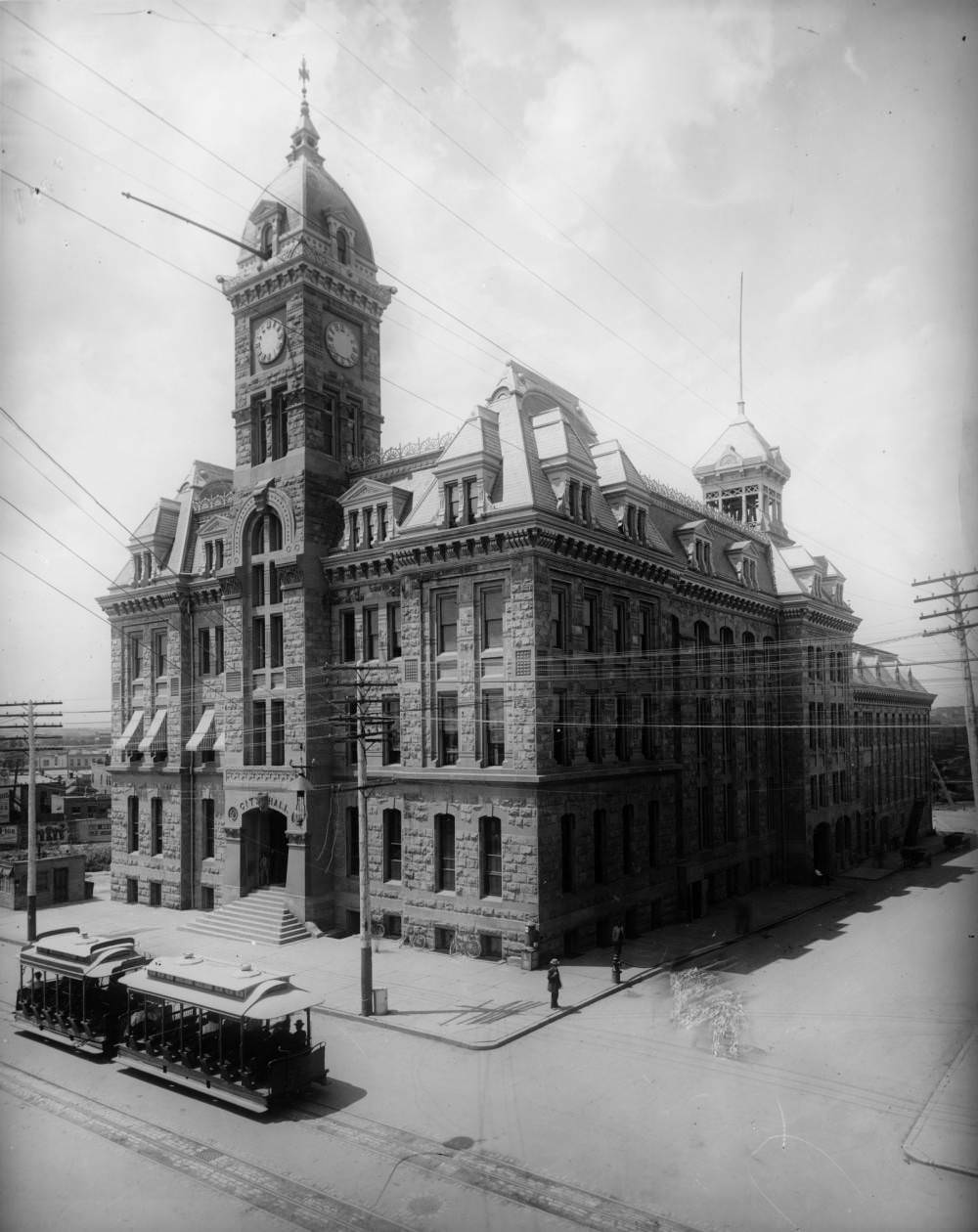
Denver City Hall on 14th Street was the administrative center of municipal government. Trolley cars and bicycles parked outside represented the full spectrum of Denver’s transportation options in the early 1900s. The bicycle had been enormously popular in the 1890s and remained a practical commuting tool into the next decade, particularly for workers who lived within a few miles of their workplace. City Hall handled everything from building permits to tax collection, and its offices were busy year-round with the business of managing a rapidly growing city.
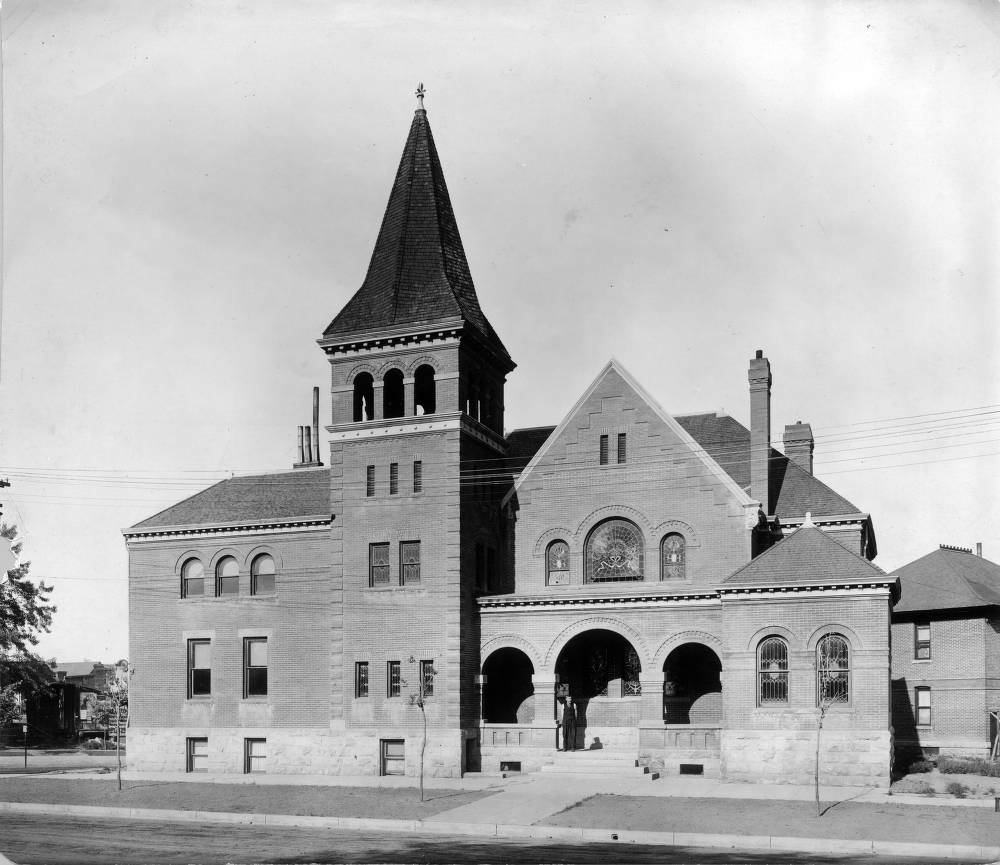
Protestant churches were a prominent feature of Denver’s residential neighborhoods. The Boulevard United Presbyterian Church, with its bell tower and stained-glass windows, served a congregation in one of the city’s established residential districts. Churches in this era functioned as social centers as well as places of worship — they ran Sunday schools, charitable programs, and social events that bound neighborhood communities together. Denver’s religious landscape was diverse, with Catholic, Jewish, and Protestant congregations each maintaining their own institutions.
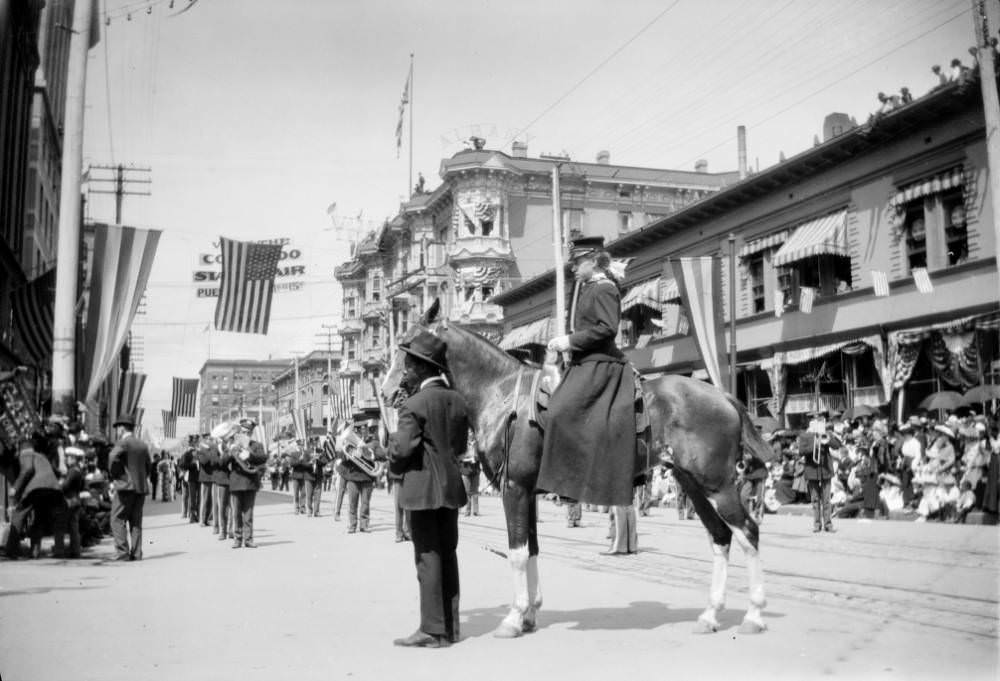
Denver’s African American community was visible in public life, including in the parades that filled 17th Street. An African American man and woman on horseback participated in a parade flanked by a marching band and U.S. flags. Denver had a small but established Black community in the early 1900s, centered in the Five Points neighborhood northeast of downtown. The community supported its own churches, businesses, newspapers, and social organizations, including the Shorter African Methodist Episcopal Church, which stood as a physical anchor of Black civic life in the city.
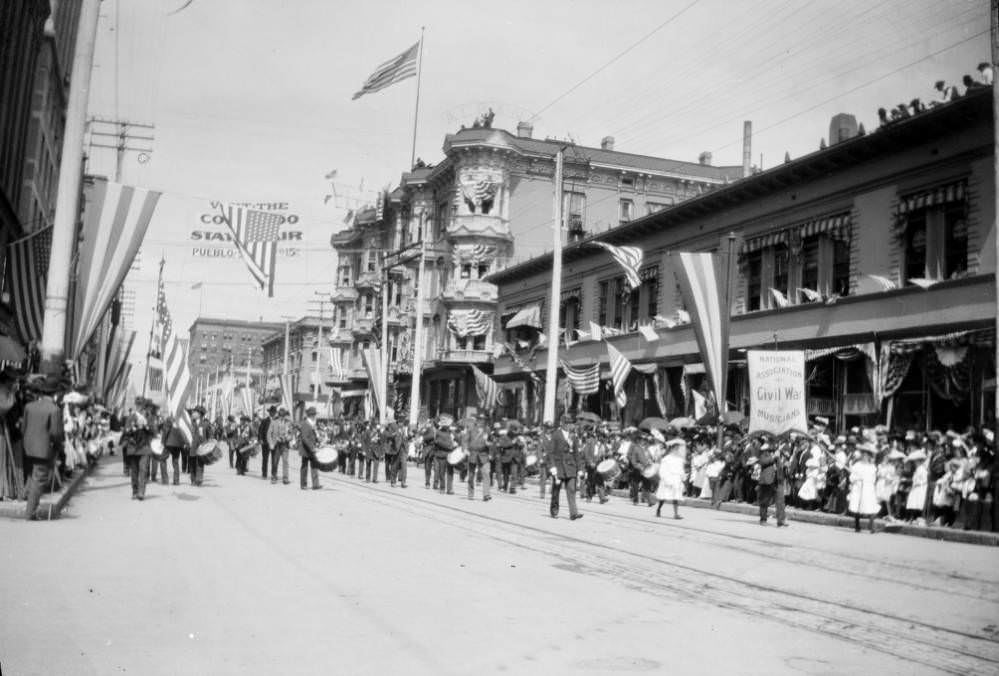
Civil War veterans and their organizations remained an active part of American public life into the early 1900s. The National Association of Civil War Musicians banner visible in a 17th Street parade placed Denver within a national network of veterans’ groups that held annual conventions, marched in patriotic celebrations, and maintained connections to a war that was still within living memory for many older residents. Denver hosted several major national conventions in this period, using its hotels and public spaces to welcome thousands of visitors.
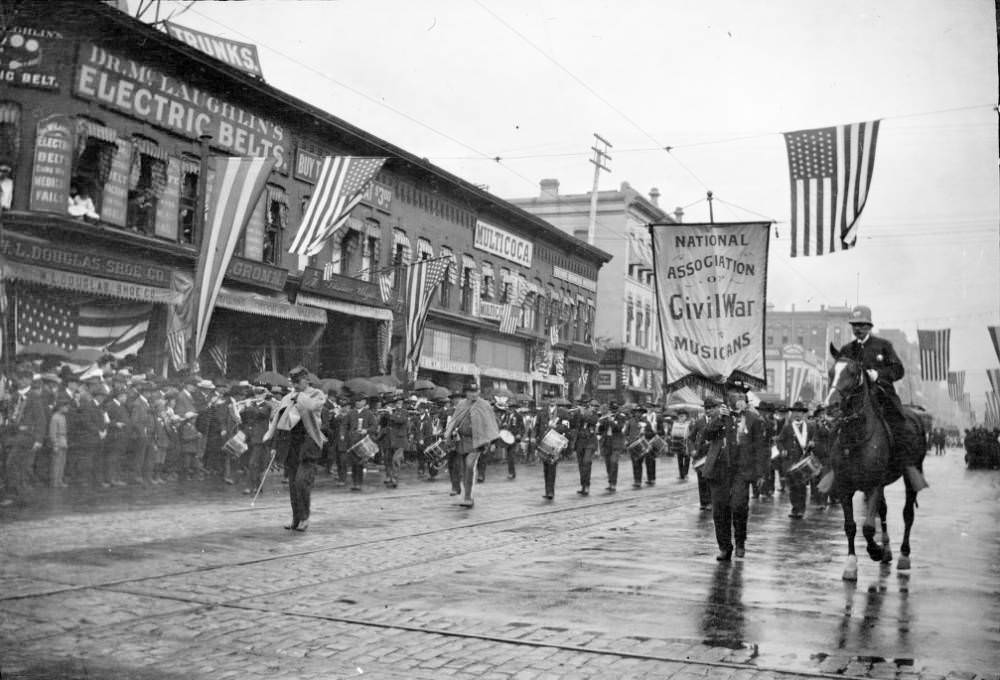
The parades on 17th Street drew spectators who lined every inch of sidewalk and leaned from the windows of the buildings above. Business signs remained visible in the background, advertising hotels, restaurants, and offices even during a public celebration. Denver’s parades served multiple functions — they were entertainment, political expression, civic bonding, and advertising all at once. The businesses that lined the parade routes benefited directly from the foot traffic, and many of them decorated their storefronts or offered specials to capitalize on the crowds.
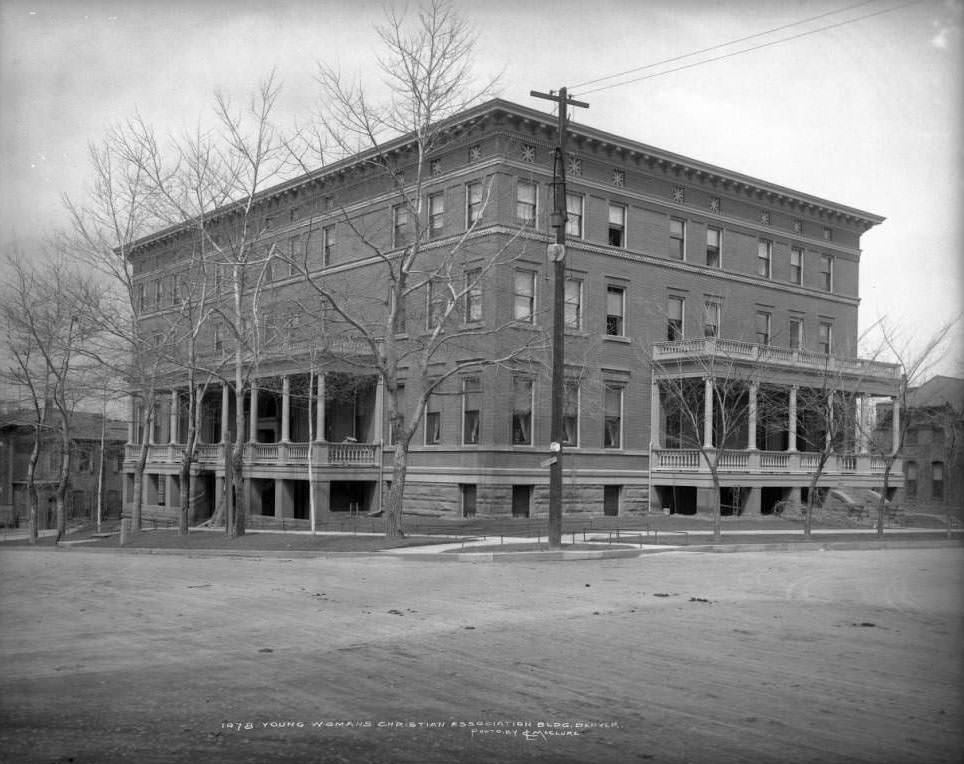
The Young Women’s Christian Association building, constructed in 1899 and standing until 1971, provided housing, job training, and social services to women who had come to Denver seeking employment. The YWCA was one of Denver’s most important social service organizations in the early 1900s, offering a safe residential option for single women in a city where affordable, respectable housing for women was difficult to find. Its location adjacent to brick residential buildings placed it in the fabric of everyday neighborhood life rather than in an institutional district.
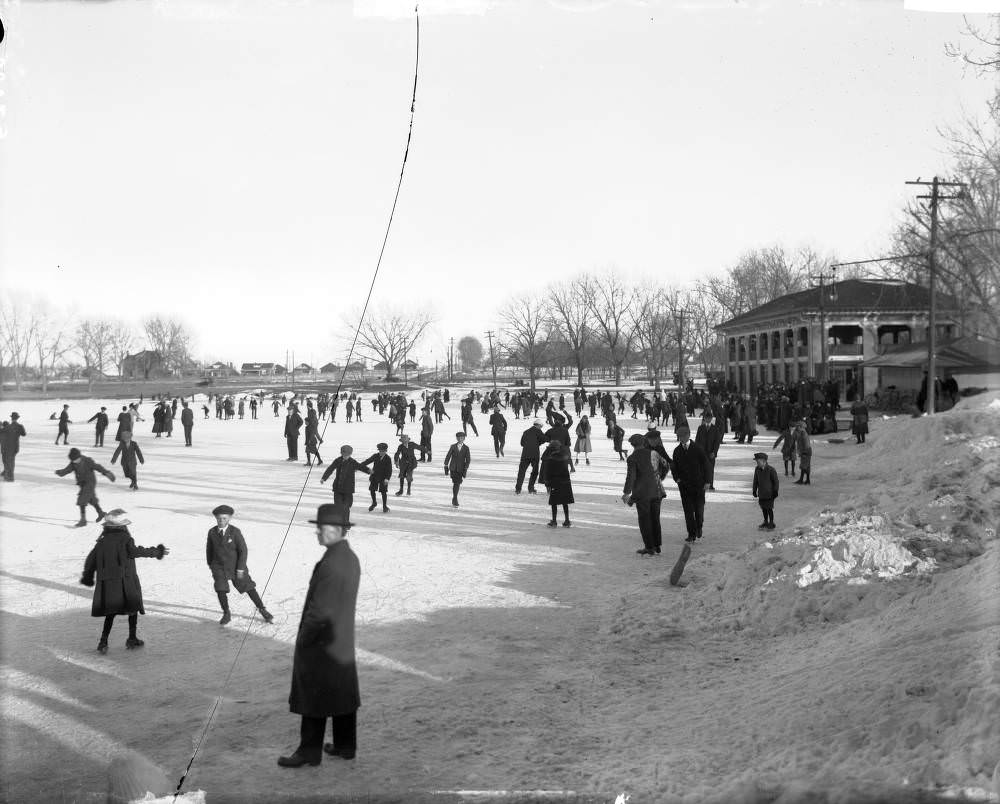
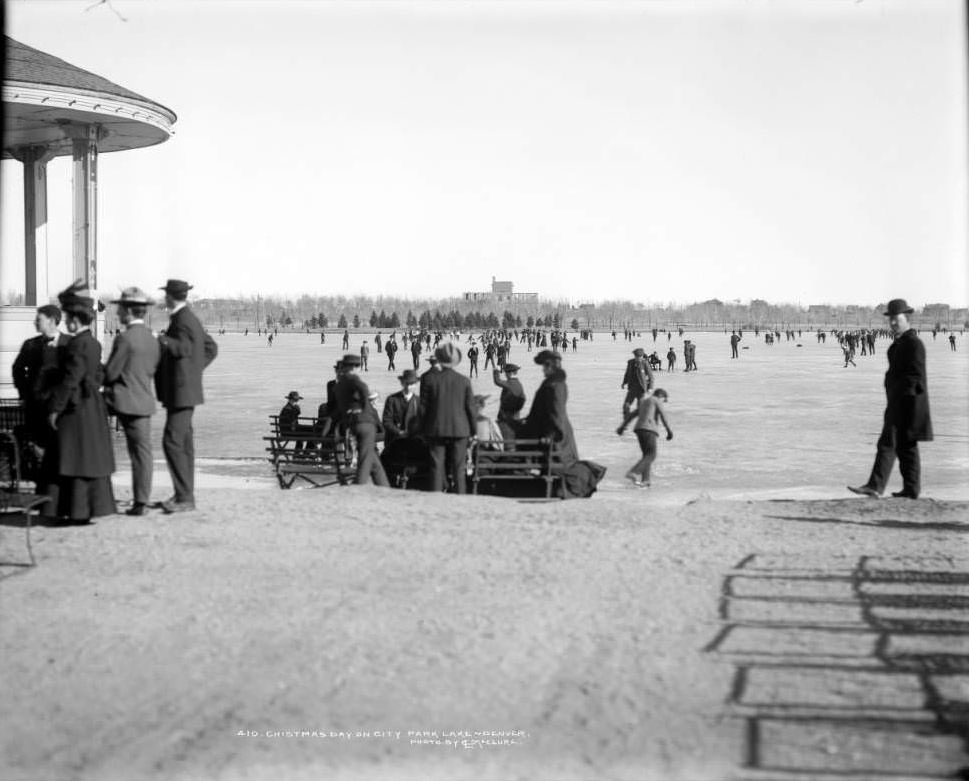
In winter, Washington Park’s Smith Lake transformed into an ice skating venue. Spectators gathered near the boat pavilion to watch skaters move across the frozen surface, and the park remained a destination even in Denver’s coldest months. Ice skating was a socially acceptable winter activity for both men and women, and the park provided a public setting where people of different backgrounds could gather. The image from 1900 shows a crowd large enough to suggest that winter recreation at Washington Park was already an established tradition.
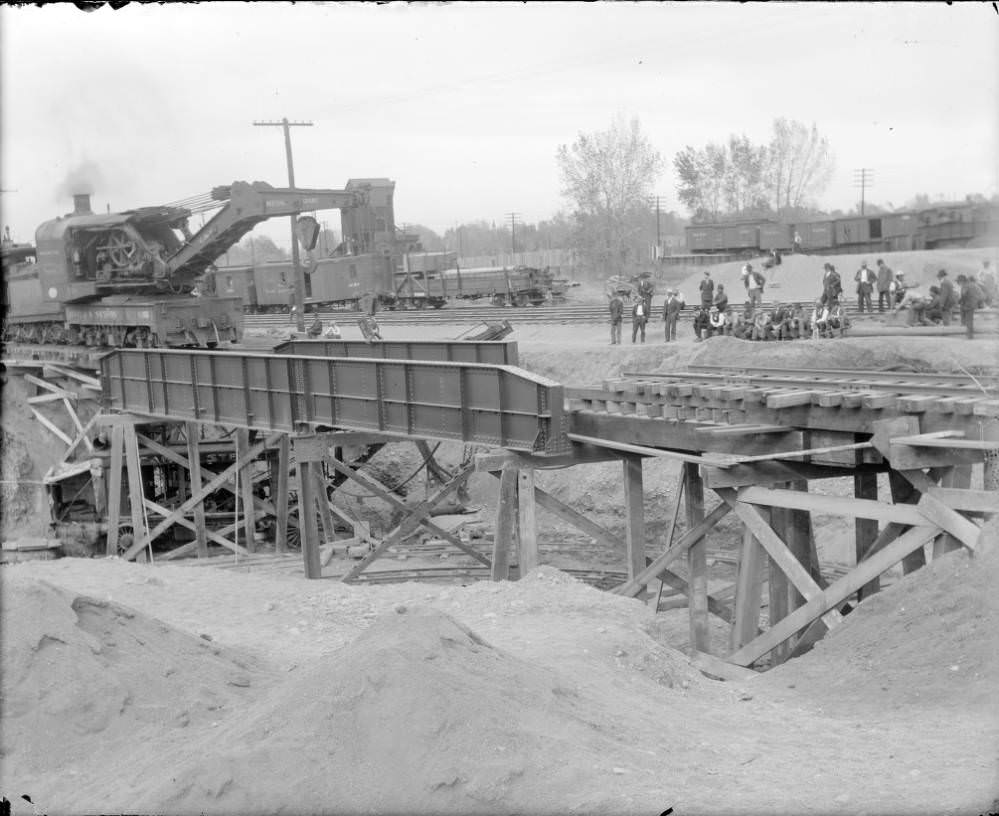
Infrastructure construction was a constant feature of Denver’s landscape in the early 1900s. A Colorado and Southern Railway crane working on a new bridge over Alameda Avenue in 1909 drew a crowd of spectators who watched the heavy machinery at work. Bridge construction across Denver’s arroyos, creeks, and rail yards required specialized equipment and skilled crews. These projects expanded Denver’s connectivity and opened new areas to residential and commercial development, pushing the city’s boundaries further outward year by year.
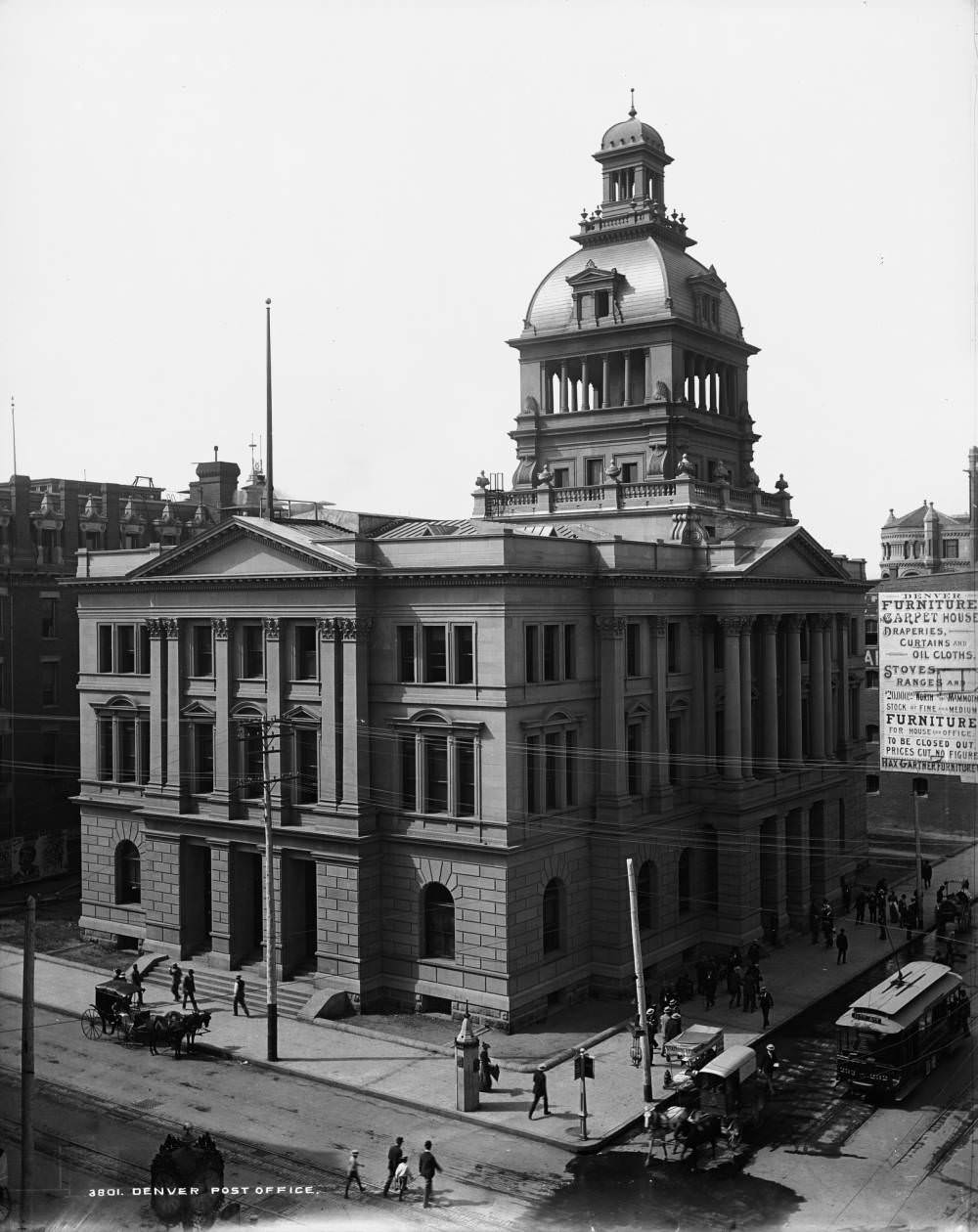
The Denver Post Office at 16th and Arapahoe Street was built in the Second Empire architectural style — a French-inspired design with a distinctive mansard roof that was popular for federal buildings in the late 19th century. A rooftop view from nearby showed the building from above, with streetcars and pedestrians moving along the streets below. The post office handled enormous volumes of mail as Denver’s population grew, and it served as a key node in the communications network that connected the city to the rest of the country.
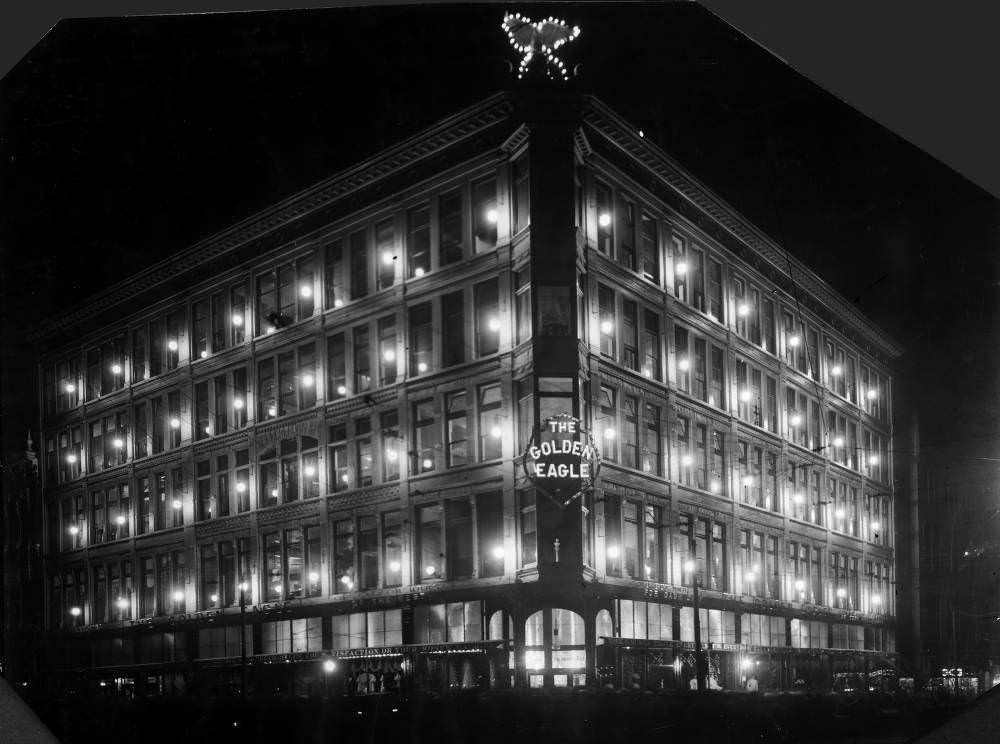
Electric lighting transformed Denver’s commercial streets in the early 1900s. The Golden Eagle Dry Goods Store at 16th and Lawrence Streets, photographed at night in 1901, blazed with electric lights that turned the storefront into a beacon visible from blocks away. Electric street lighting extended the commercial day well past sunset, allowing shops to stay open in the evening and drawing customers who would otherwise have stayed home after dark. Denver’s adoption of electric lighting was rapid, and by 1905 illuminated storefronts were a standard feature of the downtown.
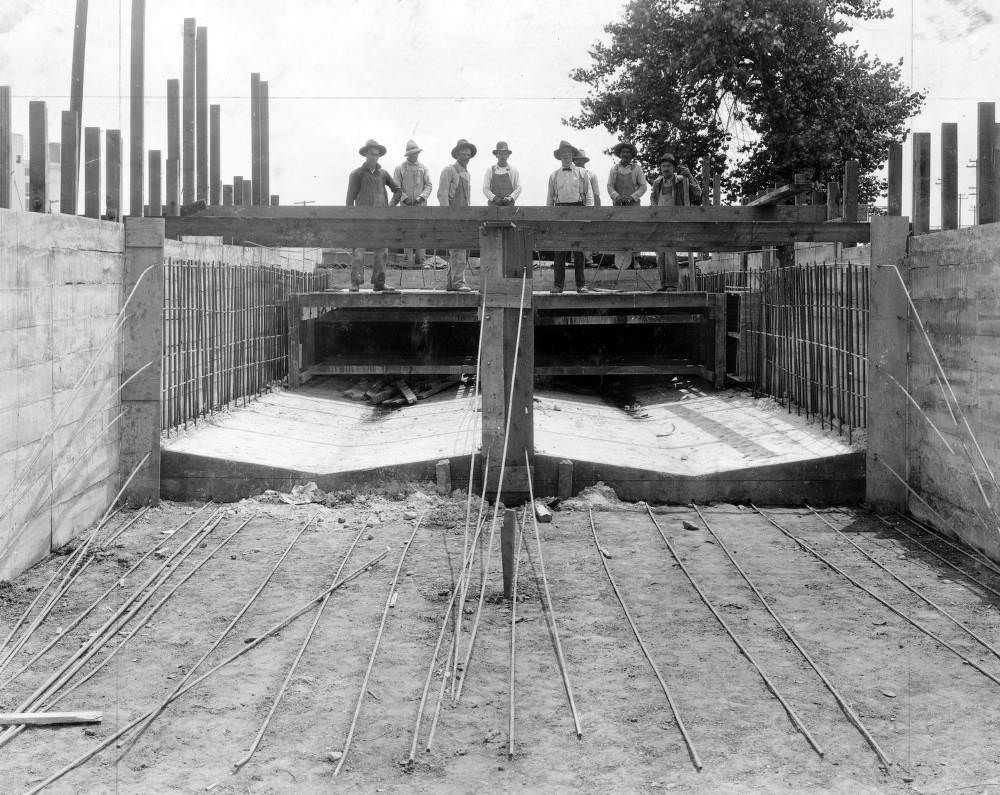
Denver’s relationship with its waterways was a constant engineering challenge. Cherry Creek and the South Platte River both flooded periodically, and the city invested in flood control infrastructure throughout the early 1900s. Workers pouring concrete forms along the waterways were engaged in the long-term project of making Denver’s rivers predictable and manageable. A major flood in 1912 would later test the limits of this infrastructure, causing widespread damage to the neighborhoods along the creek and accelerating investment in more robust flood control measures.
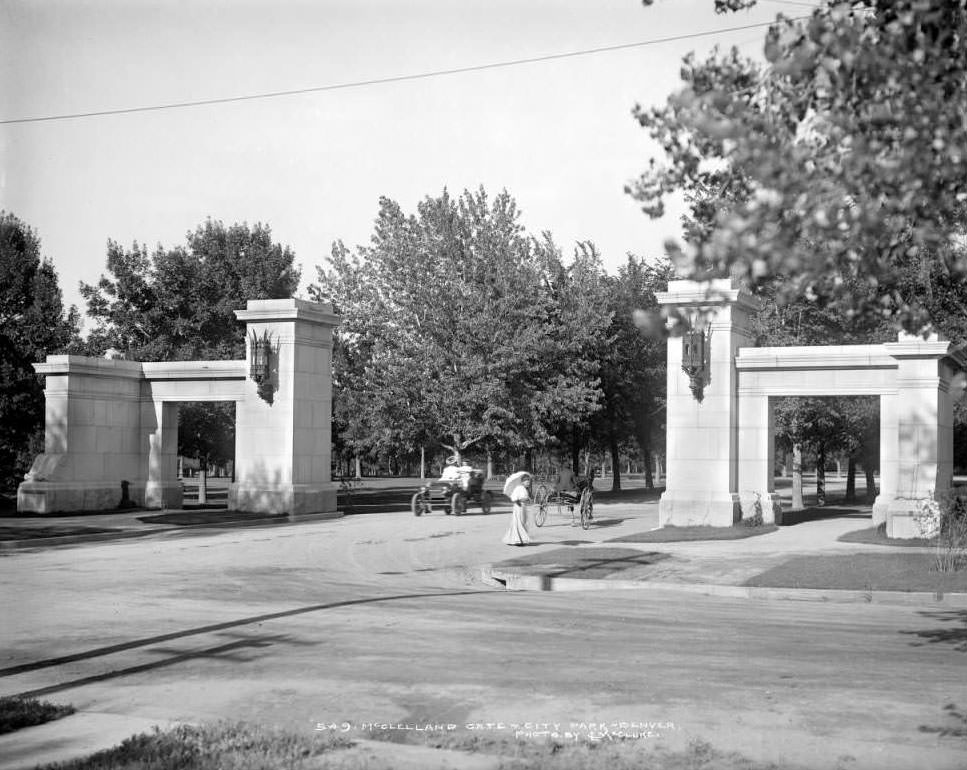
The McLellan Gate at City Park, completed in 1904, was a formal entrance to Denver’s largest public park. Automobiles and pedestrians are visible in the photograph, an early example of car traffic at a park entrance that would become far more dominant over the following two decades. City Park was accessible by streetcar from most of the city, and the park’s zoo and museum drew visitors from all social classes. The gate itself was a civic monument, designed to signal the importance Denver placed on its public green spaces.
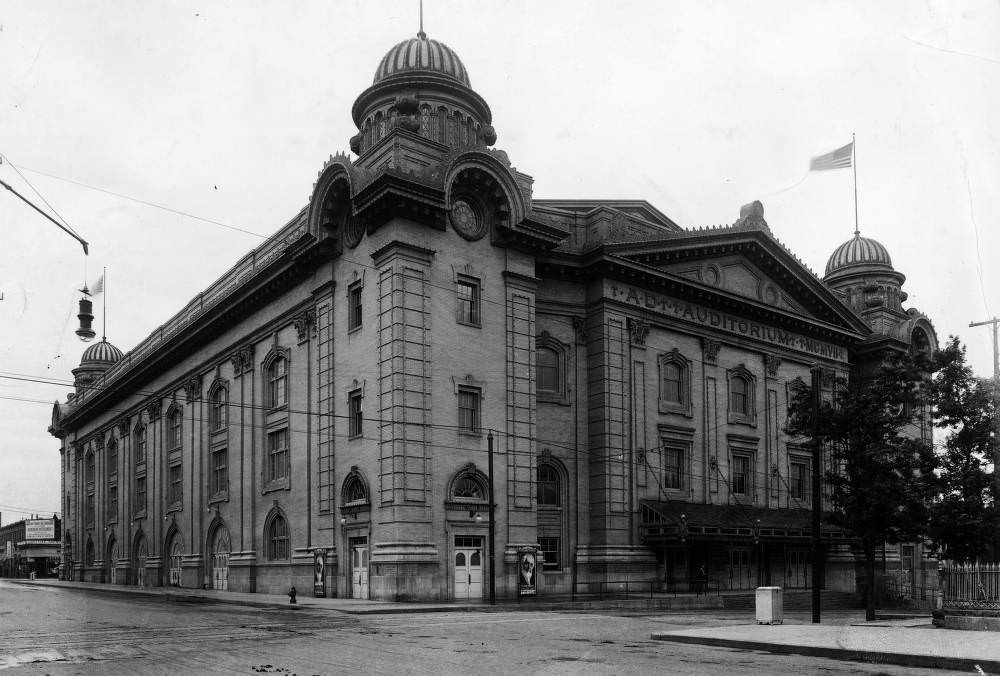
The Denver Municipal Auditorium, photographed in 1908 during its construction, was one of the most ambitious civic building projects of the Speer administration. Its Neoclassical design, with stone facades and domed features, fit the City Beautiful aesthetic that Mayor Speer championed. The auditorium was intended to host large public gatherings, conventions, and performances, giving Denver a venue capable of competing with those in much larger American cities. When it opened, it immediately became a centerpiece of Denver’s civic life.
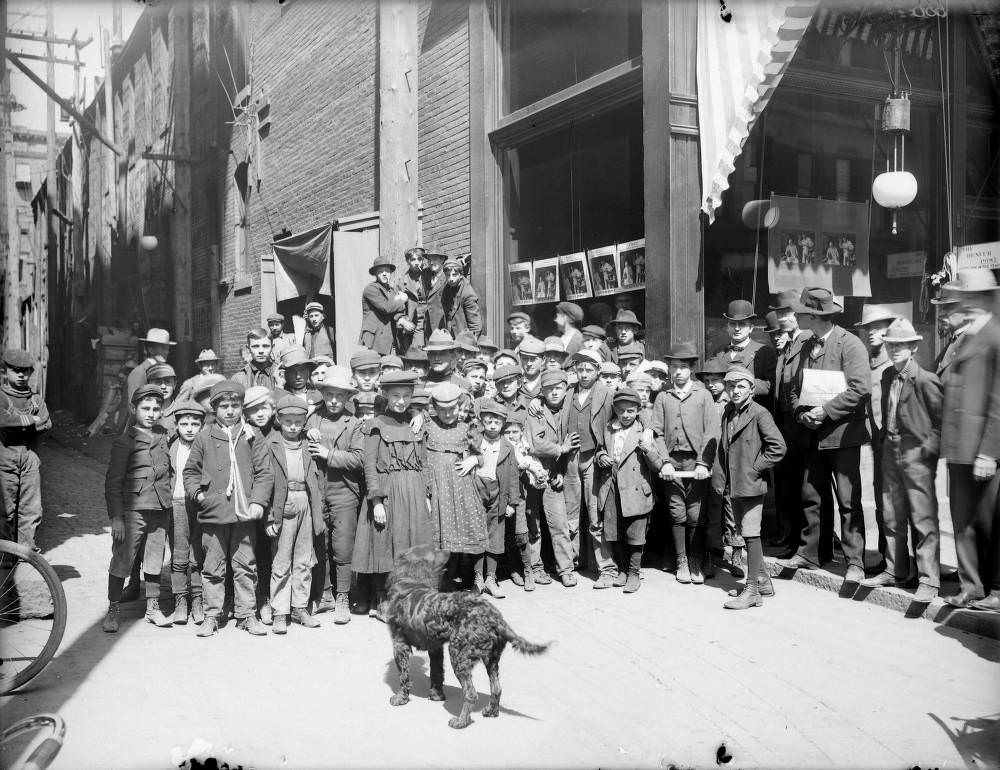
The Denver Post employed children as delivery workers — newspaper boys and girls who distributed papers to subscribers or sold them on busy street corners. Posing outside the Post’s office with a dog, the children in this photograph look confident and at home in the city’s commercial environment. The Denver Post was aggressive in its circulation tactics, using promotions, contests, and events like the Boys Band to build community loyalty. Child labor in newspaper distribution was legal, common, and largely unregulated in early 1900s Colorado.
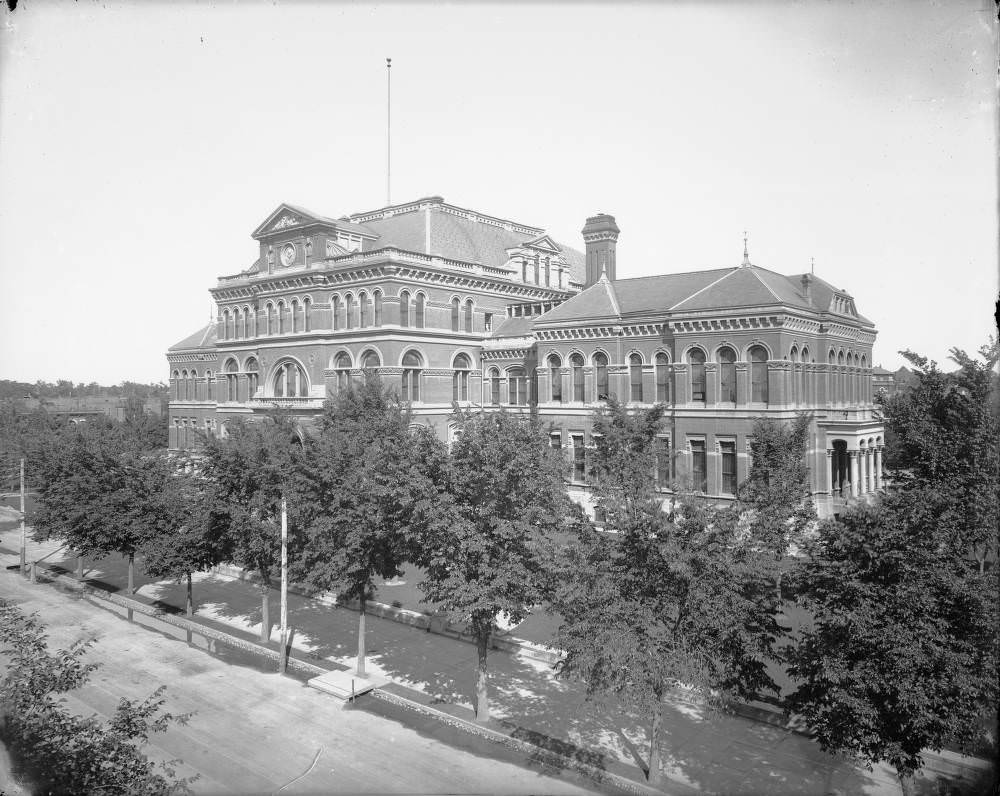
Denver High School at 19th and Stout Streets was the city’s flagship secondary school. Its Victorian Gothic architecture — pointed arches, stone trim, and vertical massing — projected the seriousness with which Denver took public education. The school served students from across the city and sent graduates to the University of Denver and to colleges elsewhere in the country. By 1908, the school’s women’s basketball team was competing in organized interscholastic athletics, and students gathered outside the building for photographs that documented their time there.
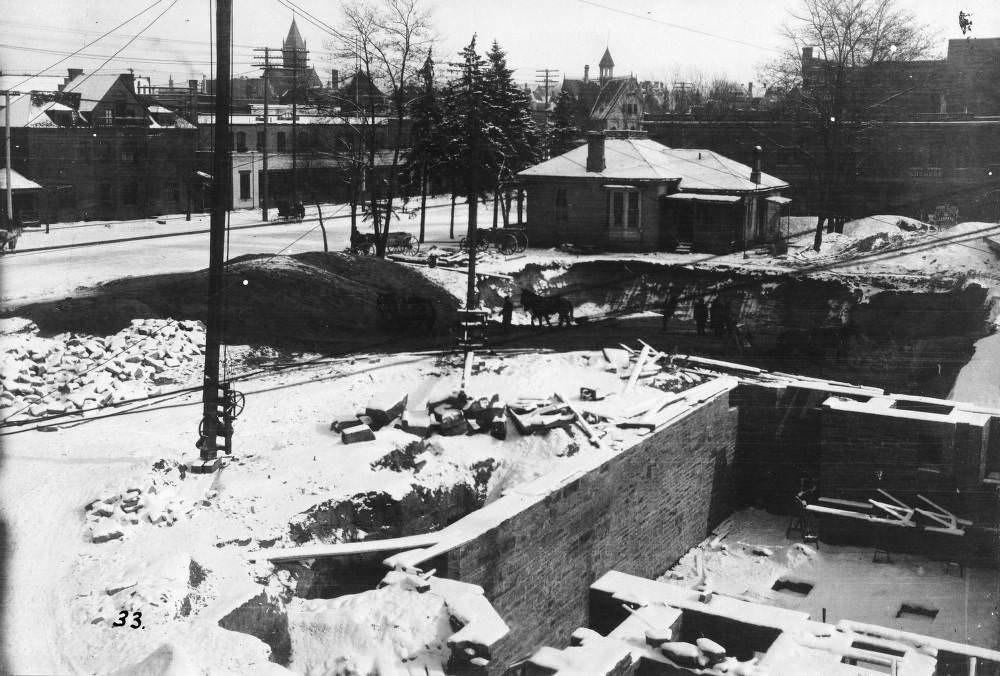
Denver’s winters could stop construction cold. A photograph of the Public Library construction site covered in snow, with Engine House Number One and the Civic Center neighborhood visible in the background, shows the practical challenges of building in Colorado’s climate. Work crews had to protect freshly poured concrete and freshly cut stone from freezing temperatures, and significant snowfalls sometimes forced complete work stoppages for days at a time. The library’s construction schedule stretched across multiple seasons as a result.
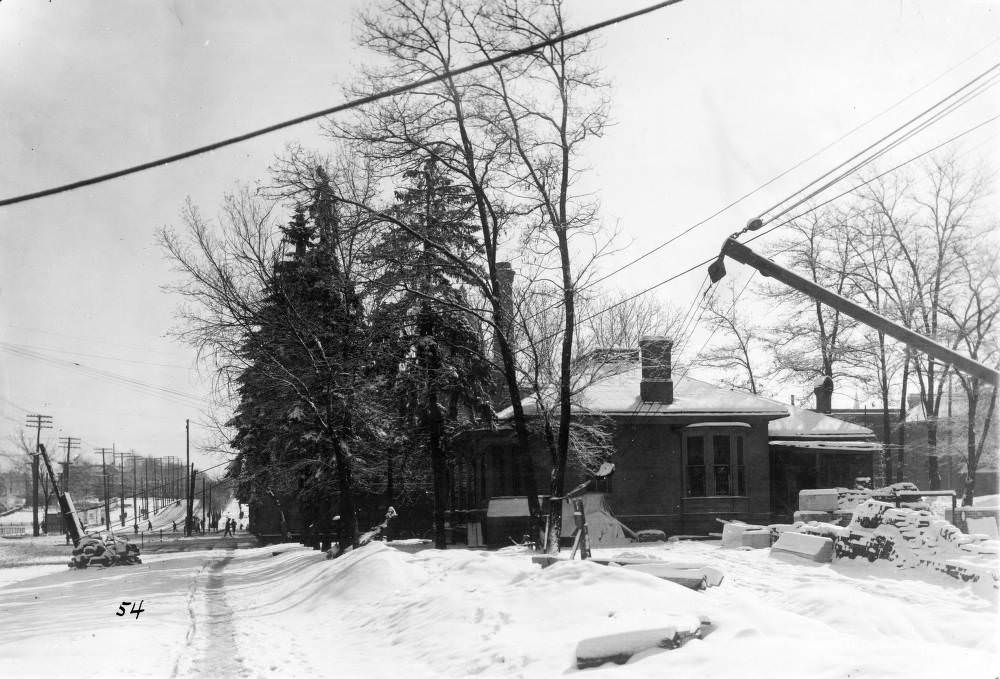
The crane visible at the library construction site was one of the largest pieces of equipment on the job. It lifted stone blocks and steel girders into position as the building’s structure grew. Snow-covered building materials in the foreground and Civic Center houses in the background frame a construction site that was, despite the weather delays, making steady progress. The neighborhood surrounding the Civic Center was itself in flux — some of the modest houses visible in these photographs would eventually be cleared to make way for the formal civic park that Speer envisioned.
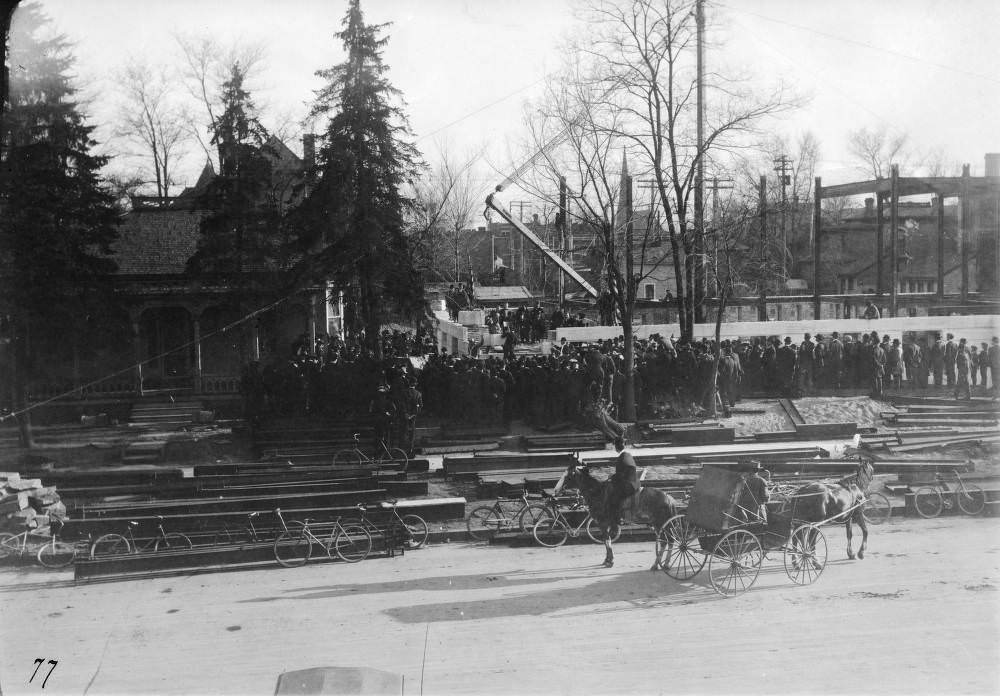
The cornerstone ceremony for the Denver Public Library drew a substantial crowd to the construction site. An automobile parked at the edge of the gathering — still a novelty in a crowd that mostly arrived on foot or by streetcar — shows the gradual infiltration of motorized transport into Denver’s public life. Ceremonies like this one gave residents a sense of ownership over civic projects funded by their taxes and donations. Governor Buchtel’s speech and Rabbi Friedman’s invocation gave the occasion both political and religious weight.
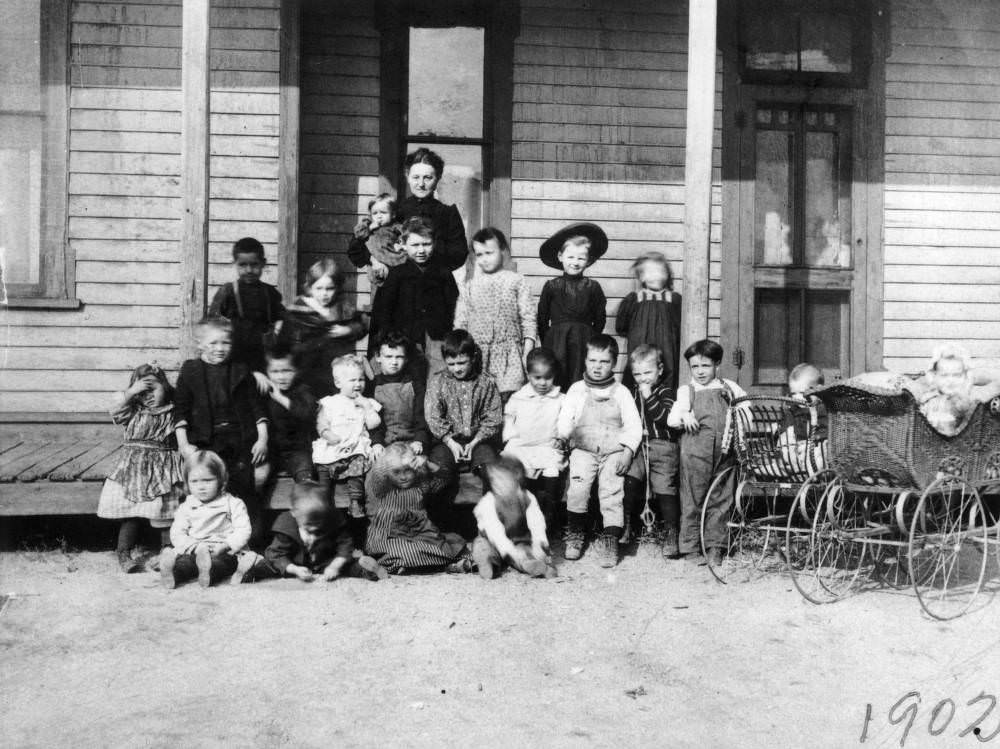
The Neighborhood House Association in Lincoln Park operated as a settlement house — a community center that provided social services, education, and assistance to the immigrant and working-class families of Denver’s west side. A woman and children on the porch in 1902 represent the daily human activity that flowed through these institutions. Settlement houses were a national movement in the early 1900s, inspired by Jane Addams’ Hull House in Chicago, and Denver’s version served the Italian, Hispanic, and other immigrant communities clustered in the Lincoln Park neighborhood.
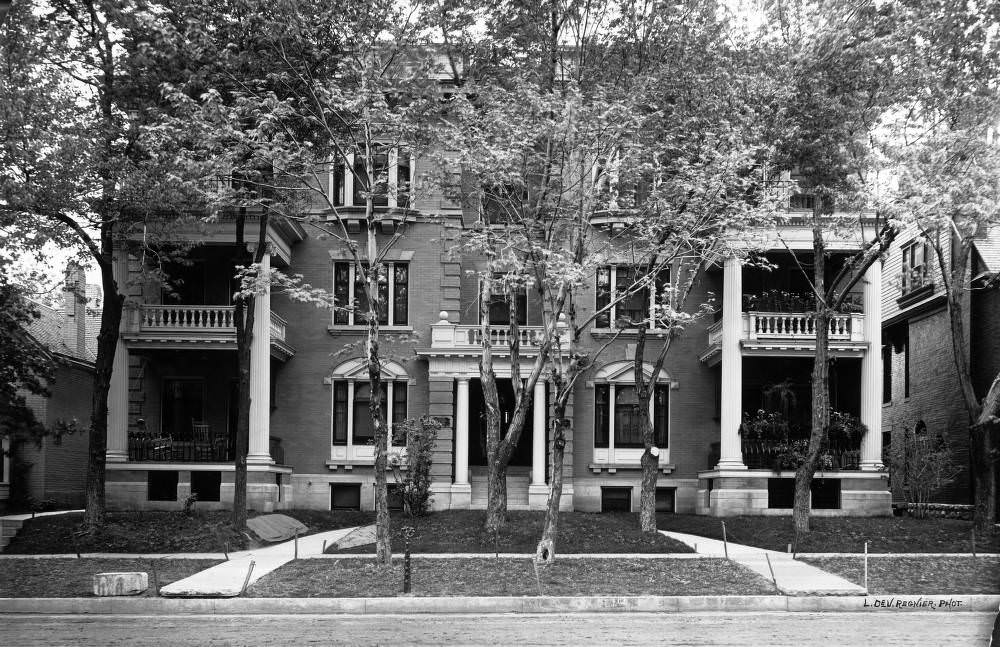
Multi-family apartment construction accelerated across Denver in the years leading up to 1910. Developers built apartment buildings with architectural details — porticos, columns, brick facades — that signaled respectability and attracted tenants who could afford something better than a rooming house but didn’t yet own property. These buildings went up on the streets of Capitol Hill, the Highlands, and other established neighborhoods, changing the density of areas that had previously been exclusively single-family residential.
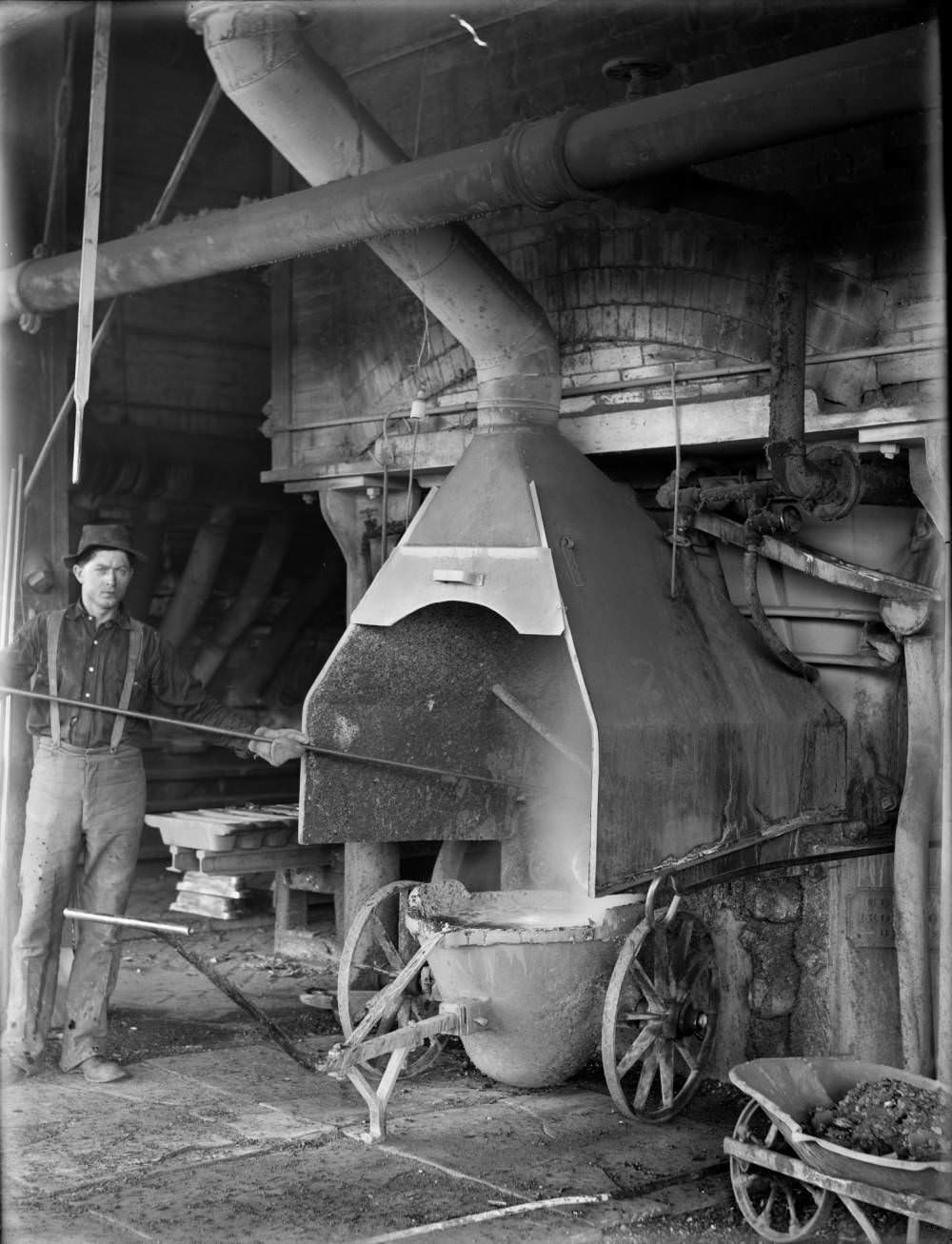
The Omaha-Grant smelter on Denver’s north side processed ore from Colorado’s mountain mining districts. Workers drew molten slag from furnaces in conditions of extreme heat and physical danger. Smelter work was among the most hazardous industrial employment in Denver, and the workforce was largely drawn from immigrant communities — particularly Italian, Slavic, and Mexican workers who had few other options. The smelter’s operation contributed significantly to air pollution in the surrounding neighborhood, and its smoke was visible across much of the city.
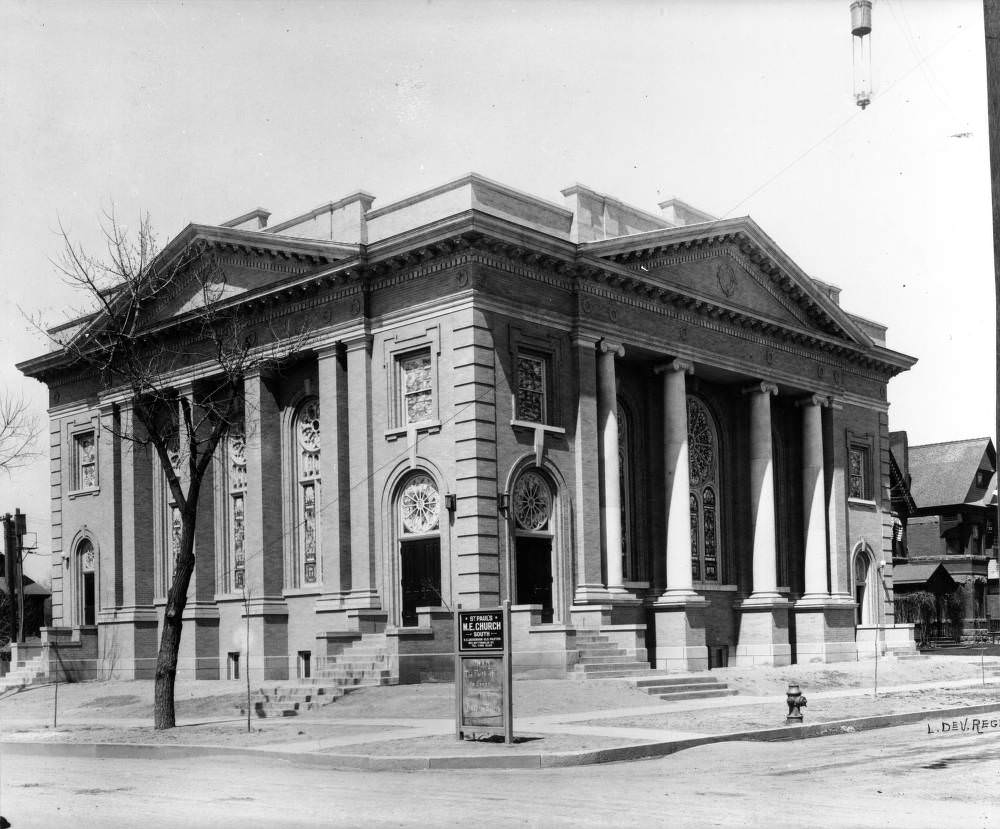
St. Paul’s Methodist Episcopal Church was one of Denver’s more substantial Protestant congregations. Its classical architecture — columns, a formal entry, symmetrical facade — was designed to project permanence and institutional confidence. Methodist churches in Denver in the early 1900s were active in temperance advocacy, social reform, and missionary work, aligning themselves with the progressive reform movements that were reshaping American cities. The church building itself was both a place of worship and a statement of the congregation’s standing in the community.
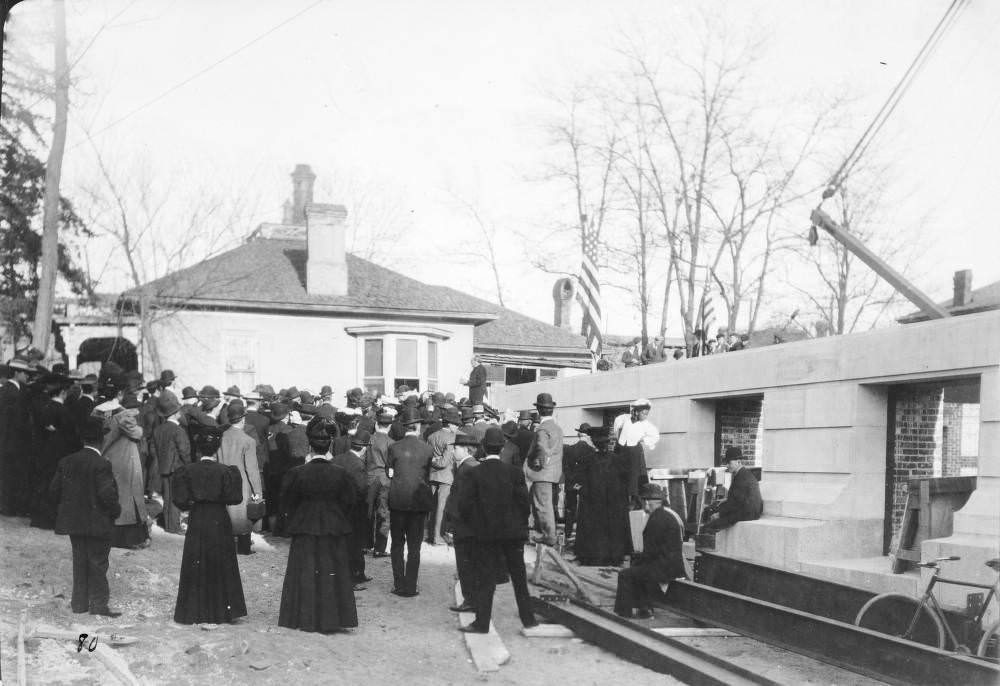
Governor Henry Buchtel was a Methodist minister as well as a politician, and his presence at the Denver Public Library cornerstone ceremony connected the project to both civic and moral authority. Buchtel had been president of the University of Denver before entering politics, and his commitment to public education made him a natural figure to preside over a library dedication. The U.S. flag flying behind him as he spoke placed the local event within a broader patriotic frame — the library as an expression of American democratic values.
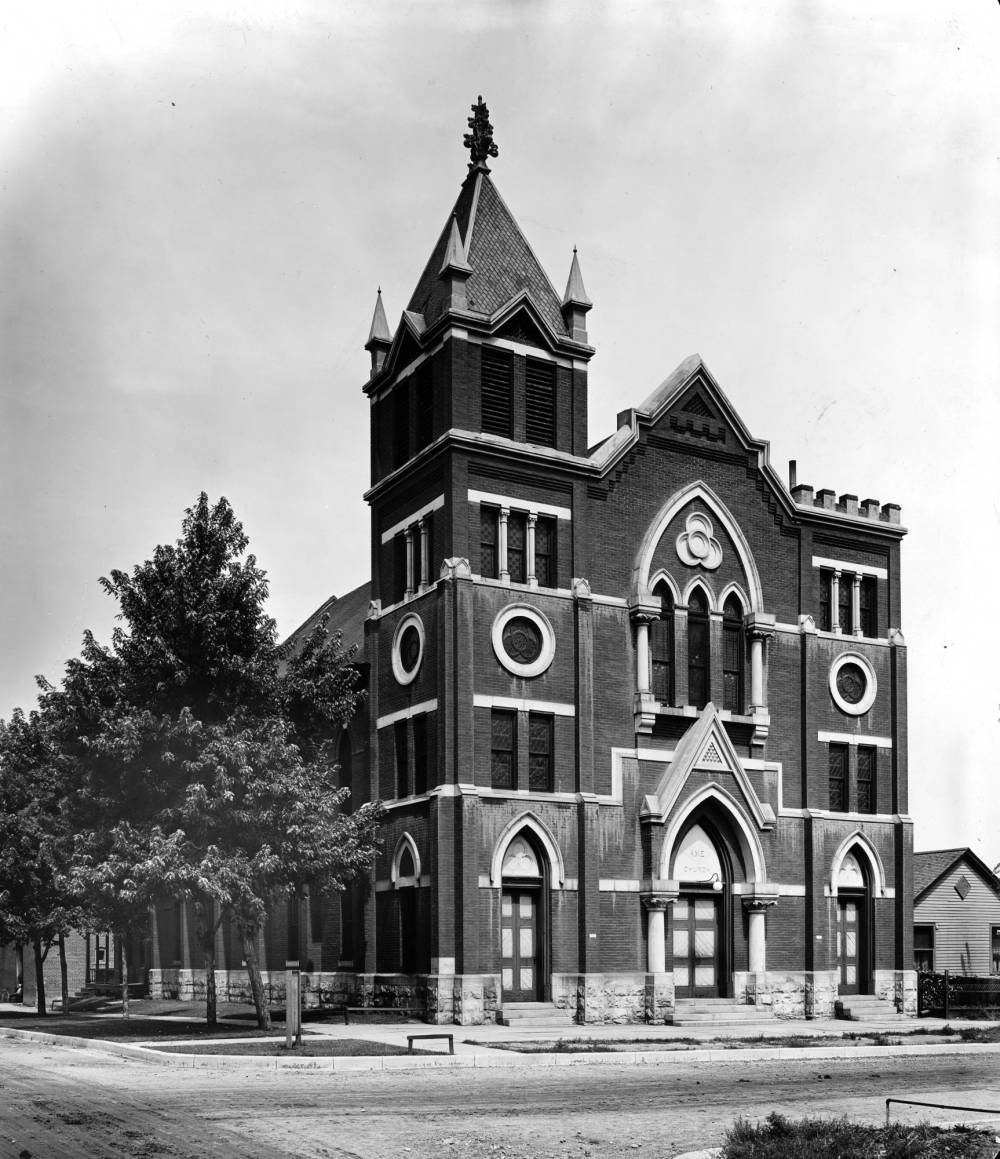
The Shorter African Methodist Episcopal Church was a cornerstone of Denver’s Black community. Its stone trim and gothic arches gave it an architectural dignity that matched its social importance. The AME church tradition had deep roots in the African American experience, and Denver’s Shorter AME served not just as a religious congregation but as a community organizing center, a social safety net, and a venue for political discussion. The Five Points neighborhood where the church stood was the cultural center of Black Denver, and the church’s building was one of its most visible institutions.
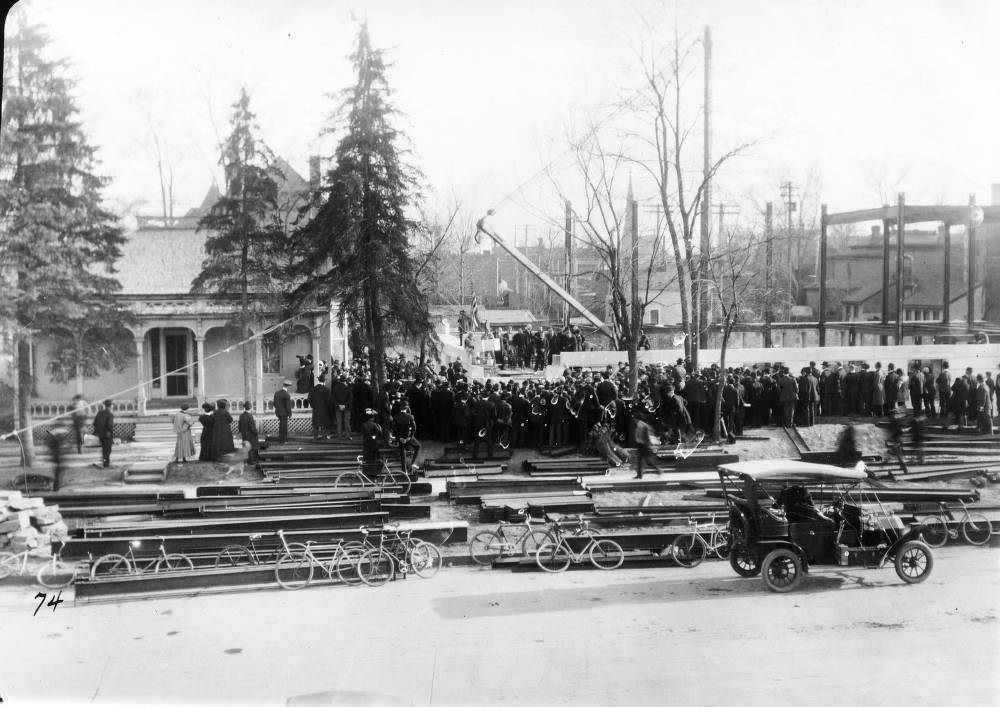
Rabbi Friedman’s invocation at the Denver Public Library cornerstone ceremony was a meaningful gesture toward Denver’s Jewish community. The West Colfax neighborhood was home to a significant Jewish population that had established synagogues, schools, and businesses in the city. Jewish residents were active in Denver’s commercial and civic life, and their inclusion in a major public ceremony — alongside the Methodist governor — reflected a city that was negotiating its diverse identity in a relatively public way.
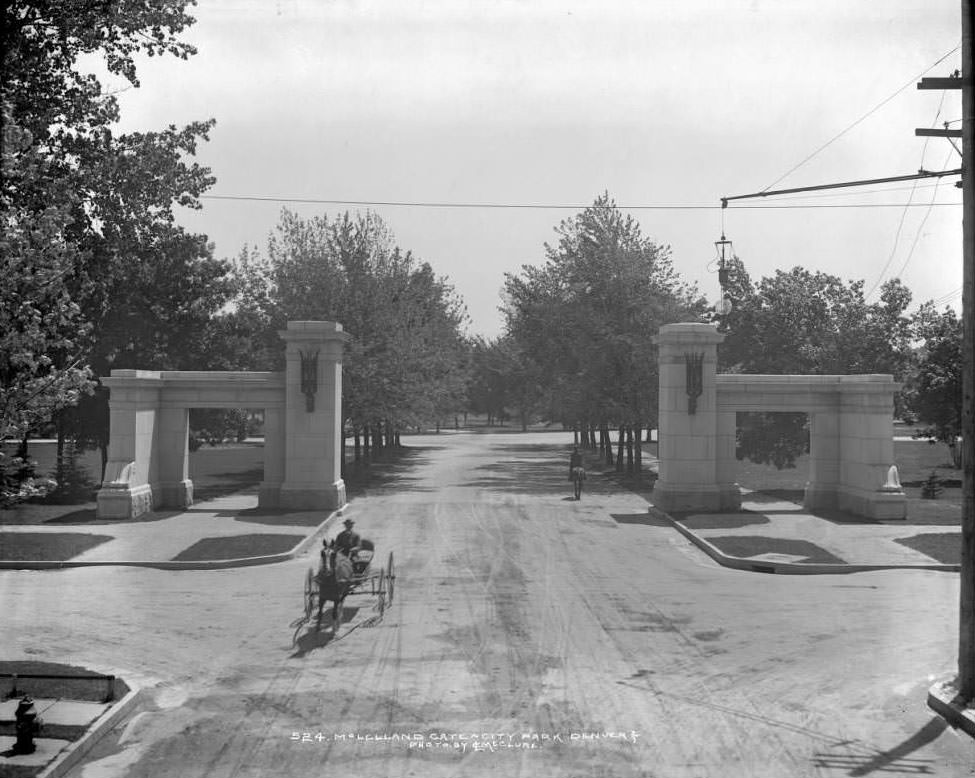
A horse-drawn buggy passing through the McLellan Gate at City Park in 1904 shows how park visitors arrived in the era before automobiles dominated the road. The streetlight visible near the gate indicates that Denver had extended electric lighting to its park entrances, making evening visits possible and safe. City Park’s popularity was high enough by 1904 that the city was actively managing access and improving the entrance infrastructure, treating the park as the major civic asset it had become.
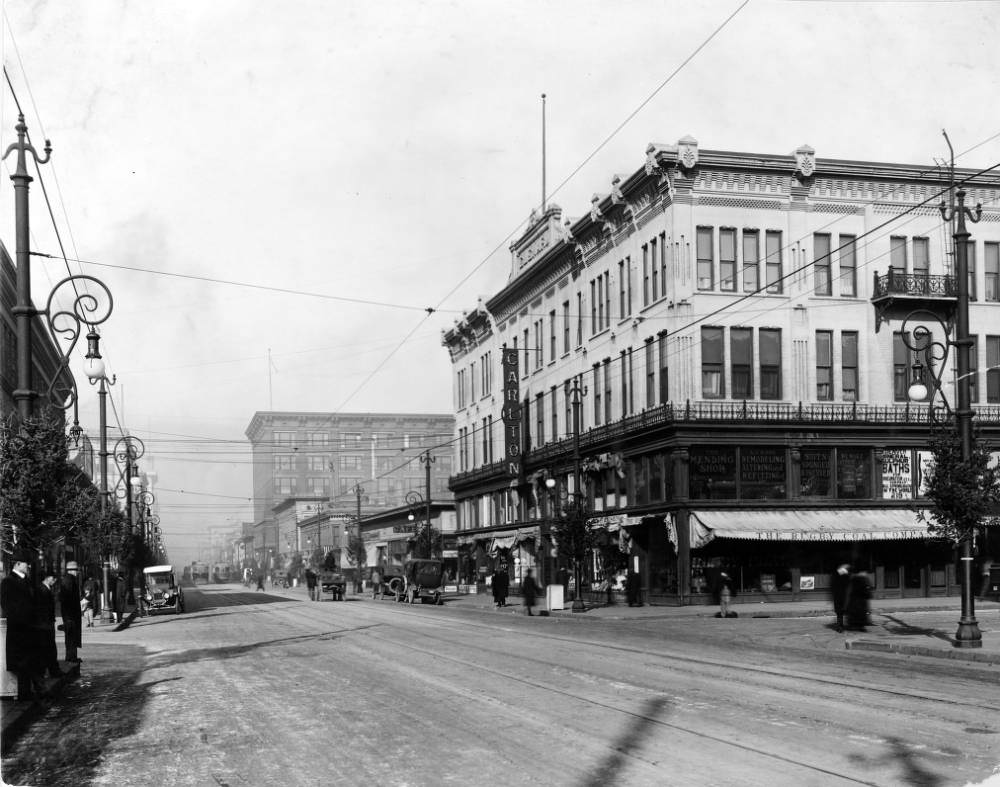
Glenarm Place crossed 15th Street in a section of downtown Denver that mixed office buildings with hotels and retail shops. Pedestrians and streetcars shared the intersection without the benefit of traffic signals, relying on familiarity and caution to navigate around each other. The density of foot traffic on Denver’s downtown streets in the early 1900s was comparable to much larger American cities — a testament to how thoroughly the streetcar had concentrated commercial activity in the walkable blocks around the transit network’s core.
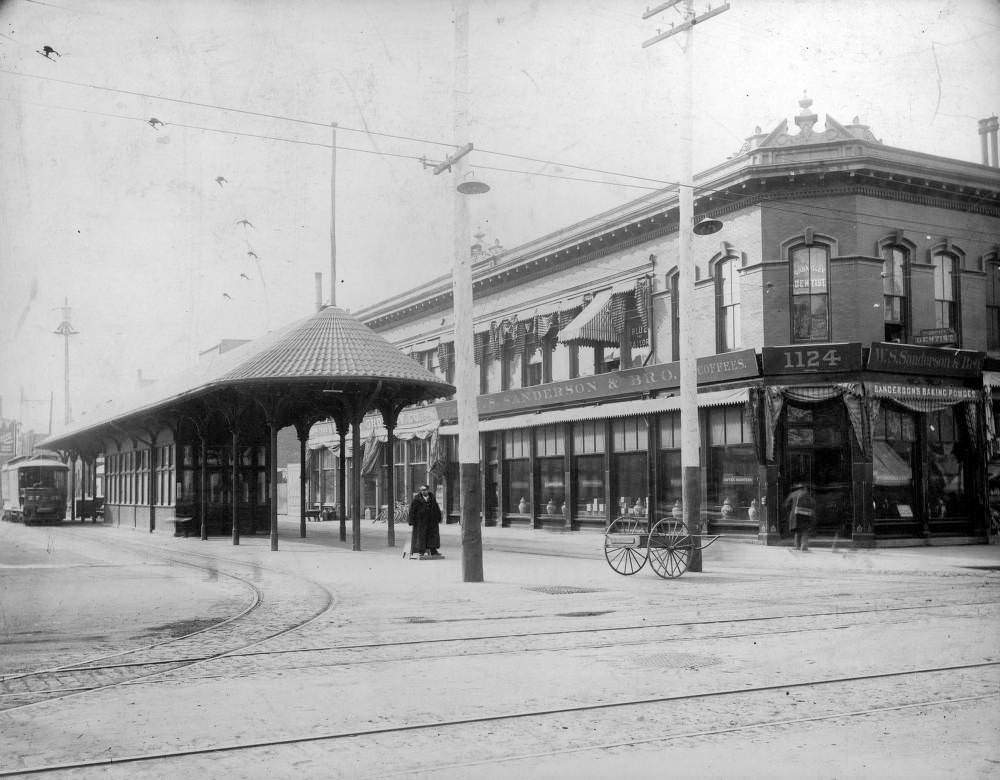
The Central Loop at 15th and Arapahoe Streets was the hub of Denver’s streetcar network. Trolleys from different routes converged here, allowing passengers to transfer between lines. A covered passenger pavilion provided shelter while riders waited. The loop was one of the busiest spots in the entire transit system, and the area around it was dense with businesses that catered to the constant flow of passengers. Banks, restaurants, and retail shops clustered around the loop, drawn by the guaranteed foot traffic the transit hub generated.
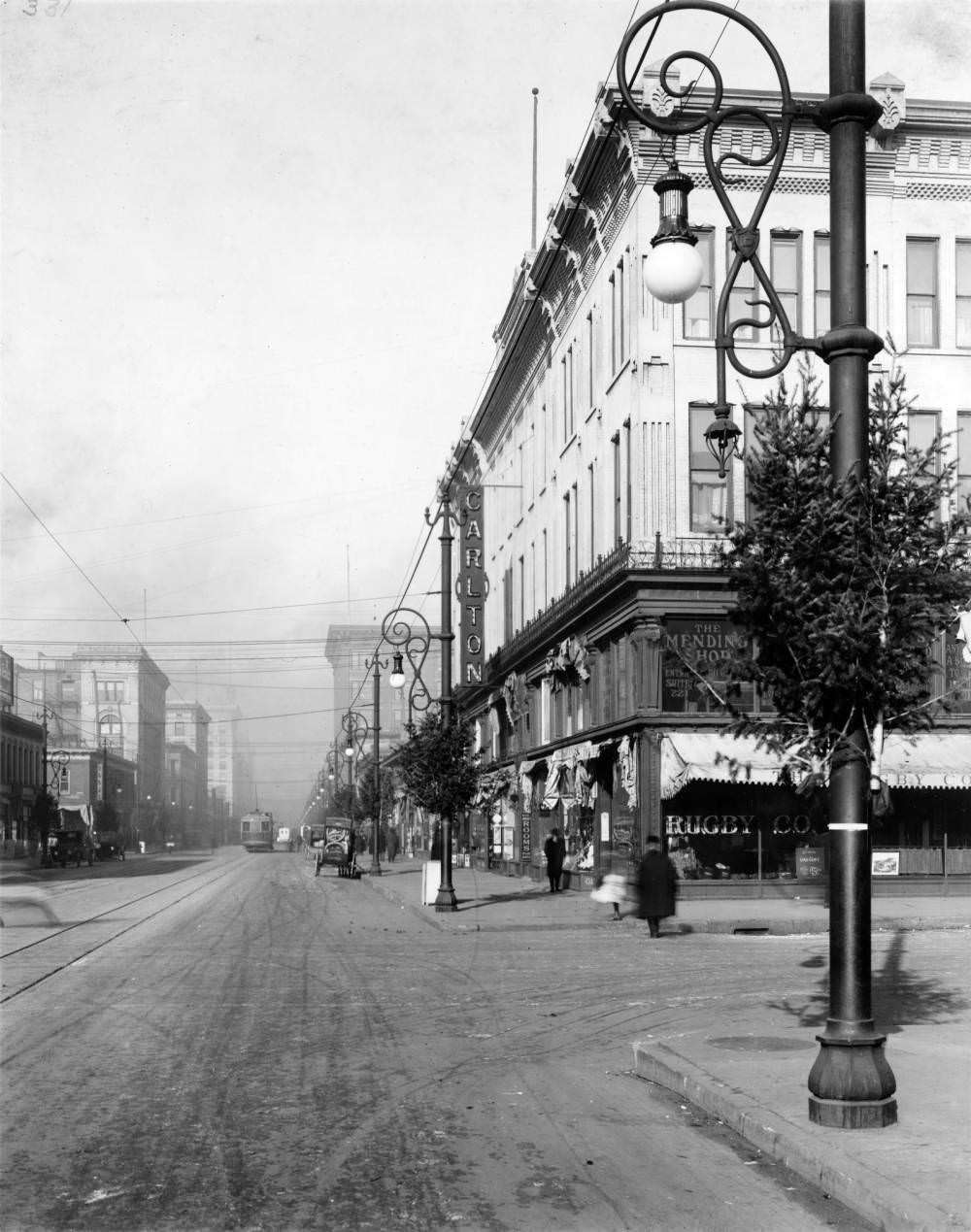
Christmas trees for sale at the intersection of 15th and Glenarm Streets transformed a familiar transit hub into a seasonal market. The presence of automobiles alongside the streetcar shows the gradual shift underway in Denver’s transportation mix. Christmas tree sellers occupied the sidewalks and open corners of the city each December, and their presence at a busy transit intersection guaranteed maximum exposure to the shoppers and commuters passing through. Denver’s holiday commercial season was already well established by the early 1900s.
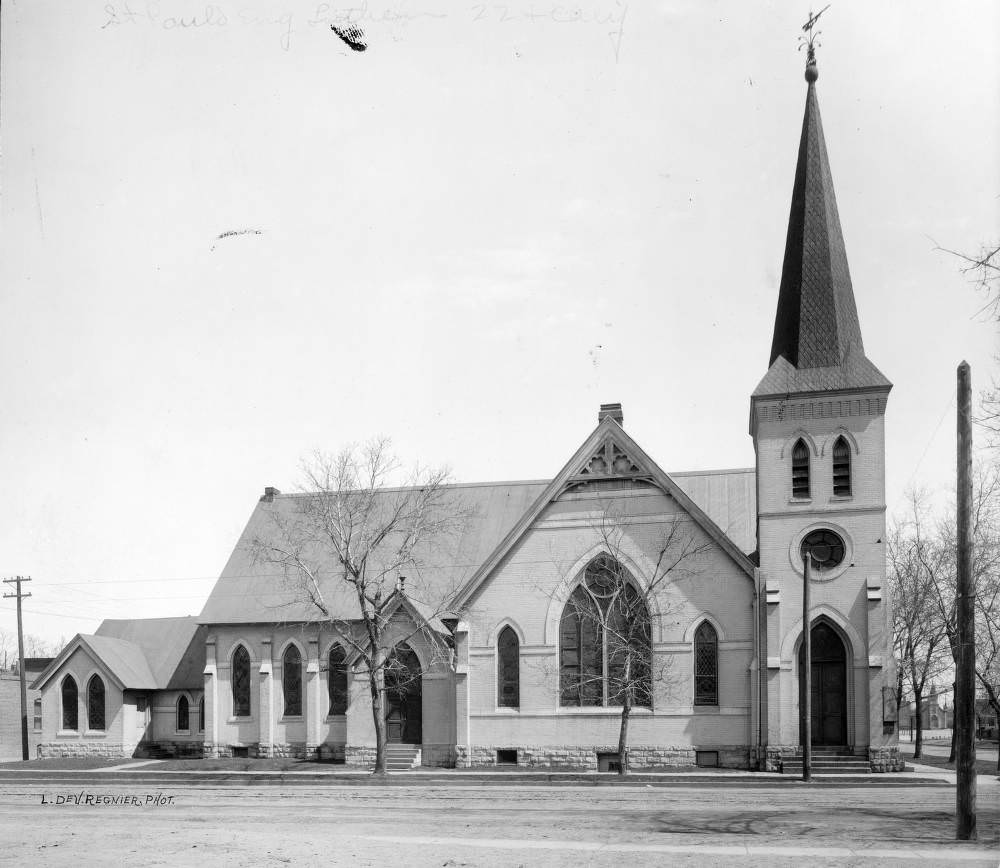
Denver’s religious landscape was shaped by the diversity of its immigrant communities. St. Paul’s English Lutheran Church served a congregation with roots in the German and Scandinavian immigrant communities that had settled in the city. Its gothic arches and stained-glass windows were architectural signatures of the Lutheran tradition, designed to create a sense of sacred space and communal identity. The church stood in a residential neighborhood, its bell tower marking the skyline above the surrounding houses and helping newcomers orient themselves in a still-unfamiliar city.
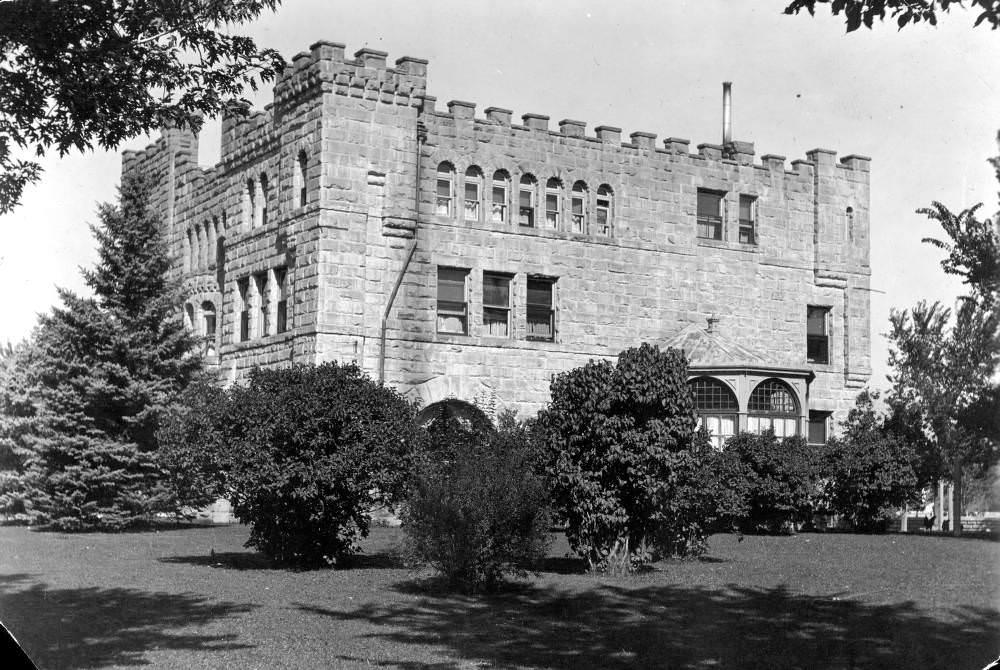
Dean Peck’s Training School for Girls offered a private educational option for young women in Denver. Its stone construction and arched windows gave it an institutional gravitas that was meant to reassure parents and students alike. Private training schools like this one prepared girls for employment as teachers, stenographers, and office workers — the female occupations that were expanding most rapidly in Denver’s early 20th-century economy. The school existed alongside public high schools like Denver High School and West Denver High School, competing for students whose families could afford the tuition.
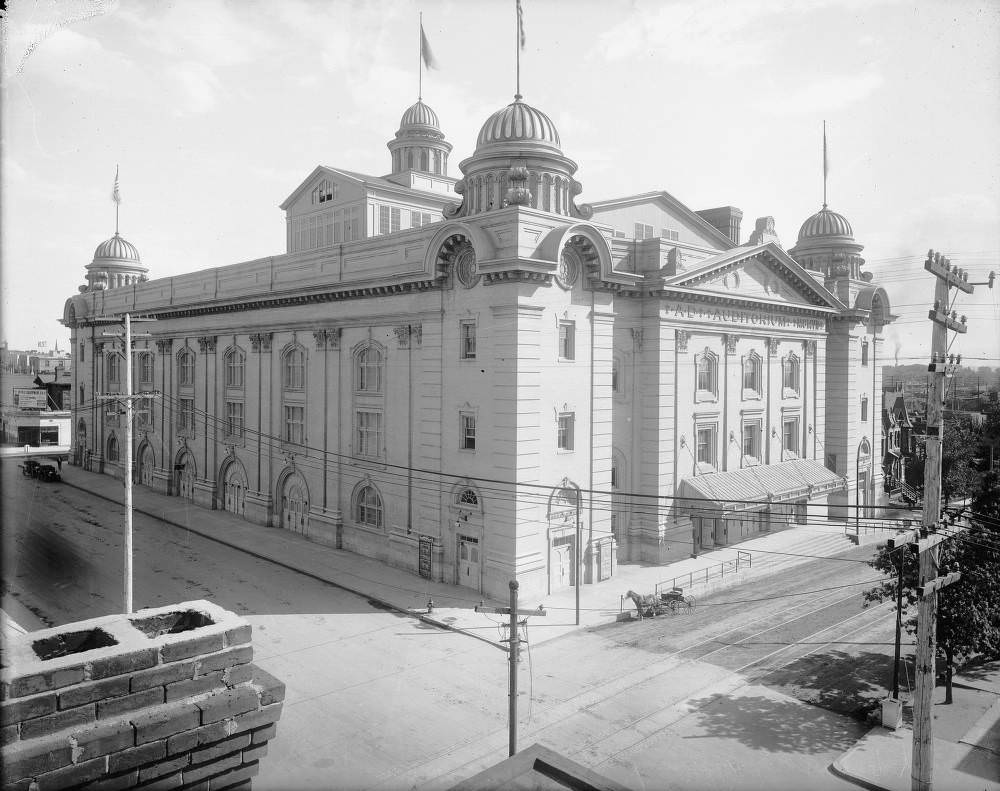
The Denver Municipal Auditorium’s exterior combined Neoclassical columns and formal stonework with the practical scale needed to host thousands of people at once. A horse-drawn carriage in front of the building captures the transition period in which the auditorium was built — designed for a city that was beginning to use automobiles but still relied heavily on horses for daily transport. The auditorium was intended to position Denver as a convention city capable of hosting national political and professional gatherings, which it did within a few years of opening.
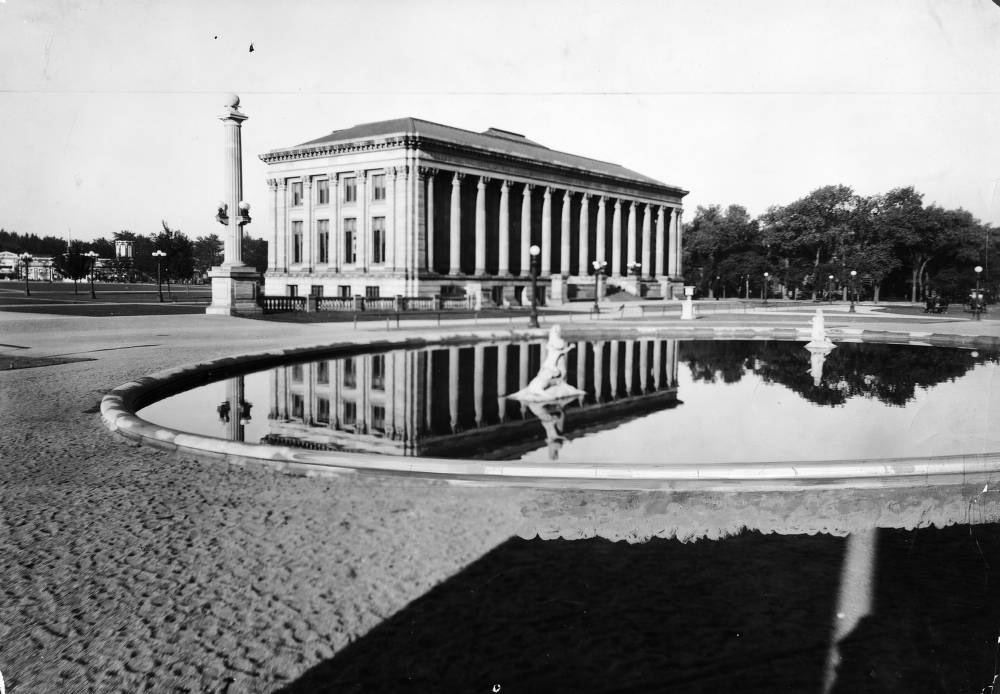
The completed Denver Public Library, photographed in 1909, sat at the edge of the Civic Center with the Seal Fountain nearby. The building’s classical facade fit the formal character of the civic campus that Mayor Speer was assembling around the State Capitol. Women staffed the library’s catalog department, operating in one of the few professional spaces where female employment was not only accepted but dominant. The library opened its doors to Denver residents across all social classes, providing access to books, periodicals, and research materials that many households could not afford to own.
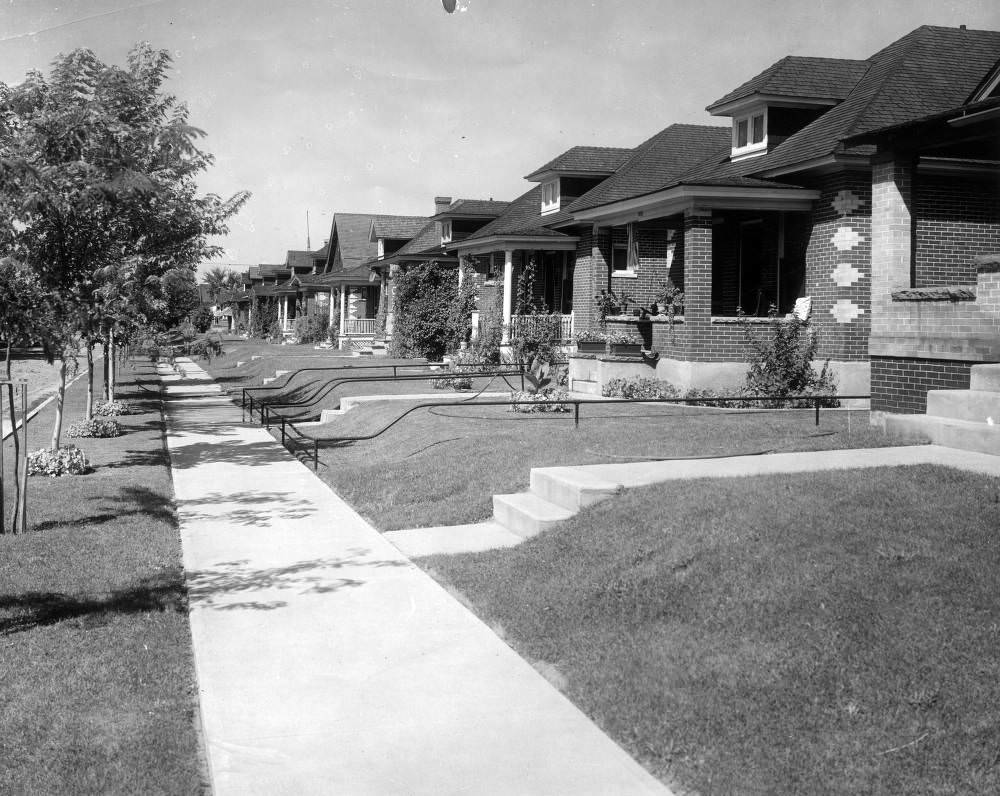
Pennsylvania Street in 1900 showed a residential neighborhood still finding its character. Brick houses lined both sides of the street, and young trees — recently planted — stood in front of each property, their trunks barely thicker than the fence posts nearby. Within a decade, those trees would shade the sidewalks and transform the street’s appearance entirely. This pattern of brick construction and planned tree planting was deliberately encouraged by Denver’s city planners, who understood that street trees were essential to making neighborhoods livable and attractive.
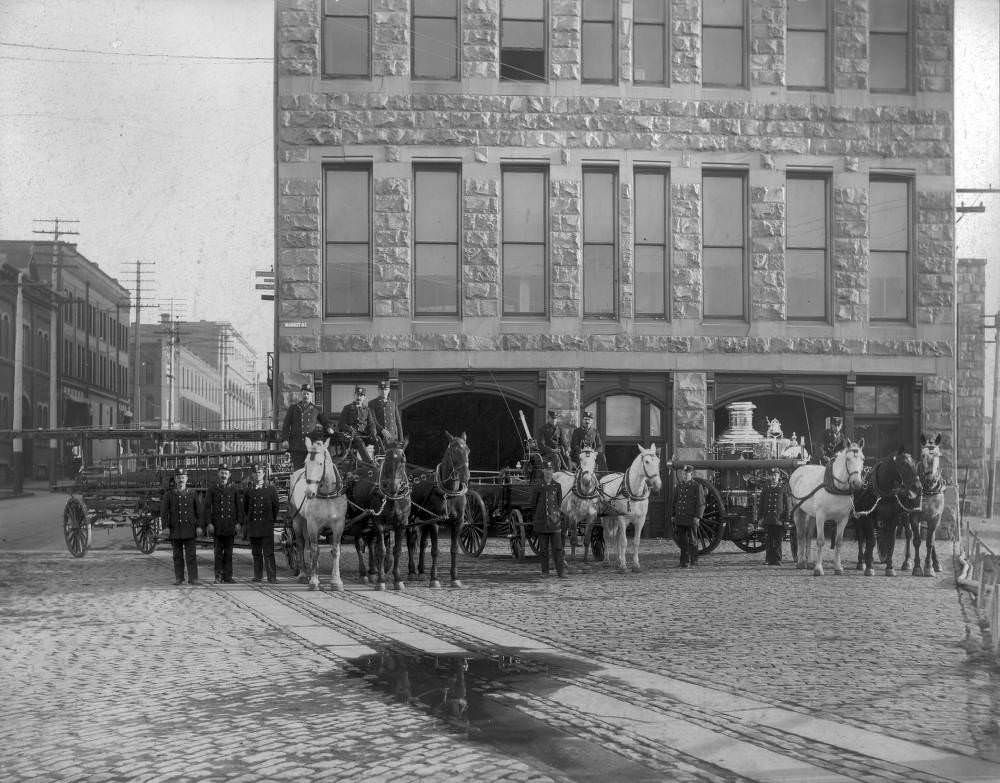
Denver’s firefighters posed proudly in front of the department’s headquarters at City Hall. The fire department was one of the city’s most visible public services, and its men and horses were well known throughout their neighborhoods. Denver’s fire stations were spread across the city, with Engine House No. One at Colfax and Broadway serving as the flagship facility. The department was in the process of modernizing throughout the early 1900s, adding motorized equipment while retaining horses for some operations until the technology was fully proven.
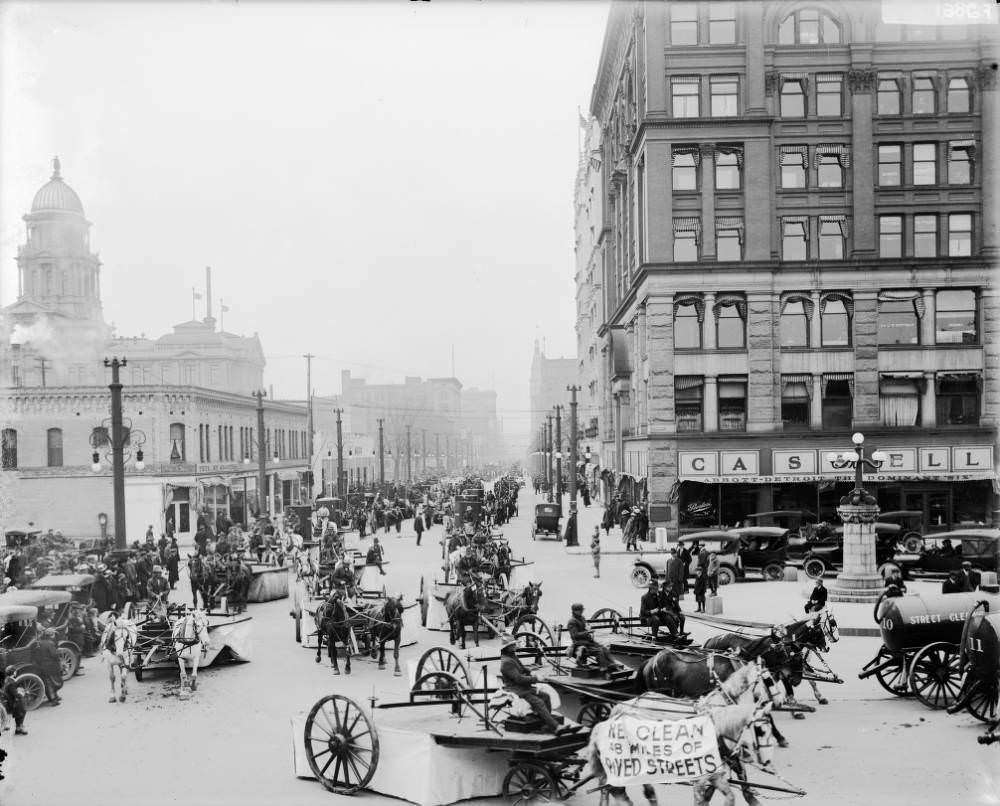
Denver’s street sweepers at Broadway and 16th Streets in 1905 worked the city’s single busiest intersection, keeping the pavement clear of the horse manure, debris, and dust that accumulated constantly on heavily trafficked streets. The Sanitation Department employed a significant workforce of sweepers, wagon drivers, and supervisors who worked in rotating shifts to keep the downtown presentable. Their work was unglamorous but essential, and the 1905 Street Cleaning Parade was one way the city publicly acknowledged their contribution.
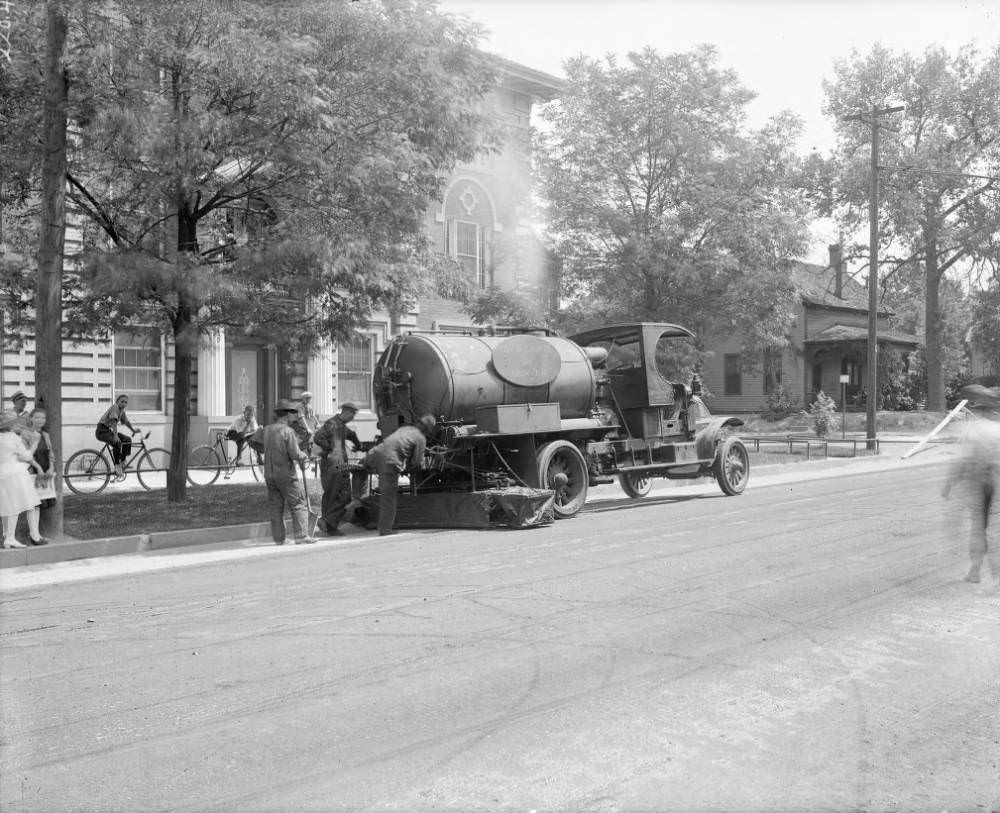
Street oiling — applying petroleum oil to unpaved road surfaces — was one of the most effective dust control methods available to Denver in 1905. Children watched as a motor truck worked its way down the street, leaving a dark, glistening surface behind it. The oil bound the road surface together and prevented the dry Colorado soil from becoming airborne, a significant improvement over simply wetting the streets with water. Dust was a serious quality-of-life problem in Denver, and the city tried multiple technologies to address it before asphalt paving became the standard solution.
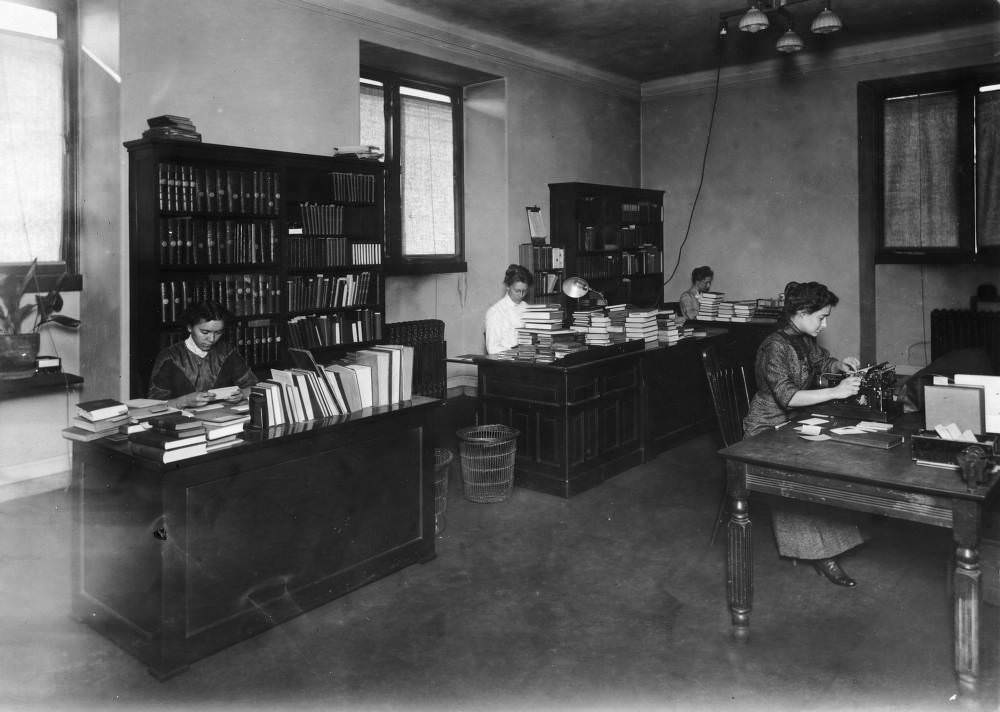
The Denver Public Library’s catalog department was staffed almost entirely by women. Library work was one of the few professional fields that actively recruited female employees in the early 1900s, and librarianship had developed as a female-dominated profession over the previous three decades. The women who organized, cataloged, and maintained the library’s collections held skilled positions that required education and precision. Their work was less visible than the building’s architecture or the politicians who spoke at its cornerstone ceremony, but it was essential to the library’s actual function.
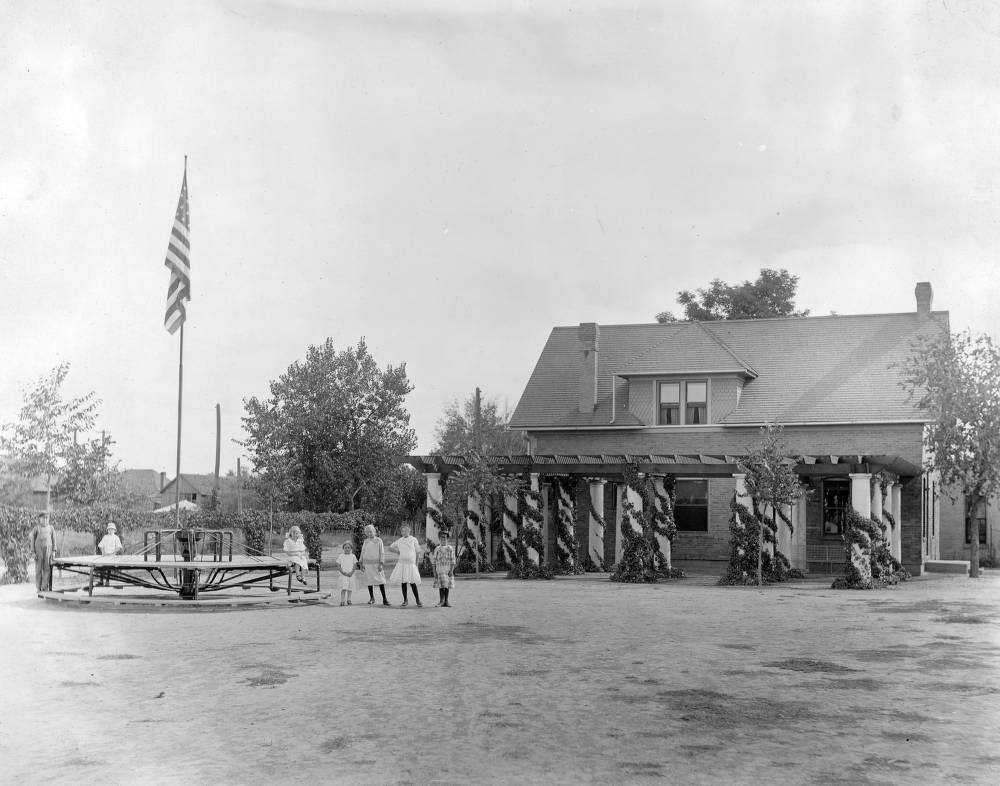
Elyria Park sat in one of Denver’s poorer neighborhoods, and the playground there served children who had few other recreational options. The playground movement in early 1900s America was driven by the belief that structured play in supervised public spaces would keep children out of trouble and improve their physical and social development. Denver invested in playgrounds in its working-class and immigrant neighborhoods specifically because reformers recognized that children in those areas had the least access to private recreational space and the most need for public alternatives.
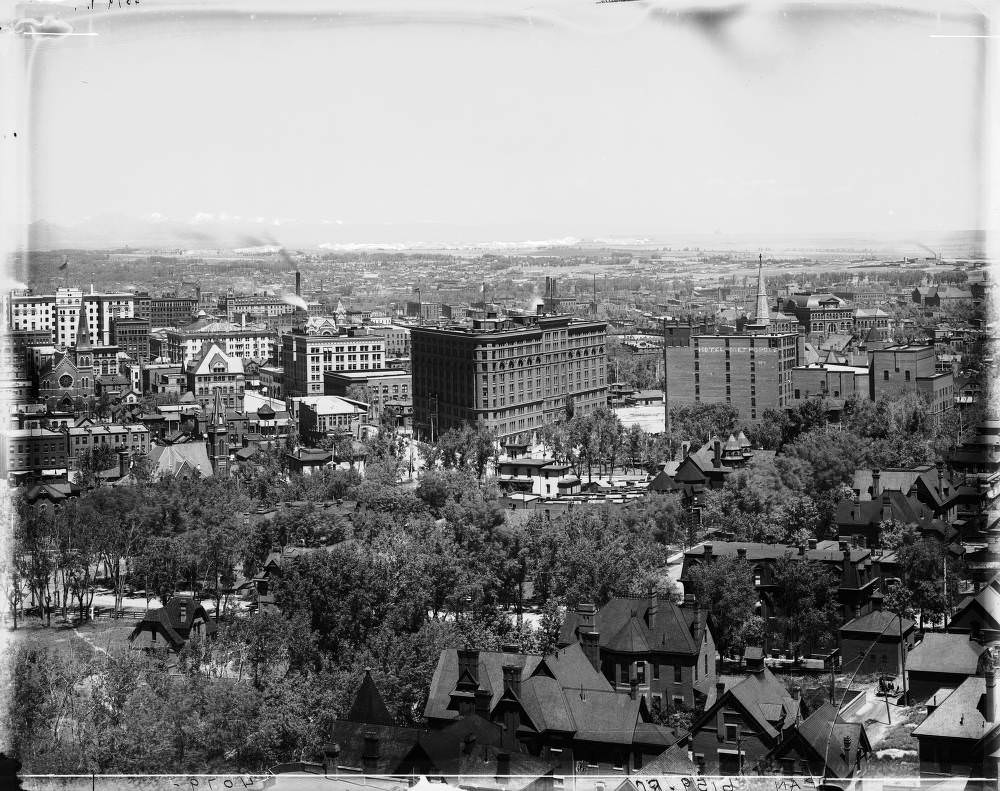
A panoramic view of Denver from the State Capitol dome showed a city that stretched from the mountains to the eastern horizon. Church steeples, the domes of civic buildings, and the towers of commercial blocks all competed for vertical attention. The Capitol itself, with its gold dome, was the highest point in the downtown, and the view from it gave observers a sense of the city’s true scale. The mountains in the background — always present on clear days — reminded viewers that Denver existed in a geographic setting unlike any other major American city.
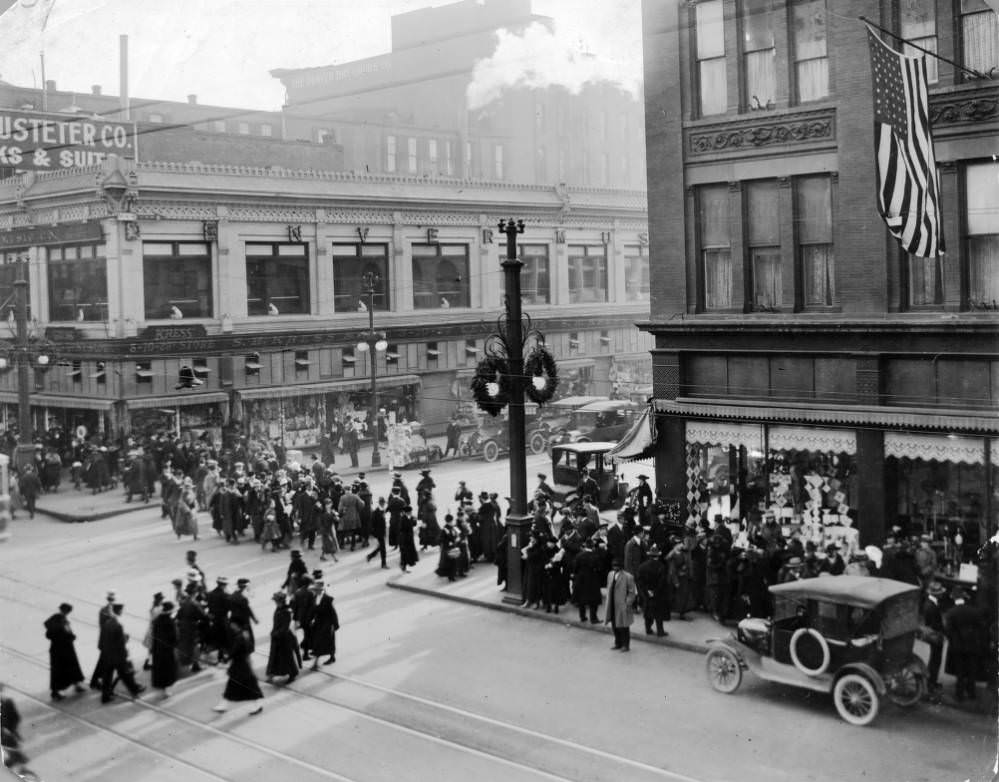
Christmas decorations at 16th and Stout Streets transformed the downtown into a seasonal spectacle. Electric lights, garlands, and window displays competed for the attention of shoppers who crowded the sidewalks during the holiday season. Denver’s retailers invested heavily in Christmas advertising and decoration, recognizing the commercial importance of the weeks between Thanksgiving and Christmas. The decorated streetscape, combined with the constant movement of trolleys and pedestrians, made the downtown feel especially alive during the holiday months.
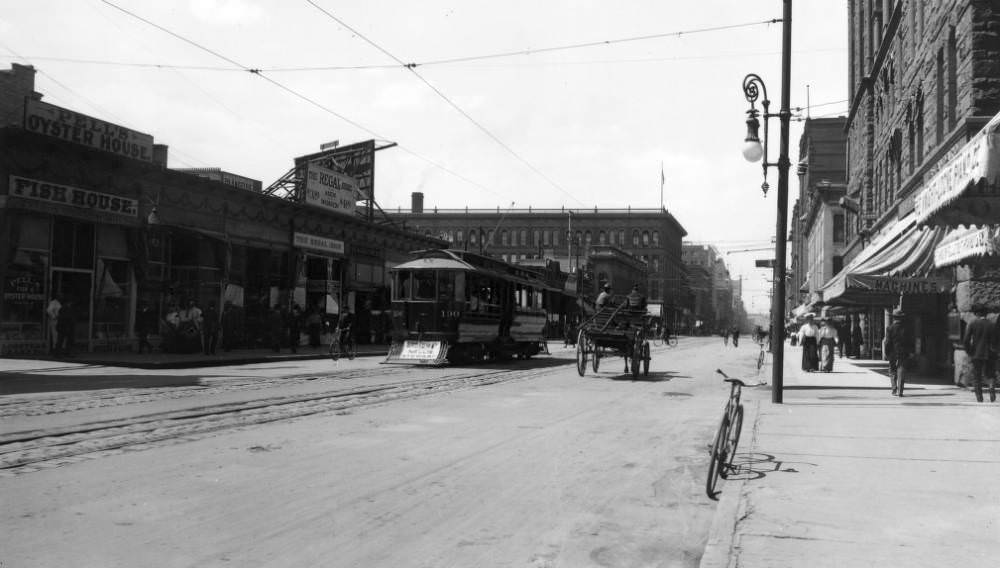
Tramway Car 190 on busy 16th Street moved through a corridor packed with shoppers, workers, and visitors. 16th Street was the route that connected the most people to the most destinations, and its trolleys ran with a frequency that reflected that demand. The advertising panels on the side of the car offered a rotating display of local businesses and events, turning each trolley into a moving billboard. Riding the 16th Street line was an experience that put passengers in physical contact with the city’s commercial heartbeat.
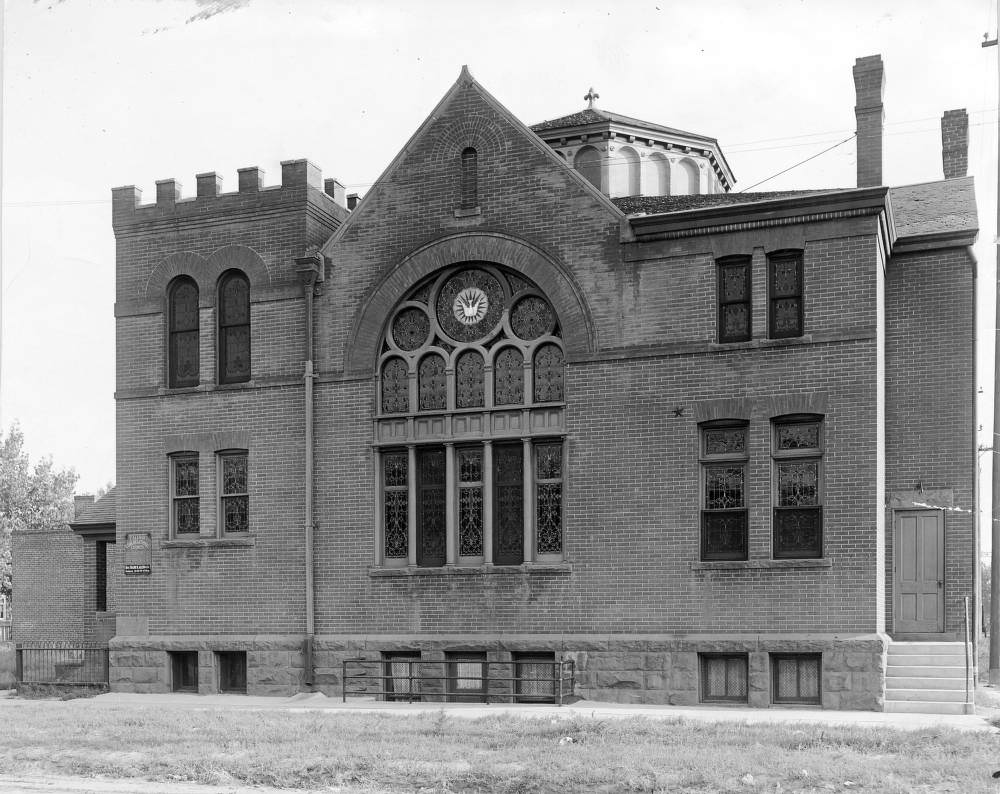
The Third Congregational Church at West 5th Avenue and Fox Street served a congregation on Denver’s west side, a neighborhood that was more working-class than the Capitol Hill districts where the city’s wealthiest churches stood. Congregational churches had a strong tradition of social activism and community engagement, and Denver’s Congregational congregations were involved in temperance work, education, and support for immigrant communities. The church’s location on the west side placed it in the midst of the Italian and other immigrant neighborhoods that had formed since the 1880s.
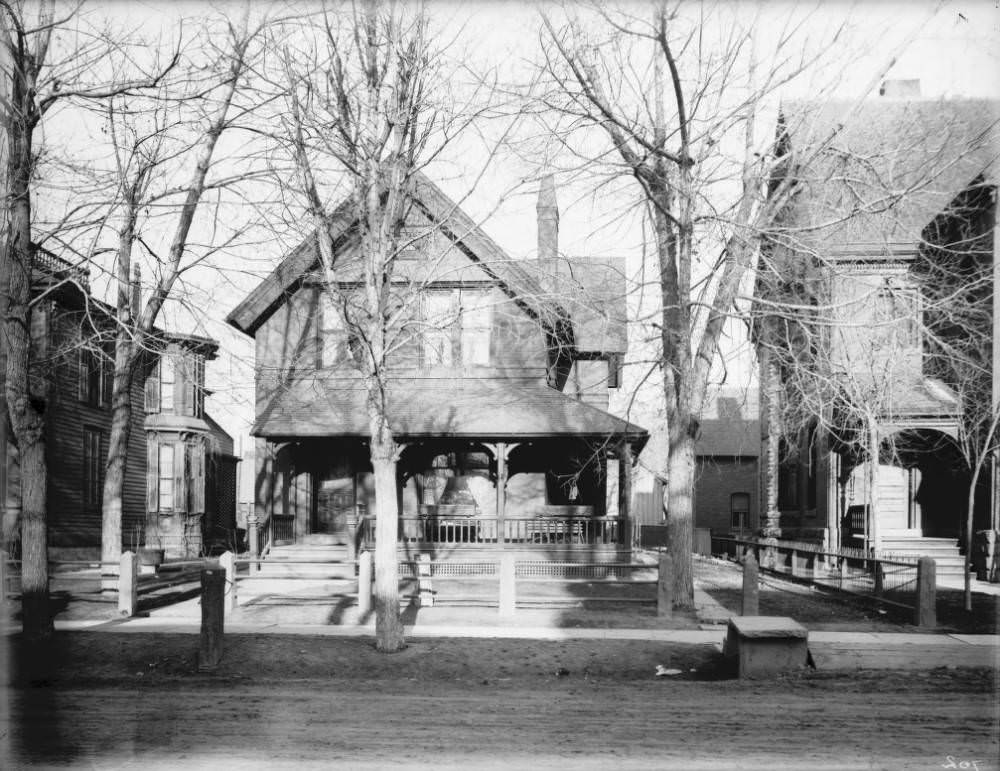
A two-story frame house with a covered porch and gable roof was the standard middle-class home in turn-of-the-century Denver. Built by the thousands across the city’s expanding residential districts, these houses reflected the aspirations of families who had arrived in Denver with modest means and worked their way into stability. The covered porch was a social space as well as an architectural feature — a place to sit in the evening, talk with neighbors, and participate in the street life of the block. Inside, the houses were modest by the standards of Capitol Hill but comfortable by the standards of the era.
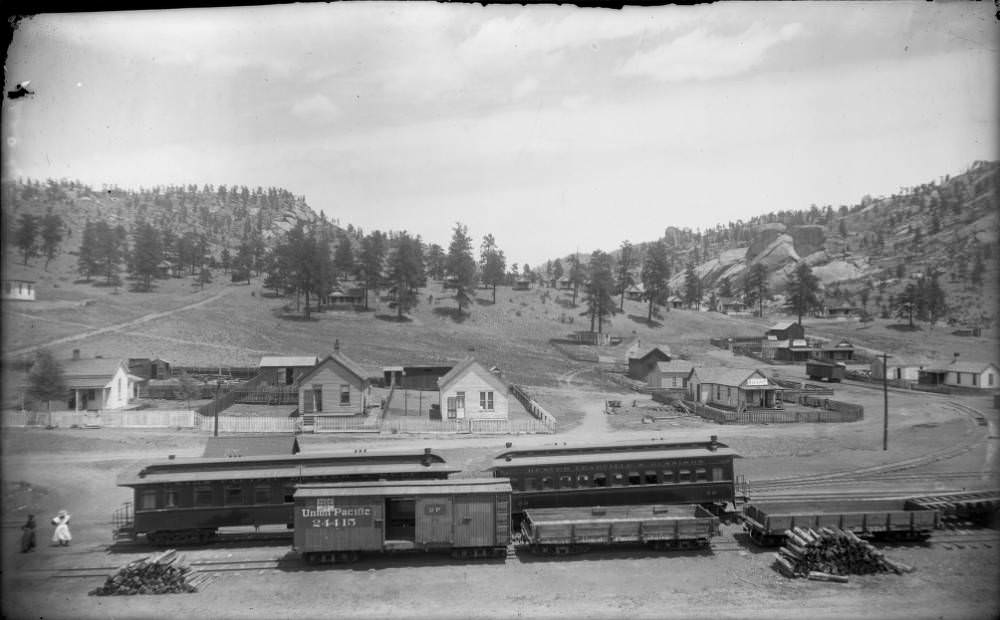
The Denver, Leadville and Gunnison Railway connected Denver to the silver-mining districts of central Colorado. The line ran through dramatic mountain terrain, climbing to elevations that tested the limits of steam locomotive technology. Pine, Colorado — a small mountain community along the route — appeared in photographs as a waypoint between the city and the mining centers further west. Denver’s economic health was directly tied to the continued productivity of Colorado’s mountain mines, and the railroads that served those mines were essential links in the chain.
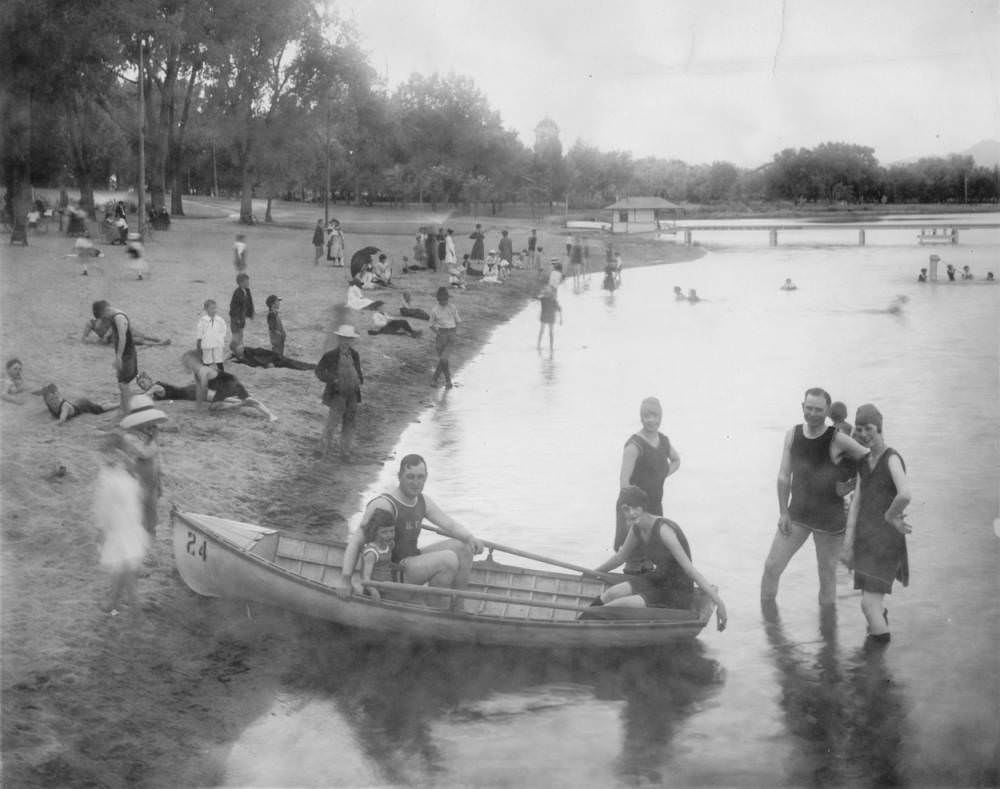
Berkeley Lake in the Berkeley neighborhood on Denver’s northwest side offered another public recreational space. The Berkeley Park Beach drew summer crowds who waded, swam, and picnicked along the lake’s edge. Berkeley was one of several communities that had been annexed by Denver during its rapid expansion, and its park system was integrated into the city’s broader network of public recreational spaces. Rocky Mountain Lake in the same neighborhood also attracted campers and outdoor enthusiasts who wanted to experience nature without leaving the city.
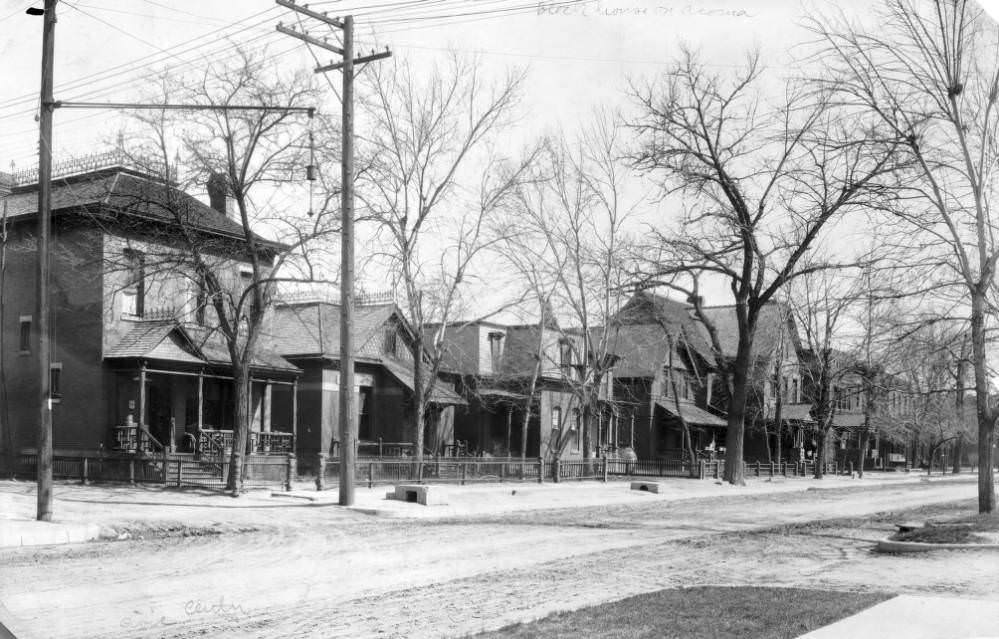
Acoma Street near the Civic Center was a residential block that would eventually be transformed by the expansion of Denver’s civic campus. In the early 1900s, it was still lined with modest houses featuring covered porches and metal fences — the ordinary residential fabric of a working-class Denver neighborhood. Some of these houses at 1445 and 1447 Acoma Street were photographed precisely because they were destined for demolition as the Civic Center project moved forward. The photographs preserve what the neighborhood looked like before it was reshaped by civic planning.
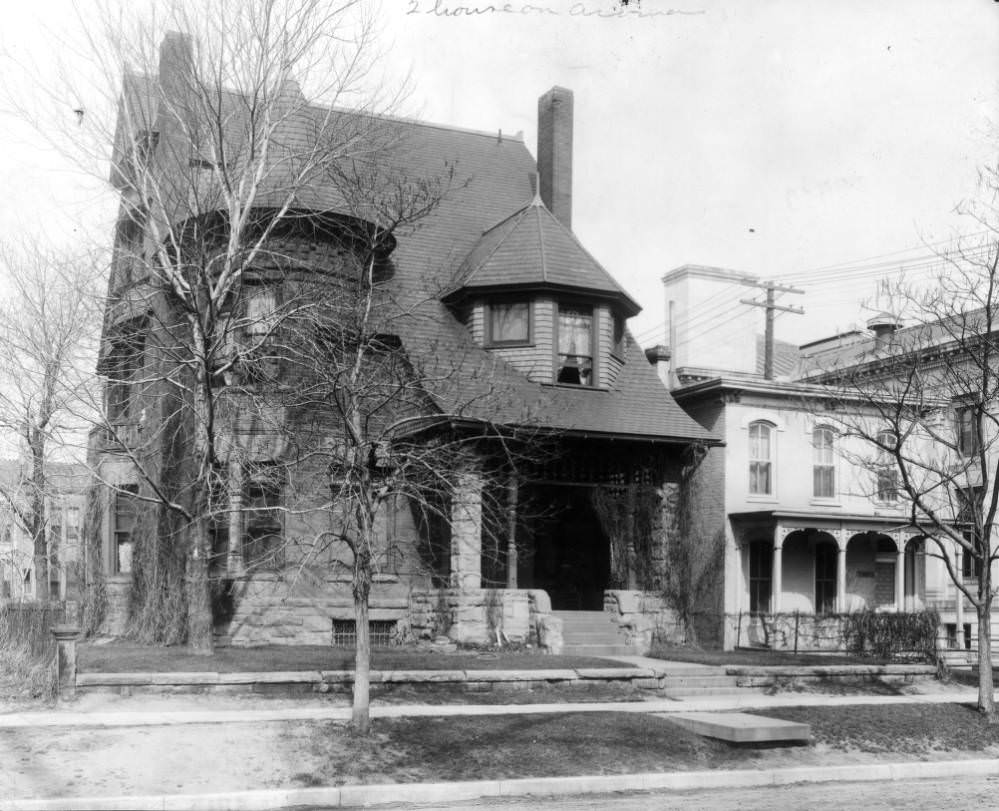
The specific houses at 1445 and 1447 Acoma Street represented the domestic scale of what existed before Denver’s Civic Center was formally developed. Mayor Speer’s vision for the Civic Center called for clearing existing residential and commercial properties to create a formal campus of public buildings connected by landscaped grounds. The residents of these houses were displaced as the project moved forward, a pattern common to City Beautiful-era civic improvements across American cities. Their homes were modest, well-maintained, and typical of the working-class neighborhoods that surrounded the future civic campus.
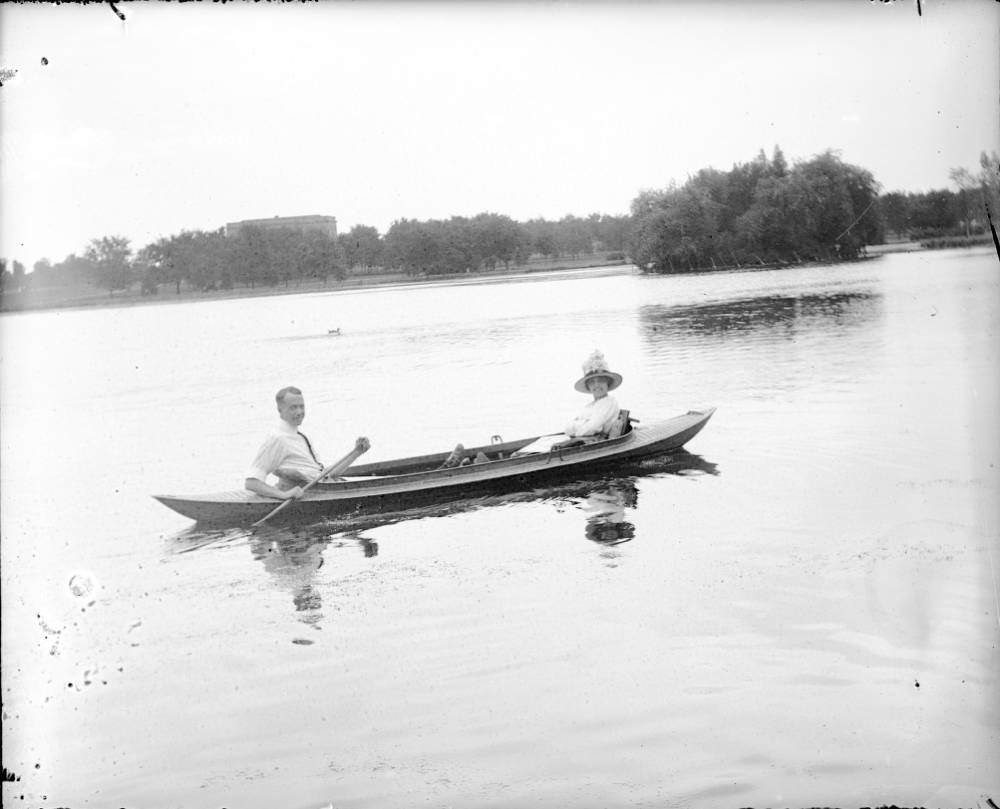
City Park Lake offered canoeing as a leisure activity in the middle of the city. A man and woman paddling together with the Denver Museum of Natural History visible in the background composed an image that the park’s planners might have designed deliberately — urban nature recreation framed by civic culture. The museum, the park, the lake, and the canoe all represented different aspects of what Denver believed a modern city should offer its residents: culture, nature, recreation, and a sense that public life was worth investing in.
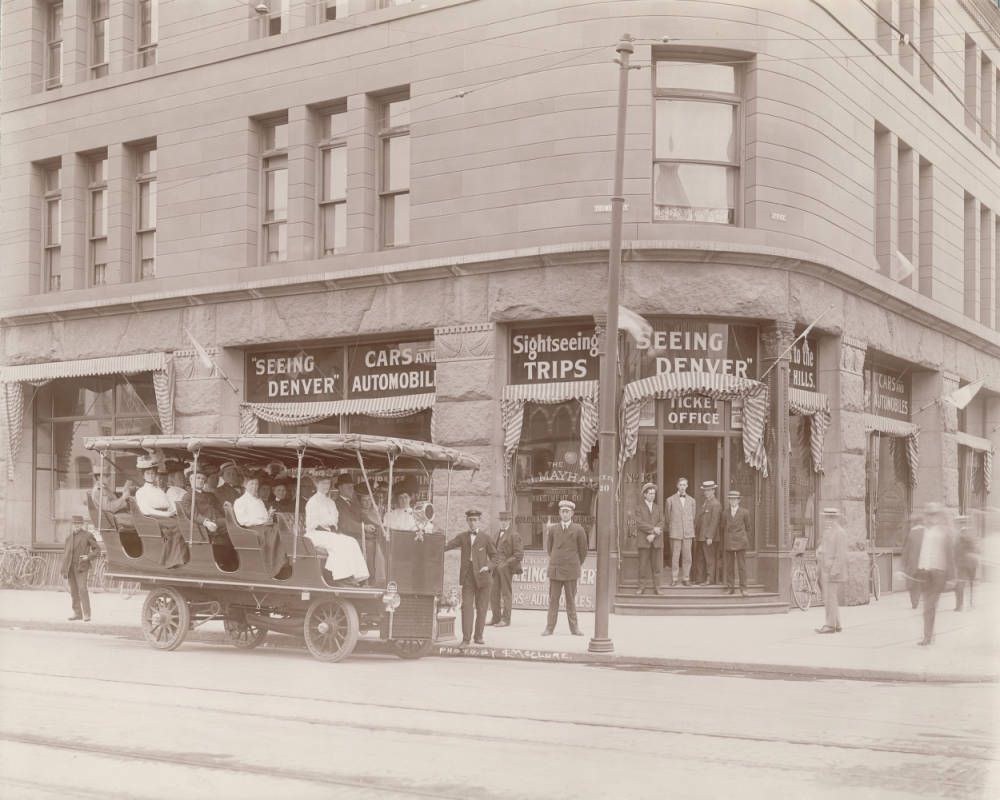
The “Seeing Denver” electric tour coach at 17th and Tremont Street was part of a growing tourism infrastructure that had developed around the city’s attractions. Open-air electric coaches carried visitors past the Brown Palace, the State Capitol, City Park, and other landmarks on guided tours that lasted several hours. Denver was marketing itself aggressively as a destination in the early 1900s — to health seekers, to business travelers, and to tourists who came specifically to see the Rocky Mountains. The tour coaches were a visible part of that marketing effort.
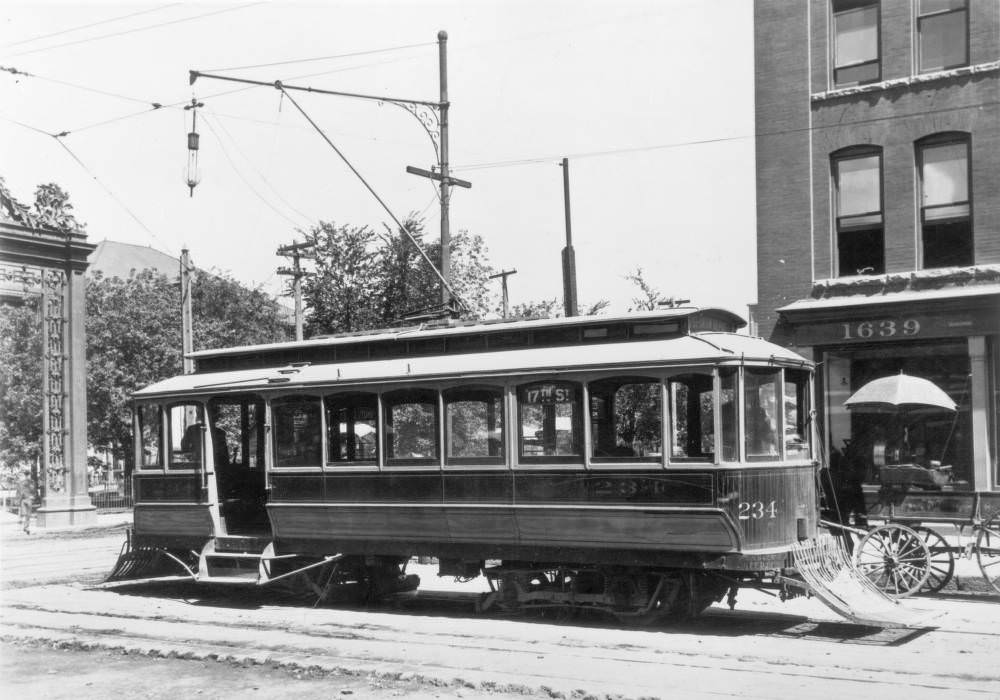
A Denver City Tramway car near Union Station in 1909 operated in a landscape that was more automobile-influenced than it had been a decade earlier. Cars were appearing with increasing frequency alongside the trolleys, and the city was beginning to wrestle with questions about traffic management that would become far more urgent in the following decade. Union Station remained the dominant transit hub, but the private automobile was starting to offer an alternative to rail travel for those who could afford one. Denver’s tramway ridership was still growing in 1909, but the forces that would eventually undermine it were already visible.
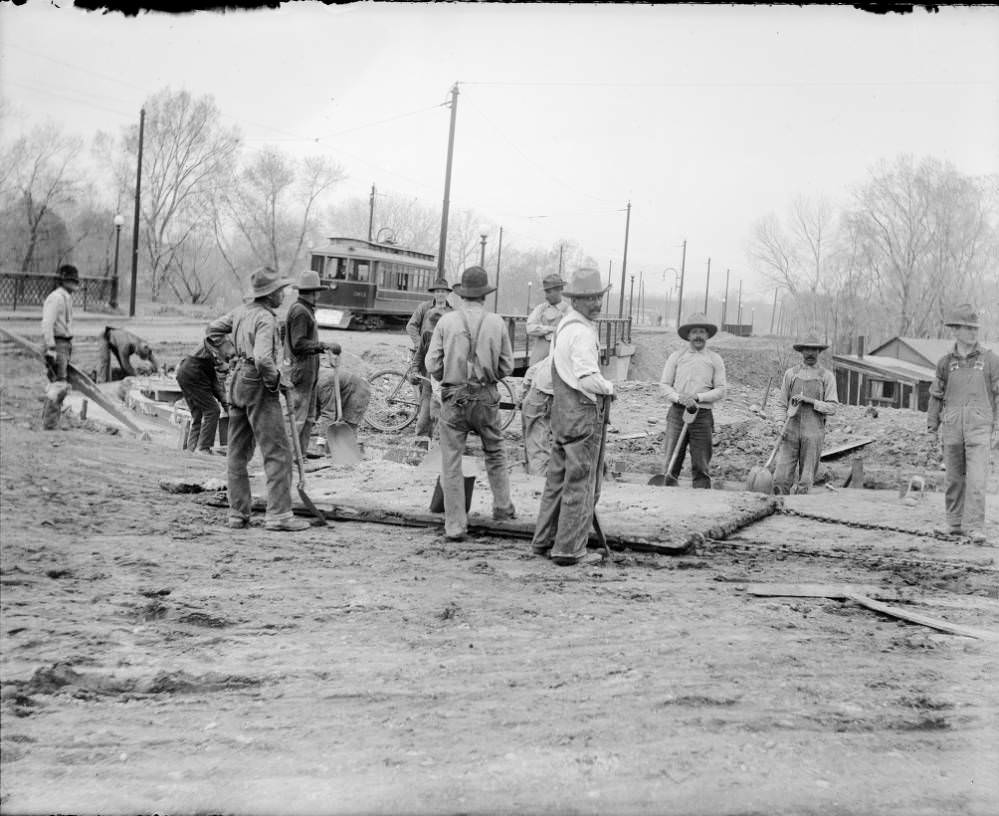
Construction crews working near the Alameda Avenue bridge were part of Denver’s ongoing infrastructure expansion in the southern part of the city. Bridge construction in this area opened new territory to residential development, extending the city’s reach and connecting previously isolated neighborhoods to the tramway network. The crews visible in photographs from this period were largely immigrant workers — Italians, Slavs, and Mexicans who provided the physical labor for Denver’s construction boom while living in the neighborhoods closest to the work sites.
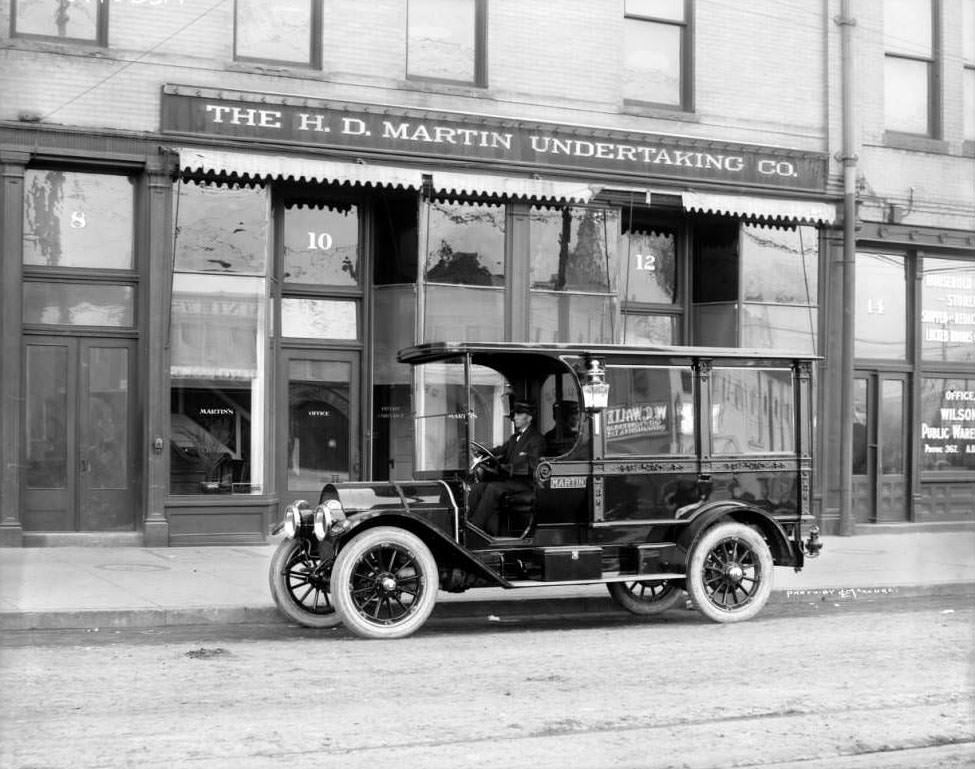
West Colfax Avenue was home to a diverse mix of businesses, including undertakers who served the neighborhood’s working-class and immigrant population. H. D. Martin’s funeral establishment was one of many small businesses that catered to the everyday needs of Denver residents who lived at a remove from the fashionable commercial districts of 16th Street and Capitol Hill. West Colfax was also the center of Denver’s Jewish community, and the businesses along it reflected the cultural mix of the surrounding neighborhoods.
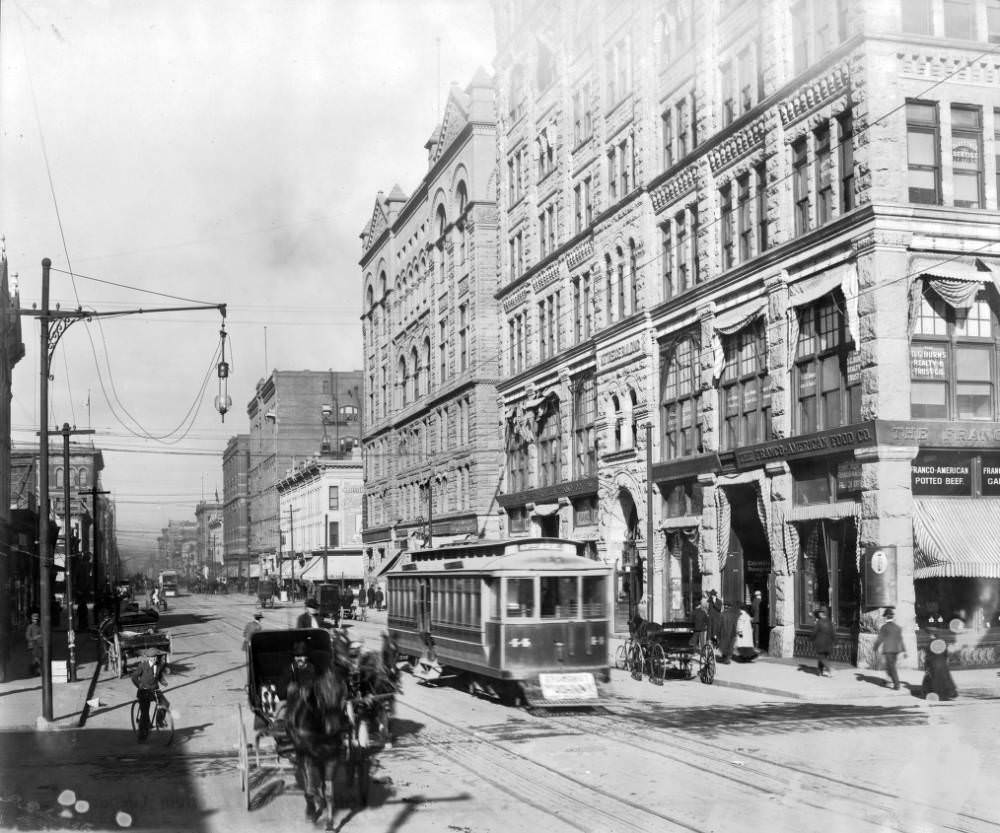
The Kittredge Building on 16th Street was one of the finer commercial structures in Denver’s downtown. Built with detailed stonework and multiple commercial floors, it housed offices and retail tenants who benefited from the constant foot traffic on 16th Street. A Denver Tramway trolley passing in front captures the building in its active commercial context — not just an architectural object, but a working part of the city’s economic fabric. Buildings like the Kittredge defined the downtown’s character by setting a standard of quality that neighboring structures tried to match.
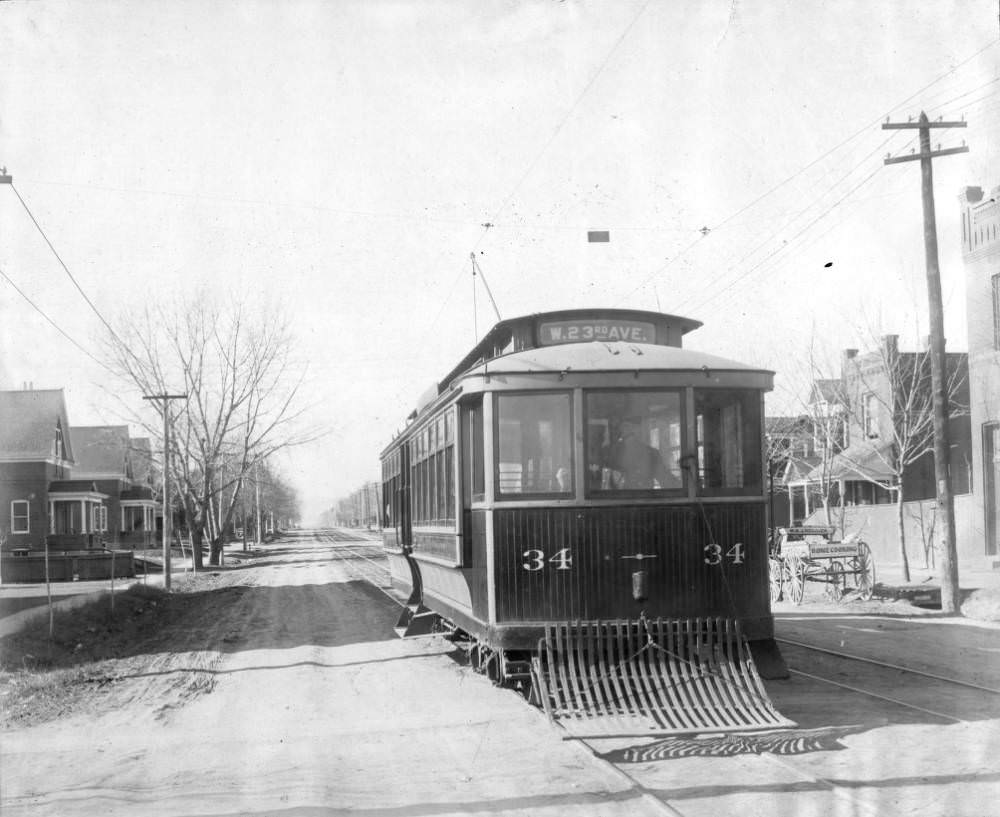
West 23rd Avenue in the Highlands neighborhood was served by Denver Tramway lines that connected this elevated community to the downtown. The Highlands sat on a plateau north of the South Platte River and had developed rapidly in the 1880s and 1890s as an affluent residential alternative to the closer-in neighborhoods. By 1905, the area was fully built out with Victorian homes, churches, and commercial blocks, and the trolley line along West 23rd was essential to its residents’ daily lives.
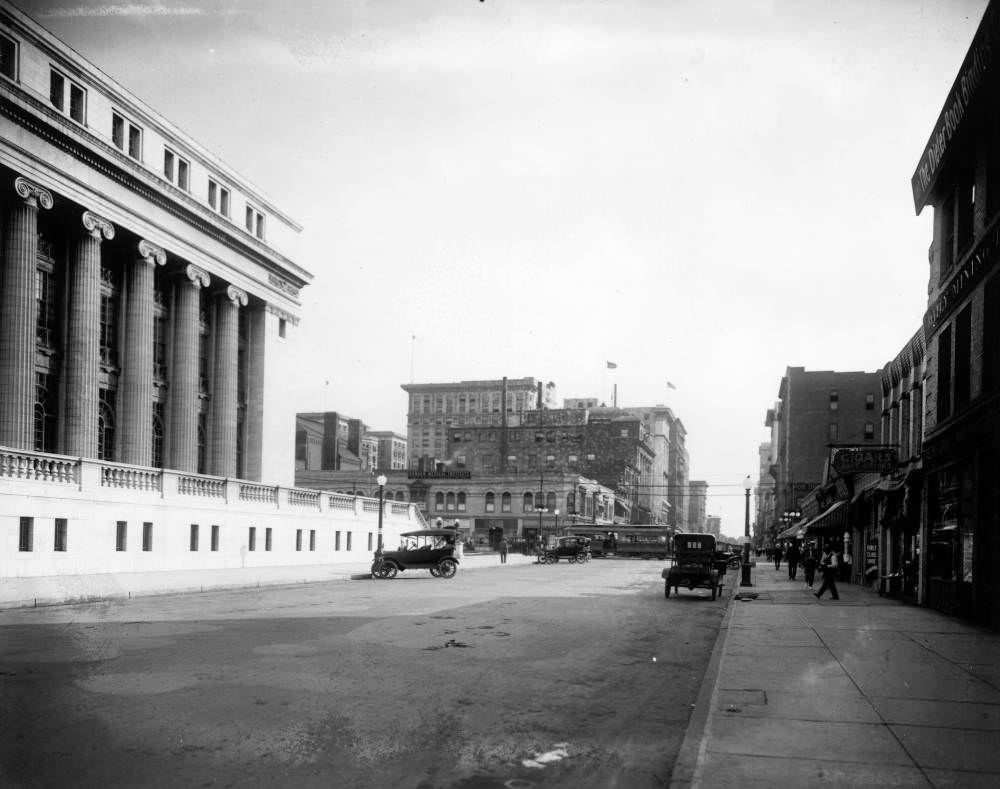
Stout Street in the early 1900s showed the coexistence of automobiles and streetcars that was becoming more common across Denver. The cars were still outnumbered by the trolleys, but their presence was increasingly routine. Stout Street ran through the heart of the downtown, connecting office districts to civic buildings, and its streetcar tracks carried commuters who would eventually be replaced by automobile drivers. The transition was slow, and in 1905 or 1908, very few people in Denver would have predicted how completely the automobile would transform their city within two decades.
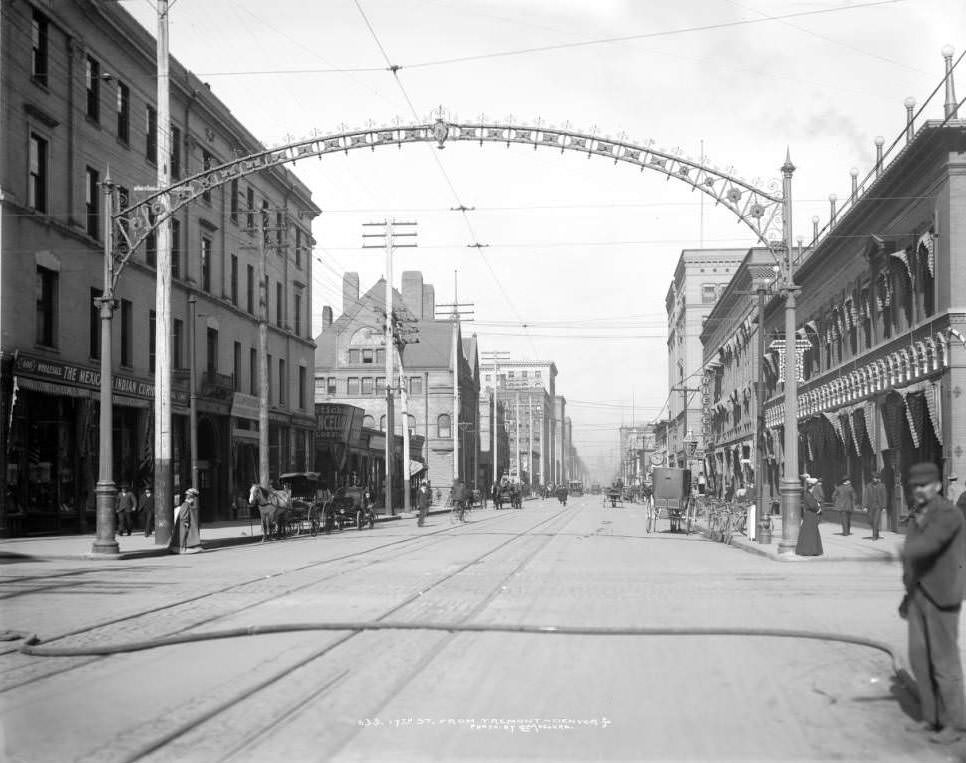
Looking from 17th Street toward Tremont Place in 1907, a viewer saw the concentrated wealth and civic ambition of Denver’s downtown in a single glance. Hotels, financial offices, and commercial buildings filled the view, each one built to last and built to impress. Tremont Place was a short street connecting 17th to 18th, lined with some of Denver’s most prestigious addresses. The view captured in this photograph shows a downtown that had achieved genuine metropolitan character — not a frontier outpost or a regional center, but a real city with real permanence.
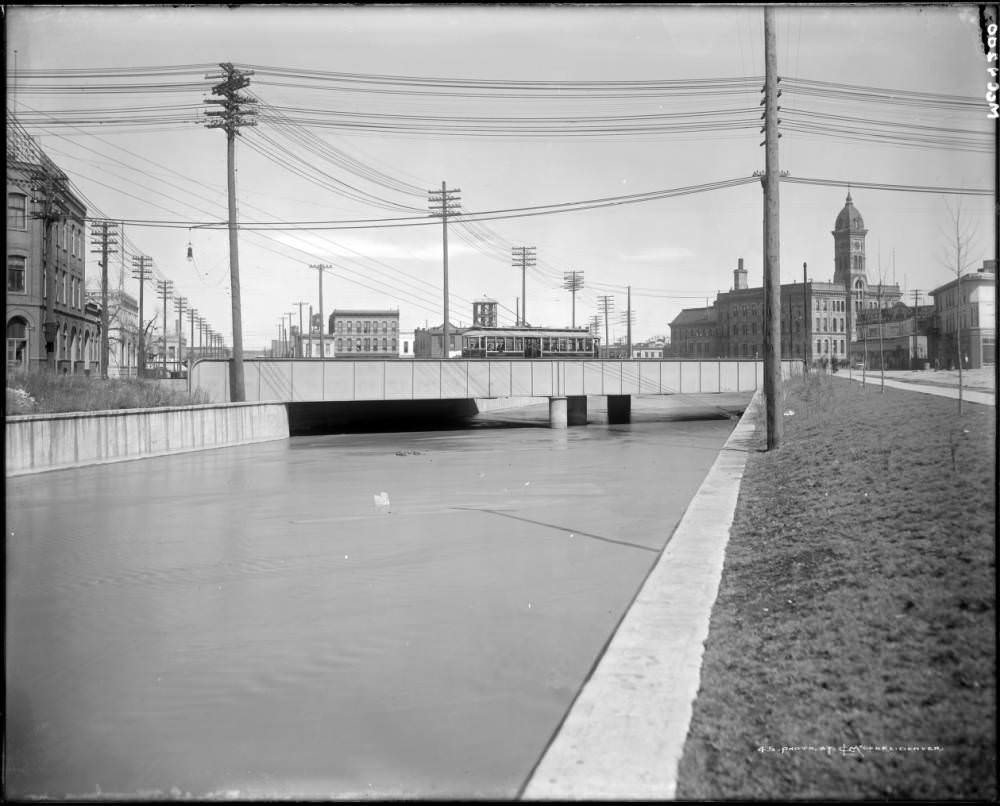
Cherry Creek flowed through the heart of Denver, and the bridges that crossed it were essential connectors between the city’s eastern and western halves. The Lawrence Street Bridge in 1907 carried pedestrians, vehicles, and streetcars across the creek, which had been partially channeled and controlled but still flooded periodically. The creek’s banks, while not yet the formal Speer Boulevard promenade they would become, were in the process of being landscaped and improved as part of the City Beautiful effort to transform the waterway into an asset.
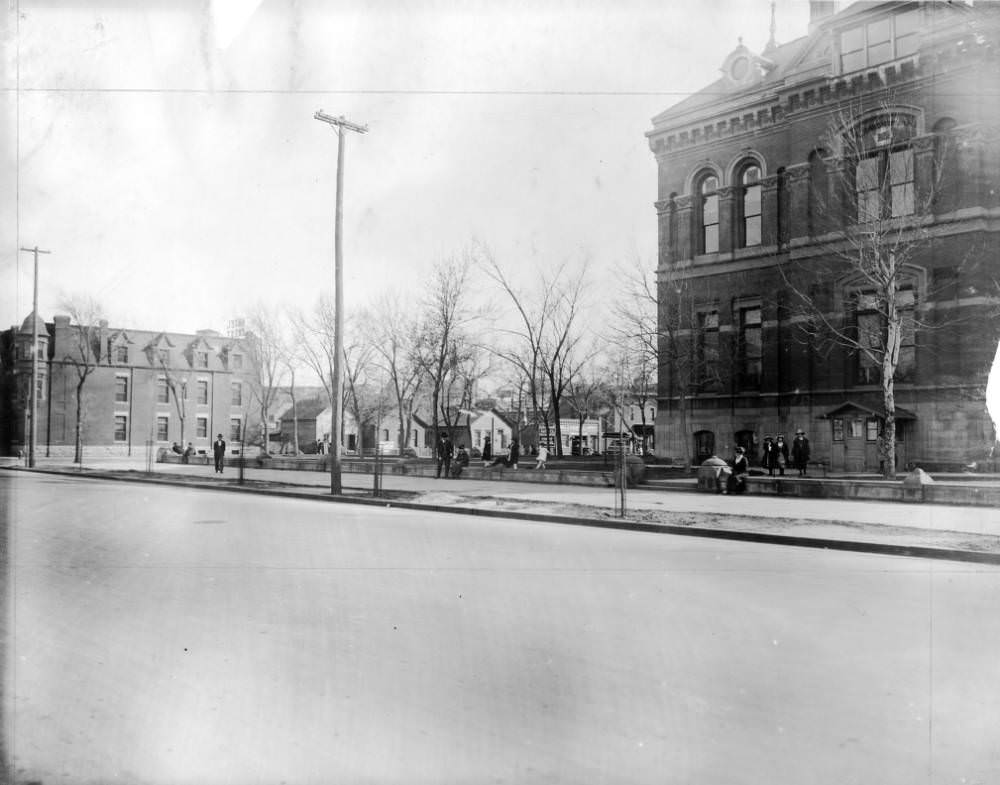
East Denver High School at 19th and Stout was a social hub as well as an educational institution. Students gathered outside the building before and after school, and the surrounding streets were busy with the movement of young people between the school and their homes. Denver’s high school enrollment was growing steadily in the early 1900s as the city’s population expanded and as compulsory education laws were more consistently enforced. The school’s Victorian Gothic building, with its pointed arches and stone trim, was designed to inspire a sense of institutional seriousness in its students.
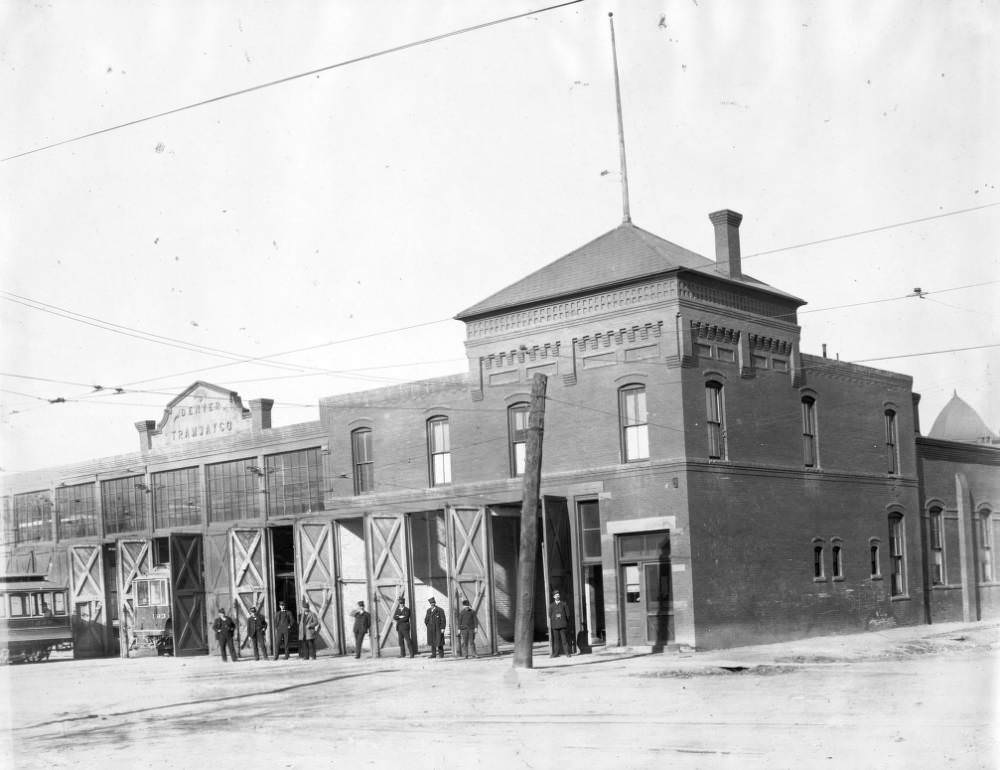
The Denver Tramway Company maintained car garages scattered across the city, each one housing the trolleys that served a particular cluster of routes. Workers at the garage on Gilpin Street posed for a photograph in 1905 — mechanics, electricians, and carpenters who kept the cars operational. Each garage was also a social space for its workers, who shared the daily experience of maintaining equipment in conditions that ranged from comfortable summer afternoons to brutal Colorado winters when frozen switches and icy tracks created constant maintenance emergencies.
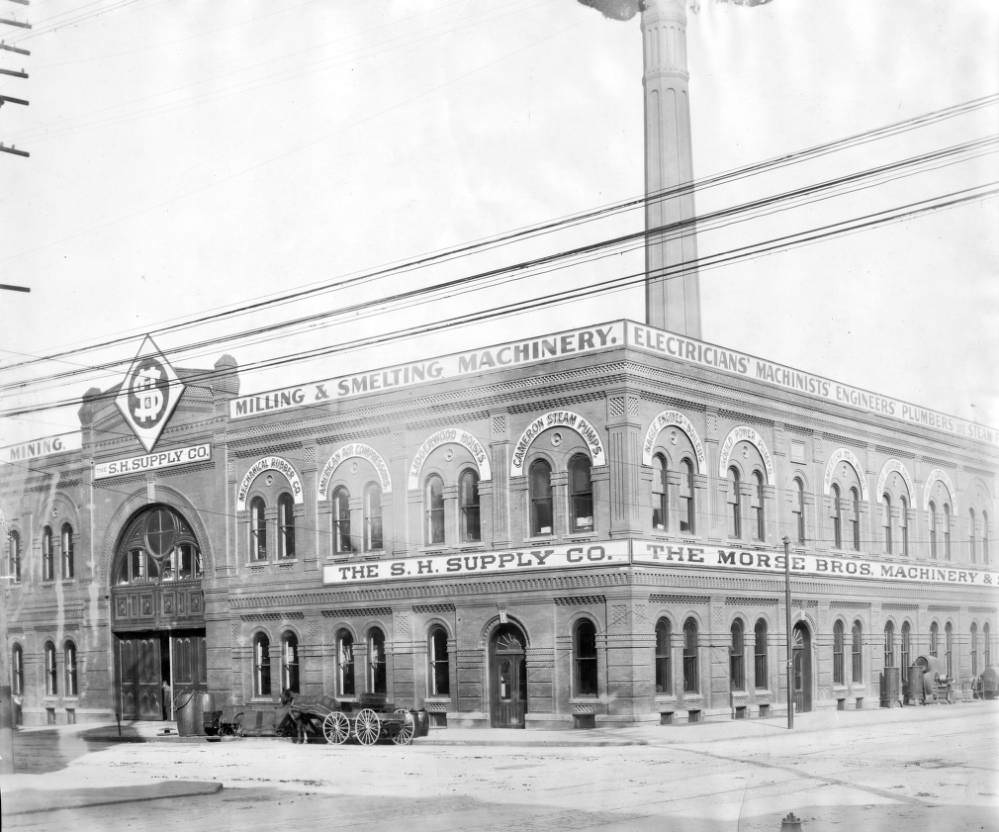
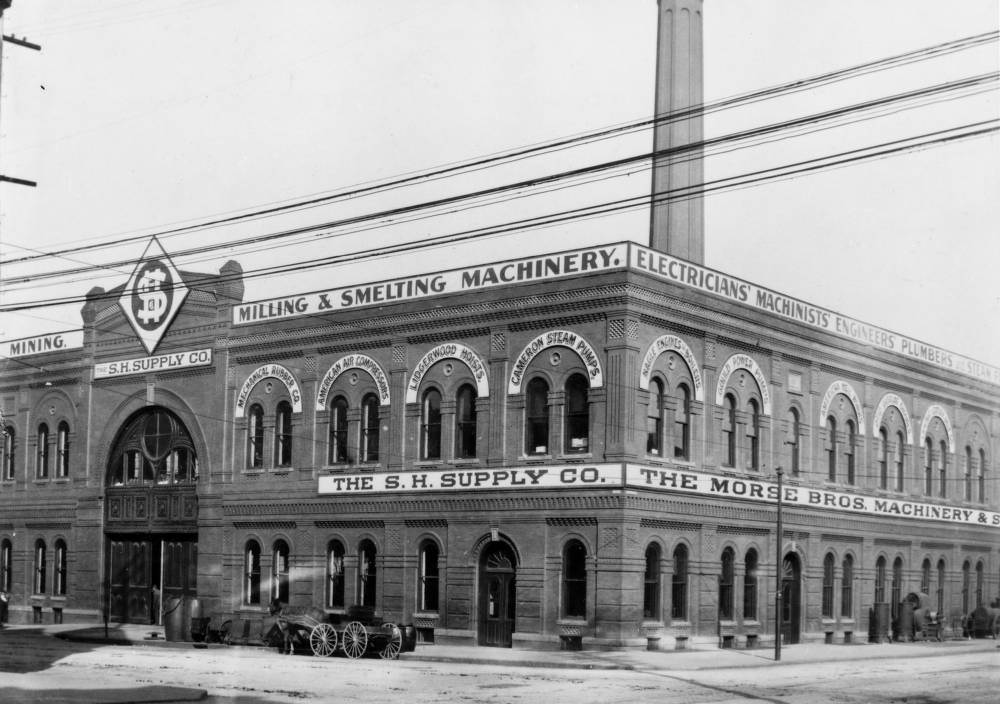
Morse Brothers Machinery and Supply Company at 18th and Lawrence served Denver’s industrial and construction sectors. Companies like Morse Brothers supplied the equipment needed for the city’s continuous expansion — pumps, engines, tools, and heavy machinery for mining, smelting, and construction. Lawrence Street in this area was an industrial and commercial corridor that supported the visible development happening throughout the city. These supply companies were the infrastructure behind Denver’s infrastructure, providing the tools that built the buildings, bridges, and transit systems that defined the city.
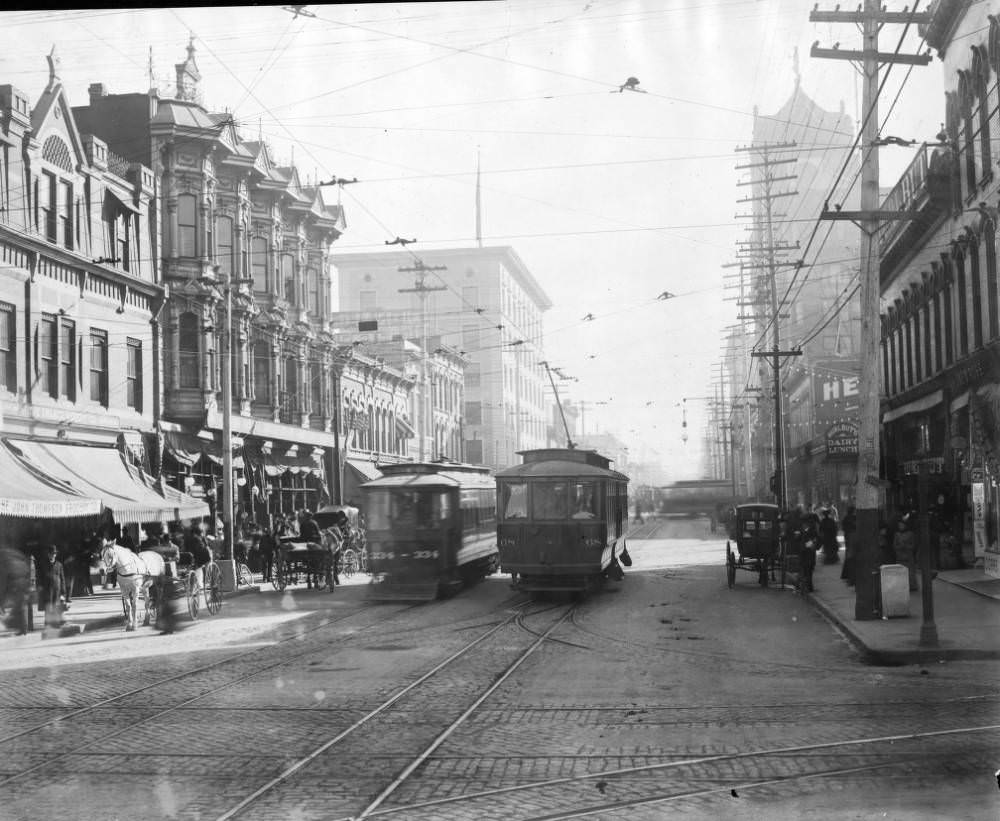
The advertising visible on Denver Tramway trolleys and surrounding storefronts in 1905 documented the commercial landscape of the early 20th century city. The John Thompson Grocery Company and businesses like it served the thousands of residents who lived within a few blocks of the tramway lines and walked to do their daily shopping. Grocery advertising on streetcar signs was a cost-effective way to reach a captured audience — riders had nothing to do but read the signs around them, making trolley advertising one of the most reliable marketing channels in the pre-radio era.
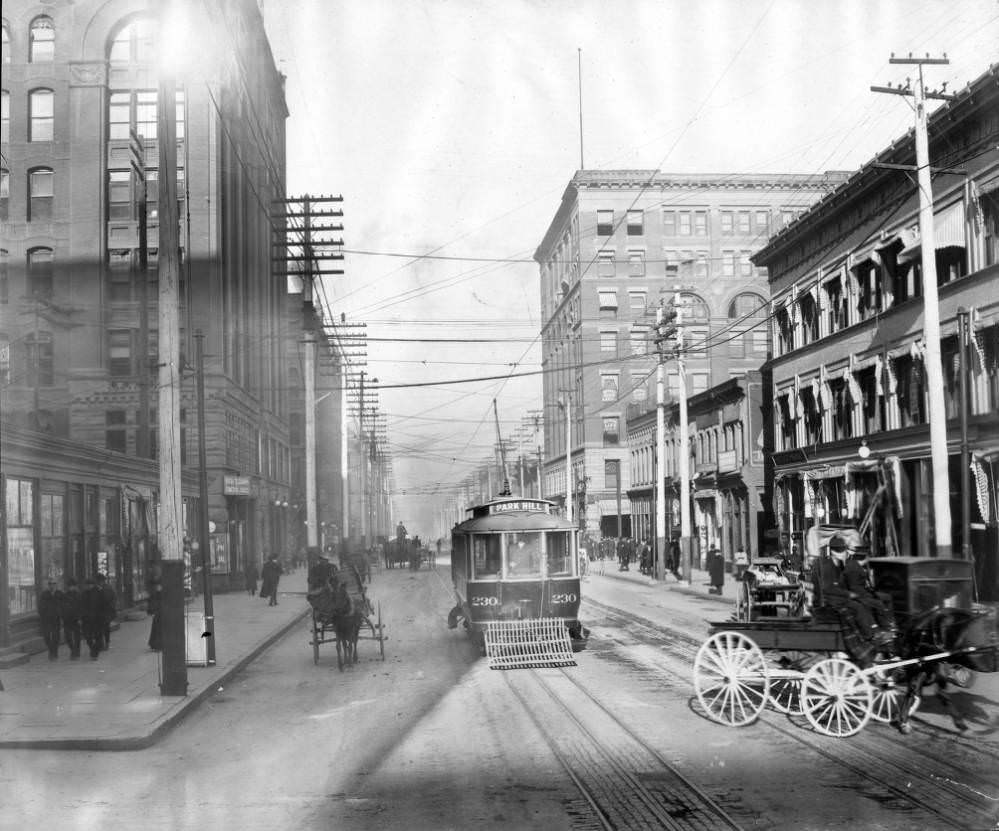
The Park Hill route ran from the downtown along 17th Street toward the Park Hill neighborhood on Denver’s east side. Park Hill was a newer residential development in 1905, its streets lined with recently built houses and its lots still partly vacant. The trolley was essential to Park Hill’s development — without transit access, the neighborhood would have been too far from the downtown to attract residents. Signs for the Boston Lunch and other quick-service restaurants near the trolley stops served workers who needed a fast meal between rides.
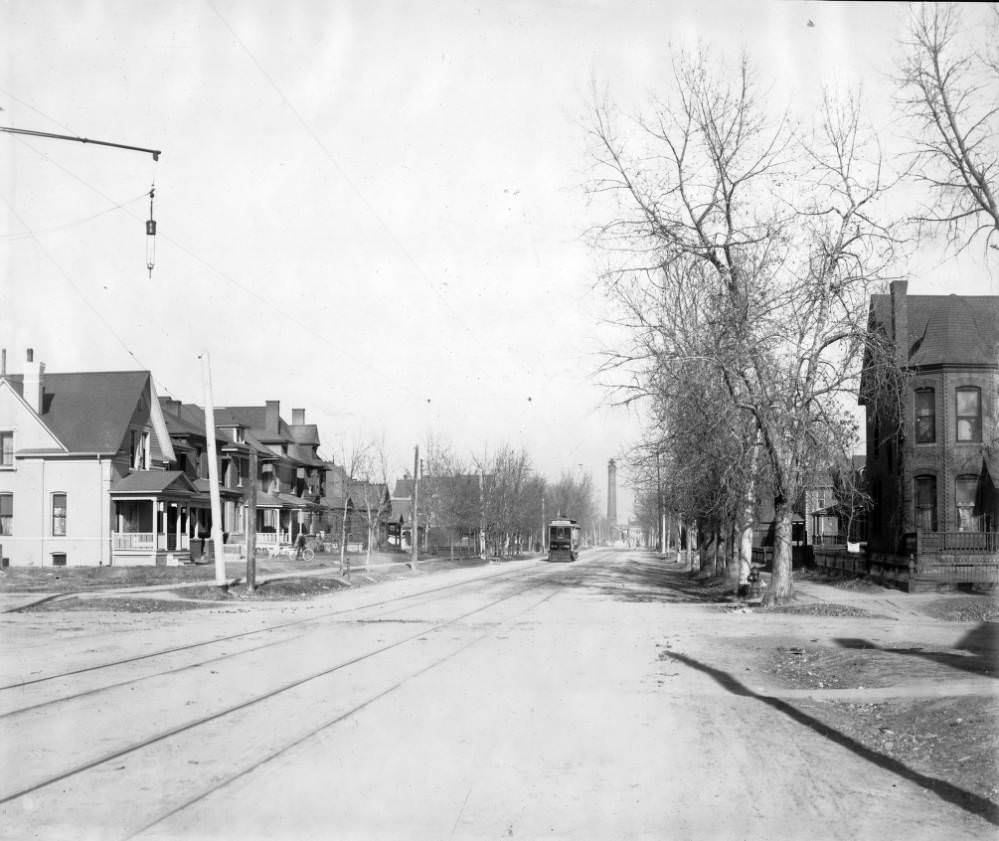
Bannock Street ran past the Colorado General Hospital, one of Denver’s major public medical facilities. Trolley 152 on this route served hospital workers, patients’ families, and residents of the surrounding neighborhood. Colorado General Hospital operated alongside Denver General Hospital and the various religious hospitals to form a substantial medical infrastructure for a city of Denver’s size. The proximity of a trolley stop to the hospital entrance made the facility more accessible to patients who could not afford private transportation.
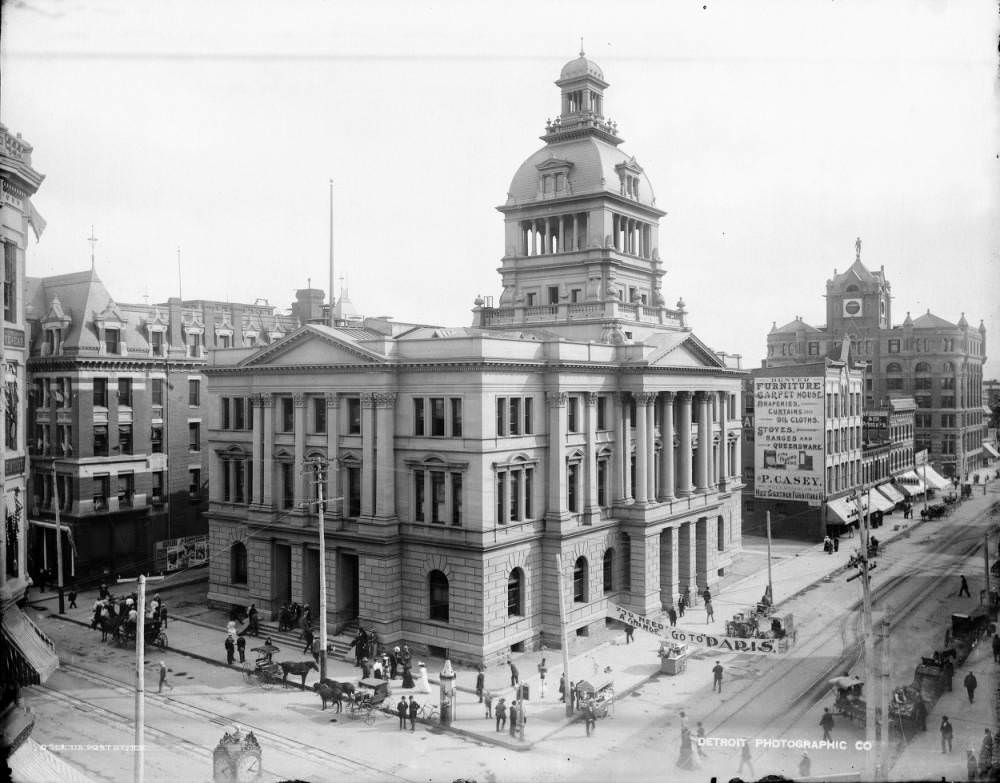
The U.S. Post Office at 16th and Arapahoe Streets was one of the federal government’s most prominent buildings in Denver. Its Second Empire style — characterized by the mansard roof, dormers, and elaborate cornice — was a standard design vocabulary for federal buildings constructed in the late 19th century. By 1905, the building was already somewhat old-fashioned architecturally, but it remained functional and well-positioned at one of downtown Denver’s busiest intersections. Federal architecture in this era was meant to project the permanence and authority of the national government.
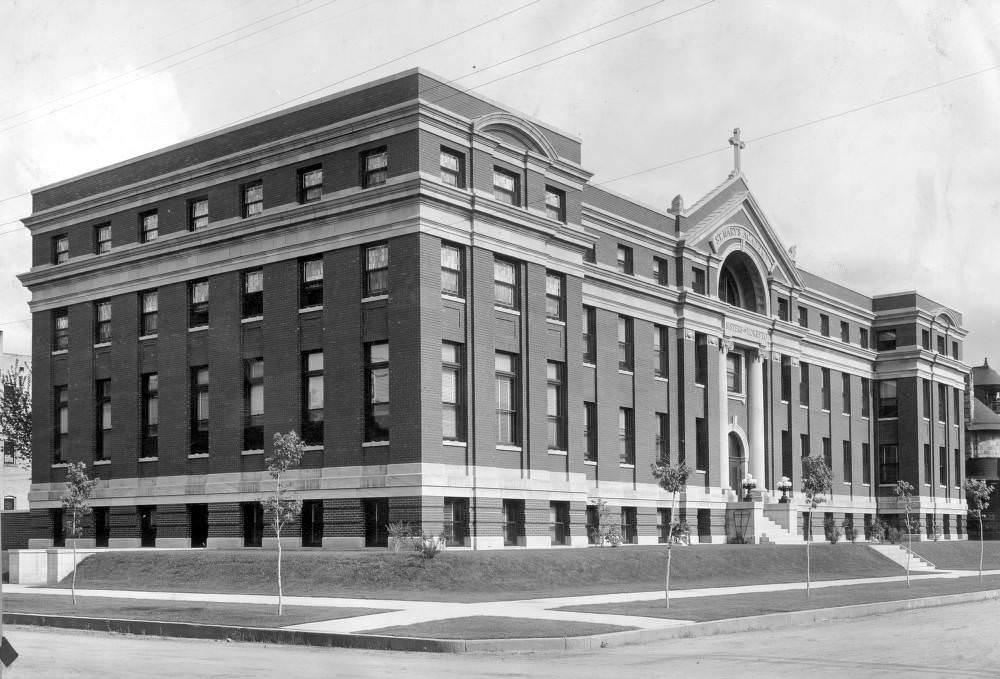
Saint Mary’s Academy on Capitol Hill was one of Denver’s most respected Catholic educational institutions. Run by the Sisters of Loretto, the school educated the daughters of Denver’s Catholic families, many of them Irish and Italian immigrants who had prospered in the city’s commercial and professional life. The stone trim and cross on the building’s exterior were unmistakable signals of its religious mission. Catholic schools like Saint Mary’s provided an alternative to the public school system and maintained a distinct educational culture tied to the Church’s traditions and values.
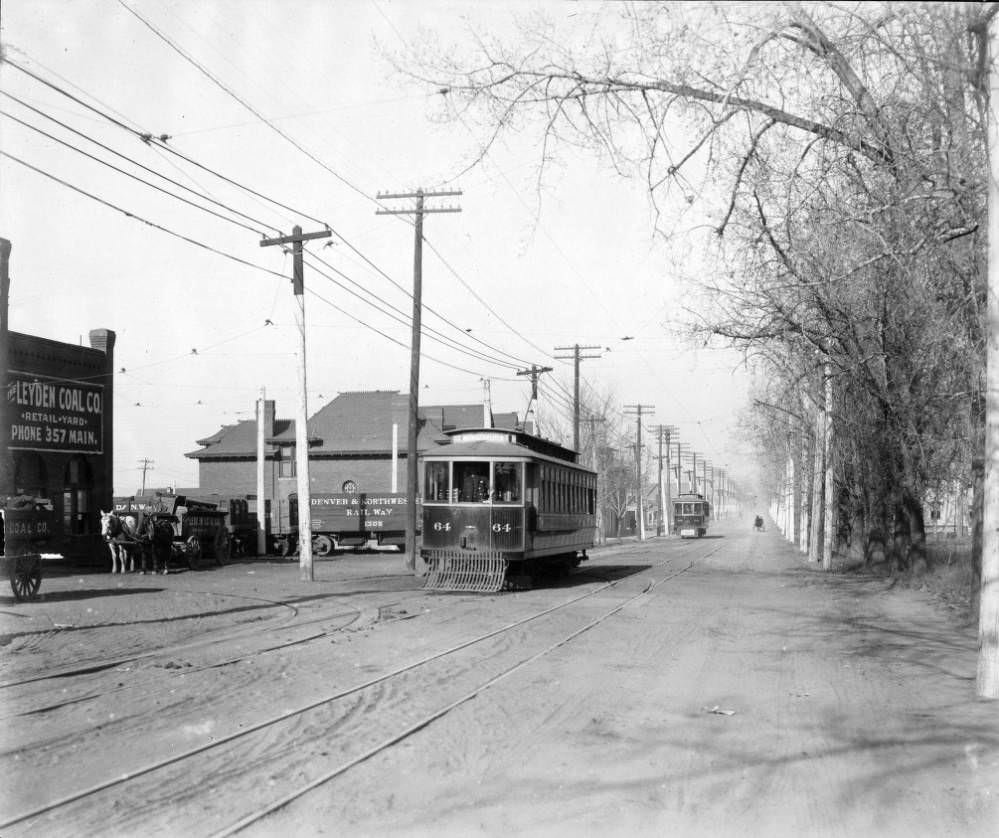
The intersection of 38th Avenue and Tennyson Street in the Berkeley neighborhood was a local commercial hub served by multiple Denver Tramway lines. The Leyden Coal Company sign visible in the photograph reflected the practical needs of a residential neighborhood that still relied on coal for home heating. Coal delivery was a seasonal business that peaked in late summer and fall as homeowners stocked up before winter. The tramway garage on 38th Avenue nearby, with its trolleys and drug store neighbors, created a small commercial cluster around the transit hub.
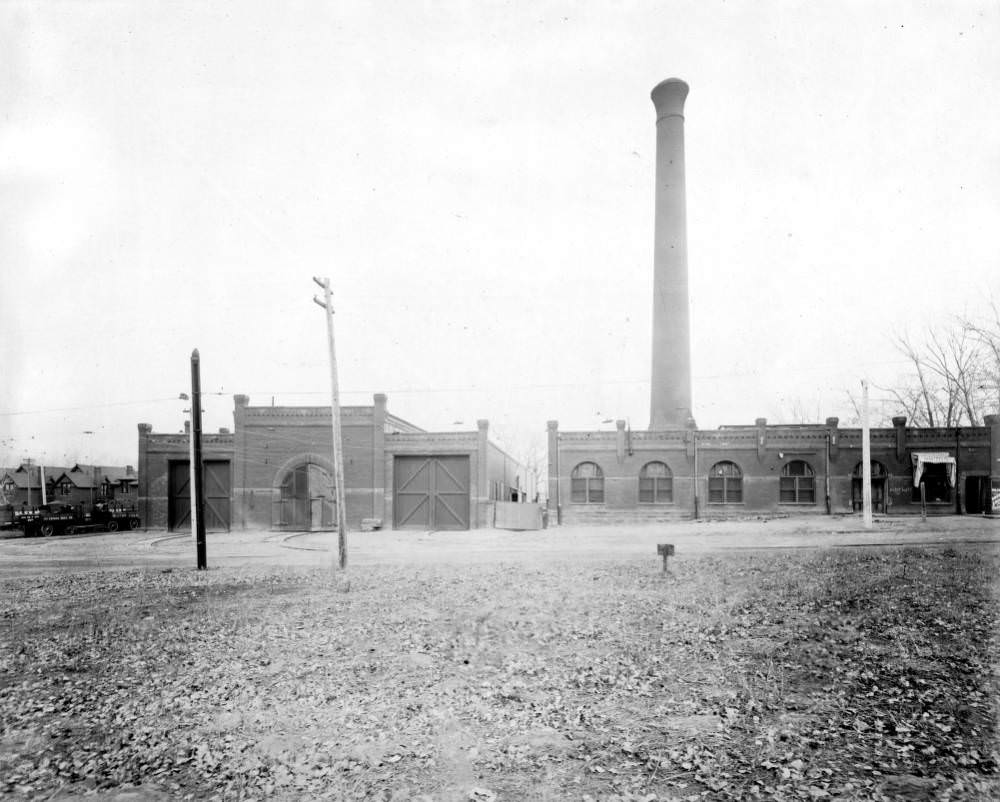
The Denver Tramway garage on 38th Avenue sat alongside the Leyden Coal Company and Wilcox Drug Store in a commercial strip that served Berkeley neighborhood residents. Drug stores in the early 1900s functioned as pharmacies, soda fountains, and general convenience stores, selling everything from prescription medicine to candy. Their placement next to transit facilities was deliberate — trolley stops generated foot traffic, and foot traffic sustained small retailers. The combination of a tramway garage, a coal yard, and a drug store on a single block captured the practical commercial ecology of a working-class Denver neighborhood.
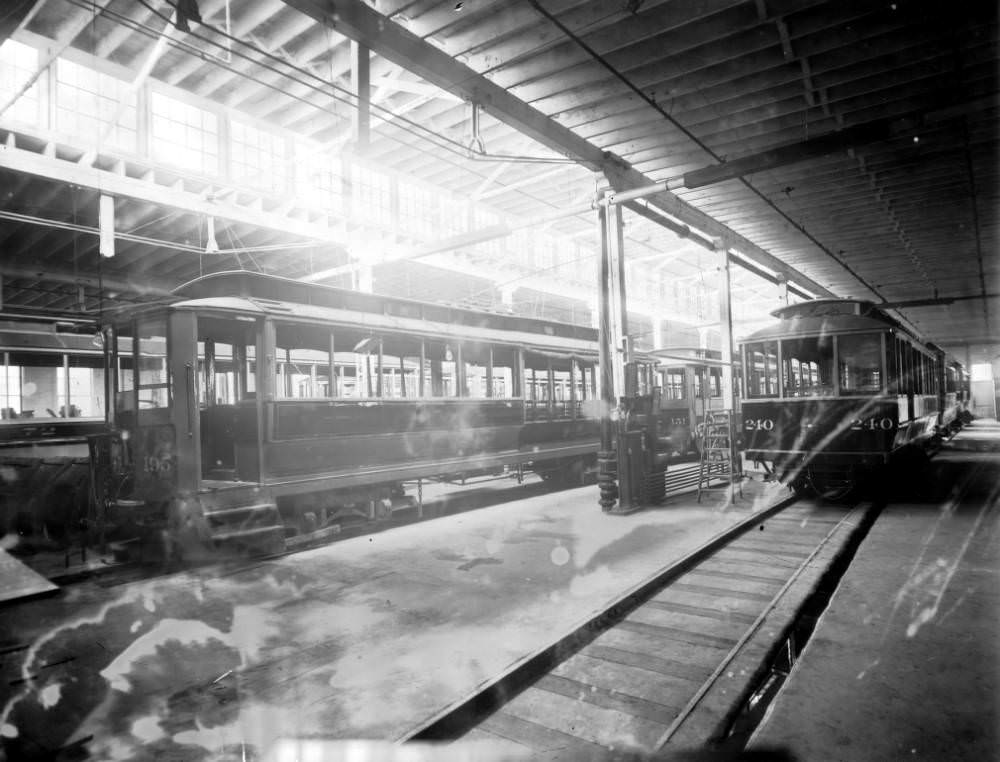
Inside the Denver Tramway Company garage on 4th Avenue, four trolleys sat in a row — cars 195, 151, 72, and 240 — waiting for their next run or undergoing maintenance. The interior of a working car barn was a busy, industrial environment. Pit inspections, wheel replacements, and electrical work all happened under the same roof, often simultaneously. The scale of the operation visible in this photograph gives a sense of just how many vehicles the tramway company maintained in service across the city at any given time.
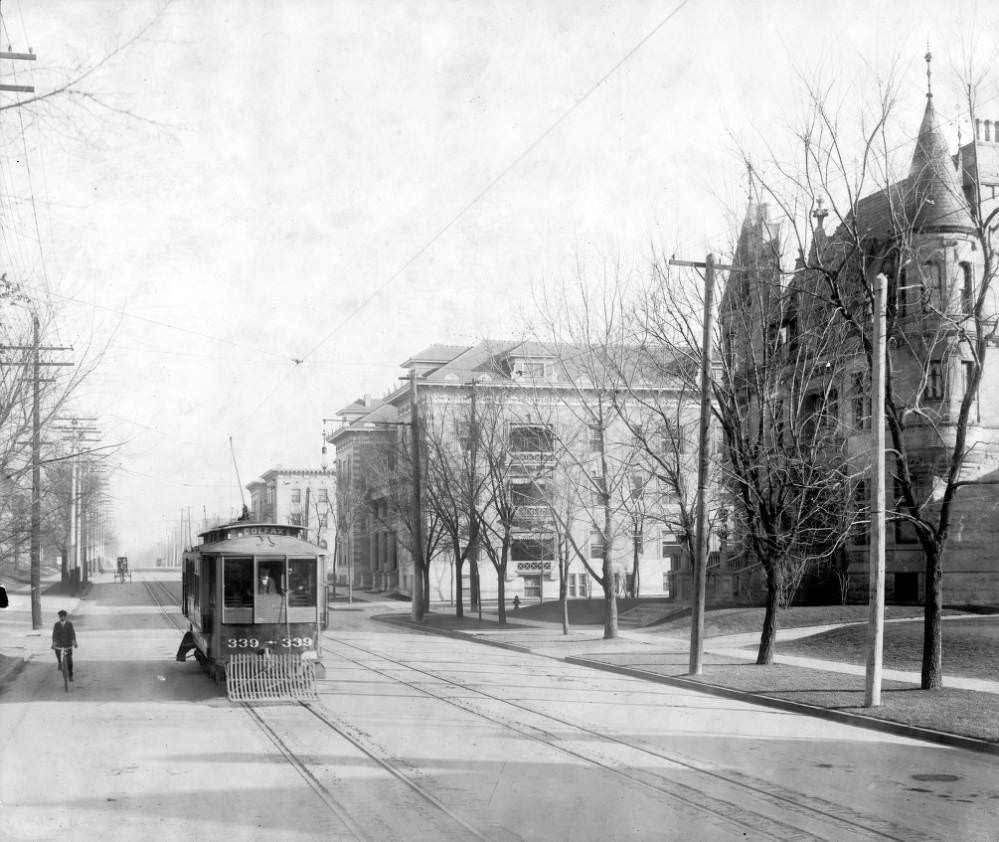
Colfax Avenue ran east from the State Capitol through a mix of residential and commercial territory. Near the Lawrence C. Phipps home, the street took on a more affluent character — Phipps was one of Colorado’s wealthiest men, having made his fortune in the Carnegie Steel Company before moving to Denver. DTC trolley 339 on Colfax connected the wealthy residential stretches of the avenue to the downtown and the neighborhoods to the east, carrying both domestic workers heading to wealthy homes and the occasional resident of those homes running errands in the city.
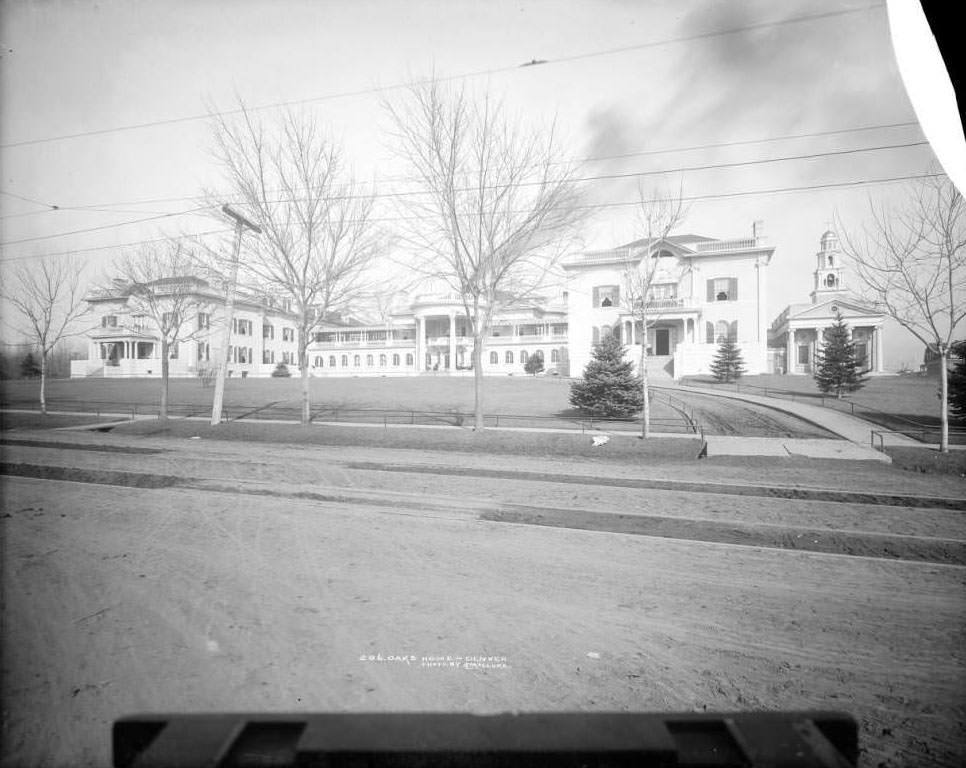
The Oakes Home on West 32nd Avenue, opened in September 1895, was an institution for tuberculosis patients in Denver. The dry Colorado climate attracted thousands of consumptives — people suffering from tuberculosis — who came hoping the mountain air would improve their condition. The Oakes Home provided residential care for patients who needed a structured environment while undergoing treatment. It sat in the Highlands neighborhood, a relatively elevated and breezy part of the city that was considered particularly suitable for respiratory patients.
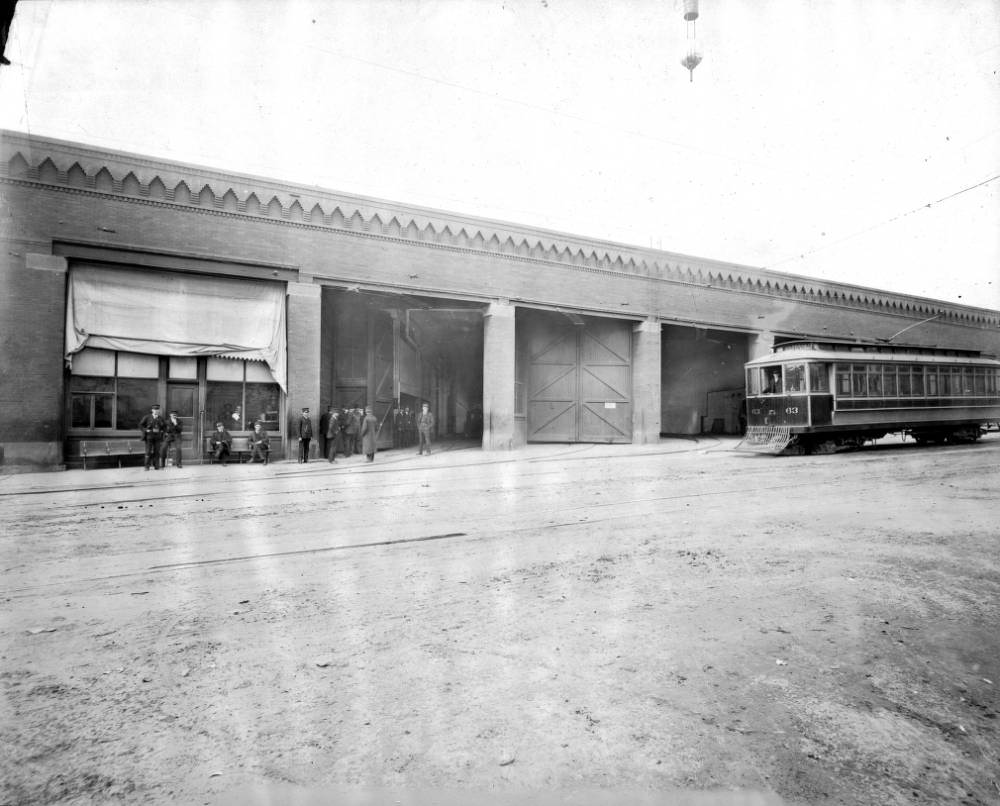
Trolley No. 63 at the Denver Tramway Company garage on 30th Avenue was one of the cars photographed at West 38th Avenue and Tennyson Street in 1900, appearing again here five years later in its home garage. The continuity of specific car numbers across multiple photographs gives a sense of the lifespan of individual vehicles in the tramway fleet. Cars were built to last and were repaired repeatedly before being retired, and a car like No. 63 could serve the same routes for a decade or more before being scrapped or significantly rebuilt.
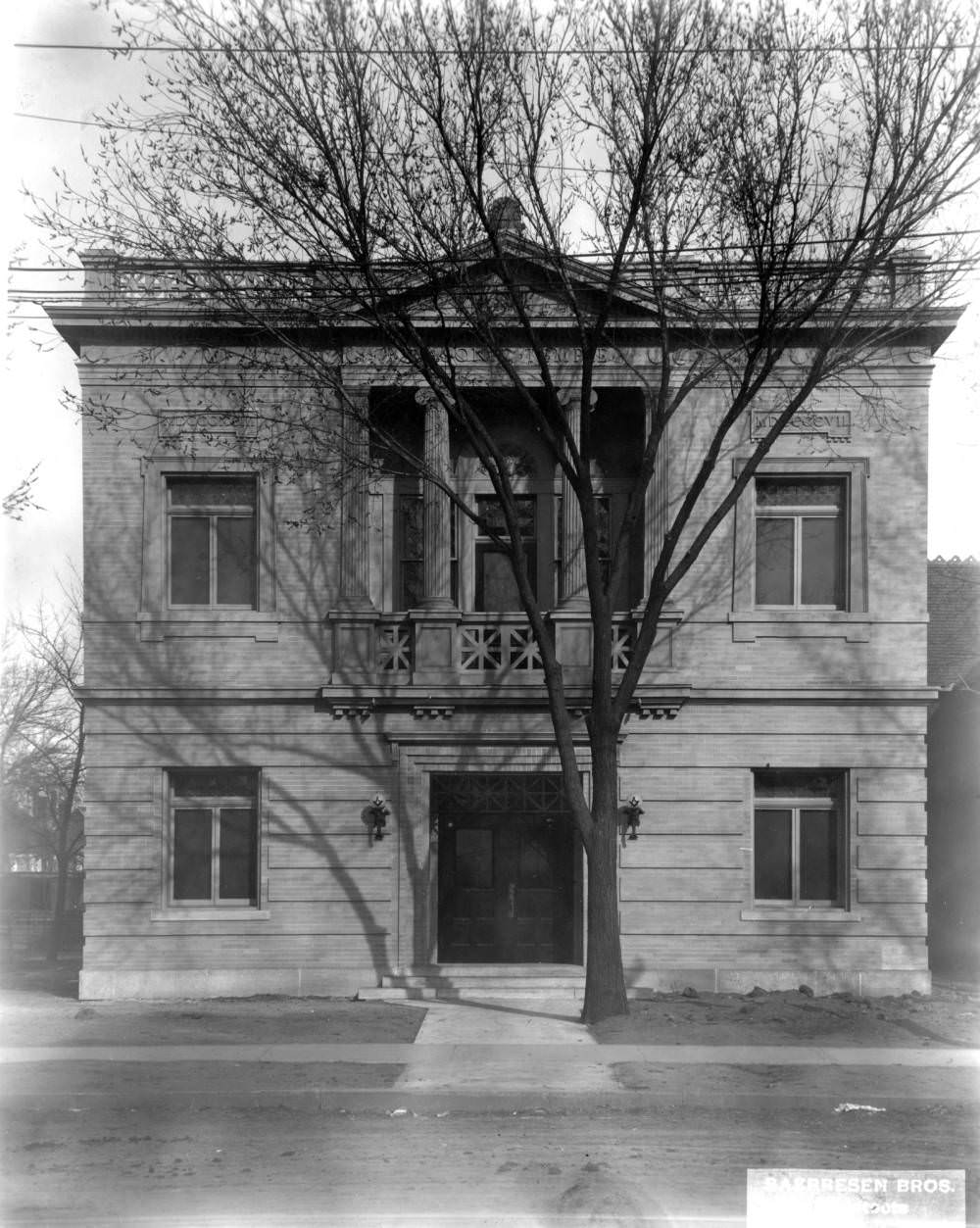
Masonic lodges were prominent civic institutions in early 1900s Denver. South Denver Lodge Number 93’s temple, photographed in 1907, was a meeting place for businessmen, professionals, and civic leaders who shared fraternal bonds and used their organization to network and support each other. Freemasonry was widespread in Colorado, with lodges in nearly every town of any size. The Denver lodges were among the largest in the state, and their members included many of the city’s most influential figures in commerce, law, and politics.
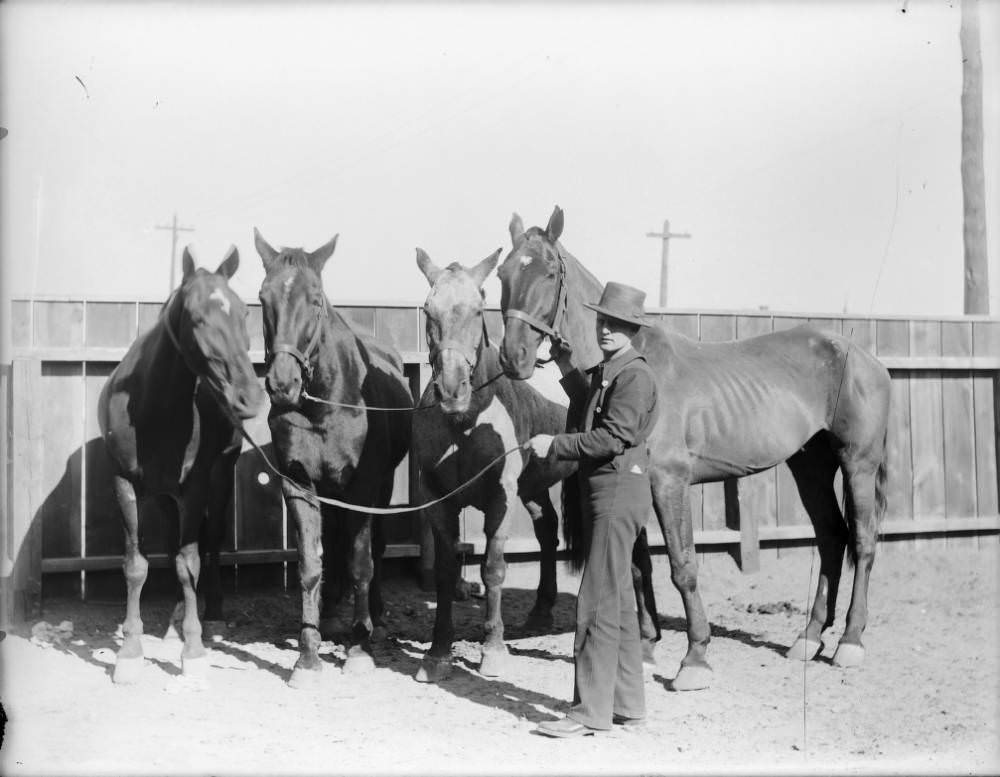
Denver’s fire department horses were as much a part of the city’s identity as the firefighters themselves. Trained to respond instantly to the alarm bell, the horses could be harnessed and on the move within seconds. Fire horses were well cared for and often became community figures in their neighborhoods. The transition to motorized fire equipment was underway in the early 1900s, and the department’s horses would be phased out over the following decade — but in the early 1900s, they remained the fastest available response technology for a fire call.
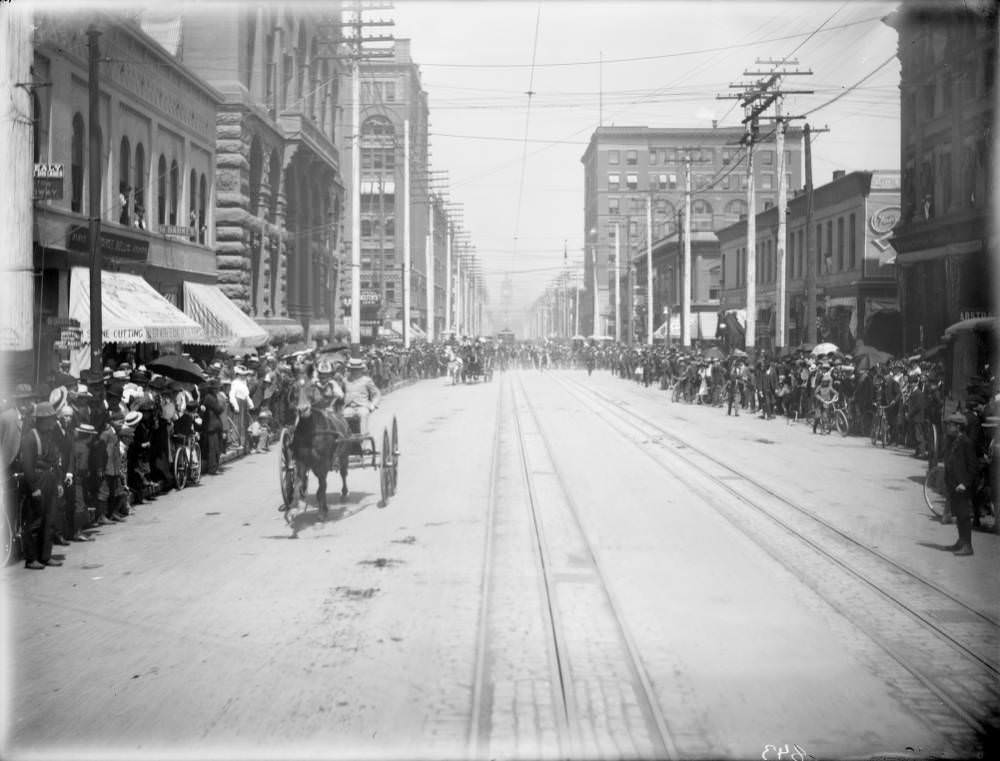
In 1902, a film crew staged a “Fireman’s Race For Life” on 16th Street, using Denver’s actual fire department equipment and personnel to create a dramatic film short. Early cinema frequently staged action sequences in real urban settings, and Denver’s fire department was willing participants in the production. The filming on 16th Street drew crowds of onlookers who watched the horses gallop past and the cameras capture the scene. The event was an early intersection of Denver’s public life with the emerging medium of motion pictures.
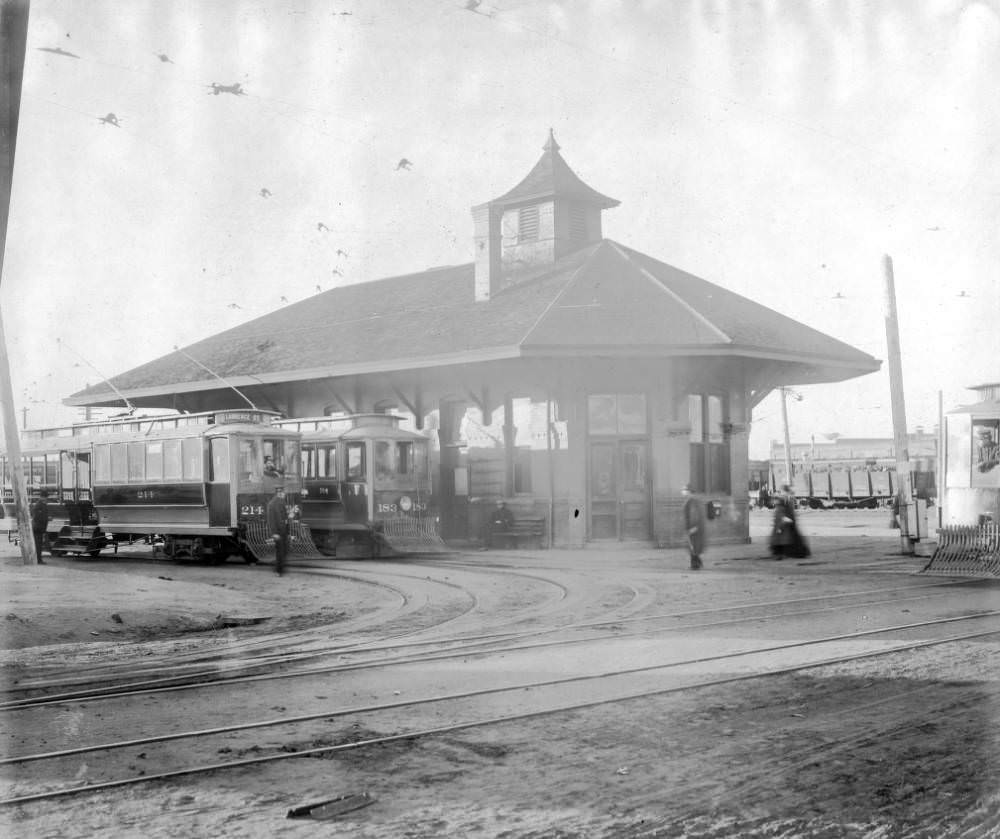
An unidentified Denver Tramway station photographed in 1905 shows two trolleys — Lawrence Street No. 214 and Larimer Street No. 183 — at the platform simultaneously. The Lawrence Street and Larimer Street routes both ran through the heart of Denver’s older commercial districts, serving the warehouses, saloons, and small businesses that had made up the city’s original commercial core. By 1905, these streets were less fashionable than 16th and 17th, but they remained busy transit corridors serving the neighborhoods and businesses along their routes.
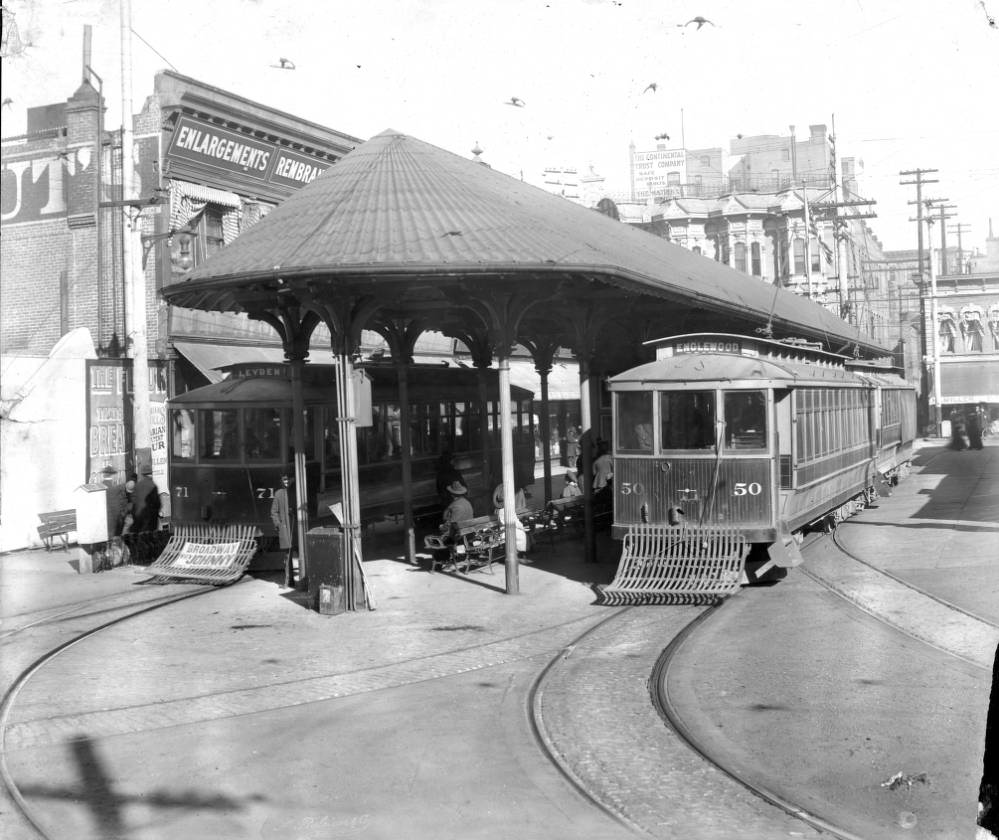
The 15th Street stop between Arapahoe and Lawrence was a mid-block stopping point in the dense commercial core of downtown Denver. Multiple trolleys used the stop in close sequence during peak hours, and the sheltered platform gave riders a place to wait without standing directly in the street. The density of the transit network in this block — with routes crossing and overlapping in every direction — made downtown Denver genuinely navigable by public transit, a characteristic that the city would not be able to replicate by automobile for another half century.
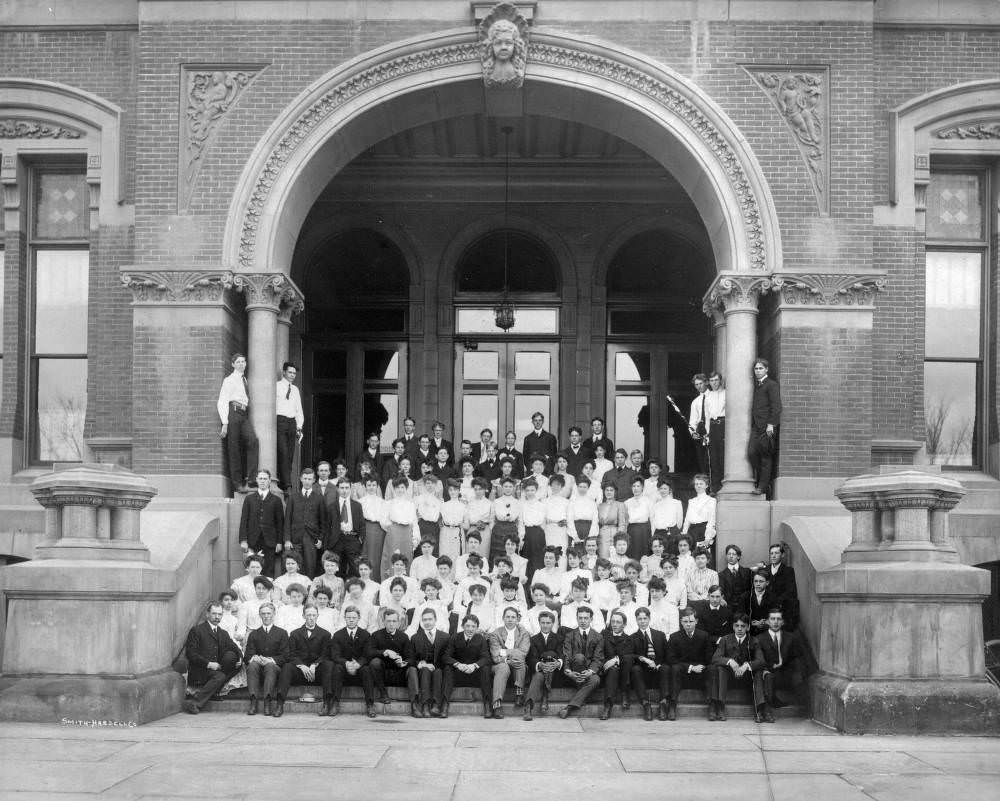
Students gathered outside East Denver High School for photographs that documented their time at the school. The building’s Victorian Gothic facade provided an imposing backdrop that conveyed the seriousness of the educational enterprise. East Denver served students from a range of backgrounds — the children of professionals and shopkeepers, of recent immigrants and established families. Denver’s public high schools were among the better-funded in the region, and their graduates competed successfully for university places and professional positions across the country.
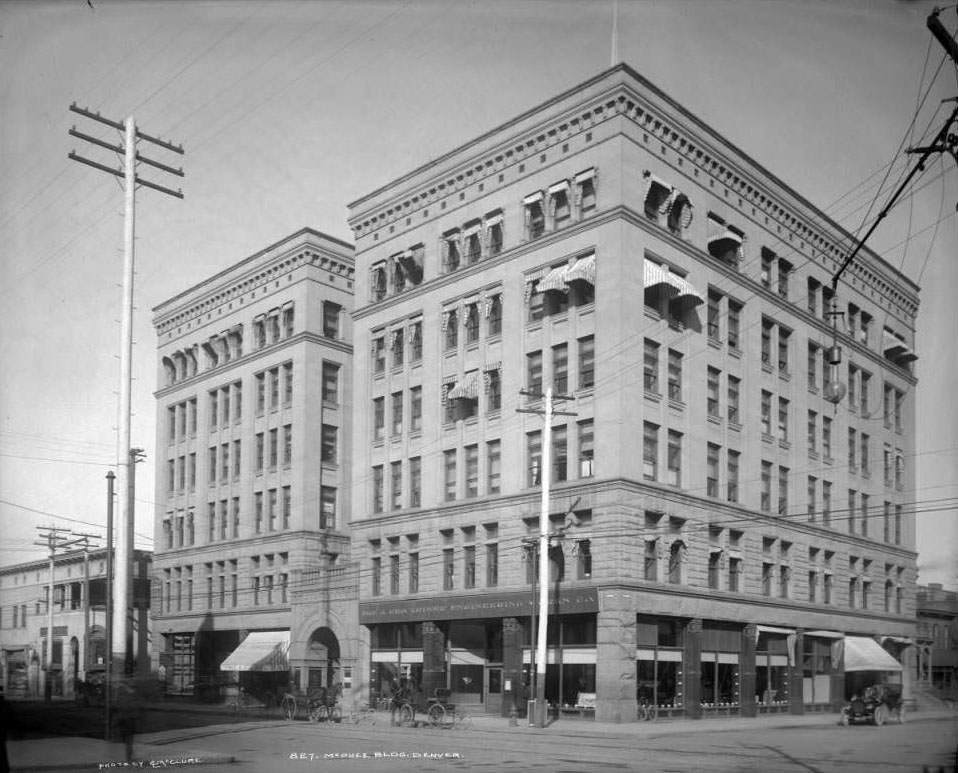
Early automobiles parked outside the McPhee Building at 17th and Glenarm in 1906 were still enough of a novelty to be worth noting in a photograph. The McPhee Building was a commercial office structure in the heart of Denver’s financial district, and the cars parked outside it belonged to the wealthier professionals and businessmen who occupied its offices. By 1906, Denver had enough automobiles on its streets that the city was beginning to discuss regulations, and automobile clubs were organizing to advocate for better roads and infrastructure.
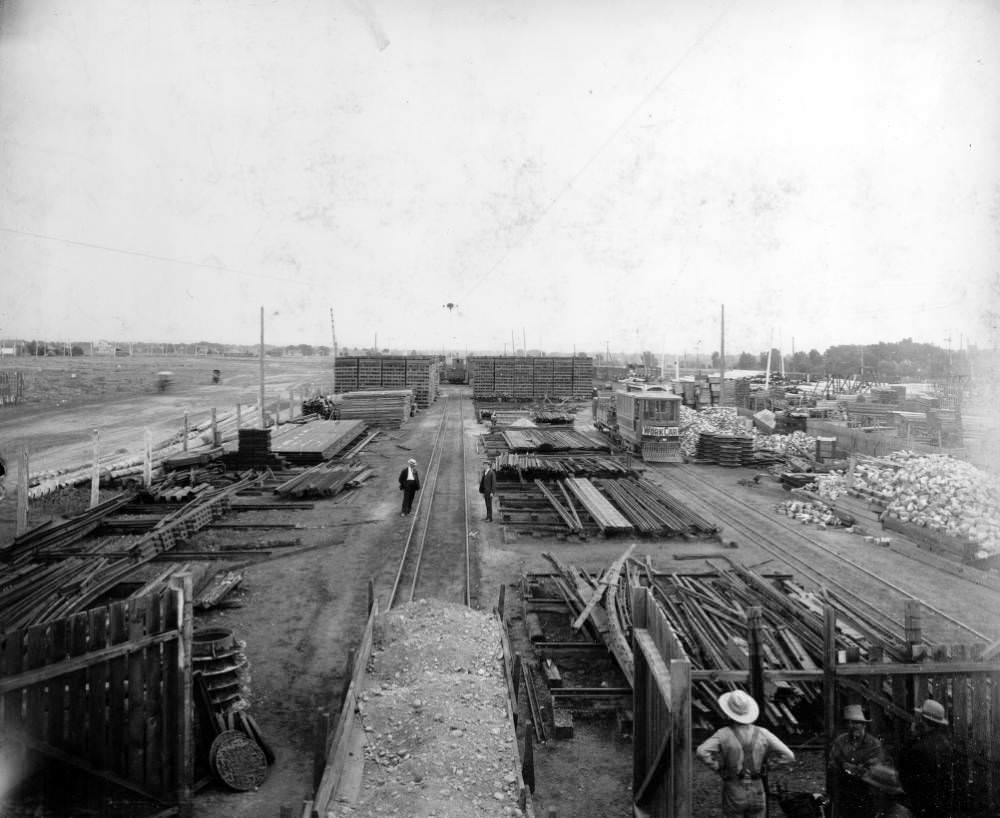
Steel tracks stacked in the Denver Tramway Company’s supply yard represented the raw material for expanding the city’s transit network. Laying new track required coordinating the delivery of steel rail, wooden ties, electrical hardware, and labor into a complex construction process that could disrupt traffic for days or weeks at a time. The tramway company managed its supply chain carefully, stockpiling materials at yards like this one so that construction projects could proceed without delays caused by shortages. The expansion of the network was a continuous process throughout the early 1900s.
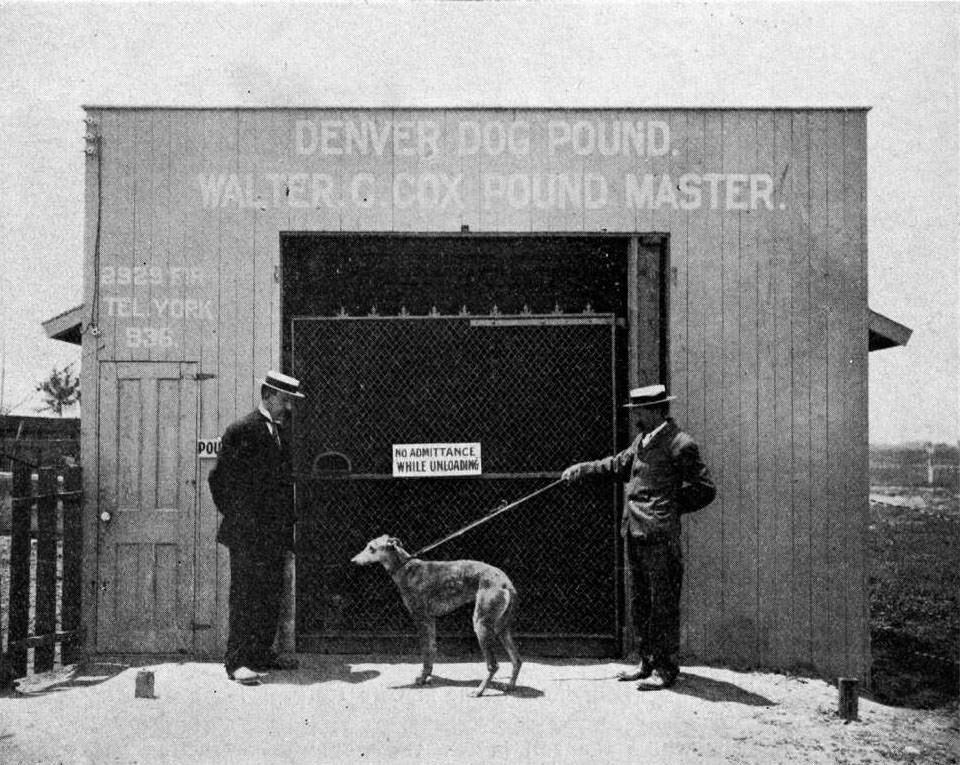
The Denver Dog Pound in 1909 was a municipal facility that reflected the city’s growing investment in animal control as a public health measure. Stray dogs were a genuine problem in urban Denver — they created nuisances, spread disease, and occasionally posed dangers to residents. City officials posed with a dog outside the facility in a photograph that served as documentation of the department’s existence and operations. Animal control was one of dozens of new municipal services that Denver was developing in this period as it built out the apparatus of modern city government.
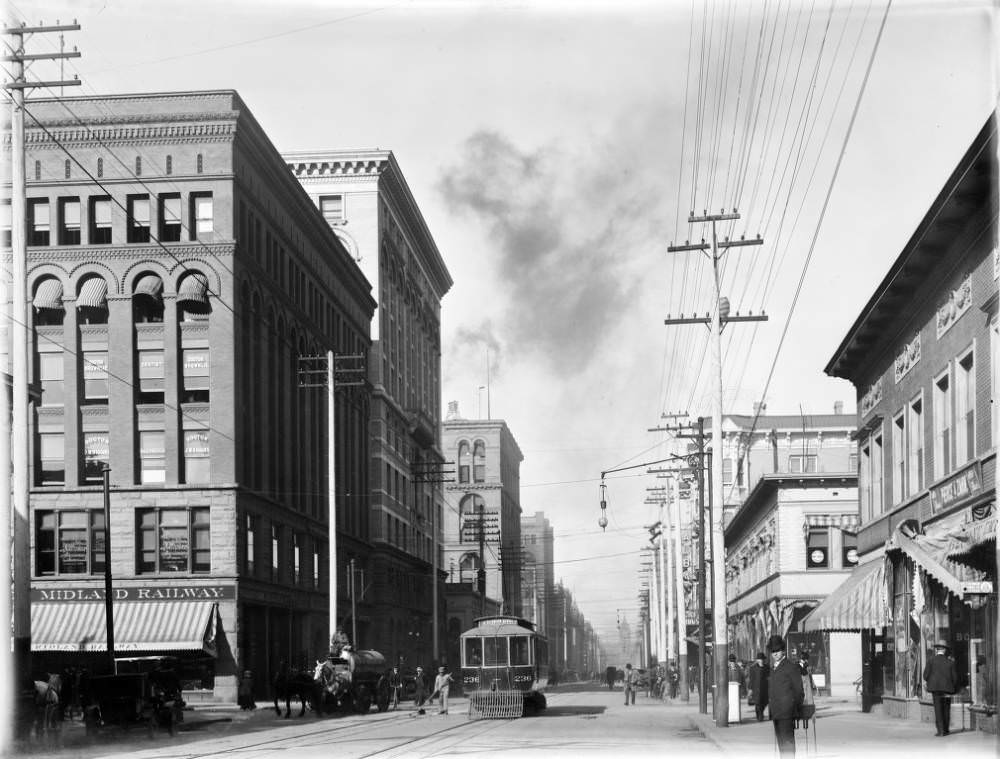
Denver City Tramway car 236 on 17th Street moved through the financial district at a pace dictated by the traffic around it — both the other trolleys sharing the track and the pedestrians, horses, and automobiles competing for the same road space. 17th Street’s trolley line was one of the most important in the system, connecting Union Station to the business district and to the residential neighborhoods of Capitol Hill and beyond. Car 236’s route represented the invisible logic of the city — the flow of workers, shoppers, and visitors that kept Denver’s economy functioning.
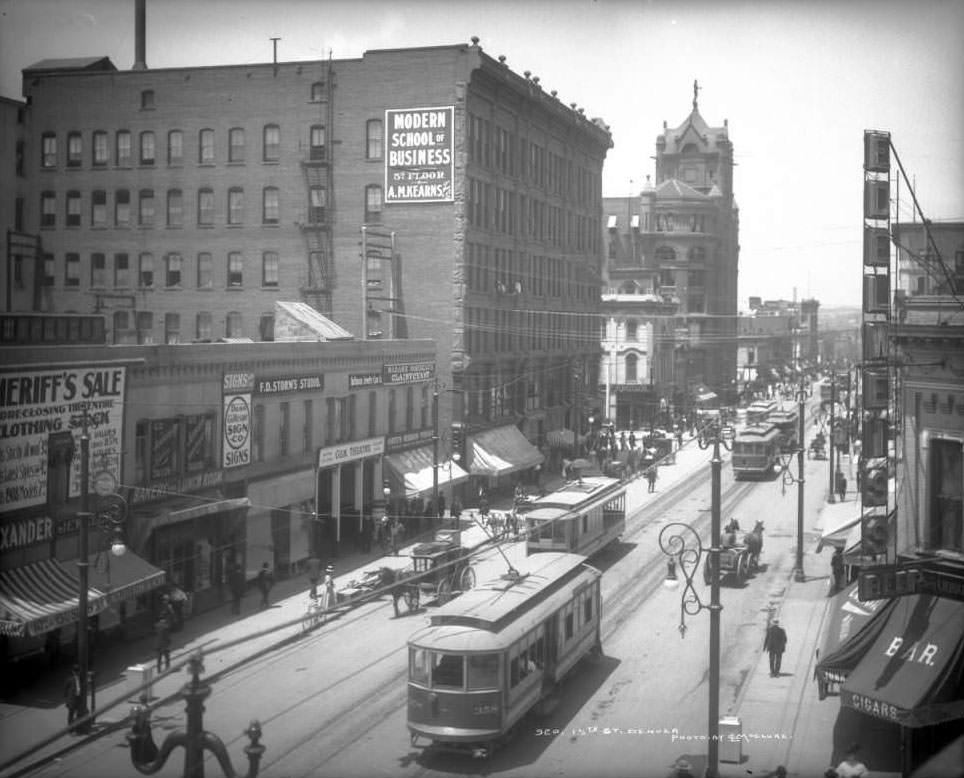
Car 358 on a busy 15th Street in 1908 operated in conditions that were noticeably more crowded than the same street just five years earlier. Denver’s population had grown substantially between 1900 and 1910, and the increase in ridership was visible in the number of passengers waiting at stops and the frequency of service on busy routes. The tramway company expanded its fleet and added cars throughout this period to keep pace with demand, but capacity remained a challenge on the most popular corridors during morning and evening rush hours.
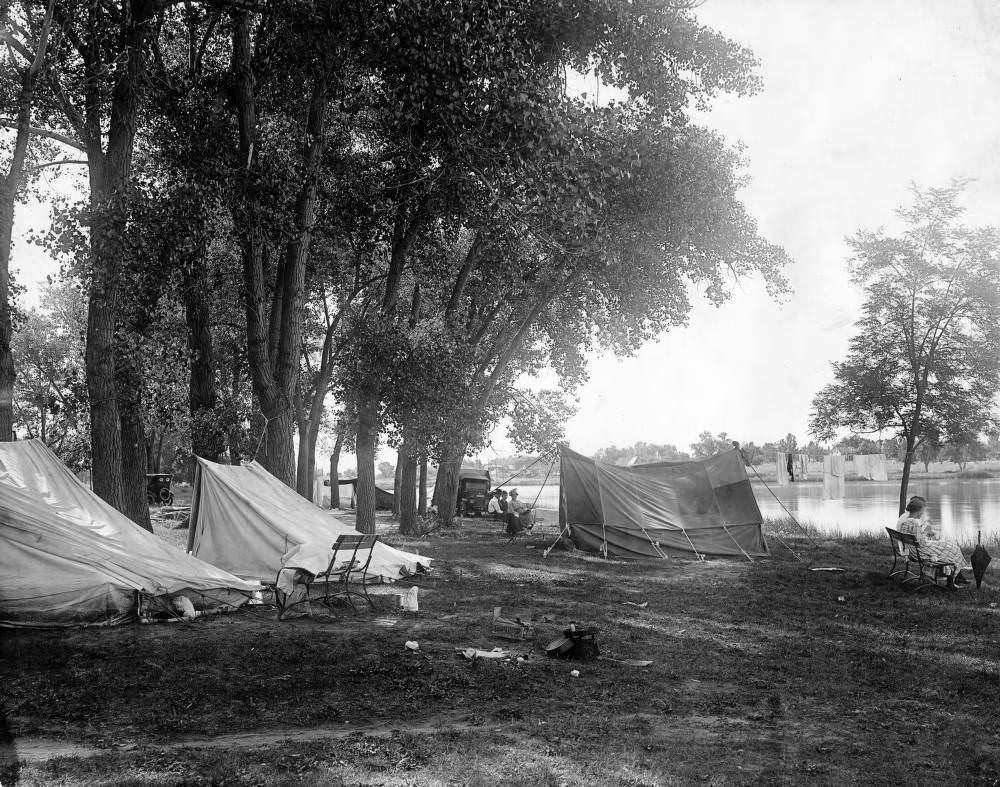
Rocky Mountain Lake in the Berkeley neighborhood offered a camping experience within the city limits. Families set up campsites at the lake’s edge, enjoying an outdoor experience without traveling to the mountains. The availability of camping at Rocky Mountain Lake reflected Denver’s unusual geography — a major city within easy reach of genuine wilderness, but also equipped with natural features within its own boundaries that allowed residents to experience outdoor life without leaving the urban area. The Berkeley neighborhood’s lake was just one of several such features that made Denver distinctive among American cities of comparable size.
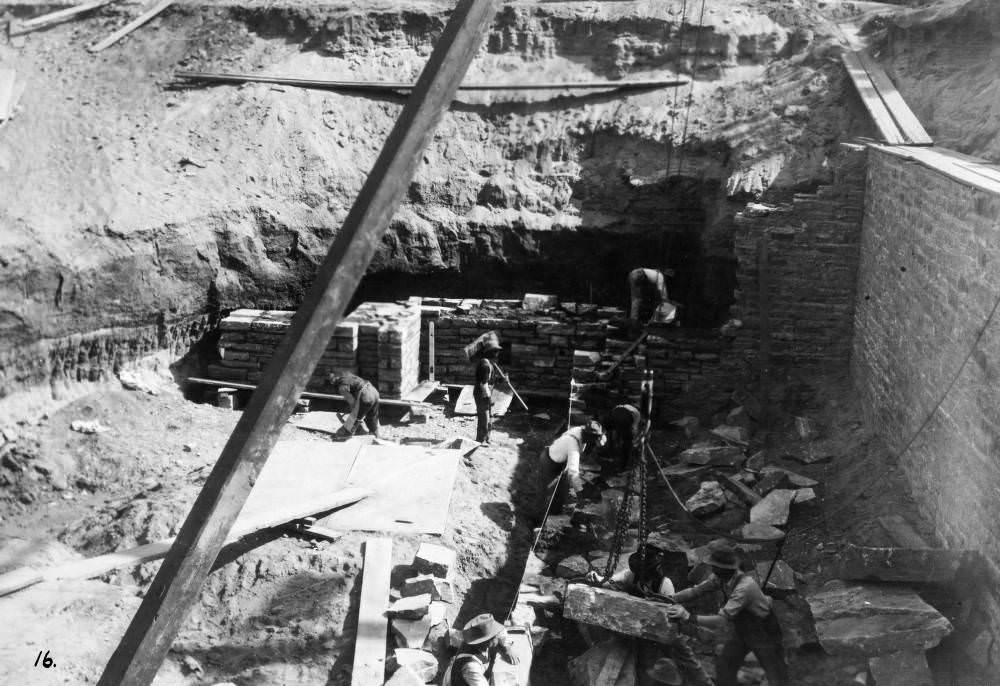
Construction on the Denver Public Library in 1906 showed the building at an early stage, with foundation work and initial masonry underway. The Civic Center neighborhood surrounding the site was still a mix of residential properties and open land that would eventually be cleared for the formal civic campus. The library was the first major building in what would become a carefully planned civic precinct, and its construction marked the beginning of a decades-long transformation of the area around the State Capitol into Denver’s ceremonial and governmental heart.
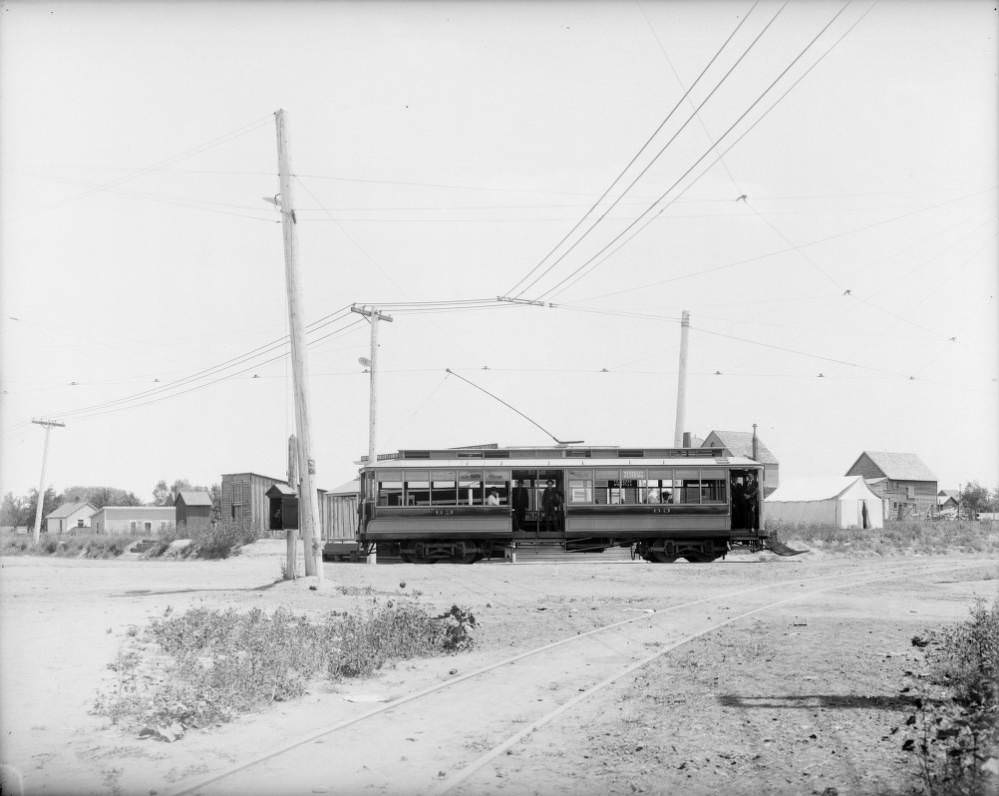
Car 63 at the Berkeley Loop terminus was one of the endpoints of the Denver Tramway system in the Berkeley neighborhood. Terminal loops allowed trolleys to reverse direction without a complicated turning maneuver, and the Berkeley Loop served as the northern endpoint for routes coming up from the downtown. Riders from the Berkeley neighborhood boarded here for the ride into the city center, and returning residents got off and walked the final blocks to their homes. The loop was a social gathering point as well as a transit facility — a place where neighbors encountered each other at the start and end of the day.
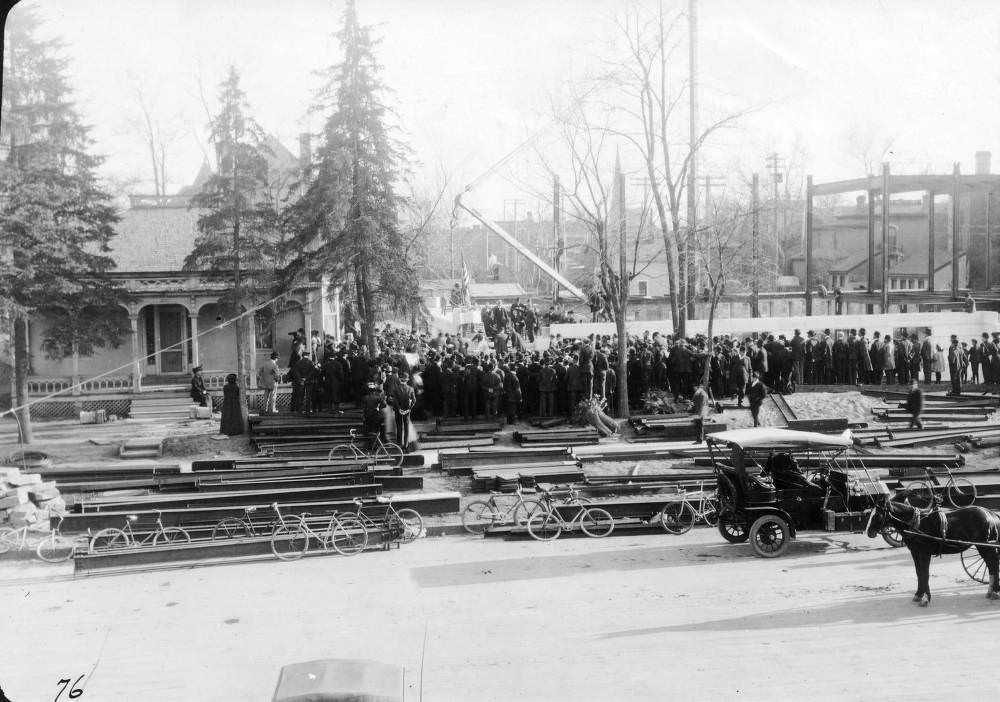
The cornerstone ceremony at the Denver Public Library in 1907 was a public event that brought together political leaders, religious figures, and ordinary citizens to mark a milestone in the city’s civic development. Ceremonies like this one served important social functions in the early 1900s — they created shared memories and reinforced the sense that civic institutions belonged to everyone, not just the officials who administered them. The library cornerstone joined a tradition of similar ceremonies at Denver’s schools, churches, and public buildings that stretched back to the city’s earliest years.
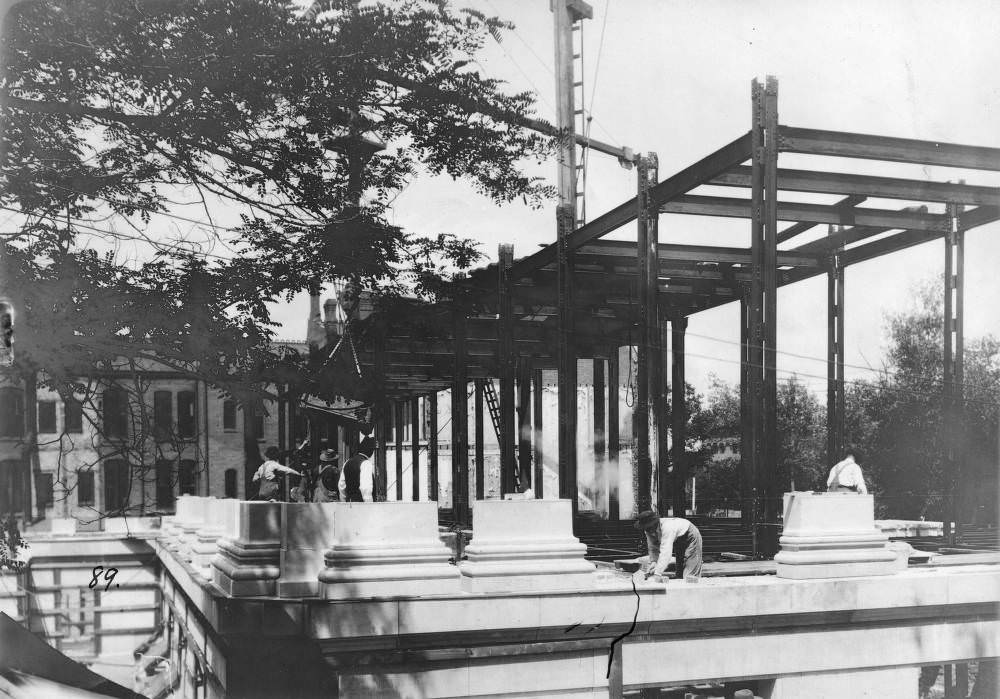
The northeastern corner of the Denver Public Library under construction in 1907 showed the building’s classical proportions beginning to emerge from the scaffolding and construction debris. Stone courses were laid with precision, and the architectural details that would define the building’s exterior were being carved and set into place. The construction workforce included skilled stonemasons and carpenters whose craft was visible in every finished surface. The library’s construction was a prolonged community event — photographed repeatedly, discussed in the newspapers, and watched by Denverites who passed the site on their daily routes.
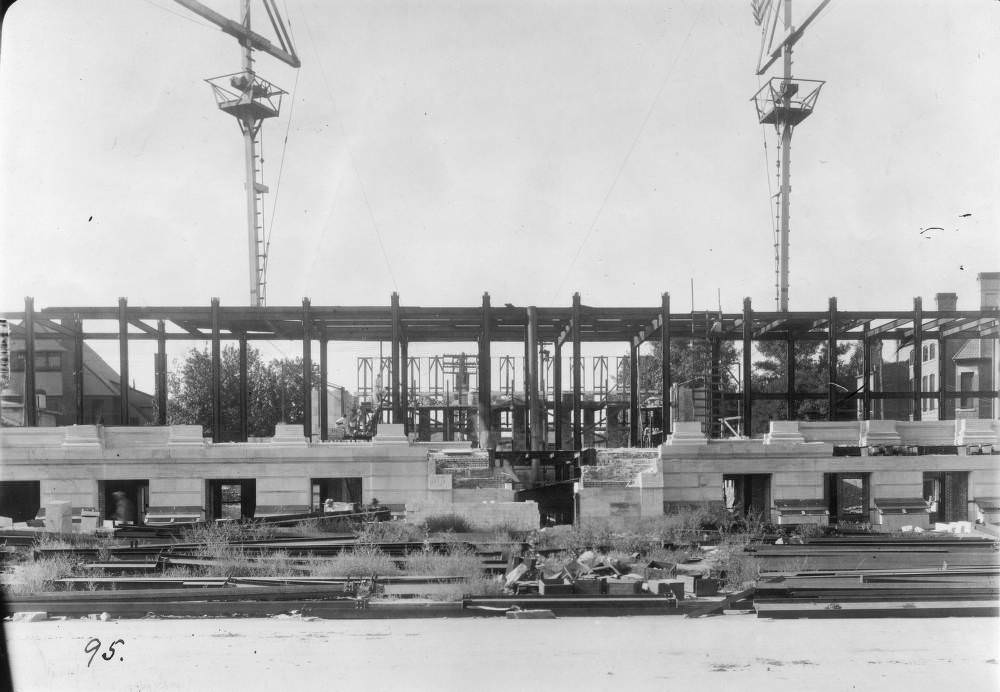
A wider view of the Denver Public Library construction in 1907 showed the building in the context of the Civic Center neighborhood. The surrounding streets, the modest houses nearby, and the open land that would eventually be transformed into formal parkways and civic grounds were all visible. The library was being built on the edge of a neighborhood that was itself in transition, and the photographs taken during its construction document that transition as clearly as they document the building itself. The Civic Center that emerged over the following two decades would look nothing like what surrounded the library in 1907.
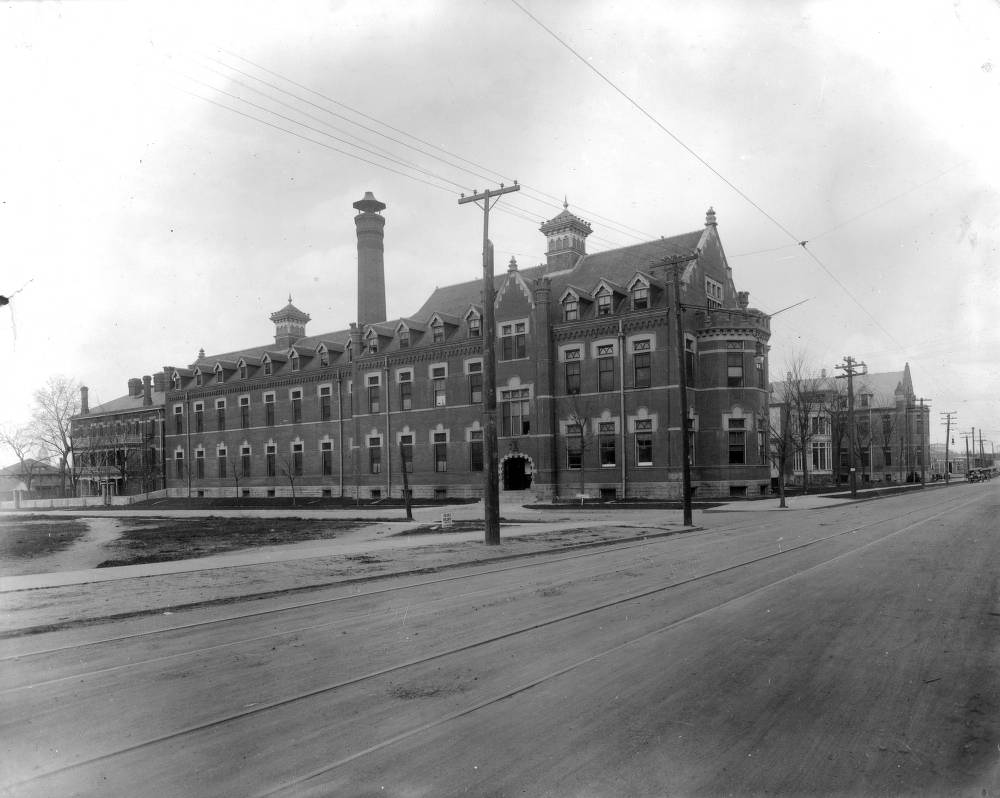
Denver General Hospital included a Home for Nurses on its grounds, providing residential accommodations for the nursing staff who worked in the wards. Nursing in the early 1900s was a residential profession — nurses often lived at the hospital, eating their meals there and being available for shifts at short notice. The profession was almost entirely female and required both formal training and a willingness to live under institutional conditions. Denver General’s nursing staff cared for the city’s poorest patients, handling everything from routine illnesses to trauma cases and infectious disease wards.
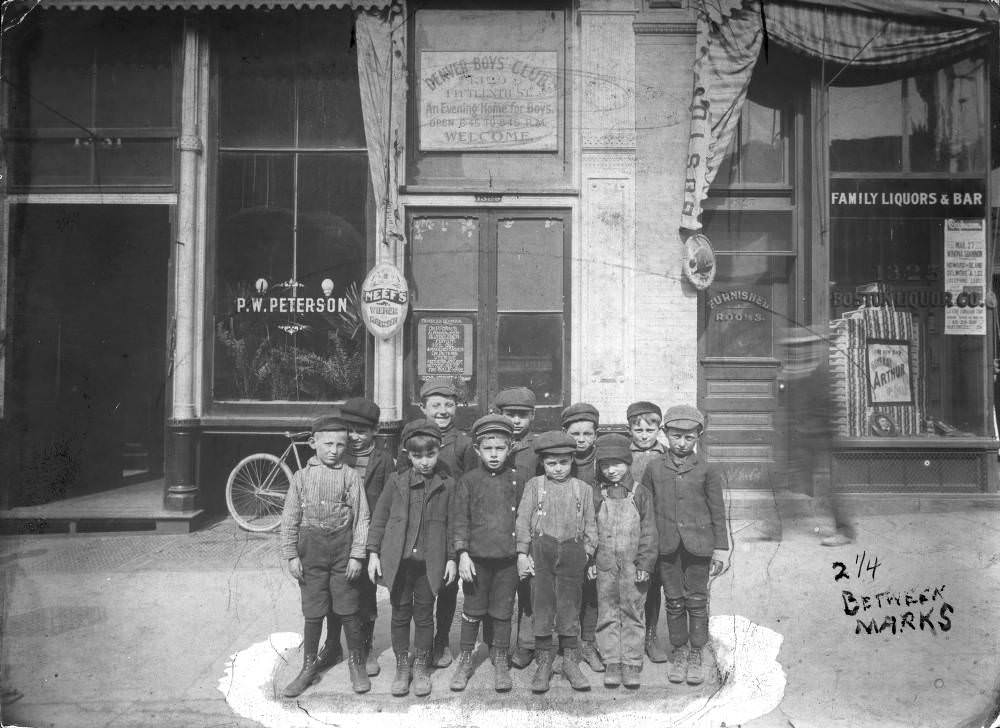
The Denver Boys Club offered working-class and poor boys a supervised alternative to street life. Boys gathered in front of a classroom that offered basic education, vocational training, and recreational activities designed to keep them engaged and out of trouble. The Boys Club movement was part of a broader national effort to address juvenile delinquency by providing structured programming for boys whose parents worked long hours and could not supervise them directly. Denver’s version served the city’s most economically vulnerable youth, many of them the sons of recent immigrants working in the city’s industrial economy.





Wow. These are really cool. I live in the Clements historical district and 2115 Glenarm is being restored. It was Denver’s first boarding house and I cannot wait to see the inside. I love our city. Thanks for sharing.
I would love for the welcome arch to come back!
Bring back the darn streetcars