Chicago in the 1910s was a city in constant motion. Its population was climbing fast, its streets were filling with new arrivals from different parts of the world, and its skyline was changing year by year. The decade brought extraordinary growth, but also deep conflict. Parades and protests, labor strikes and race riots, new buildings and new industries — all of it unfolded in a city that never slowed down.
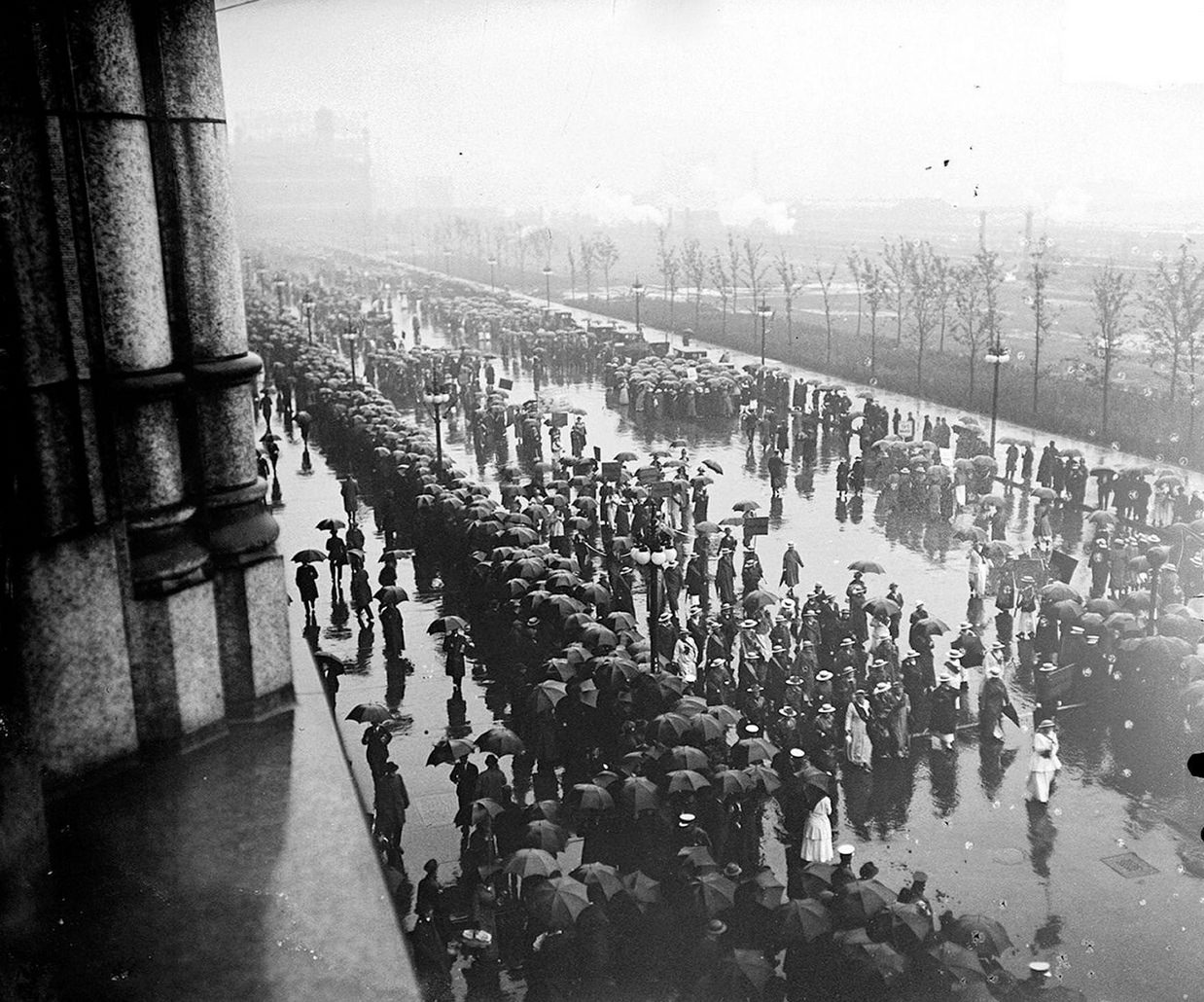
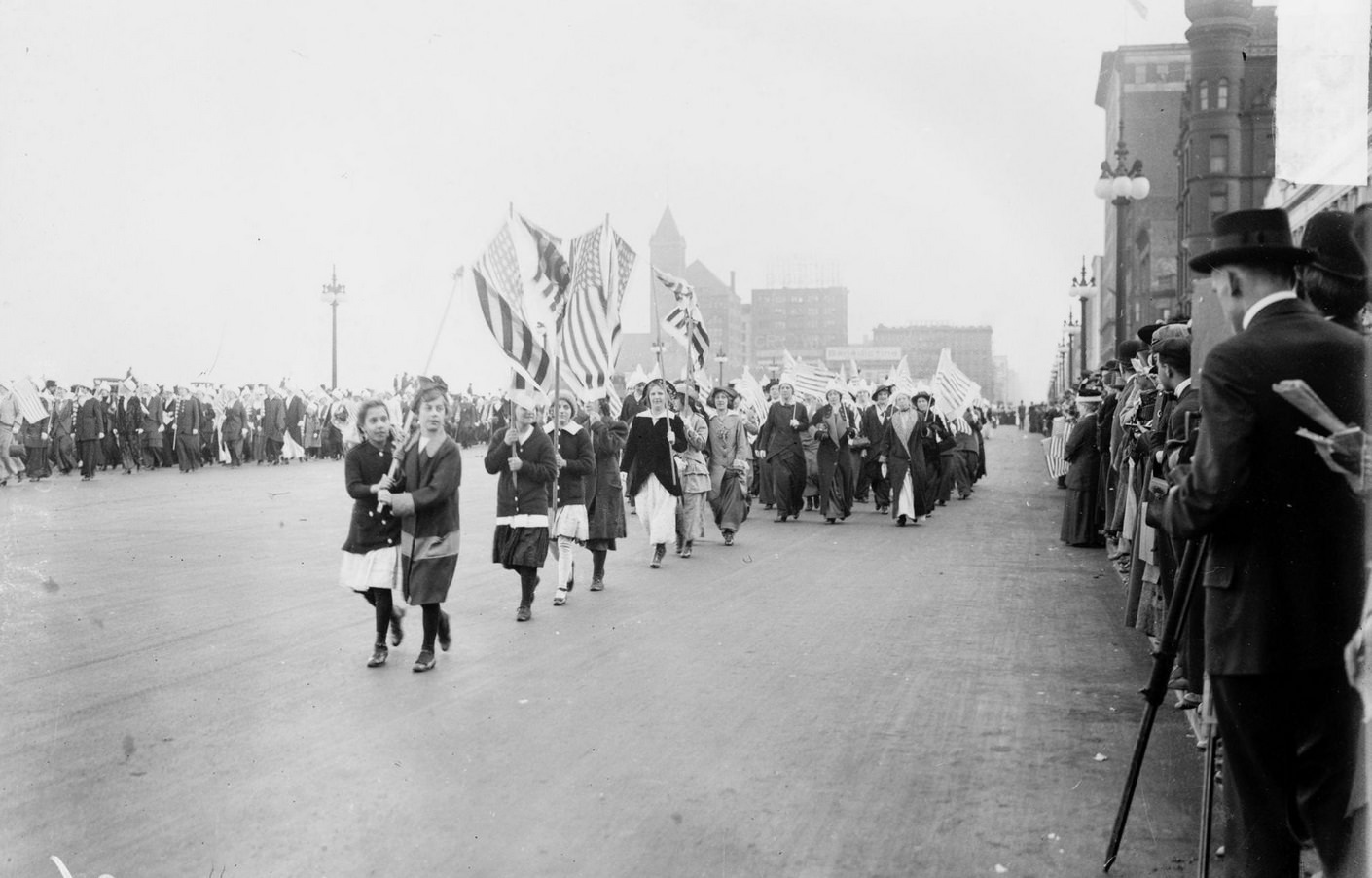
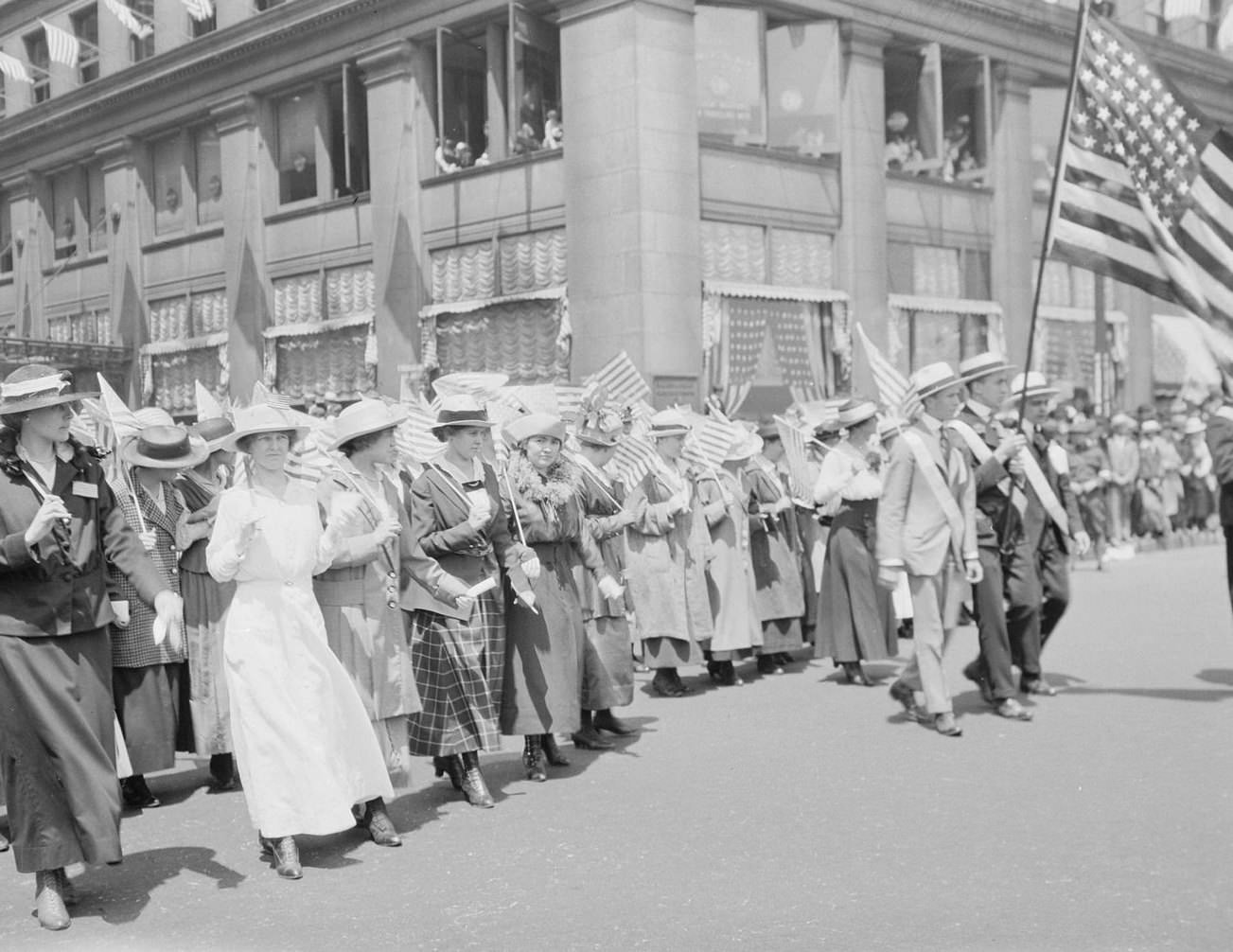
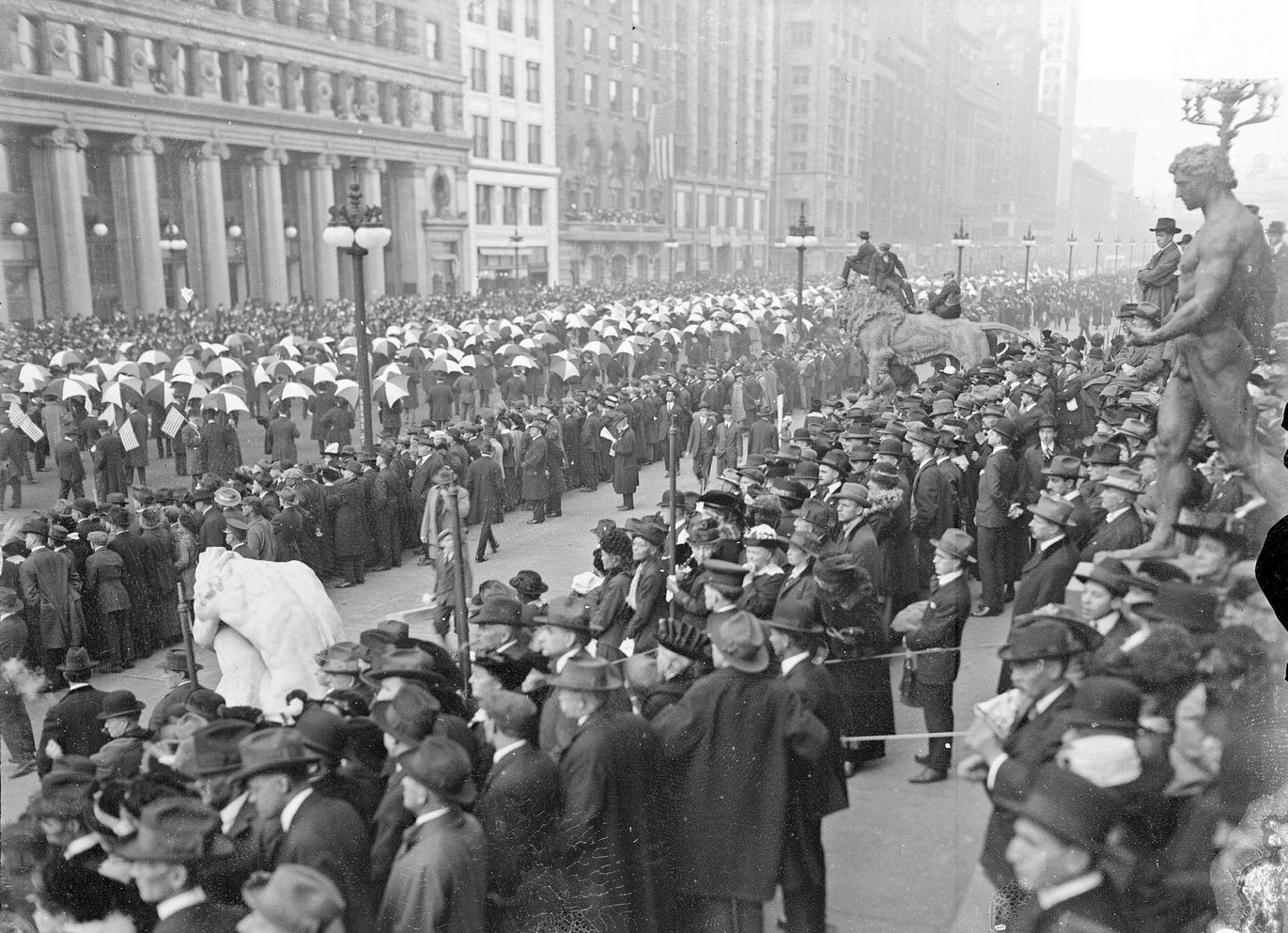
One of the most visible movements of the era was the fight for women’s suffrage. Women marched in large numbers along South Michigan Avenue, demanding the right to vote. These demonstrations drew crowds of spectators and were organized with real discipline — banners, flags, and marching formations filled the wide boulevard. The suffrage movement in Chicago was active and public, long before the 19th Amendment was ratified in 1920.
The suffrage parade, with spectators looking on in the rain, on South Michigan Avenue across from Grant Park in the Loop community area of Chicago, Illinois, 1910s.
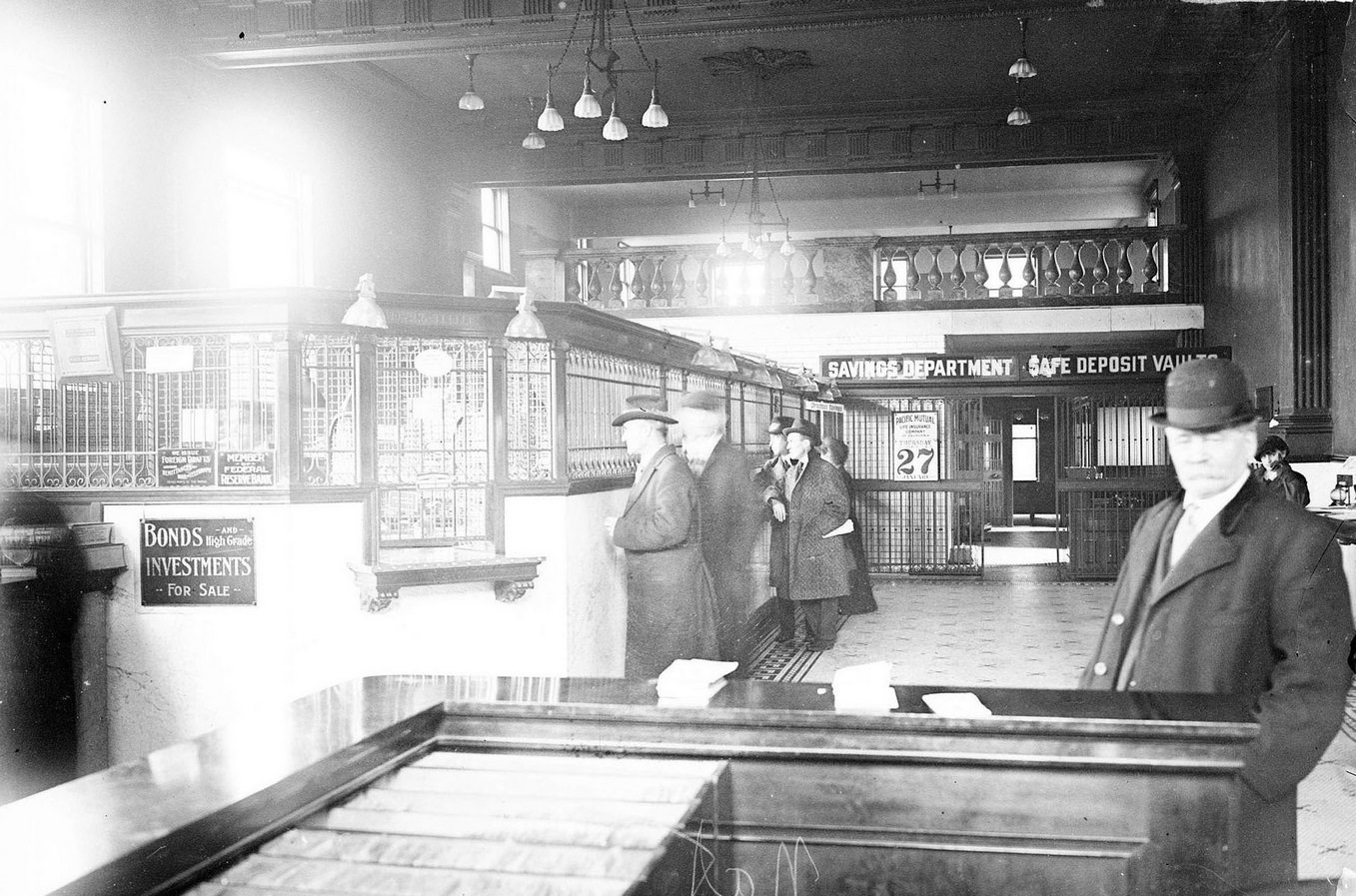
Chicago’s financial life hummed along even in neighborhoods far from the Loop. Banks like the Washington Park National Bank on East 63rd Street served communities on the South Side, offering a glimpse of the city’s commercial reach beyond downtown.
Interior view of Washington Park National Bank at 730 East 63rd Street in the Woodlawn community area of Chicago, Illinois, 1910s.
Cultural life in Chicago was rich and varied. The Chicago Conservatory drew musicians and music lovers alike, while institutions like the Field Museum of Natural History were still being built. Construction on the Field Museum’s new building began in 1915, marking a major investment in the city’s public cultural life.
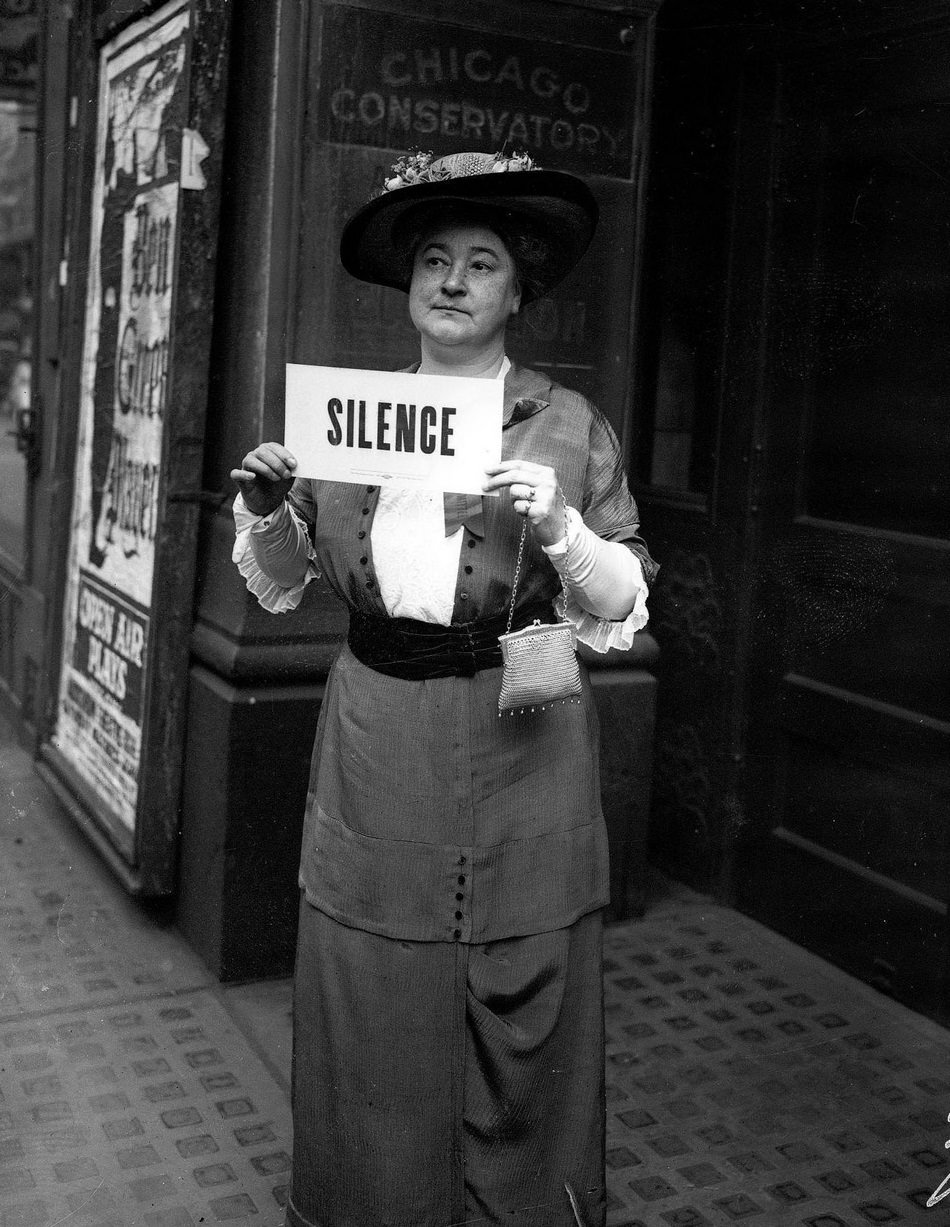
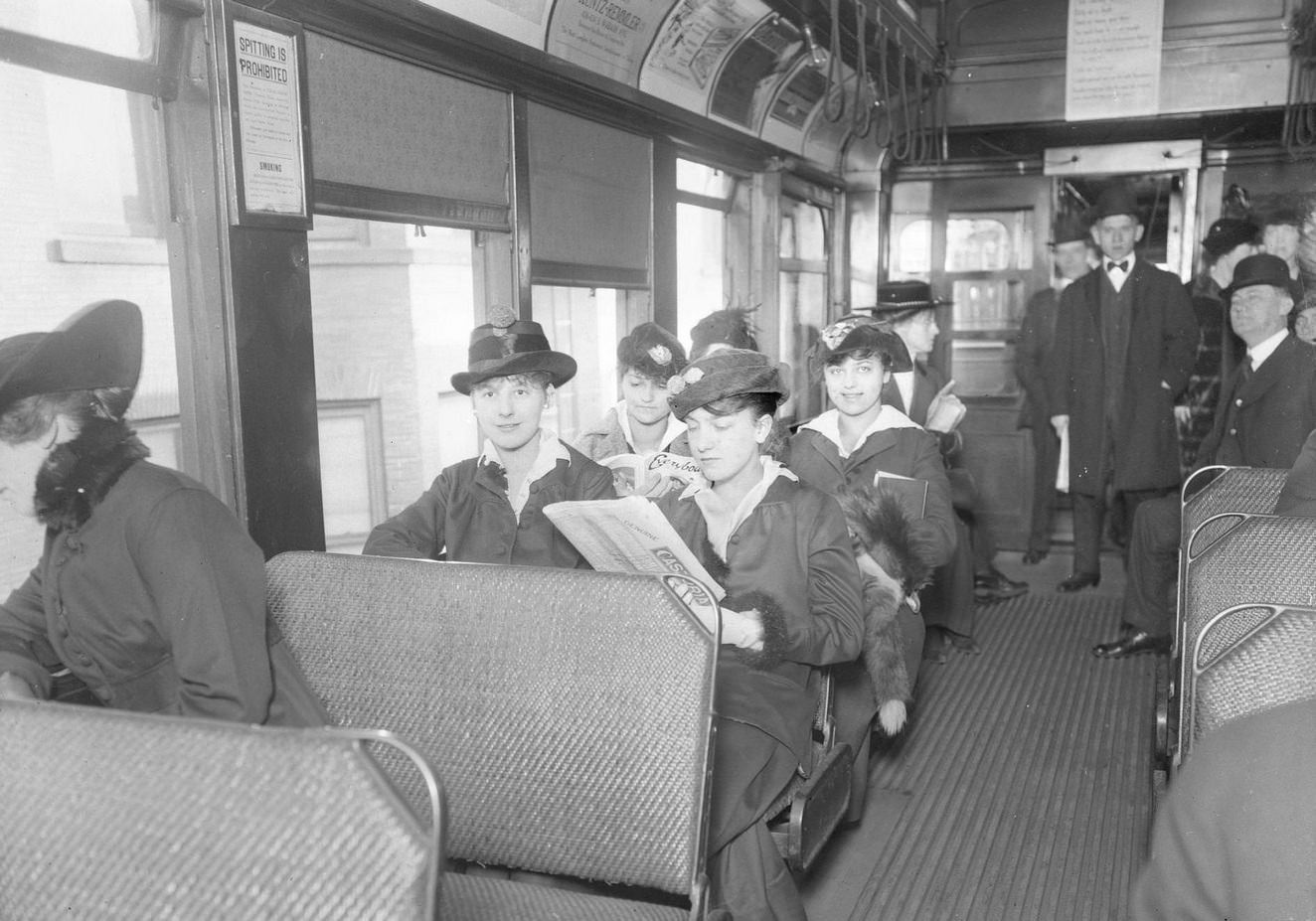
Mrs CL Hartwell holding a sign that reads, Silence, standing in front of the Chicago Conservatory in Chicago, Illinois, 1910s.Passengers sitting on an open window elevated train car on the Jackson Park branch in Chicago, Illinois, 1910s.
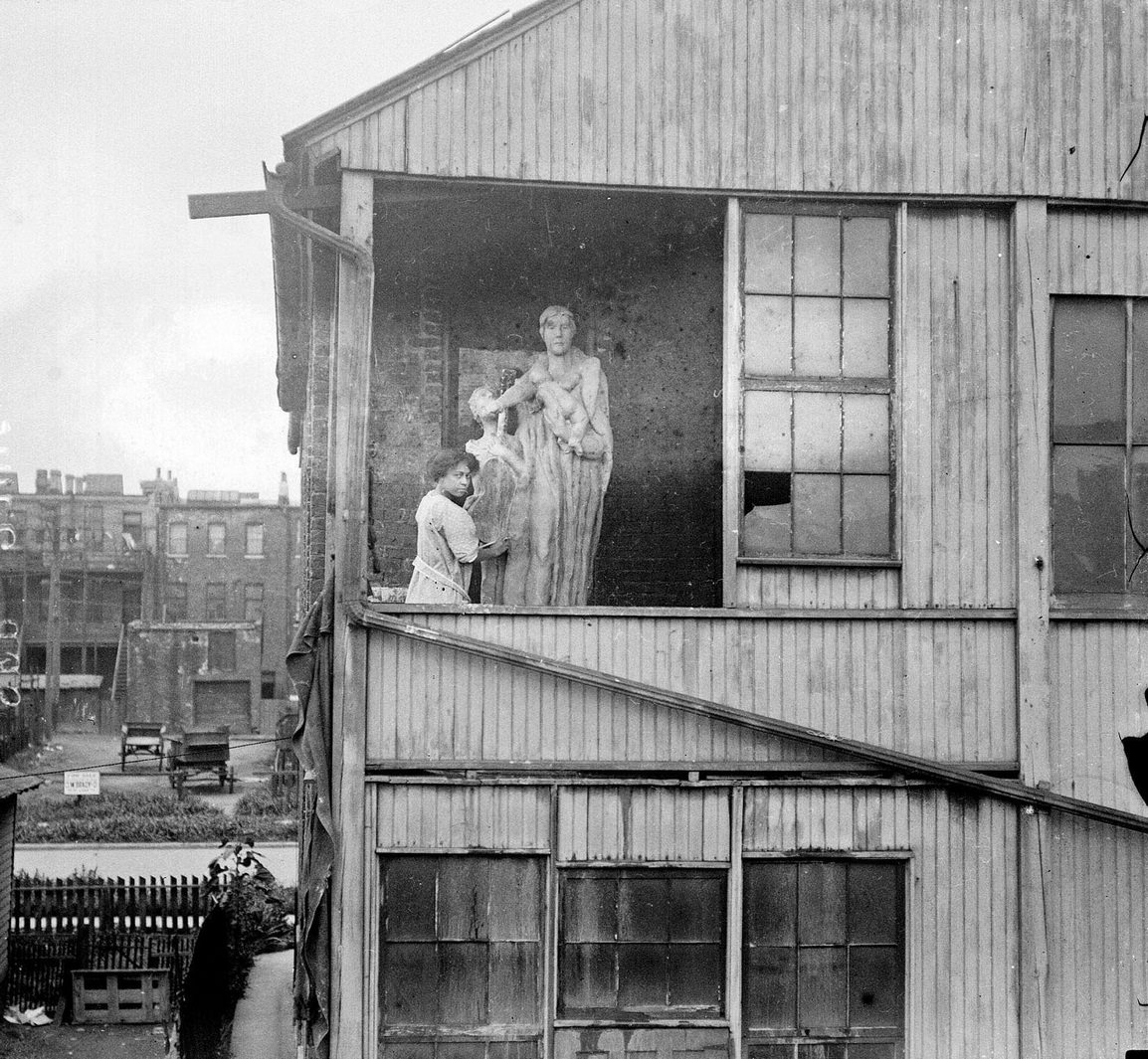
The elevated train system was already a defining feature of Chicago’s daily life. Commuters packed open-window cars on lines like the Jackson Park branch, riding above the city’s streets. Meanwhile, at street level, artists and residents carved out lives in the city’s dense neighborhoods. African American sculptor Ida McClelland Stout worked from a tenement porch, her monumental Ethiopian sculpture standing beside her as a testament to serious artistic ambition in modest surroundings.
Ida McClelland Stout, an African American sculptor, standing on a tenement porch, next to a monumental Ethiopian sculpture, Chicago, Illinois, 1910s.
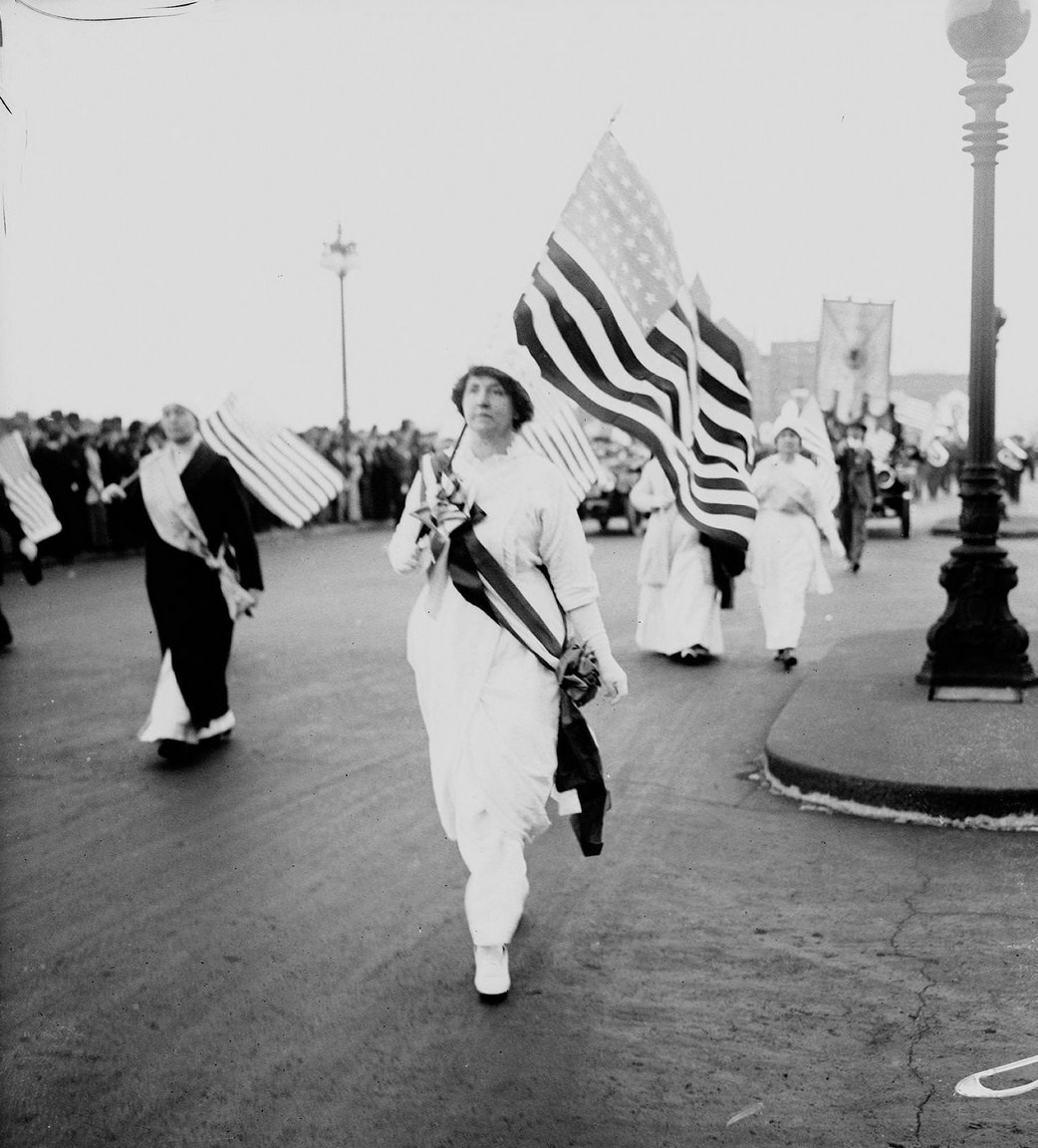
Suffrage marches on Michigan Avenue were organized affairs, with participants like Grace Wilbur Trout leading columns of women carrying American flags northward through the Loop. These parades were not small gatherings — they moved through the heart of the city in full public view, drawing both supporters and critics from the sidewalks.
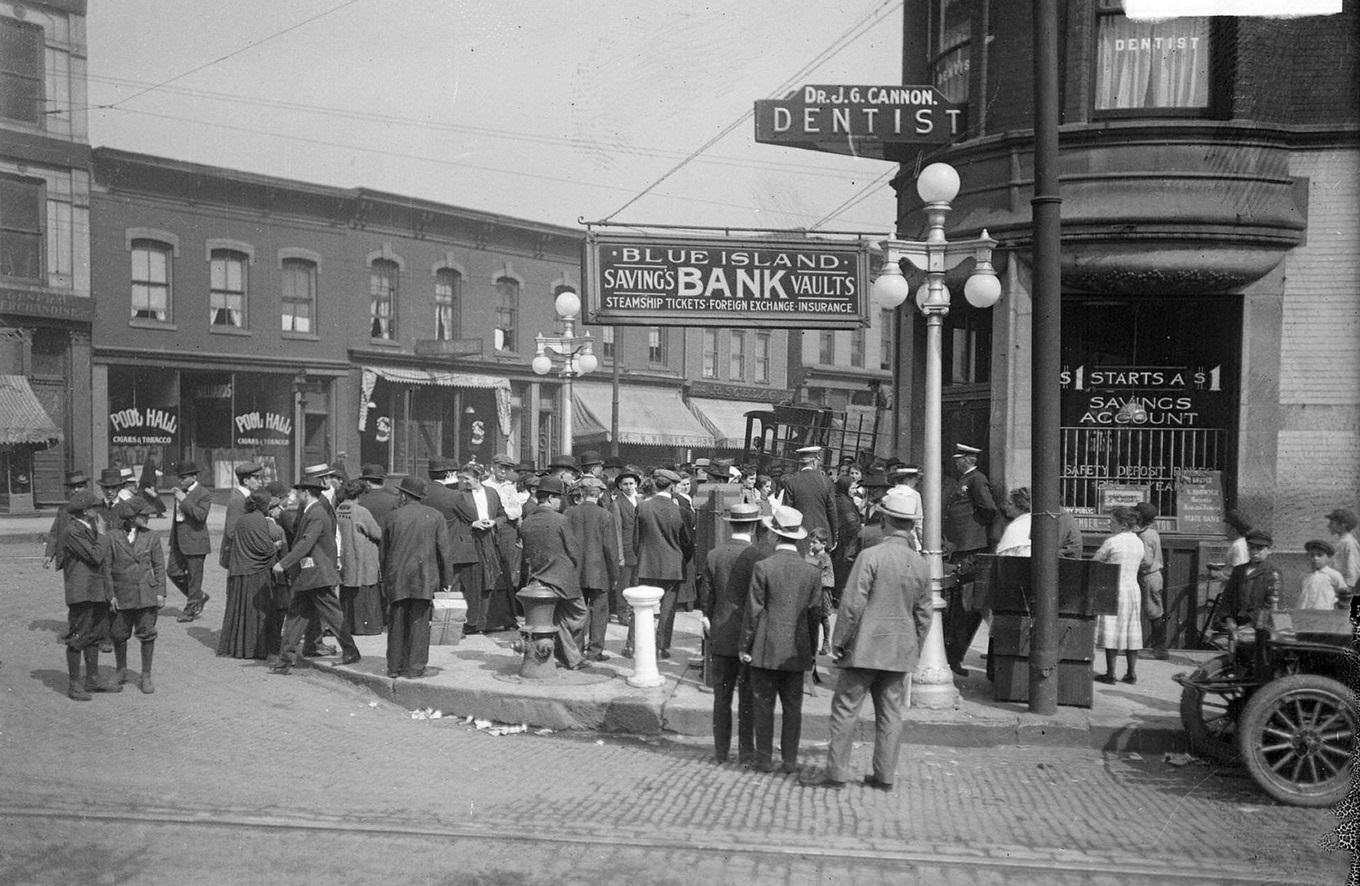
Grace Wilbur Trout wearing a sash, holding an American flag, marching north on South Michigan Avenue, with other suffragists holding flags marching nearby in a women’s suffrage parade in the Loop community area of Chicago, Illinois, 1910sCrowd standing outside the Blue Island Savings Bank at 1147 Blue Island Avenue, Chicago, Illinois, 1915.
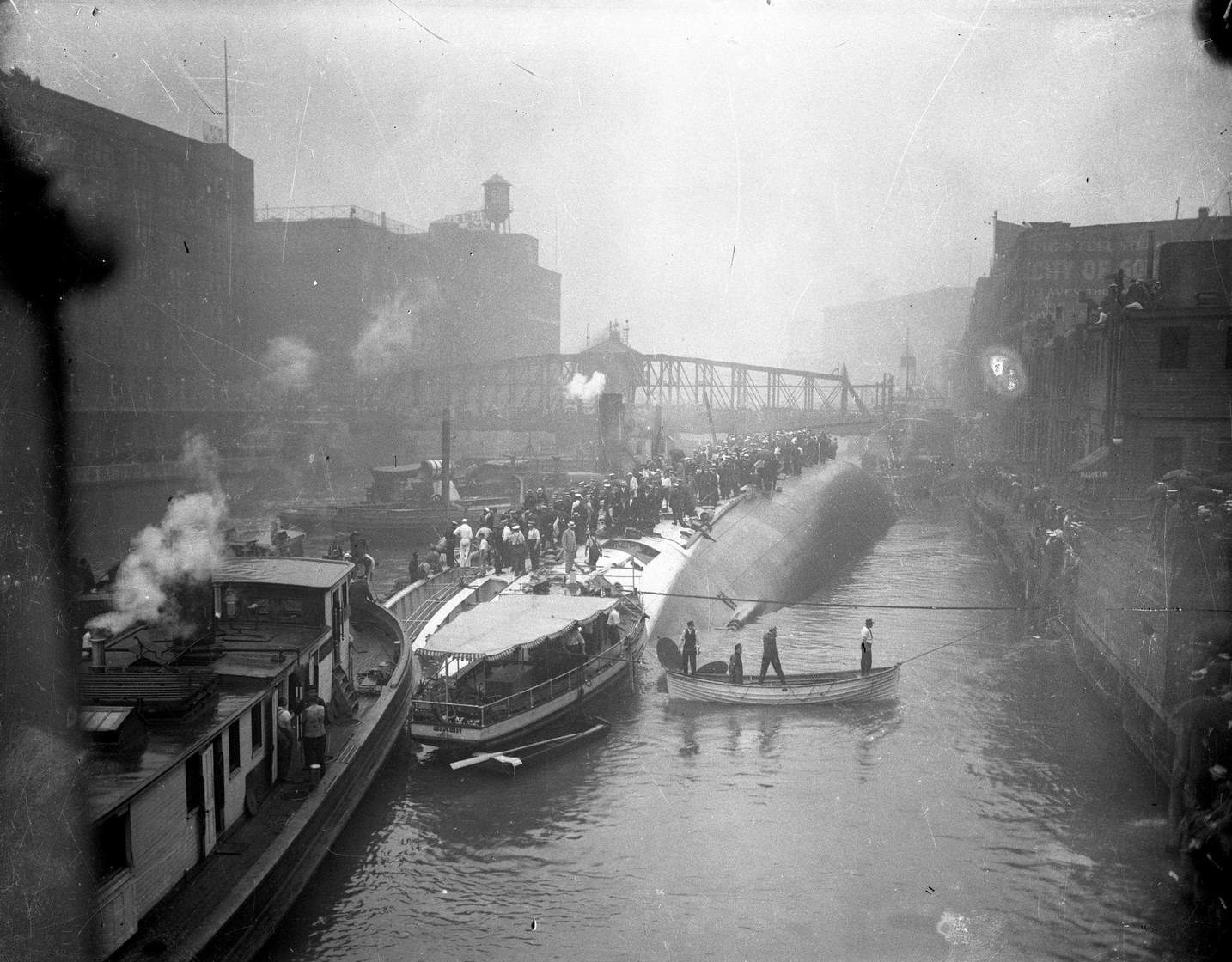
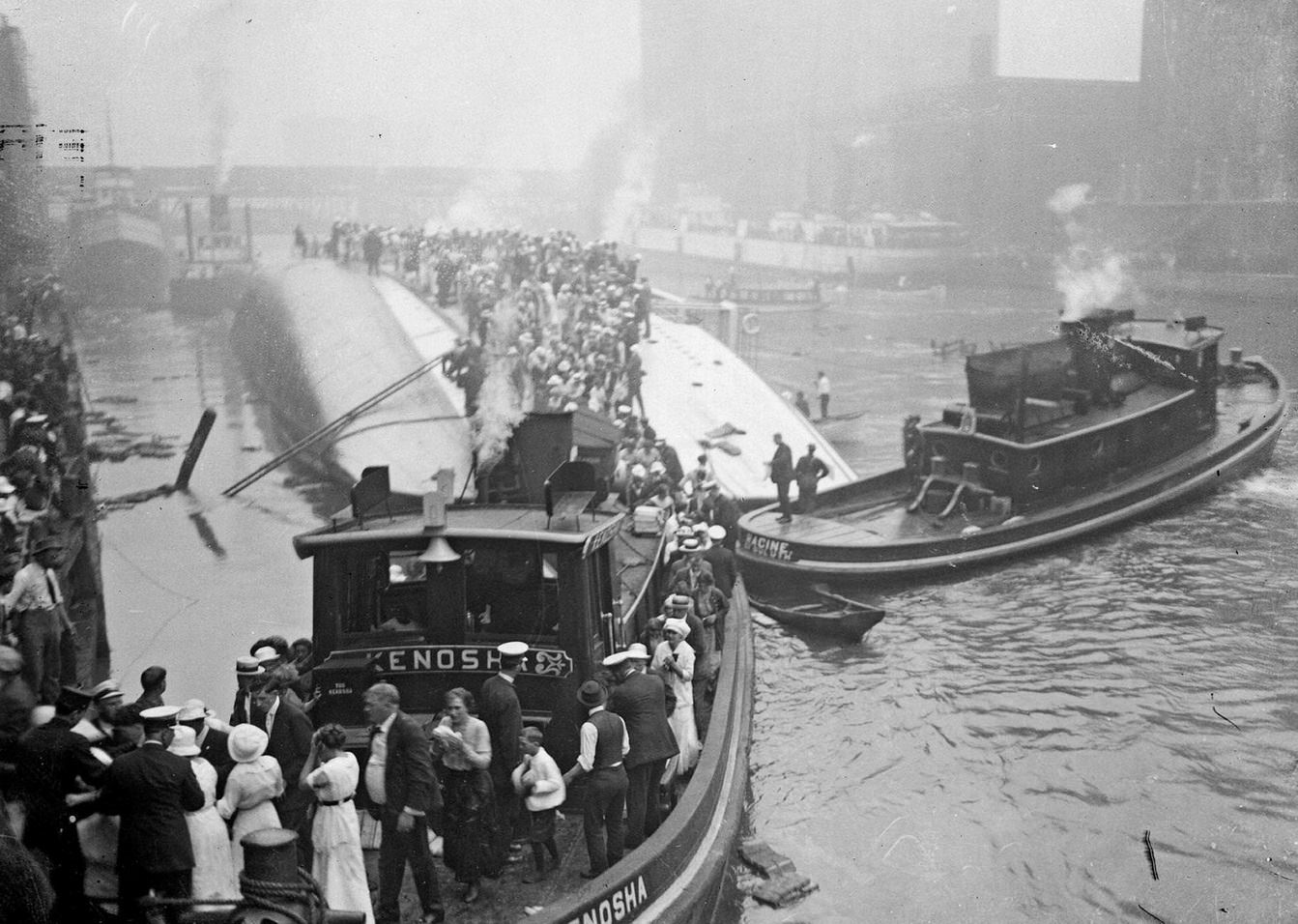
The year 1915 was one of the most eventful in Chicago’s history. On July 24, the steamship Eastland capsized in the Chicago River while docked at the Clark Street wharf. The ship rolled onto its side in just minutes, and 844 people drowned. It remains the deadliest single disaster in Chicago’s history. Rescue workers and tugboats converged on the scene, pulling survivors from the hull.
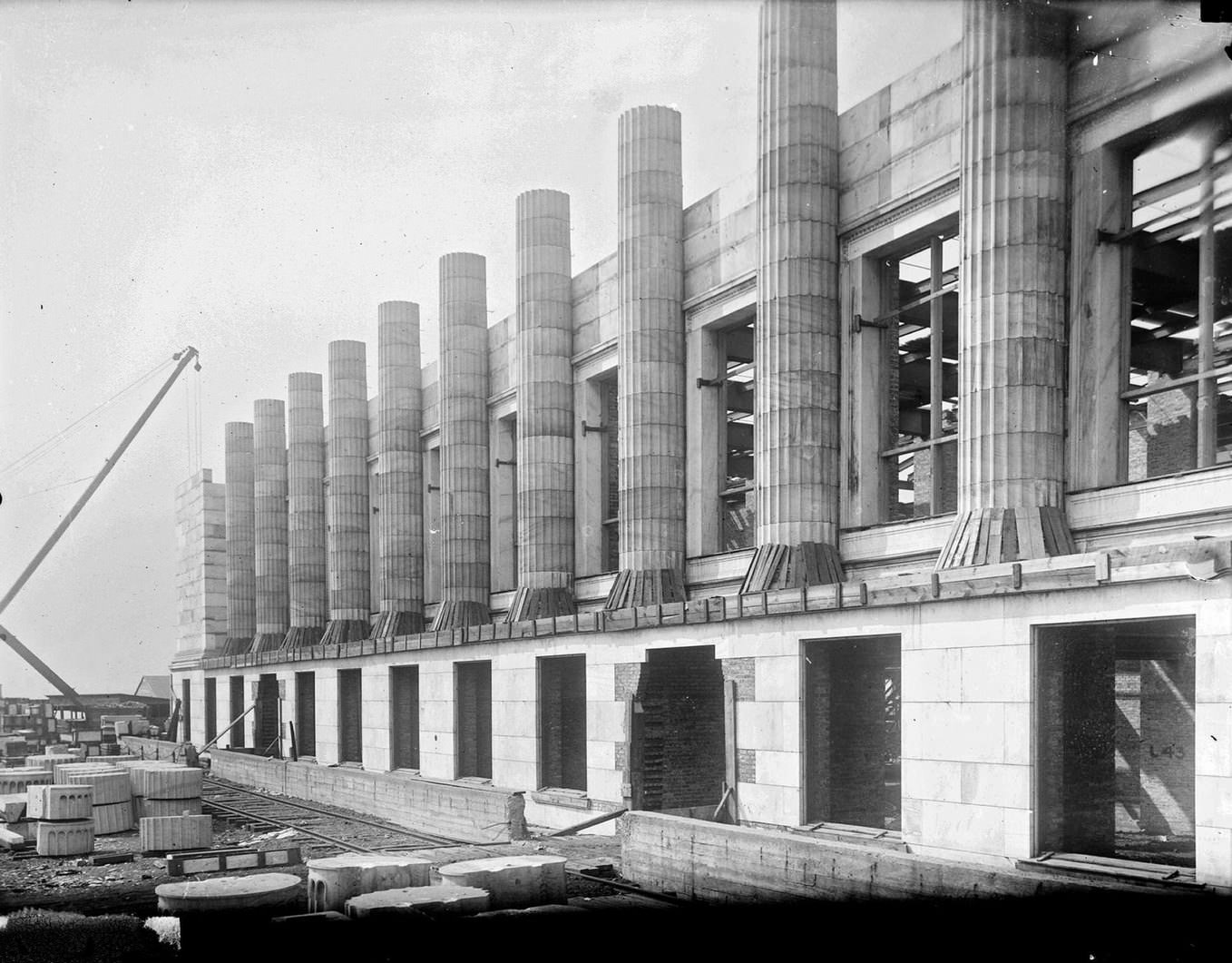
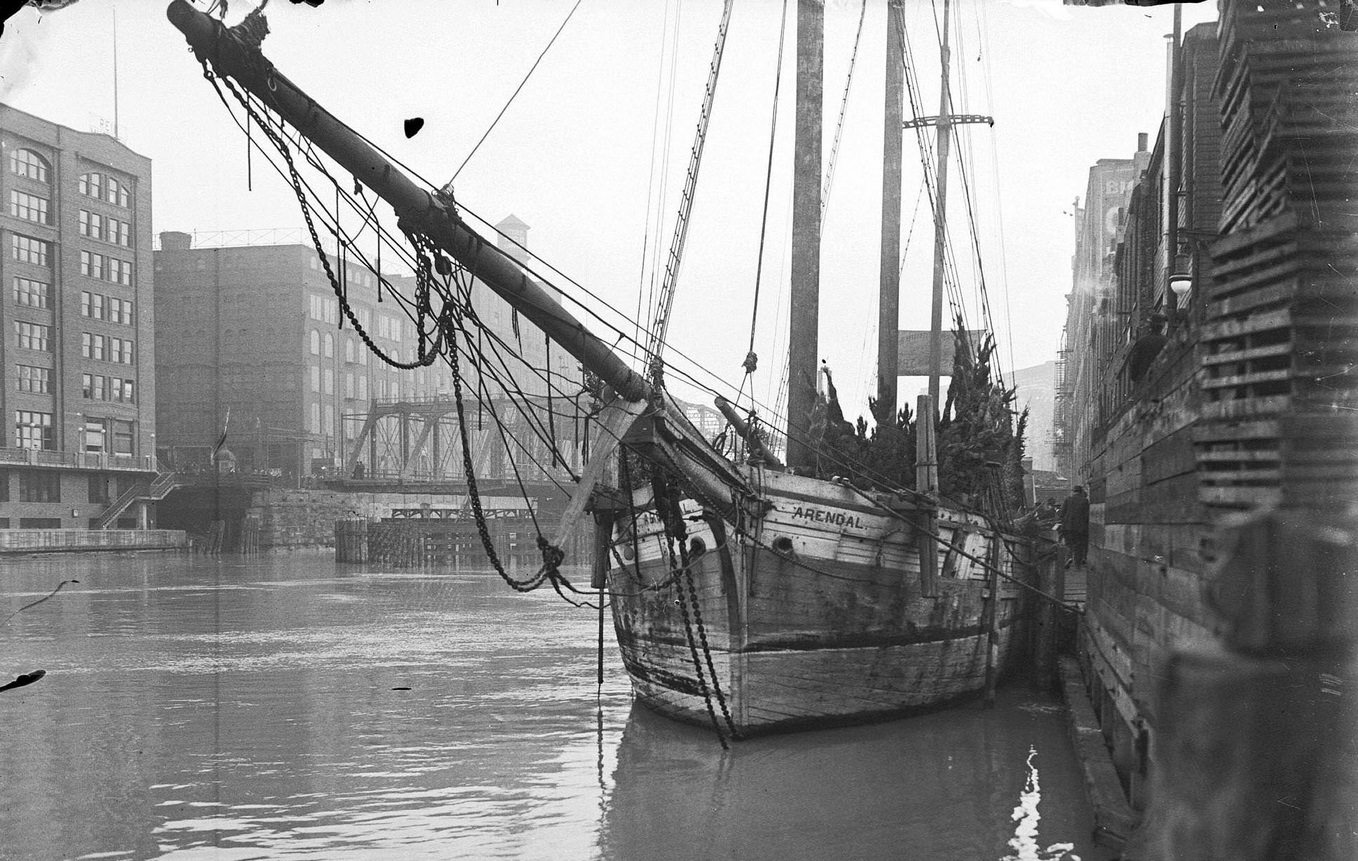
Construction of the new Field Museum of Natural History, east side of the building, Chicago, Illinois, 1915.Schooner Arendal, docked at Clark Street, to deliver Michigan-grown Christmas trees, Chicago, Illinois, December 3, 1914.
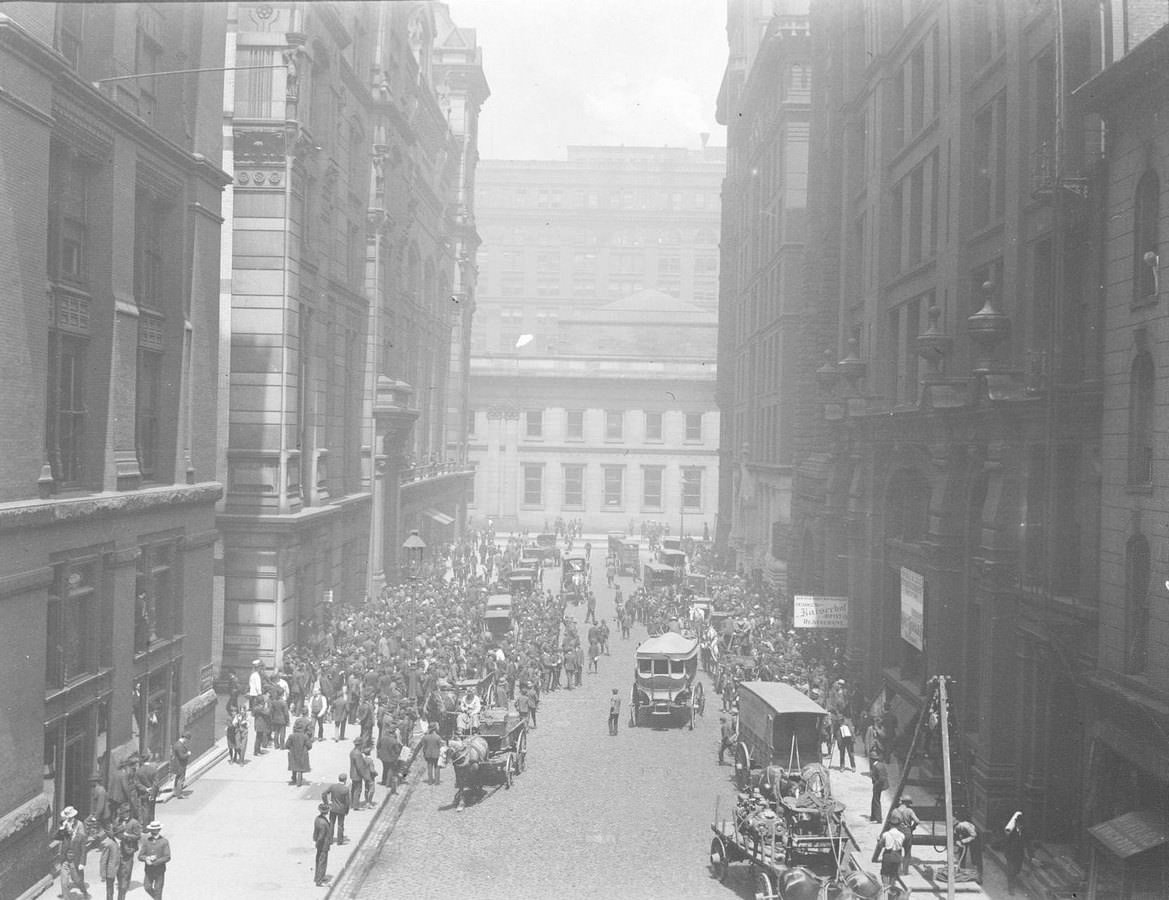
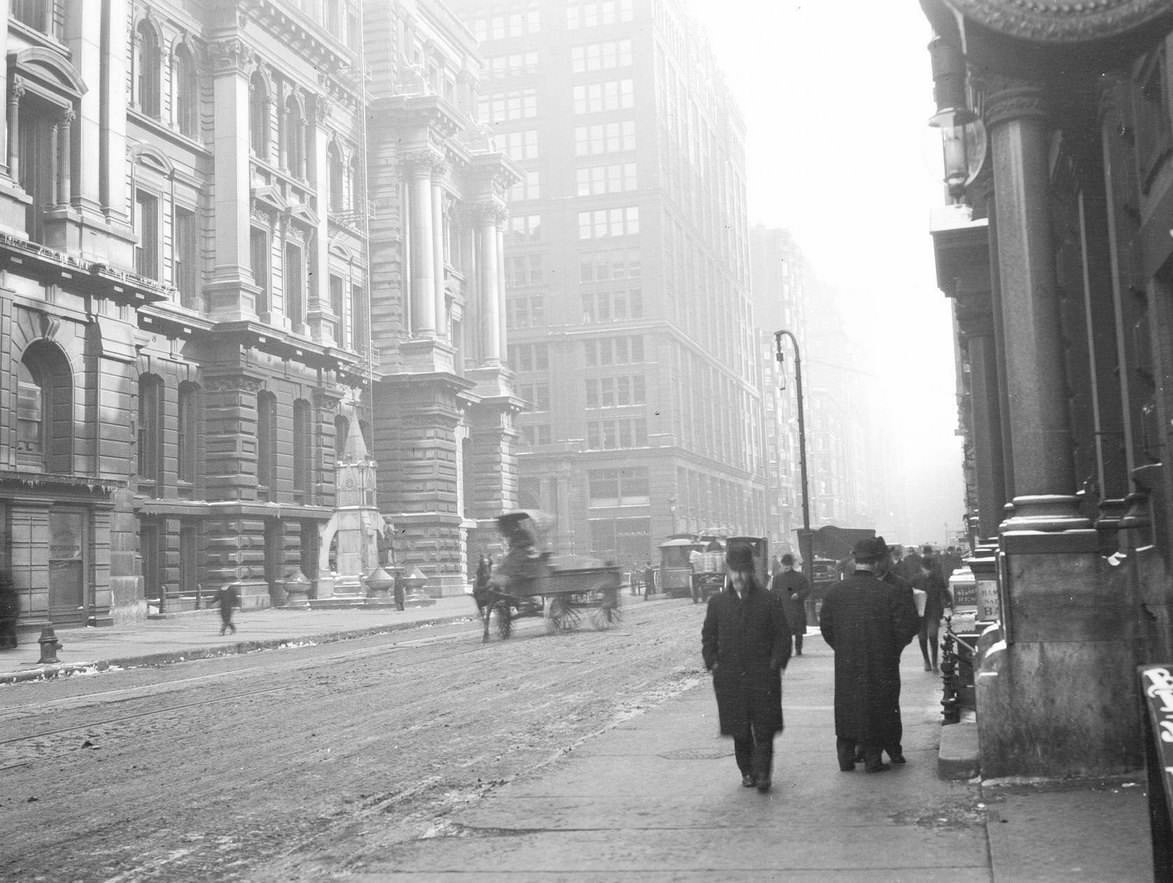
Chicago’s streets in the mid-1910s showed the city in transition. Horse-drawn wagons still shared roads with automobiles and streetcars. Photographs of Michigan Avenue, State Street, and the Loop’s main corridors captured a city where old and new forms of transportation competed for space on the same block.
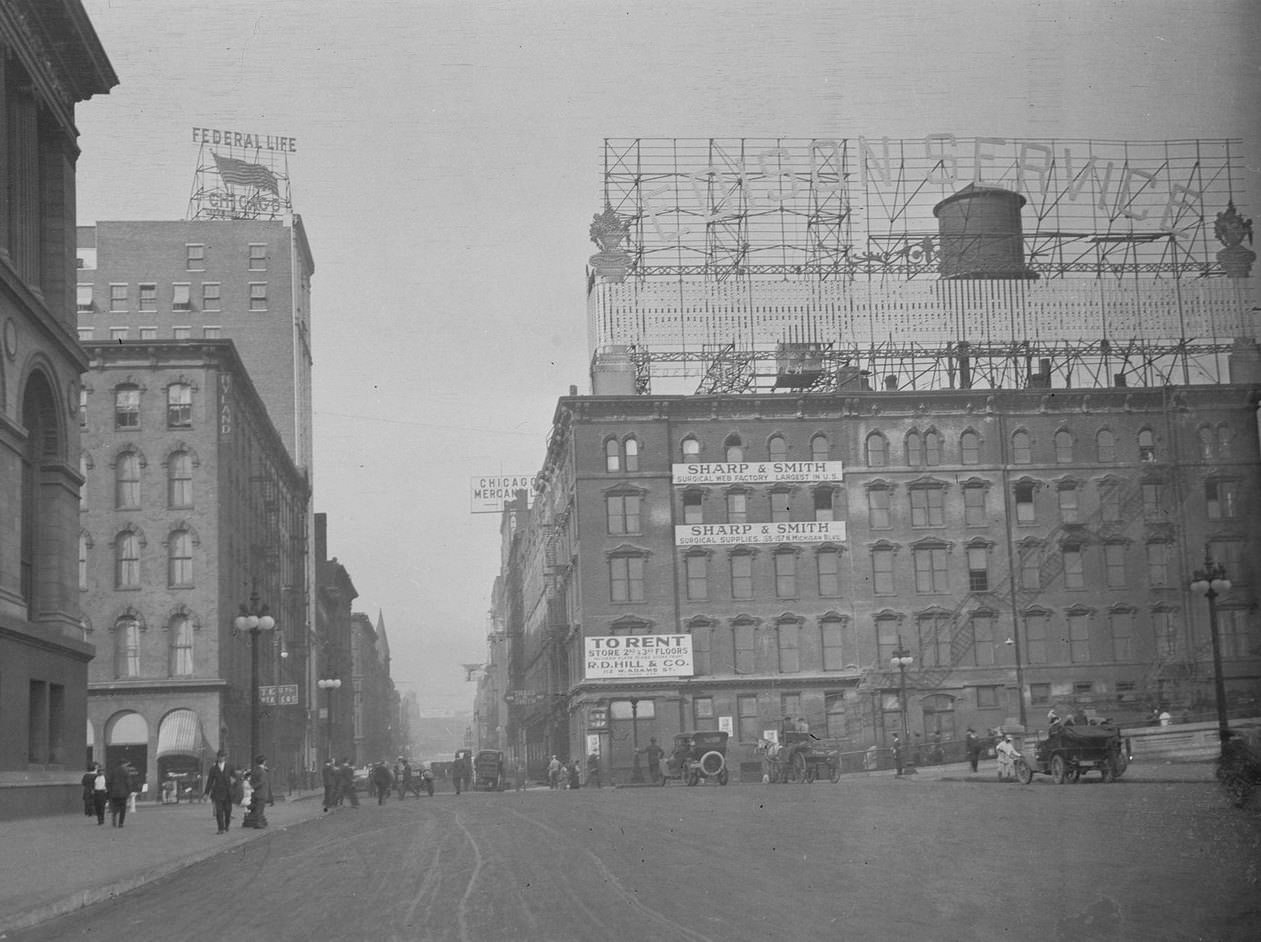
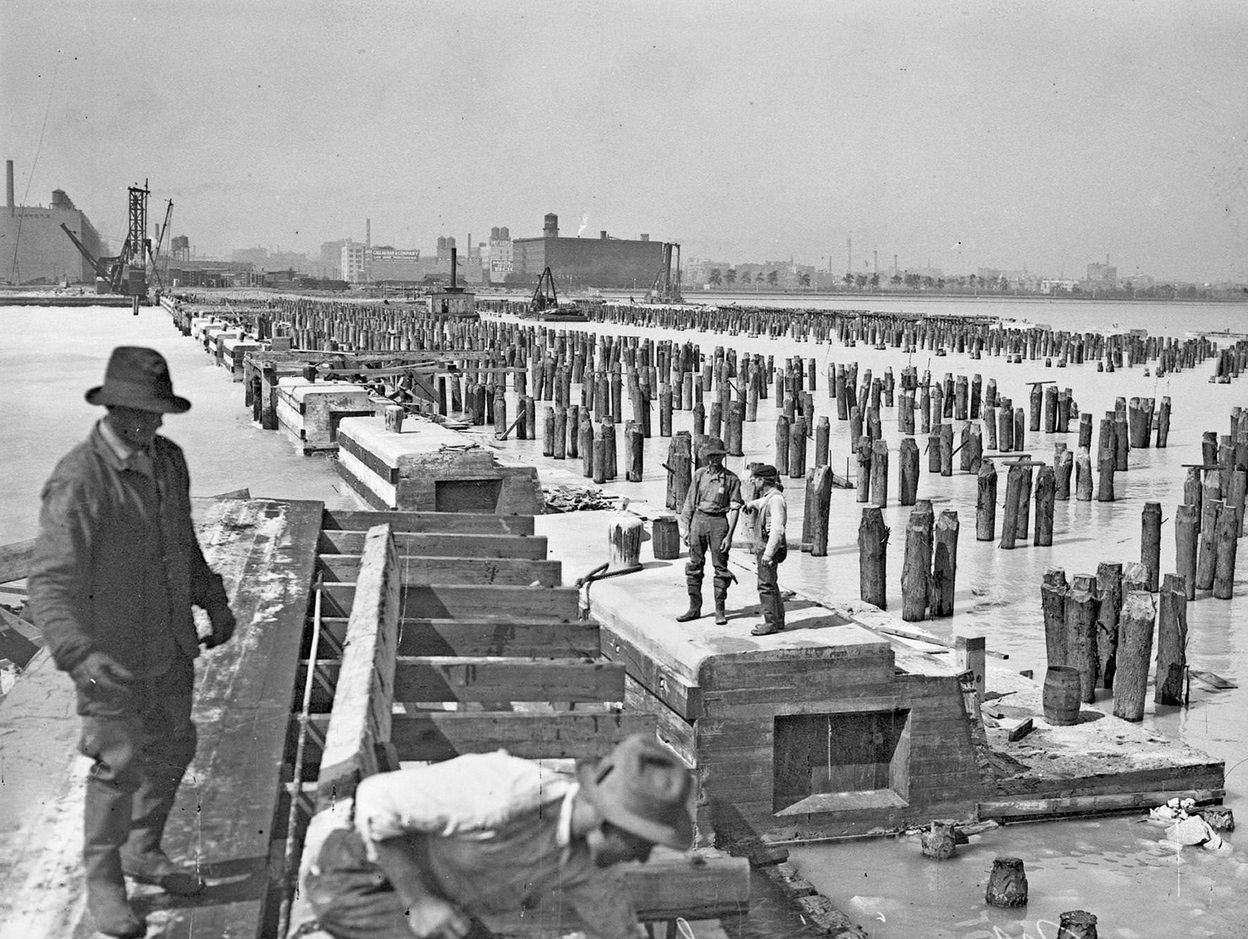
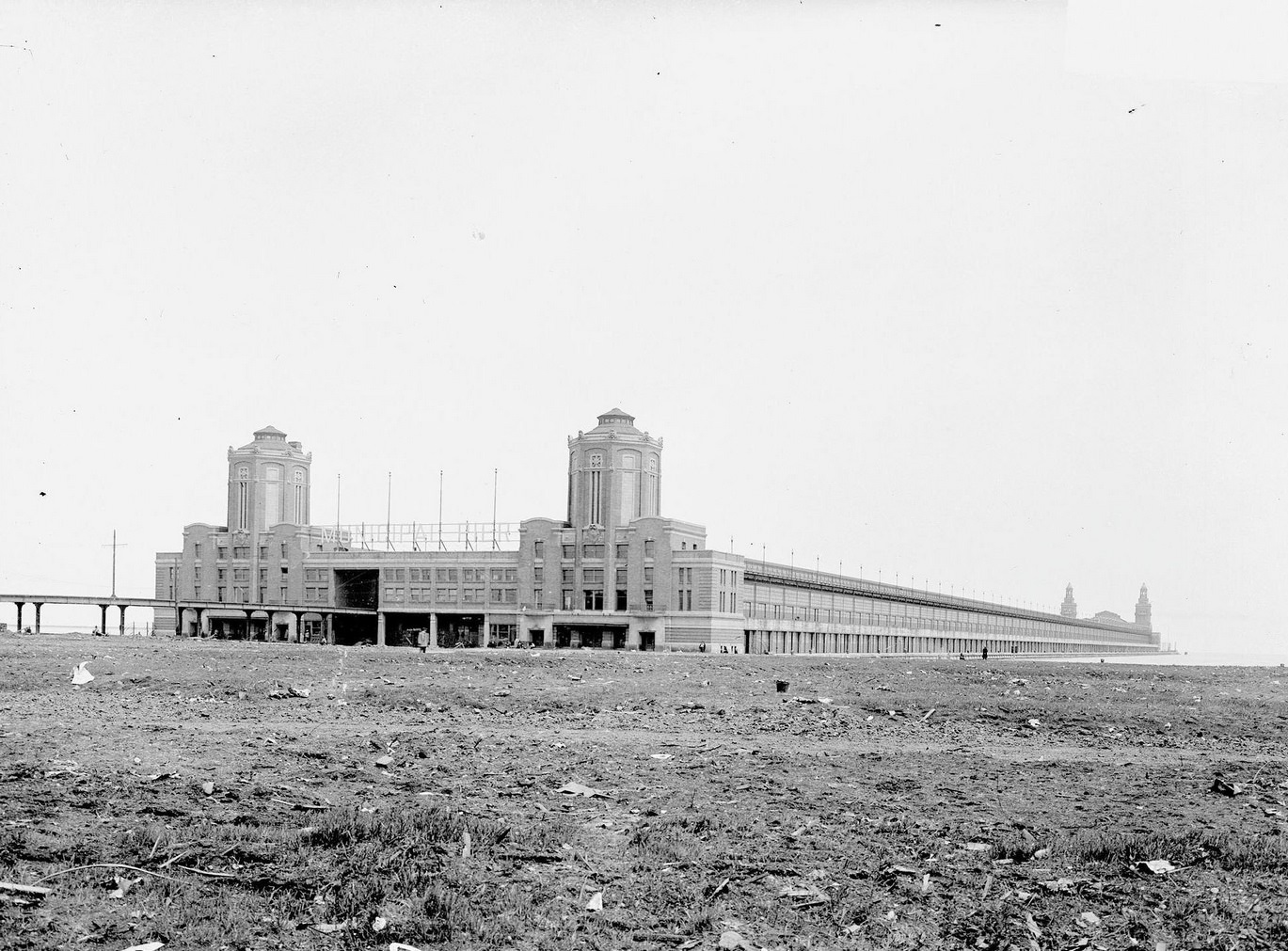
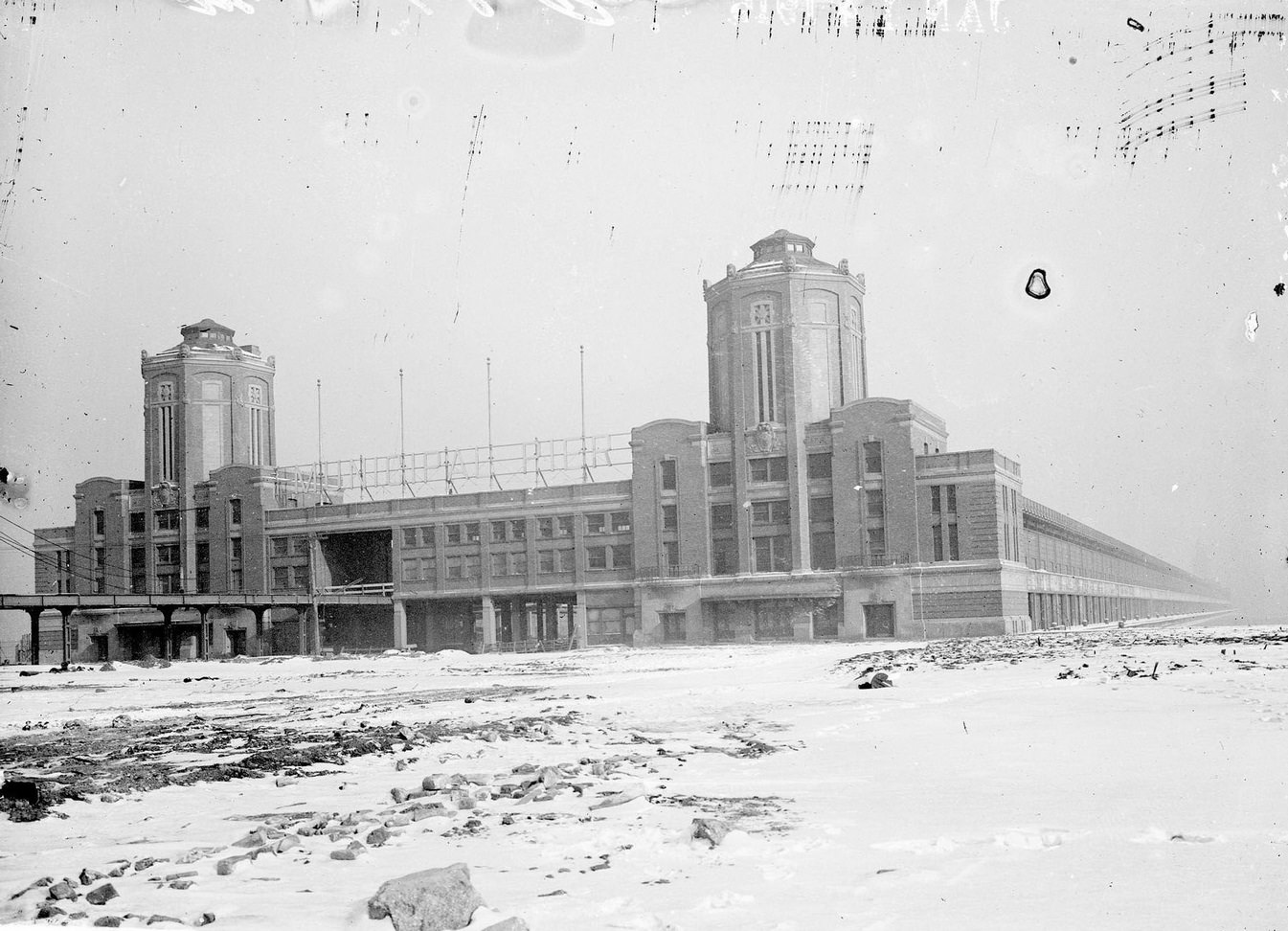
Michigan Avenue at Randolph Street, Chicago, Illinois, December 1914.Construction of new municipal pier, Chicago, Illinois, September 17, 1914.
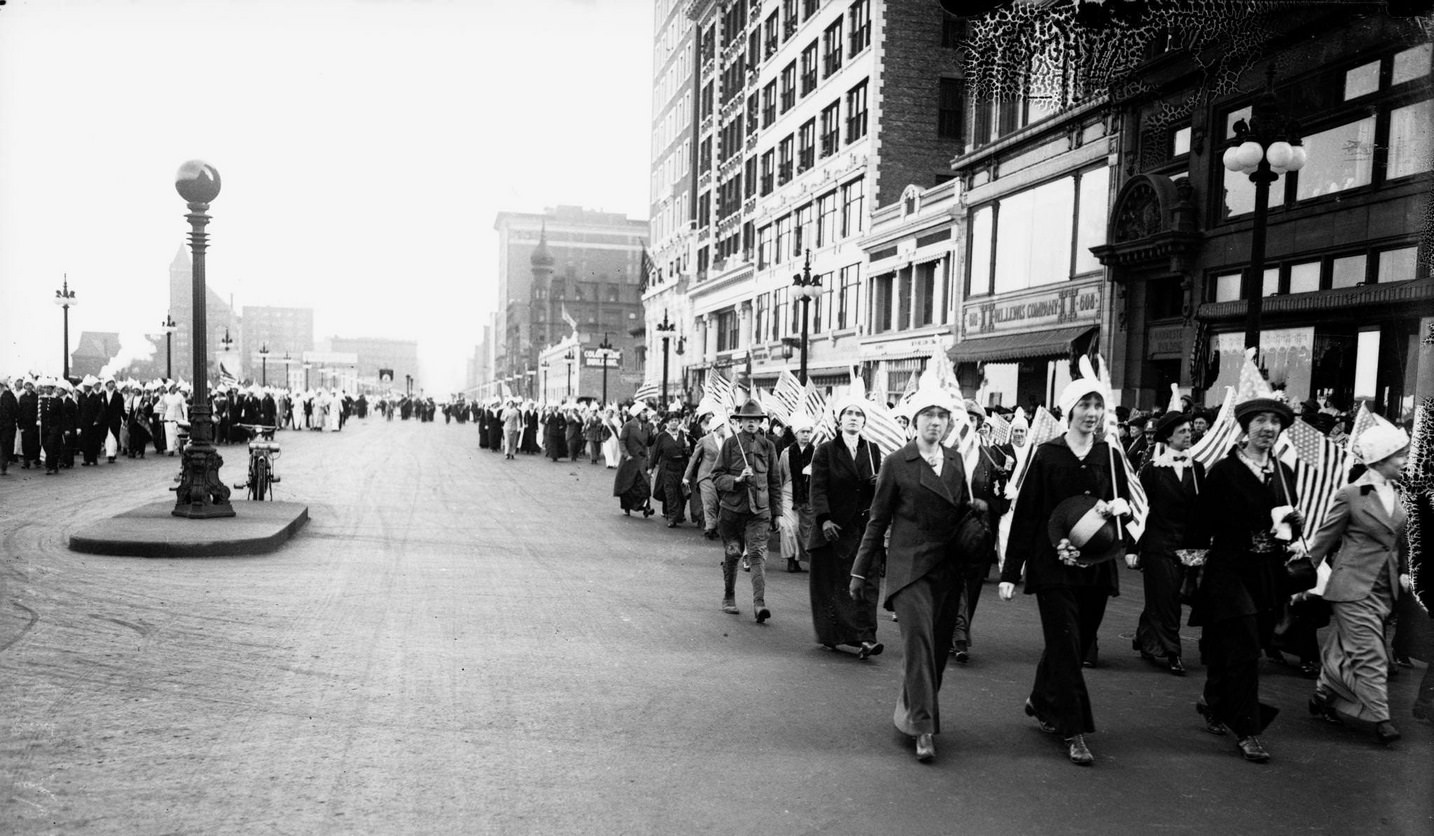
Municipal Pier — later renamed Navy Pier — was under construction during this period. The massive structure along the lakefront was designed to serve both commercial shipping and public recreation. As it took shape, it became one of the most significant infrastructure projects of the decade. Suffrage parades continued to fill Michigan Avenue, with women marching in organized formations past crowds of onlookers.
Women wearing parade hats and marching in parade formation north on South Michigan Avenue with another group of women marching on the east side visible in the background in the Loop community area, Chicago, Illinois, May 2, 1914.Women’S Suffrage Parade, Girls & Young Women Carrying Flags, 1910s
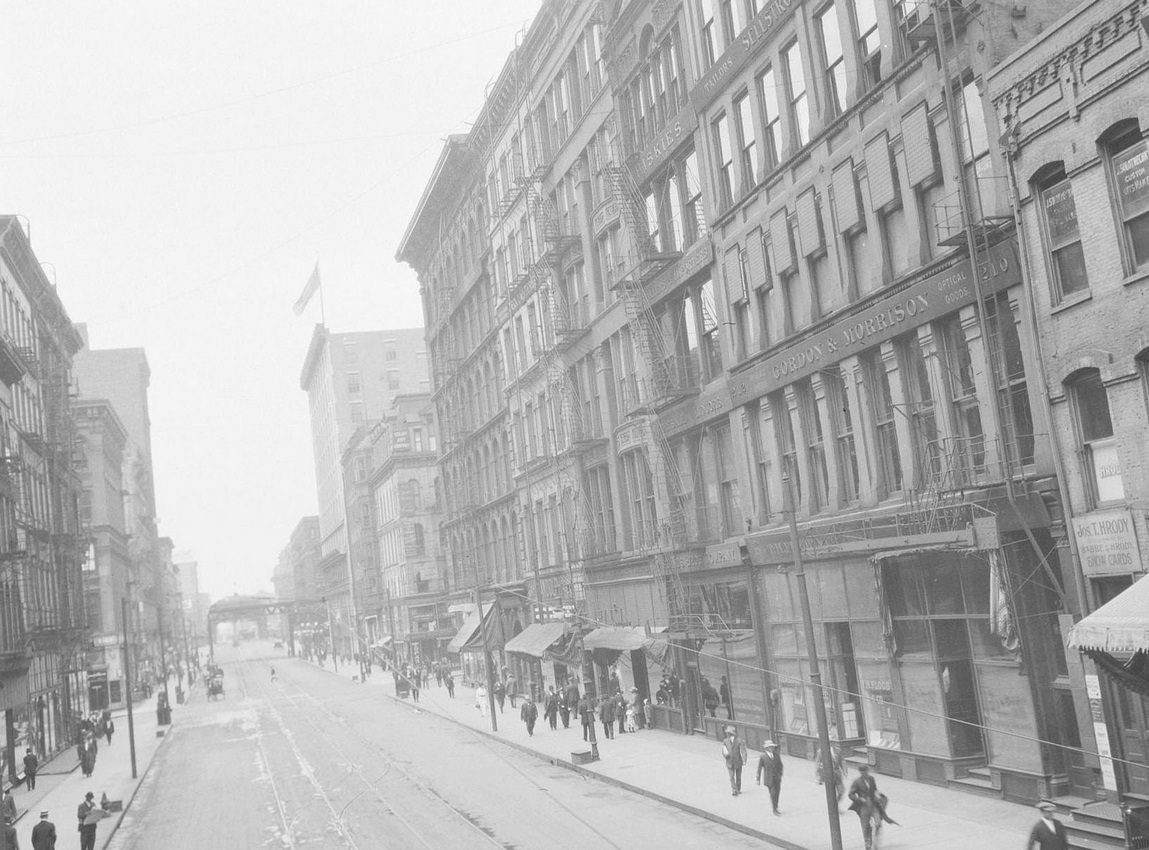
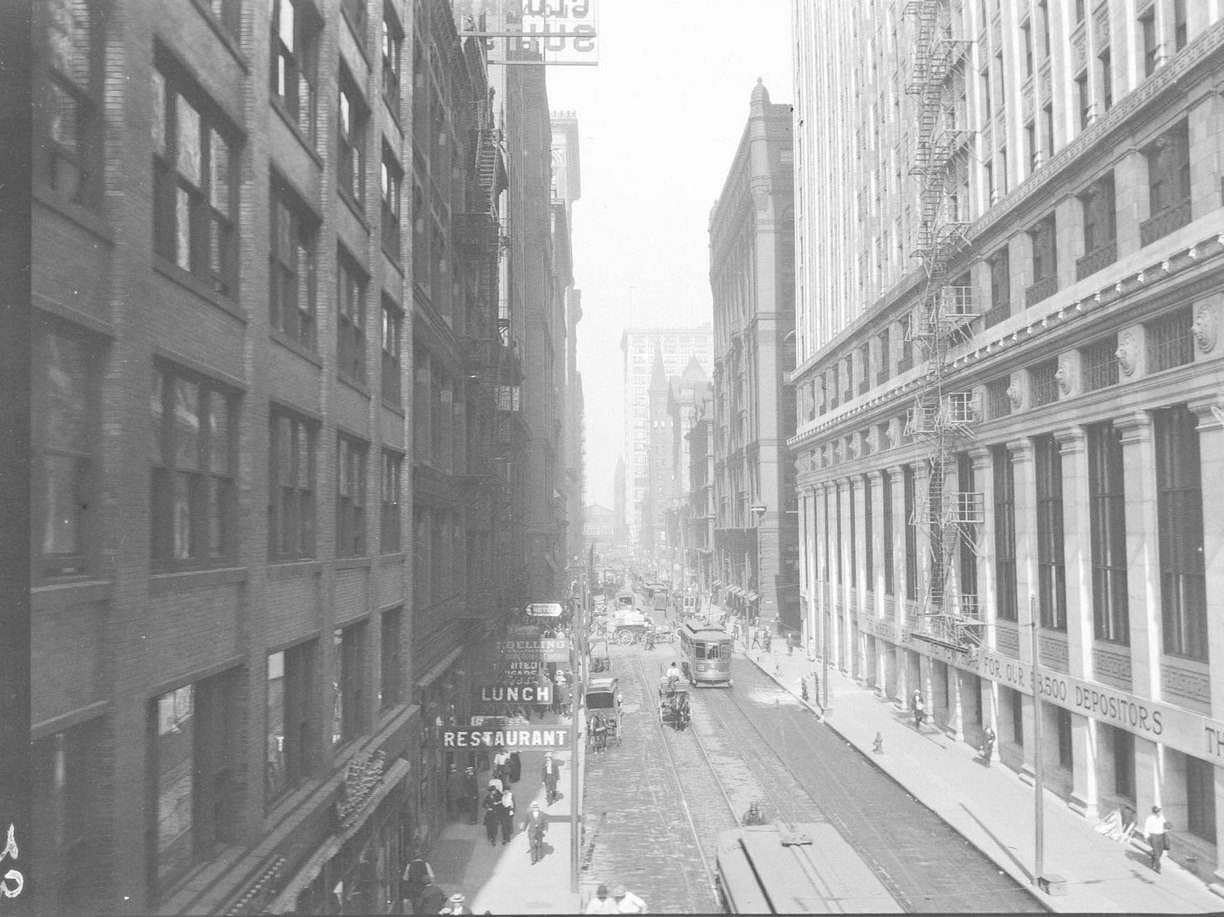
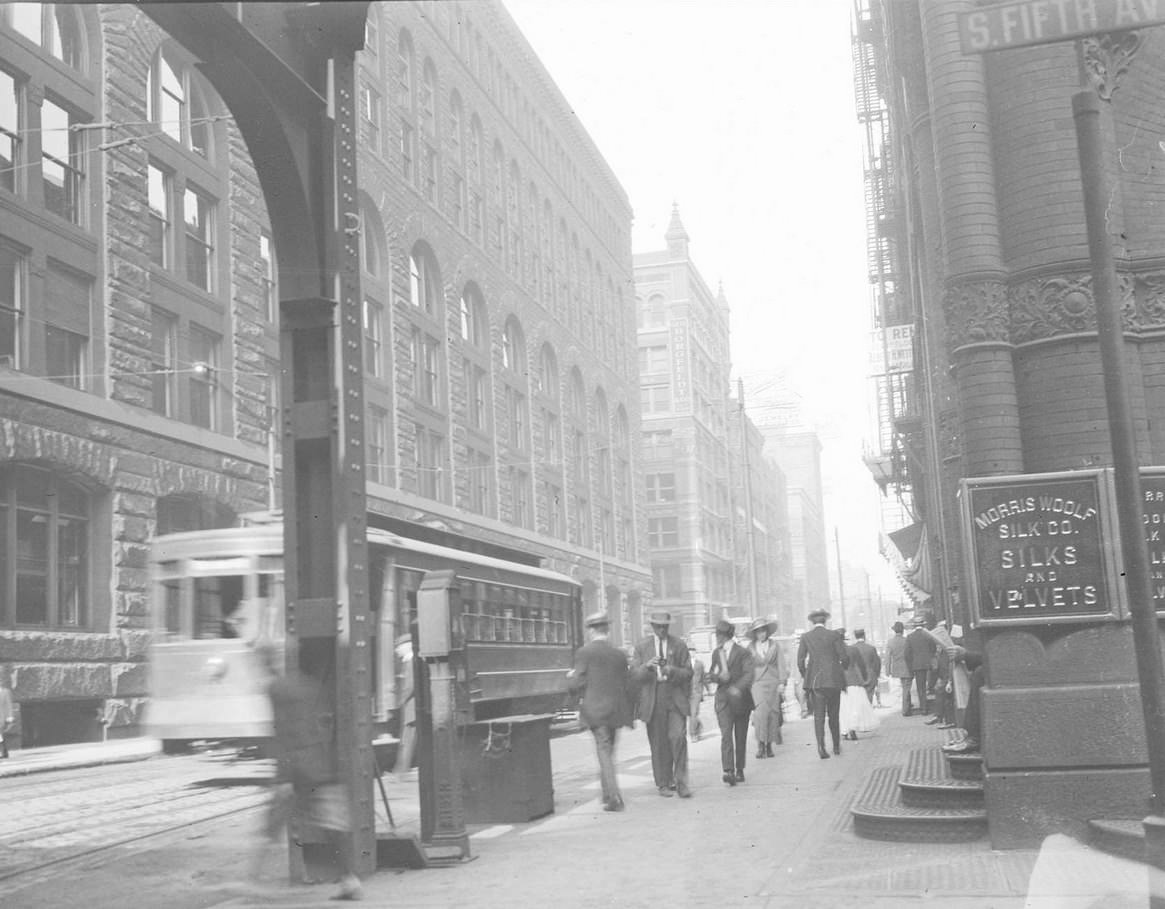
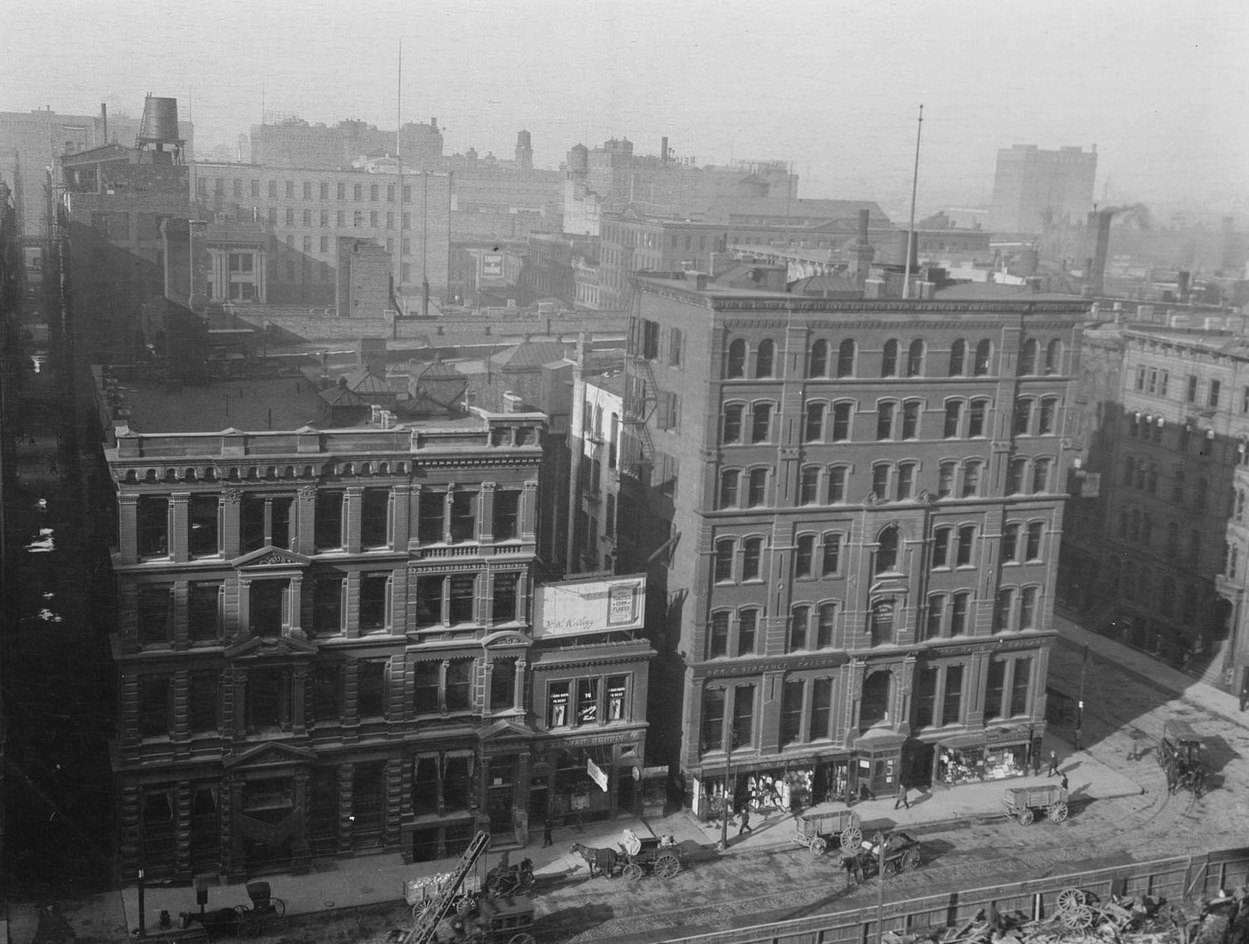
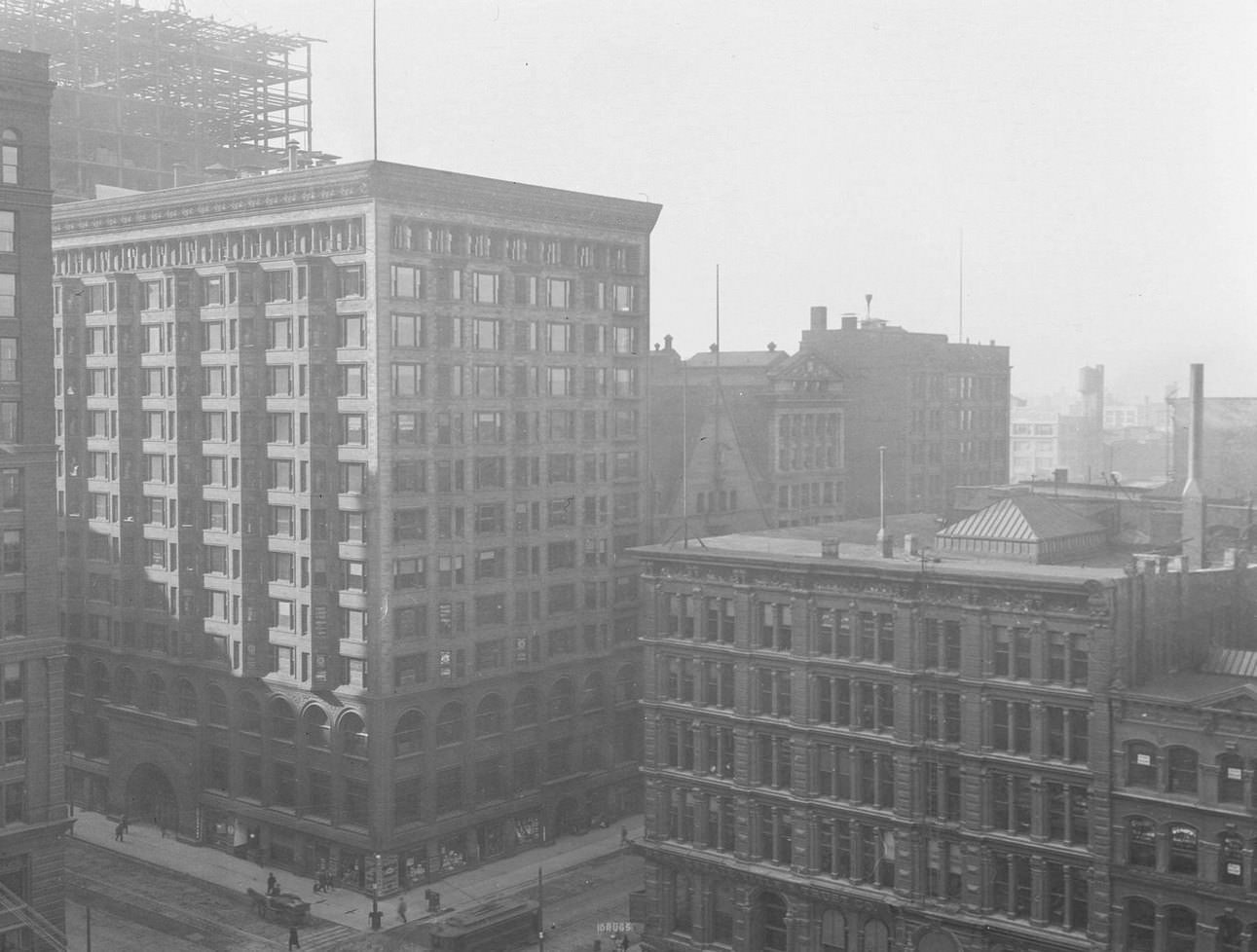
Downtown Chicago’s commercial corridors — Wabash Avenue, Washington Street, Monroe Street, and Madison Street — were dense with foot traffic, storefronts, and elevated train infrastructure. These streets formed the economic backbone of the city, connecting workers, shoppers, and businesses across the Loop.
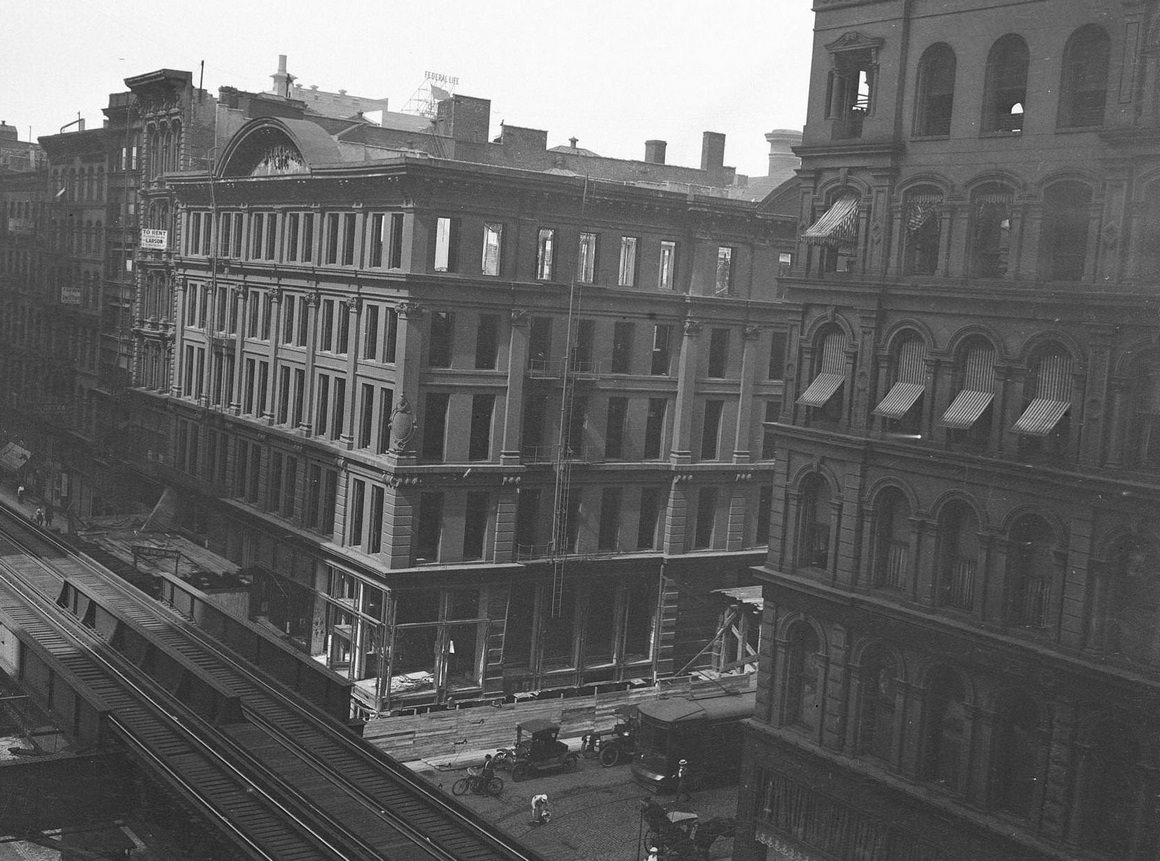
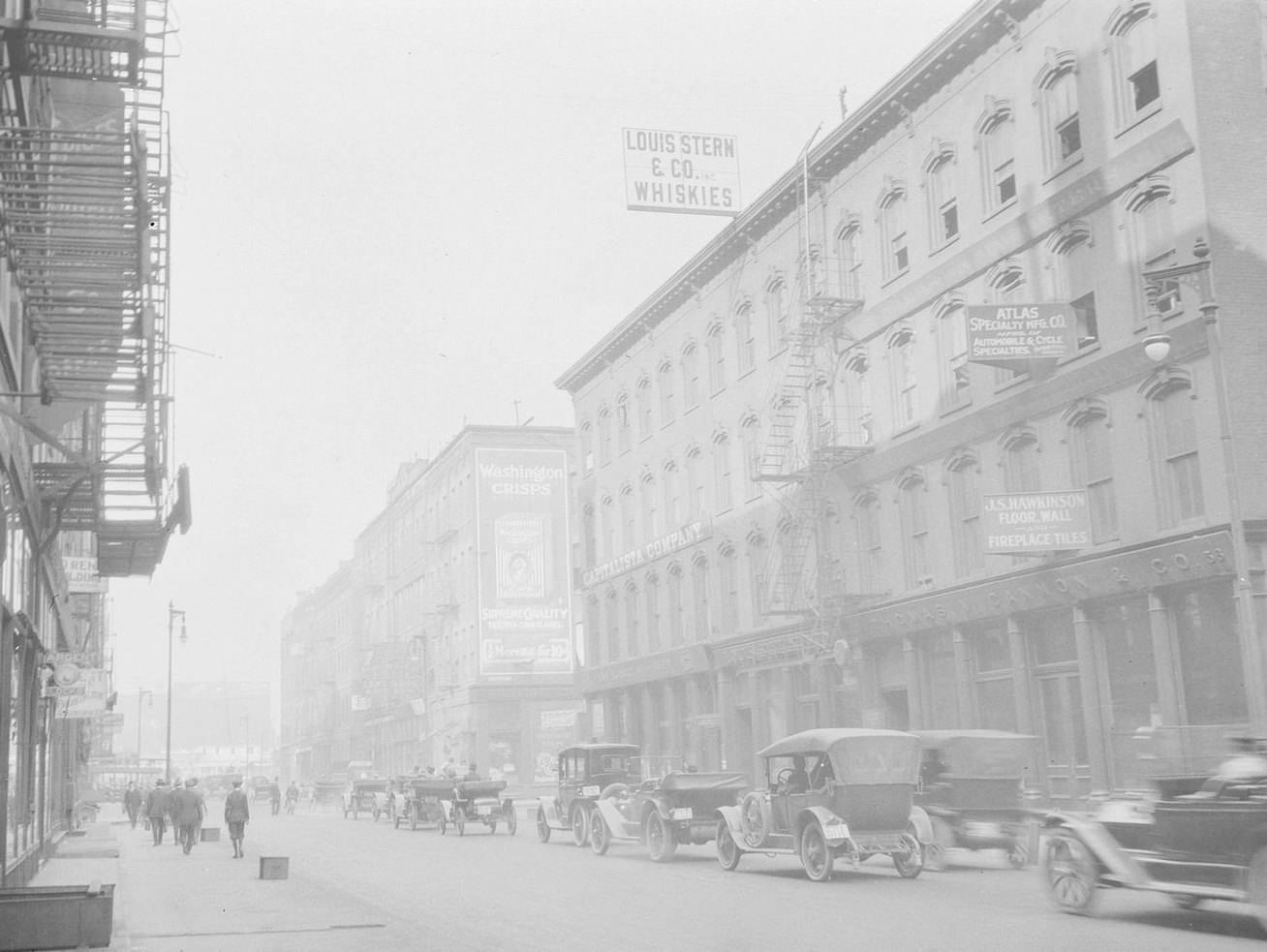
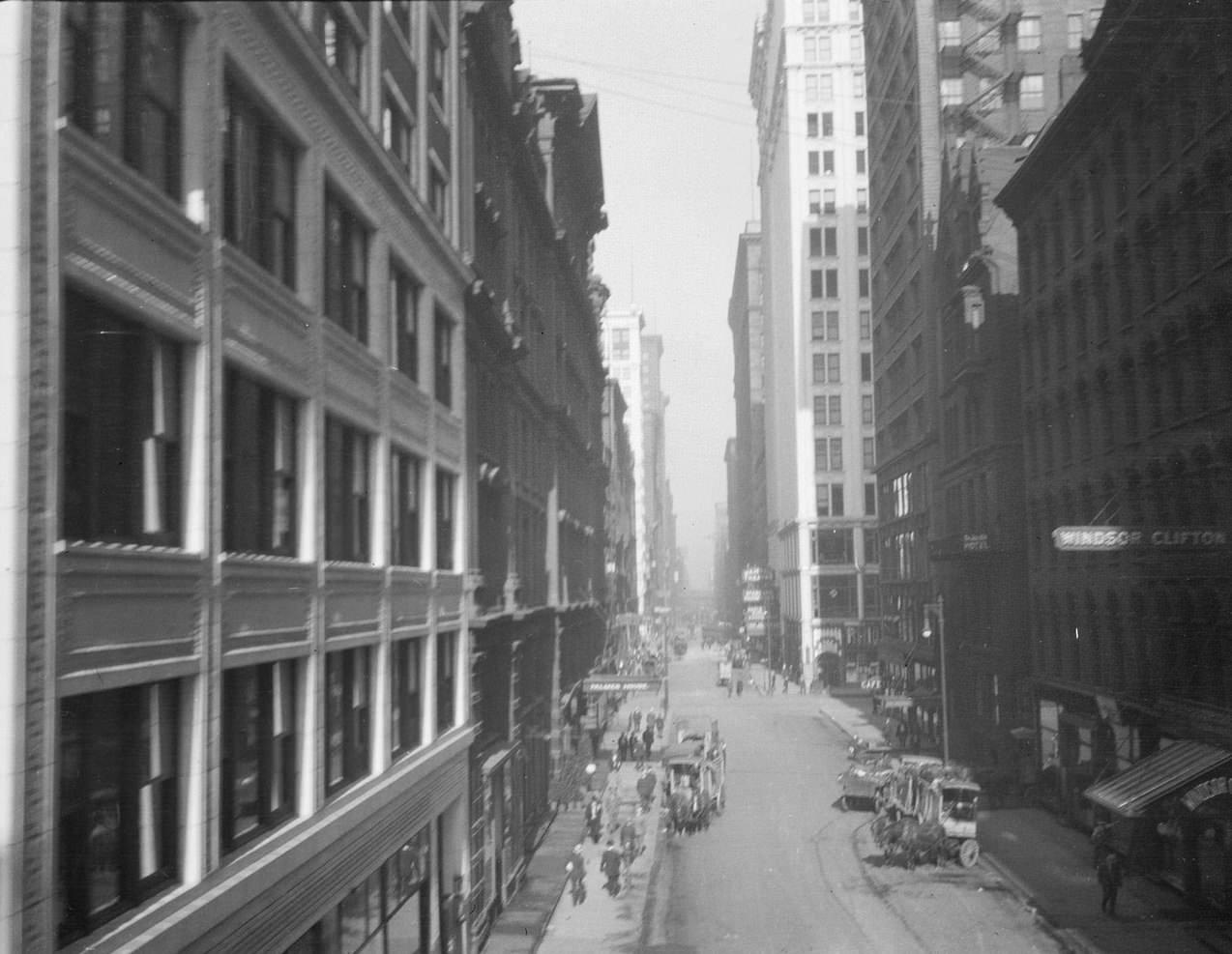
View of the northeast corner of Wabash Avenue and Washington Street, Chicago, Illinois, 1914.Michigan Avenue, north from Lake Street, Chicago, Illinois, 1914.Monroe Street, west from Wabash Avenue, Chicago, Illinois, 1914.Madison Street, west from Fifth Avenue (Wells Street), Chicago, Illinois, 1914.Adams Street east from Fifth Avenue (Wells Street), Chicago, Illinois, 1914Adams Street from Fifth Avenue (Well Streets), Chicago, Illinois, 1914.
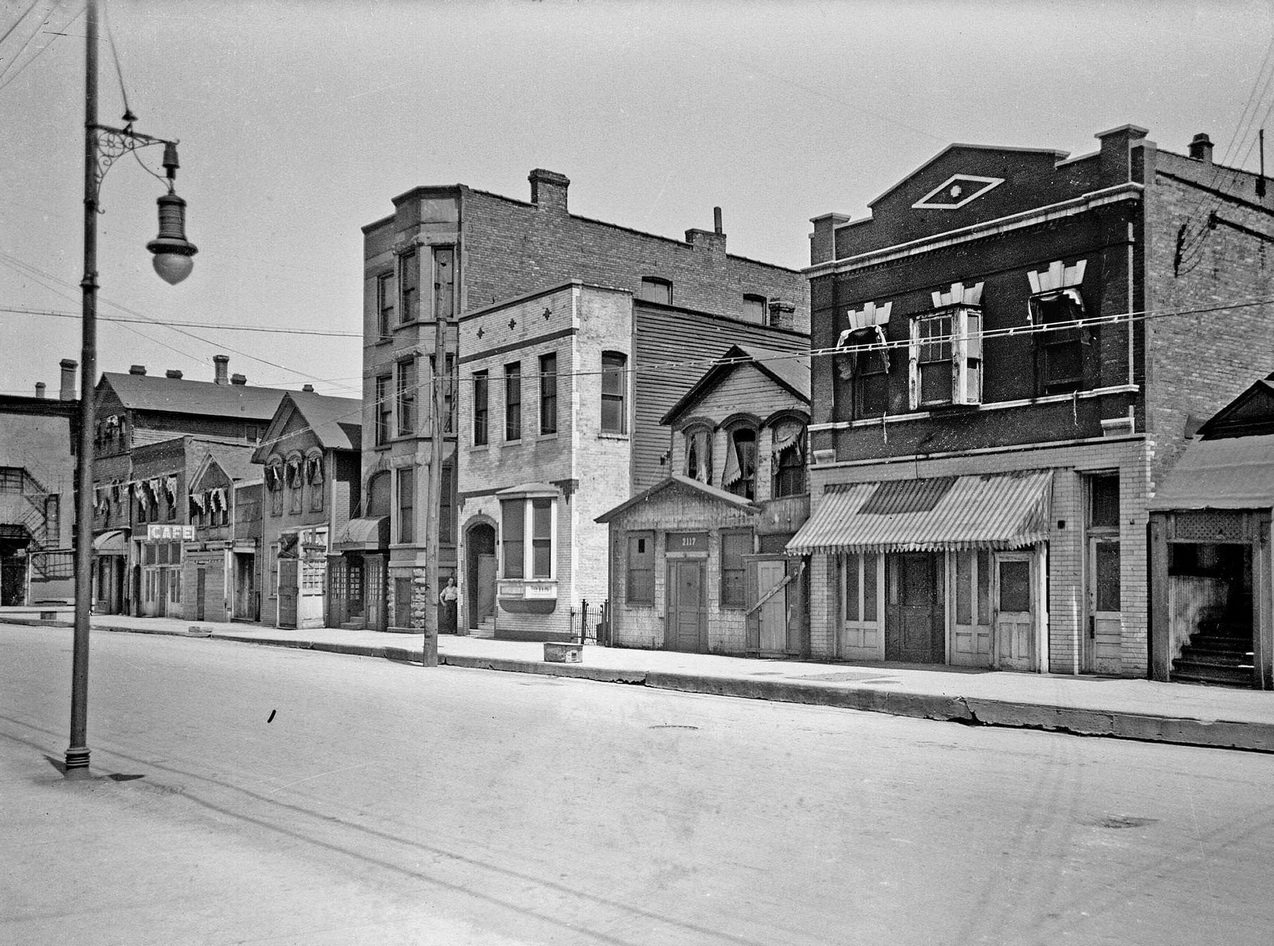
Not all of Chicago’s streets were prosperous. The Levee District was a well-known vice district on the South Side, home to saloons, gambling houses, and brothels. Its residential blocks stood in stark contrast to the grand avenues of the Loop just a short distance away.
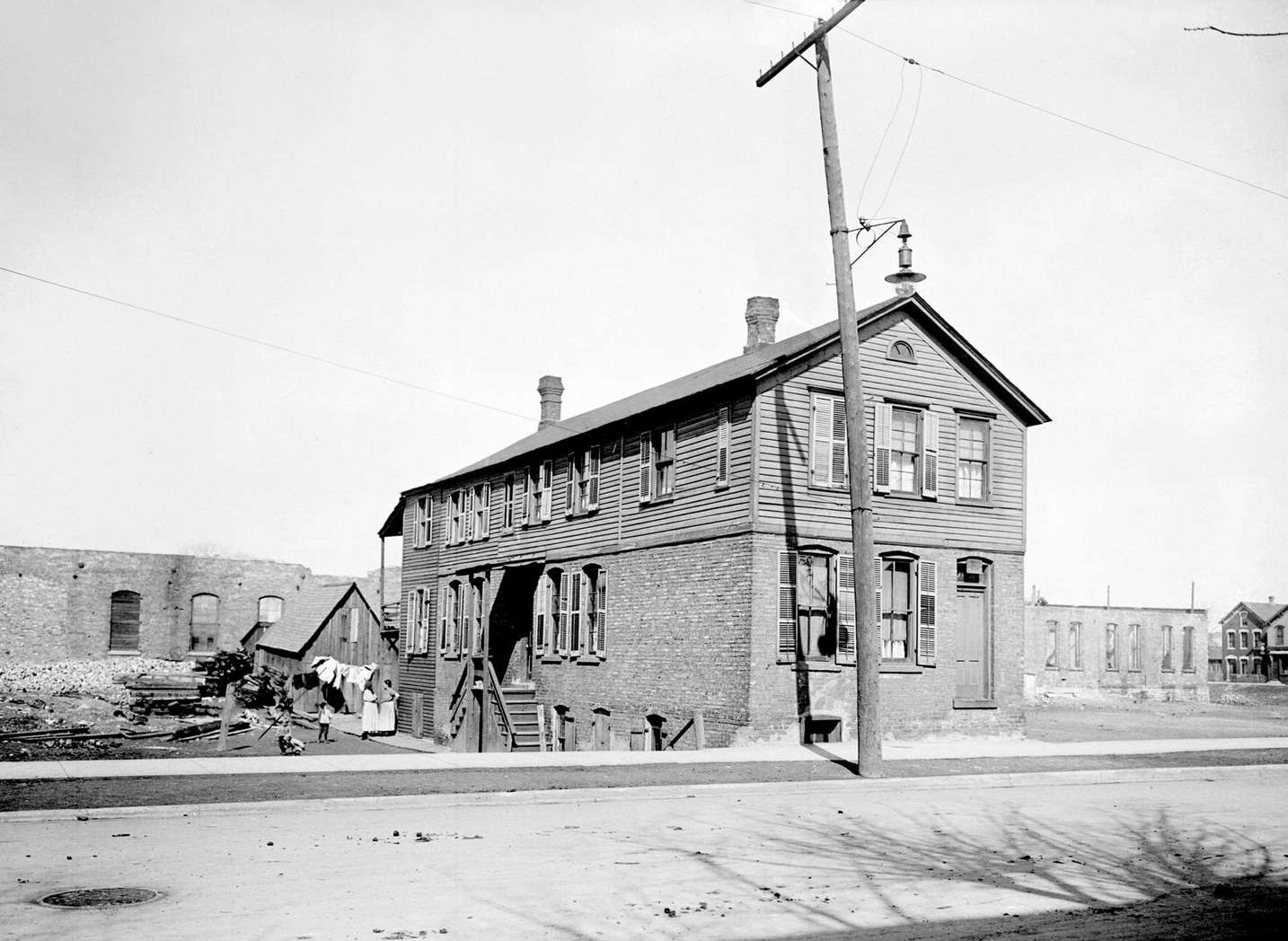
Houses on Federal Street, in the Levee District, Chicago, Illinois, 1914.
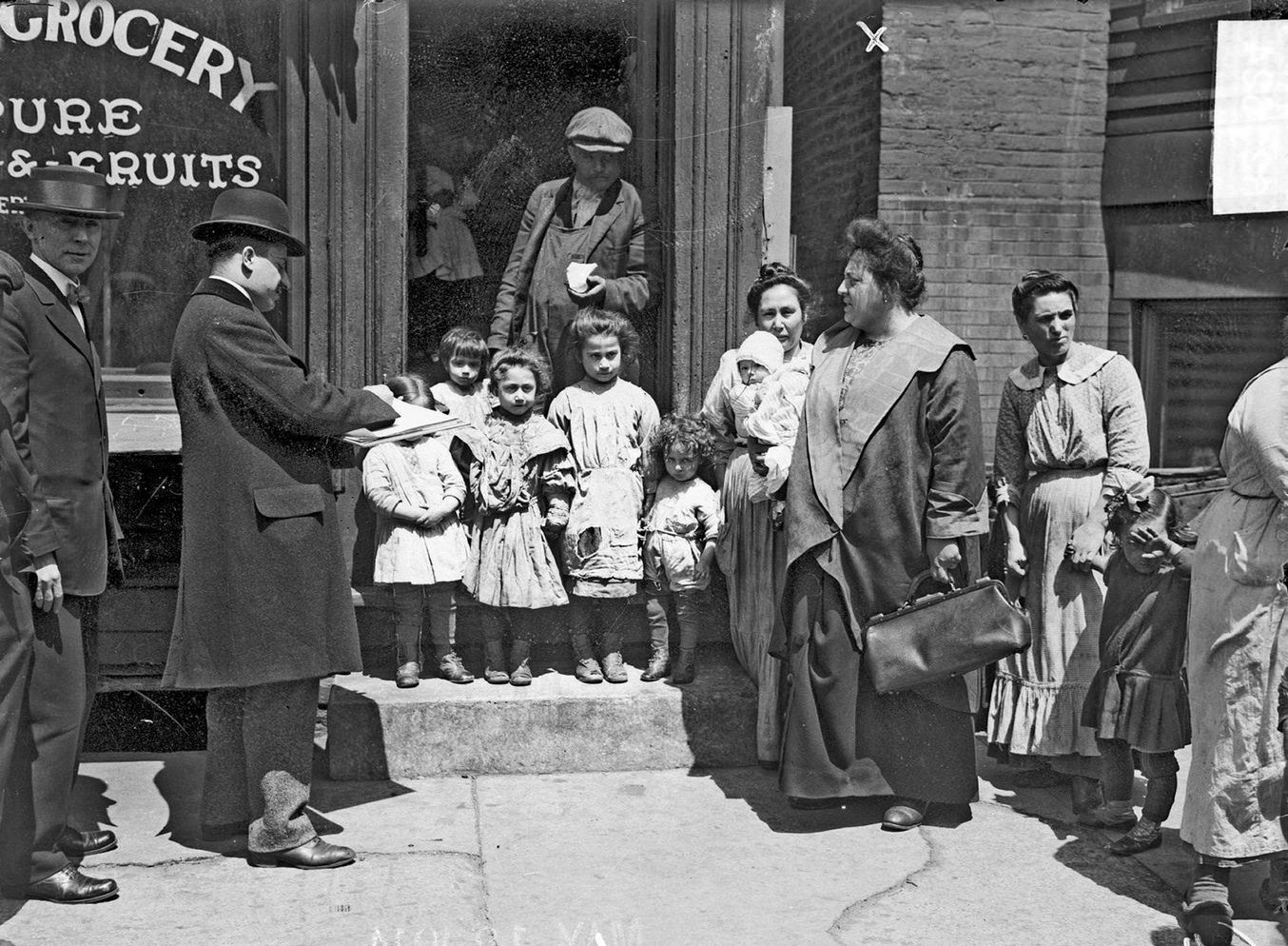
Immigrant communities built their own commercial and social worlds throughout the city. Little Italy had its own local figures, like Annie Carlo-Blasi, photographed outside a grocery store surrounded by her neighbors. The Near West Side’s Maxwell Street was the beating heart of Chicago’s Jewish community, where the famous Sunday market drew merchants and shoppers from across the city every week.
Annie Carlo-Blasi, queen of Little Italy, standing beside grocery store with men, women, and children, Chicago, Illinois, 1914.
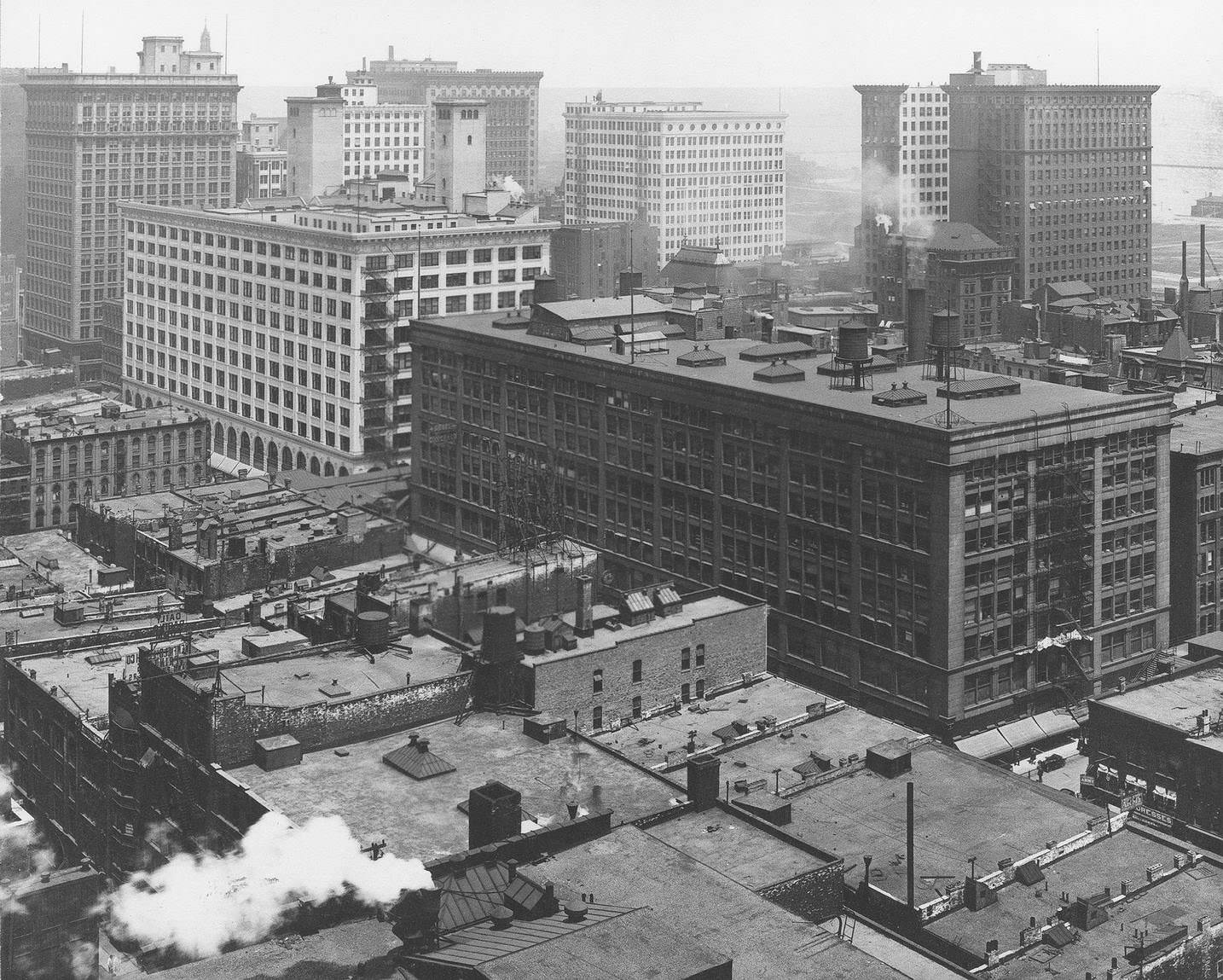
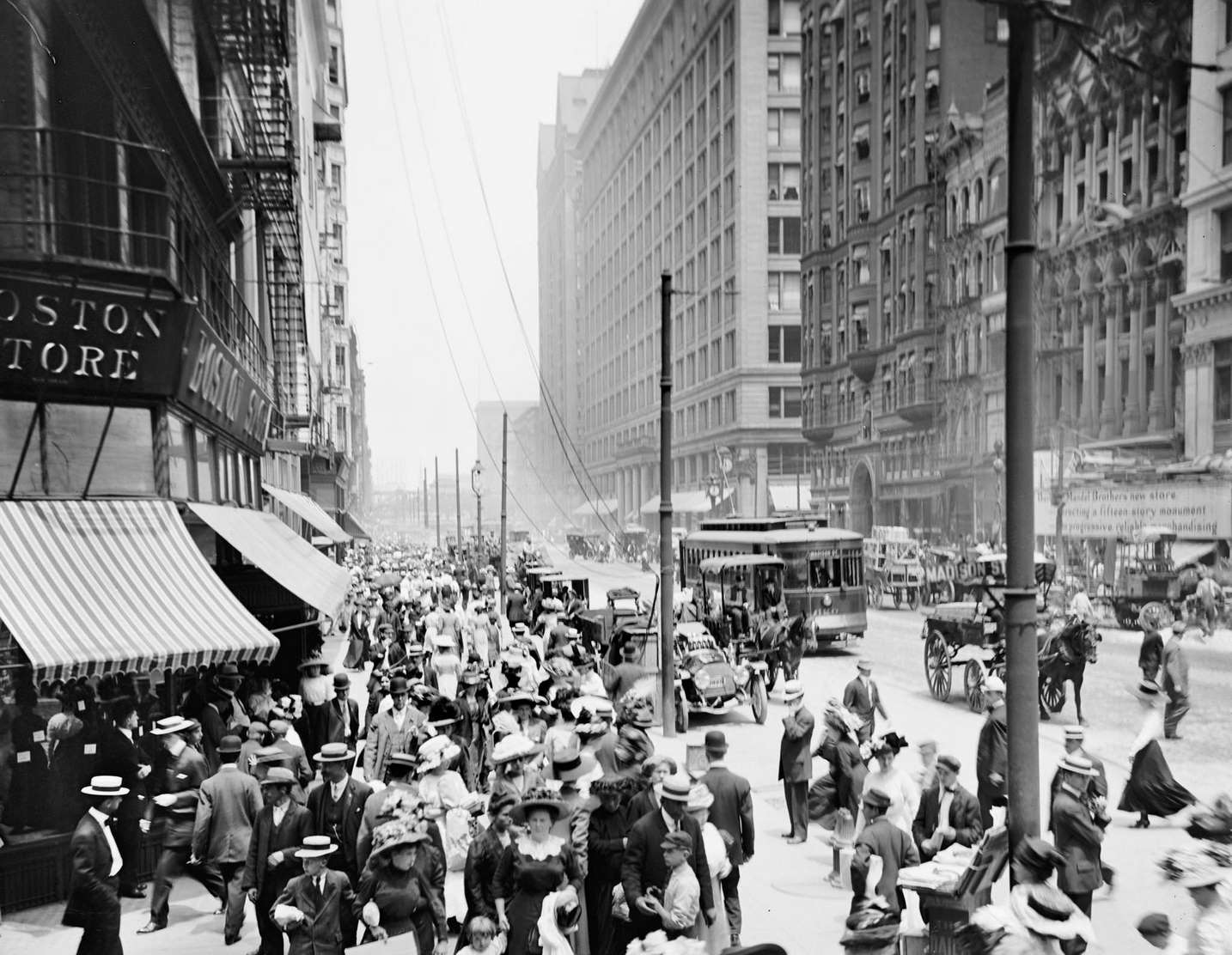
State Street at Christmas in 1913 was a scene of organized chaos. Sidewalks were packed with shoppers, and the street itself was jammed with automobiles, horse-drawn wagons, and streetcars all competing for the same lanes. The Loop was already the city’s commercial center, drawing people from every neighborhood.
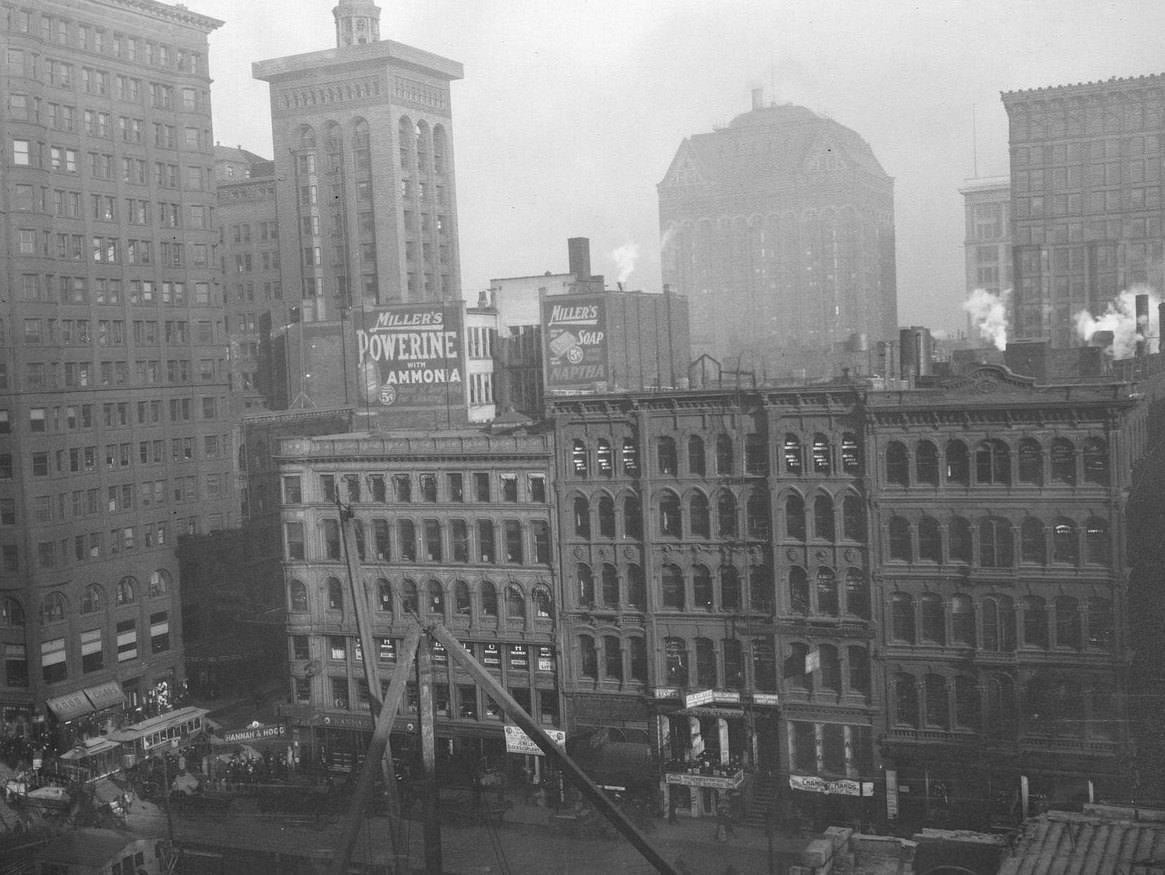
State Street in the Loop community area at Christmas, with sidewalk crowded with shoppers and street crowded with automobiles, horse drawn wagons, and streetcars, Chicago, Illinois, December 1, 1913.Panoramic view of Chicago Loop, Chicago, Illinois, 1913.
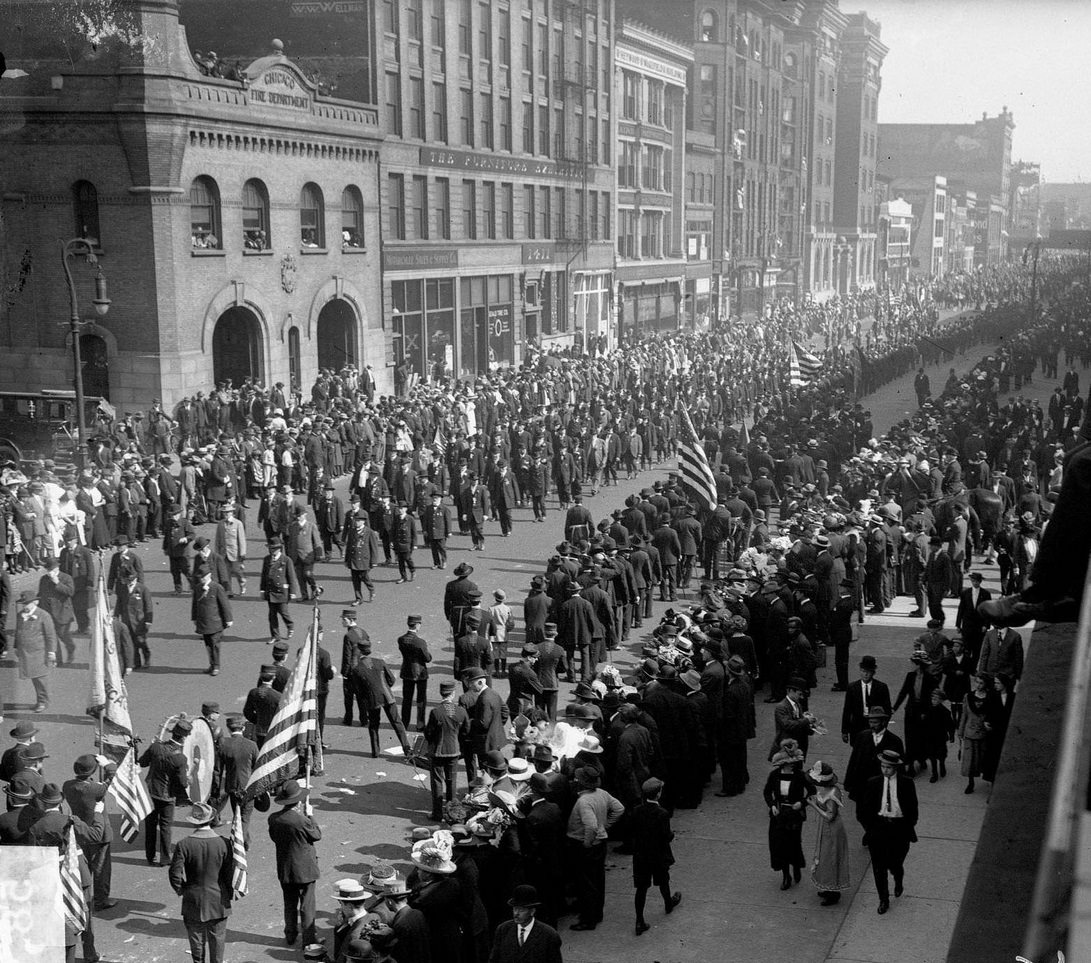
In May 1912, Civil War veterans marched down South Michigan Avenue in a Grand Army of the Republic Memorial Day parade. By this point, these men were aging survivors of a war fought half a century earlier. The sight of them marching past the firehouses and commercial buildings of Motor Row connected Chicago’s present to a much older American story.
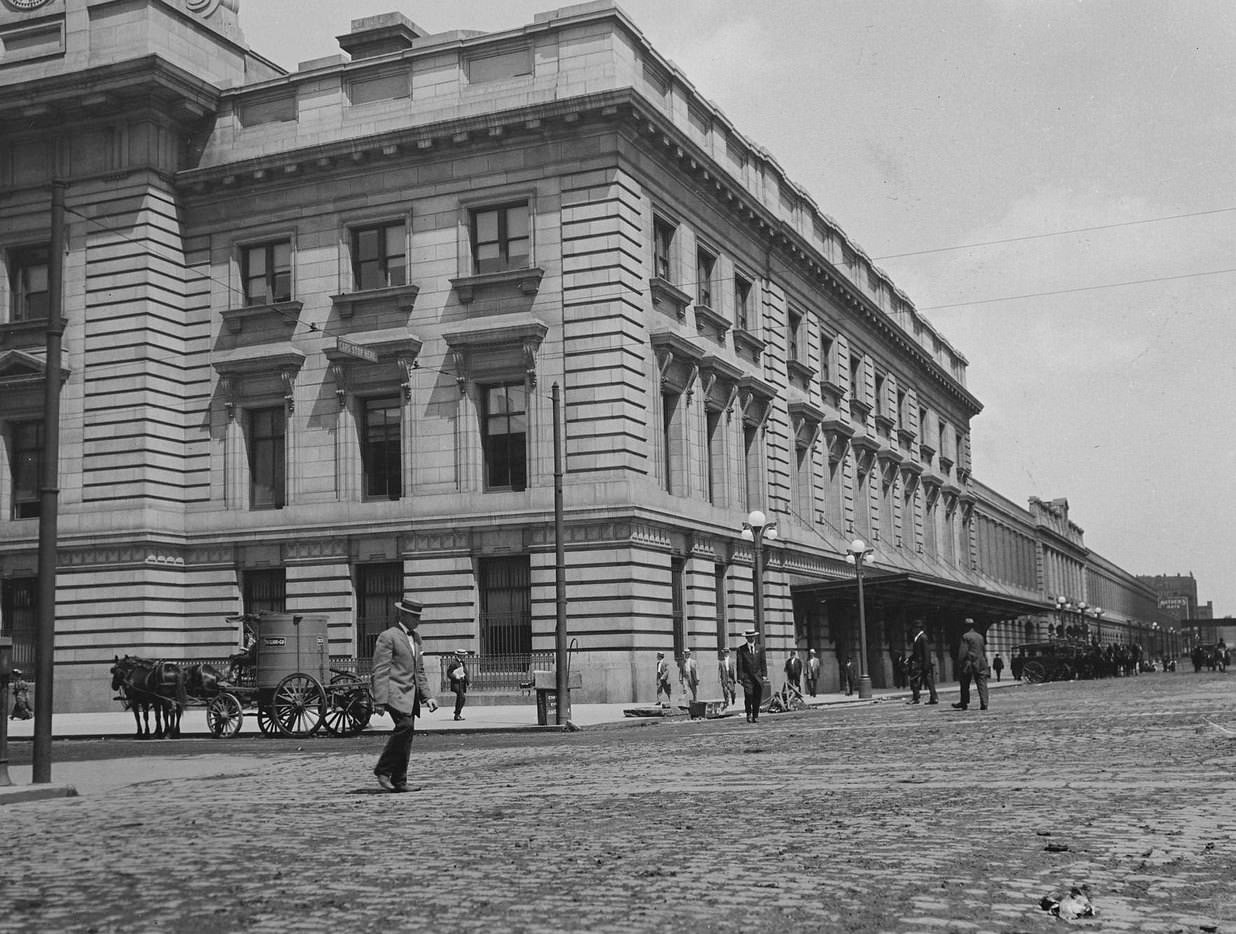
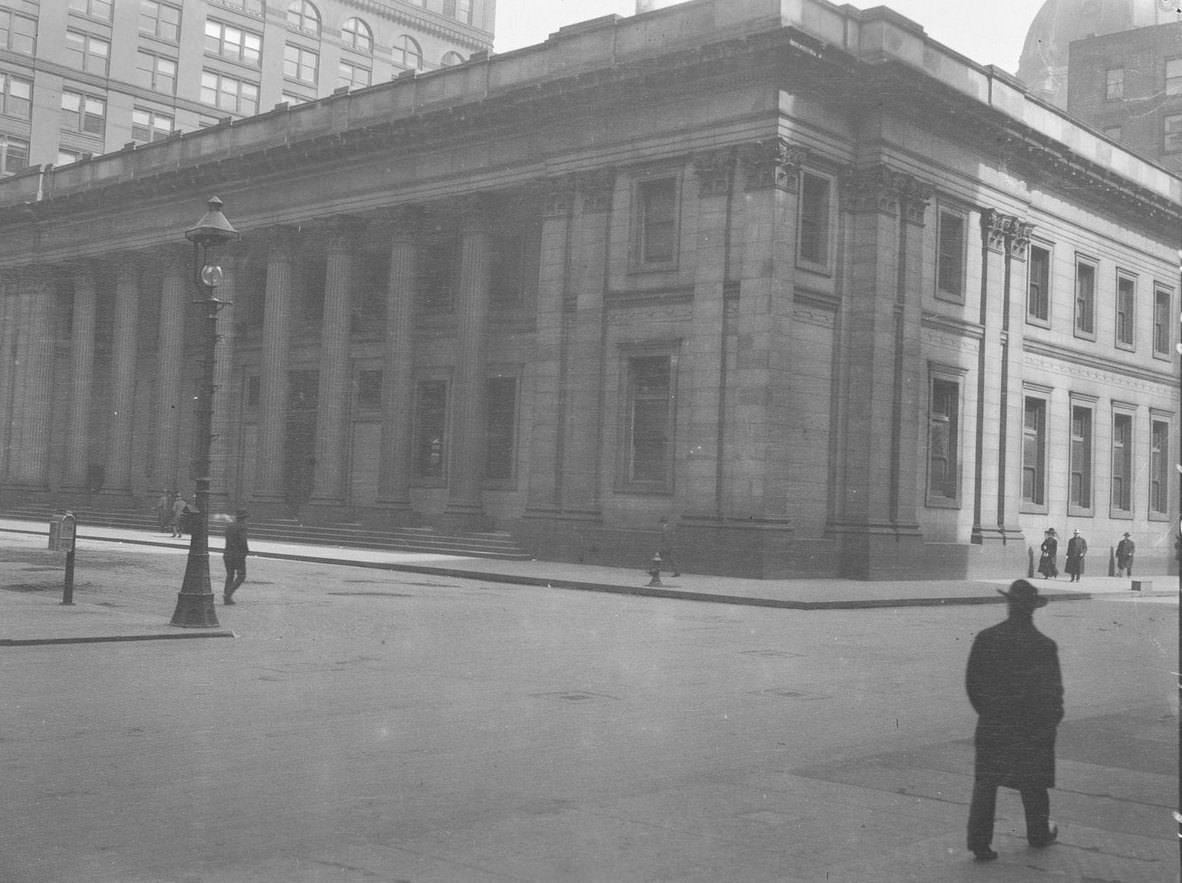
Civil War veterans marching in a Grand Army of the Republic Memorial Day parade along the 1400 block of South Michigan Avenue in the Near South Side community area, Chicago, Illinois, May 27, 1912.Chicago and North Western Railroad Depot, located on the northwest corner of Madison Street and Canal Street, Chicago, Illinois, 1911.
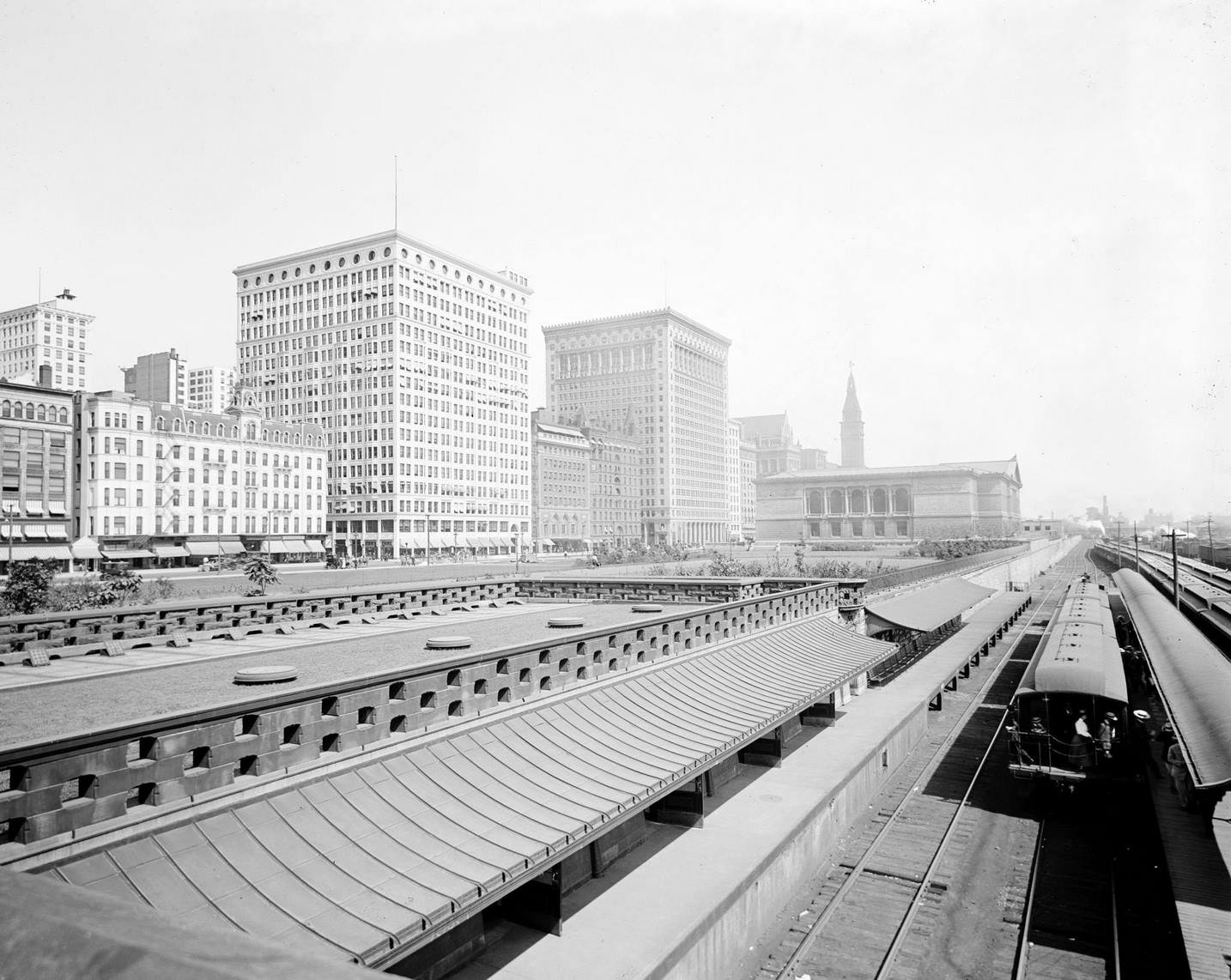
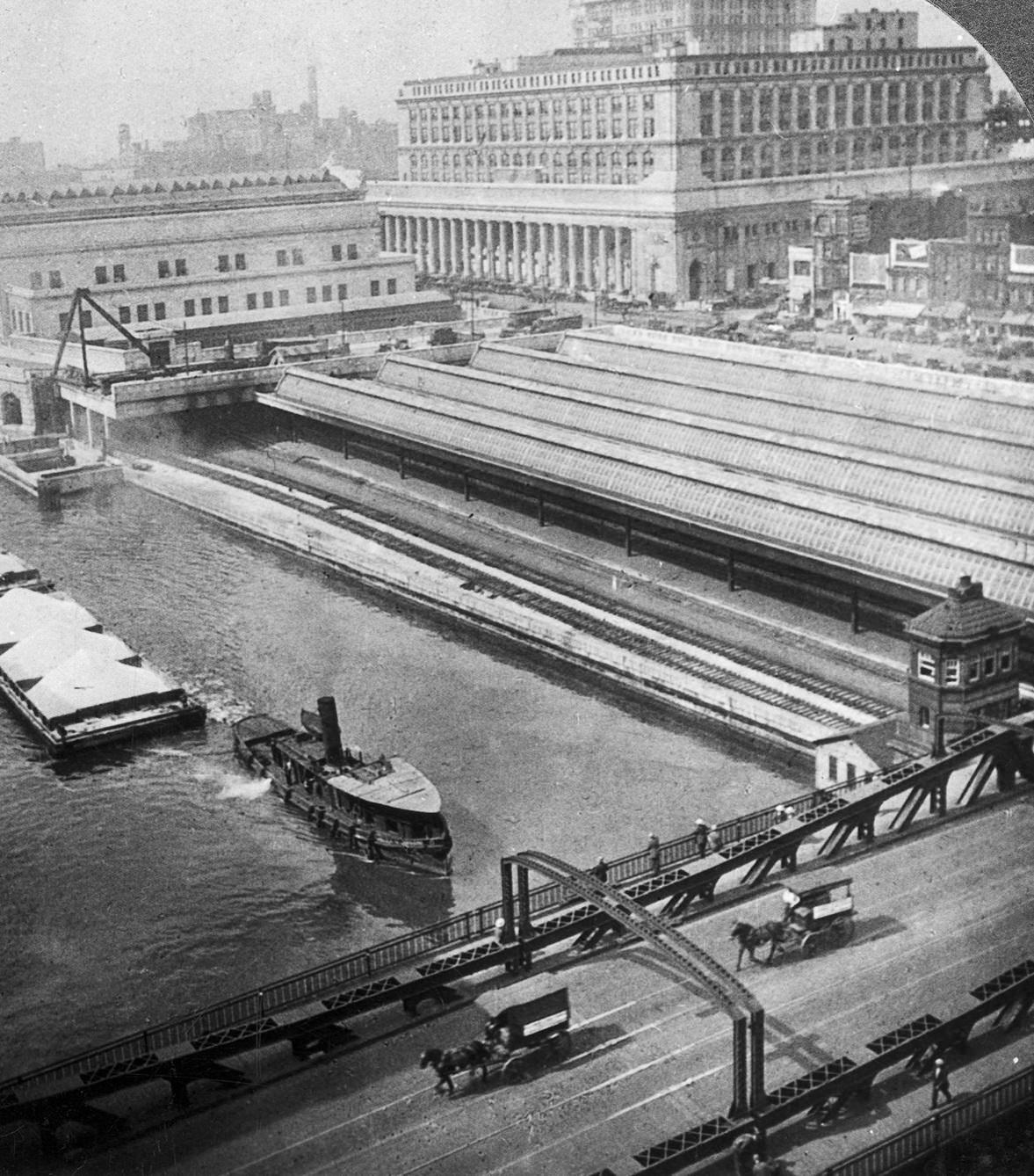
Chicago was the railroad capital of the United States in this era. More rail traffic passed through the city than anywhere else in the world. The Chicago and North Western Railroad Depot, the Union Station, and the vast rail yards near Canal Street and Van Buren Street were all central to this reality. The city’s river and rail networks worked together, handling freight and passengers around the clock.
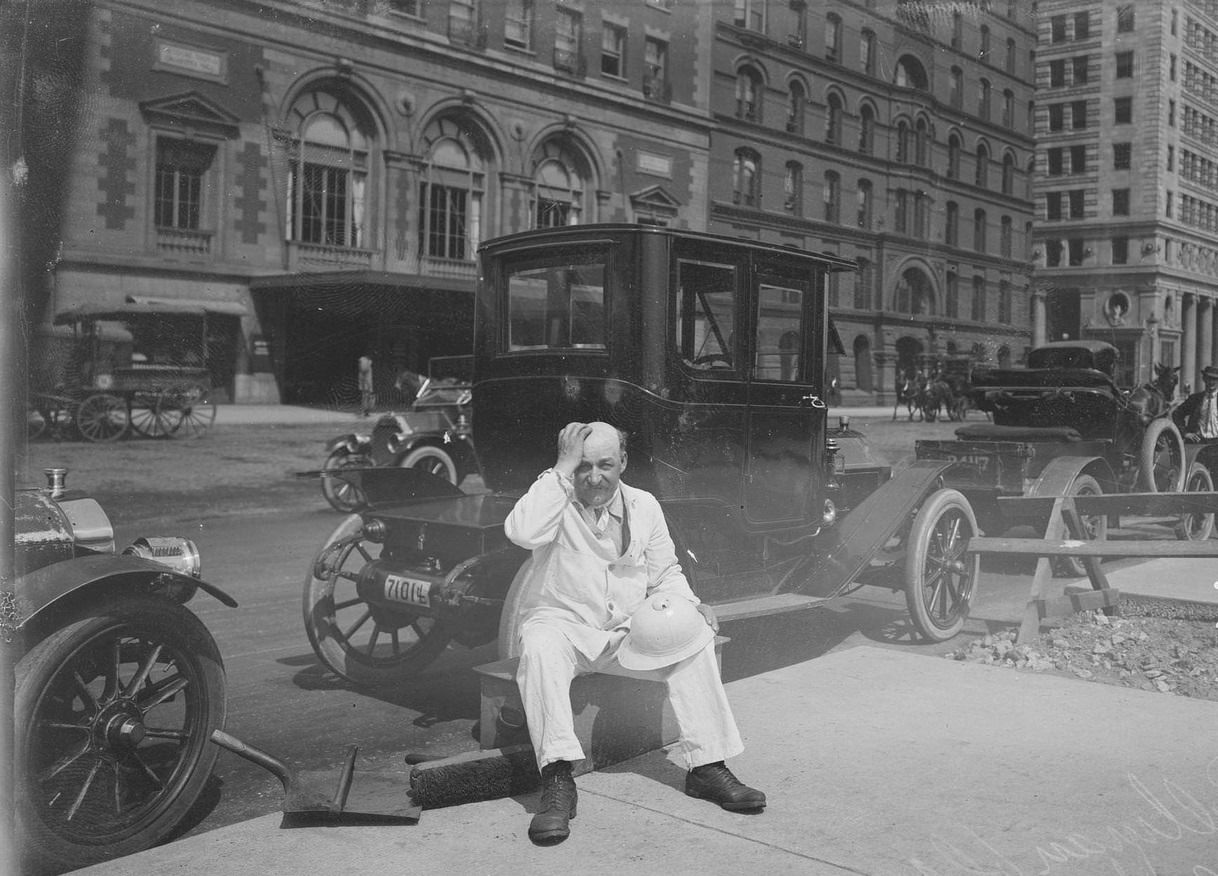
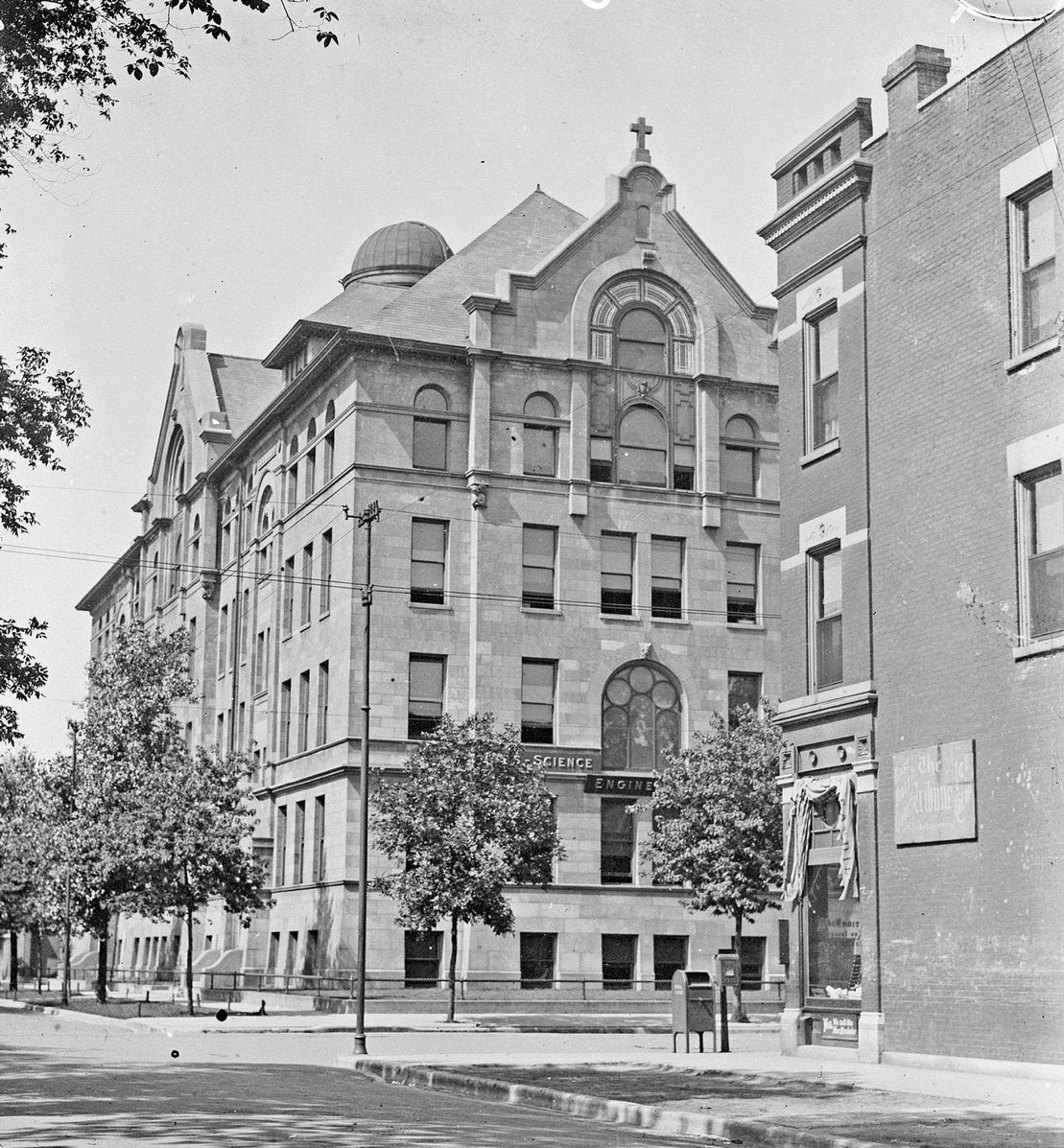
City of Chicago street sweeper on a hot day, sitting on a trash can on Michigan Avenue, across from Orchestra Hall, Chicago, Illinois, 1911.Exterior of DePaul University building, Chicago, Illinois, 1911.
Education in Chicago during the 1910s was a complicated picture. Public schools served large numbers of children, but many Catholic families sent their children to the city’s extensive parochial school system. Private schools like the Latin School and the Francis Parker School served families with greater means. Institutions like DePaul University stood as part of the Catholic educational network that shaped large parts of the city.
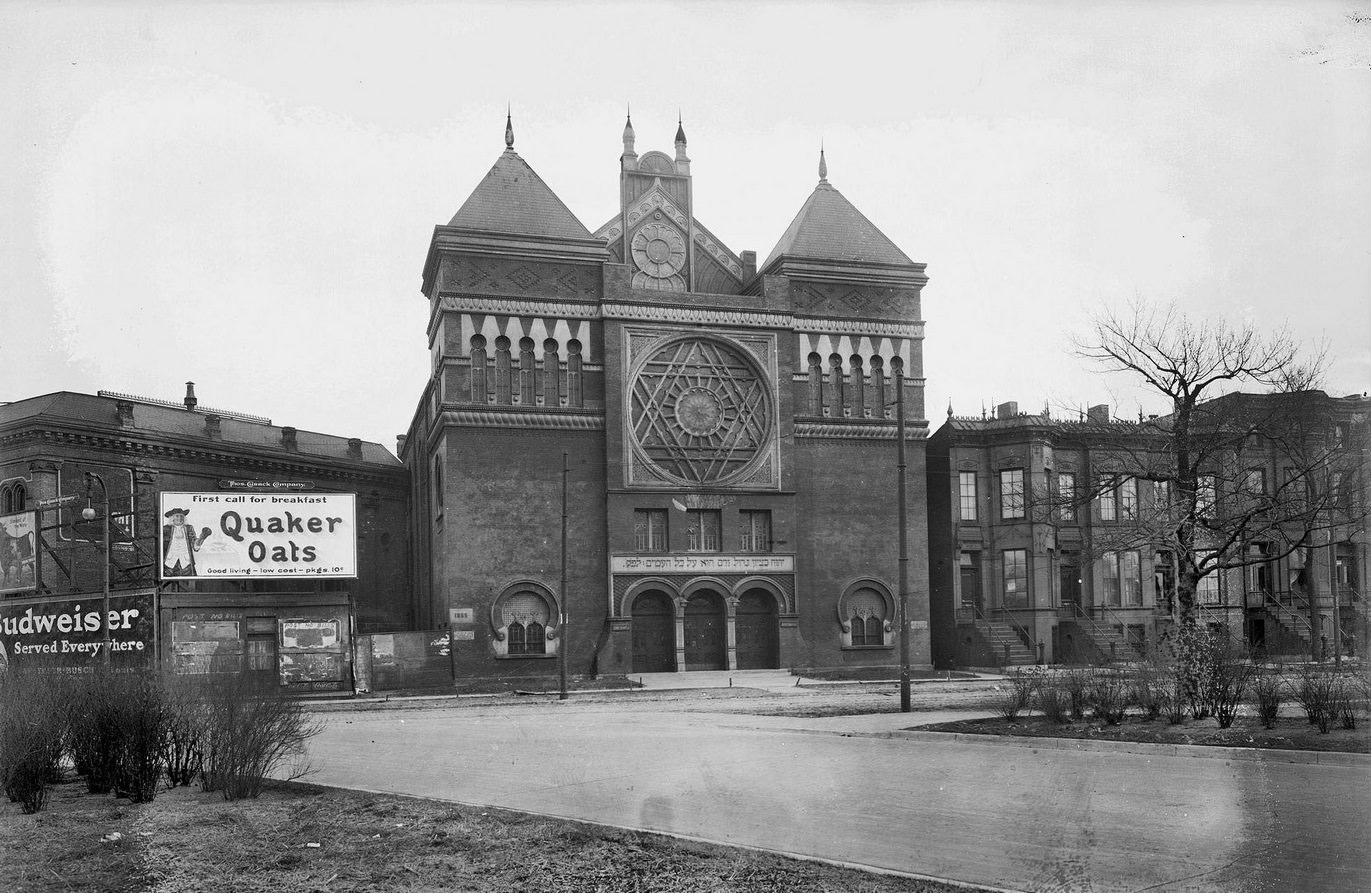
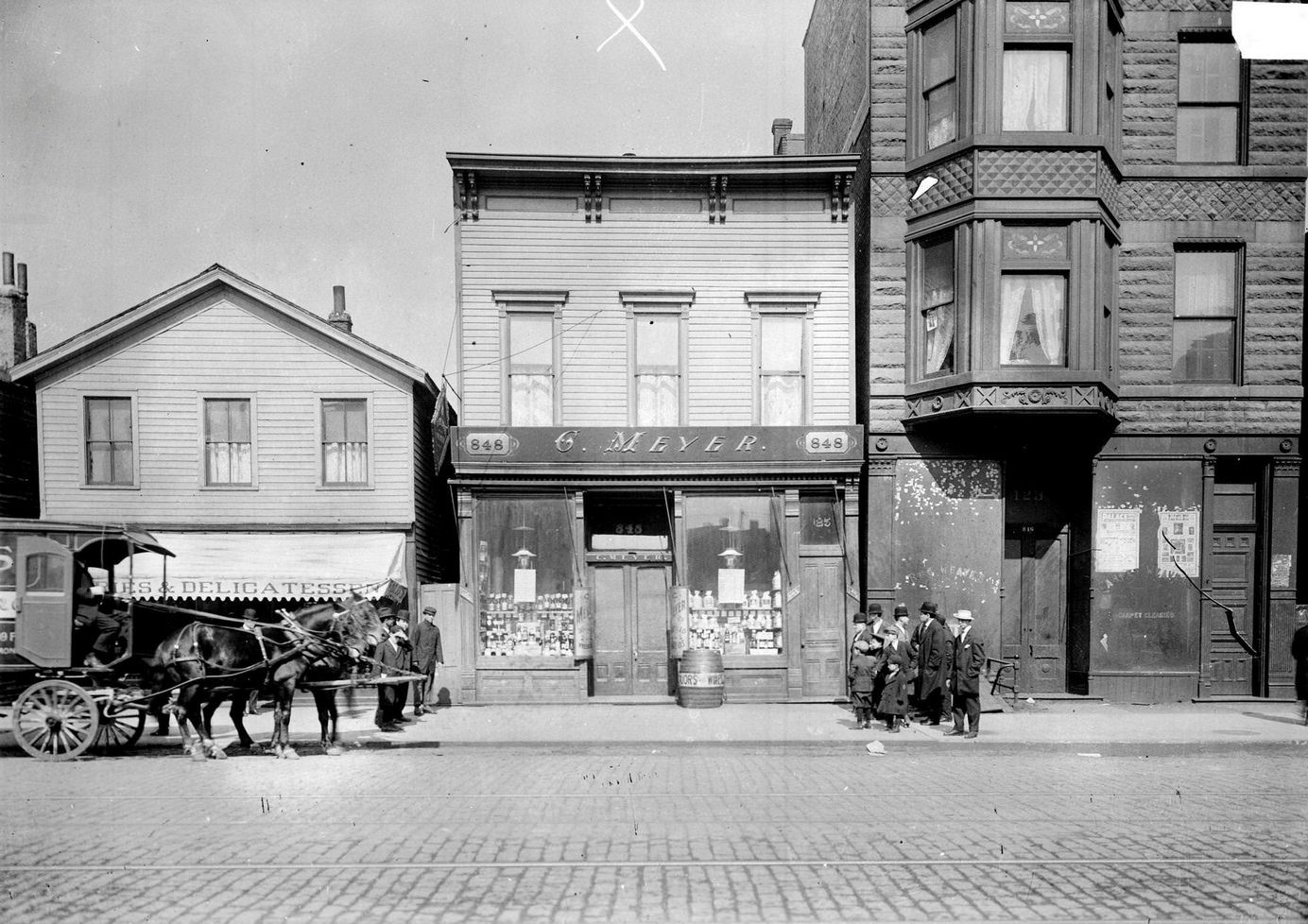
Exterior view of Zion Temple located at North Ogden Avenue and West Washington Street in the Near West Side community, Chicago, Illinois, 1911.Exterior view of Cerf Meyer’s saloon at 848 Blue Island Avenue in Chicago, 1911.
Chicago’s saloon culture was deeply woven into neighborhood life. Places like Cerf Meyer’s on Blue Island Avenue served as community gathering spots, especially in working-class and immigrant neighborhoods. On the other end of the legal spectrum, a building on South State Street was identified by authorities in 1911 as the site of a counterfeit coin operation.
A building at 6657 S. State Street which operated a counterfeit coin operating racket, Chicago, 1911.
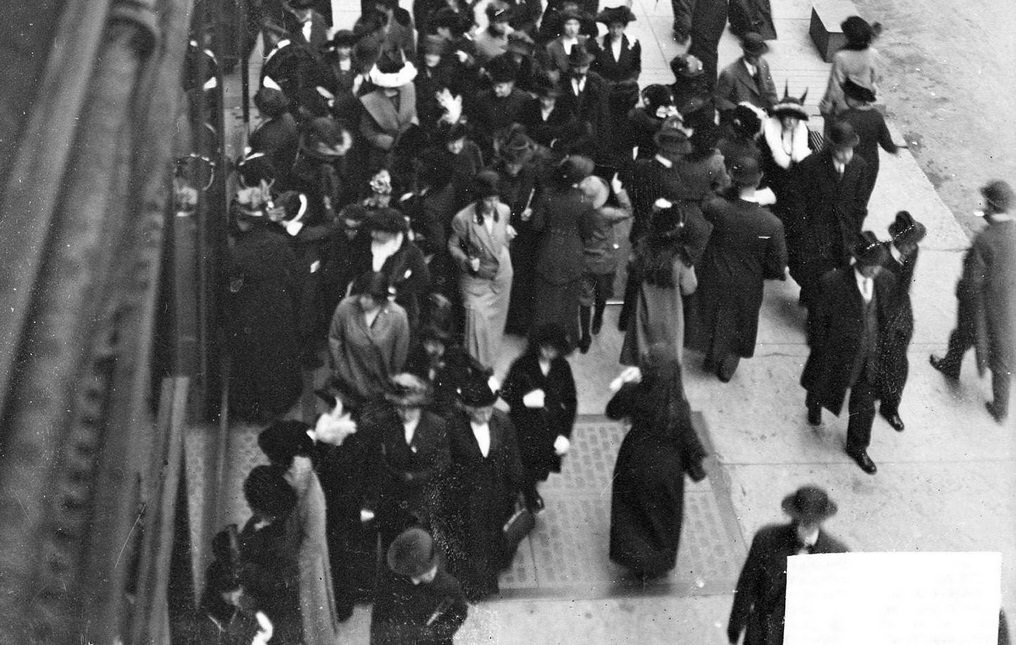
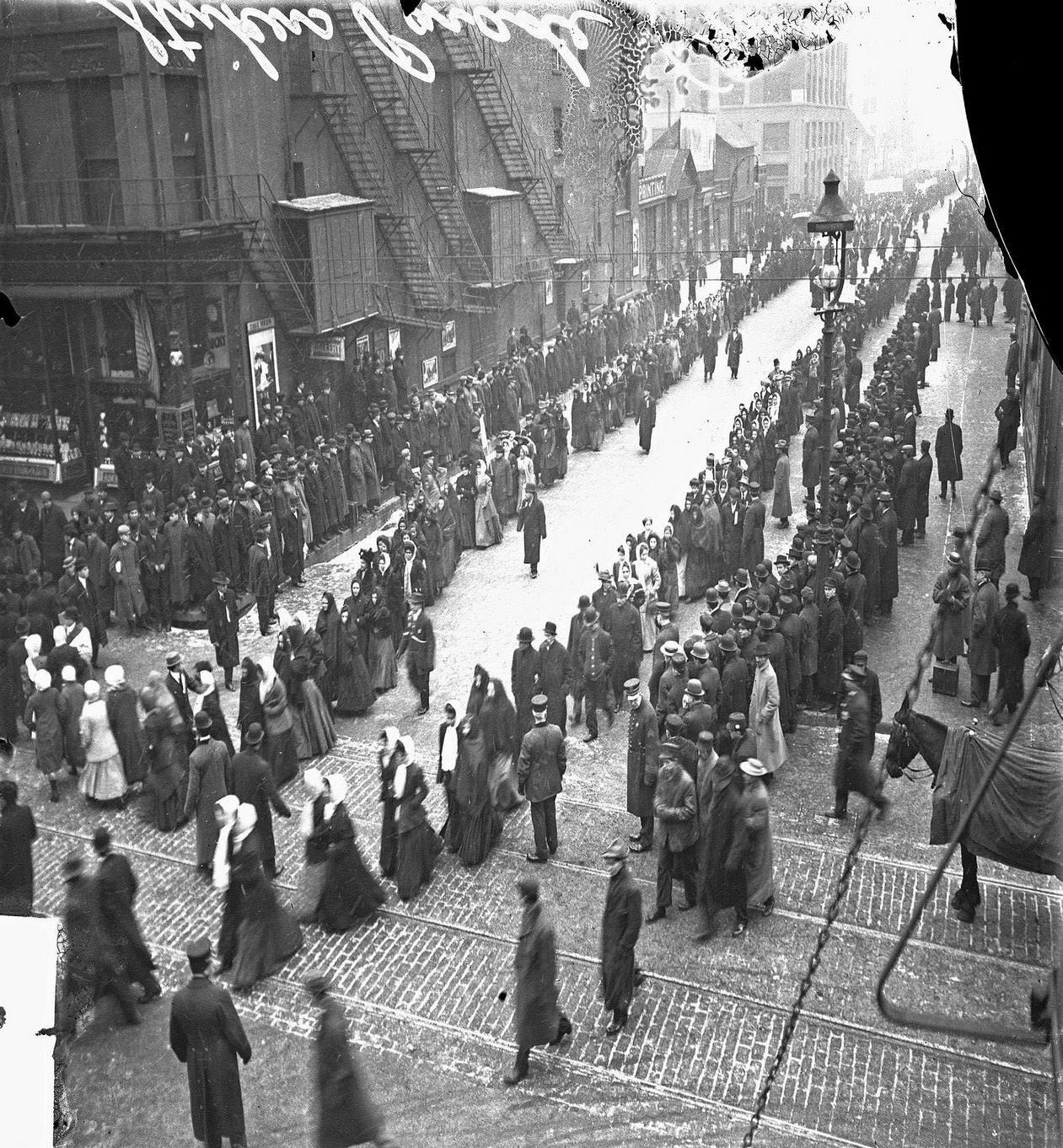
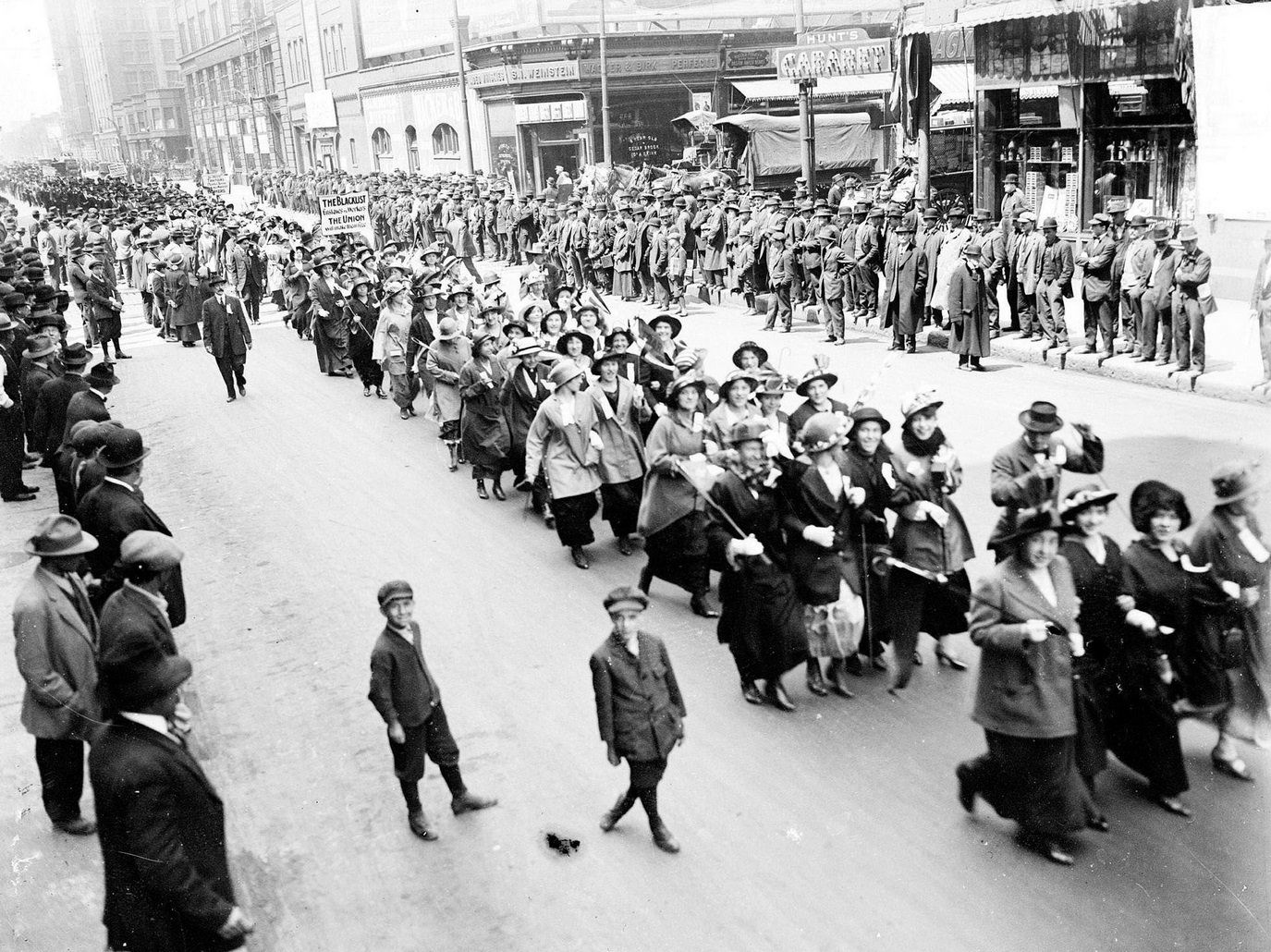
Labor conflict was a recurring fact of life in Chicago throughout the decade. In December 1910, workers from the United Garment Workers of America took to West Jackson Boulevard in a major strike. Garment manufacturing was one of Chicago’s largest industries, and the battle over wages and conditions was fought out in the streets as much as in the factories.
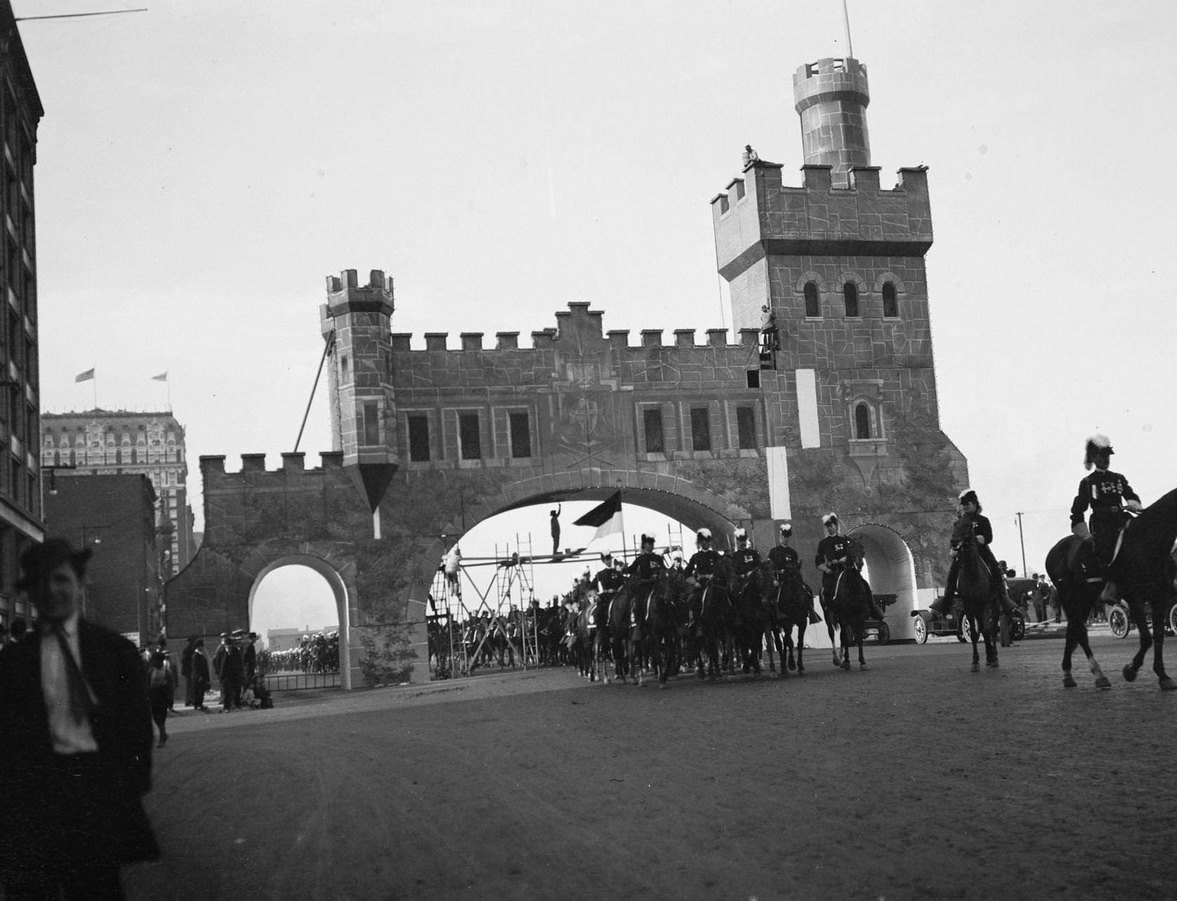
A parade of men and women along West Jackson Boulevard during the United Garment Workers of America strike, Chicago, Illinois, December 12, 1910.Knights Templar parade, Chicago, Illinois, August 9, 1910.
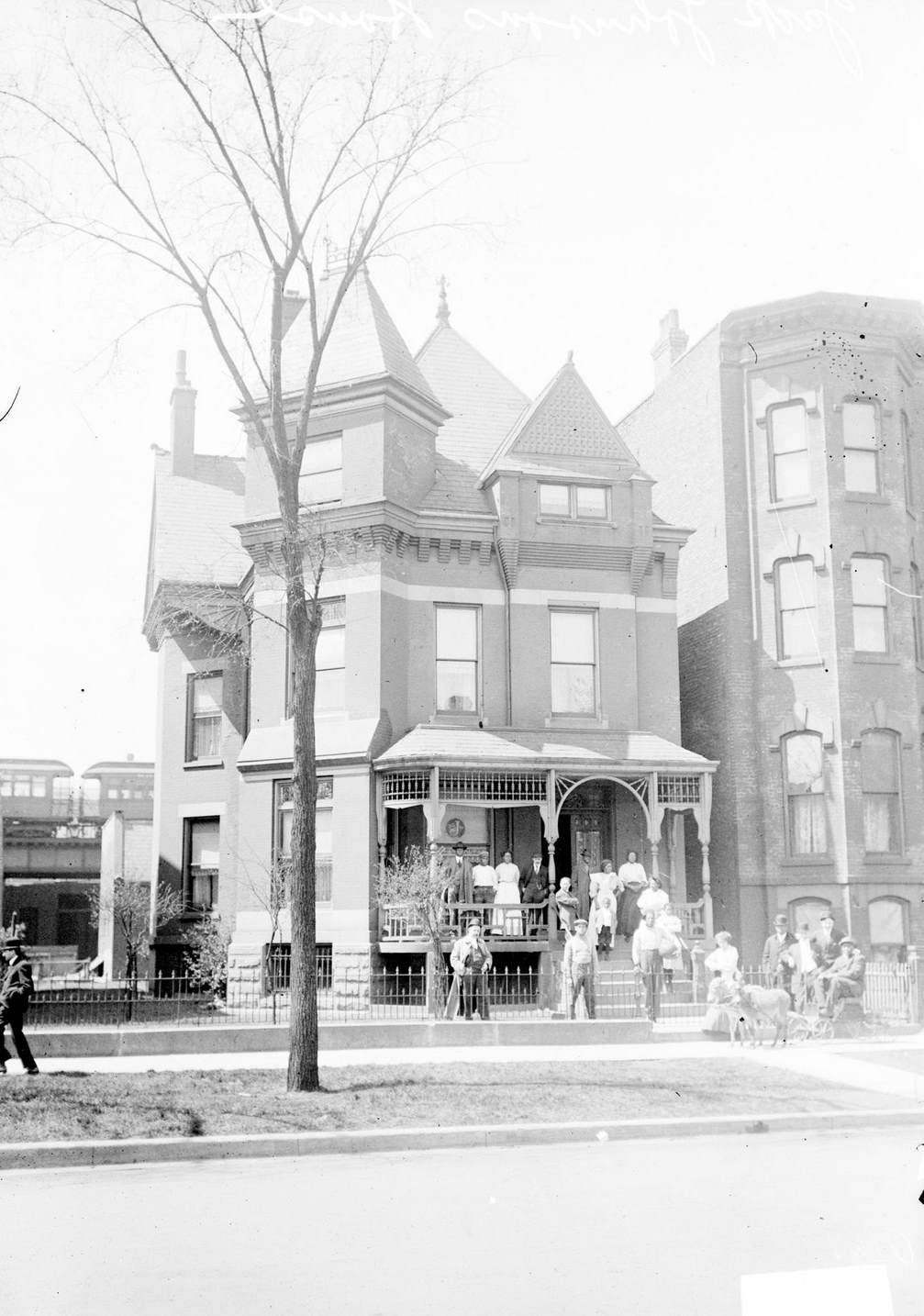
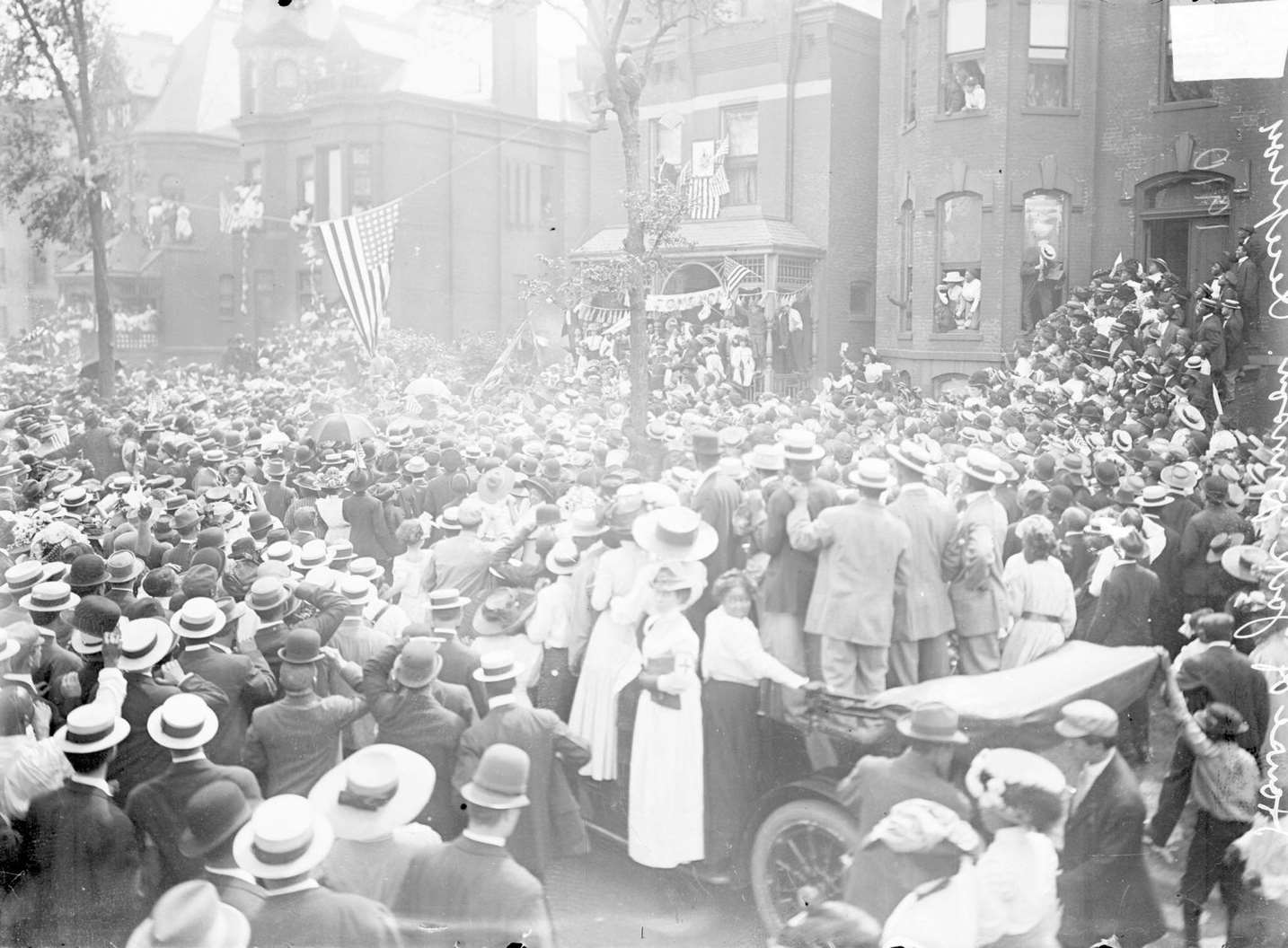
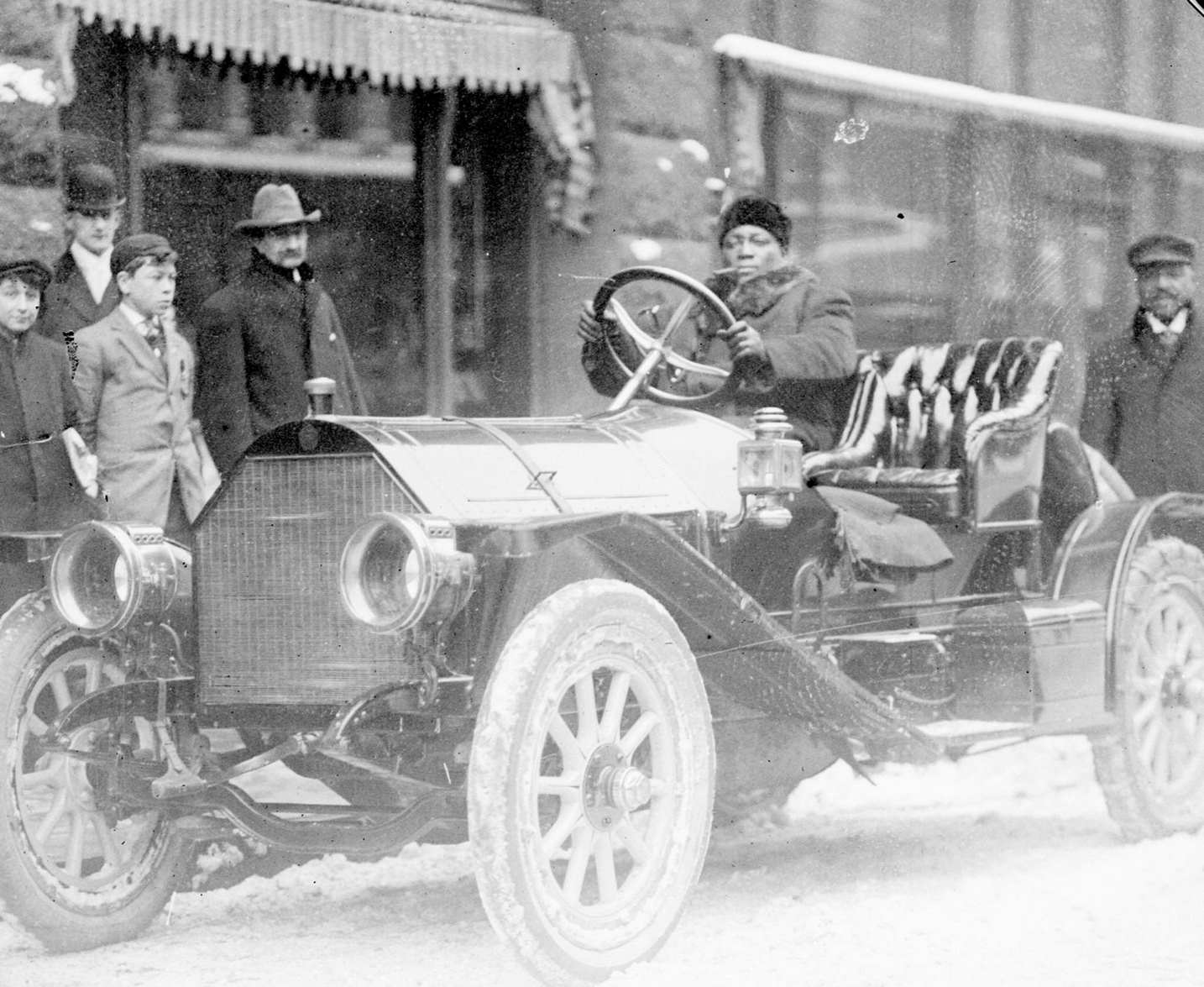
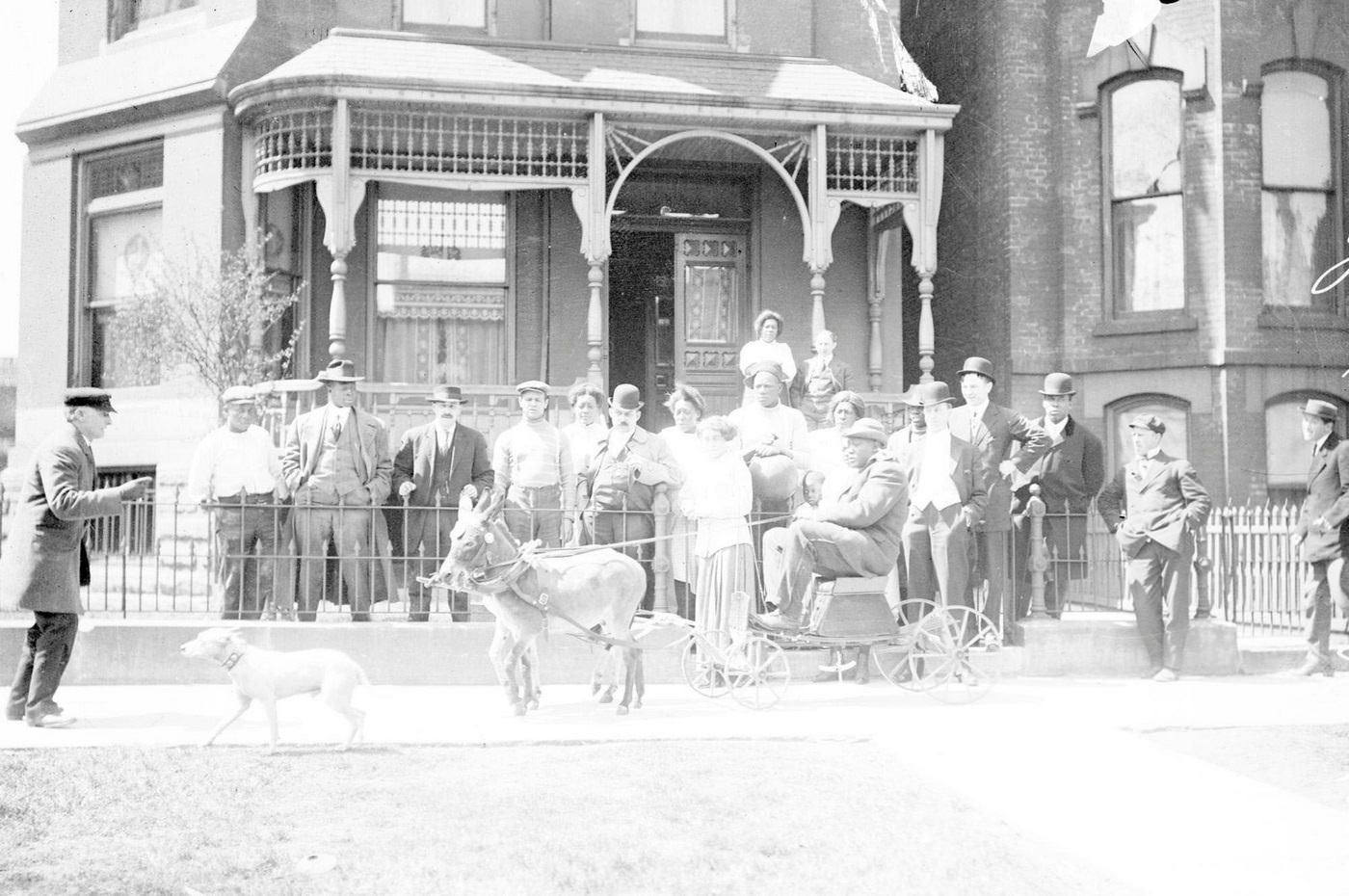
Heavyweight boxing champion Jack Johnson was one of Chicago’s most famous residents at the start of the decade. Johnson was the first African American to hold the world heavyweight title, and his home on the South Side drew large crowds. In 1910, people gathered outside for a reception in his honor, filling the street and crowding the porch. Johnson was also known for his love of automobiles, a symbol of wealth and modernity that he embraced fully.
The home of Jack Johnson in Chicago, IL, 1910. Many people are standing on the porch and in front of the building.A large crowd of people gathering on the street in front of a house where Jack Johnson’s reception was taking place in Chicago, 1910.Pugilist Jack Johnson sitting in the driver’s seat of a convertible automobile and holding on to the steering wheel on a snow-covered street in Chicago, Illinois, 1910s.Boxer Jack Johnson driving a small wagon pulled by two small donkeys on the sidewalk in front of a house in Chicago, 1910.
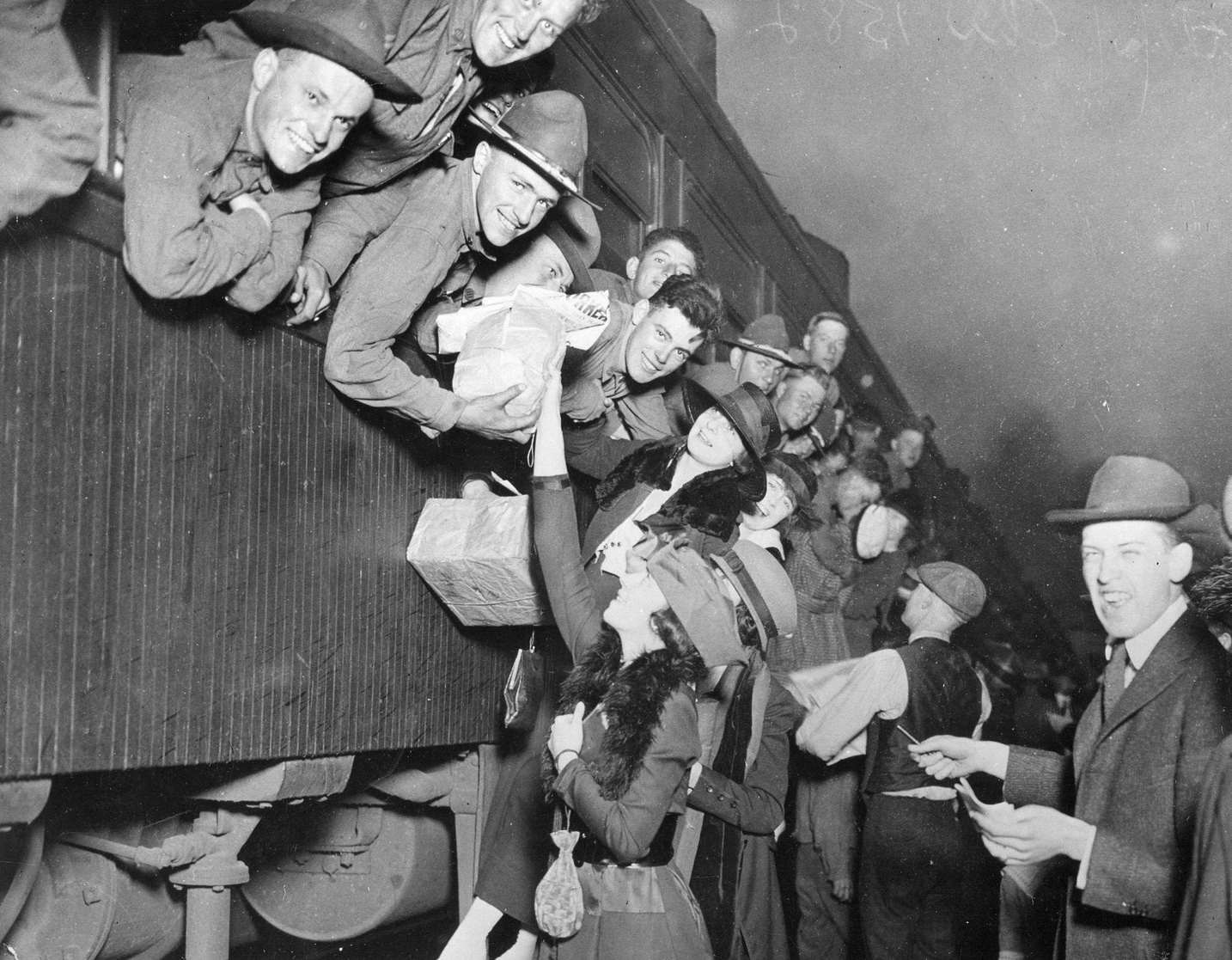
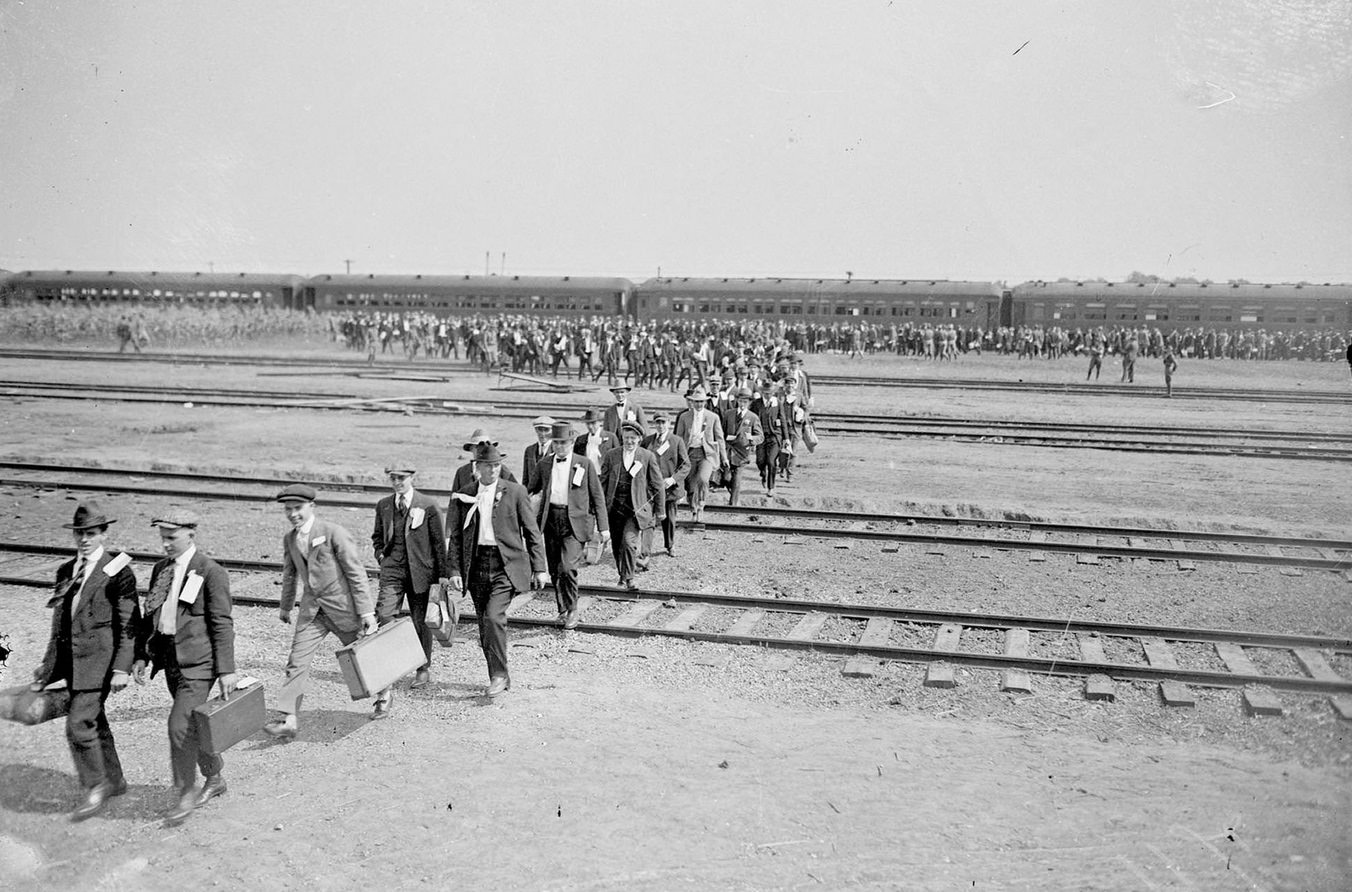
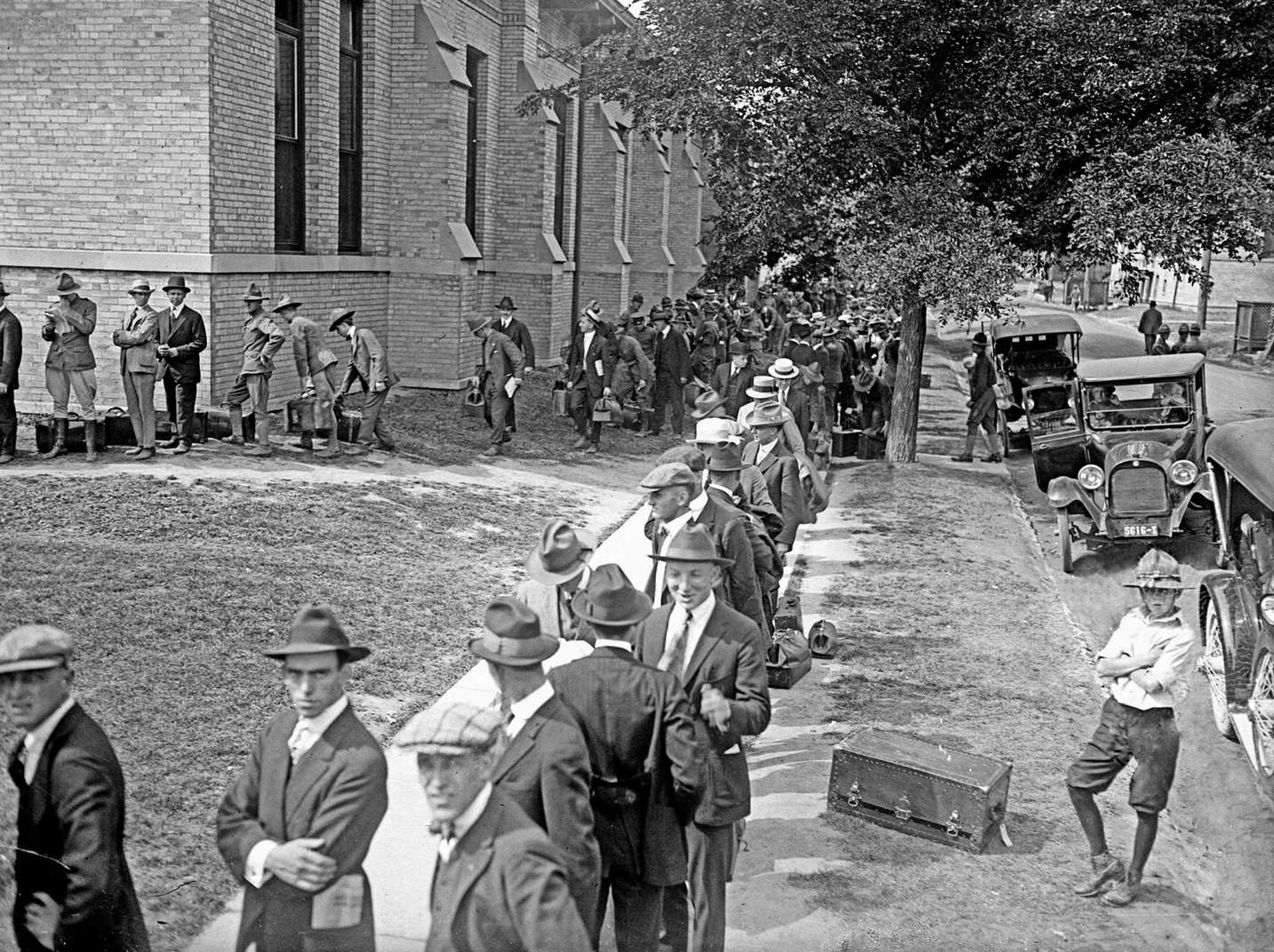
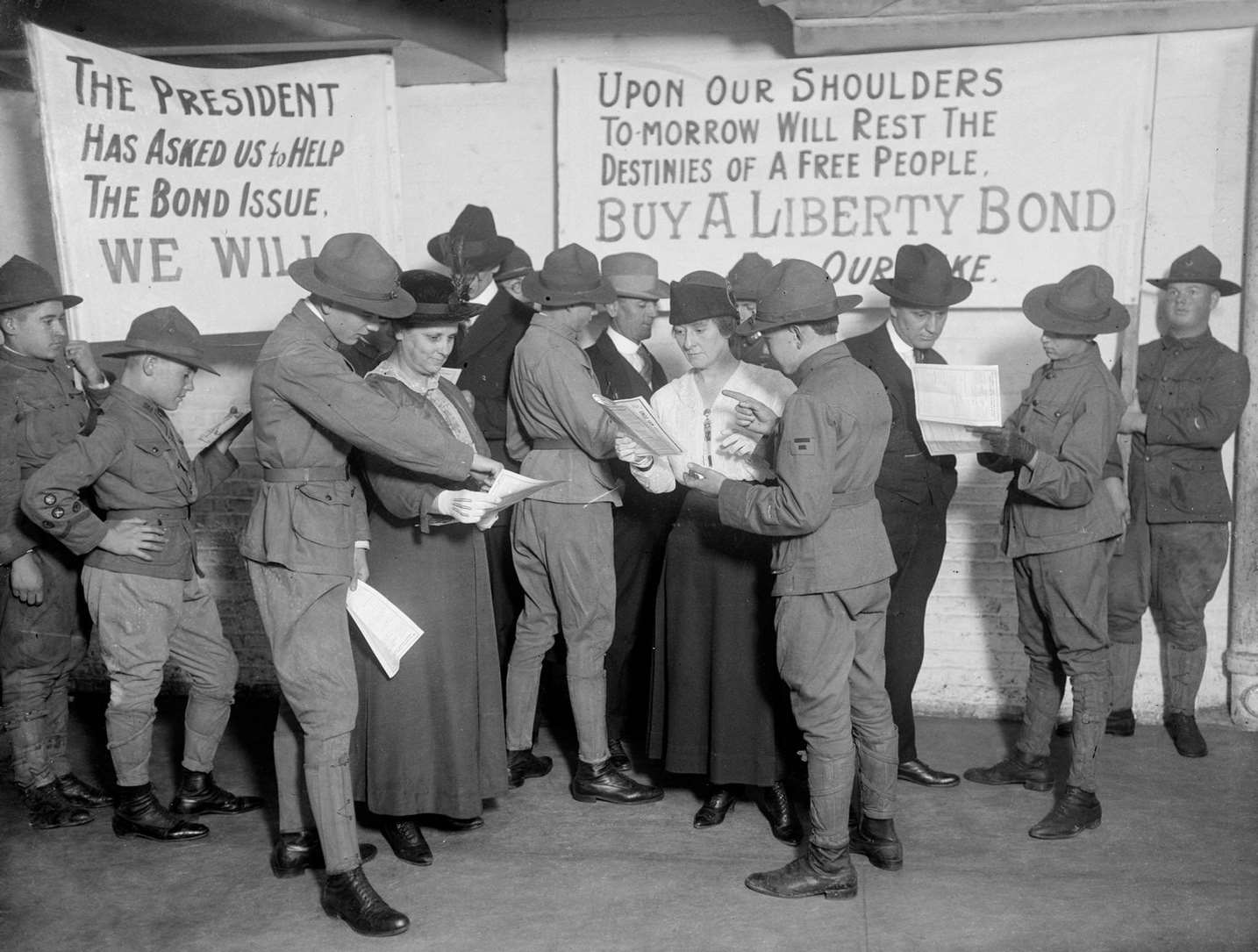
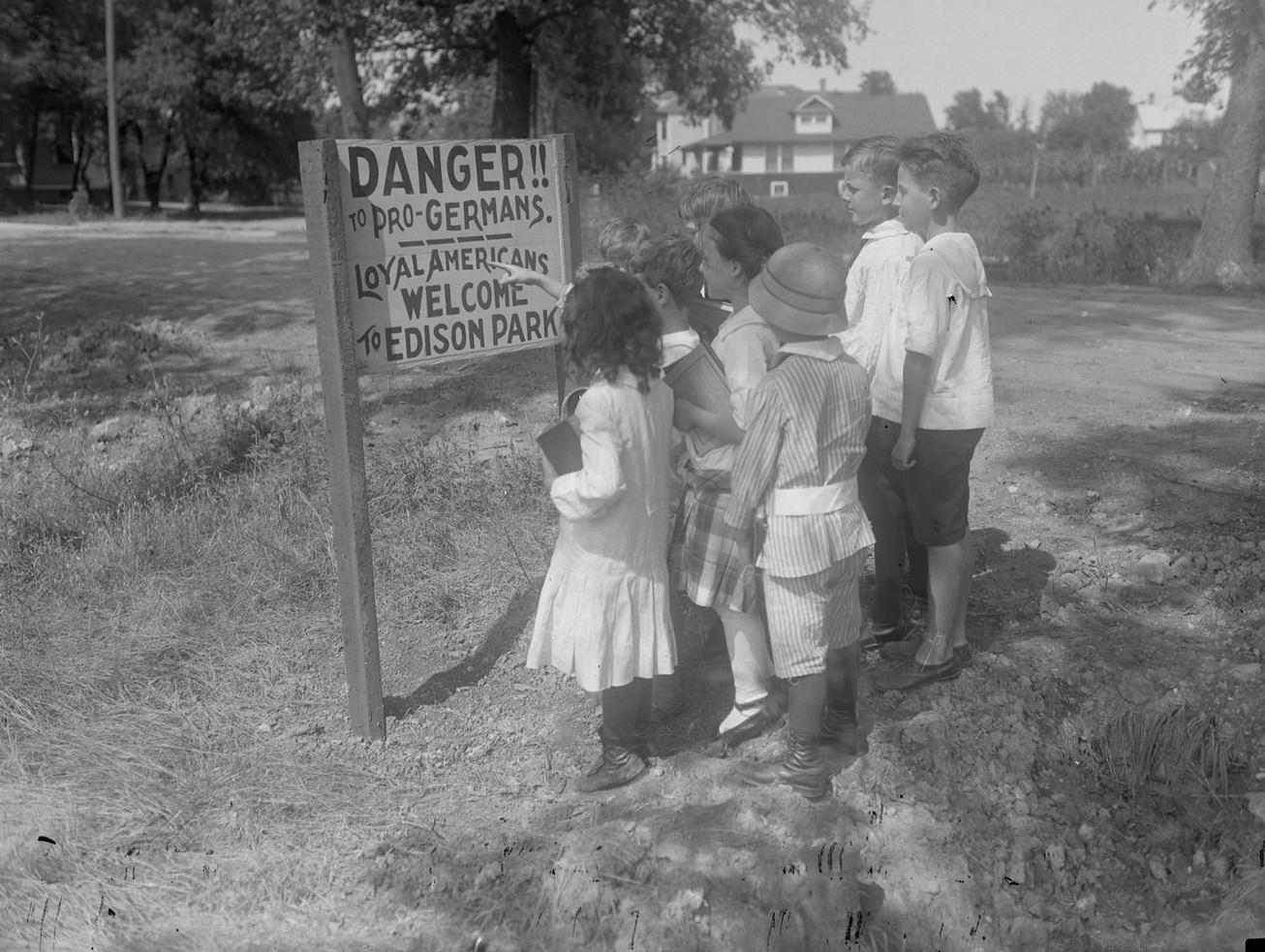
World War I reshaped Chicago’s population and economy. When the United States entered the war in 1917, thousands of Illinois men were drafted. Draftees hung from train windows as they departed for training, and recruits walked across railroad tracks at Camp Grant in Rockford. Meanwhile, the city’s industrial base shifted toward the war effort. Boy Scouts sold Liberty Bonds, anti-German signs appeared in neighborhoods like Edison Park, and J. Ogden Armour of the meatpacking industry served as treasurer of the Illinois State Council of Defense.
American draftees as they hang excitedly out of the windows of a train as they wait to leave for World War I training and combat, Chicago, Chicago, Illinois, 1917Recruits from Chicago, Illinois, walking across railroad tracks at Camp Grant in Rockford, Illinois, Chicago, Illinois, 1917.A view of men arriving for officers’ training at Fort Sheridan, just north of Chicago, 1917.Boy scouts wearing U.S. Army uniforms sell Liberty Bonds to several men and women in a room in Chicago, Illinois, 1917.Group of children standing in front of an anti-German sign posted in the Edison Park, Chicago, Illinois, 1917.
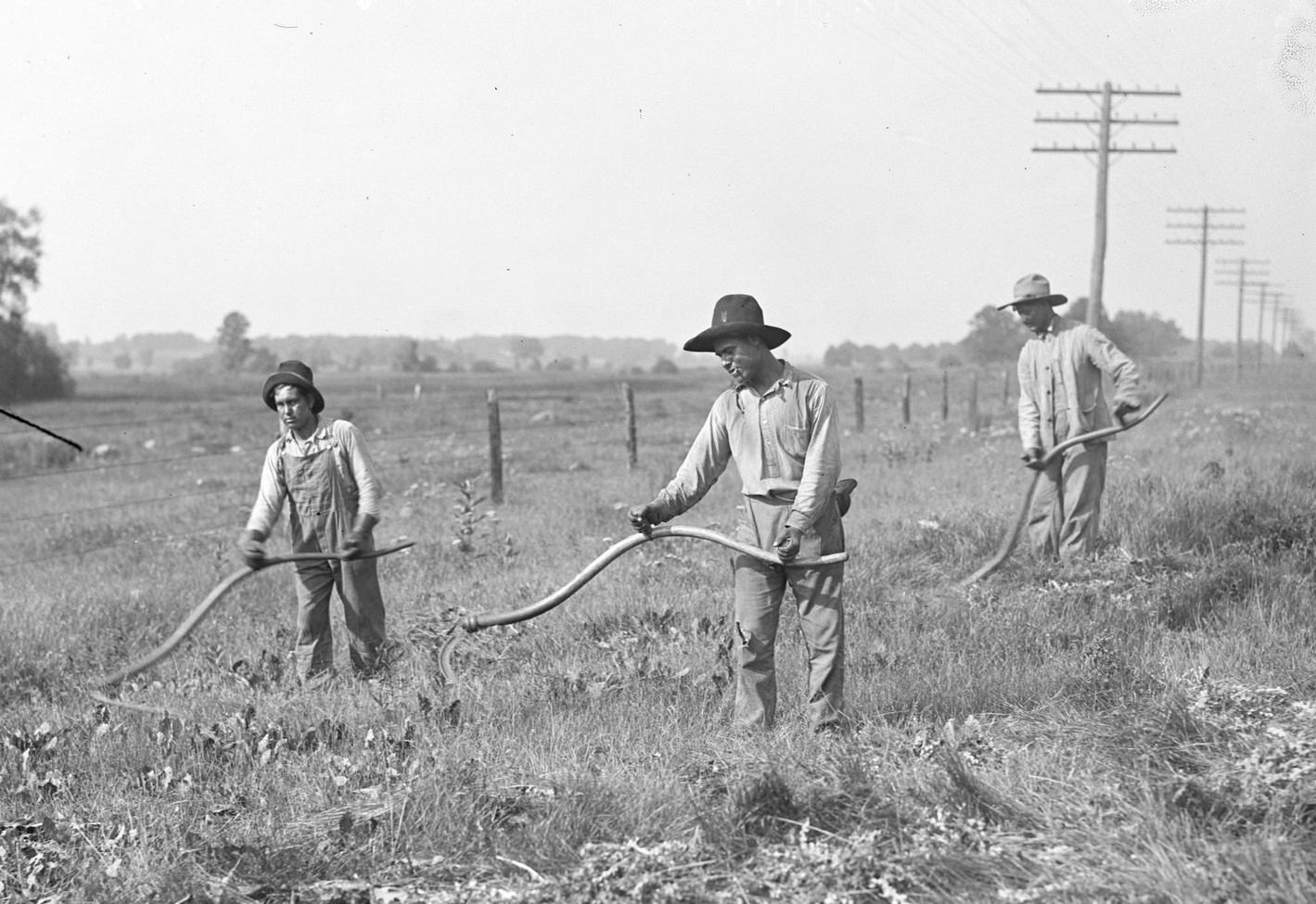
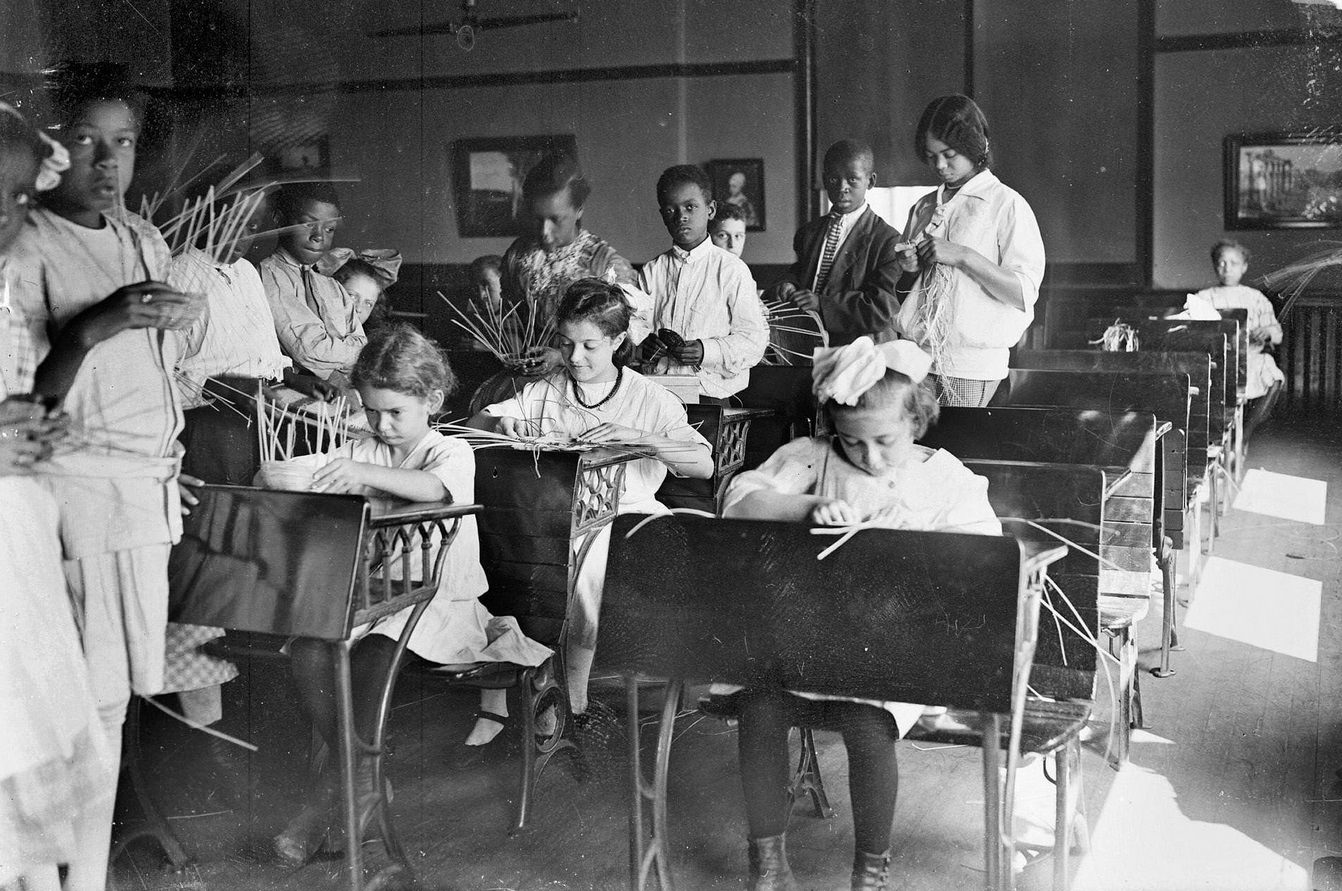
World War I also accelerated the Great Migration. African Americans from the rural South began moving north in large numbers after 1914, drawn by factory jobs left open as white workers went to war. Mexican immigrants also arrived in growing numbers after 1910, many taking on agricultural and labor work on Chicago’s outskirts. These new arrivals transformed entire neighborhoods, particularly on the South Side, where competition for housing intensified sharply.
Mexican immigrants working with sickles to cut weeds along the side of a road, Chicago, Illinois, 1917.School children, including several African Americans, at Raymond School sitting and standing at their desks and learning basket weaving in the Douglas community area, Chicago, Illinois, 1910s.
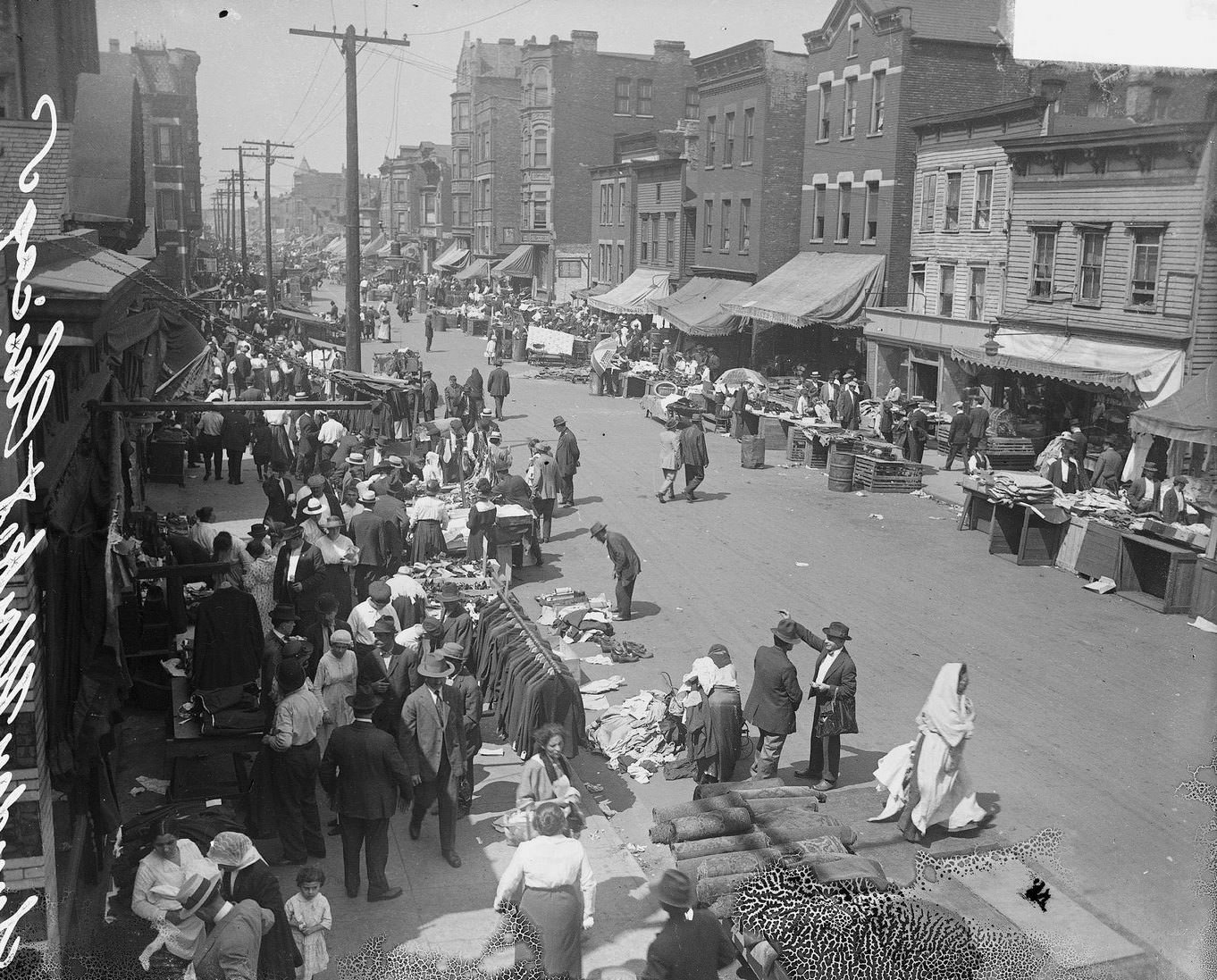
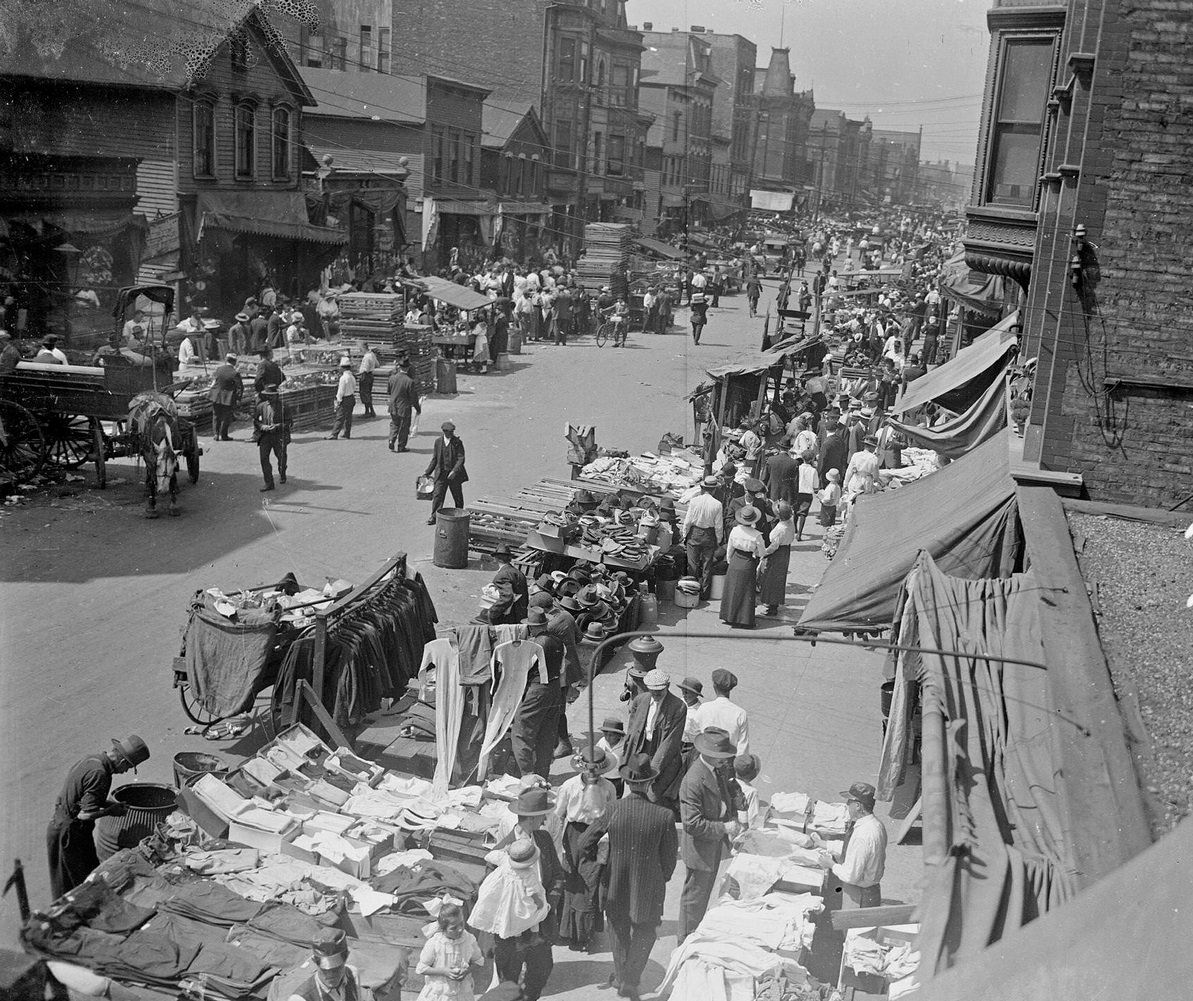
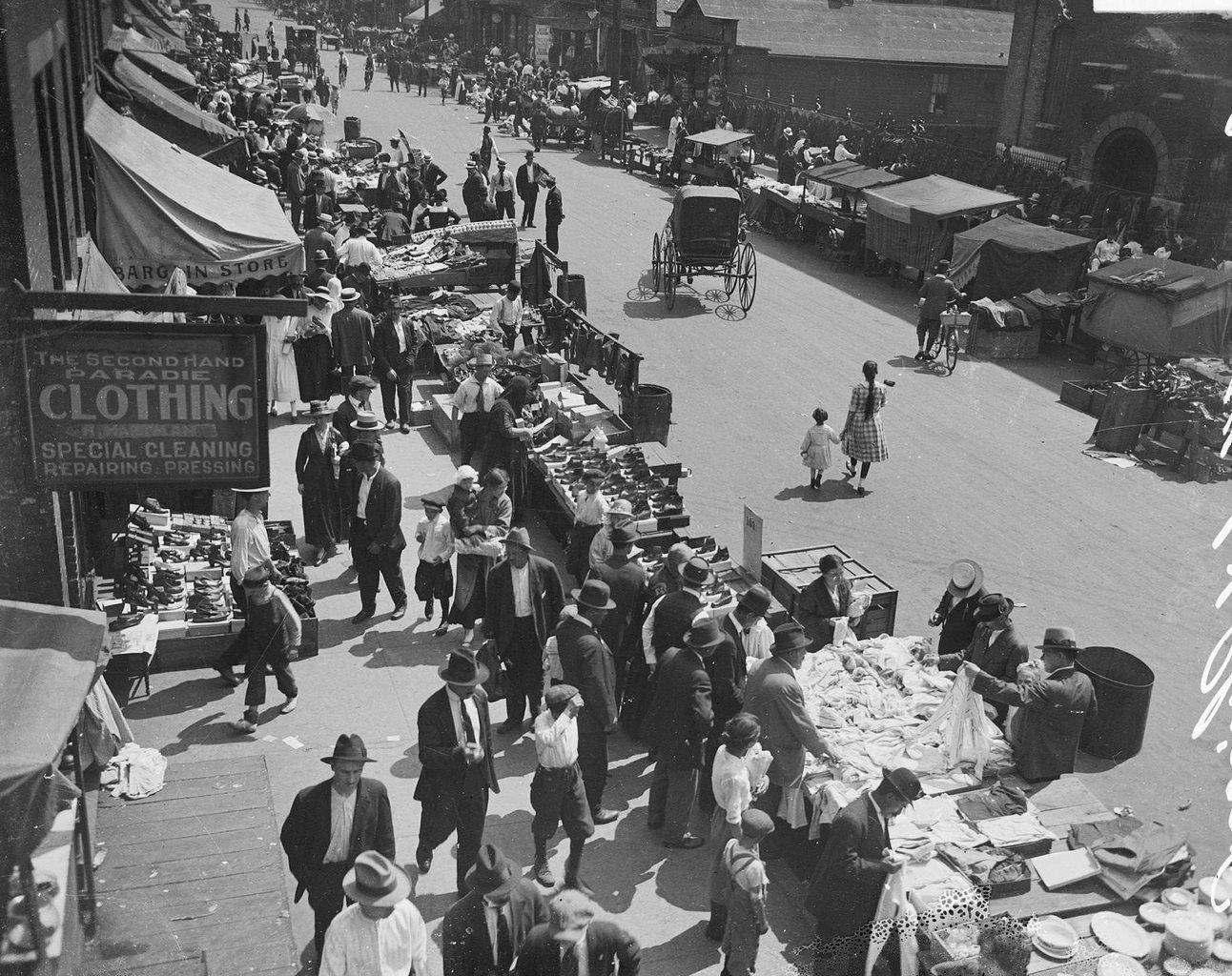
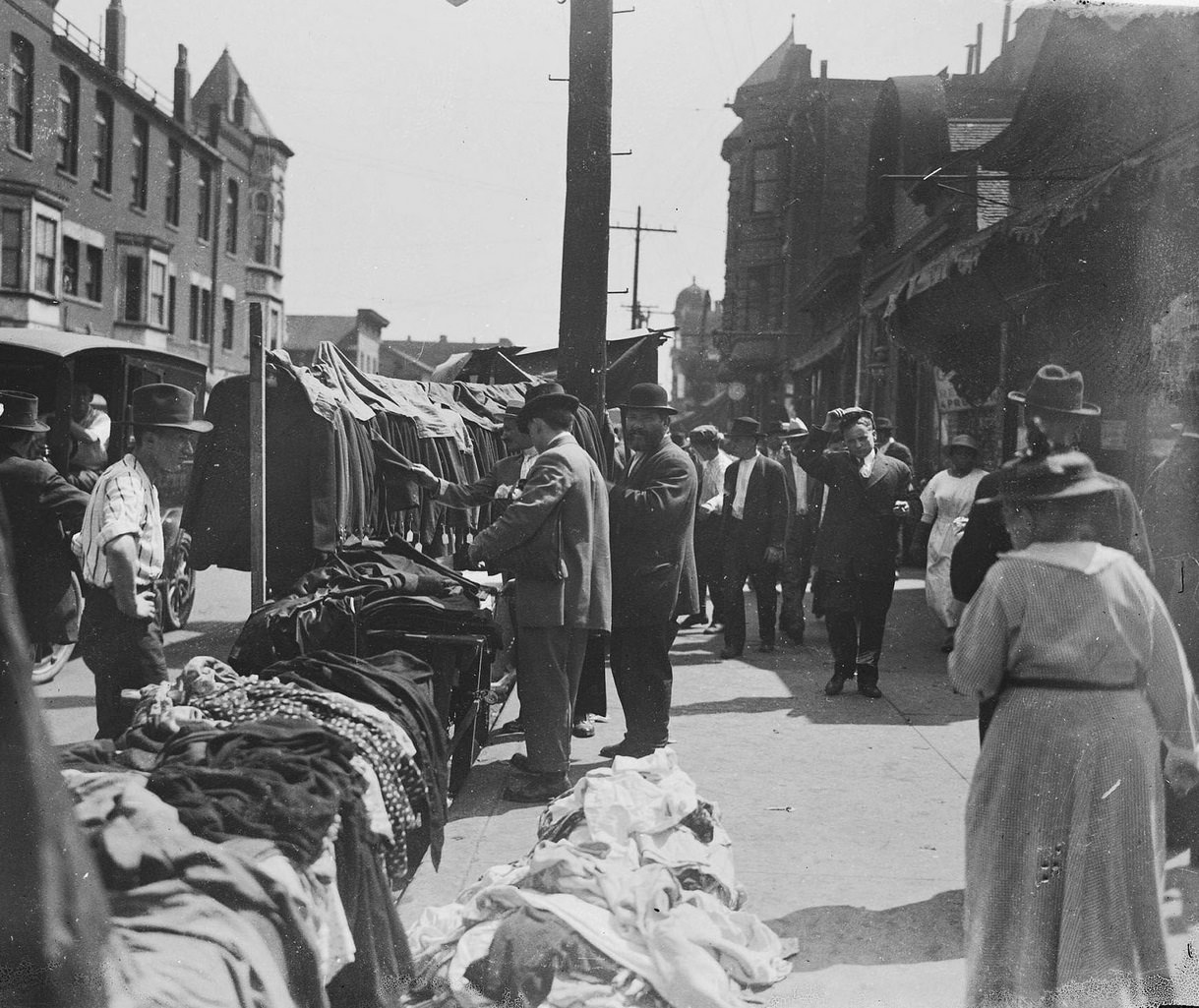
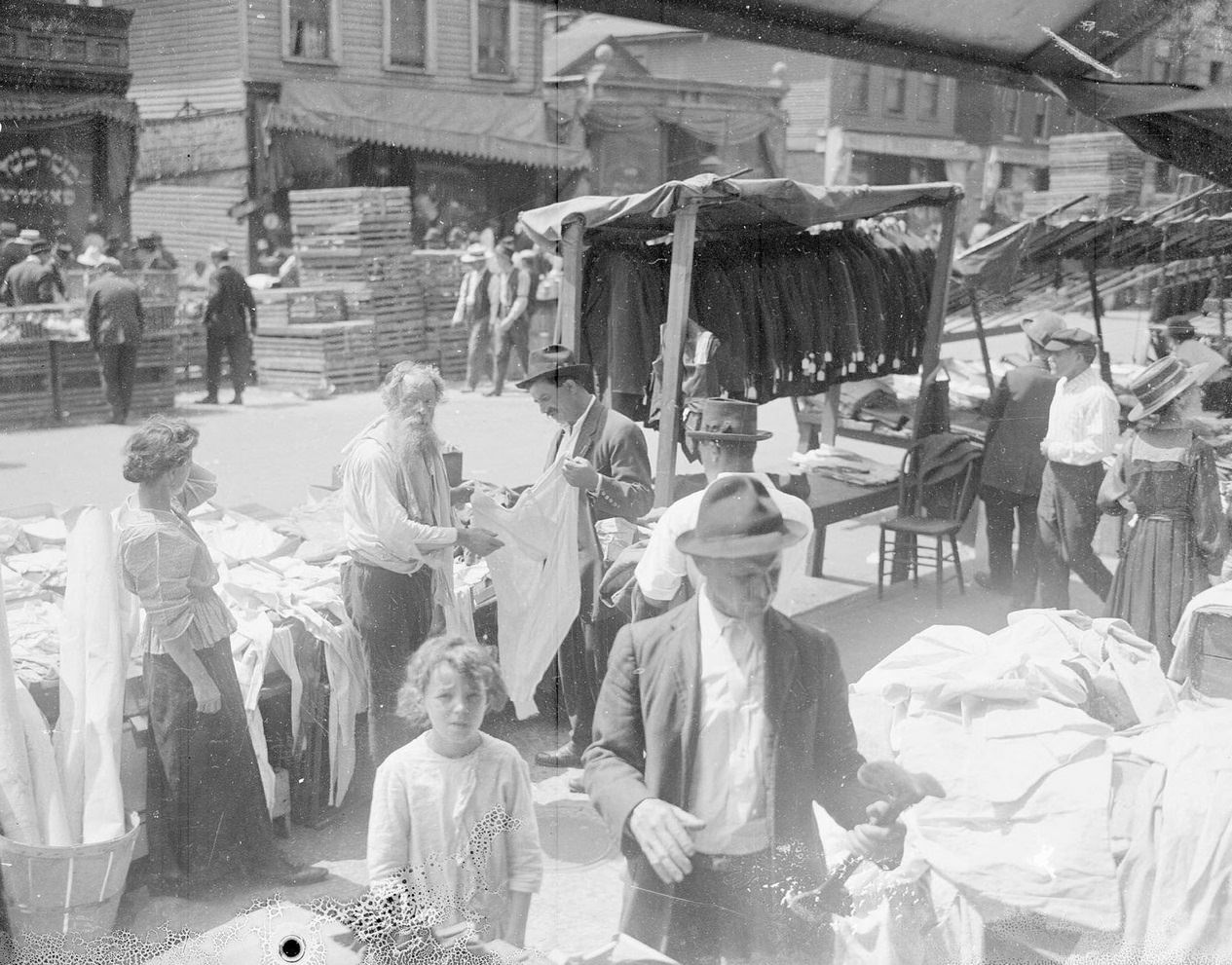
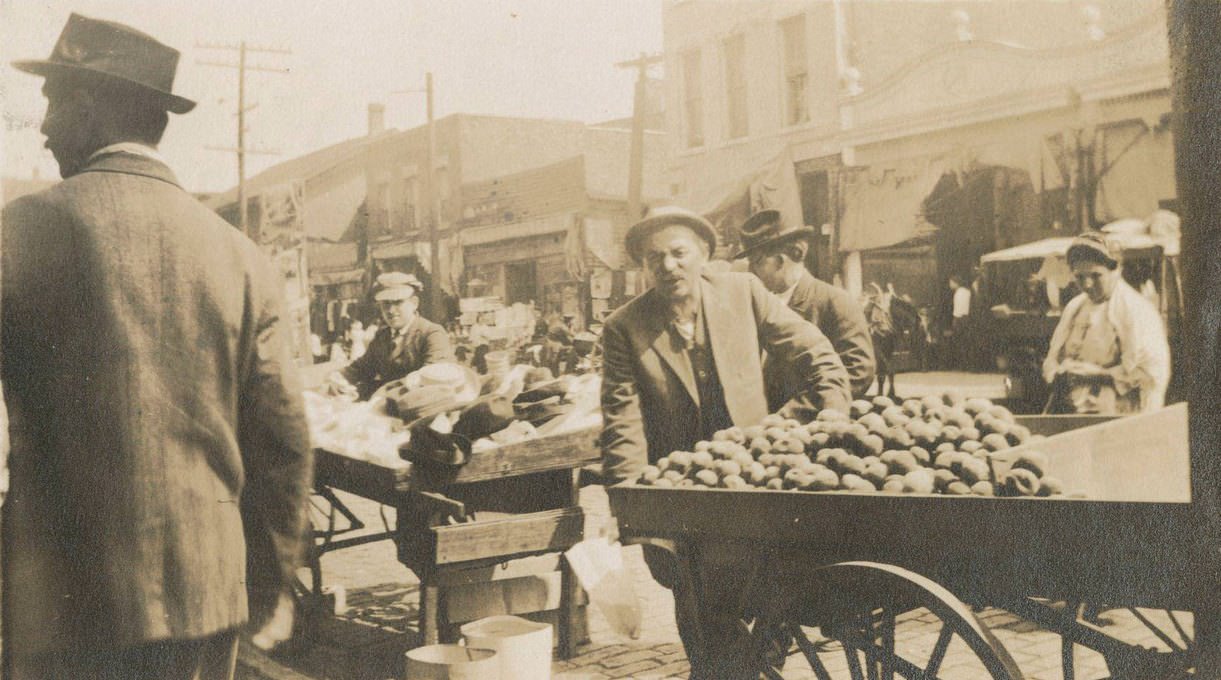
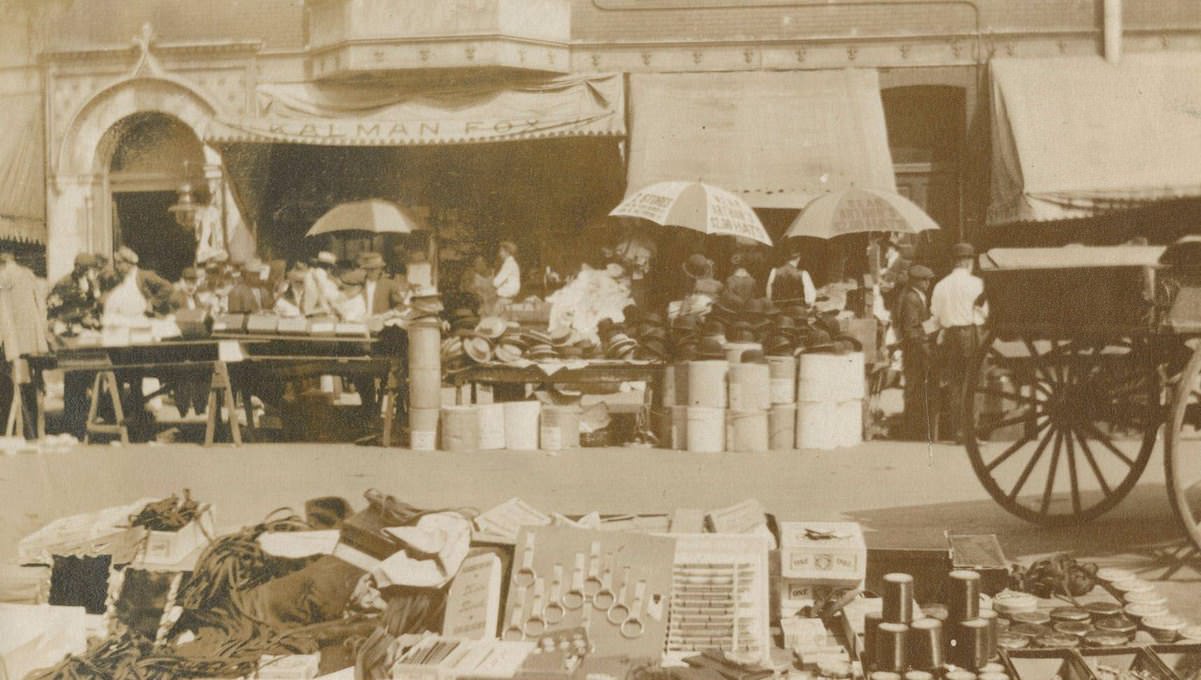
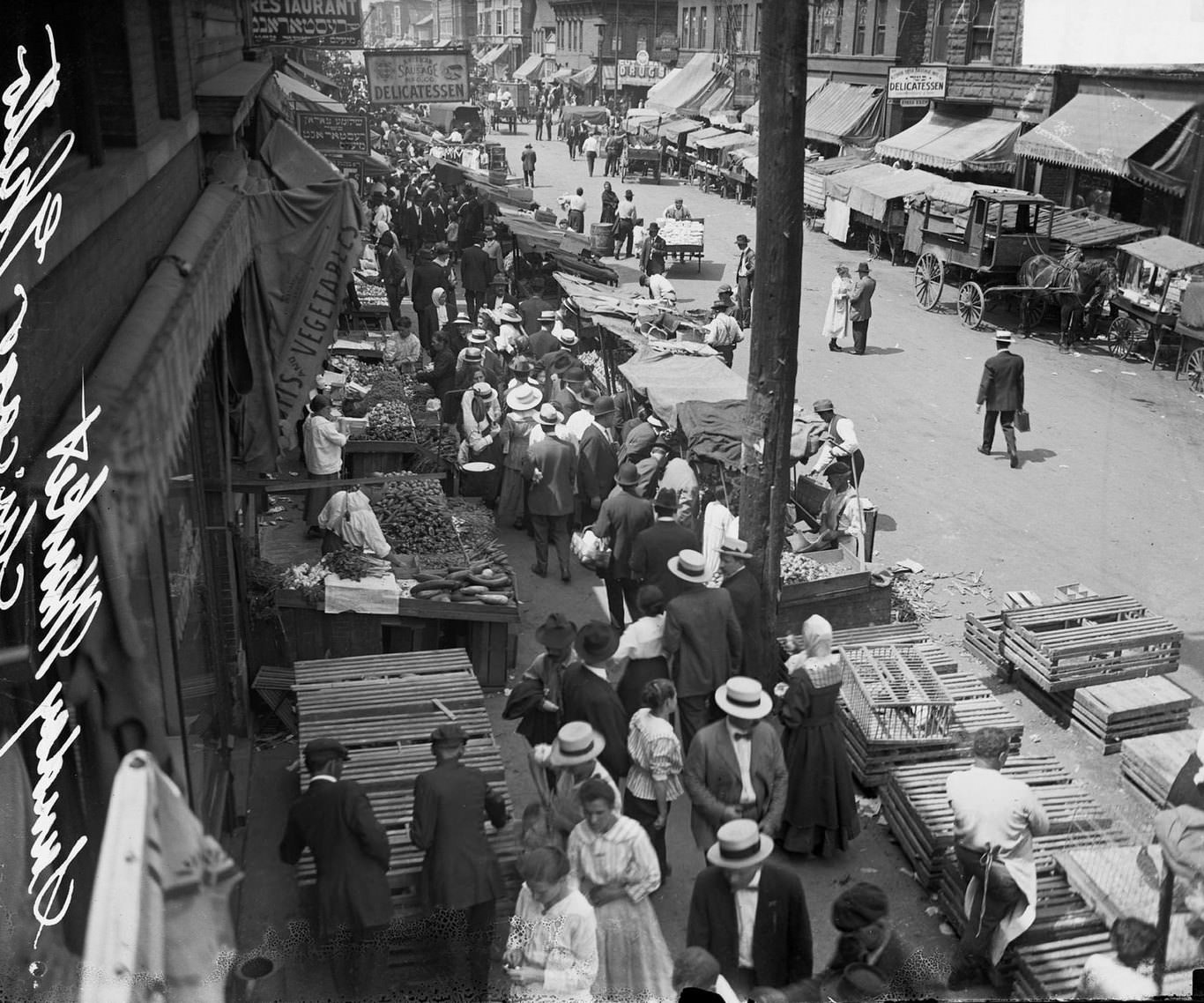
Maxwell Street on the Near West Side was the center of Chicago’s Jewish immigrant community. Every Sunday, the street transformed into an open-air market where merchants sold clothing, food, and household goods. The market was a social institution as much as a commercial one, drawing thousands of people each week.
The merchants and shoppers along Maxwell Street at the Sunday market in the city’s Jewish community located in the Near West Side community area, Chicago, Illinois, 1917.Clothing merchants selling goods along Maxwell Street, probably during the Sunday market, Chicago, Illinois, 1917.Merchants and shoppers along Maxwell Street at the Sunday market in the Chicago Jewish community located in the Near West Side community area, Chicago, Illinois, 1917.Merchants selling clothing and a group of men inspecting the goods on Maxwell Street at the Sunday market in the city’s Jewish community located in the Near West Side community area, Chicago, Illinois, 1917.Sunday market near Maxwell Street, Chicago, Illinois, 1917.
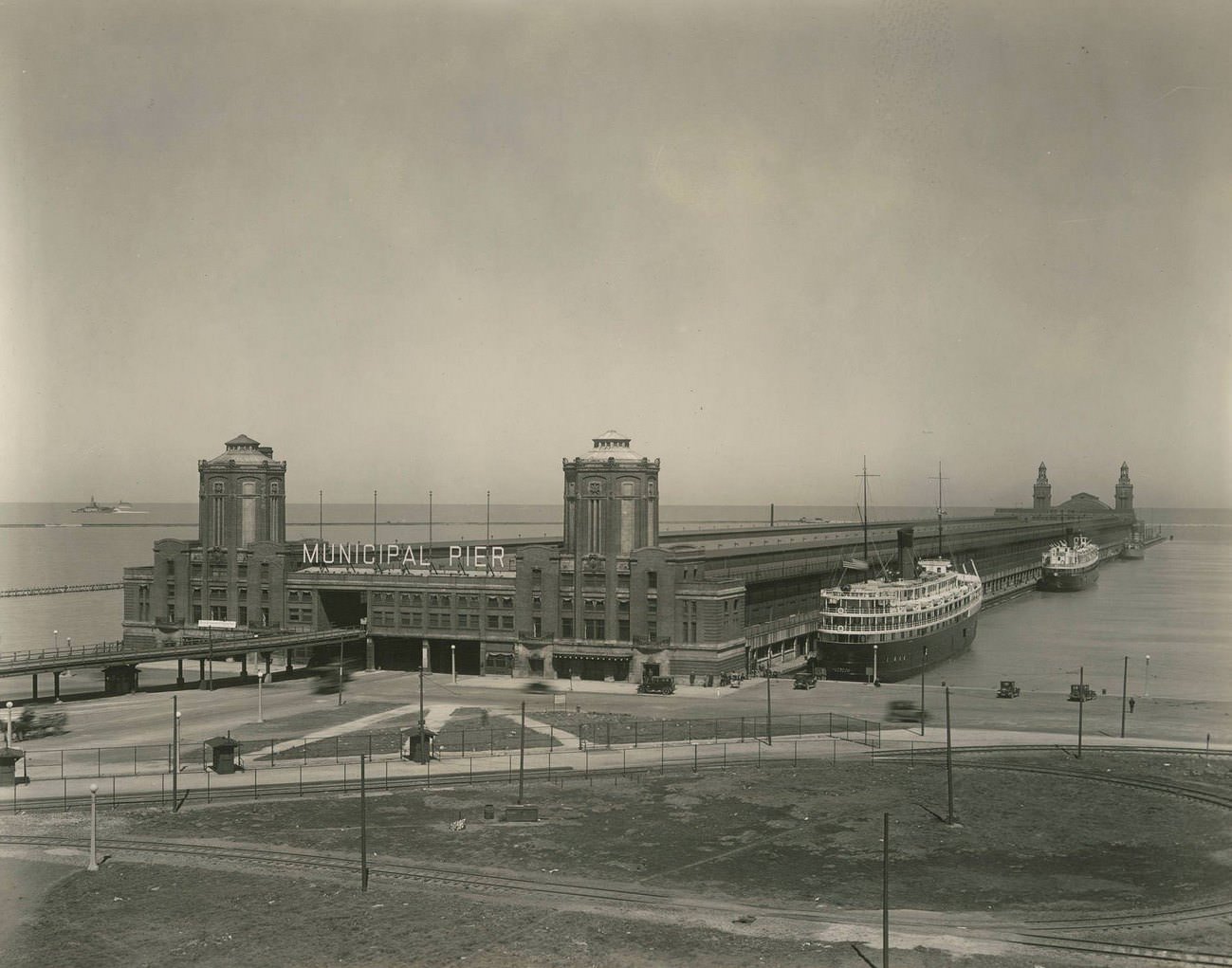
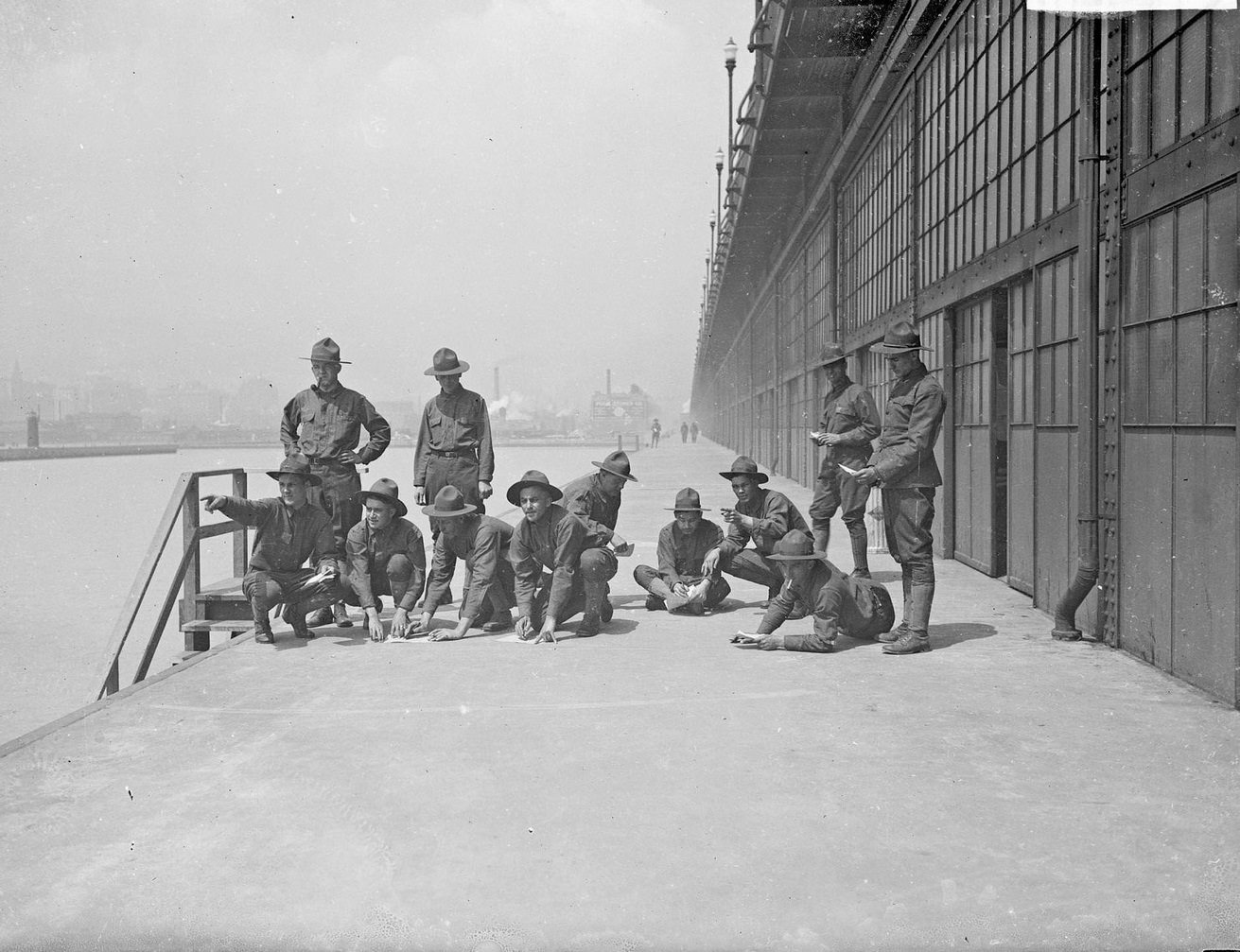
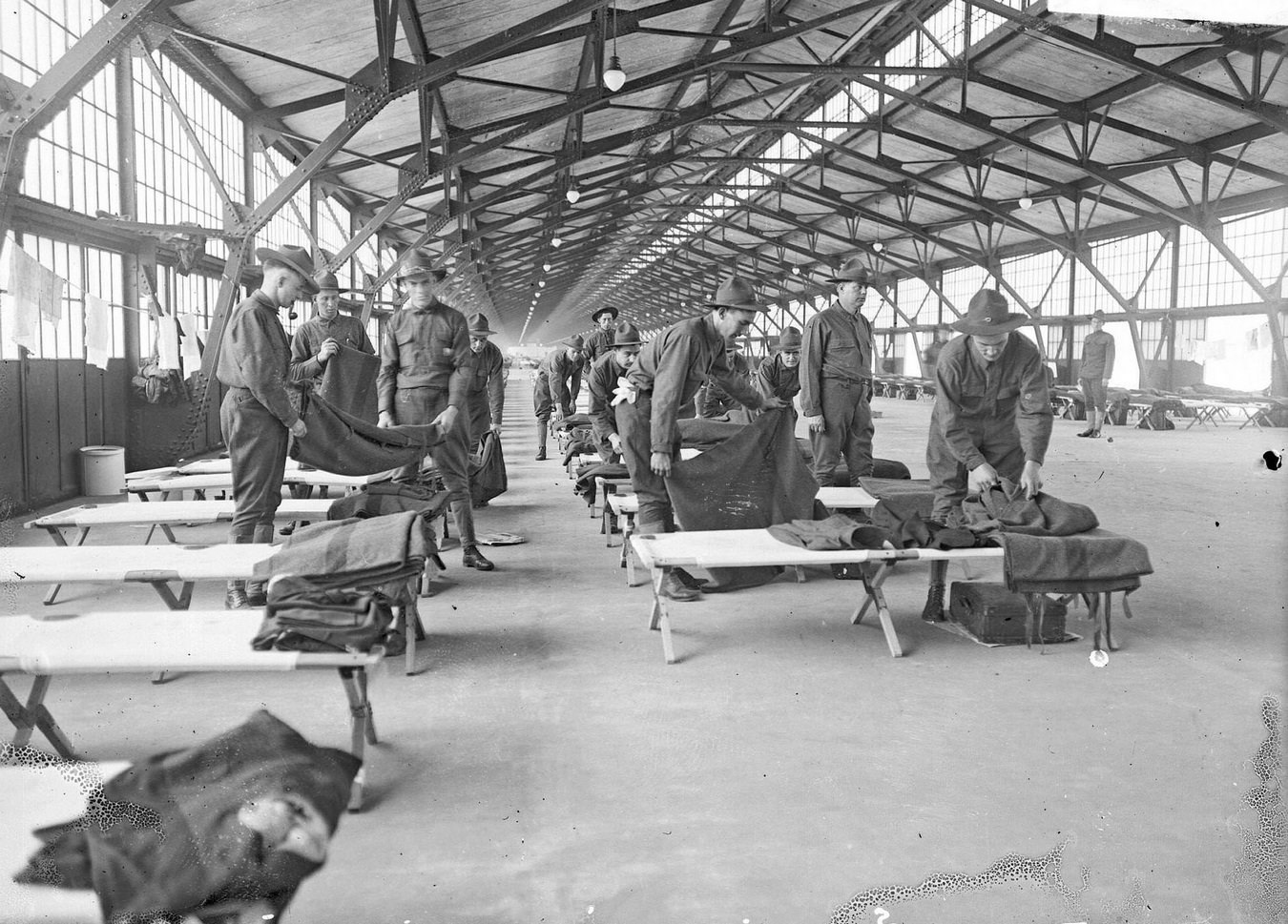
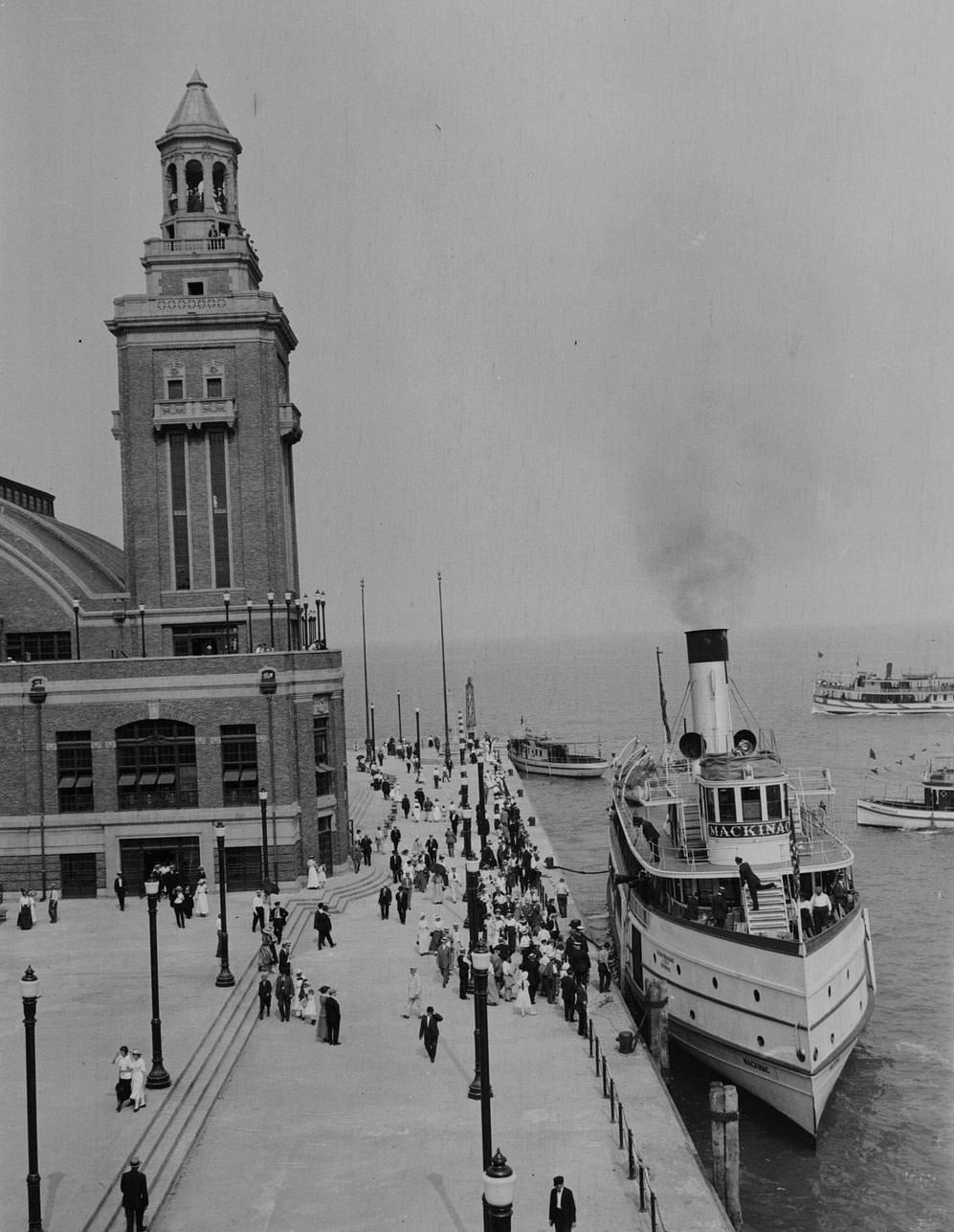
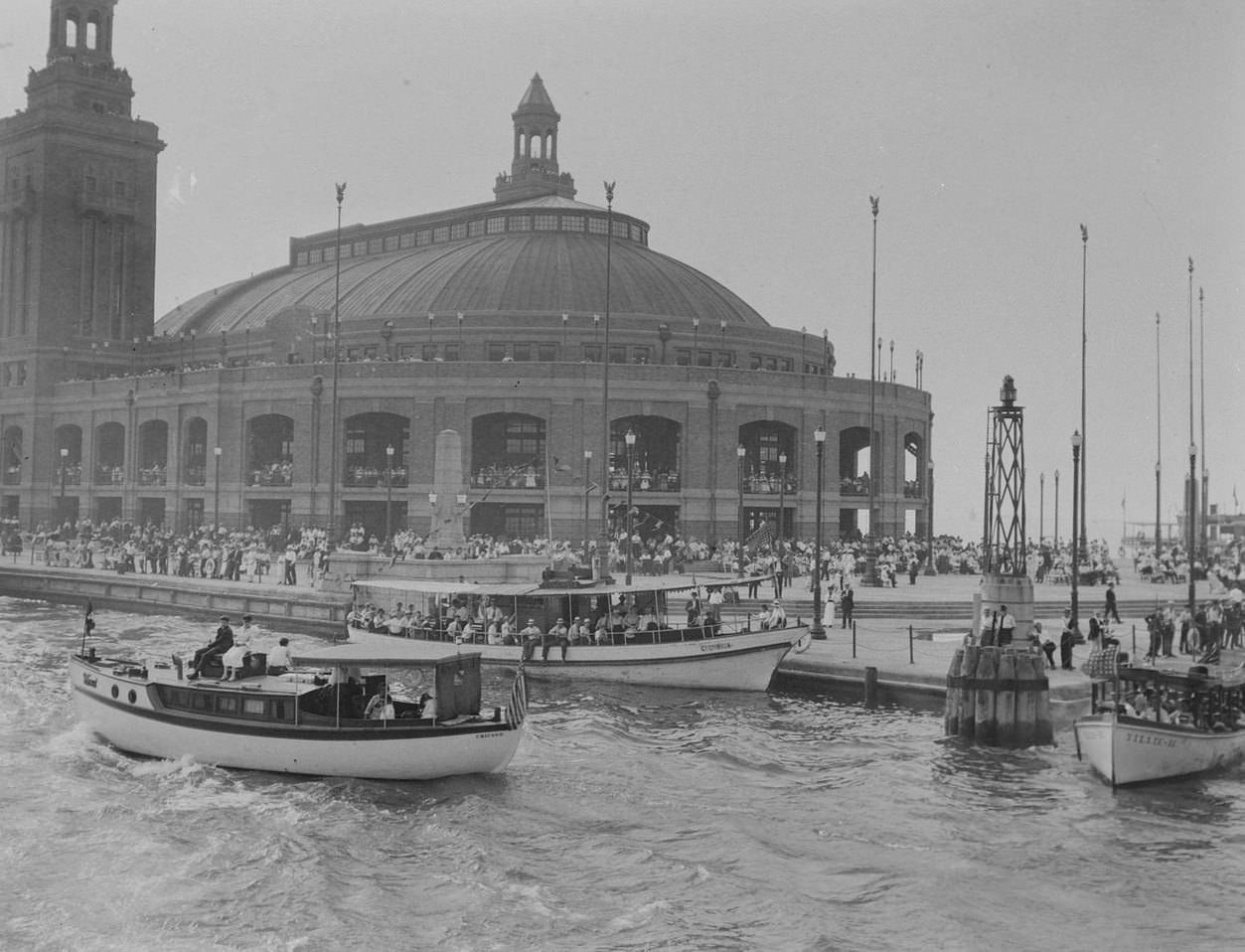
Municipal Pier opened in 1916 and quickly became a hub for both commerce and recreation. Steamboats docked at its landing area, and by the time the United States entered the war, the U.S. Army’s 3rd Reserve Engineers were using the building as a barracks, folding blankets at cots set up along the pier’s vast interior.
Exterior view of Municipal Pier, later renamed Navy Pier, Chicago, Illinois, 1917.US Army, 3rd Reserve Engineers, gathering on the cement outside the building at the Municipal Pier (Navy Pier), Chicago, Illinois, 1910s.US Army 3rd Reserve Engineers folding blankets at their cots set up in the building at the Municipal Pier (Navy Pier), Chicago, Illinois, 1910s.
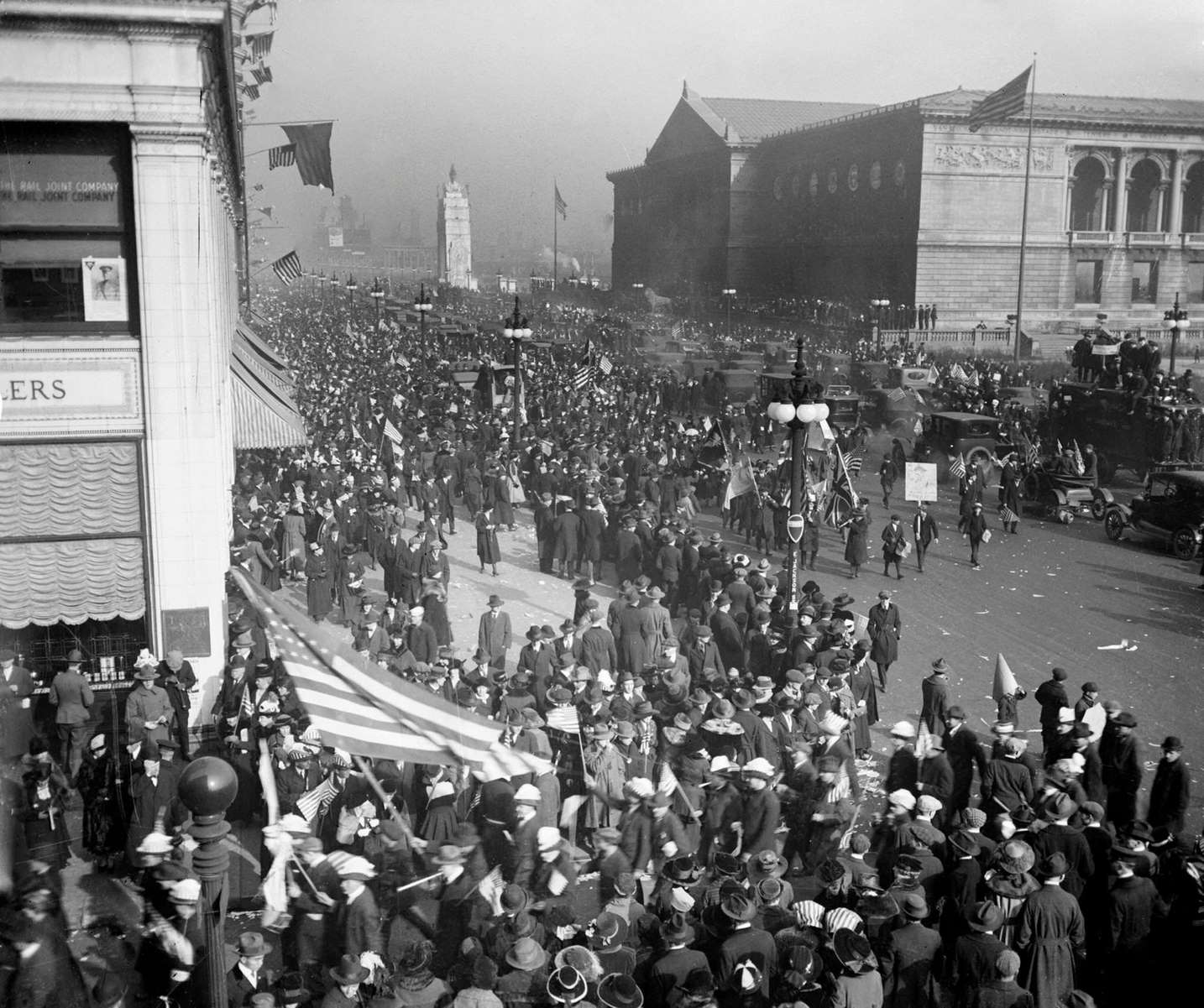
When the Armistice was declared in November 1918, Chicago erupted in celebration. Crowds filled East Jackson Street and Michigan Avenue outside the Art Institute, waving flags as automobiles pushed through the masses. The war was over — but what came next for Chicago was far from peaceful.
Crowds at the Armistice Day peace celebration marching in front of the Art Institute at 111 South Michigan Avenue in the Loop community area of Chicago, Illinois, 1918.
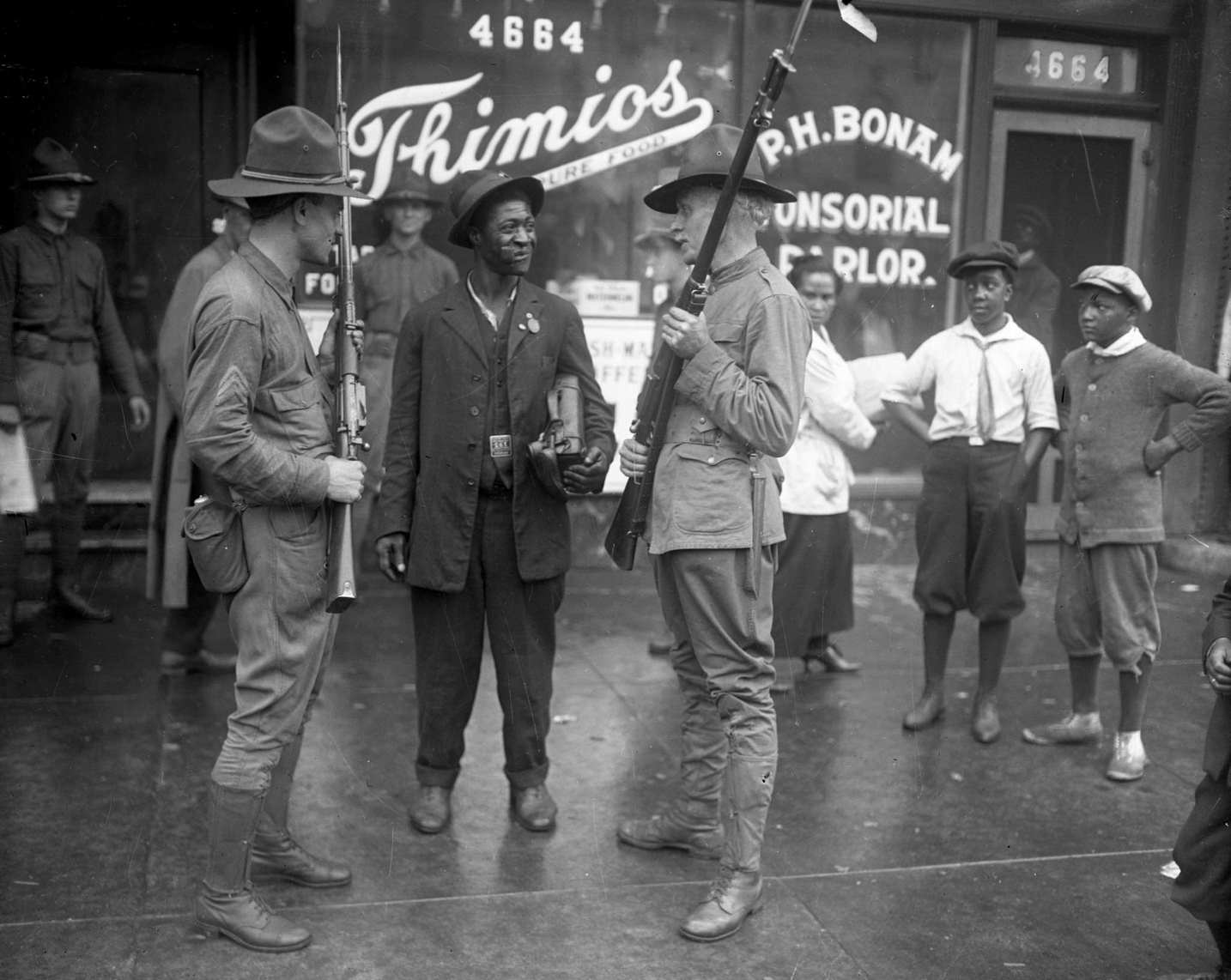
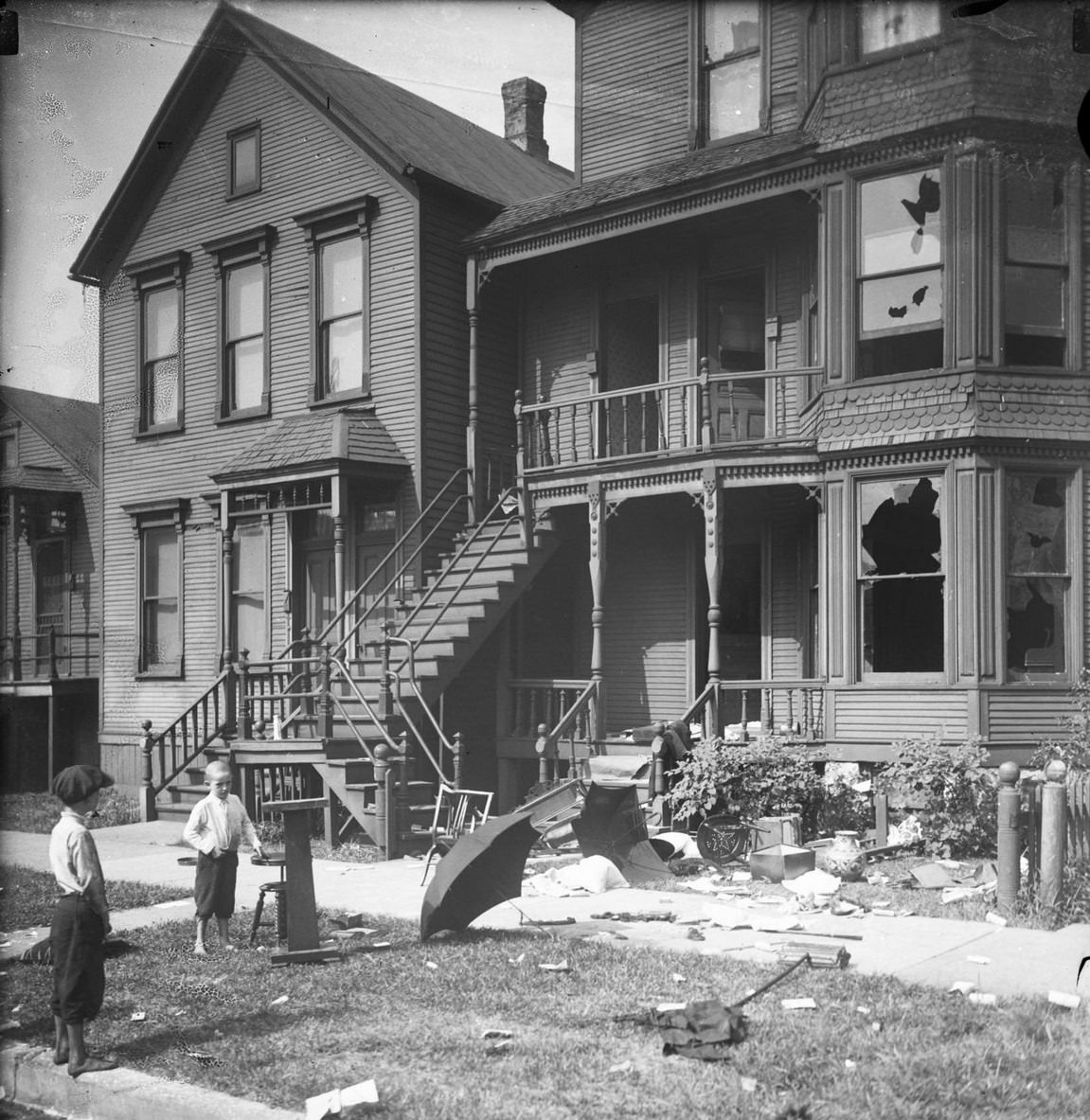
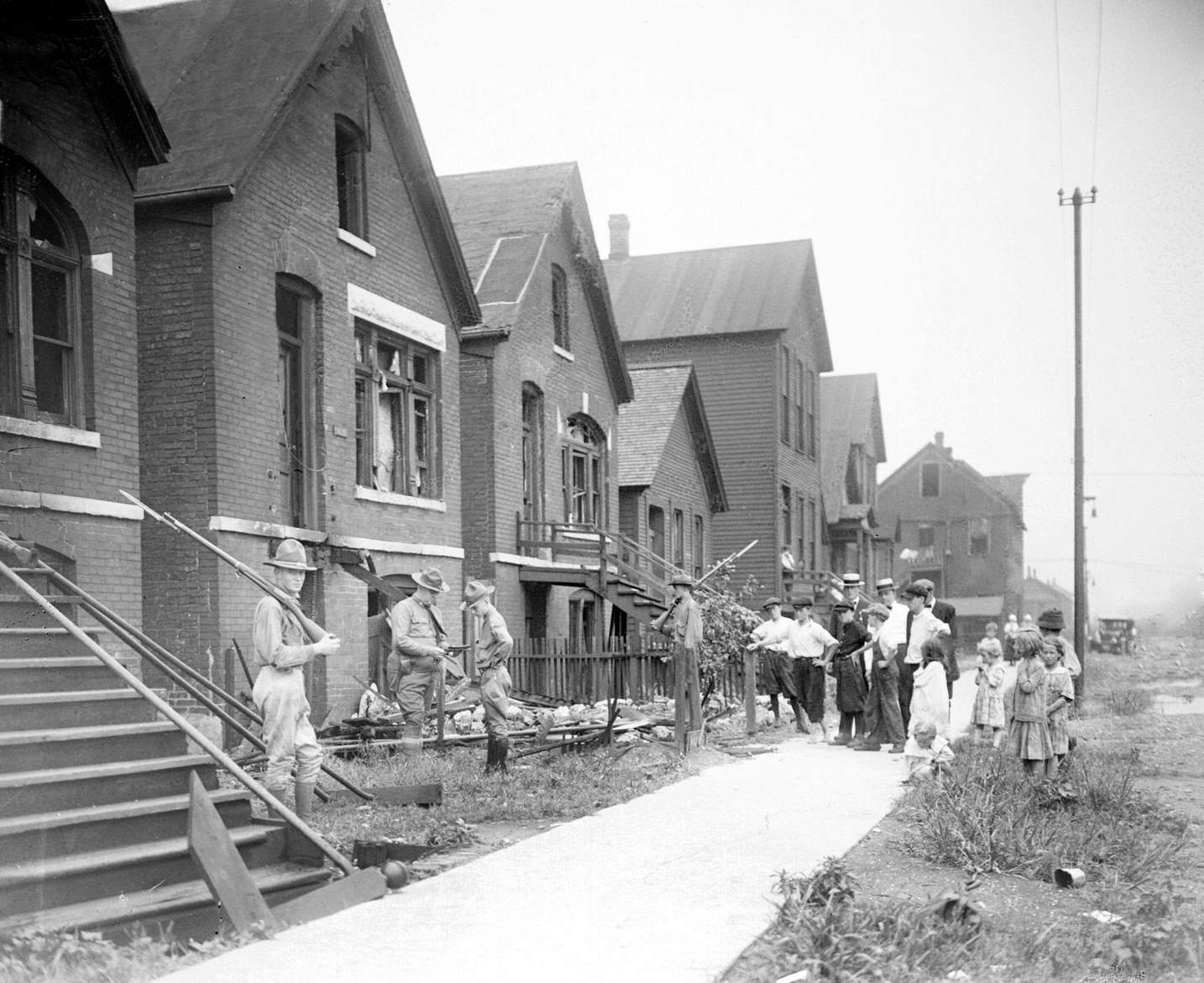
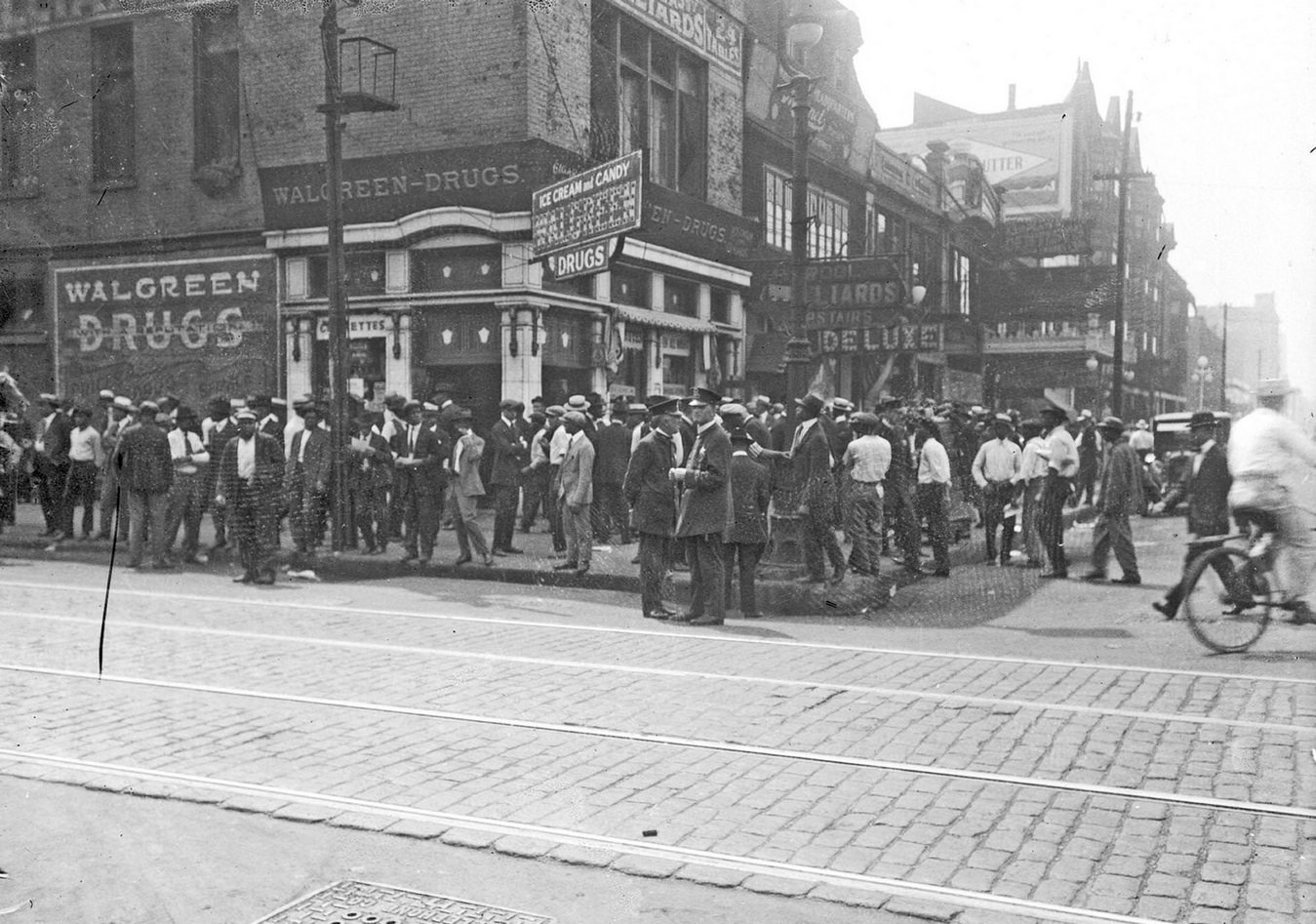
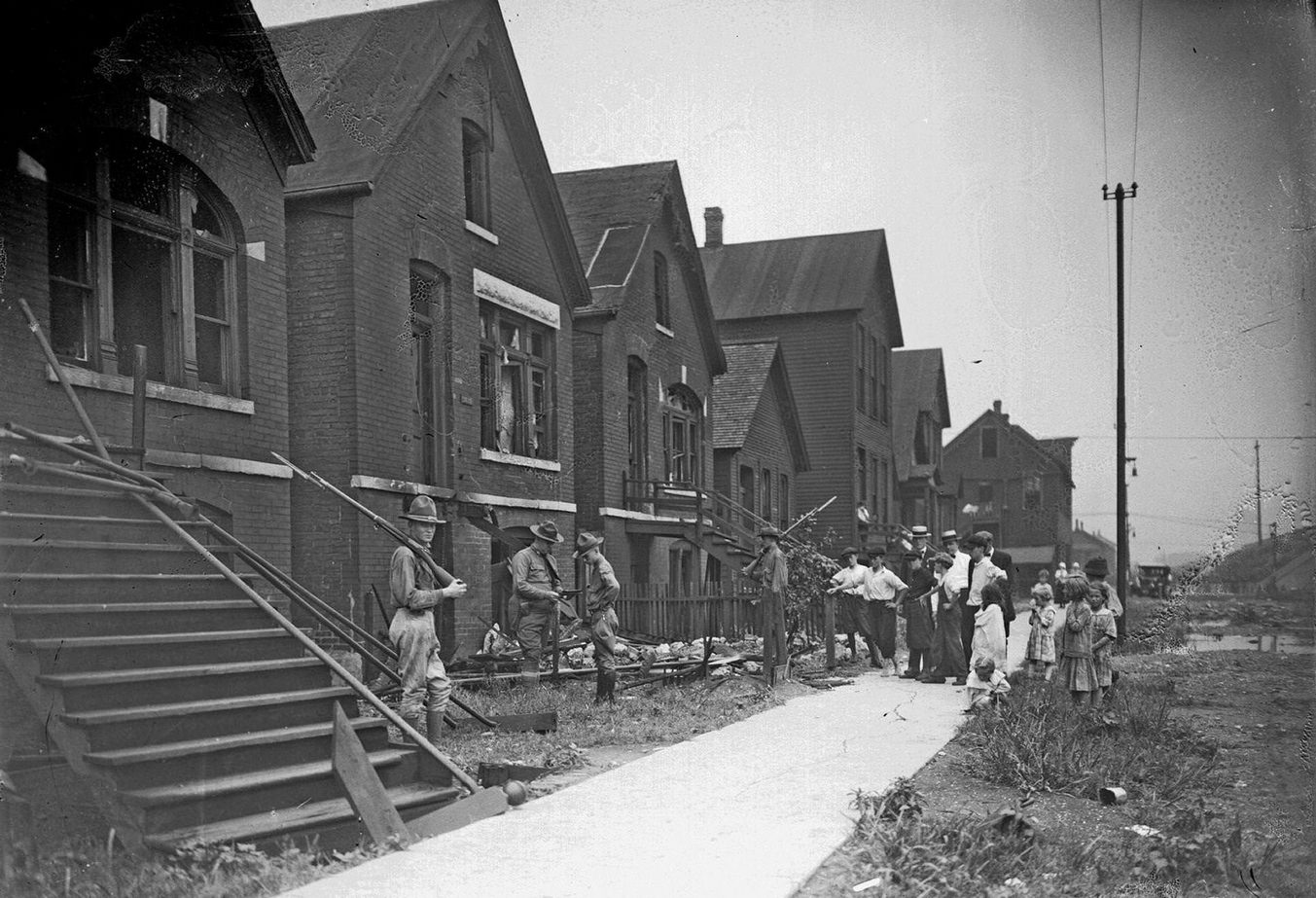
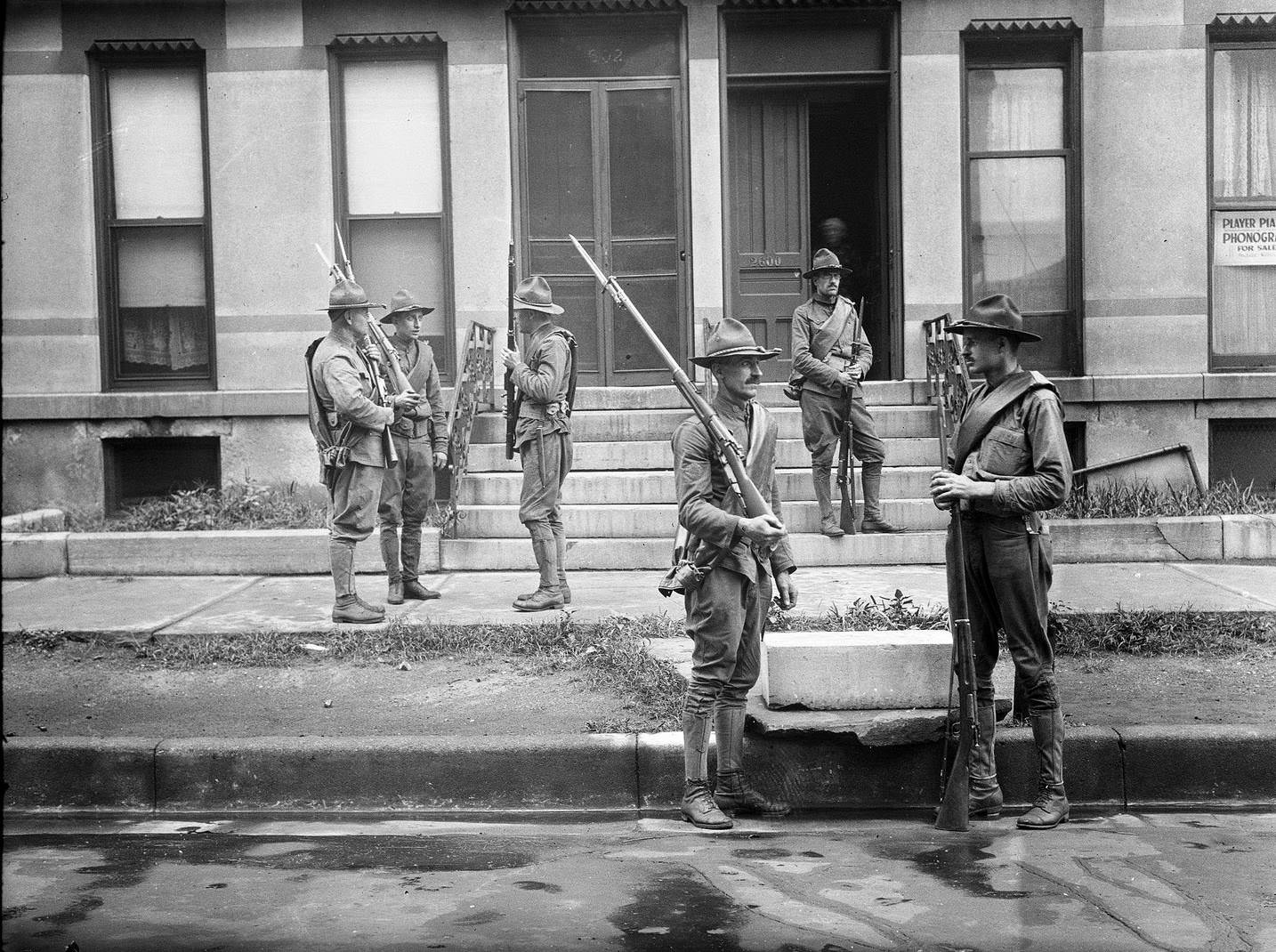
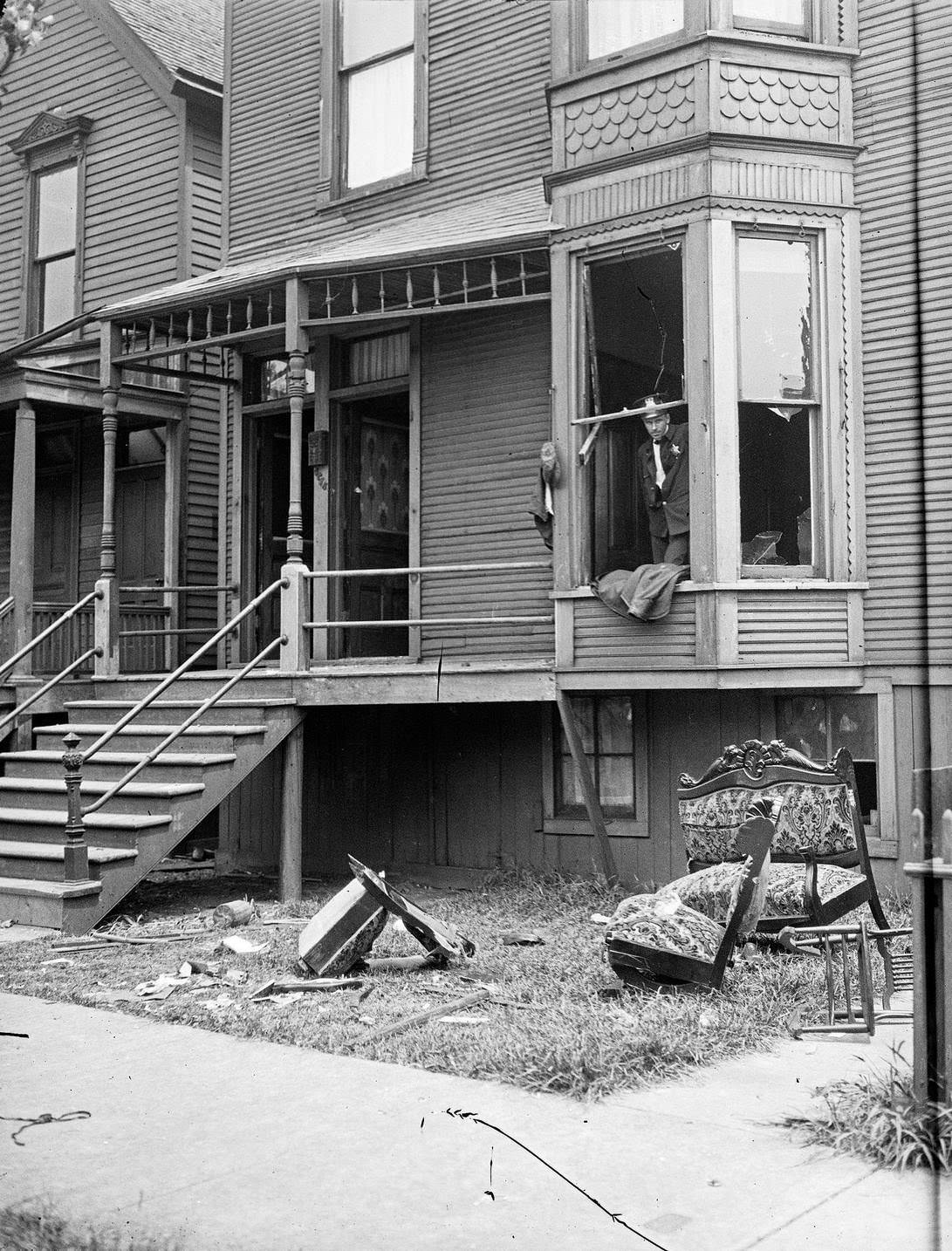
The summer of 1919 brought catastrophe to Chicago’s streets. On July 27, a young Black teenager named Eugene Williams drowned in Lake Michigan after a white man threw rocks at him near an informally segregated beach. The incident triggered a week of mass racial violence that became known as the Chicago Race Riot of 1919. Thirty-eight people died — 23 Black and 15 white — and more than 500 were injured. Over a thousand people, mostly Black residents, were left homeless after their homes were burned or destroyed. Members of ethnic Irish athletic clubs led much of the organized violence, attacking Black residents and defending what they called their territory. State militia and National Guard soldiers were eventually deployed to restore order, standing guard with rifles outside vandalized homes.
Members of the state militia talk with a man during the Chicago race riots of 1919.Two young boys outside a home, with broken windows and debris in the front yard, which had been vandalized during a race riot, Chicago, Illinois, July or August 1919.Soldiers stand guard with rifles at a house vandalized during the race riots of July-August 2, 1919 in Chicago, Illinois.Chicago race riot, African American men standing in front of Walgreen Drugs, 35th and State, Chicago, Illinois, July 30, 1919.Chicago race riot, soldiers with rifles standing guard at vandalized house, Chicago, Illinois, July 30, 1919.Armed National Guard standing outside apartments during the race riots in Chicago, Illinois, 1919.Police looking through a broken window of a house during the race riots in Chicago, Illinois, 1919.
Chicago was not alone in its violence that summer. The riots were part of what historians call Red Summer, a period in 1919 when racial violence erupted across dozens of American cities. White resentment of Black veterans returning from World War I and demanding equal treatment played a major role in stoking tensions nationwide.
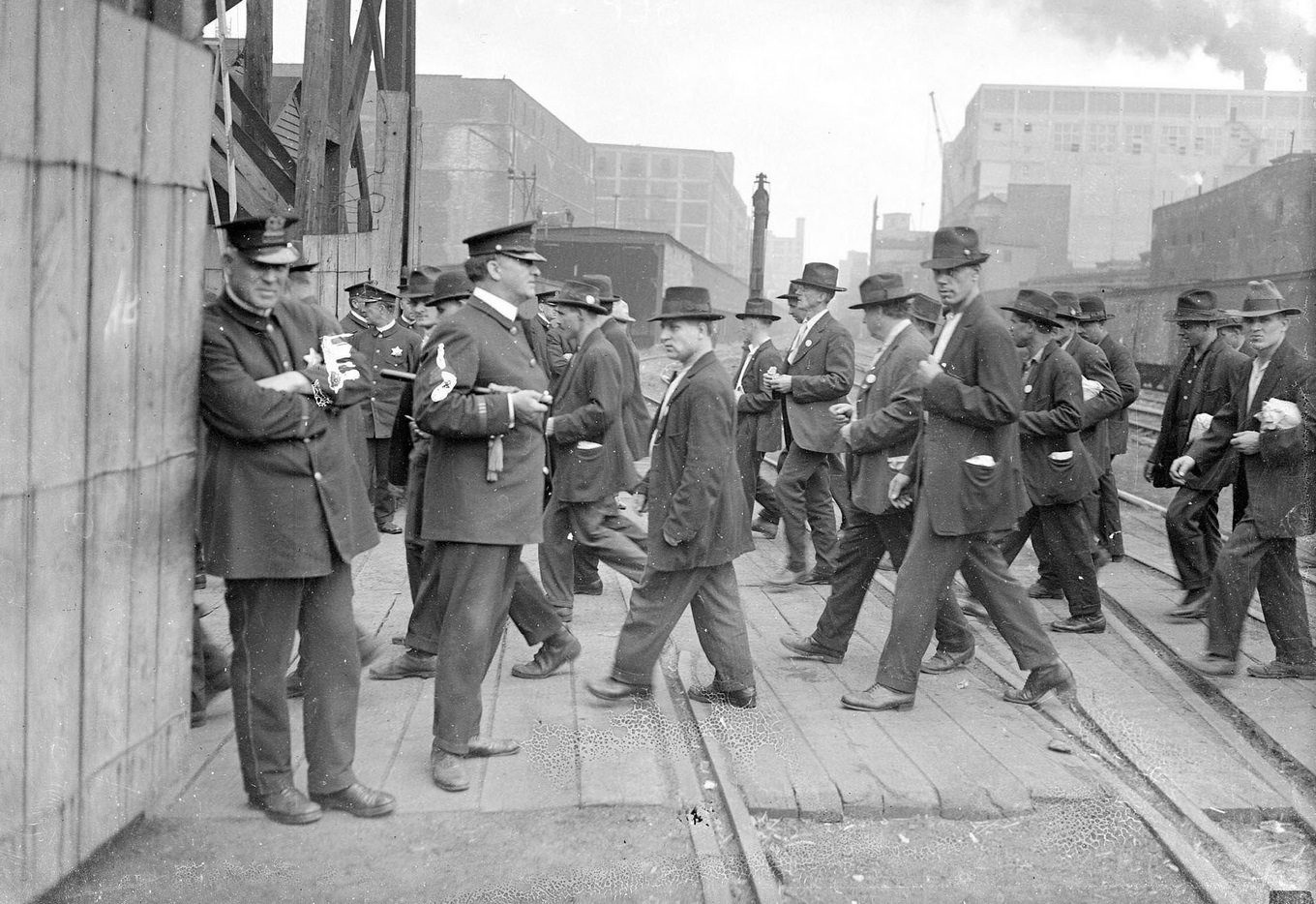
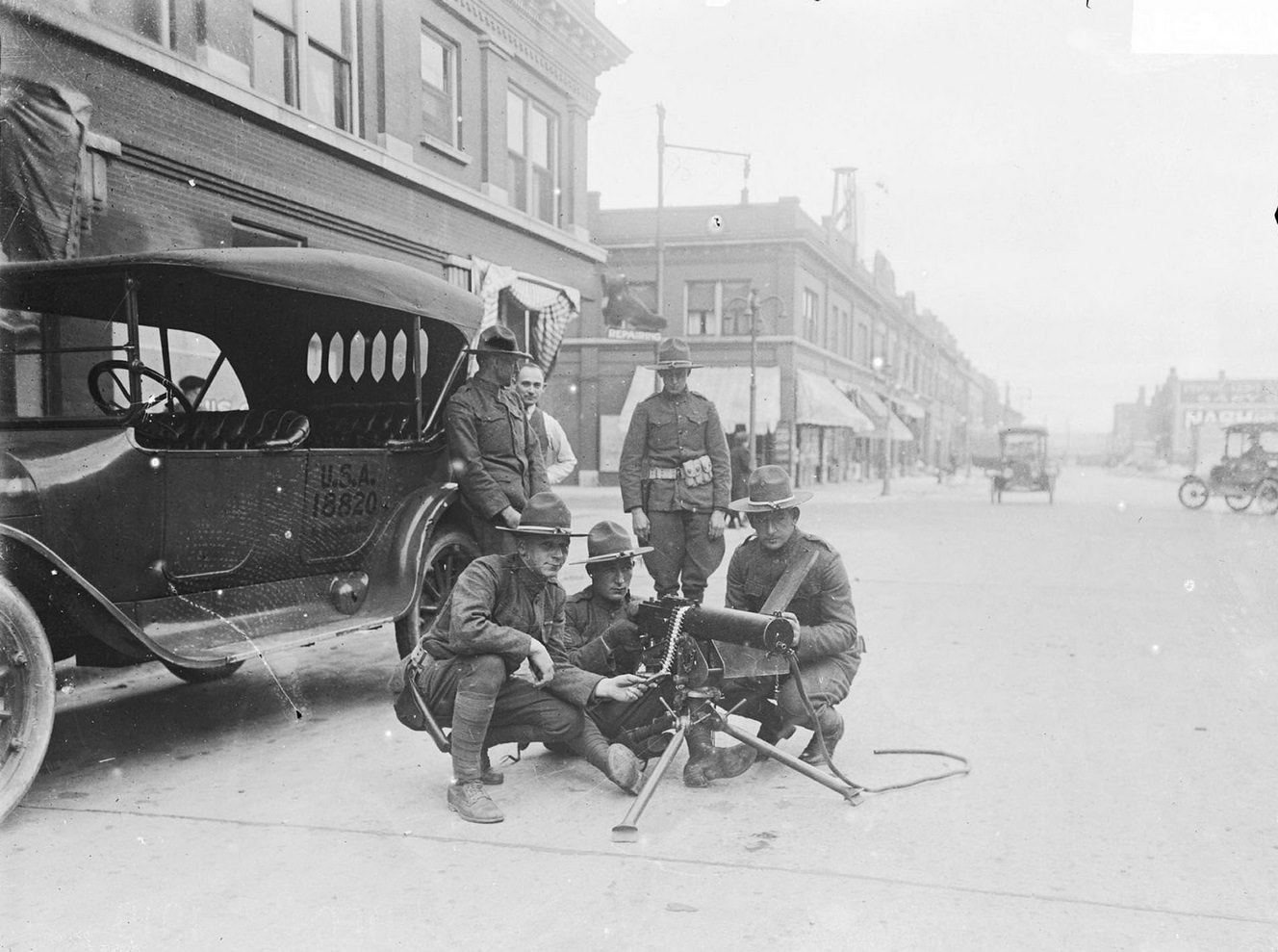
Away from the riots, Chicago’s labor movement was also boiling over in 1919. Packinghouse workers walked off the job, crossing train yards in organized strikes. Workers at U.S. Steel in nearby Gary, Indiana, also struck, and the military positioned machine guns outside the plant as a show of force. These were not isolated events — 1919 was a year of widespread labor unrest across industrial America.
Packinghouse workers during their walkout, crossing train yards, Chicago, Illinois, 1919.Strike at U.S. Steel Corporation, Gary, Indiana, with three military men squatting around machine gun, Chicago, Illinois, 1919.
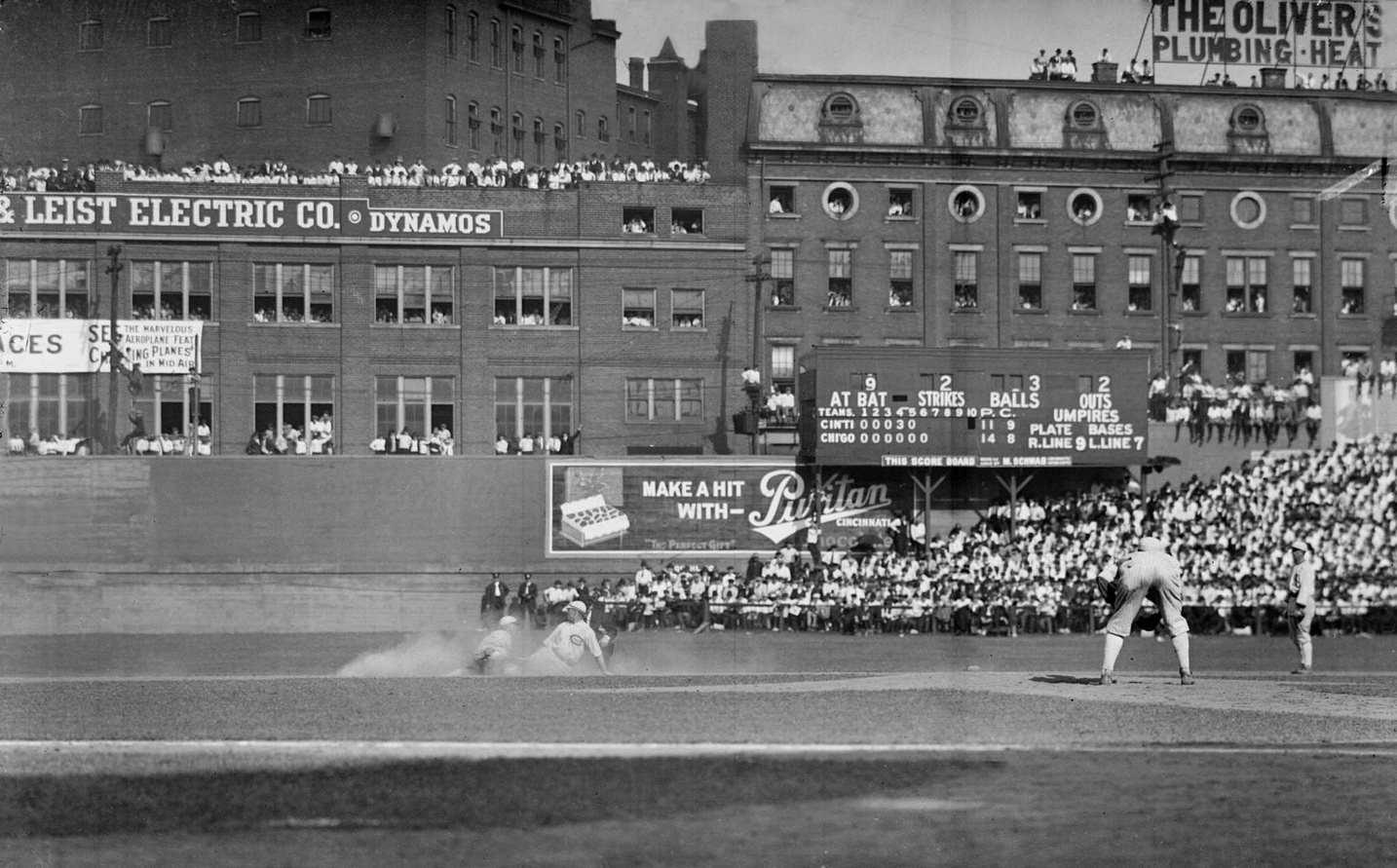
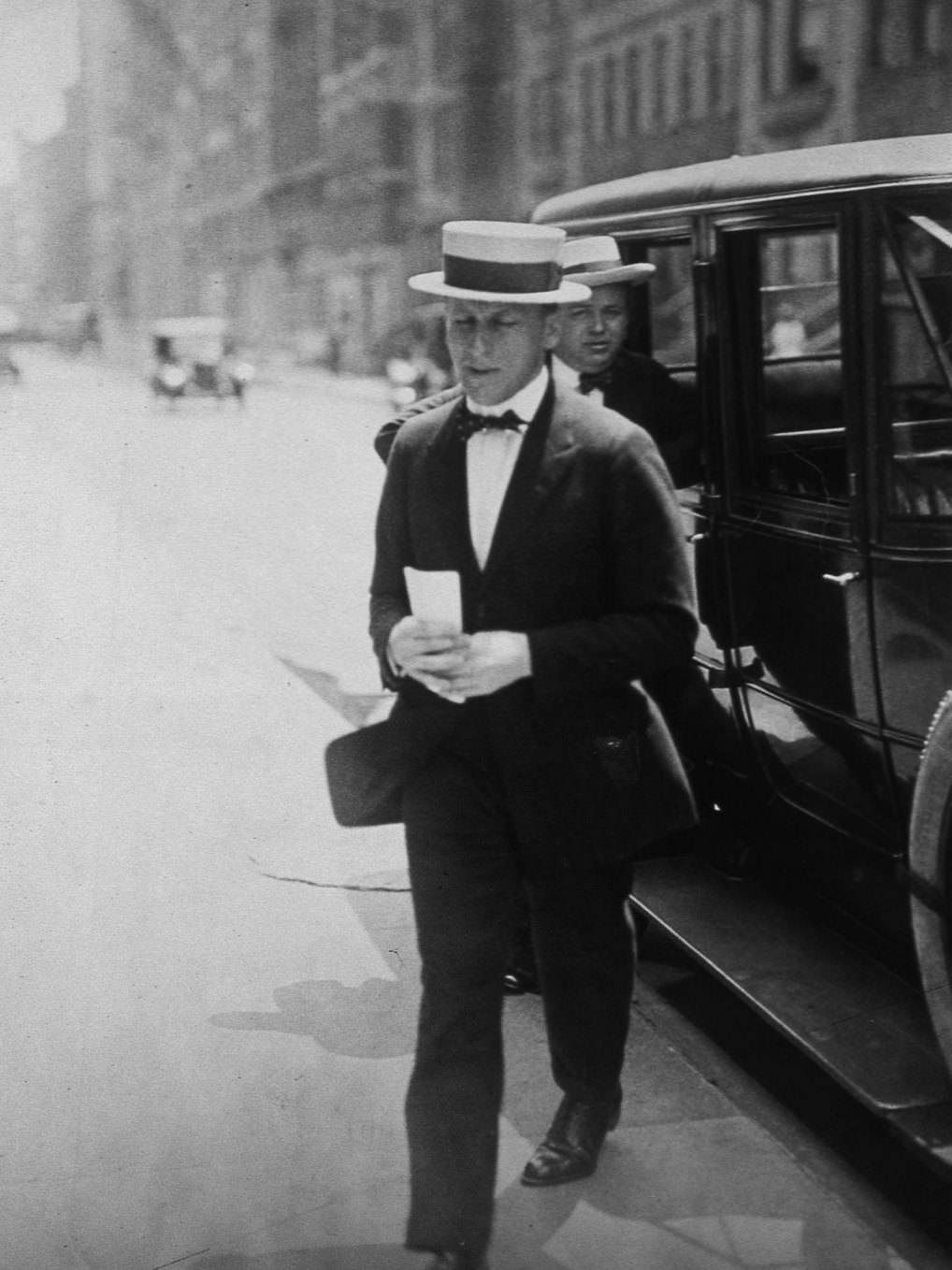
In baseball, 1919 brought Chicago both triumph and scandal. The White Sox reached the World Series, facing the Cincinnati Reds. But behind the scenes, gambler Arnold Rothstein had paid eight White Sox players to deliberately lose the series — the Black Sox Scandal. The fix was not publicly exposed until 1920, but the games themselves were already tainted.
Cincinnati Red Al Neale is out at second base after an attempted sliding steal, during game 2 of the 1919 World Series between the Reds and the American League’s Chicago White Sox.Arnold Rothstein, the gambler who set up the Black Sox scandal during the 1919 World Series in Chicago, is photographed exiting a car in Chicago, 1919.
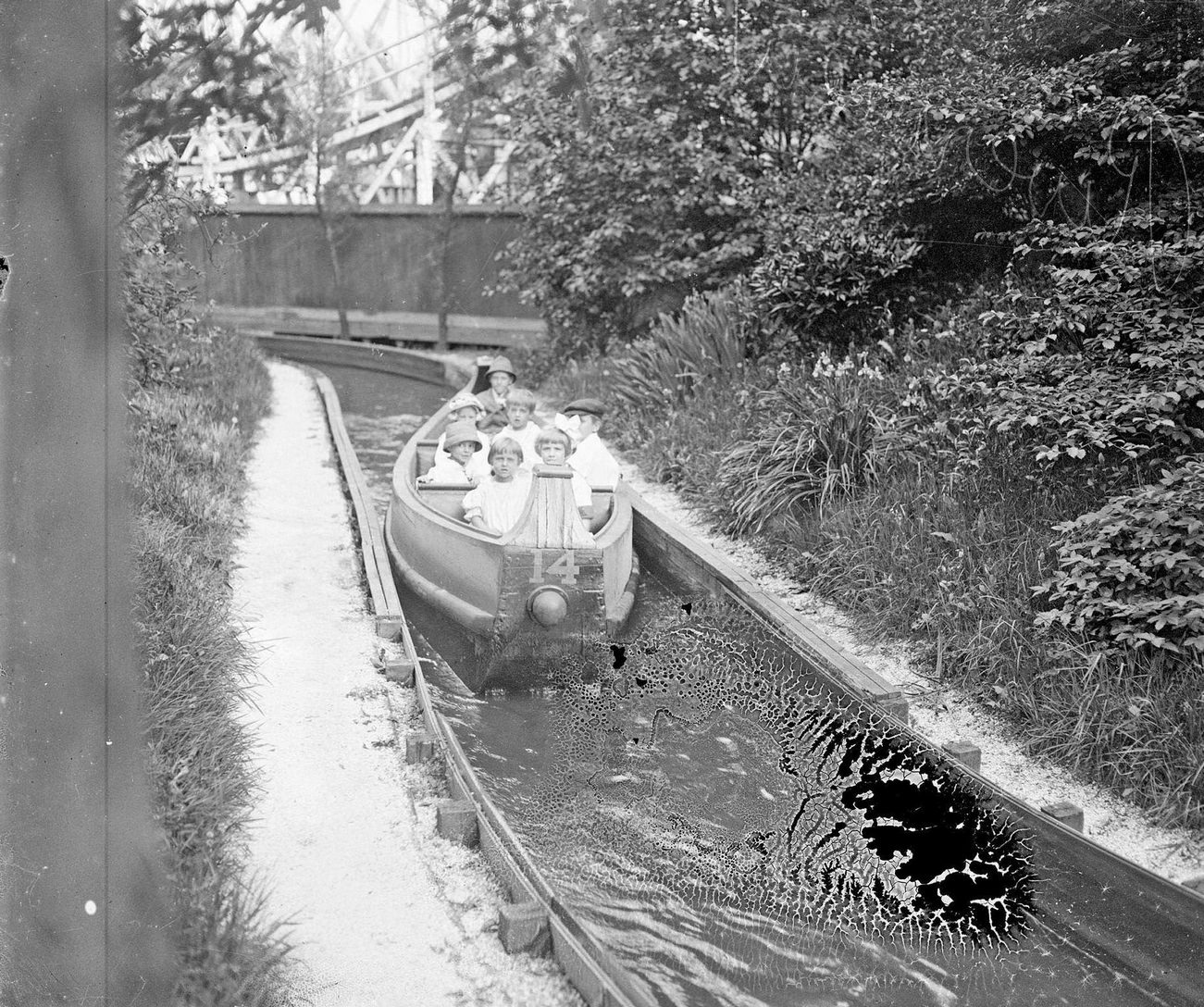
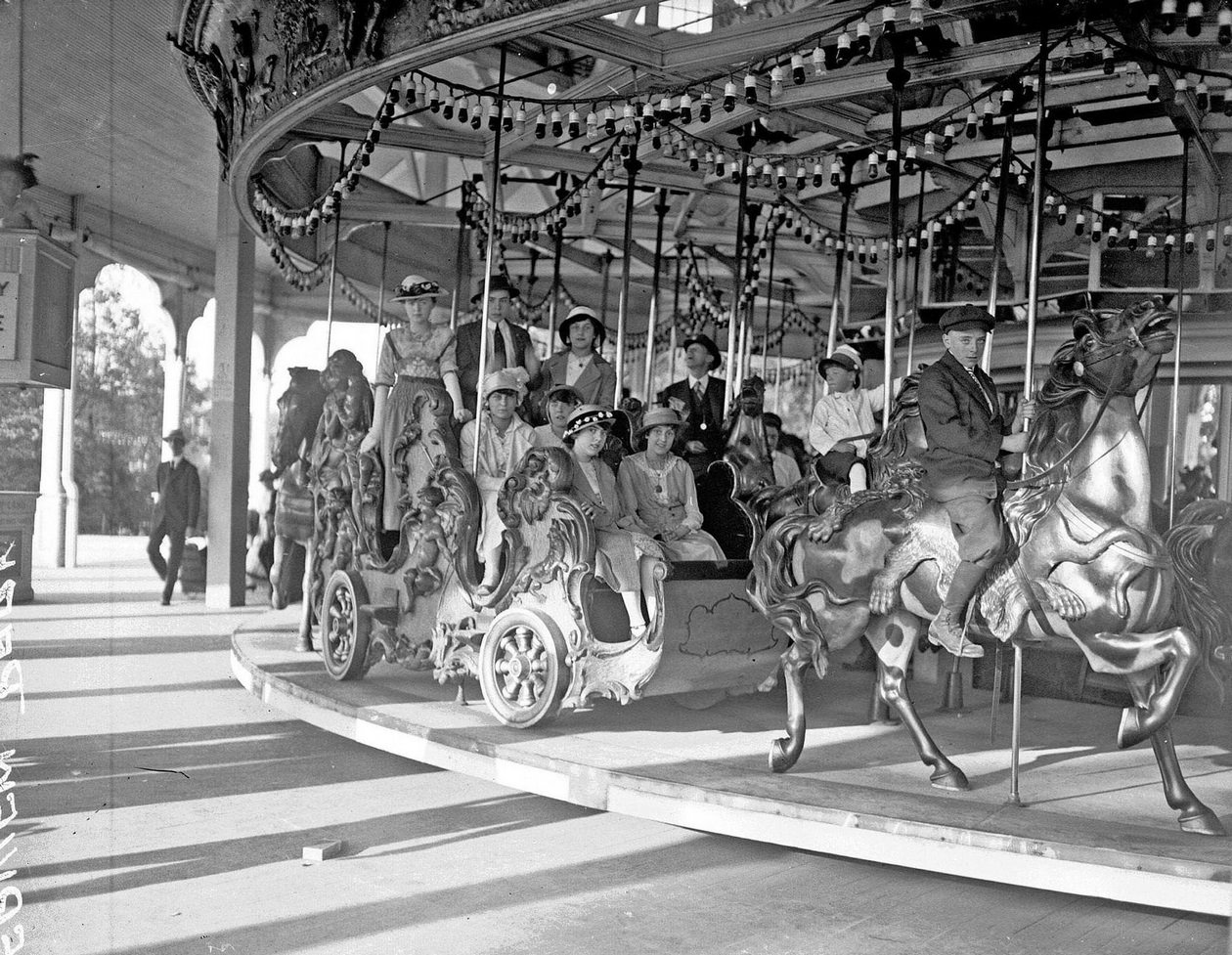
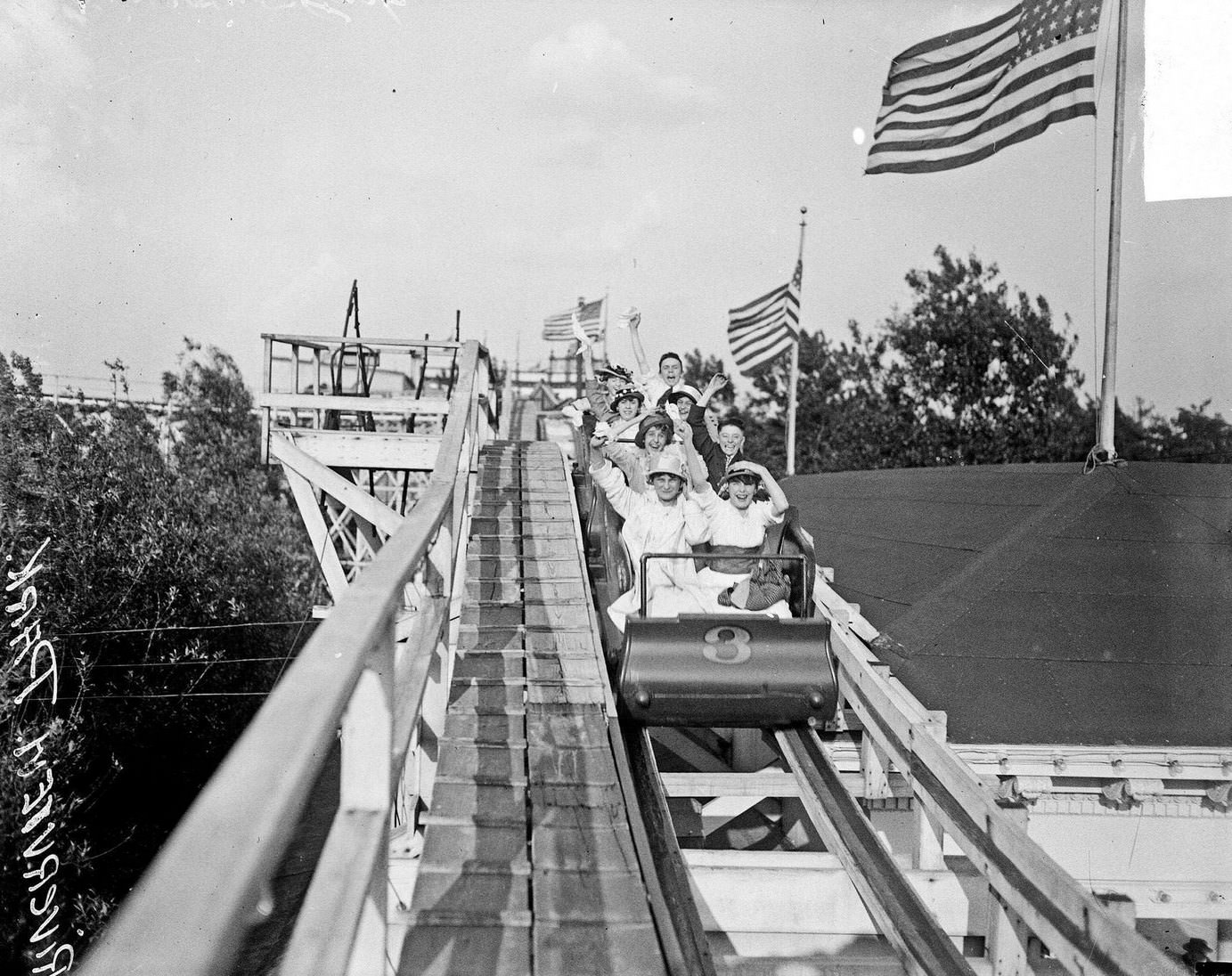
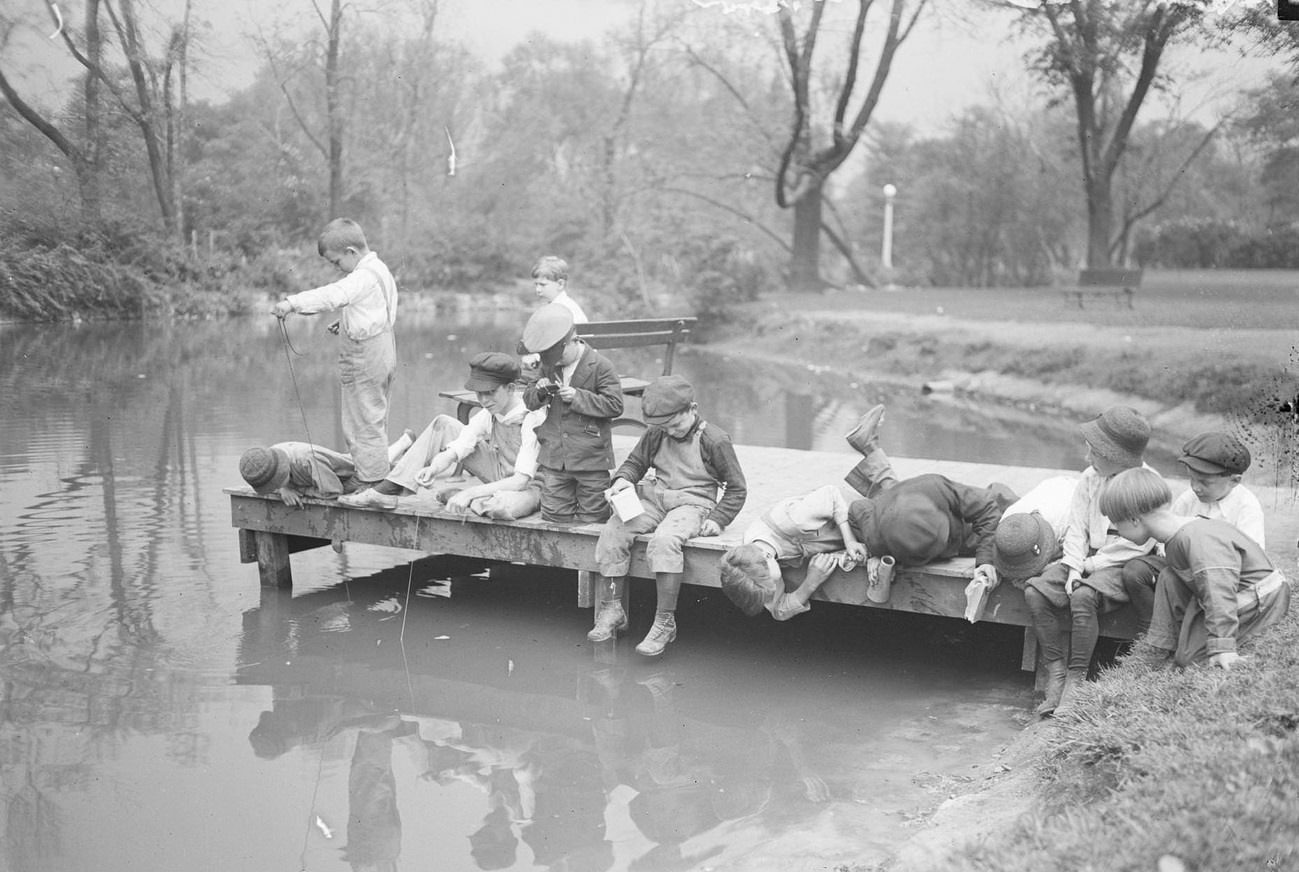
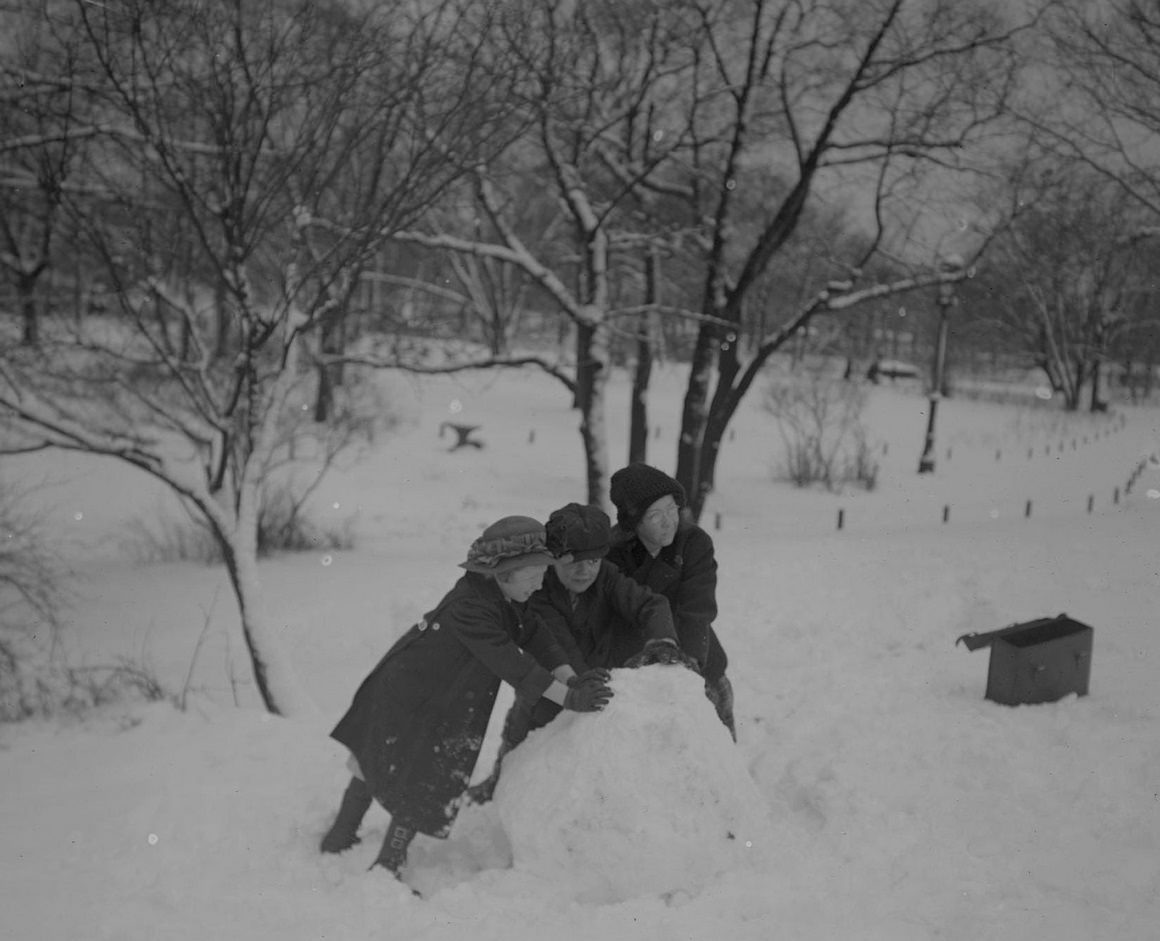
Everyday life in Chicago continued alongside all of this upheaval. Families visited Riverview Park on the North Side, riding roller coasters, carousels, and water rides. Children played in Lincoln Park, fed ducks in the ponds, rolled snowballs in winter, and fished from the docks in summer. The lakefront, the parks, and the neighborhoods offered moments of ordinary pleasure that coexisted with the decade’s larger conflicts.
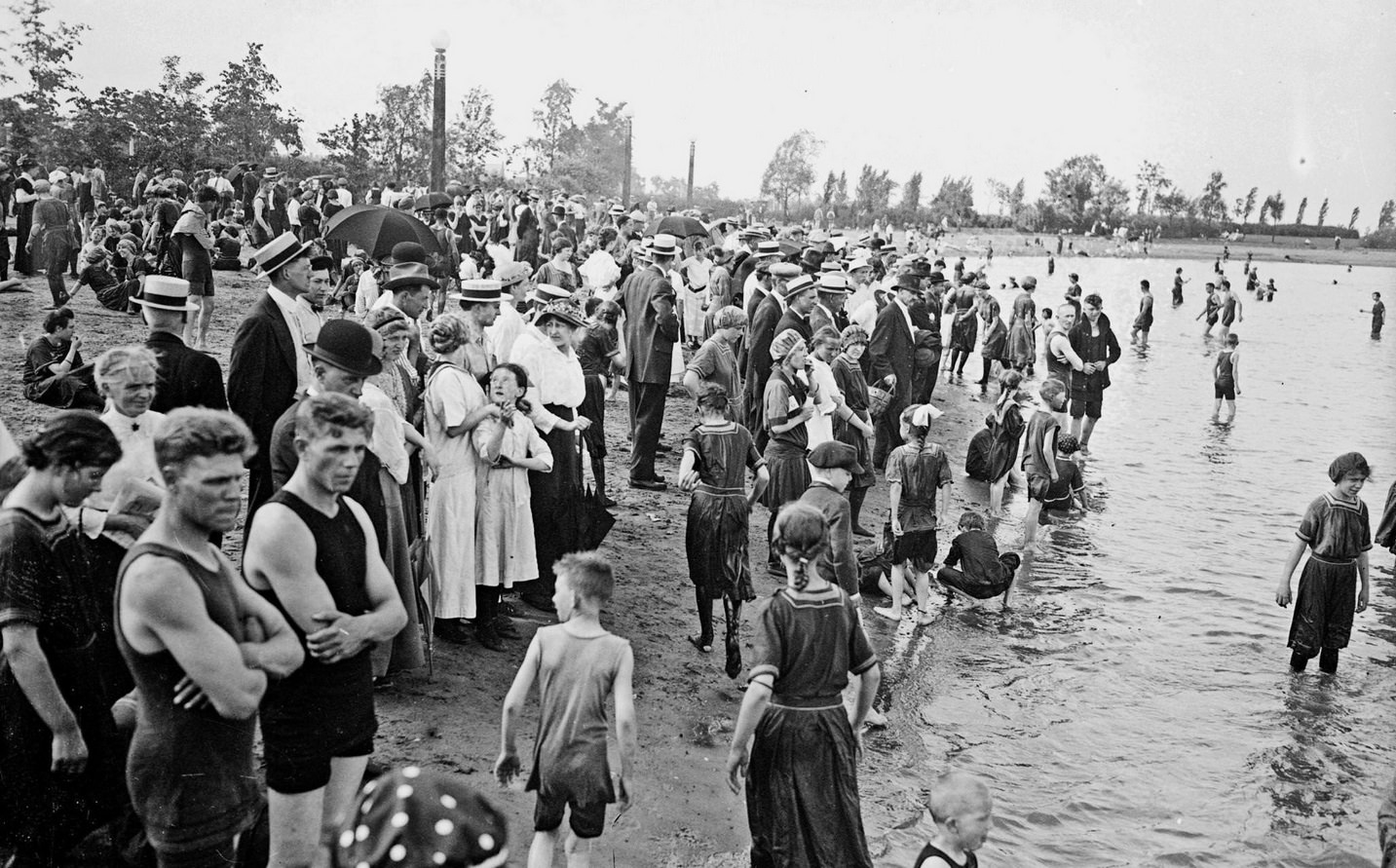
Floss Ride at Riverview Park, Chicago, Illinois, June 12, 1915.Children and adults on merry-go-round at Riverview Park, Chicago, Illinois, 1915.Parkgoers riding the Bob #3 roller coaster at Riverview Park, Chicago, Illinois, June 12, 1915.Young boys playing and fishing from a dock in Lincoln Park, Chicago, Illinois, 1919.Children rolling up a large ball of snow in Lincoln Park, Chicago, Illinois, 1910s.Swimmers and spectators on the shoreline of Lake Michigan at Diversey Beach, in the Lincoln Park community, Chicago, Illinois, 1915.
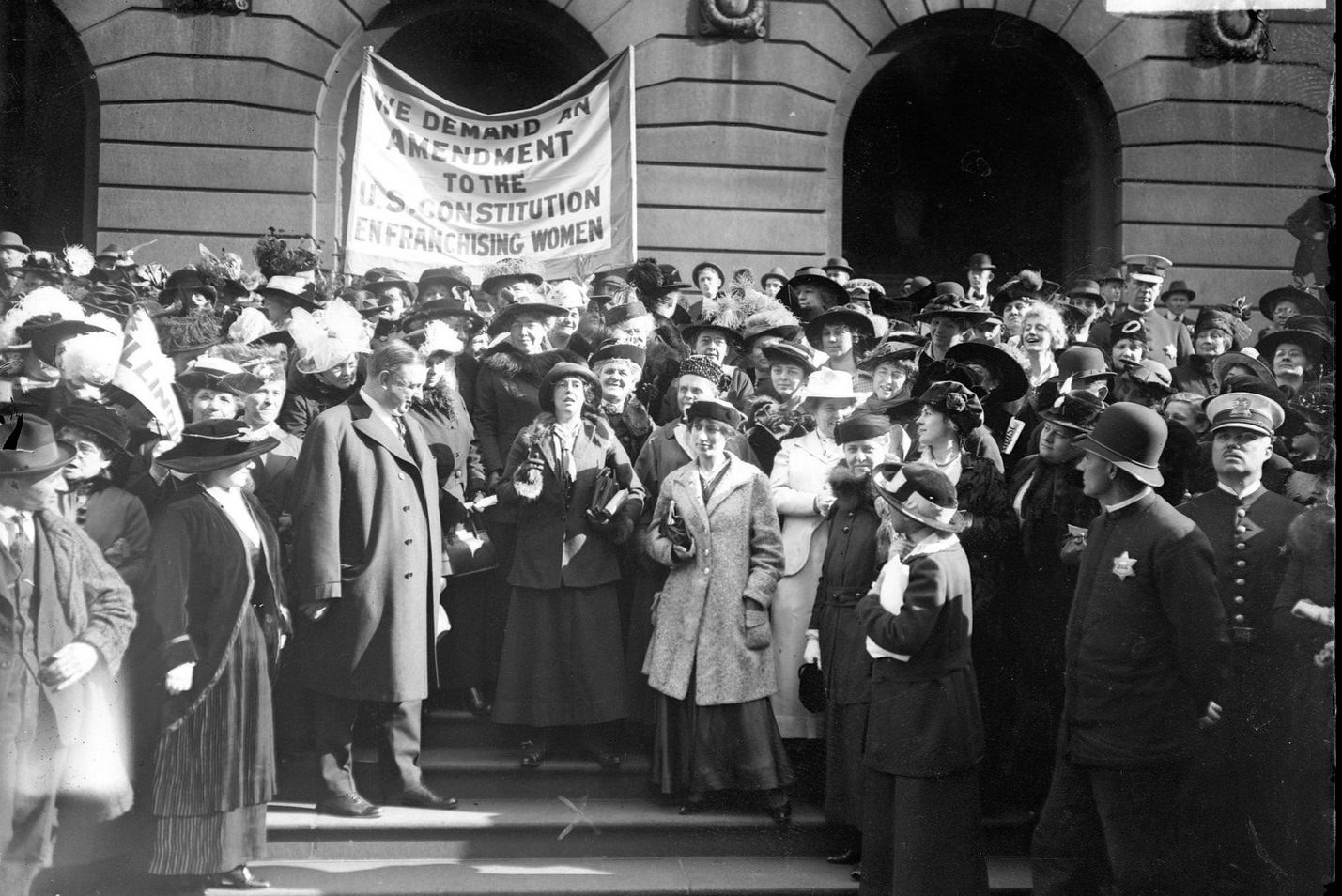
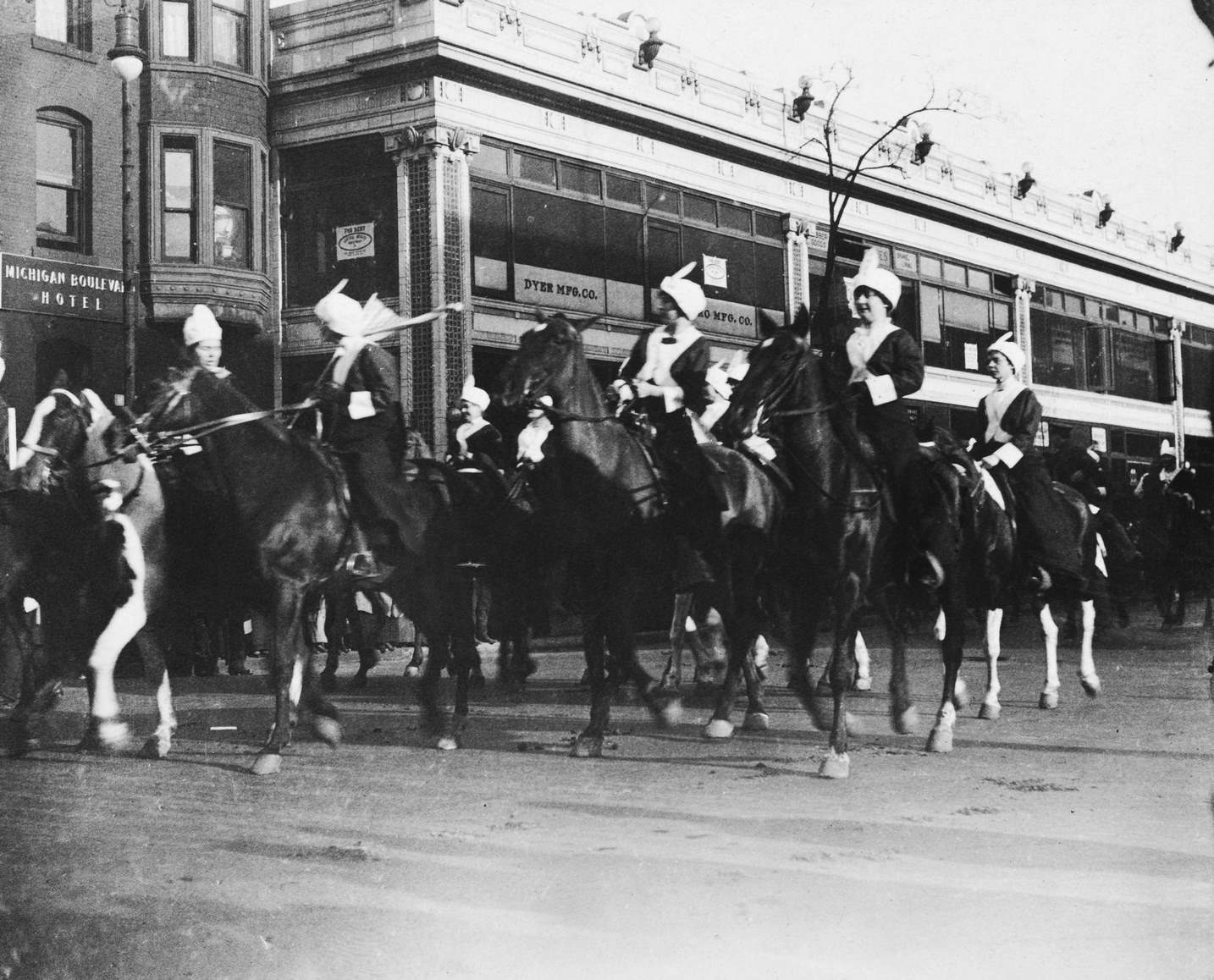
The suffrage movement remained active throughout the decade. Figures like Mabel Vernon and Sara Bard Field spoke publicly on Chicago’s street corners and gathered in front of the Art Institute demanding a constitutional amendment. Suffragettes on horseback rode through neighborhood streets, and parades continued to draw large crowds year after year.
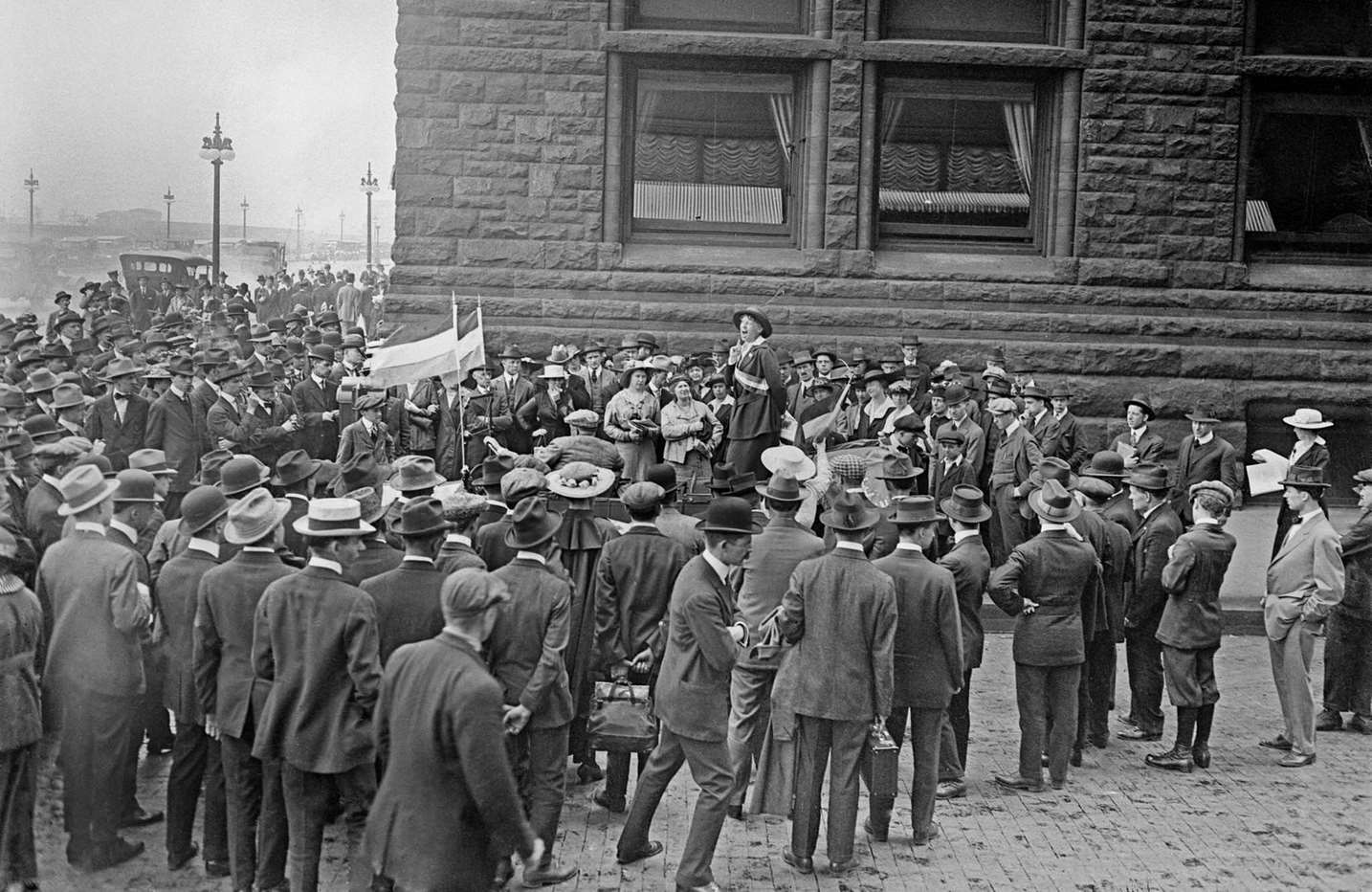
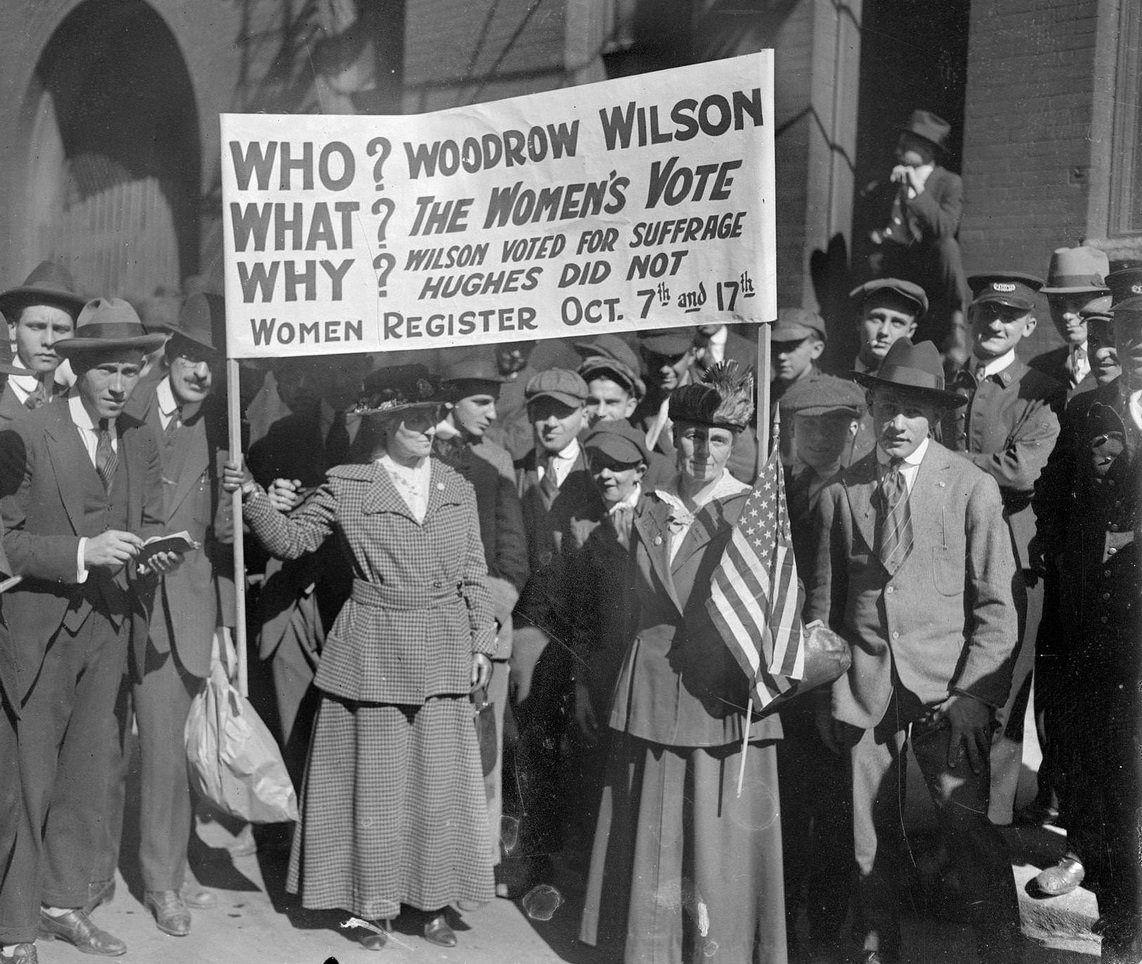
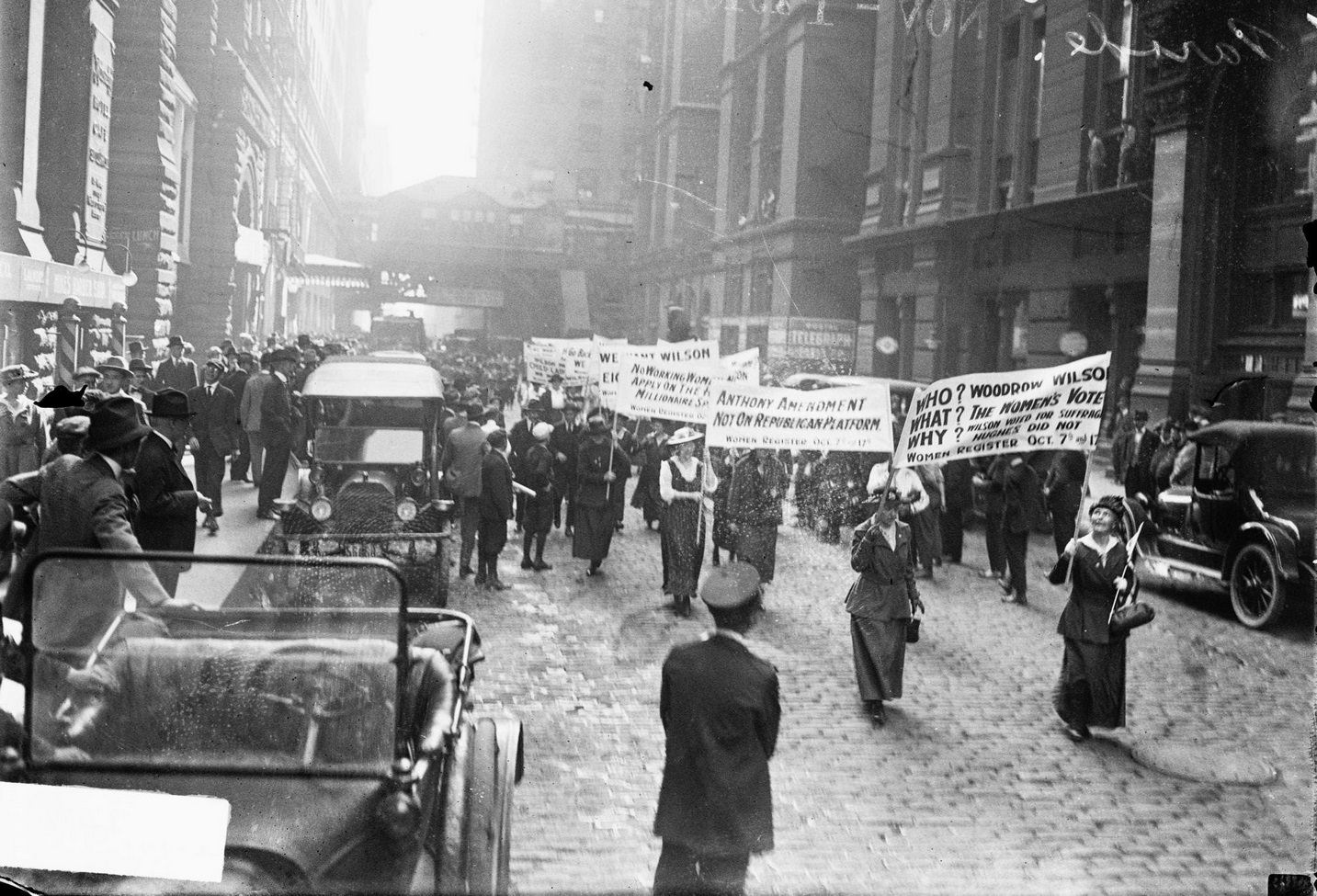
Mabel Vernon, a suffragist, speaking to a crowd on the corner of East Van Buren Street and South Michigan Avenue in the Loop community area of Chicago, Illinois, 1916Sara Bard Field, a poet and suffragist, standing in the midst of suffragists in front of the Art Institute of Chicago, located at 111 South Michigan Avenue in the Loop community area, Chicago, Illinois, December 30, 1915.Suffragettes on horseback during a parade on Ingleside Ave, Chicago, 1915.Suffragettes parade, Chicago, Illinois, 1910s.Mrs George Taylor and Mrs Catherine Waugh McCulloch, holding a banner and surrounded by men, standing in front of the LaSalle Street Station, Chicago, Illinois, 1910s.Mrs George Taylor and Mrs Catherine Waugh McCulloch leading the Democratic women’s parade on LaSalle Street in the Loop community area, Chicago, Illinois, October 5, 1916.
Politics animated the streets as well. In November 1916, the National Republican Party staged a parade through the Loop in support of presidential candidate Charles Evans Hughes. Spectators filled the steps of the Art Institute and lined both sides of Michigan Avenue, watching the procession move past some of the city’s most recognizable buildings.
A parade held by the National Republican Party in support of presidential candidate Hughes, Chicago, Illinois, November 4, 1916.
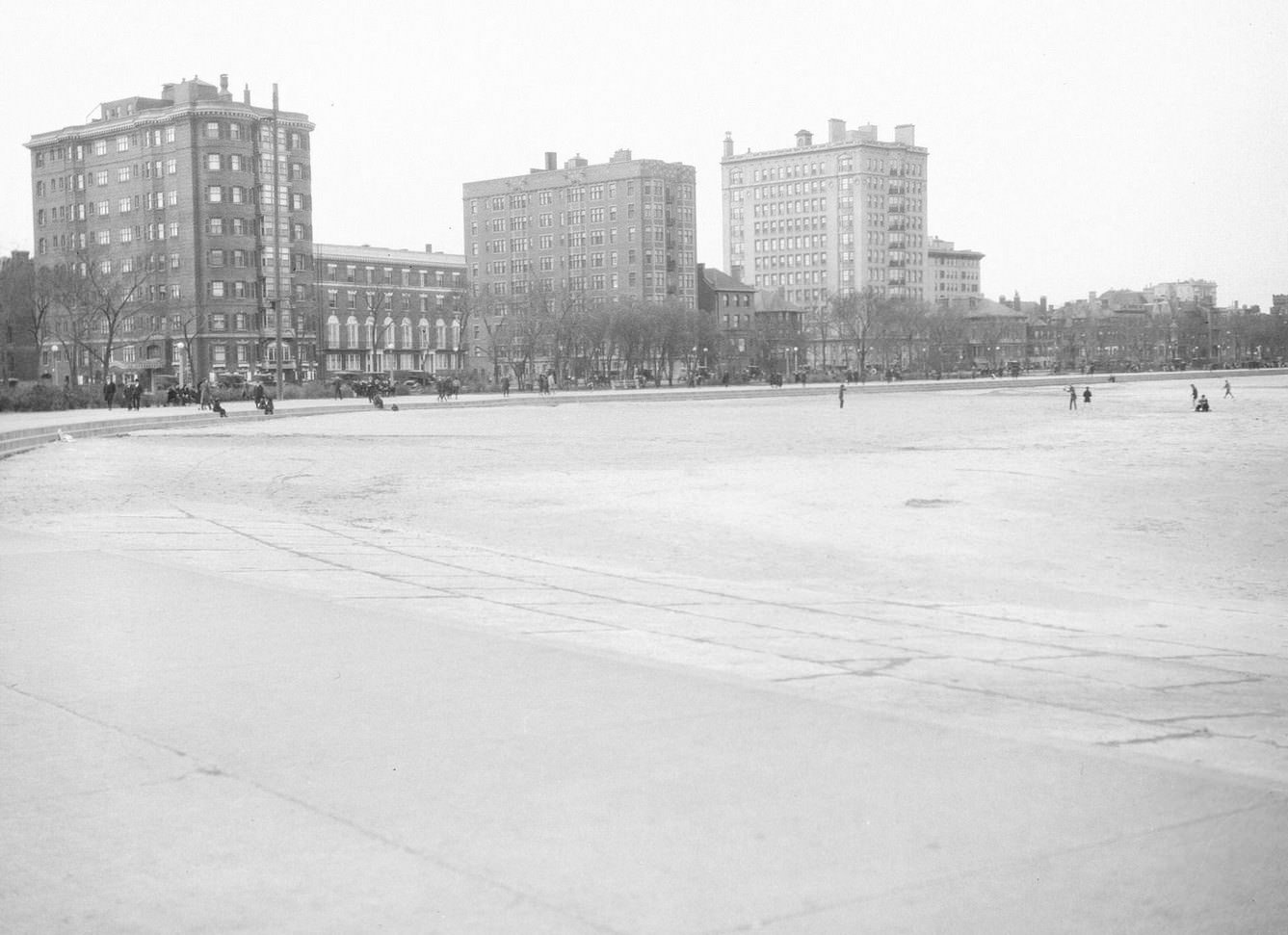
Chicago’s lakefront north of the Loop was growing in prestige. High-rise luxury apartment buildings were going up along the shore, and Lake Shore Drive was becoming one of the city’s most coveted addresses. Wealthy families who stayed in the city — rather than moving to the northern or western suburbs — settled here. The view along the drive showed a city building itself upward and outward at the same time.
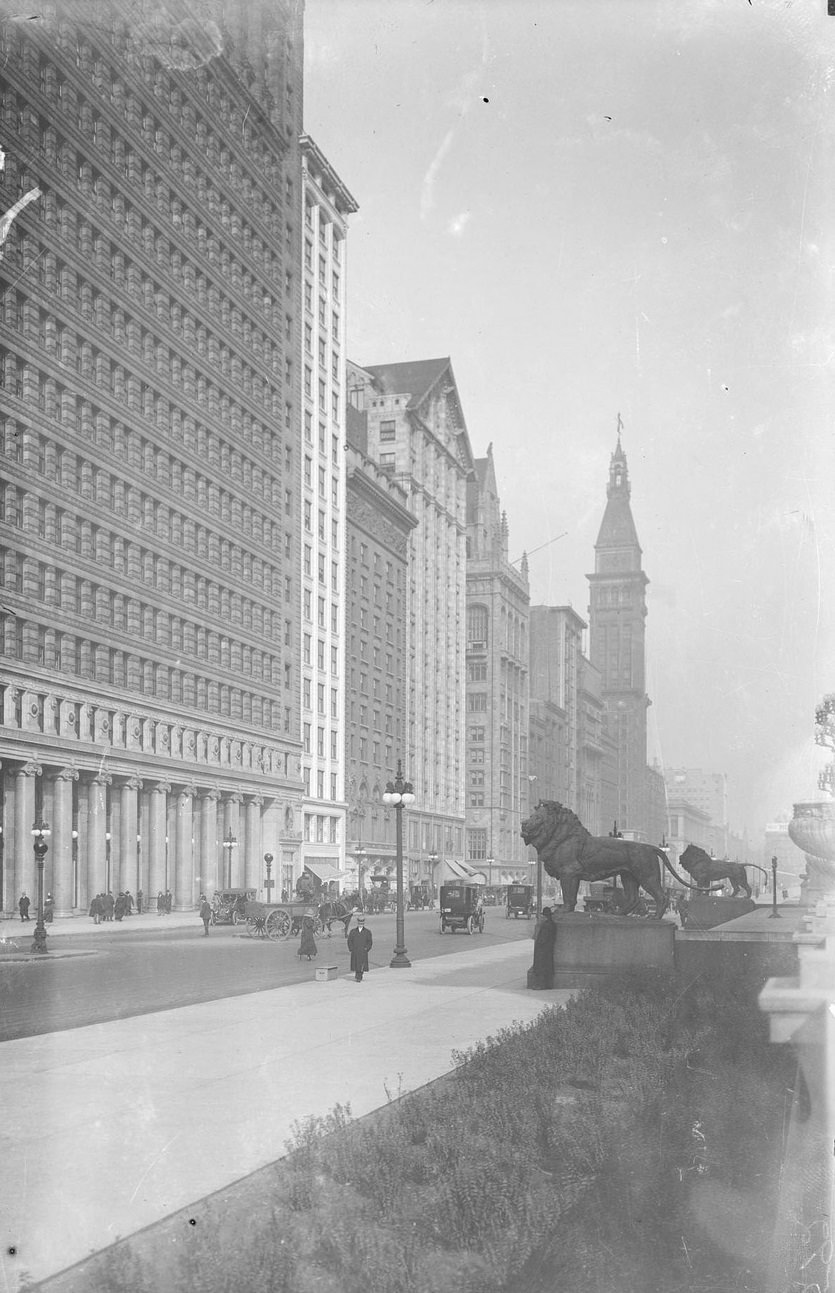
Lake Shore Drive, Chicago, Illinois, 1915.South Michigan Avenue looking north from East Adams Street, from the east side of the street, Chicago, Illinois, 1910s.
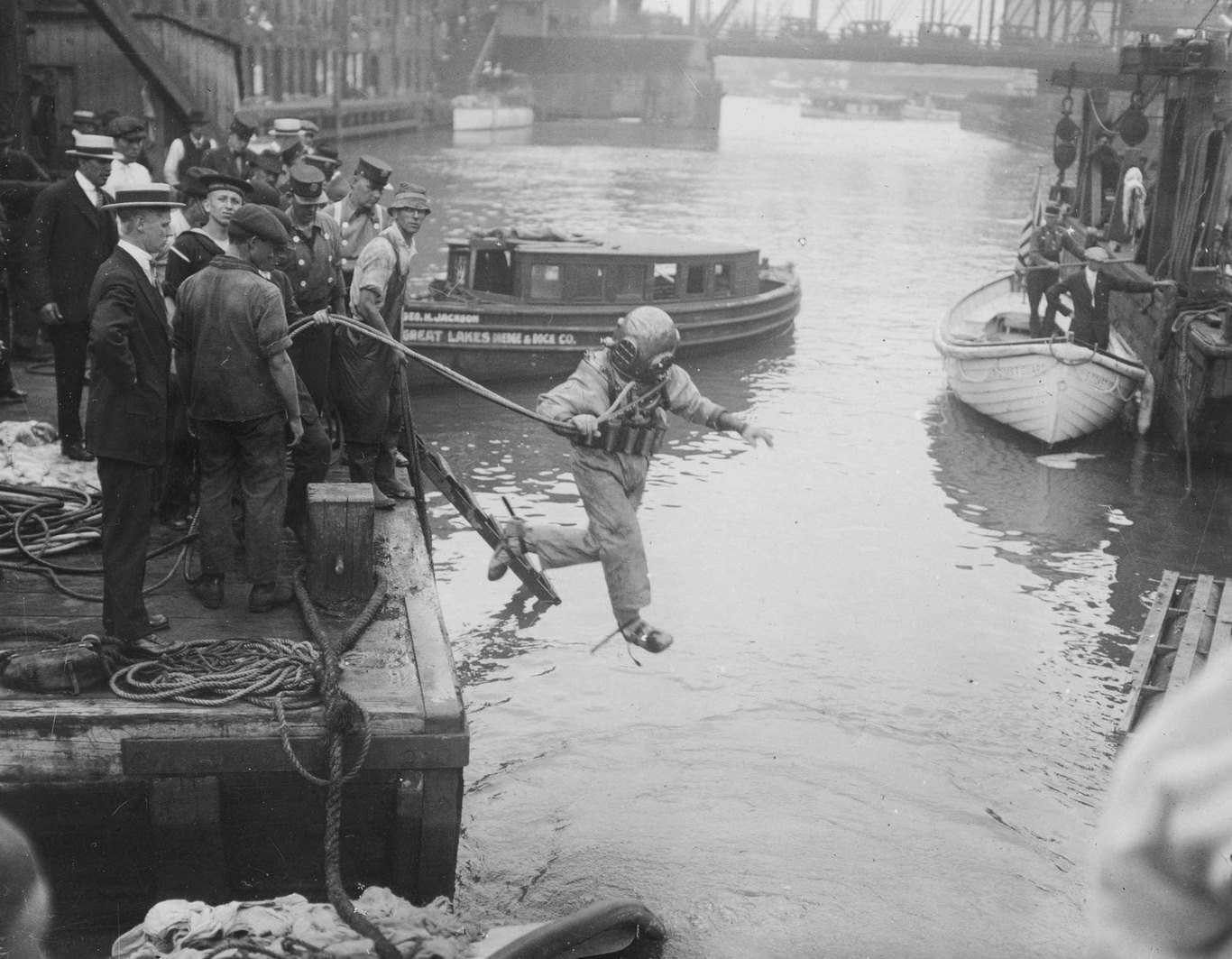
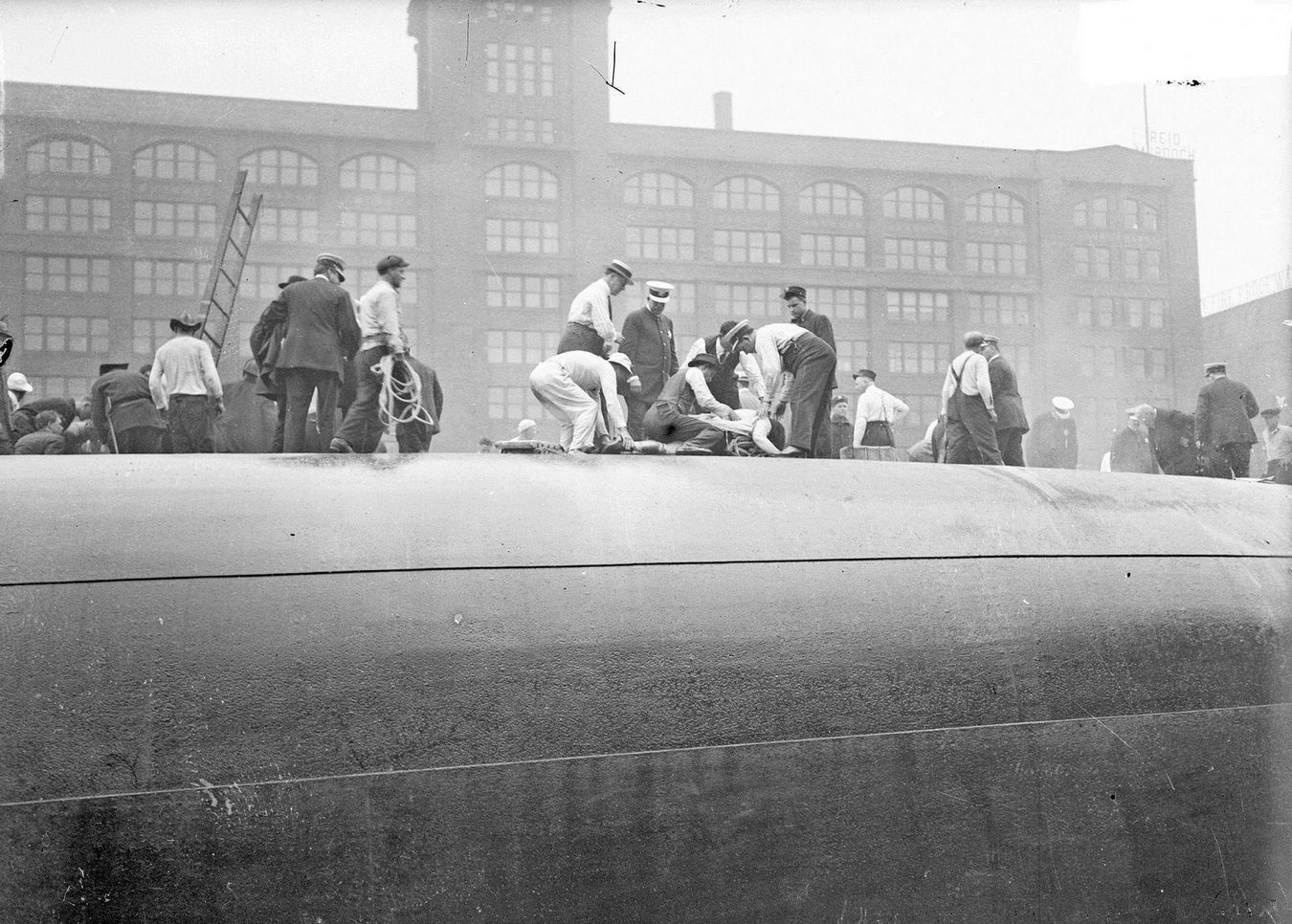
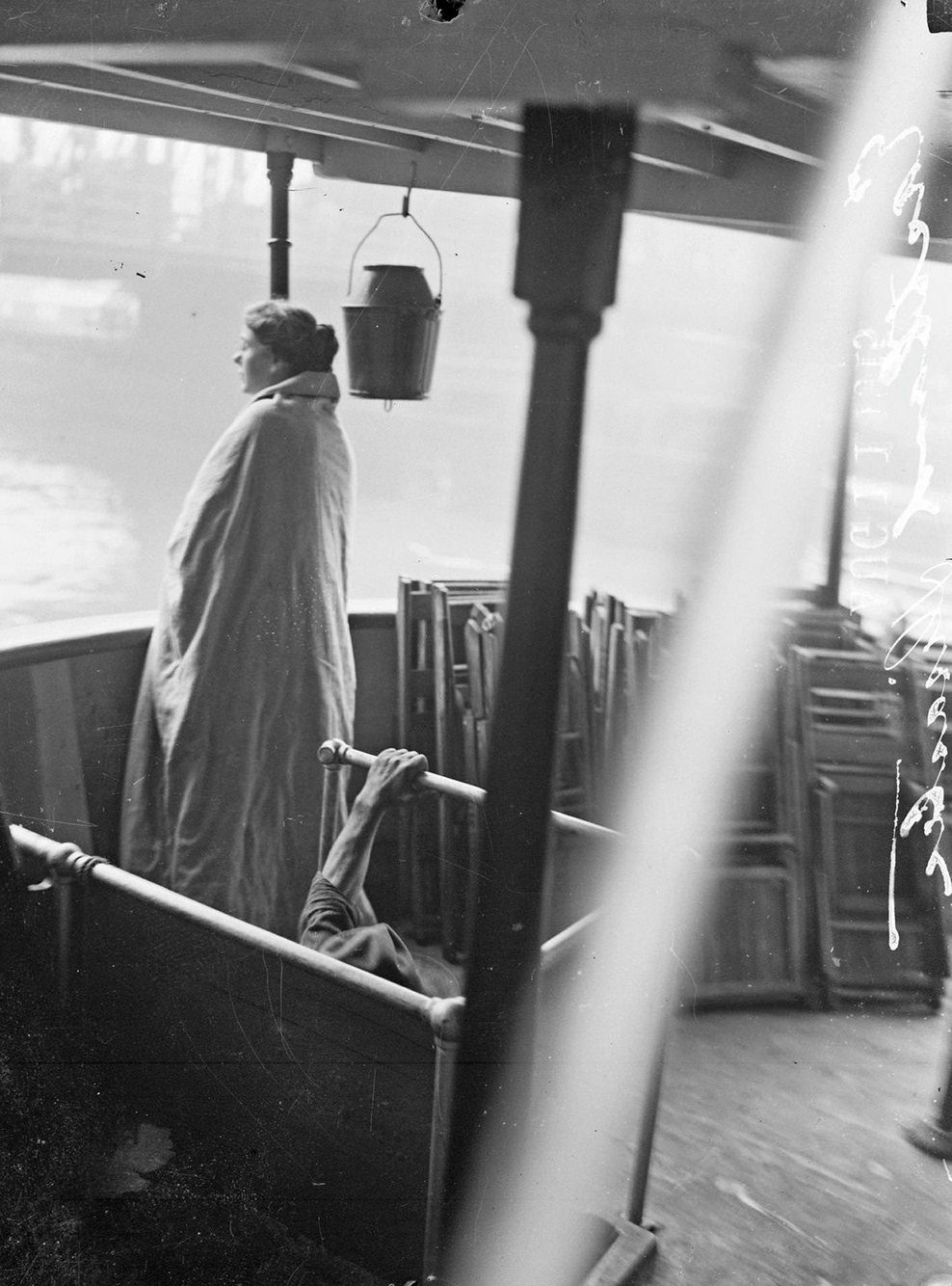
The Eastland disaster of July 24, 1915 remains one of the most devastating events in Chicago’s history. The SS Eastland was docked in the Chicago River preparing to carry Western Electric Company employees on an excursion when it slowly rolled onto its side. The ship sank in just 20 feet of water, but 844 passengers drowned, many of them trapped below deck. Rescue workers and tugboats like the Kenosha worked frantically to reach survivors. Divers with diving bells entered the water searching for victims.
Diver with diving bell leaping into water outside Eastland crash site, Chicago, Illinois, July 24, 1915Rescuers and survivors atop the hull of the overturned Eastland steamer in the Chicago River, Chicago, Illinois, circa July 24, 1915.The S.S. Eastland lying on its side in the Chicago River after slowly rolling over and drowning 844 people on July 24, 1915 in Chicago.Eastland disaster, female survivor, wrapped in a blanket, standing on upper deck of a boat, Chicago, Illinois, July 24, 1915.Eastland disaster, the Kenosha, a tugboat, rescuing survivors from the hull of the overturned steamer, Chicago, Illinois, July 24, 1915.
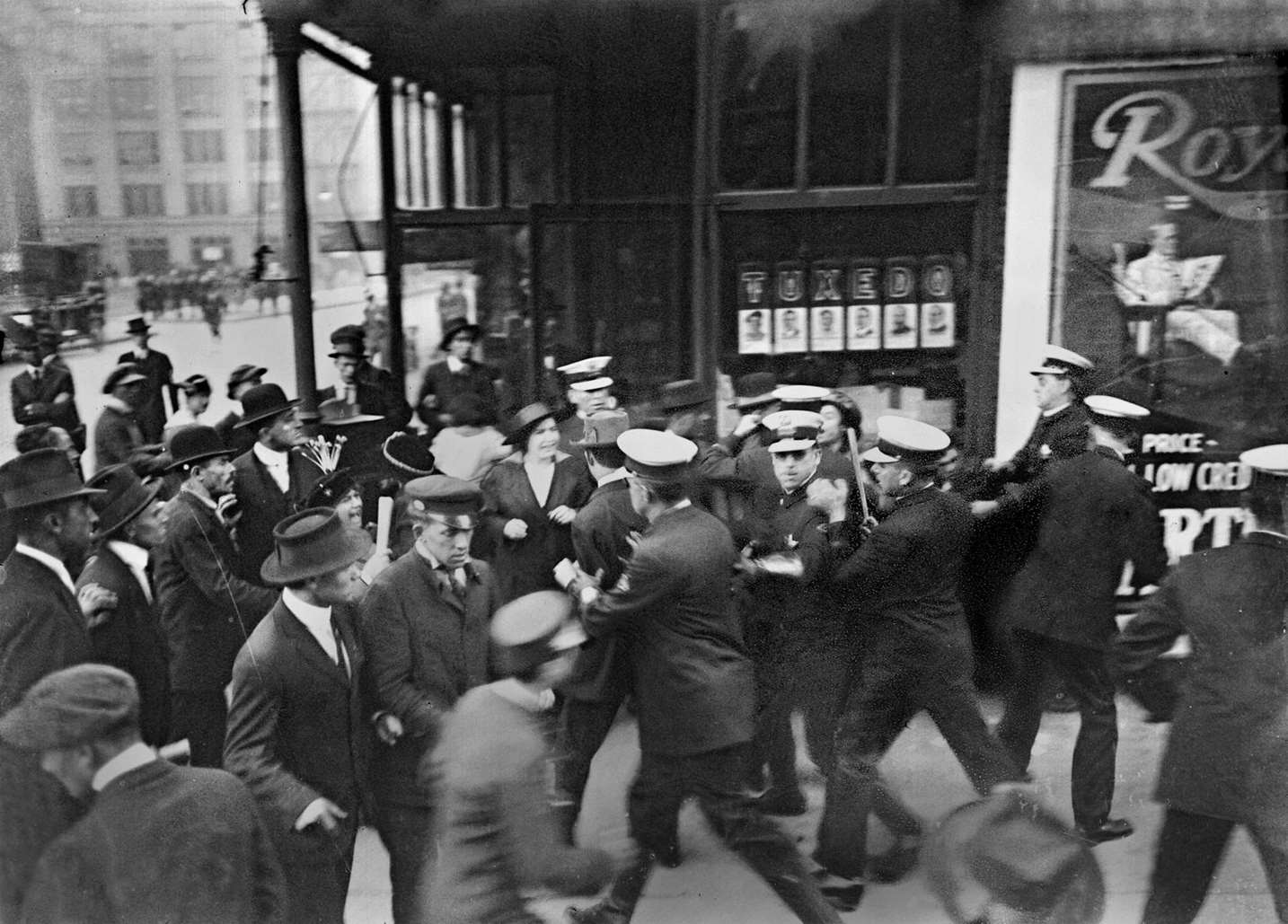
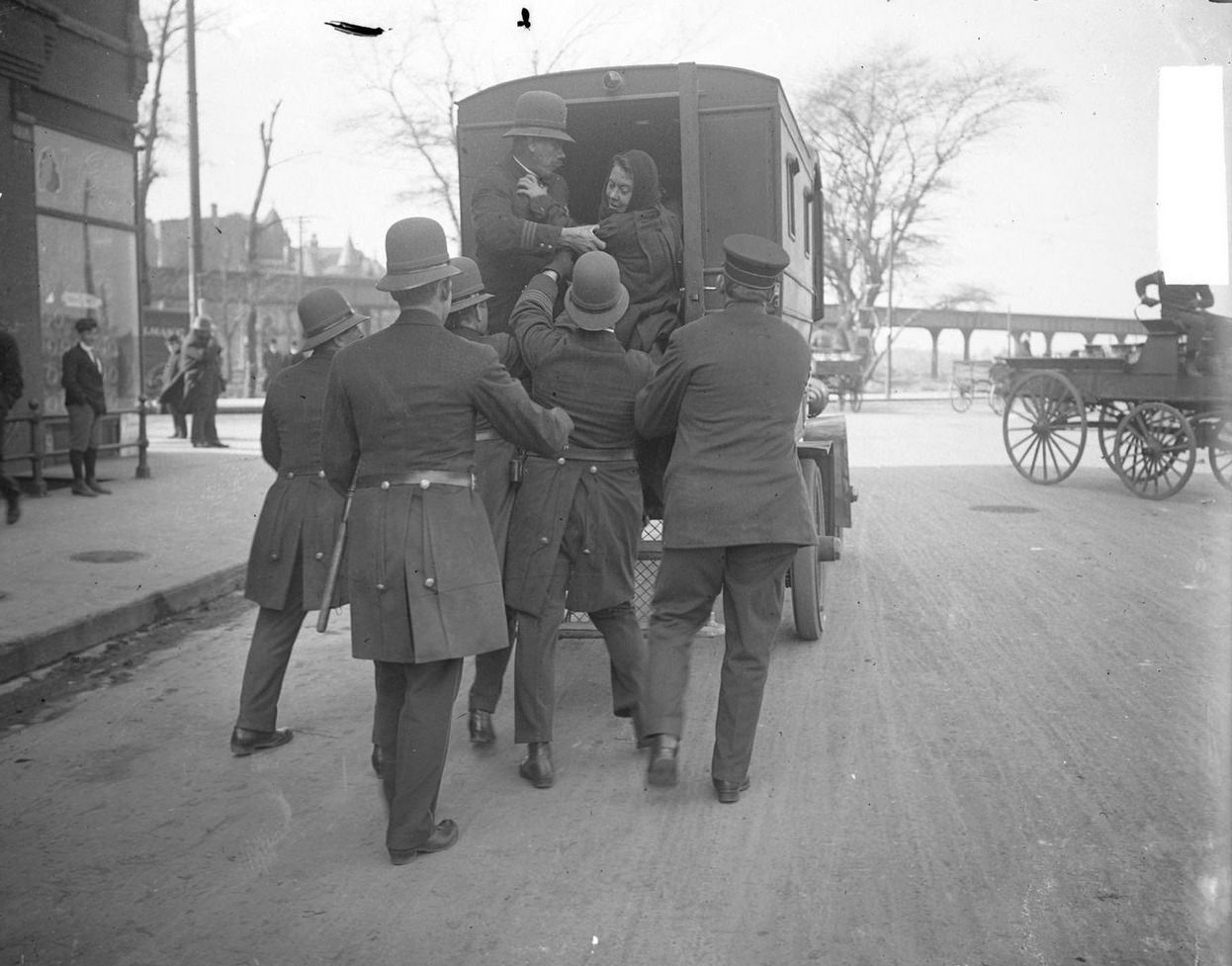
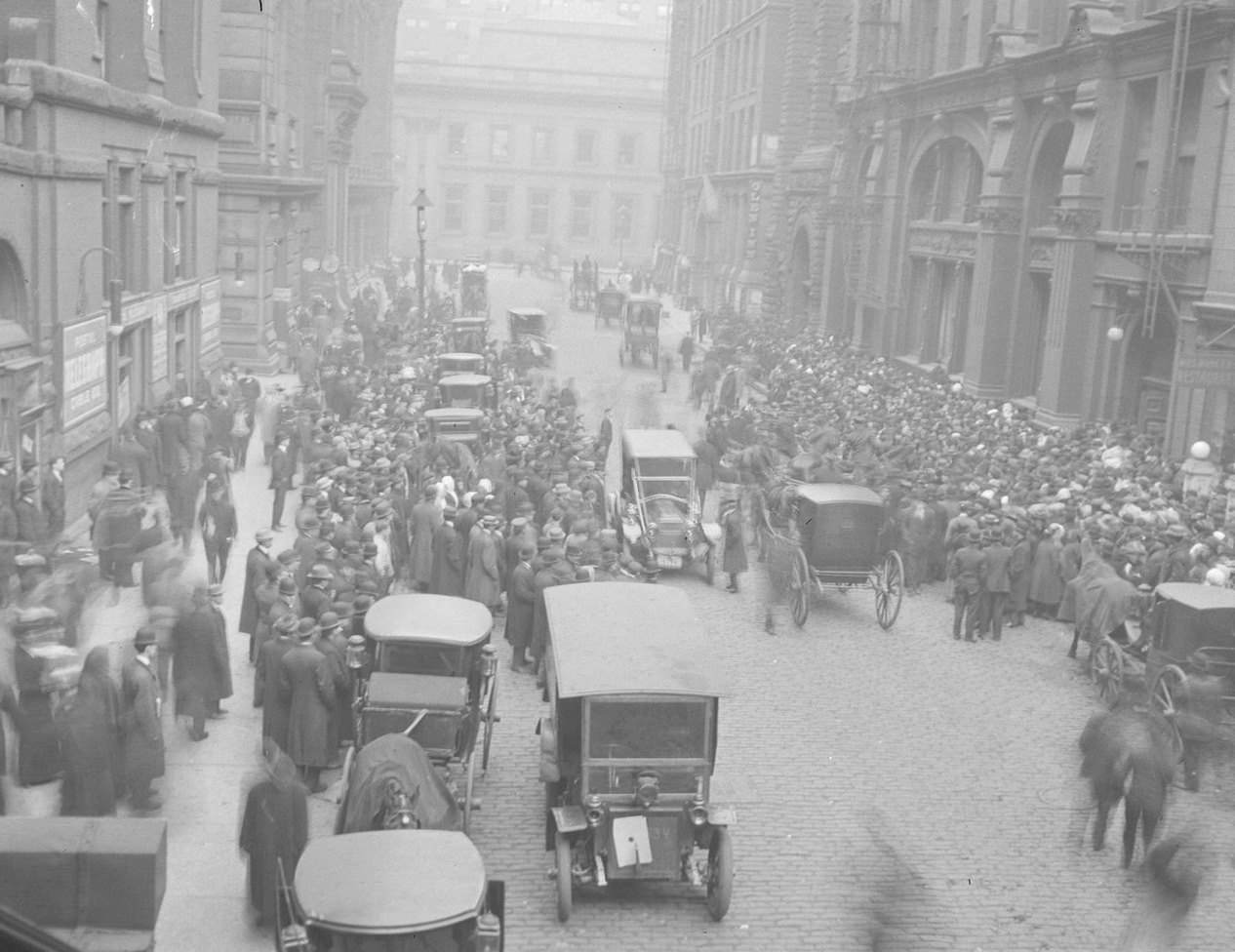
Striking garment workers were another constant presence on Chicago’s streets throughout the decade. In 1915, police physically removed women from picket lines during the garment workers’ strike. Members of the Amalgamated Clothing Workers of America marched in Labor Day parades with 10,000 participants drawn from the garment district. The industry was massive, and its workers fought hard for better conditions.
Striking garment workers and policemen scuffle in Chicago, Illinois, 1915.Members of the Amalgamated Clothing Workers of America in a Labor Day parade, Chicago, Illinois, May 1915.Police putting a woman into the back of a police wagon during Garment Workers Strike, Chicago, Illinois, 1910s.Crowd of people gathered for the garment workers’ strike on Lasalle Street, north from Van Buren Street, Chicago, Illinois, 1910s.
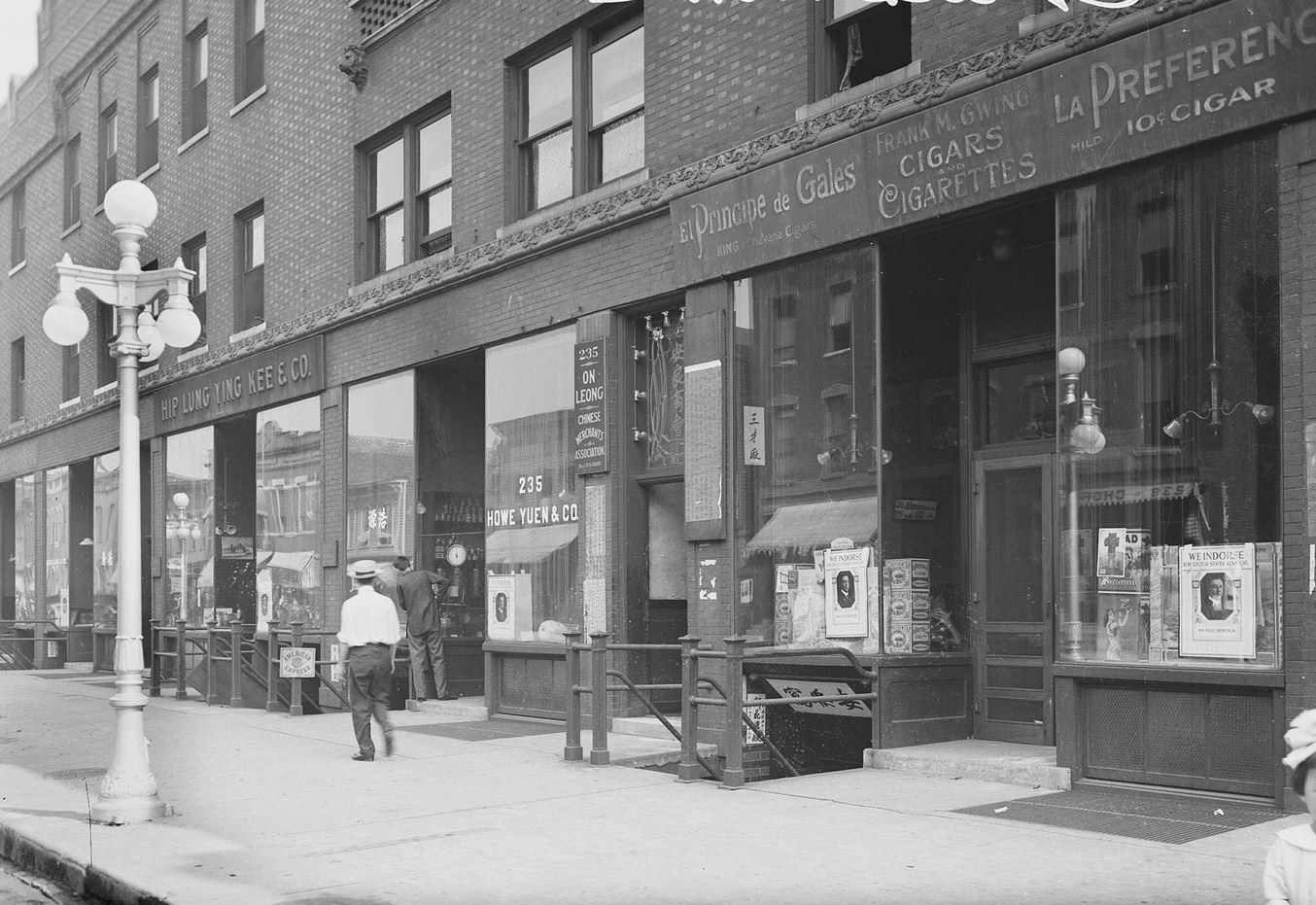
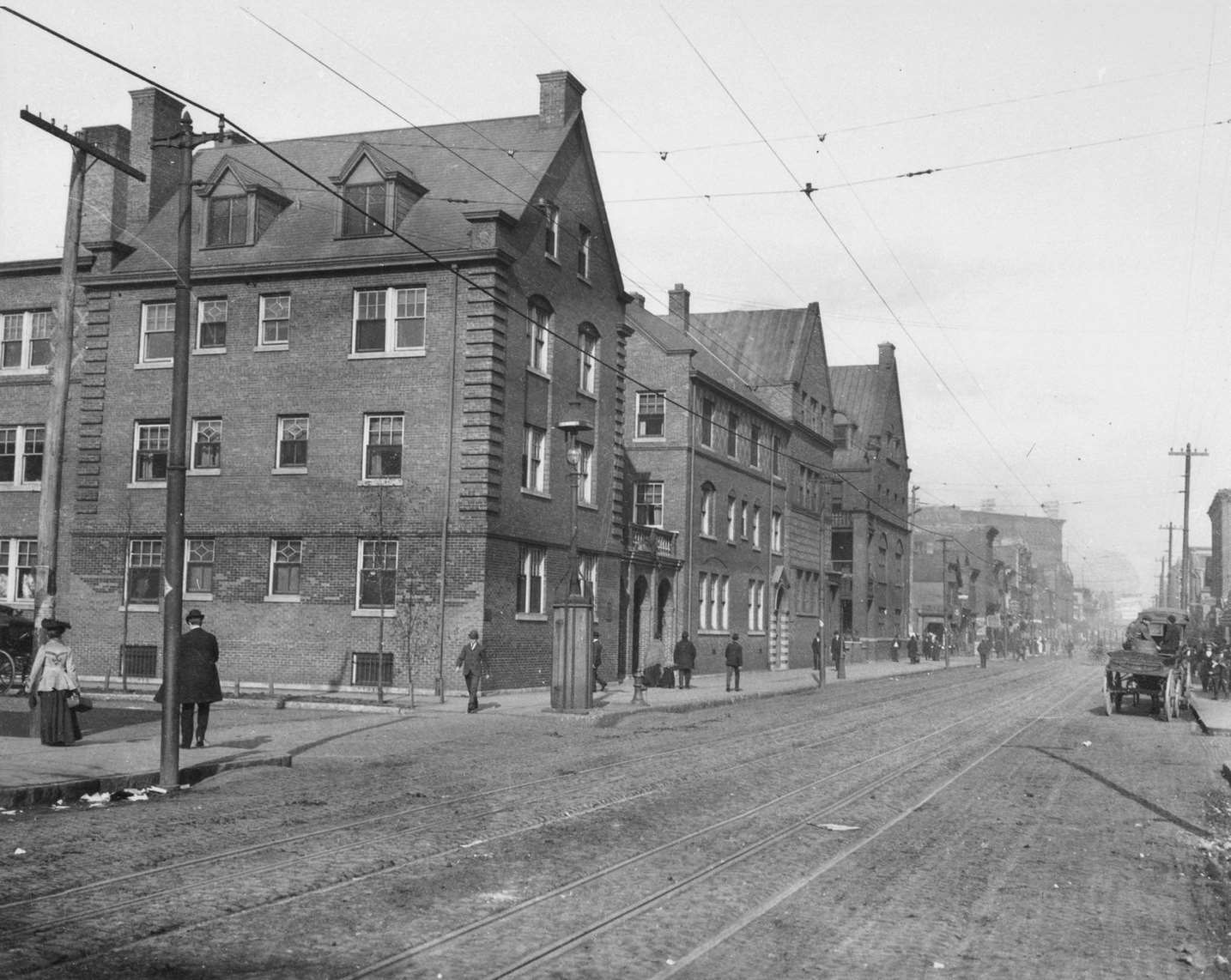
Chicago’s neighborhoods each had their own distinct character. Chinatown’s Hip Lung Yung Kee & Company operated on West 22nd Street in the Armour Square community area. Hull House, the settlement house founded by Jane Addams and Ellen Gates Starr on South Halsted Street, provided services to the city’s immigrant poor and became one of the most famous social reform institutions in the country.
View of storefront in Chinatown, Hip Lung Yung kee & Company, at 233 West 22nd Street in the Armour Square community area of Chicago, Illinois, 1910s.Hull House, the settlement house founded by Jane Addams and Ellen Gates Starr at 800 South Halsted Street in Chicago, 1910s.
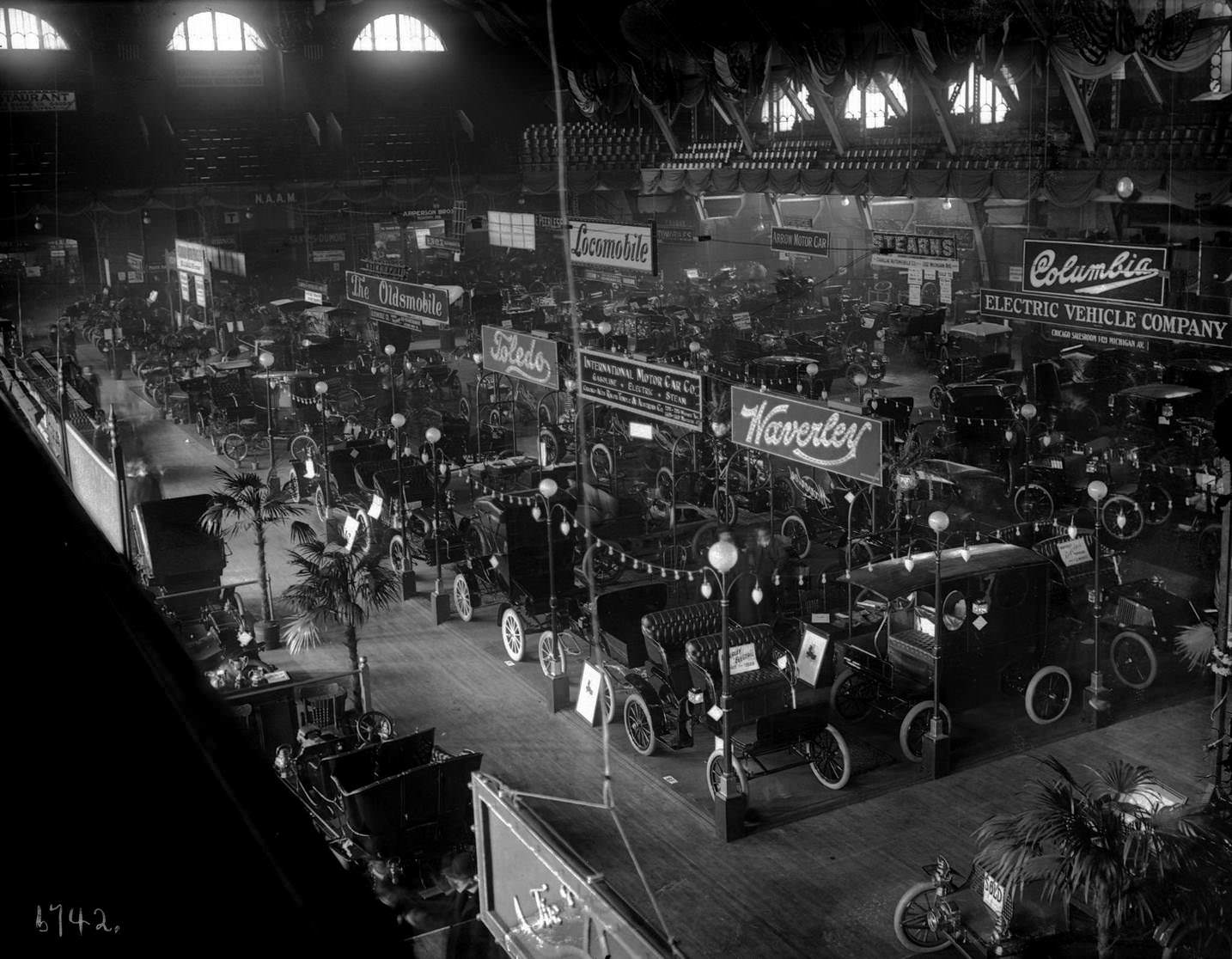
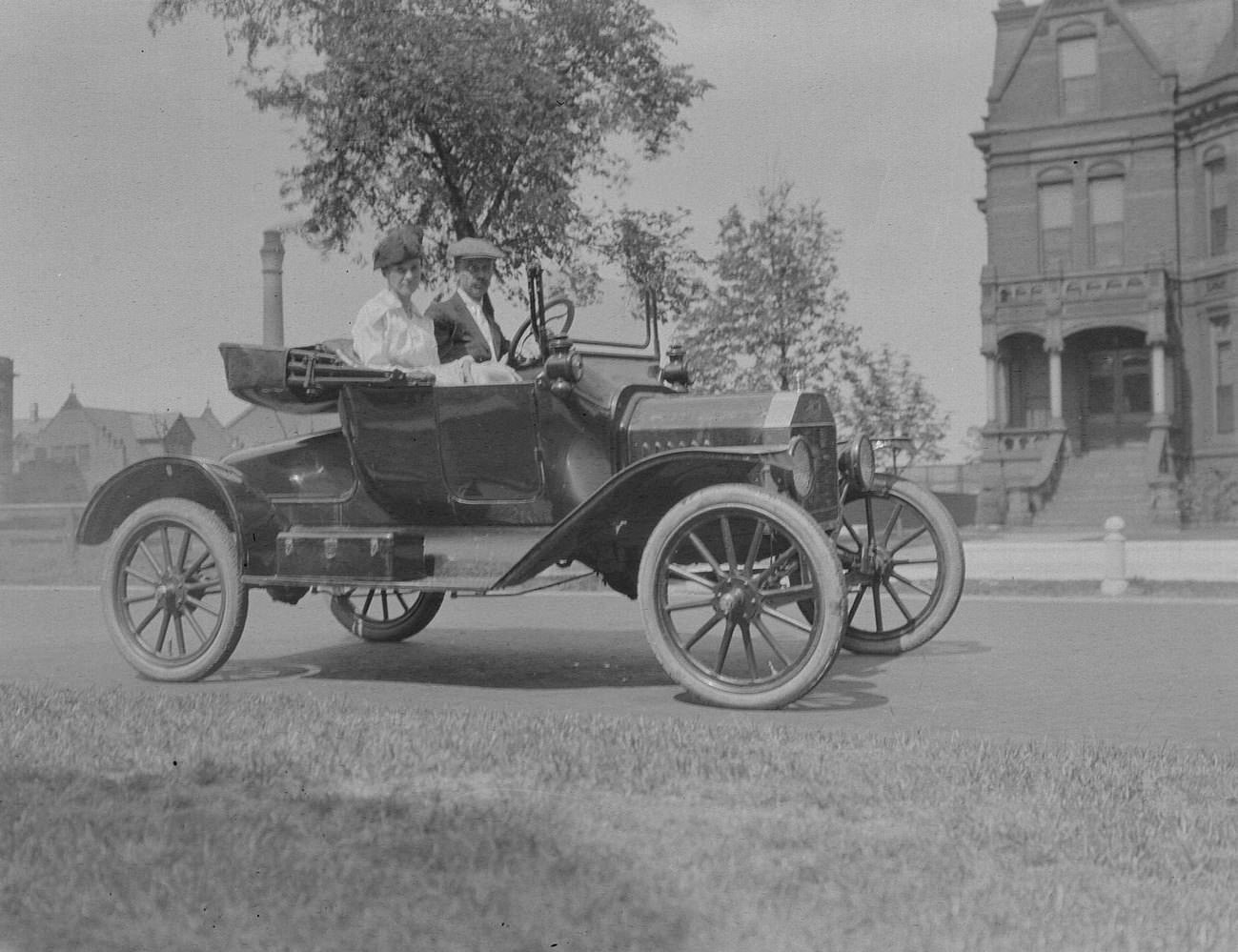
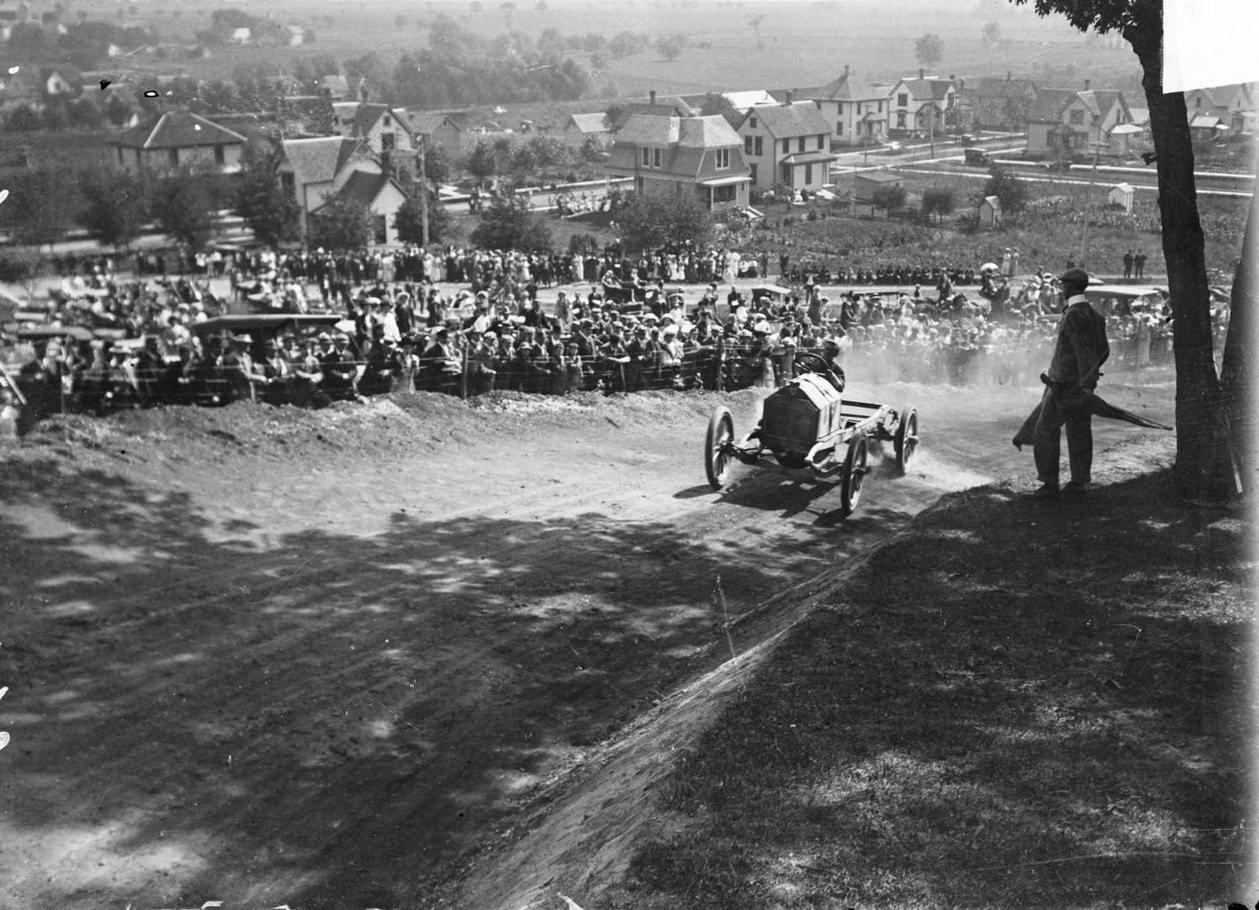
Chicago’s automobile culture was already establishing itself. The city’s annual Automobile Show filled large indoor spaces with the latest models, drawing curious crowds. People rode Ford Model T’s through the streets, and driving competitions like the Algonquin Hill Climbing Contest brought out both drivers and spectators. The car was quickly moving from novelty to necessity.
A view of the floor at the Chicago Automobile Show, Chicago, 1910sPeople riding in a Ford Model T automobile, Chicago, Illinois, 1916.Automobile driver Moukmier (or possibly Moukmeer) driving a Staver automobile up a hill during the Algonquin Hill Climbing Contest, Chicago, Illinois, 1910s.
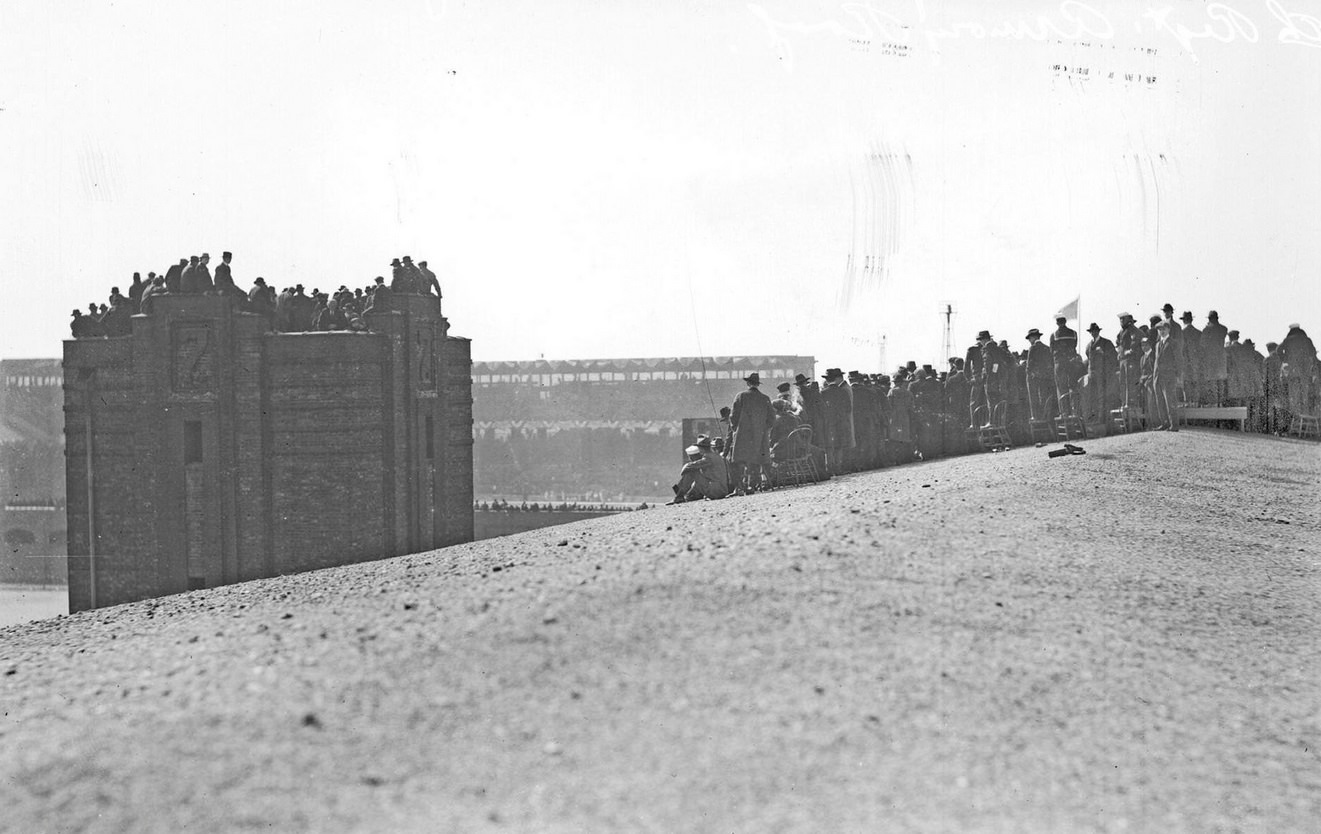
Baseball was woven into the city’s identity. In October 1917, the White Sox faced the New York Giants in the World Series, and fans without tickets climbed to building rooftops around the ballpark to watch the games. Chicago’s two major league clubs — the Cubs and the White Sox — kept the sport at the center of the city’s social calendar throughout the decade.
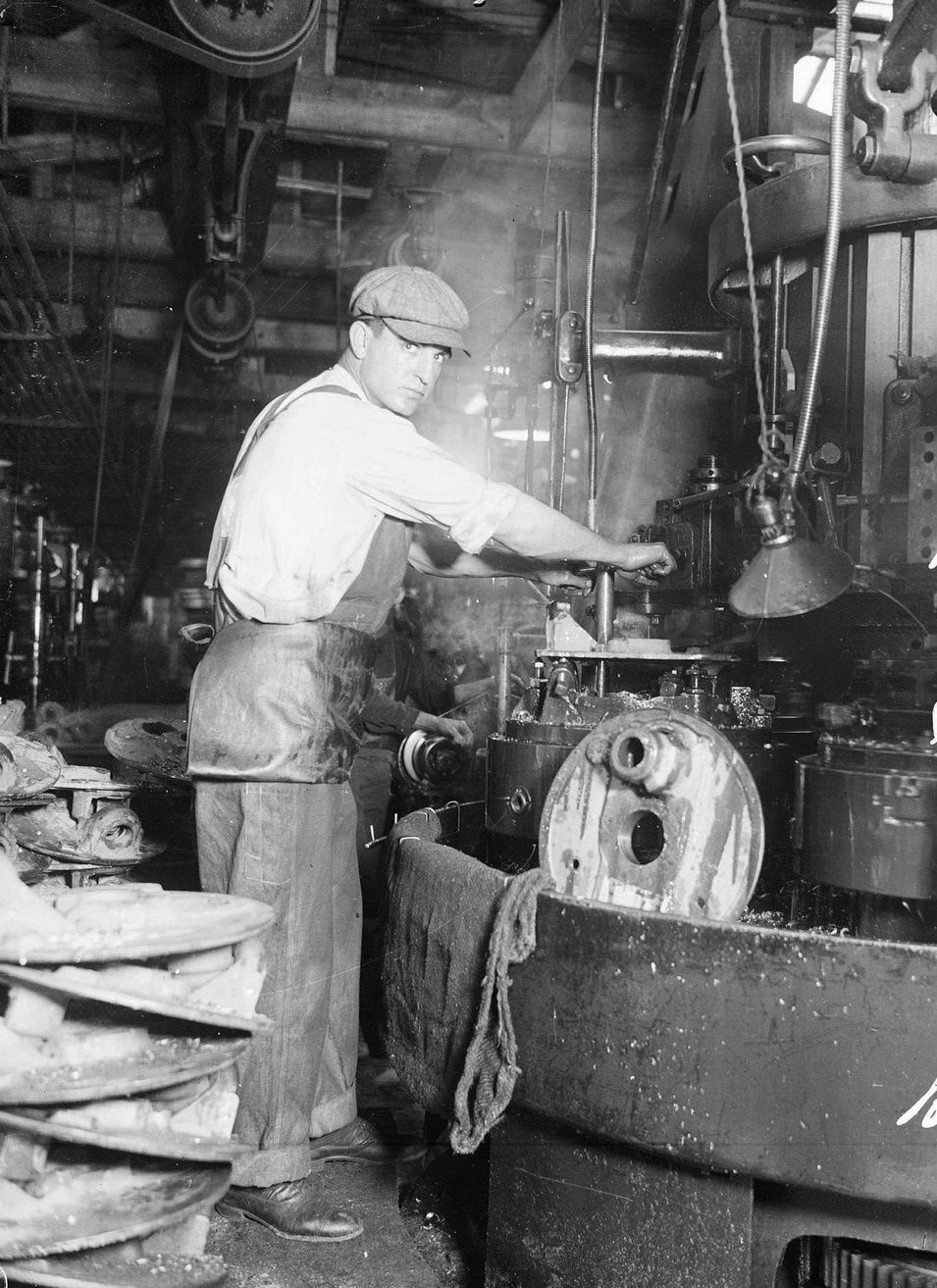
Baseball, World Series 1917, Chicago White Sox vs. New York Giants, spectators watching from building rooftops, Chicago, Illinois, October 1, 1917.Baseball player Jim Vaughn, of the National League’s Chicago Cubs, wearing street clothes and holding on to a lever attached to a large piece of machinery, standing in a room filled with machinery in or near Chicago, Illinois, 1918.
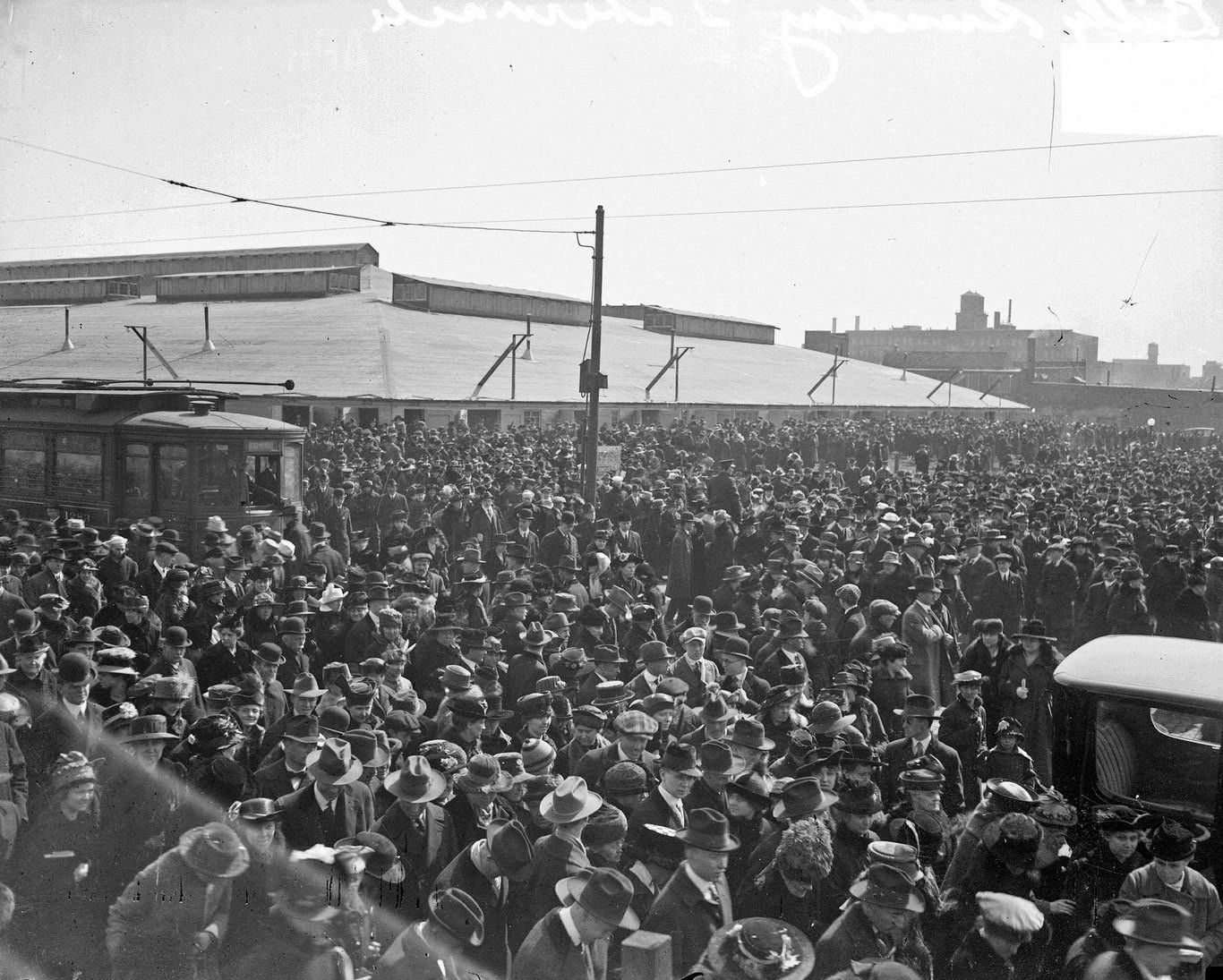
Religion played a visible role in city life. The Zion Temple on the Near West Side, the new Moody Tabernacle at North Avenue and Clark Street, and the Belden Avenue Baptist Church in Lincoln Park were among the congregations that shaped their surrounding neighborhoods. Evangelist Billy Sunday drew massive crowds to a tent tabernacle set up just north of Navy Pier in March 1918.
Crowd gathered outside evangelist Billy Sunday’s tent, called a tabernacle, set up just north of Navy Pier, Chicago, Illinois, March 15, 1918.The new Moody Tabernacle at North Avenue and North Clark Street in the Lincoln Park community area, Chicago, Illinois, 1916.
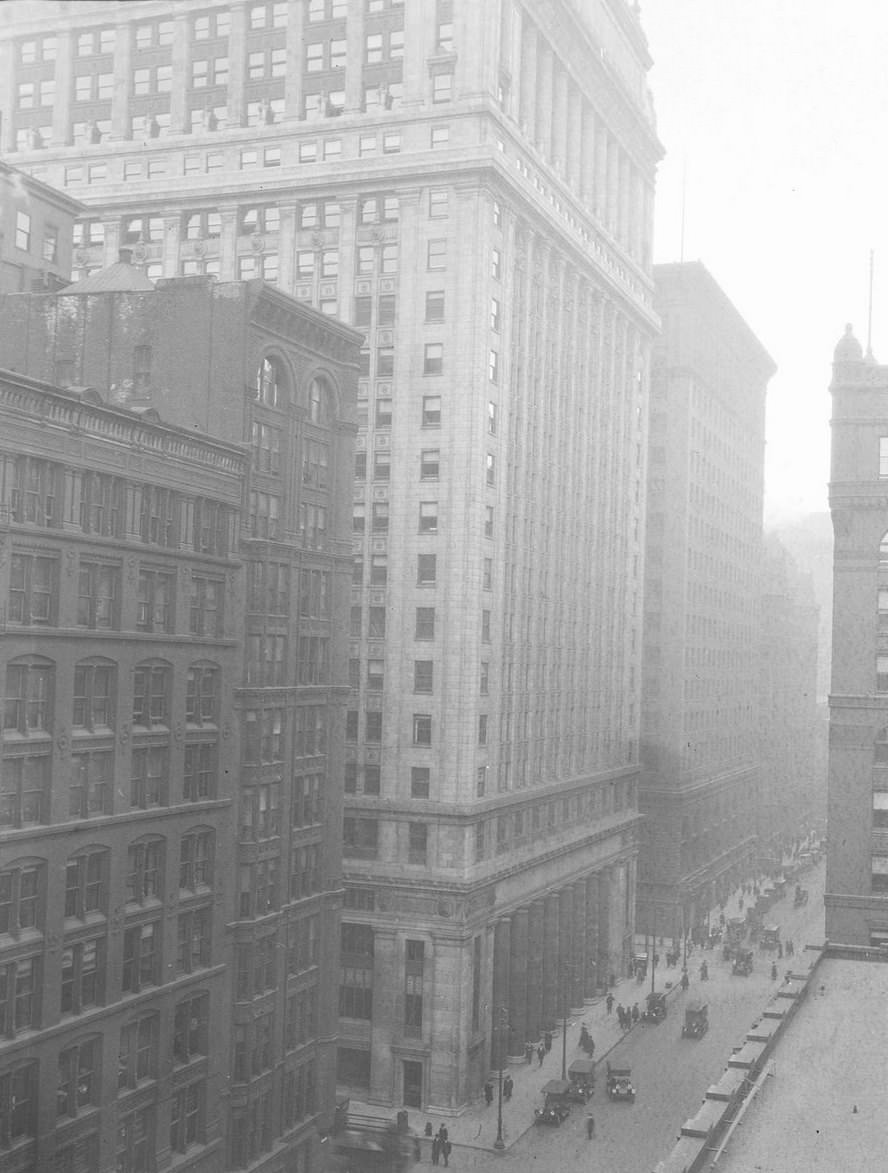
LaSalle Street was the financial spine of Chicago, lined with banks, law firms, and trading houses. Photographs from 1915 show the street packed with pedestrians and lined with tall buildings that made it feel like a canyon of commerce. The street ran from the Union Station area northward through the heart of the Loop, passing landmarks like the Chicago Board of Trade.
View of LaSalle Street, north from Van Buren Street, Chicago, Illinois, 1915.View of LaSalle Street, Chicago, Illinois, 1915.LaSalle Street, between Washington and Randolph Streets, Chicago, Illinois, 1915.East side of LaSalle Street, north of Washington Street, Chicago, Illinois, 1915.LaSalle Street, between Washington and Randolph Streets, Chicago, Illinois, 1915.The west side of LaSalle Street, north from Jackson Boulevard, Chicago, Illinois, March 1915.
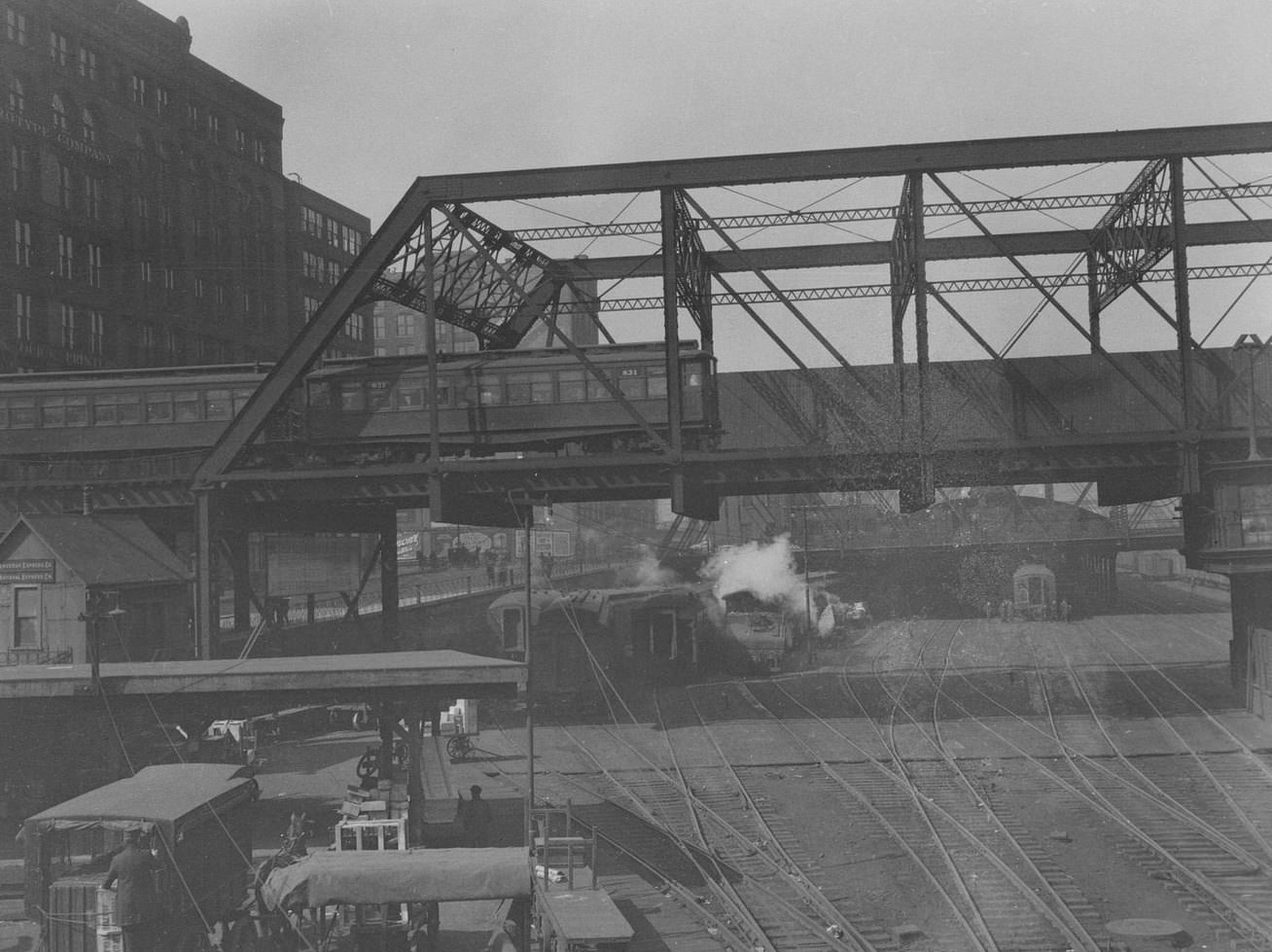
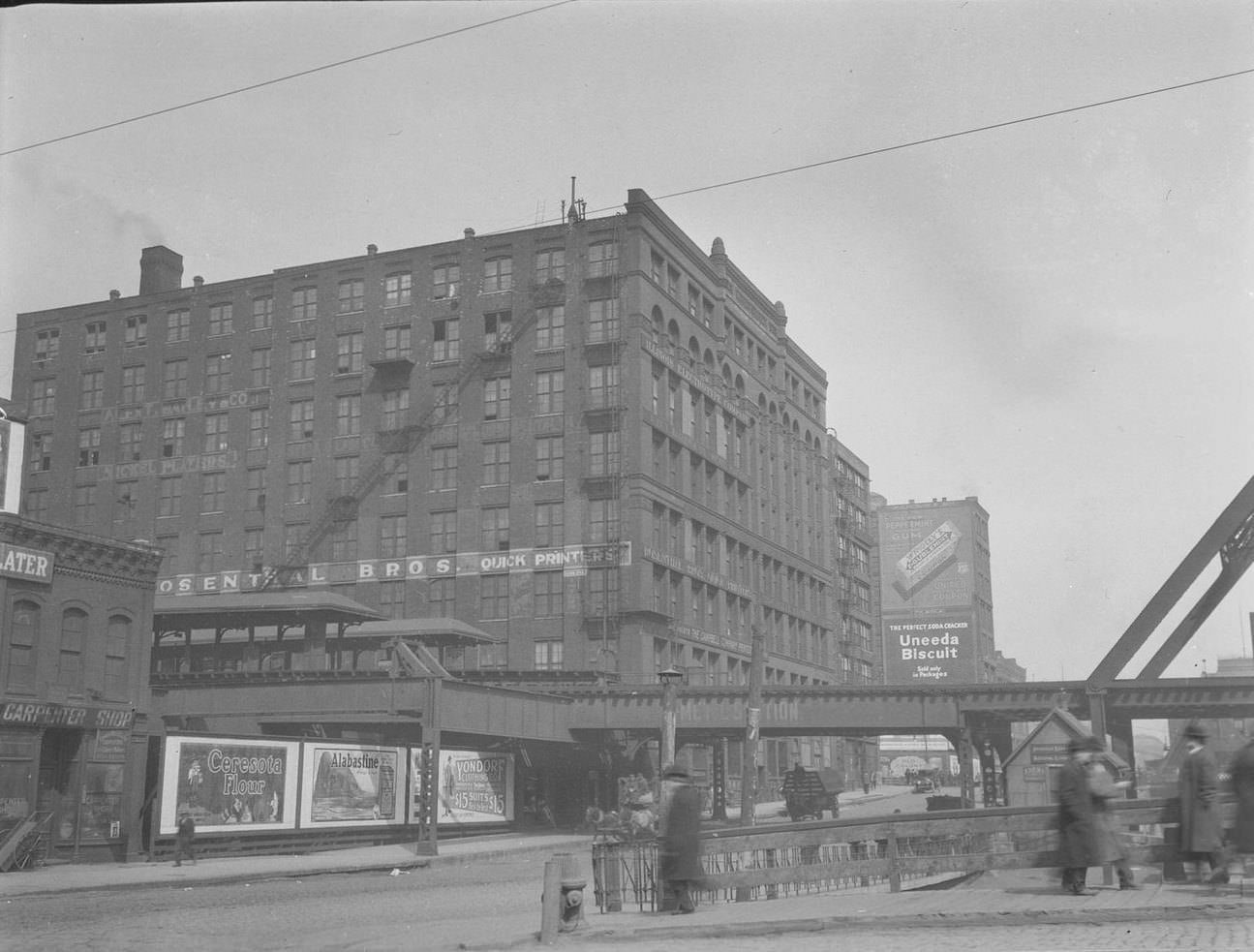
The rail yards and canal streets on Chicago’s west side were an industrial world of their own. Canal Street, Van Buren Street, Clinton Street, and Adams Street were surrounded by freight infrastructure, warehouses, and the constant movement of goods that made Chicago the distribution hub of the American Midwest.
Railroad yards at Canal Street and Van Buren Street, Chicago, Illinois, March 1915.The north side of Van Buren Street, east from Clinton Street, Chicago, Illinois, March 1915The northwest corner of Canal Street and Van Buren Street, Chicago, Illinois, March 1915.The northwest corner of Canal Street and Adams Street, Chicago, Illinois, March 1915.The southeast corner of Clinton Street and Adams Street, Chicago, Illinois, March 1915.Northeast corner of Jackson Boulevard and Clinton Street, Chicago, Illinois, 1915.View of the west side of Canal Street, north from Van Buren Street, Chicago, Illinois, 1915.View, looking northward, from the Van Buren Street railroad station, Chicago, Illinois, 1915.Union Station and The Chicago River, 1910s
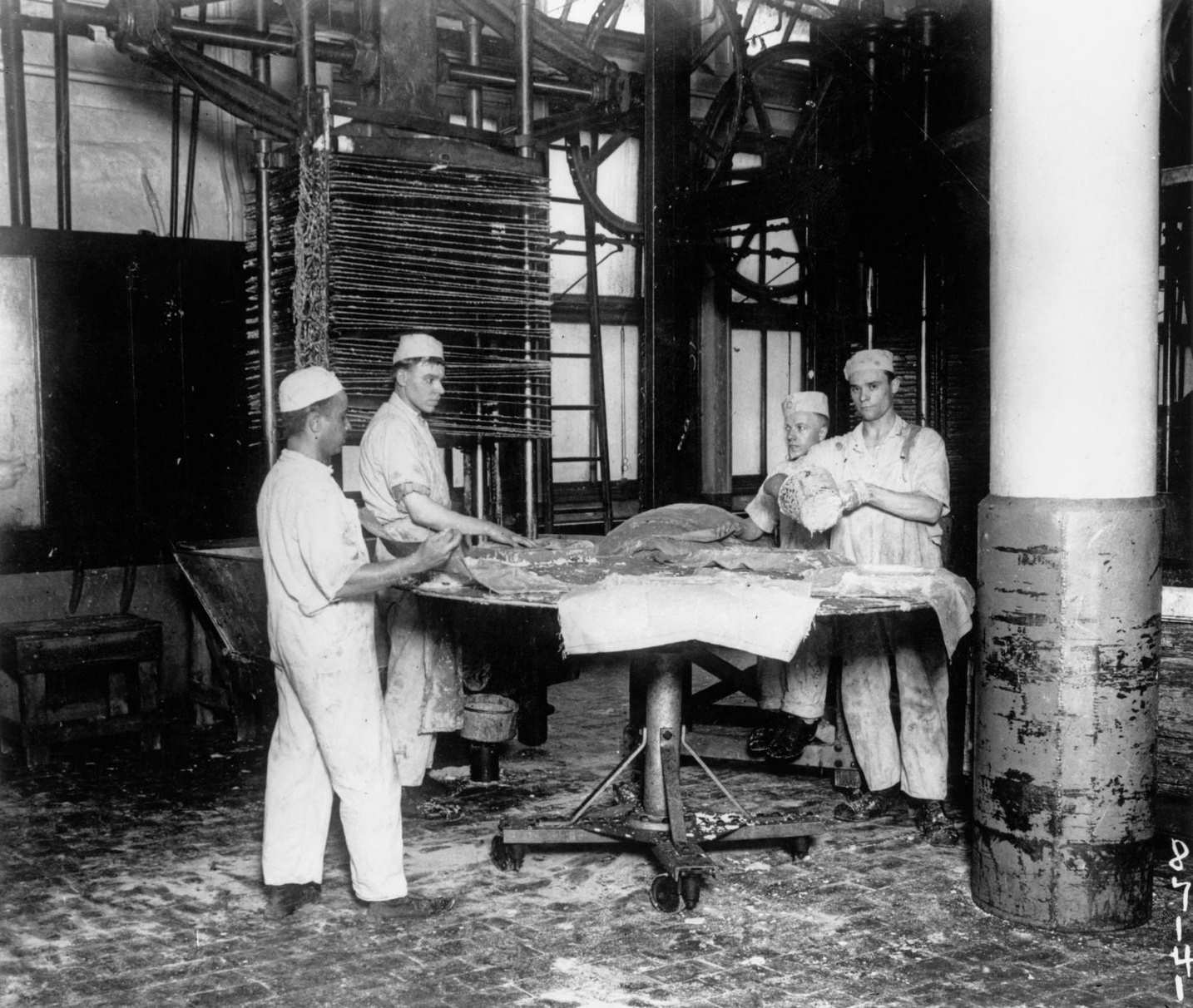
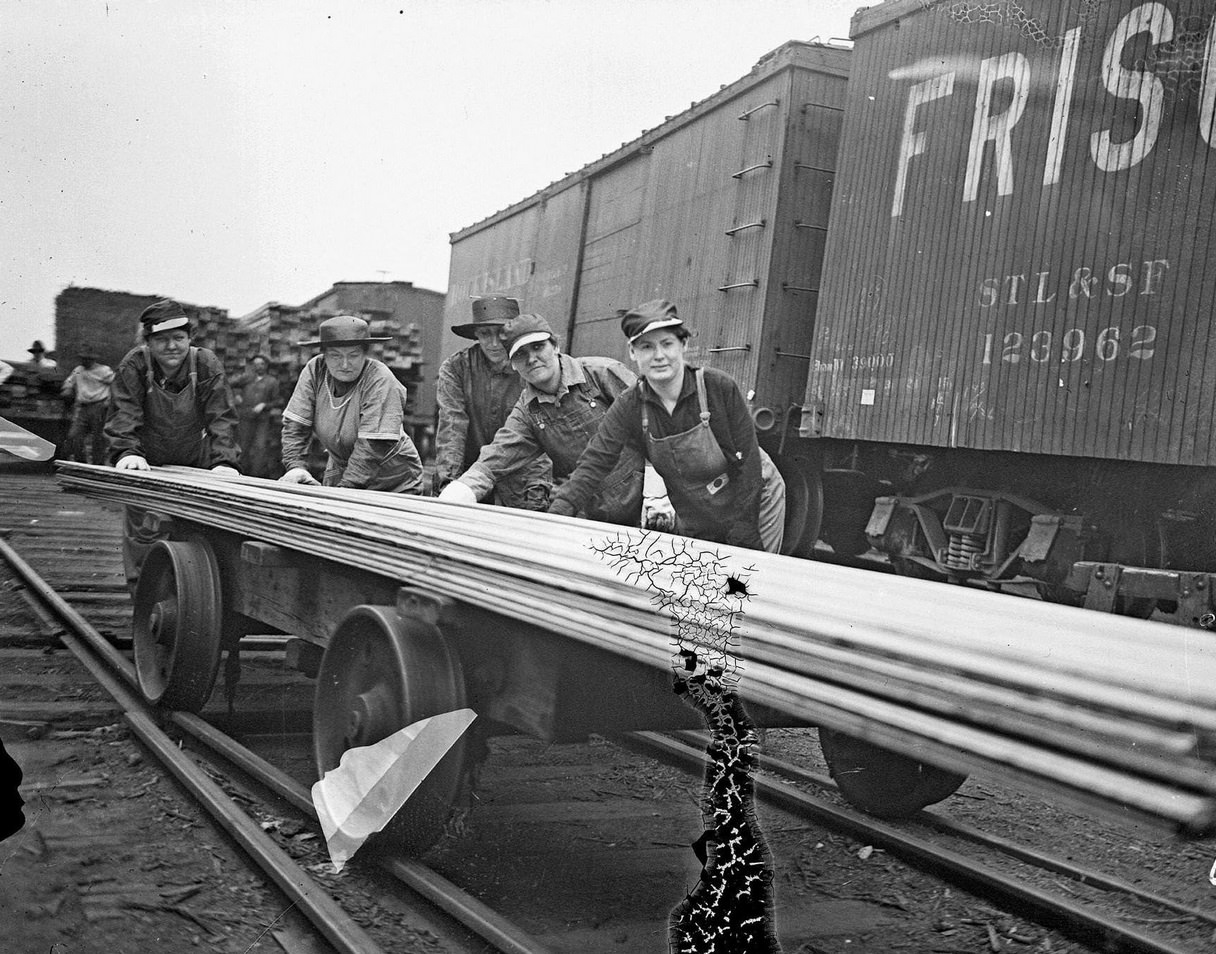
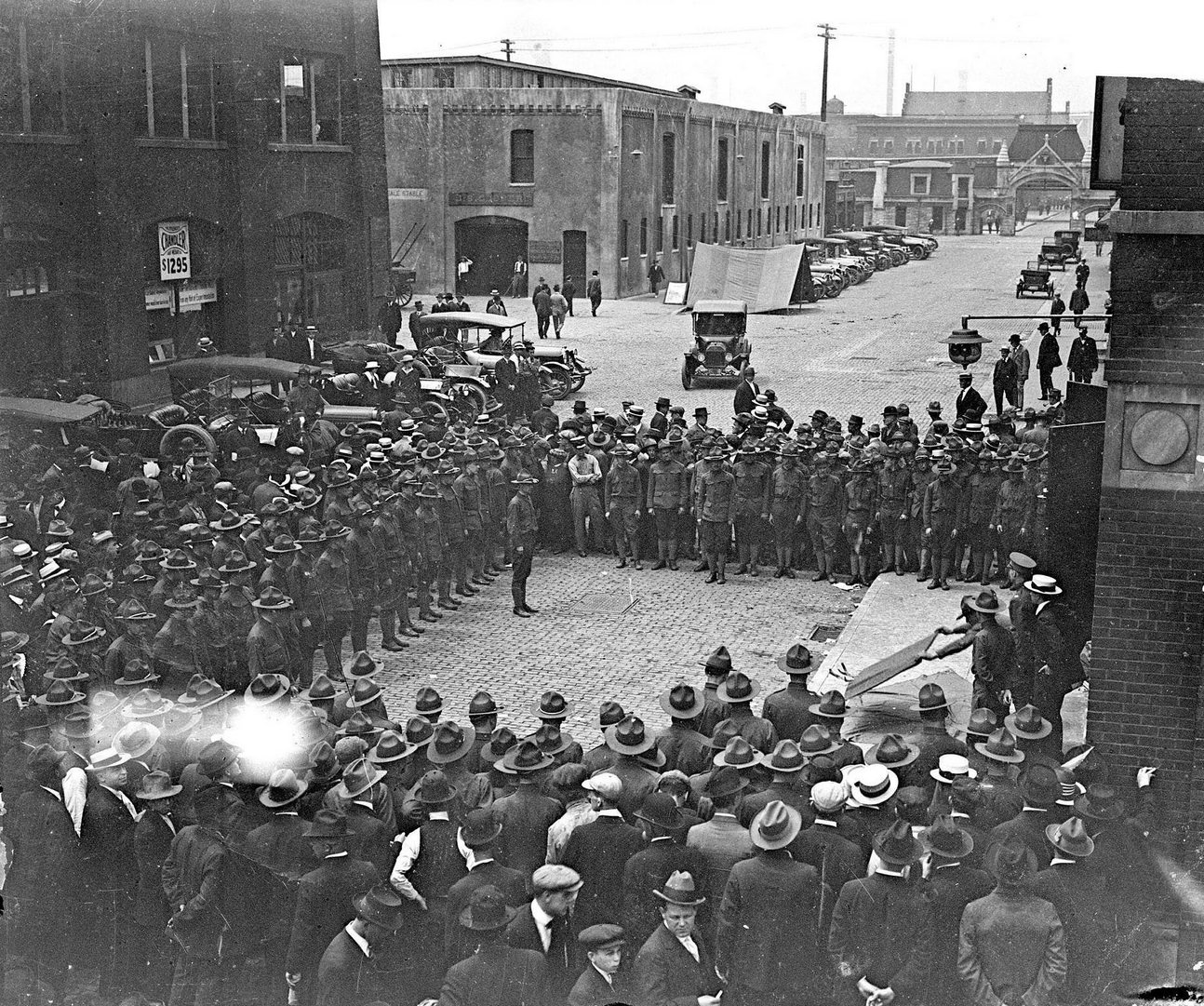
The stockyards on the South Side were the engine of Chicago’s meatpacking industry. Workers processed millions of animals each year, and facilities like the Ryan Car Shop employed both men and women. During the war years, women worked directly in the train yards, wearing coveralls and handling heavy materials. The stockyards were also used by the Illinois National Guard for demonstrations and training, including one in June 1916 where soldiers at Exchange Avenue were shown how to properly roll blankets.
Loading beef fat into an oleomargarine press for the preparation of oleomargarine (margarine) oil at stockyards in Chicago, Illinois, 7th April 1919.Women working in the train yard at the Ryan Car Shop, Chicago, Illinois, 1910s.Soldiers of Battery D of the Illinois National Guard, gathered at the stockyards on Exchange Avenue in the New City community area, Chicago, Illinois, June 30, 1916.J. Ogden Armour, of the meatpacking industry and treasurer of the Illinois State Council of Defense, walking across a street, Chicago, Illinois, 1918.
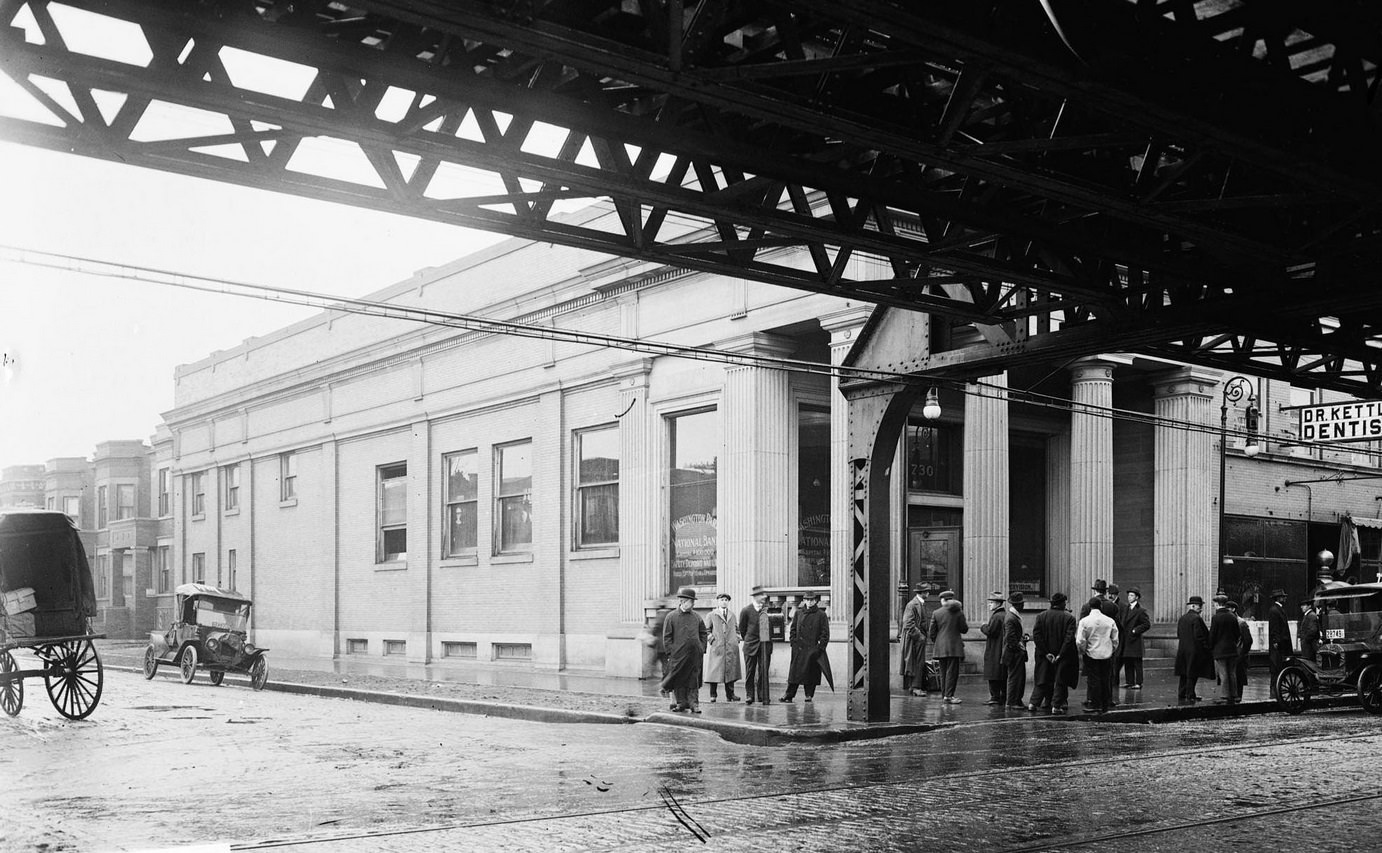
The Washington Park National Bank robbery of January 1916 was one of the city’s most talked-about crimes that year. Five robbers stole over $15,000 from the bank at East 63rd Street and South Evans Avenue, with elevated train tracks running just outside. The story of the robbery became well known across Chicago.
Washington Park National Bank, located at East 63rd Street and South Evans Avenue in the Woodlawn community area, Chicago, Illinois, January 27, 1916.
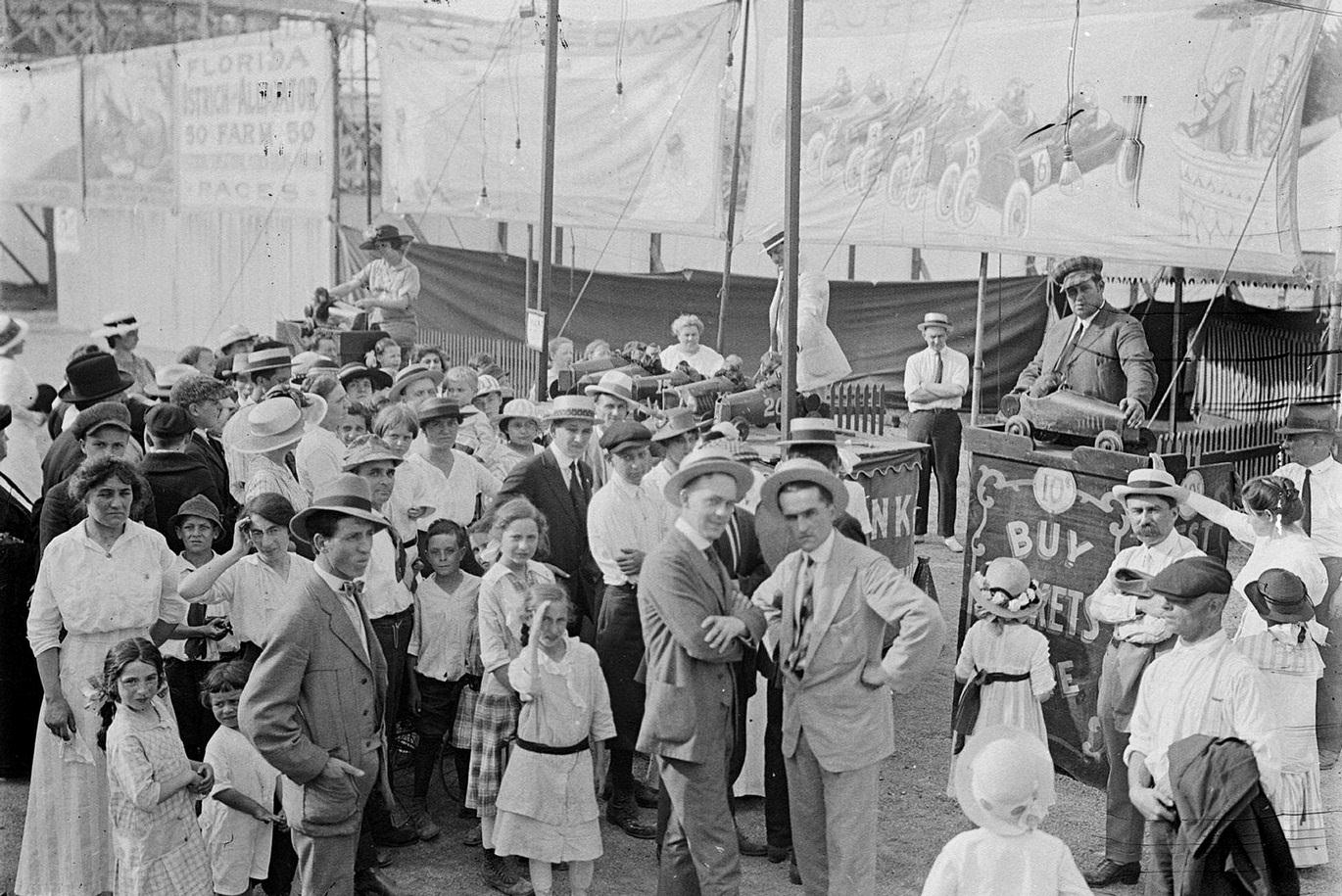
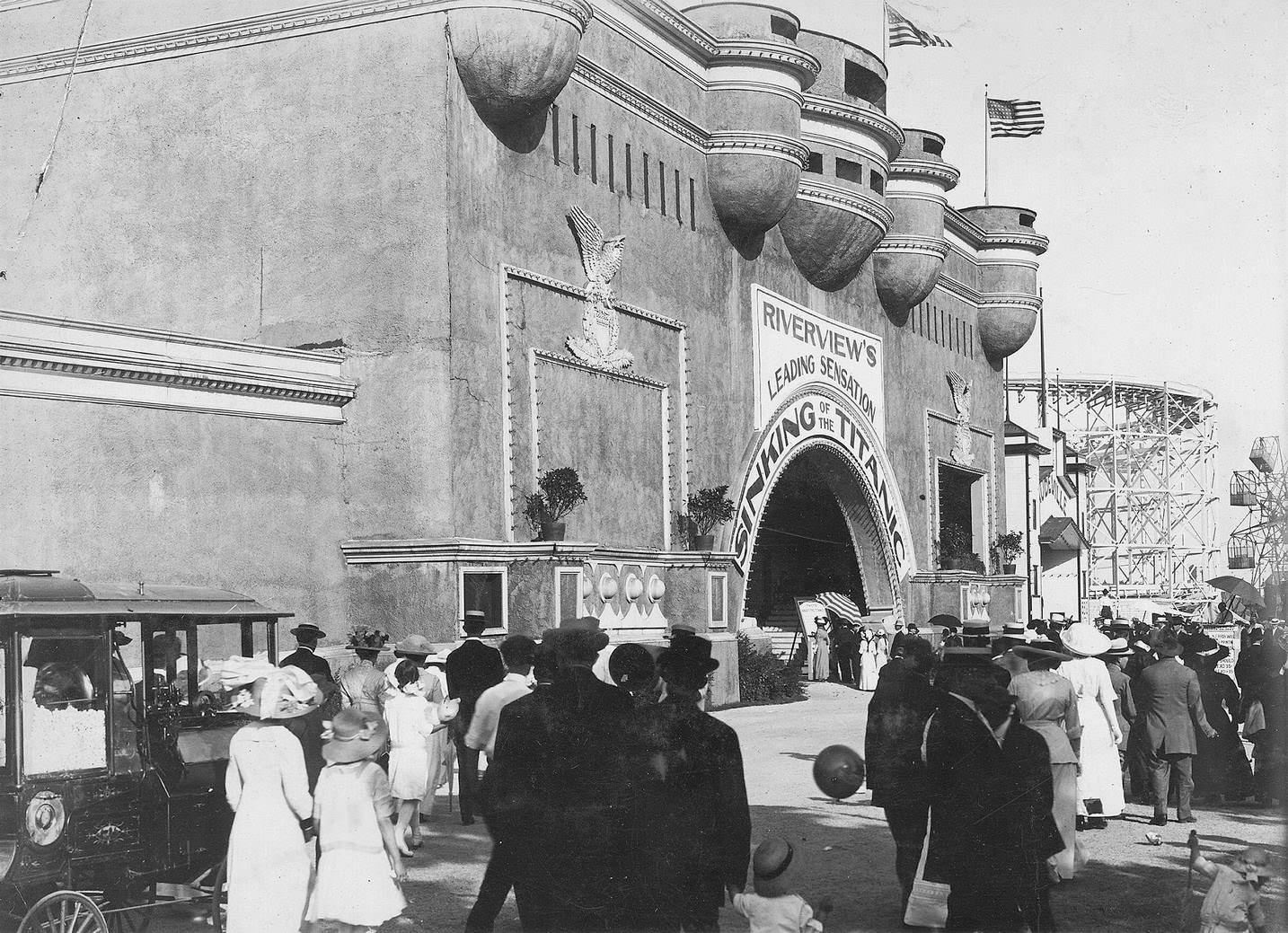
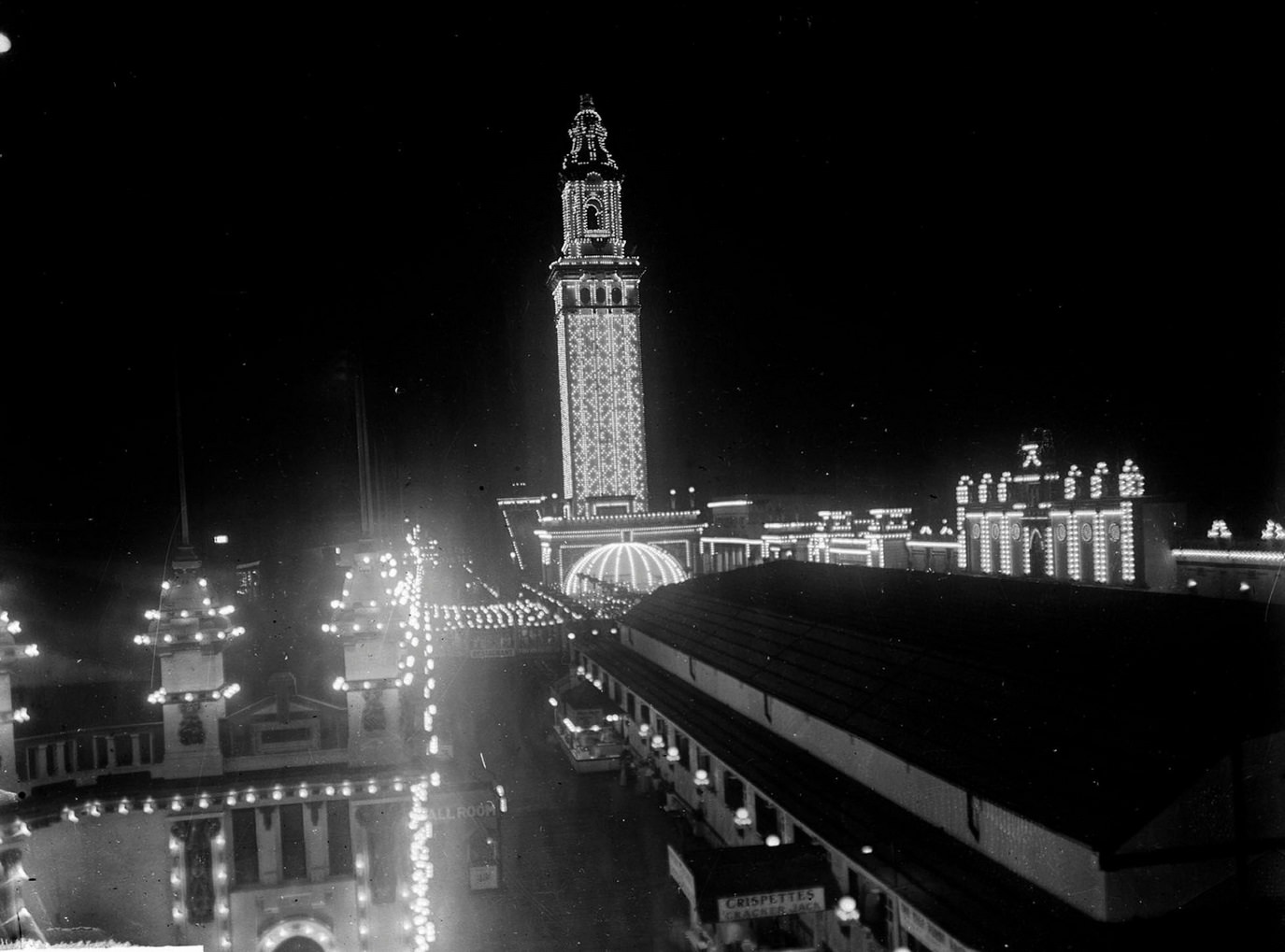
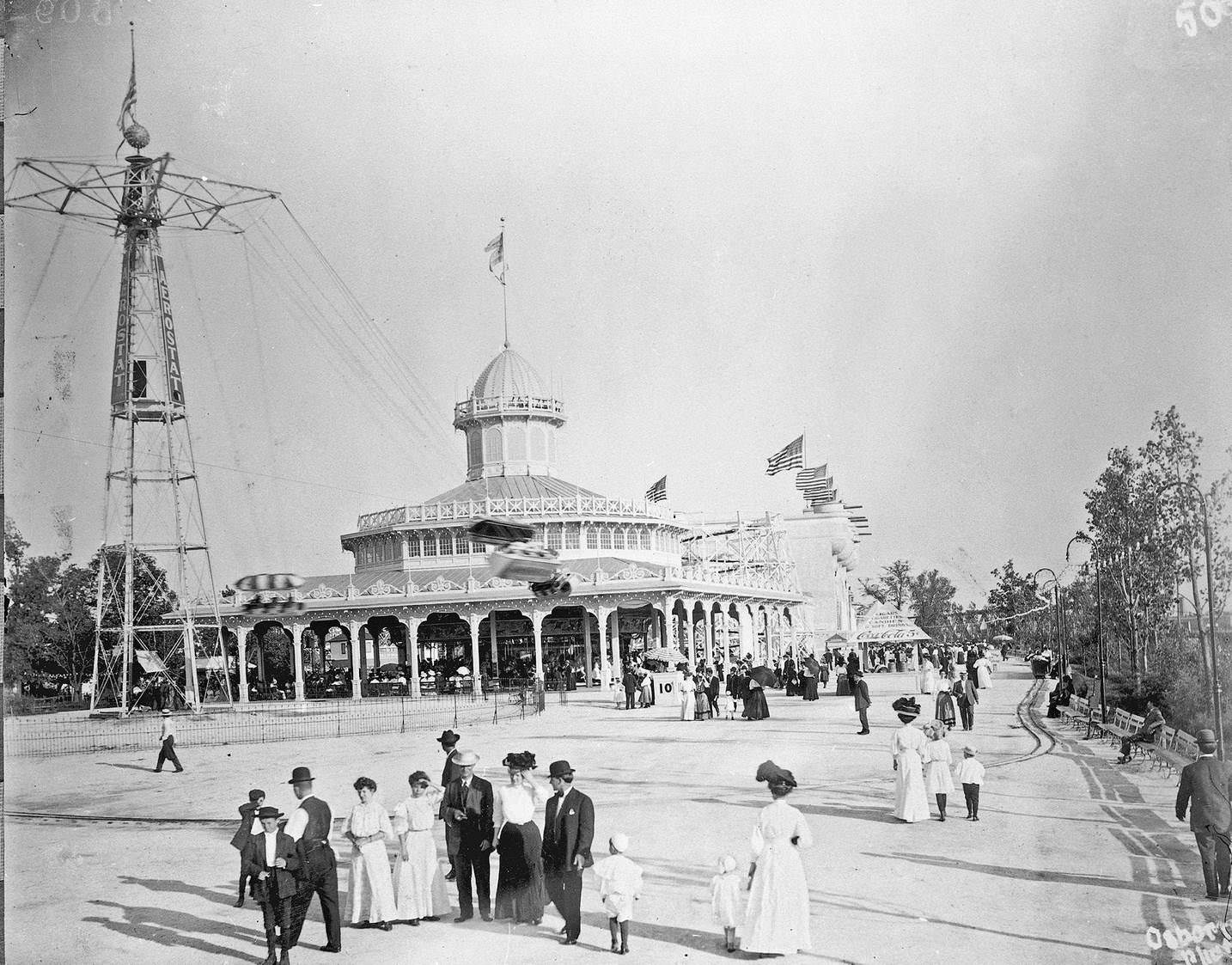
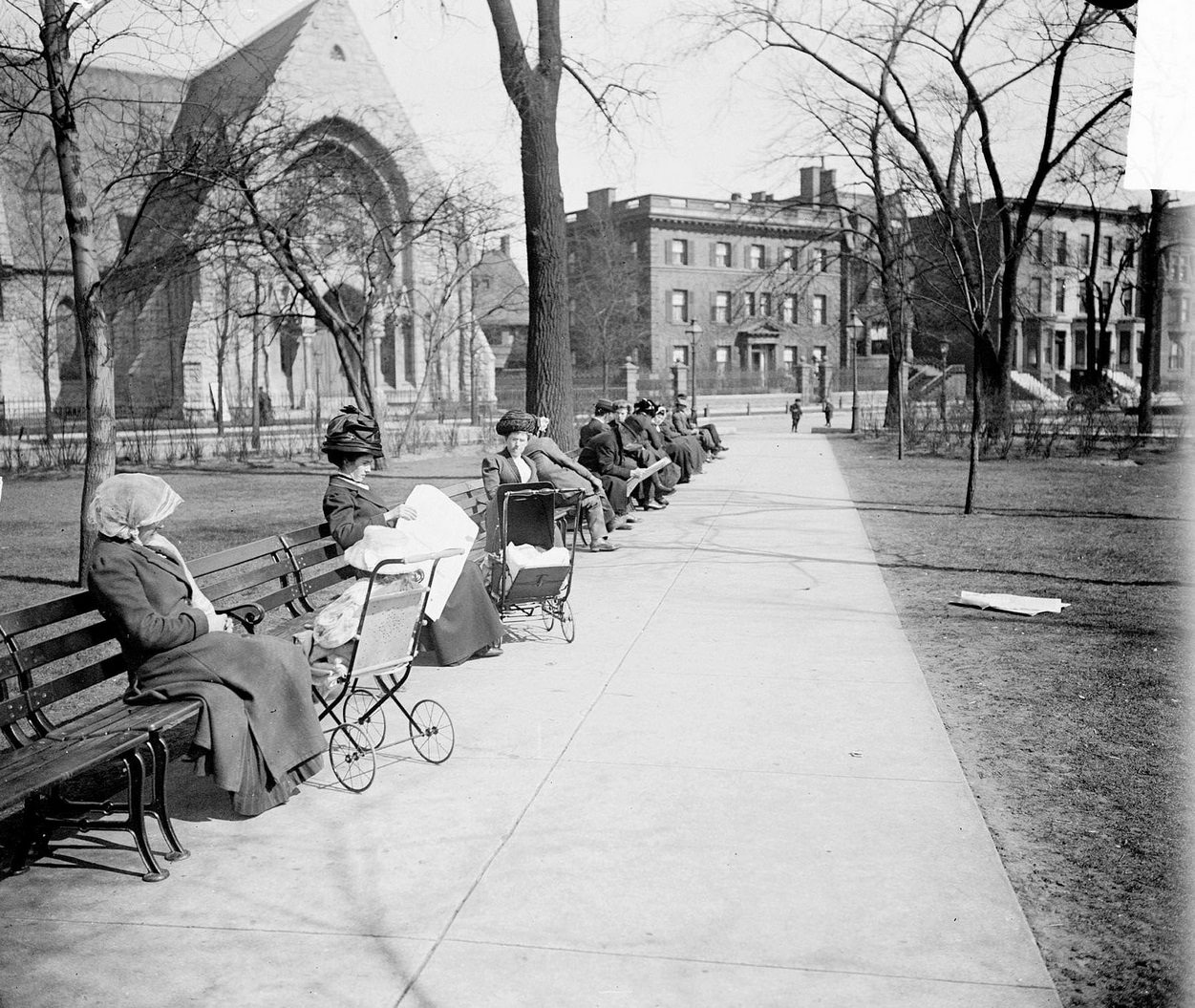
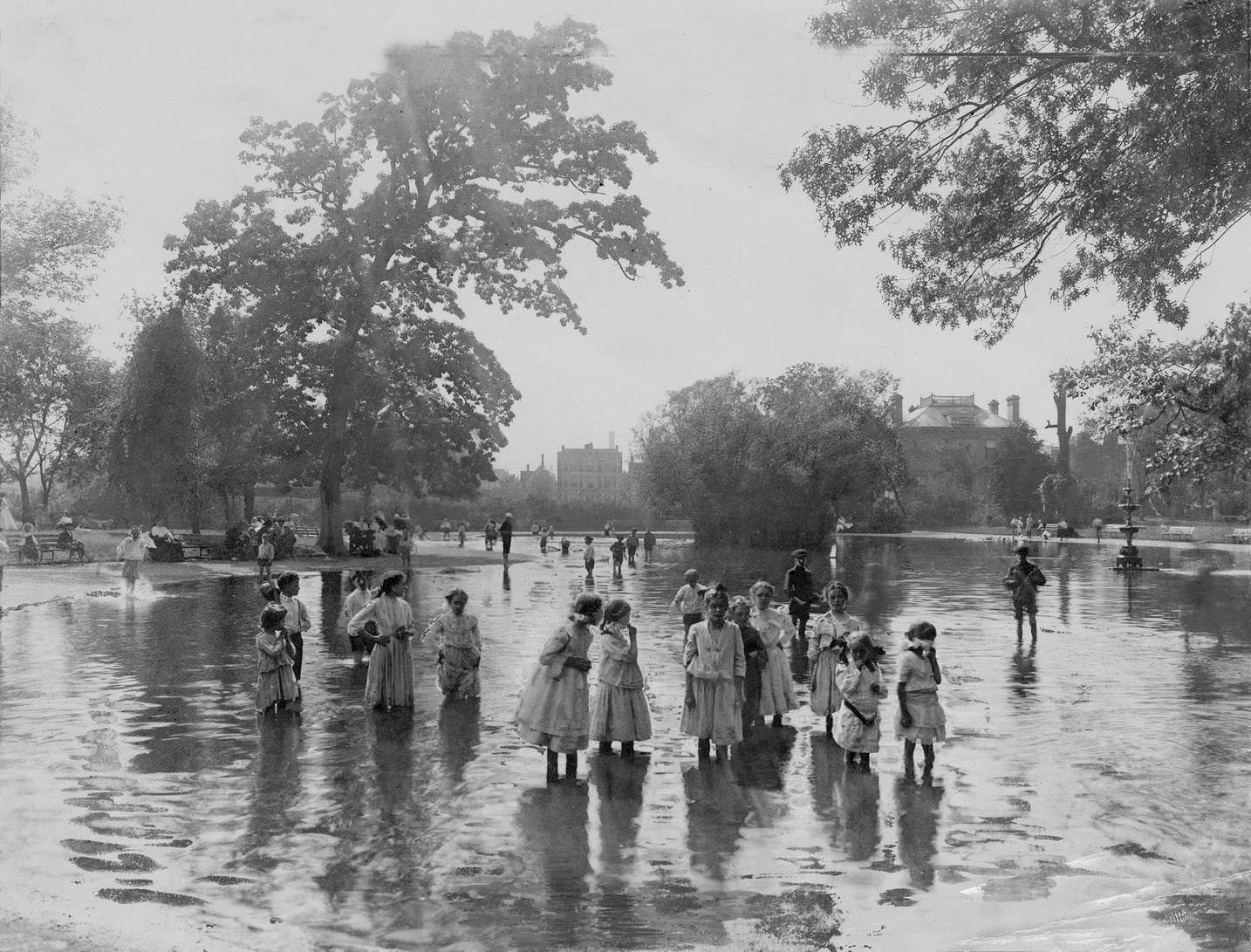
Along the city’s north side, parks and recreational spaces gave residents a place to breathe. Washington Square Park in the Near North Side offered shaded benches and pathways. Riverview Park drew crowds with its monkey show booth and its Sinking of the Titanic exhibition. White City, the amusement park at 63rd Street and King Drive, glittered at night with electric lights. These places served as escapes from the pressures of daily urban life.
Spectators standing outside the monkey show booth at Riverview Park, Chicago, Illinois, July 16, 1916.Crowds in front of the Sinking of the TItanic exhibition at Riverview Park, Chicago, Illinois, 1916.White City at night, located at 63rd Street and King Drive, Chicago, Illinois, July 9, 1916.Scene at Riverview amusement park with carousel in background, Chicago, Illinois, 1910s.People sitting on benches along a pathway through Washington Square Park in Spring in the Near North Side community area, Chicago, Illinois, 1910s.Children splashing in a pond in Lunapark in Chicago, 1910s
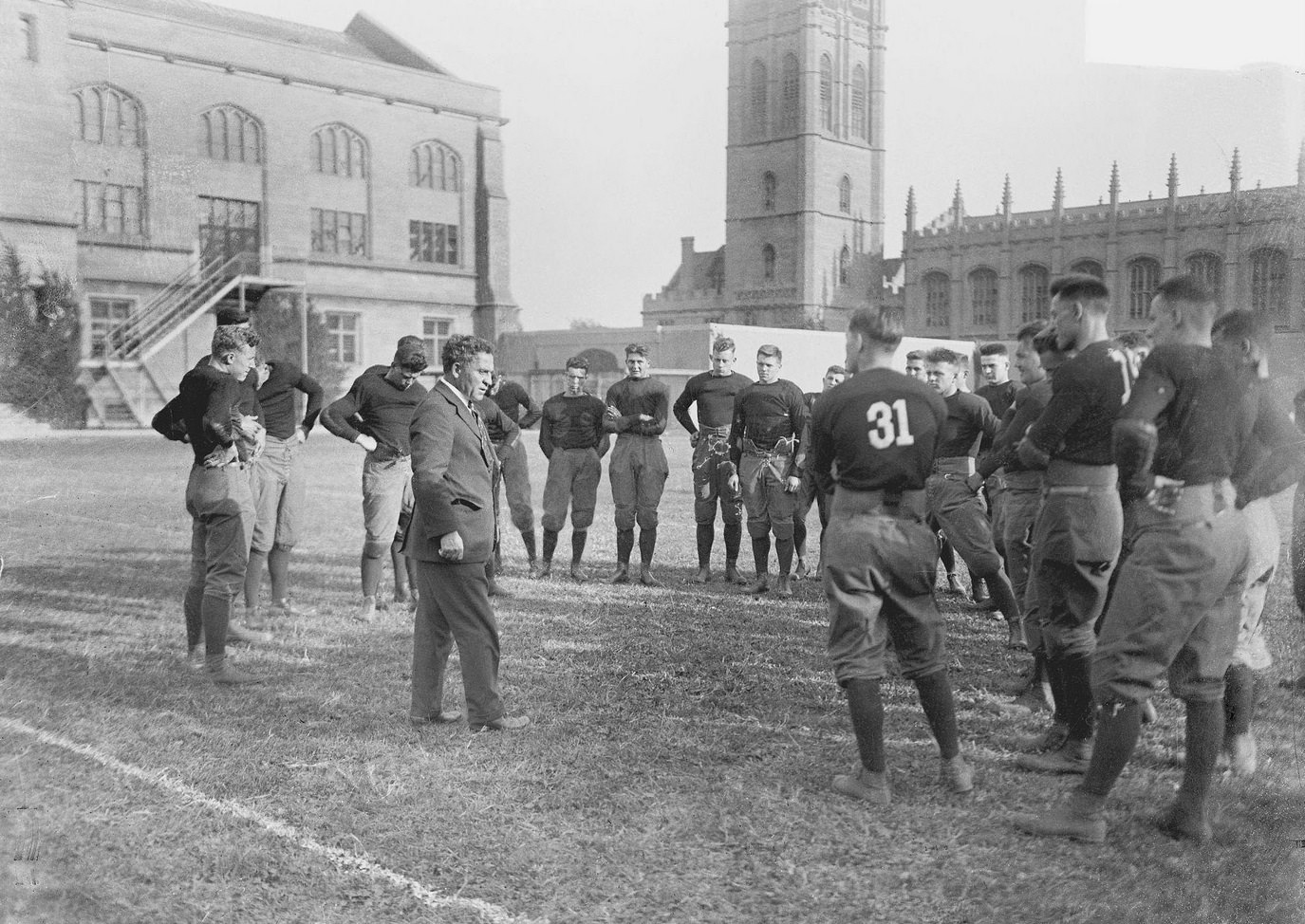
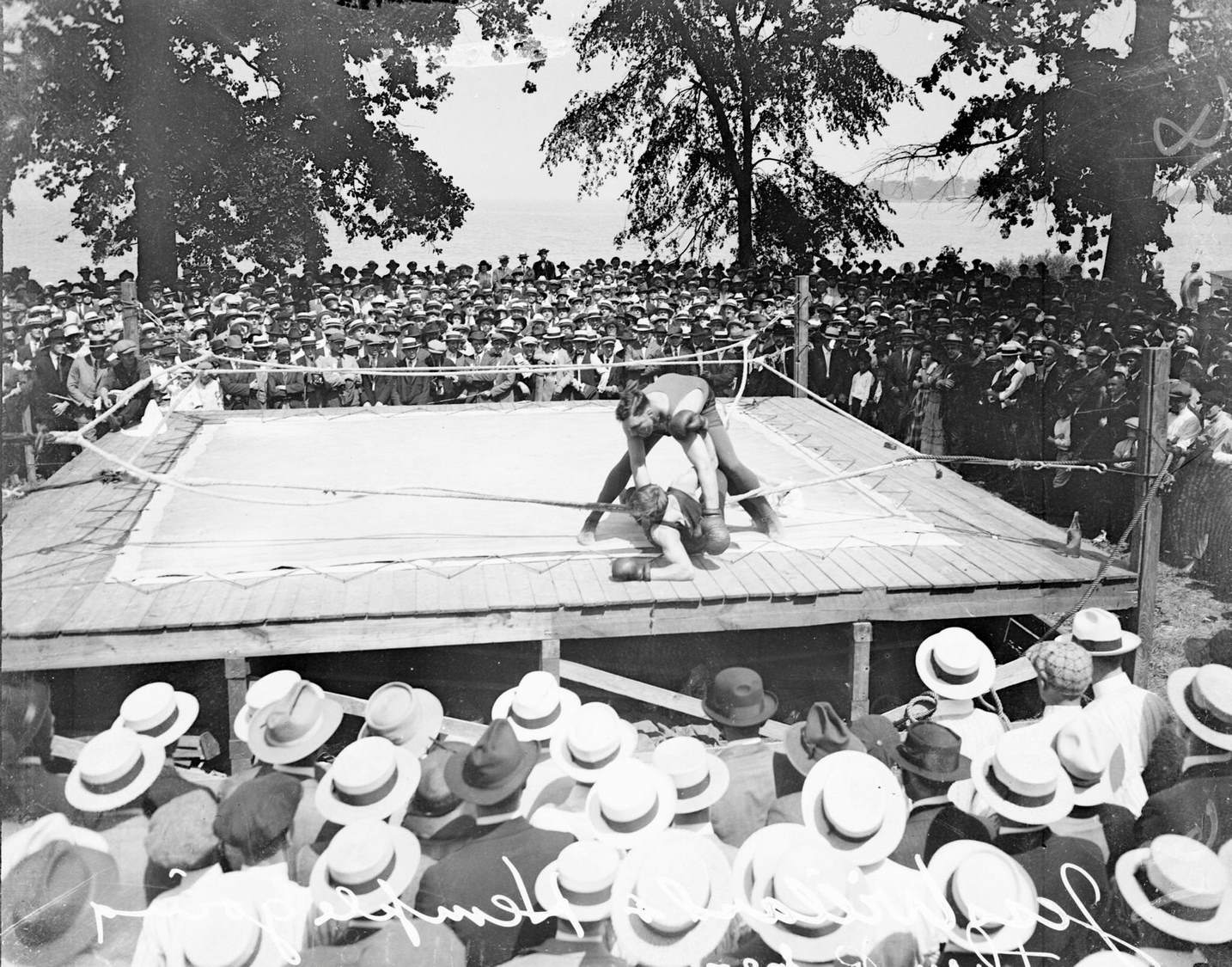
Sports beyond baseball also attracted Chicagoans. The University of Chicago football team, led by the legendary coach Alonzo Stagg, practiced on the university’s athletic field on the South Side. Boxer Jess Willard and Jack Hemple sparred in a ring set up near Lake Michigan, drawing spectators to an outdoor bout. Aviation was another growing fascination, with air shows held in Grant Park that packed the lakefront with curious crowds.
University of Chicago football team players standing around Coach Alonzo A Stagg on an athletic field at the university campus, Chicago, Illinois, 1916.Boxers Jess Willard and Jack Hemple sparring in a ring located near Lake Michigan in Chicago, Illinois, 1916.Spectators at an aviation meet in Grant Park, Chicago, Illinois, 1910s.
Captain George Wellington Streeter was a colorful Chicago figure who had spent years claiming ownership of a strip of lakefront land on the Near North Side after his boat ran aground there in the 1880s. By 1915, he and his wife Elma were still fighting for their claim, becoming regular fixtures in the city’s newspapers and courts.
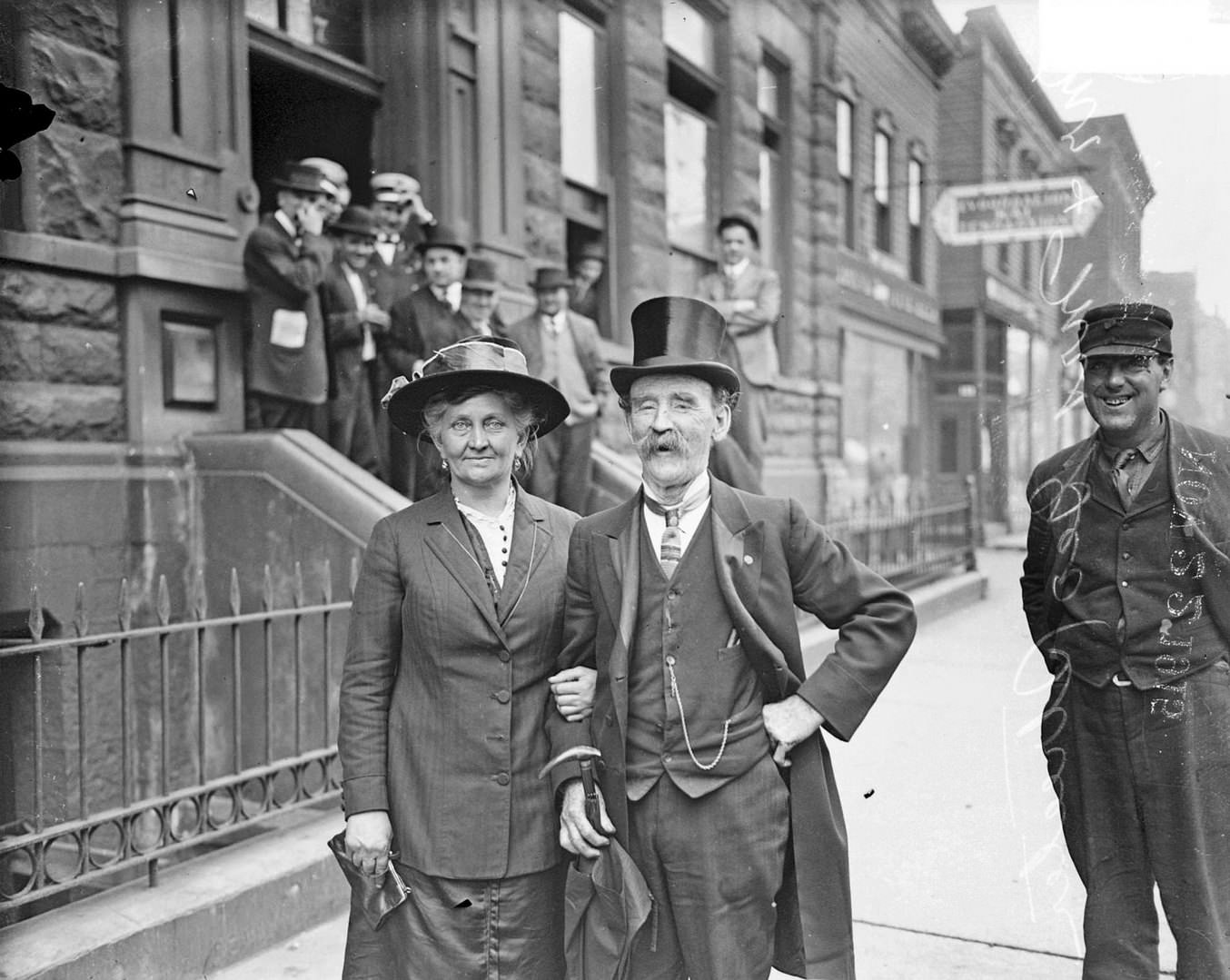
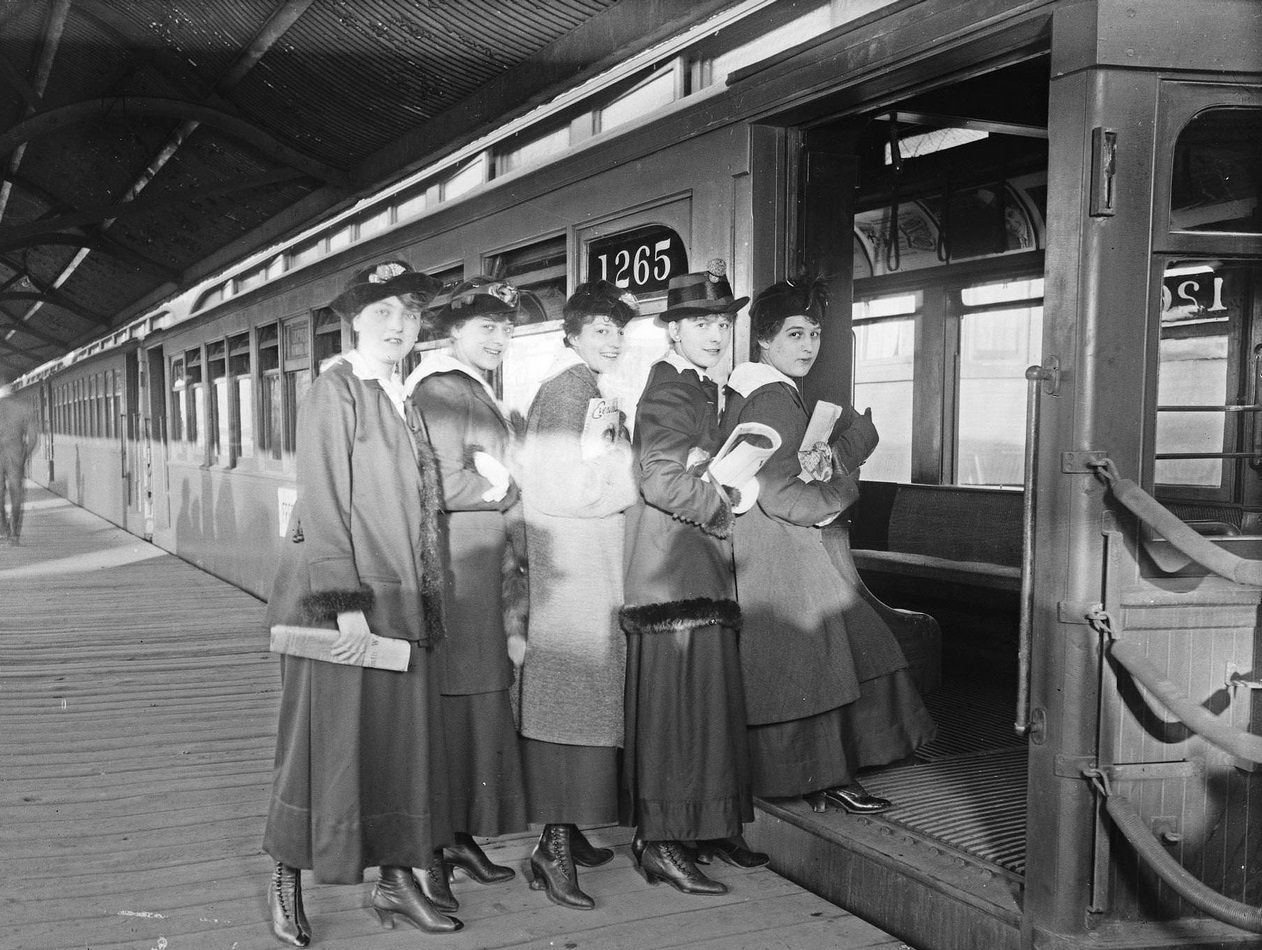
Captain George Wellington Streeter and his wife, Elma, standing on a sidewalk, Chicago, Illinois, October 13, 1915.Five women getting on an open-air elevated train car, Chicago, Illinois, November 1, 1915.
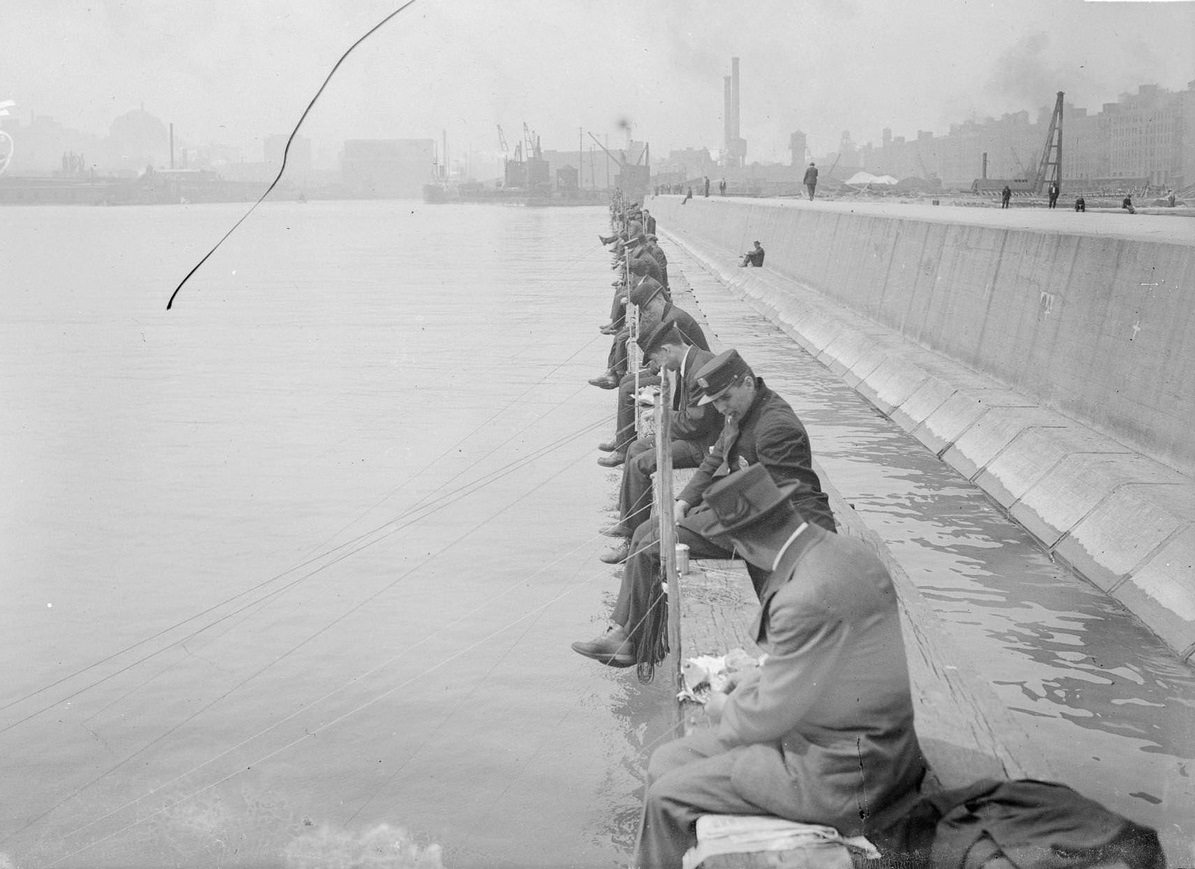
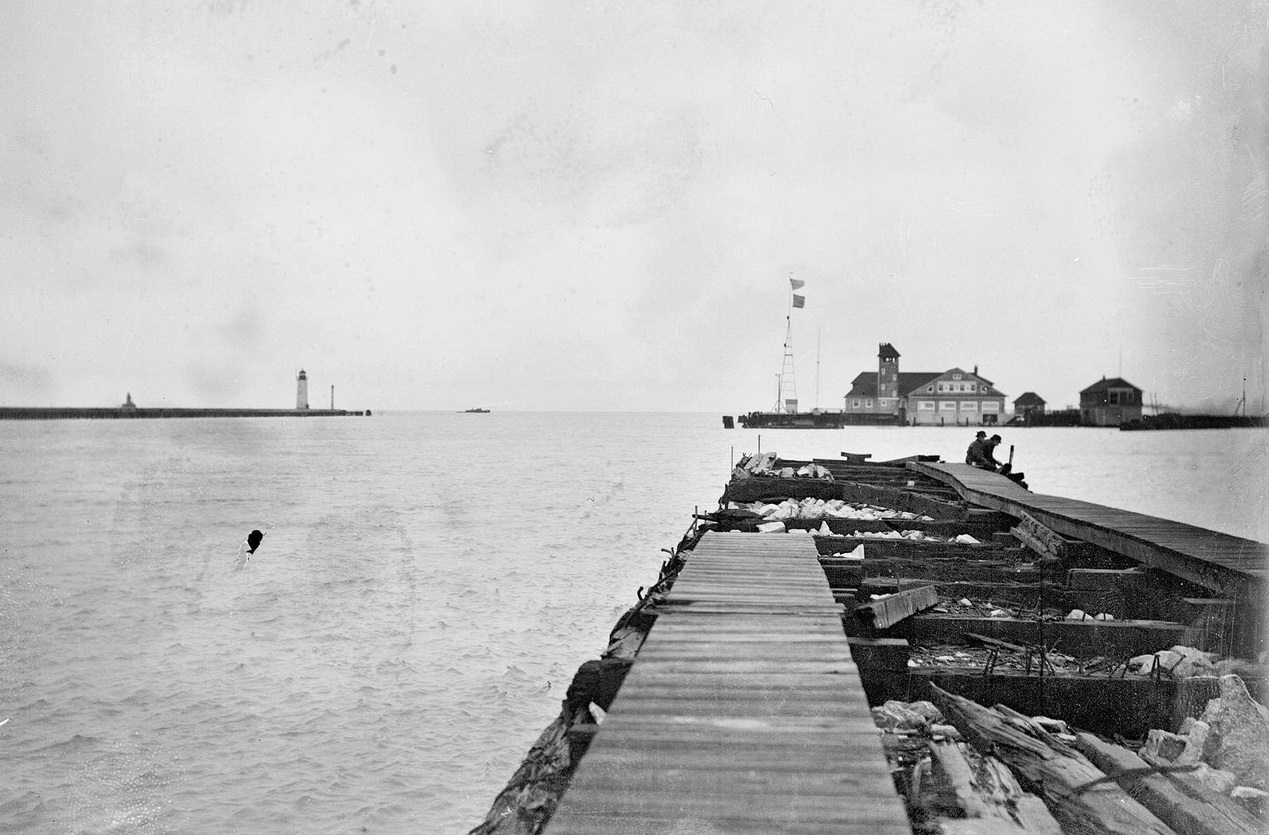
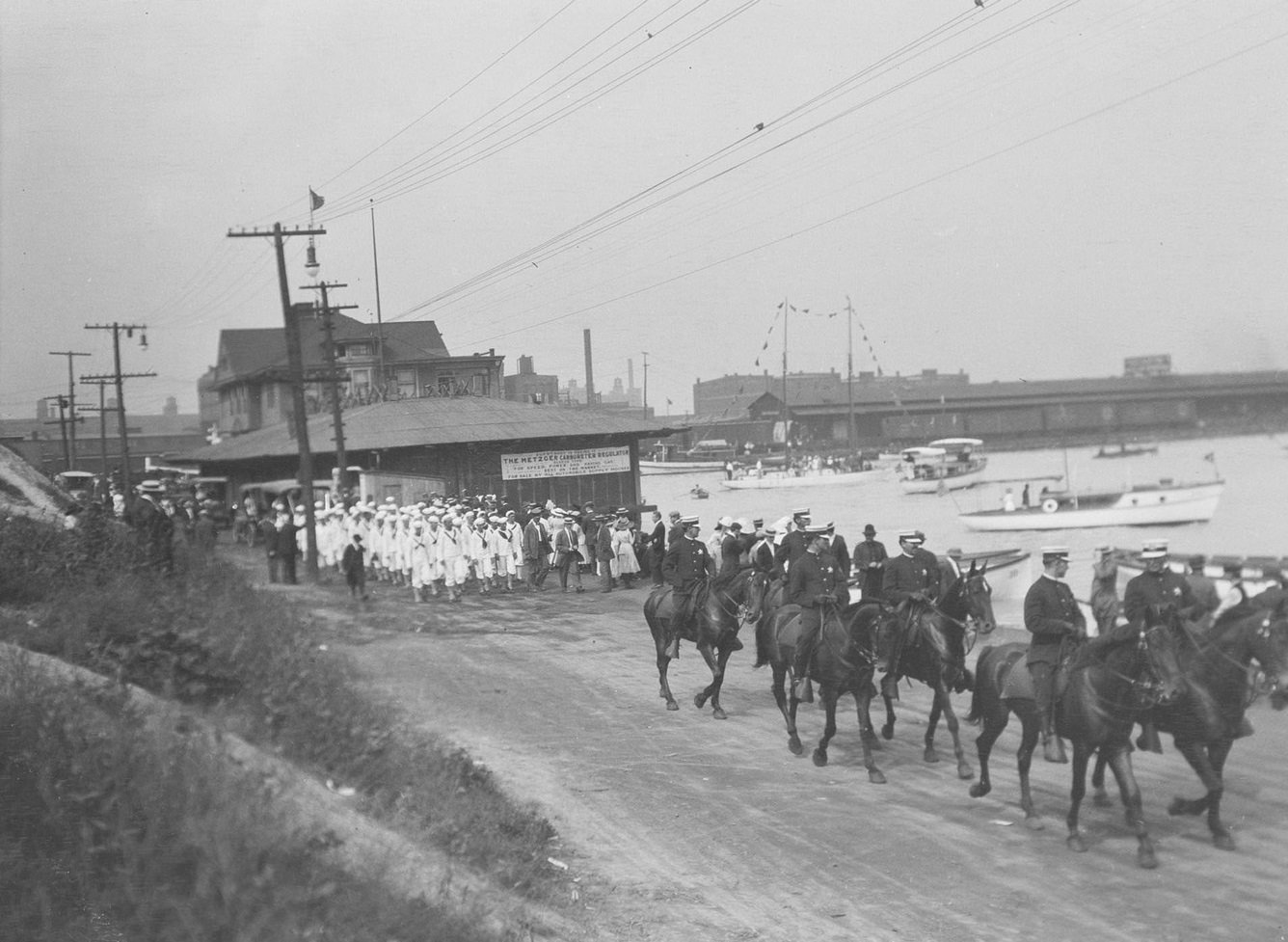
The Chicago River and its surrounding piers were used for fishing, shipping, and military operations throughout the decade. Men fished from North Pier at the river’s mouth. Sailors from the USS Wolverine marched through city streets following mounted police. The mouth of the river, marked by a U.S. Life Saving station, was one of the busiest points on the entire lakefront.
Men fishing from North Pier, sitting along a breakwater at the mouth of the Chicago River, Chicago, Illinois, 1910s.Mouth of Chicago River looking along a pier toward a US Life Saving station on Lake Michigan, Chicago, Illinois, 1910s.Sailors from the USS Wolverine of the Navy following mounted Chicago policemen, Chicago, Illinois, 1910s.
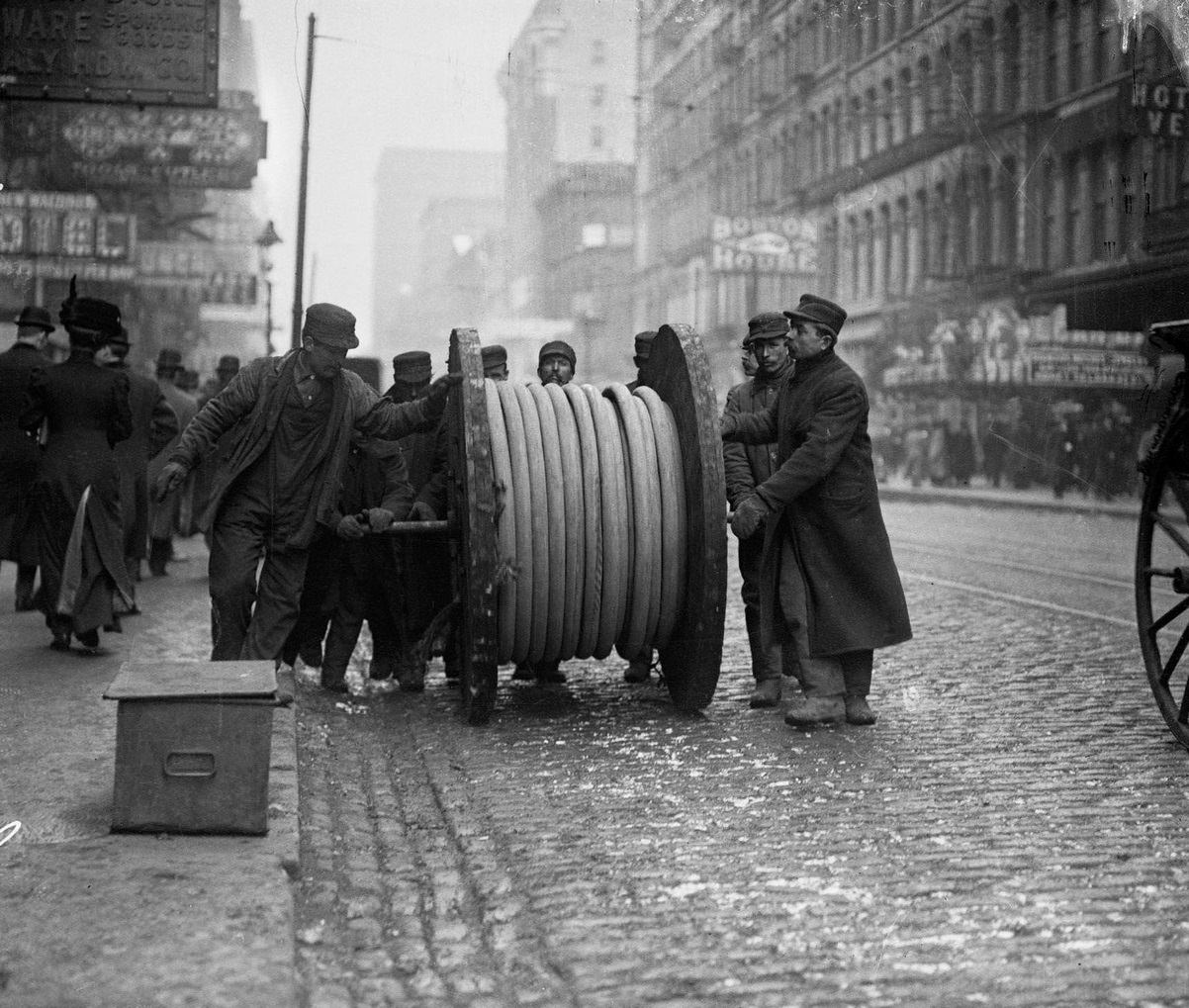
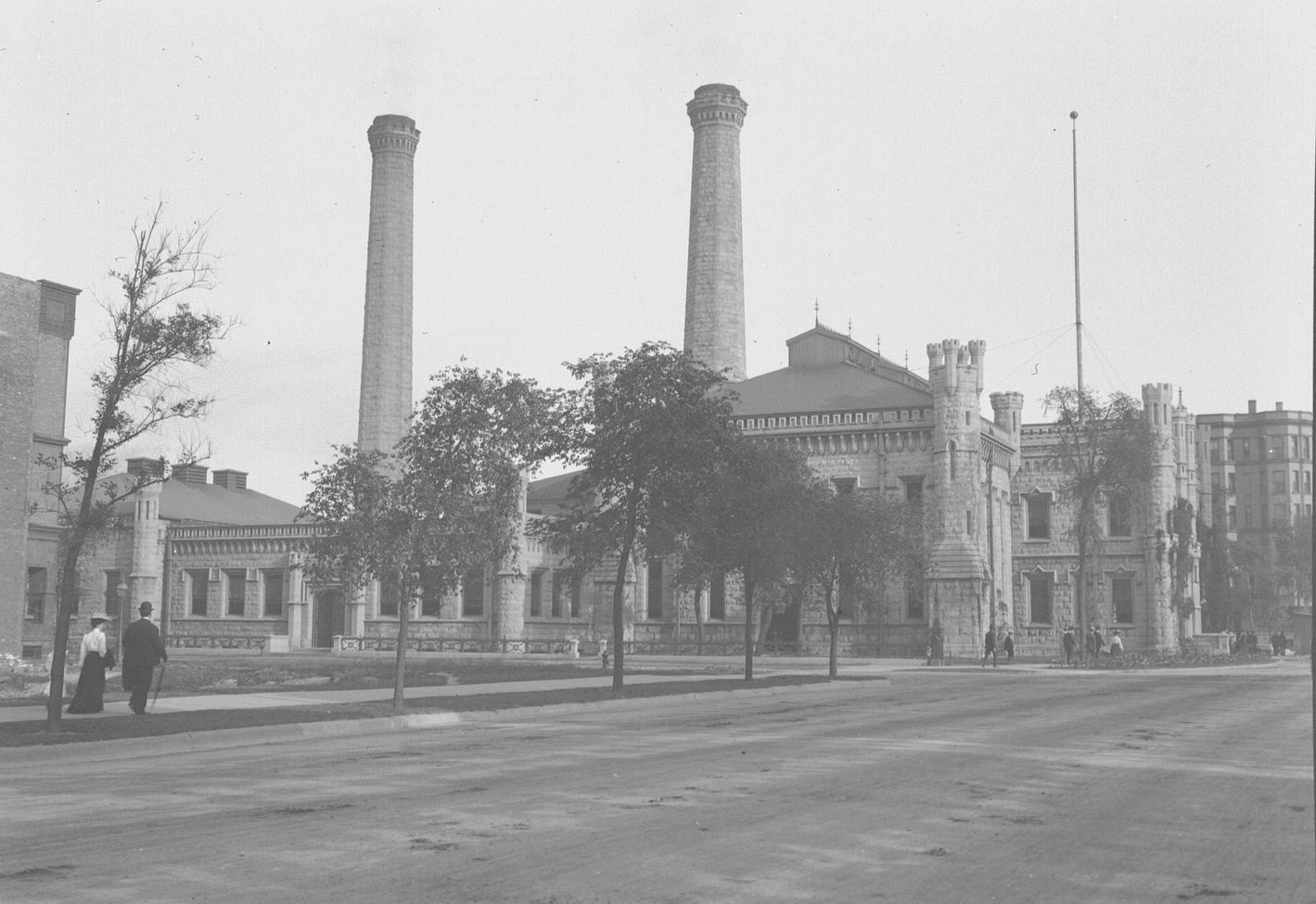
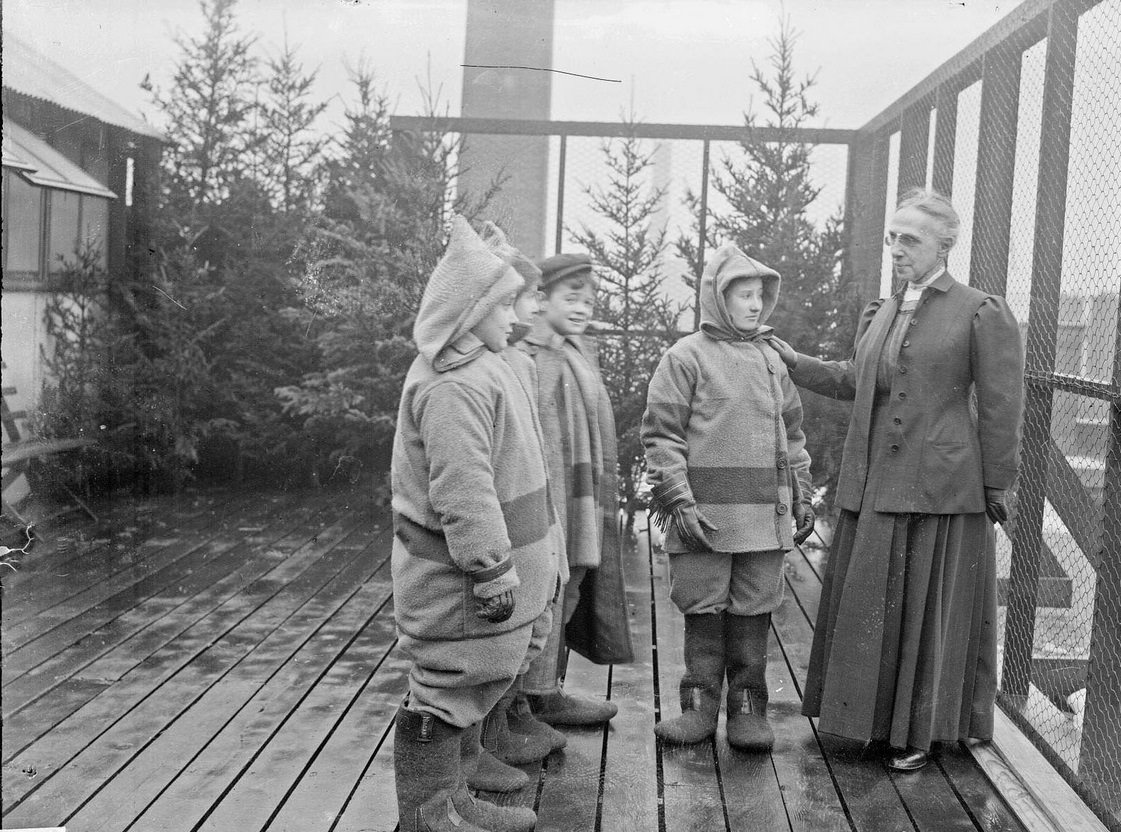
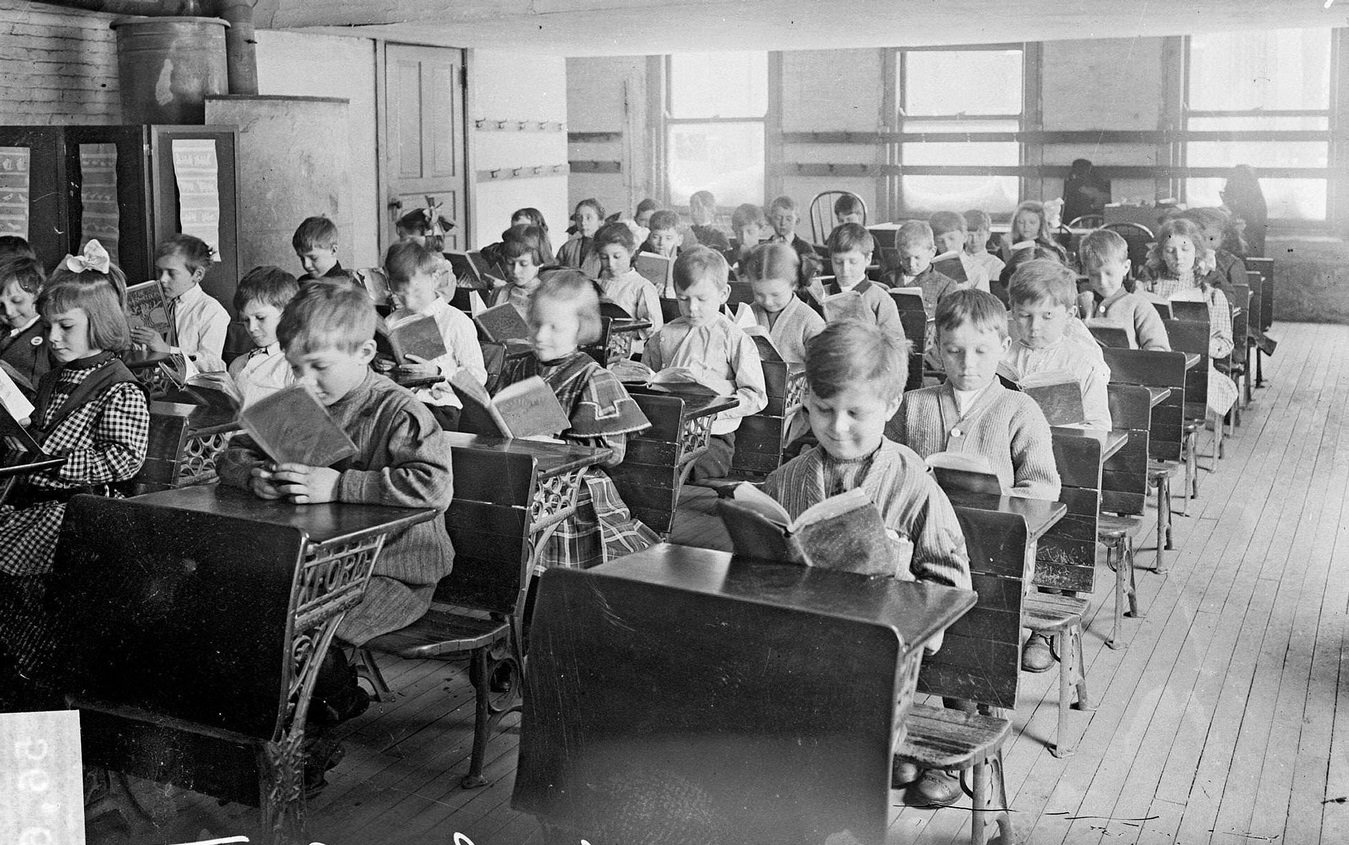
Infrastructure expansion was visible across every part of the city during the 1910s. Workers rolled heavy spools of underground telephone cable through business streets. The Chicago Avenue Pumping Station continued to serve the city’s water needs. Superintendent of Schools Ella Flagg Young oversaw classrooms at open-air schools like the Mary Crane Nursery on West Cabrini Street, where students and teachers worked outdoors in good weather.
Men rolling a large wheel of underground telephone cable on a business street, Chicago, Illinois, 1910s.Chicago Avenue Pumping Station, Chicago, Illinois, 1916.Superintendent of schools Mrs Ella Flagg Young standing with students outdoors at the Mary Crane Nursery, an open-air school, located at 782 West Cabrini Street (formerly 782 Ewing), Chicago, Illinois, 1910s.Children reading at desks in a classroom at the Robert Emmet School, looking at the children from the front of the classroom in the Austin community area, Chicago, Illinois, 1910s.
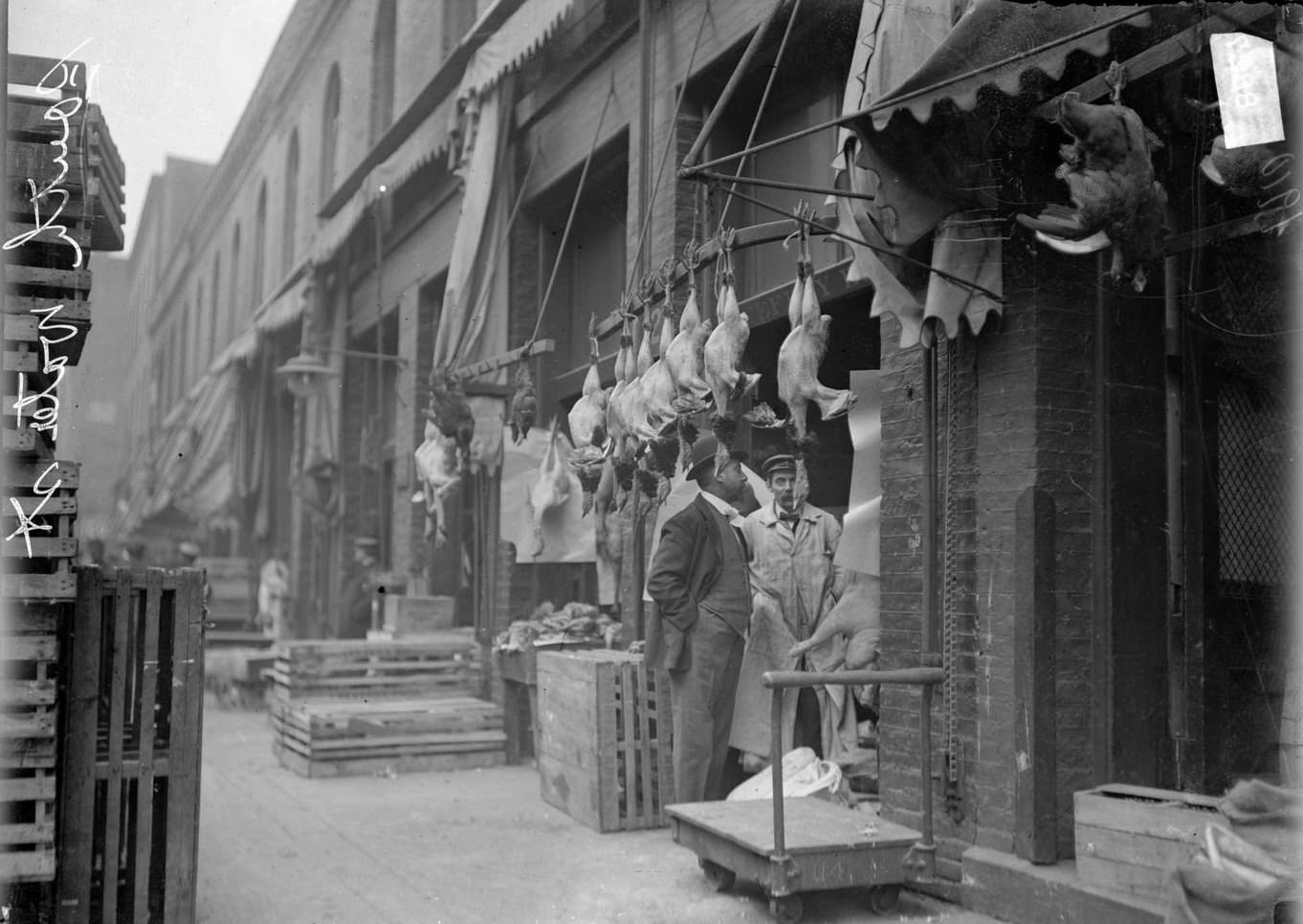
Chicago’s South Water Street Market was the city’s central wholesale food market during this era. Vendors hung chickens by the feet over doorways, and produce and meat moved through the market in enormous volumes. The market fed the city’s restaurants, groceries, and households, operating daily in the shadow of the Loop.
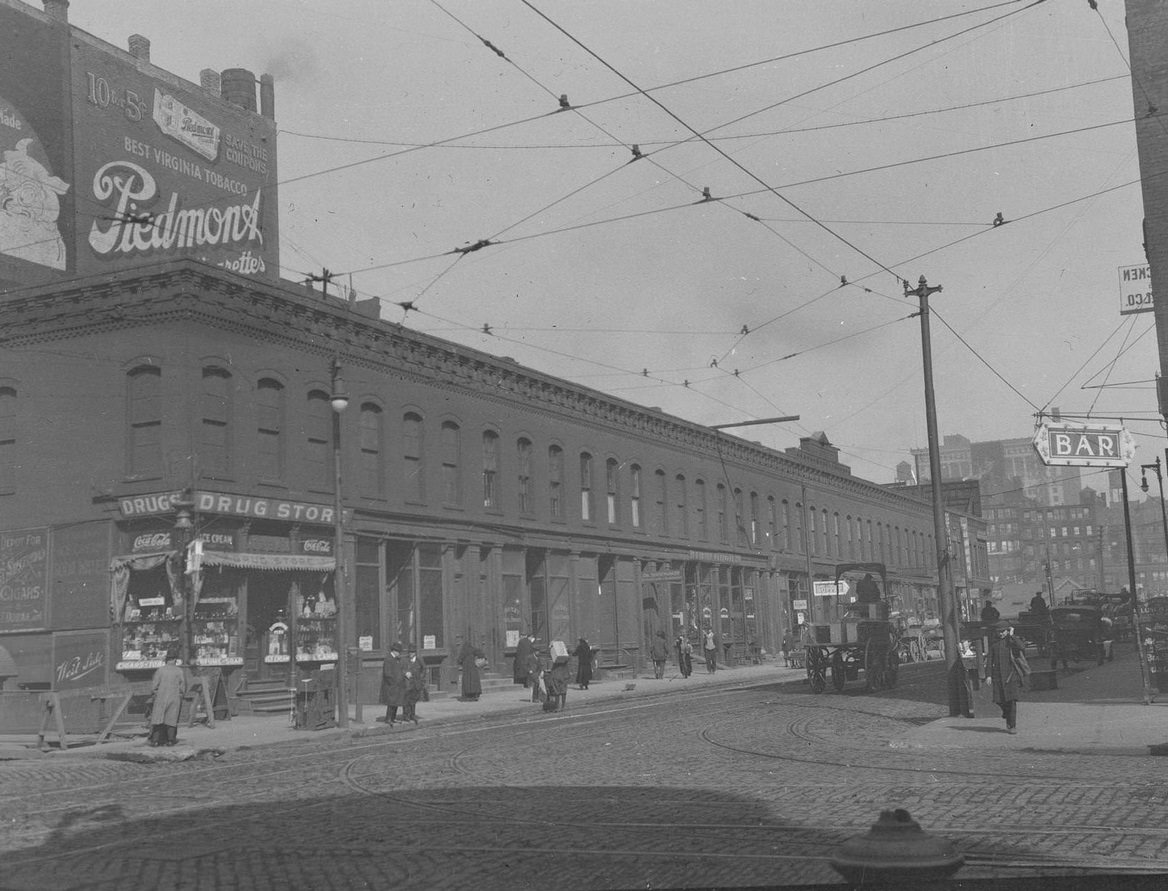
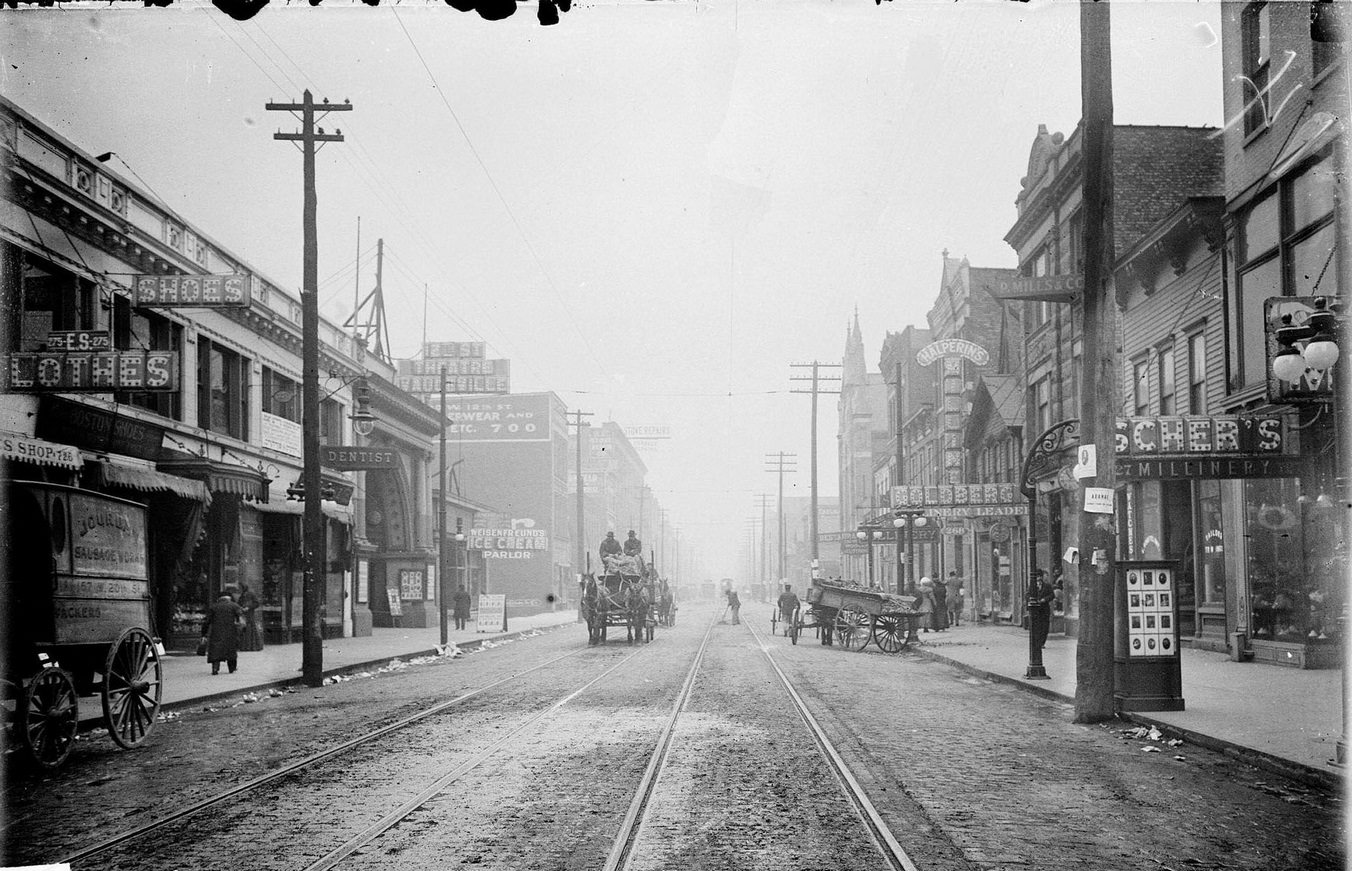
Chickens hanging by the feet from a rack over a door at the South Water Street Market, Chicago, Illinois, 1910s.West Twelfth Street (West Roosevelt Road), looking west from South Halsted Street in the Near West Side community area, Chicago, Illinois, 1910s.
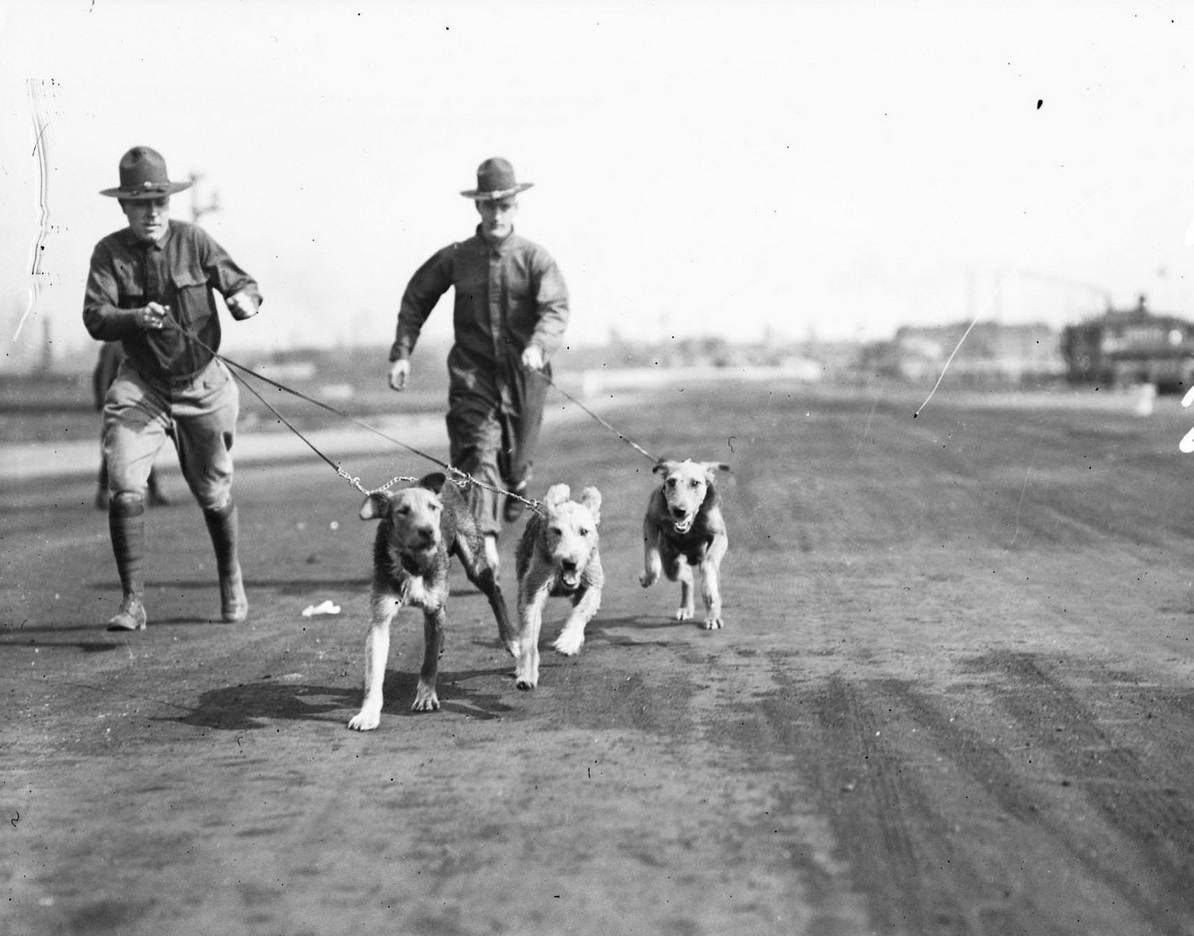
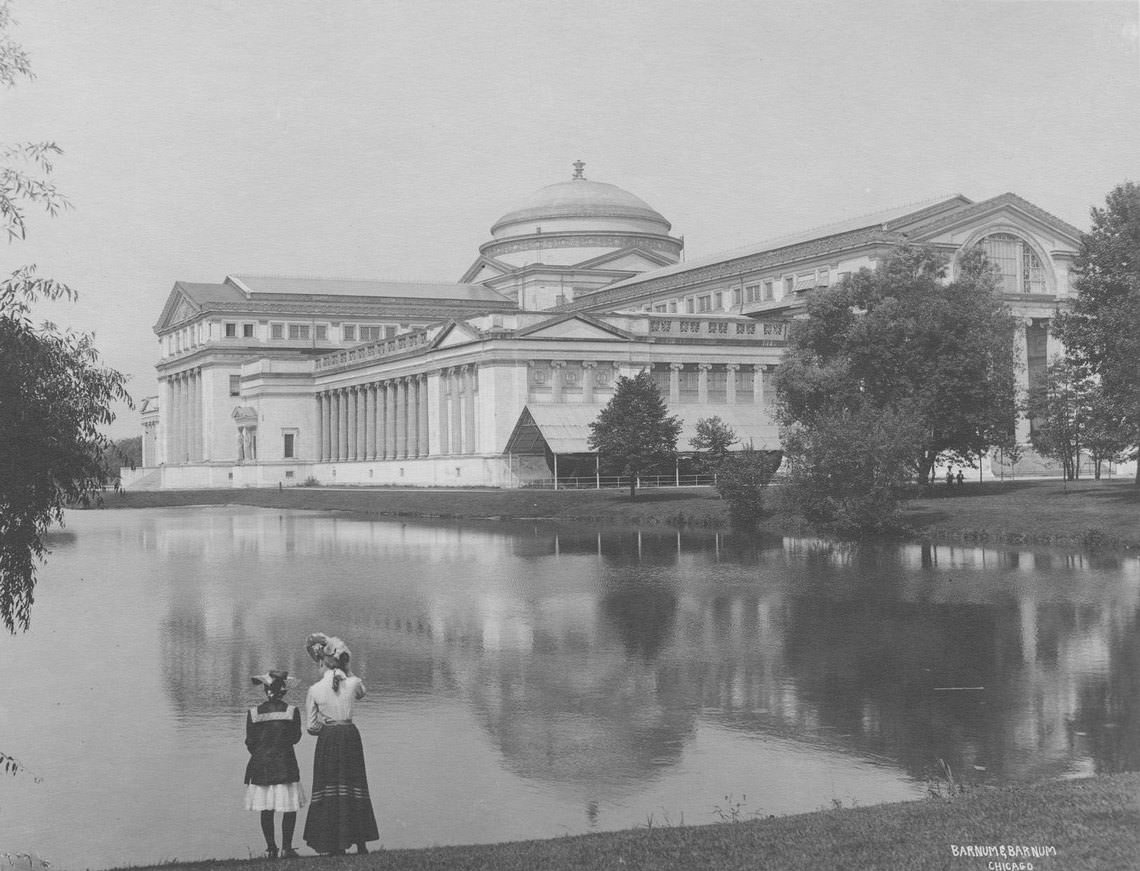
The city’s wartime atmosphere of 1918 brought war dogs to Grant Park demonstrations, soldiers to street corners, and patriotic rallies to every major public space. The Field Museum’s new building was completed during this period, and the Art Institute remained a focal point for public gatherings. By the time the decade closed, Chicago had been shaped by immigration, war, labor conflict, and racial violence in ways that would define its next chapter.
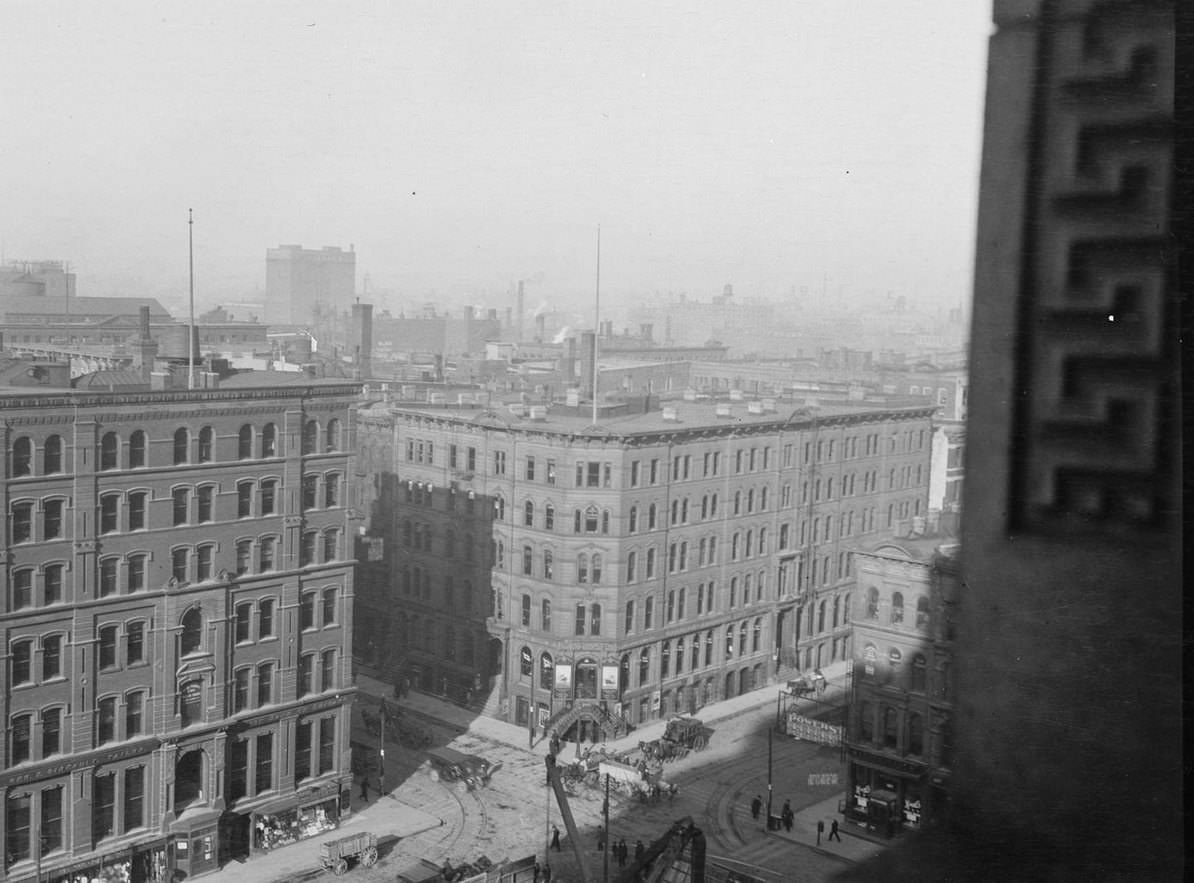
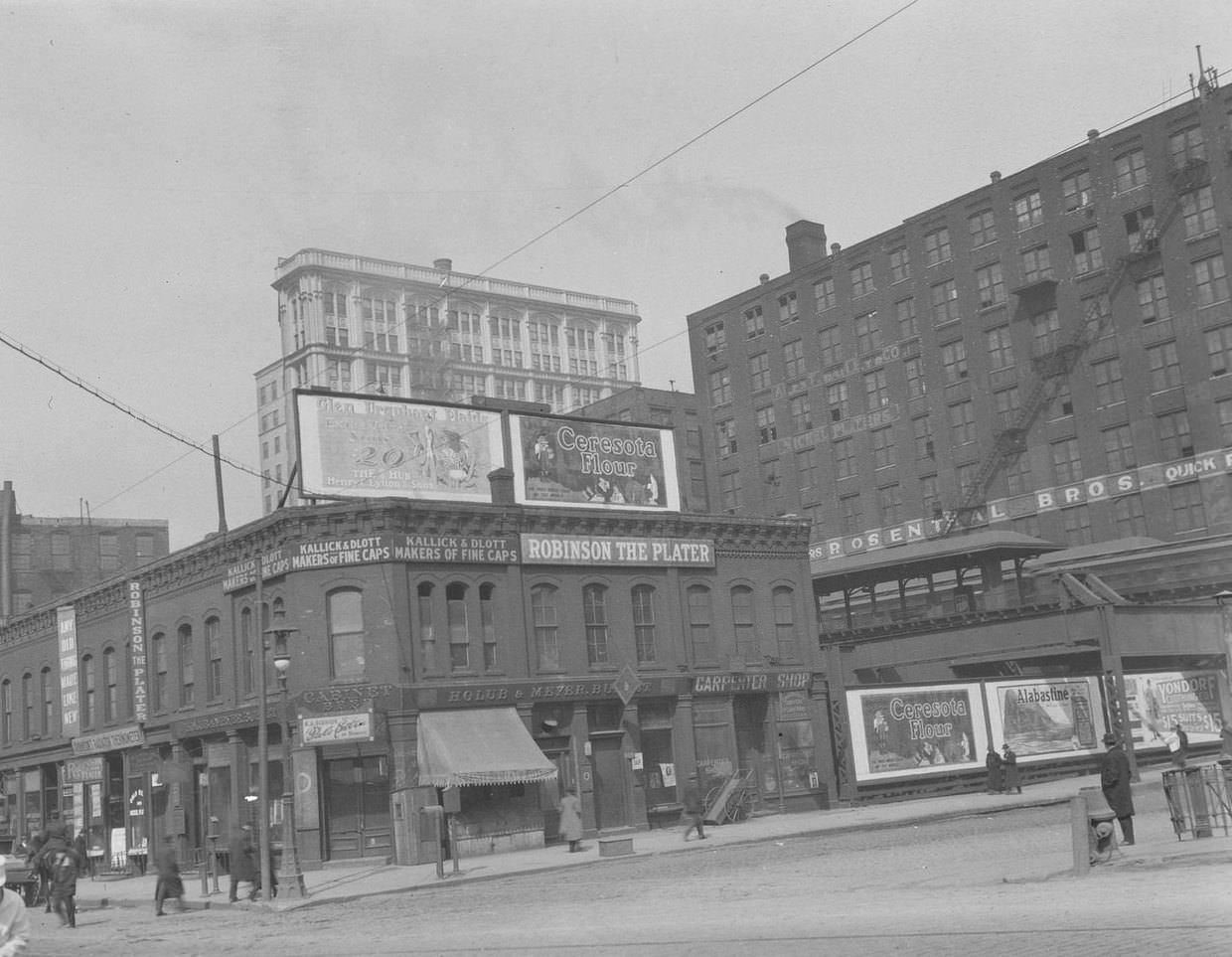
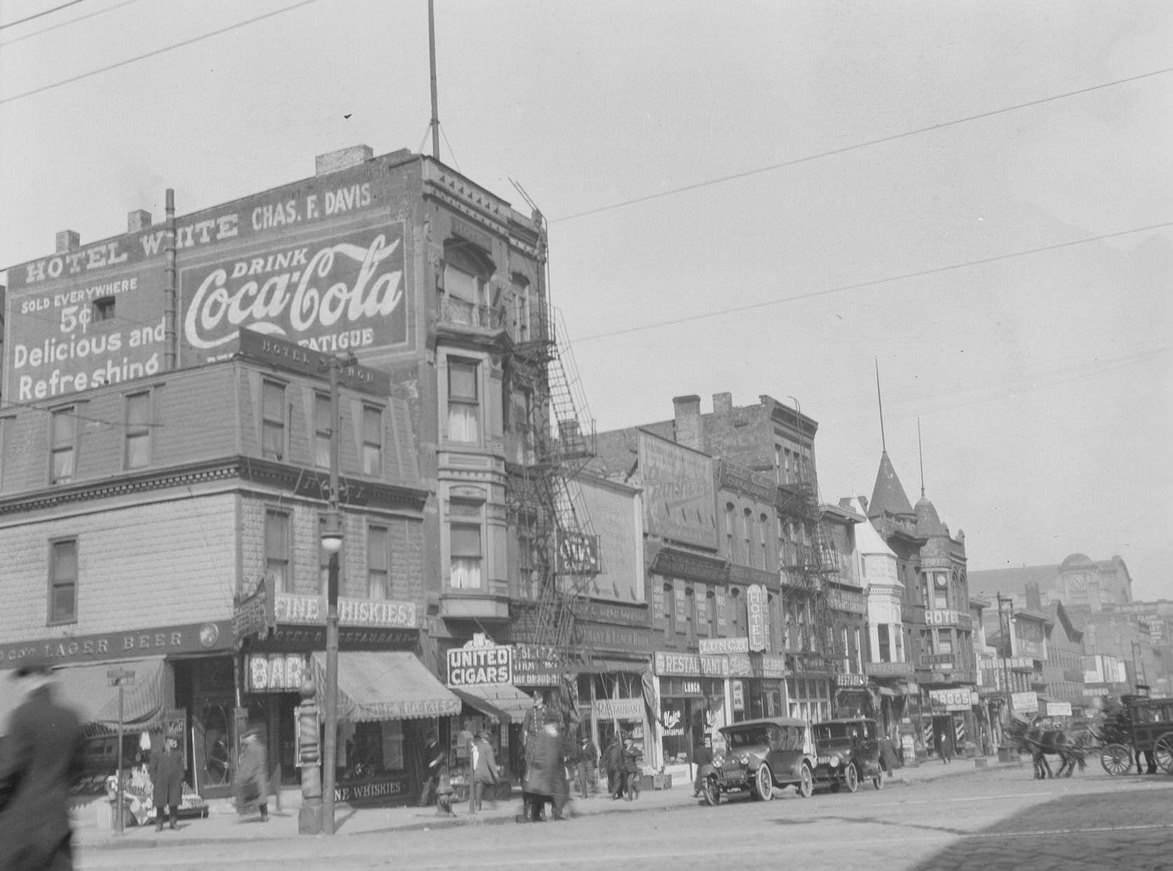
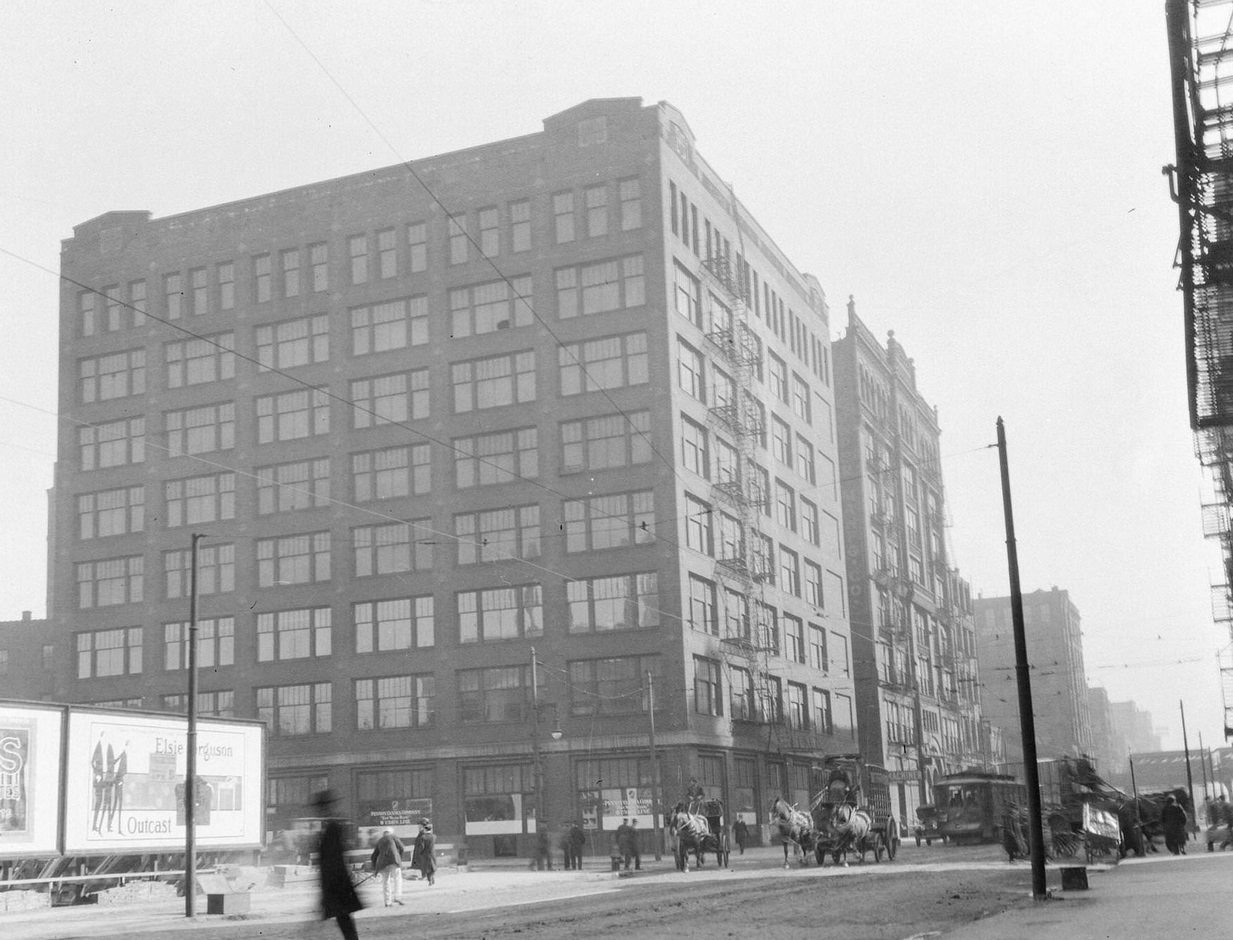
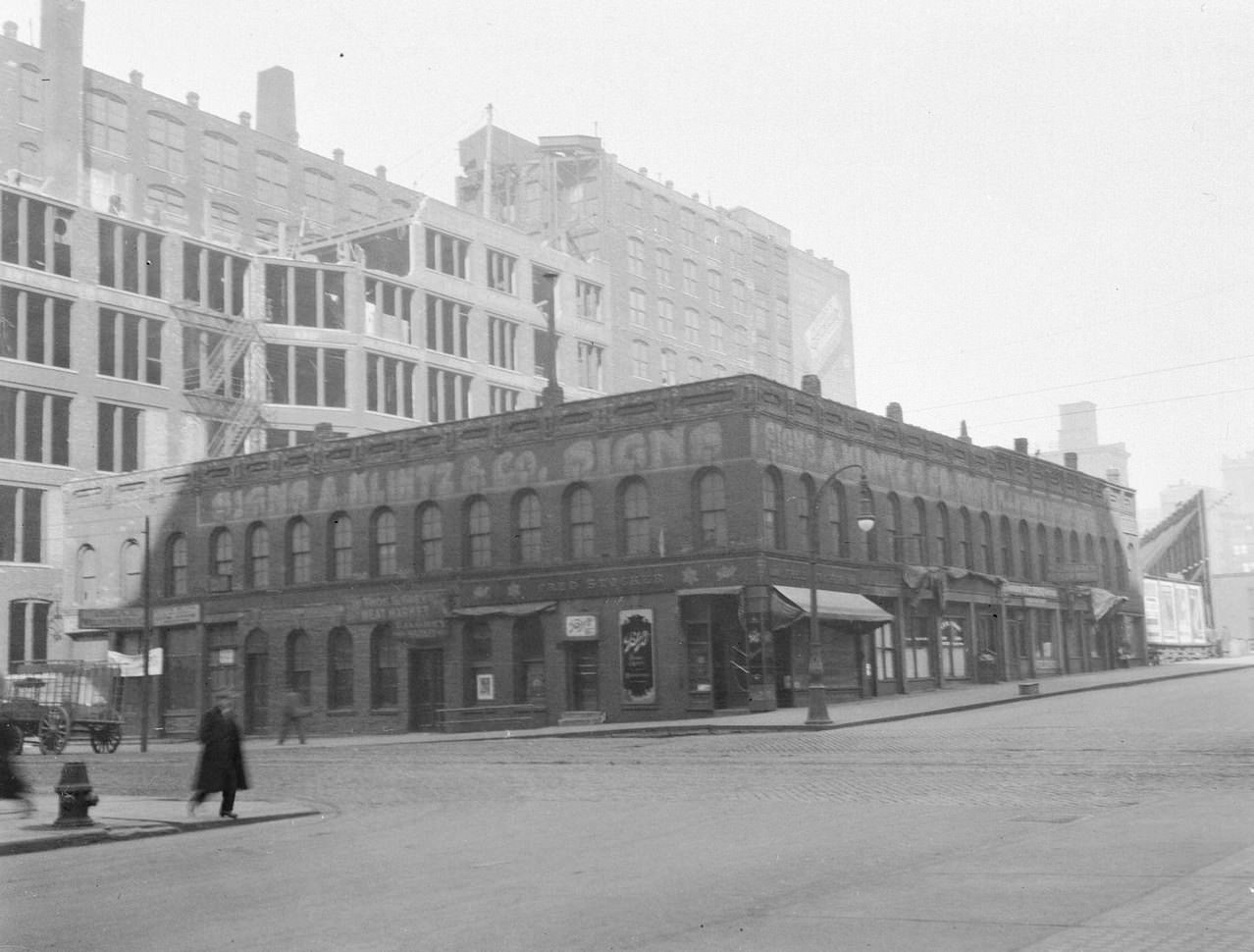
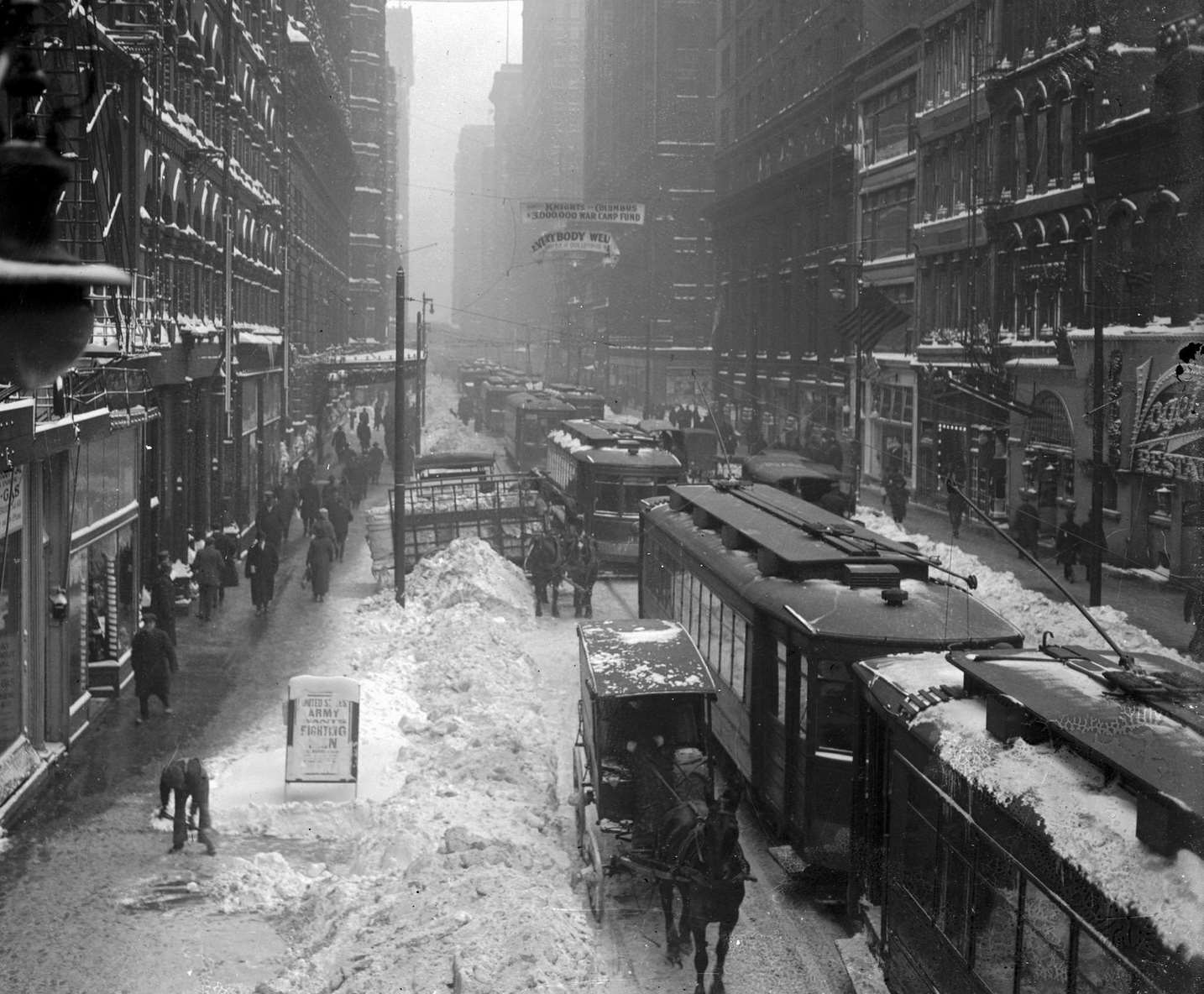
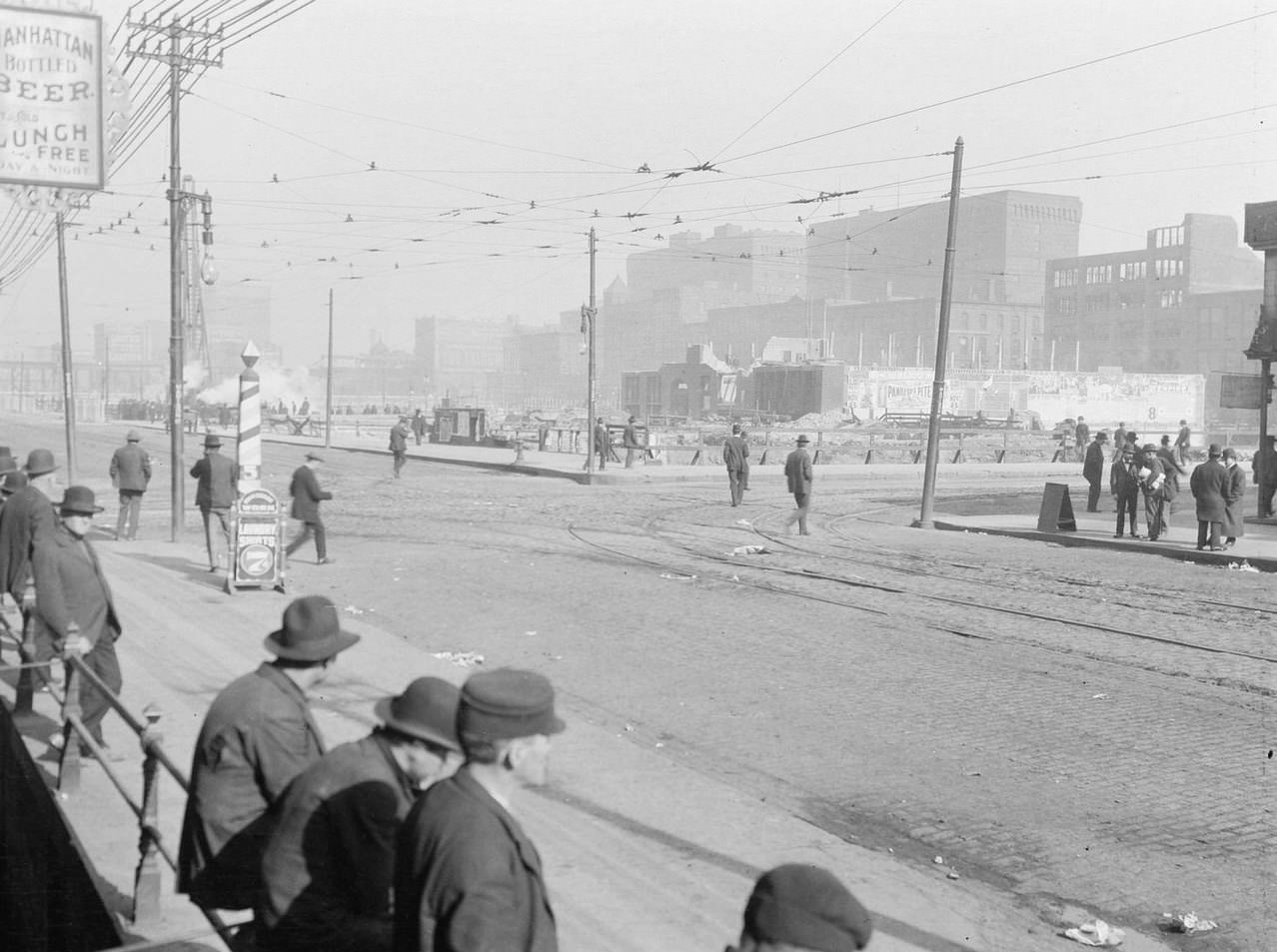
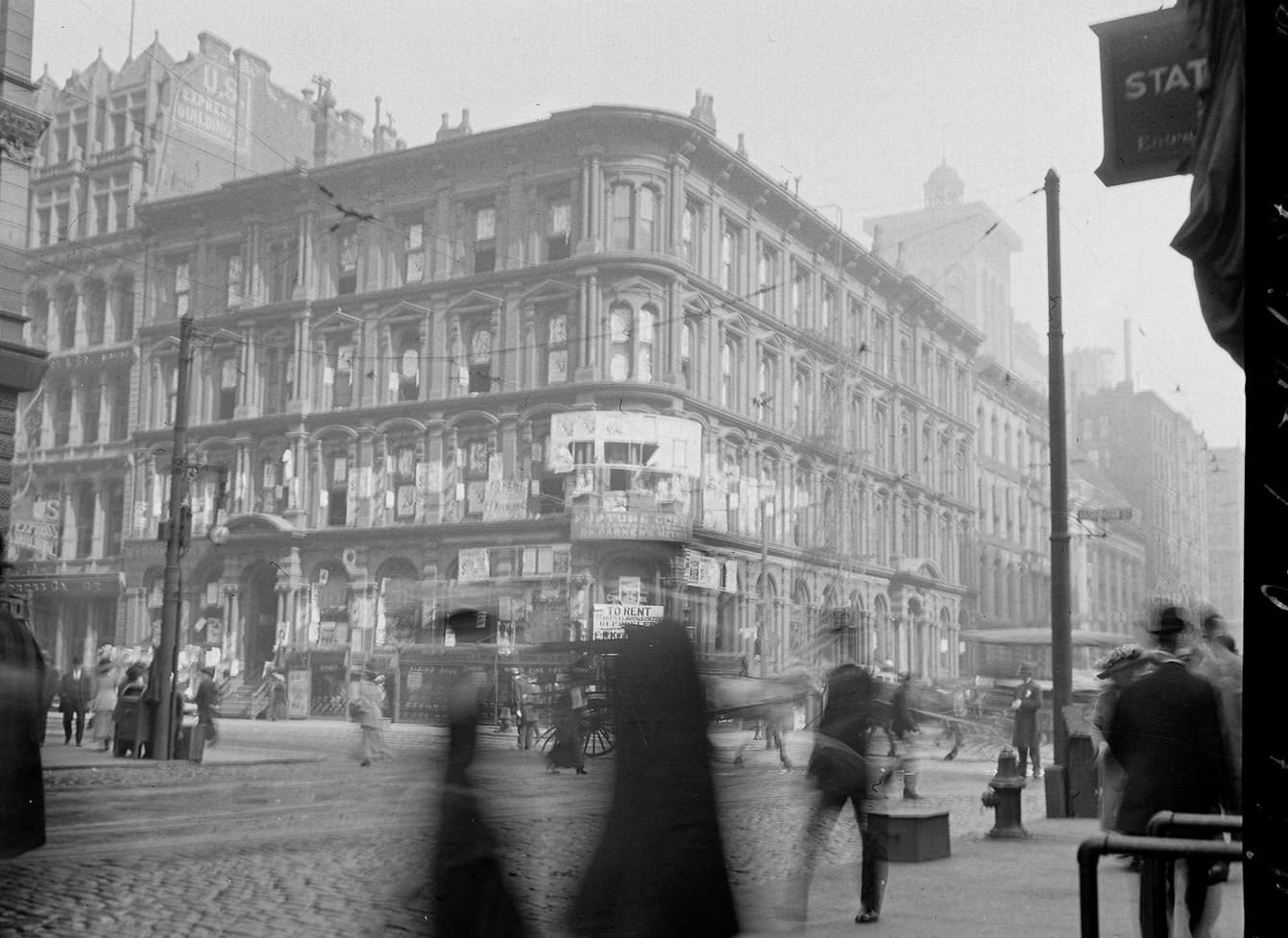
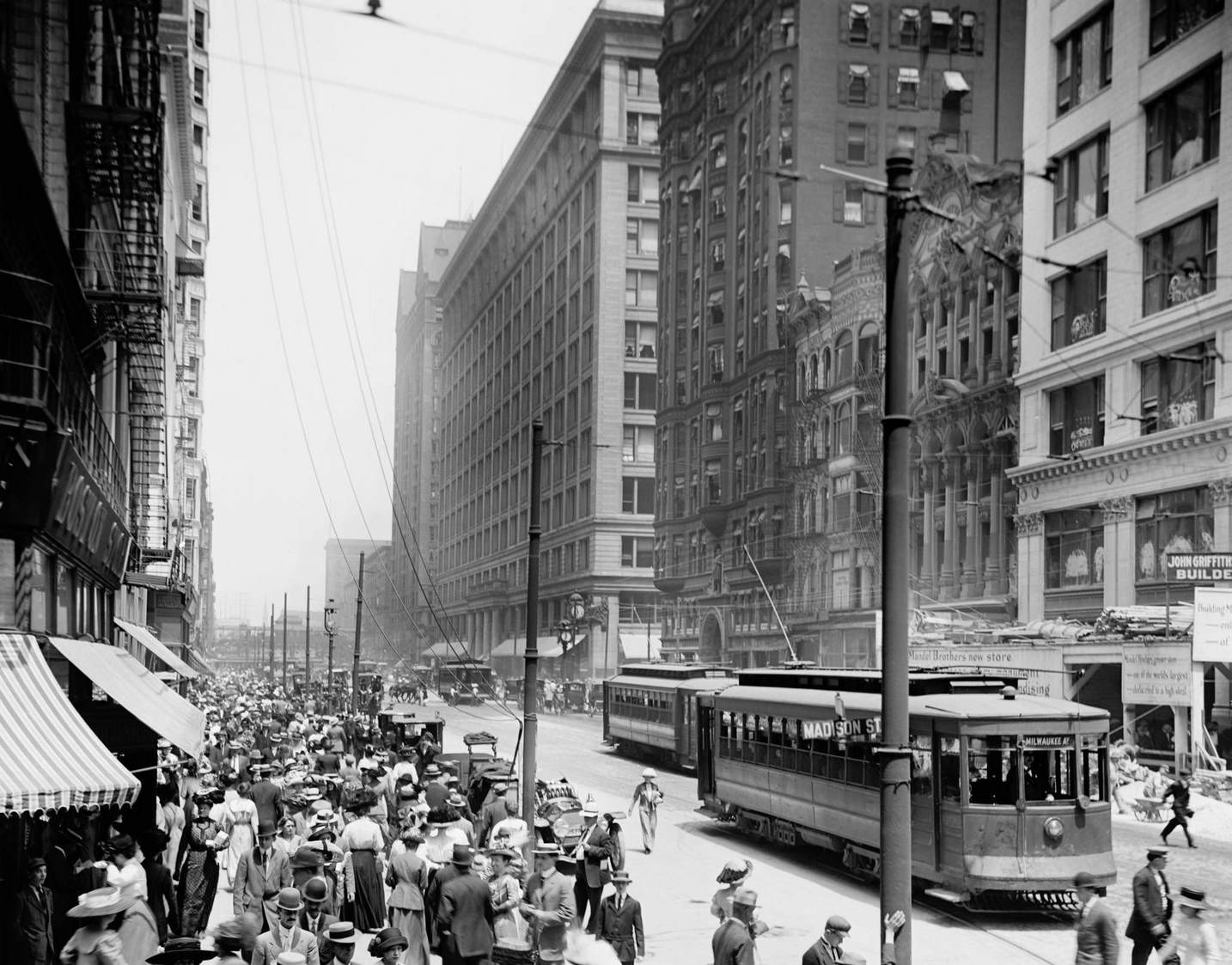
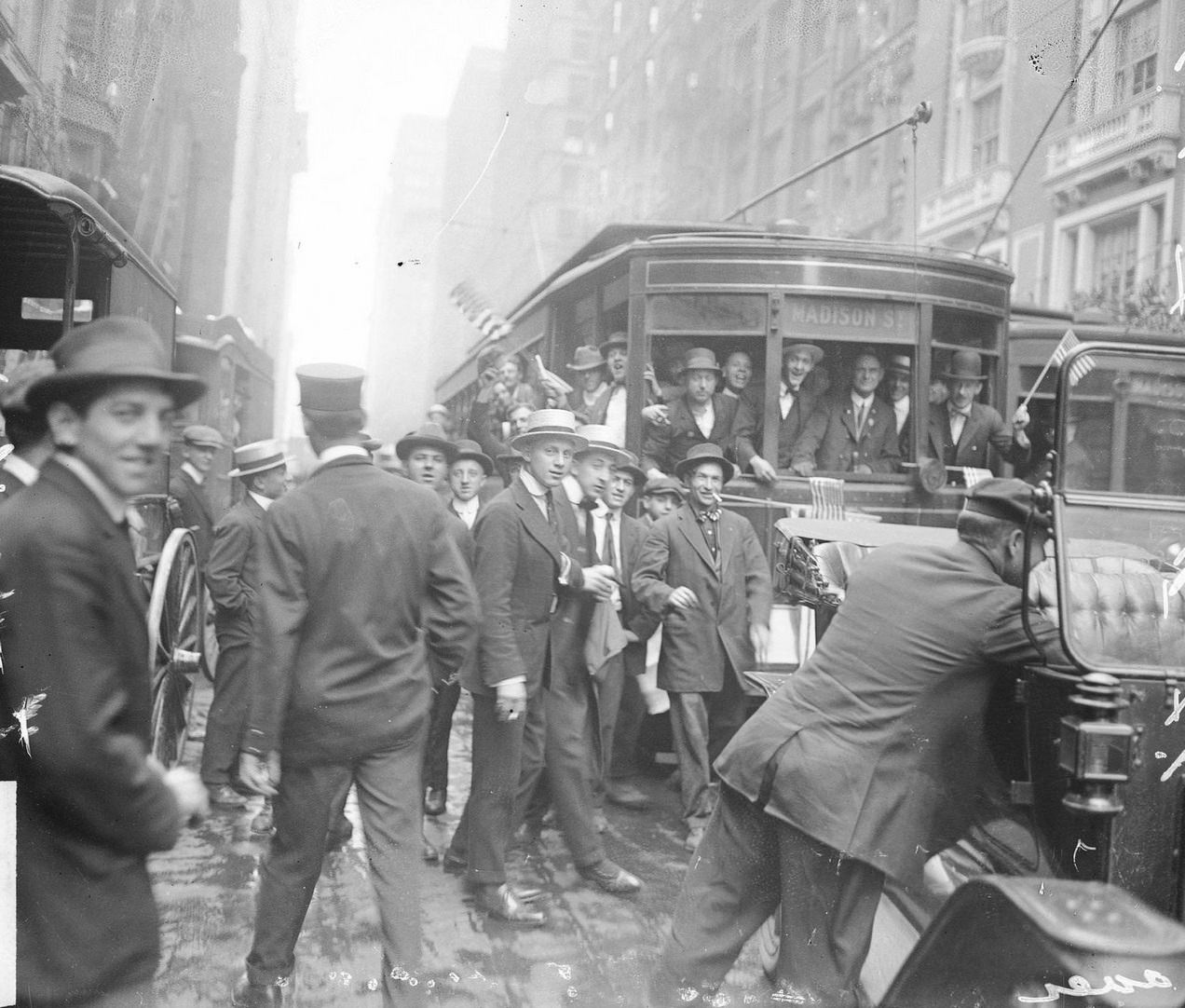
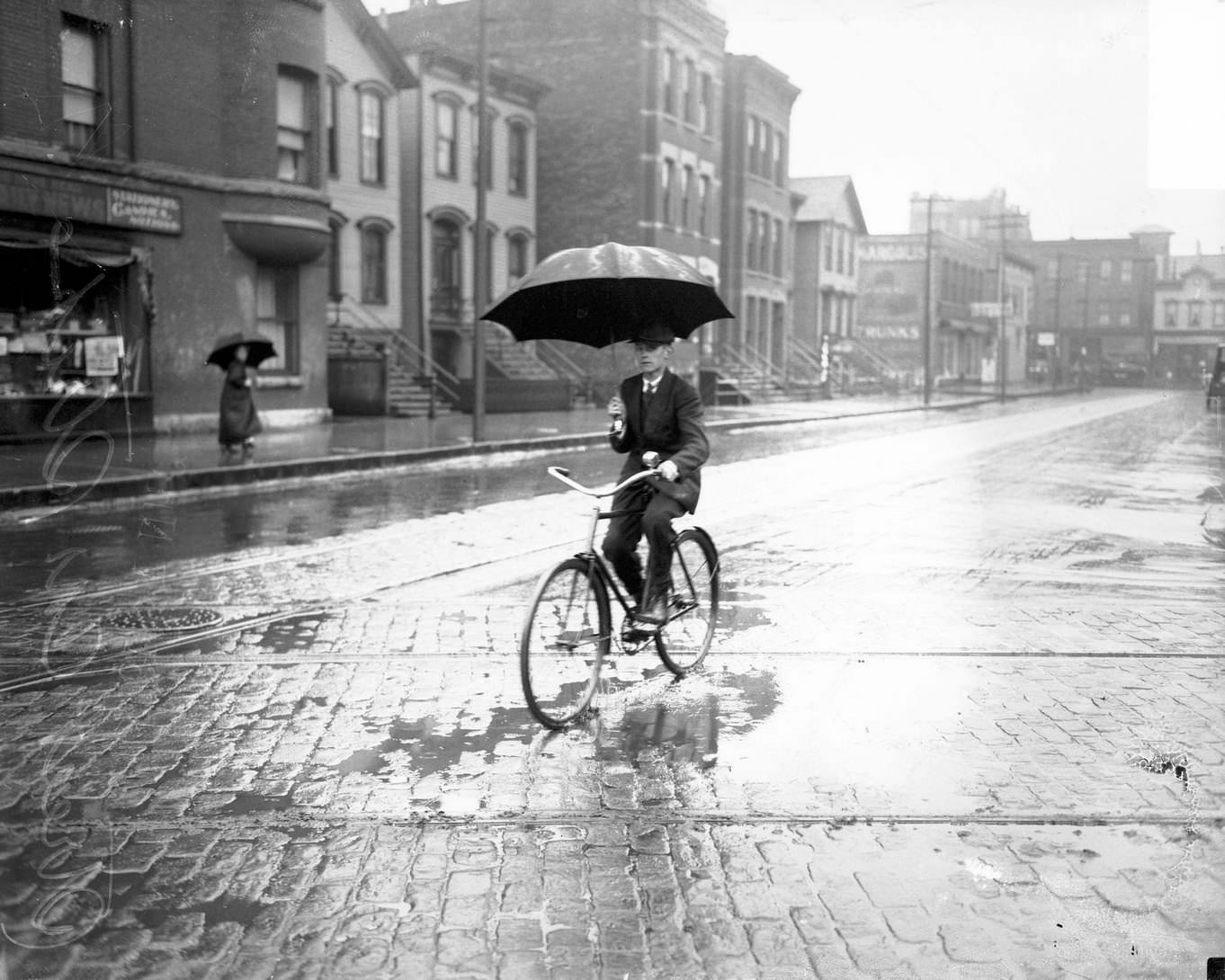
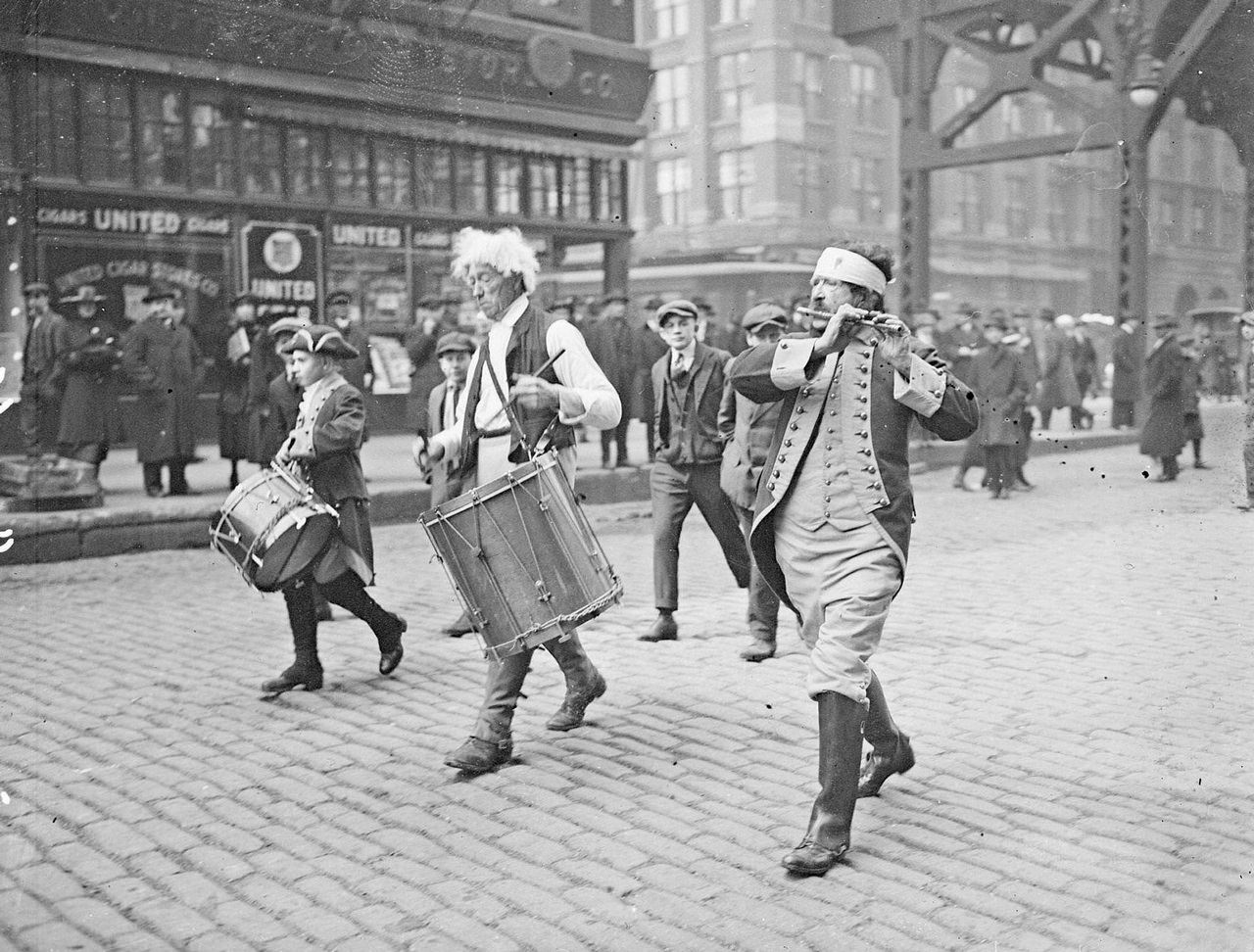
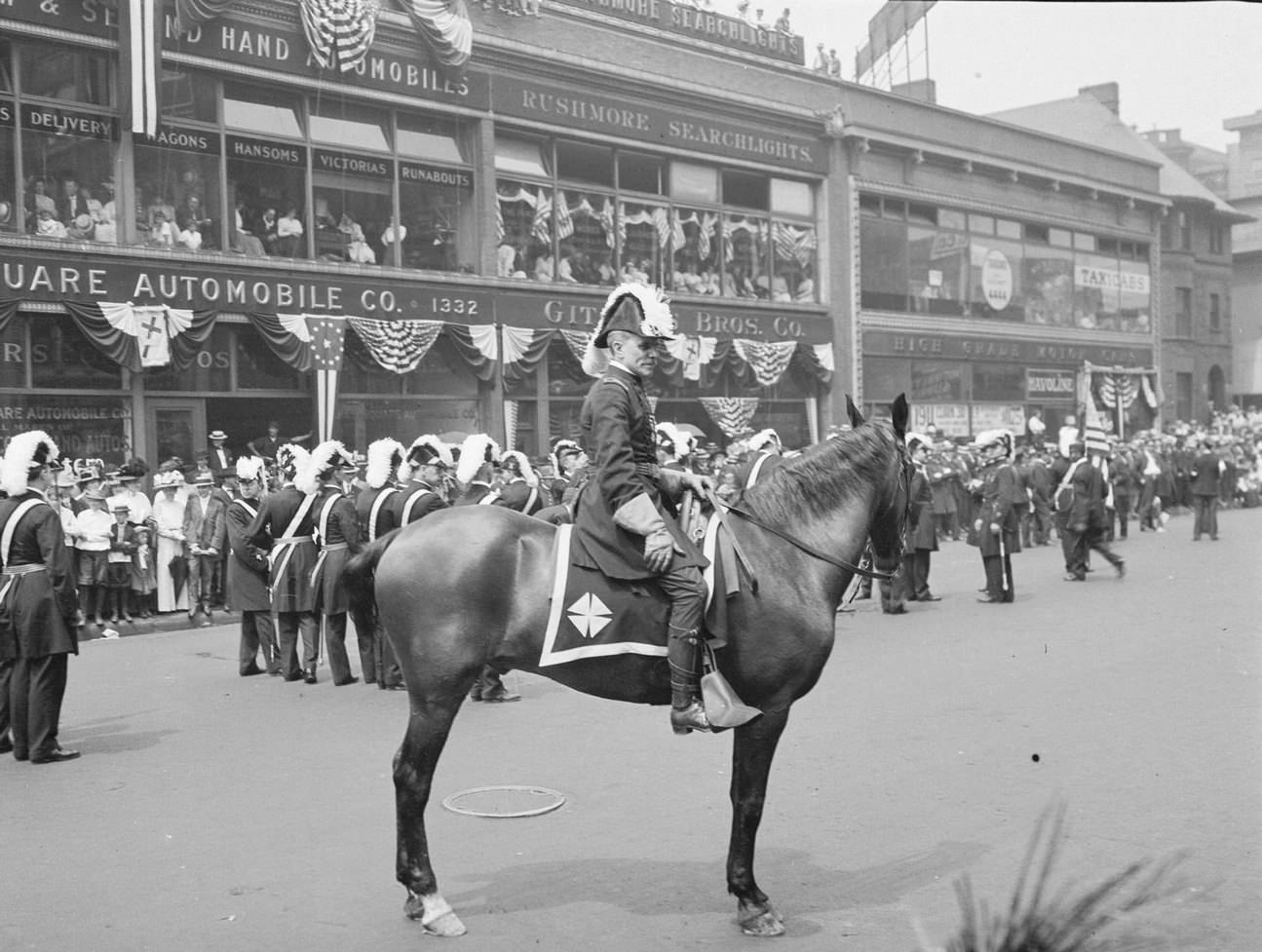
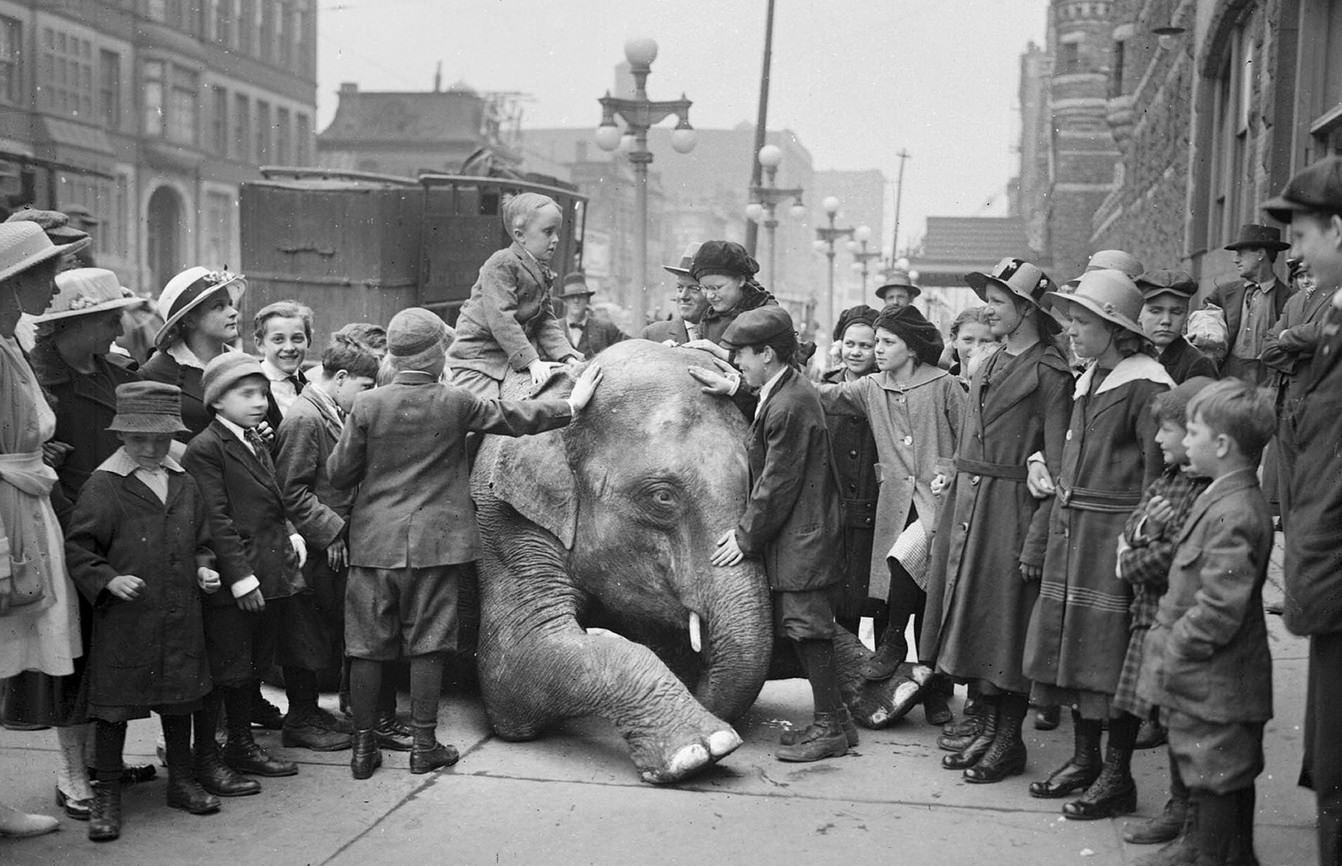
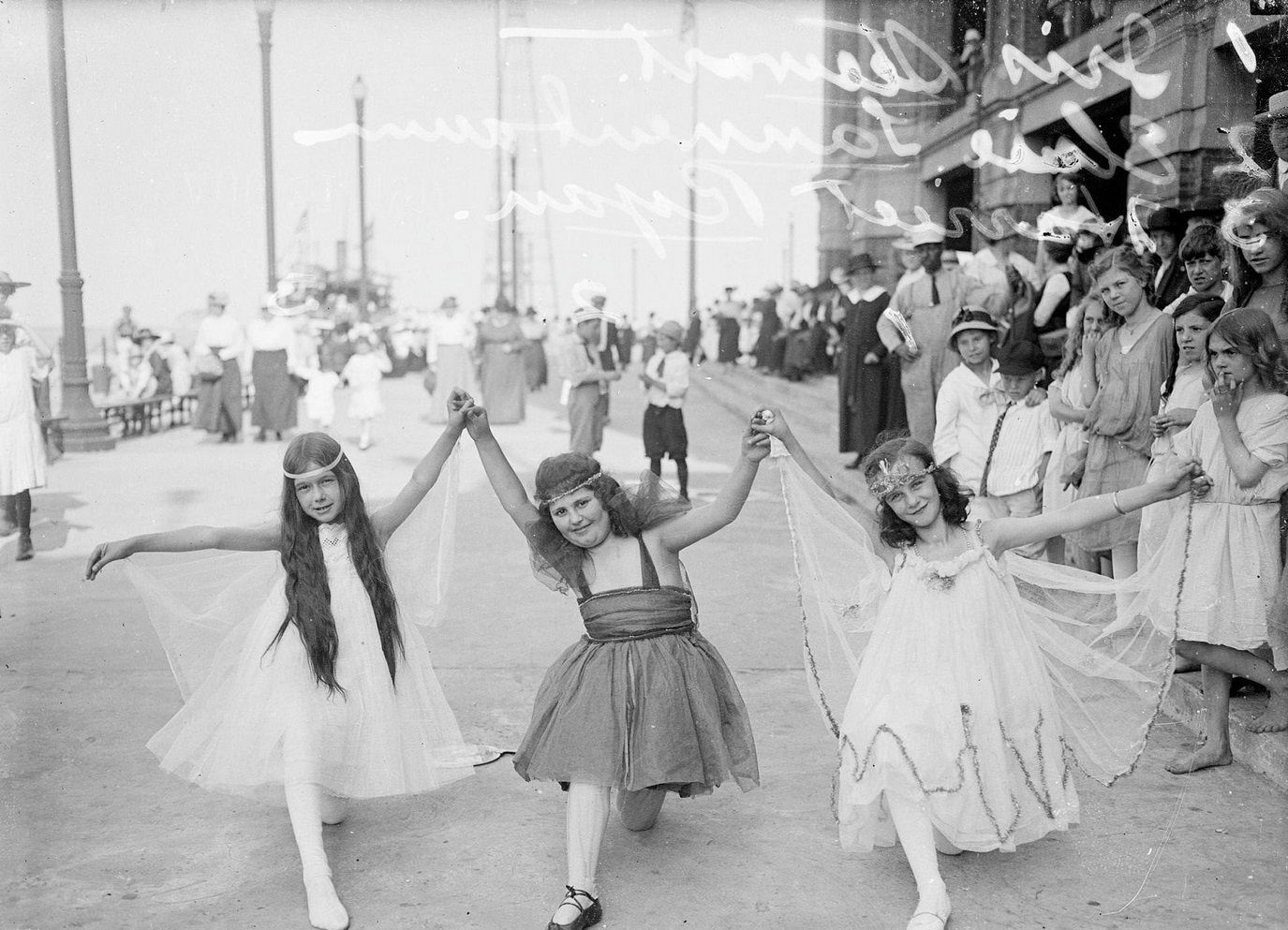
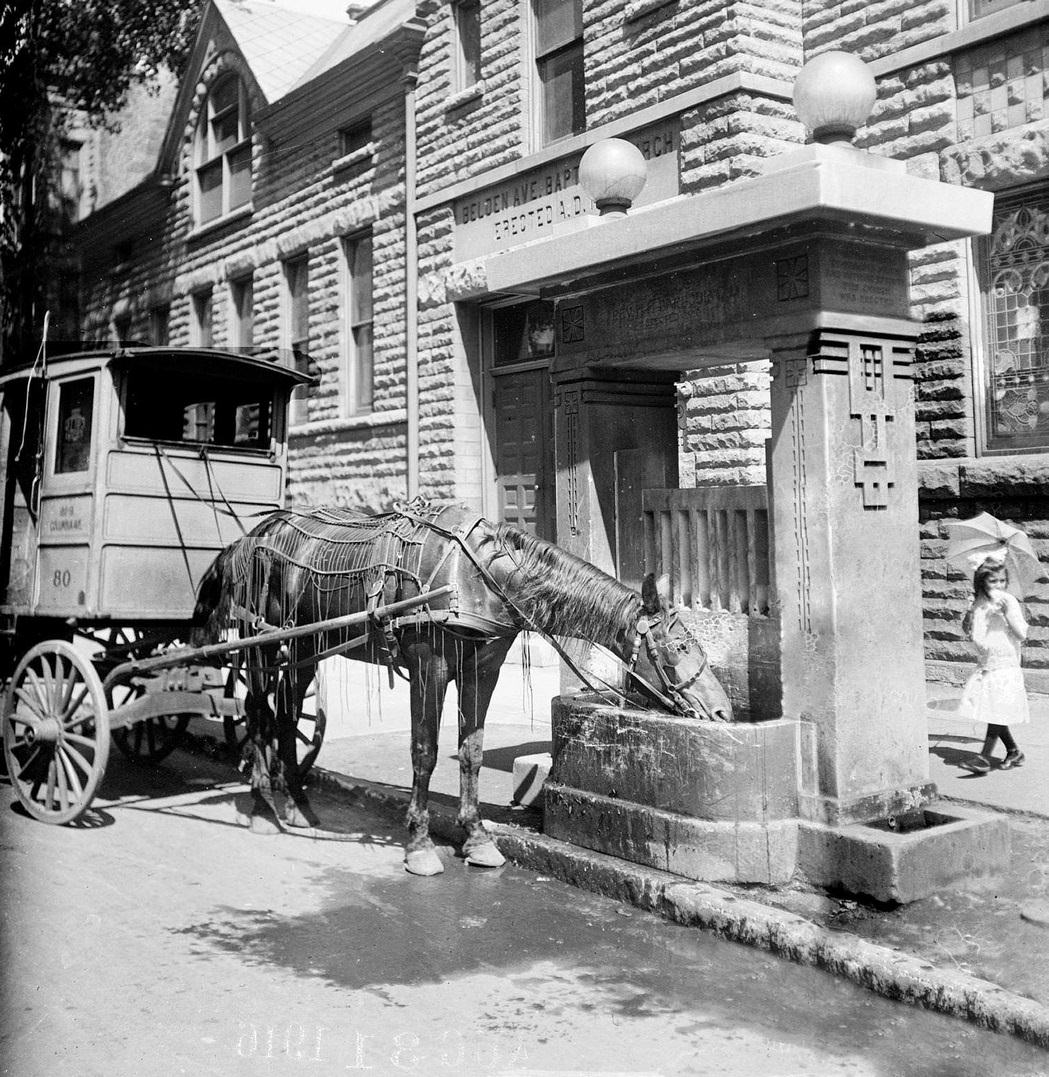
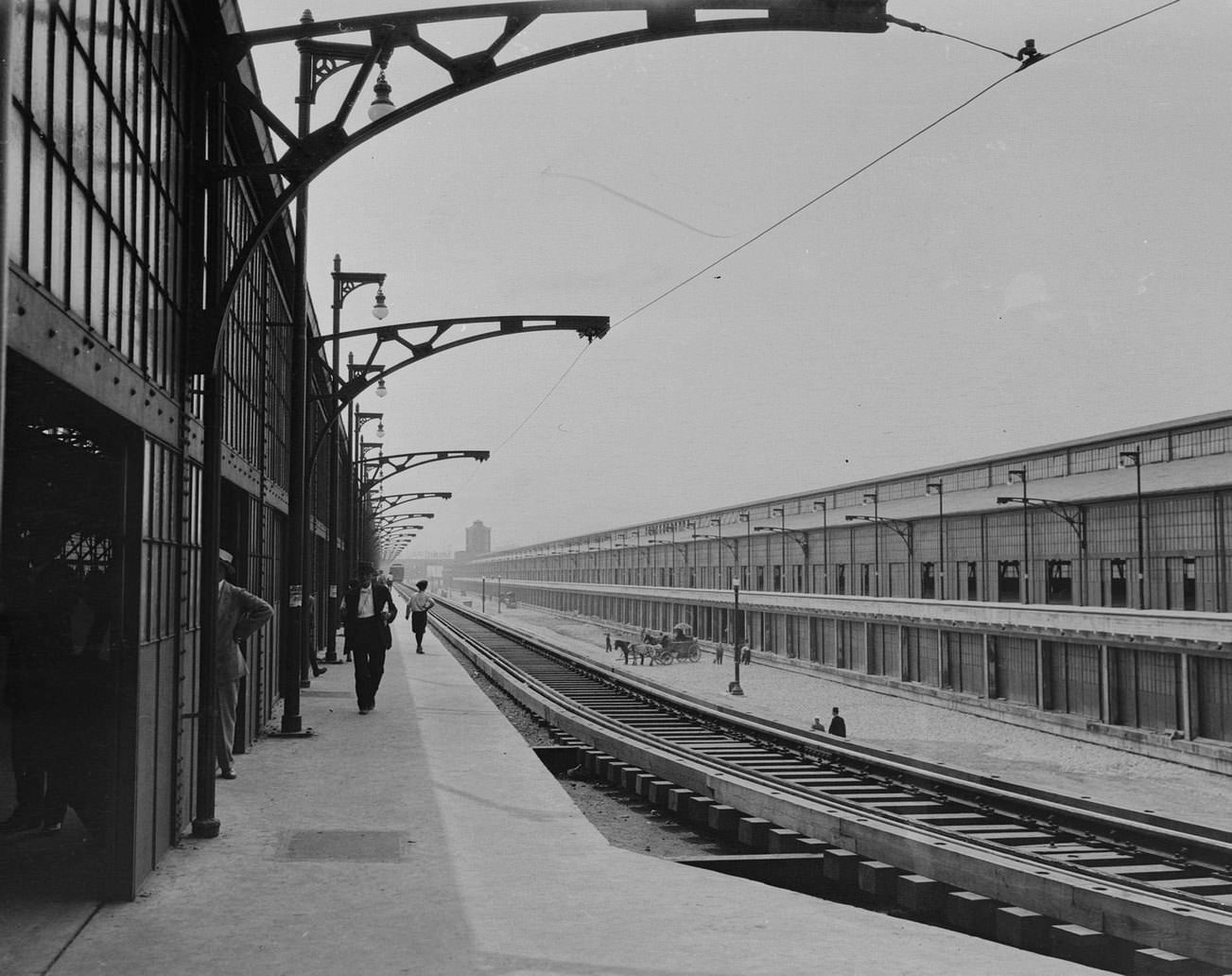
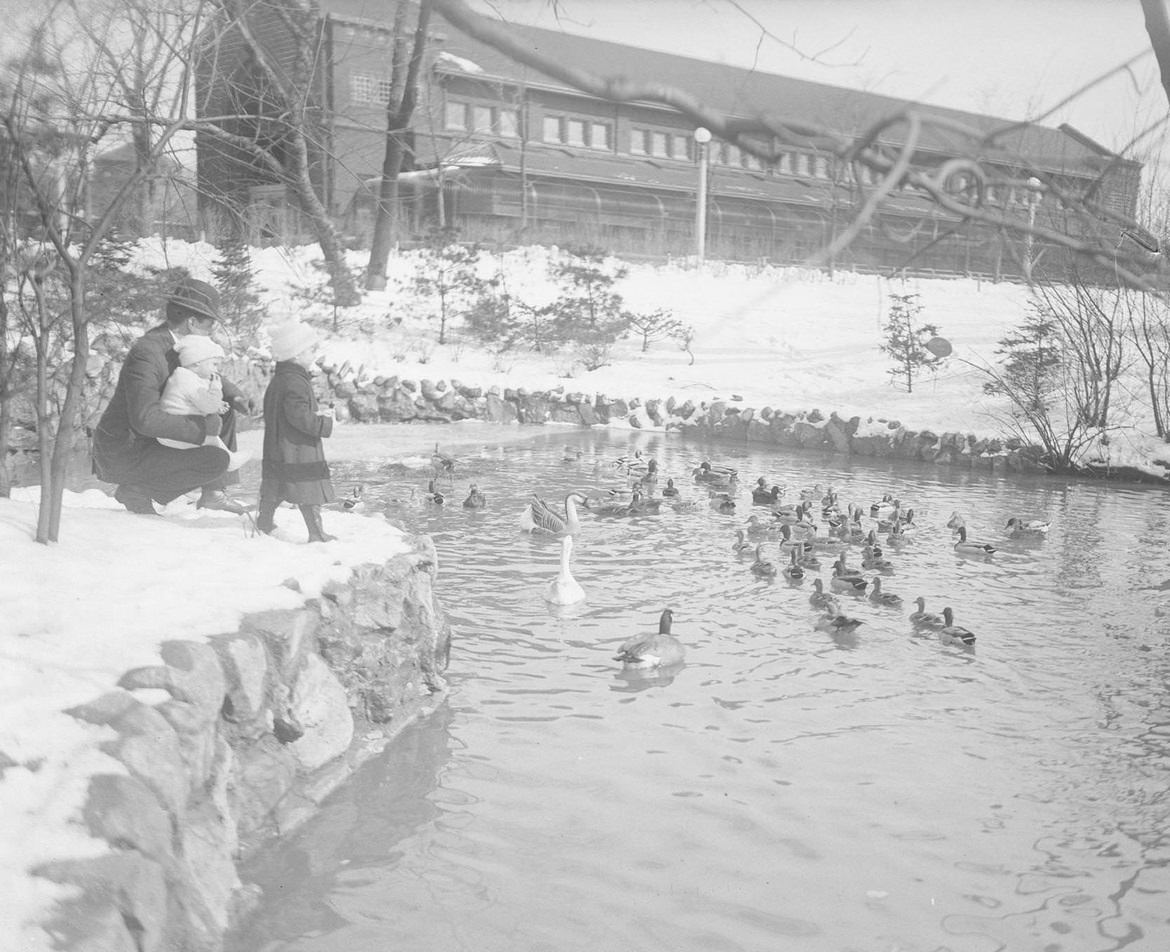
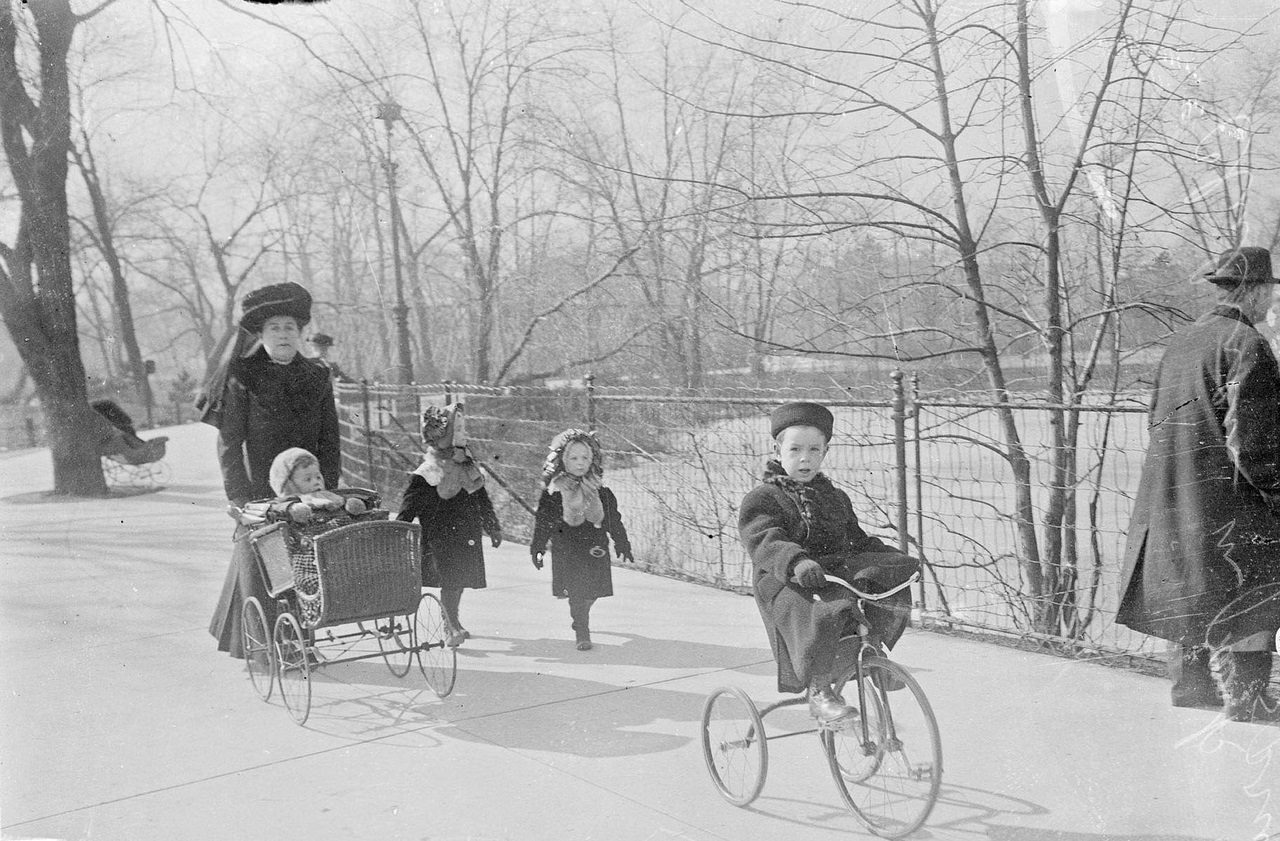
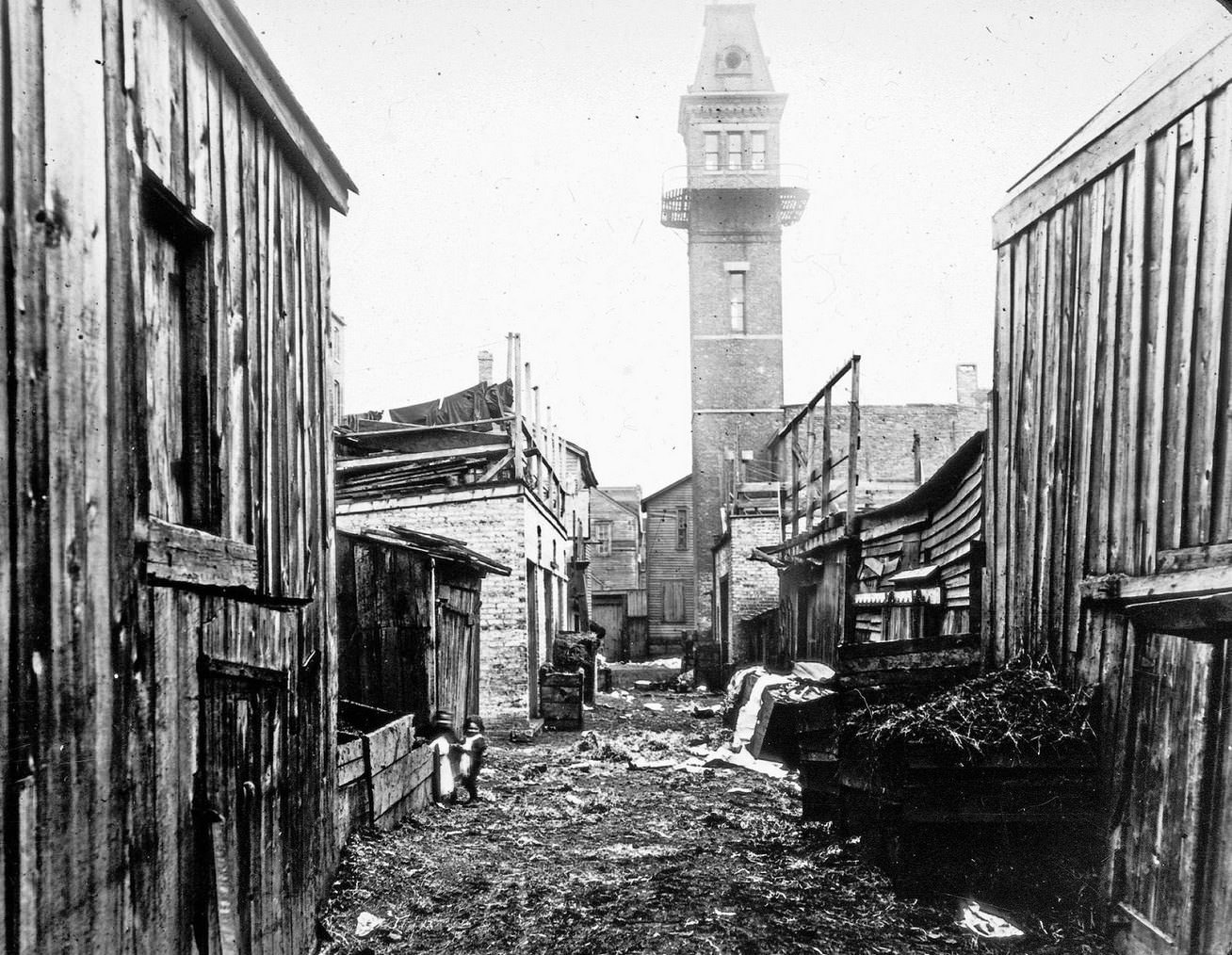
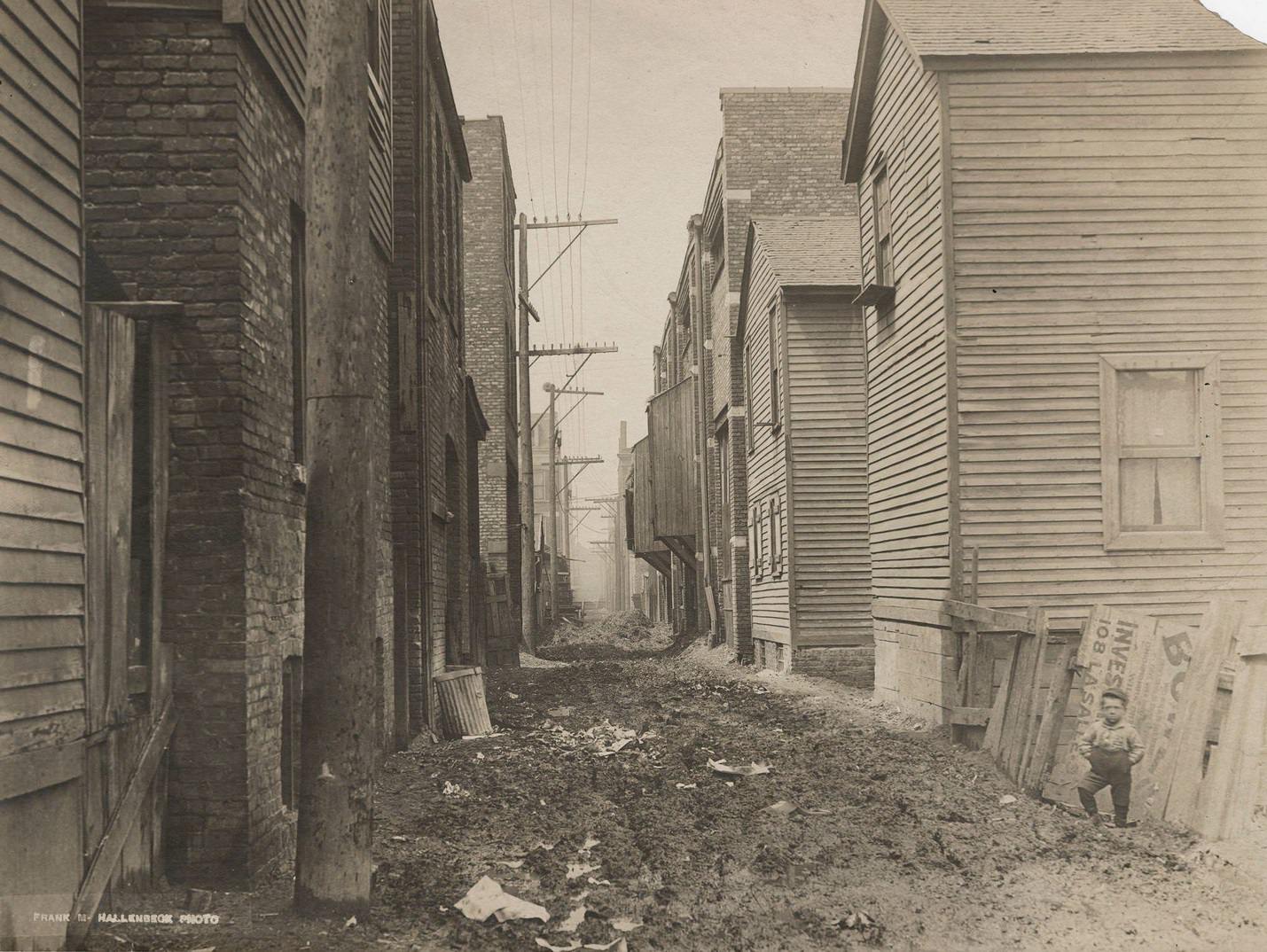
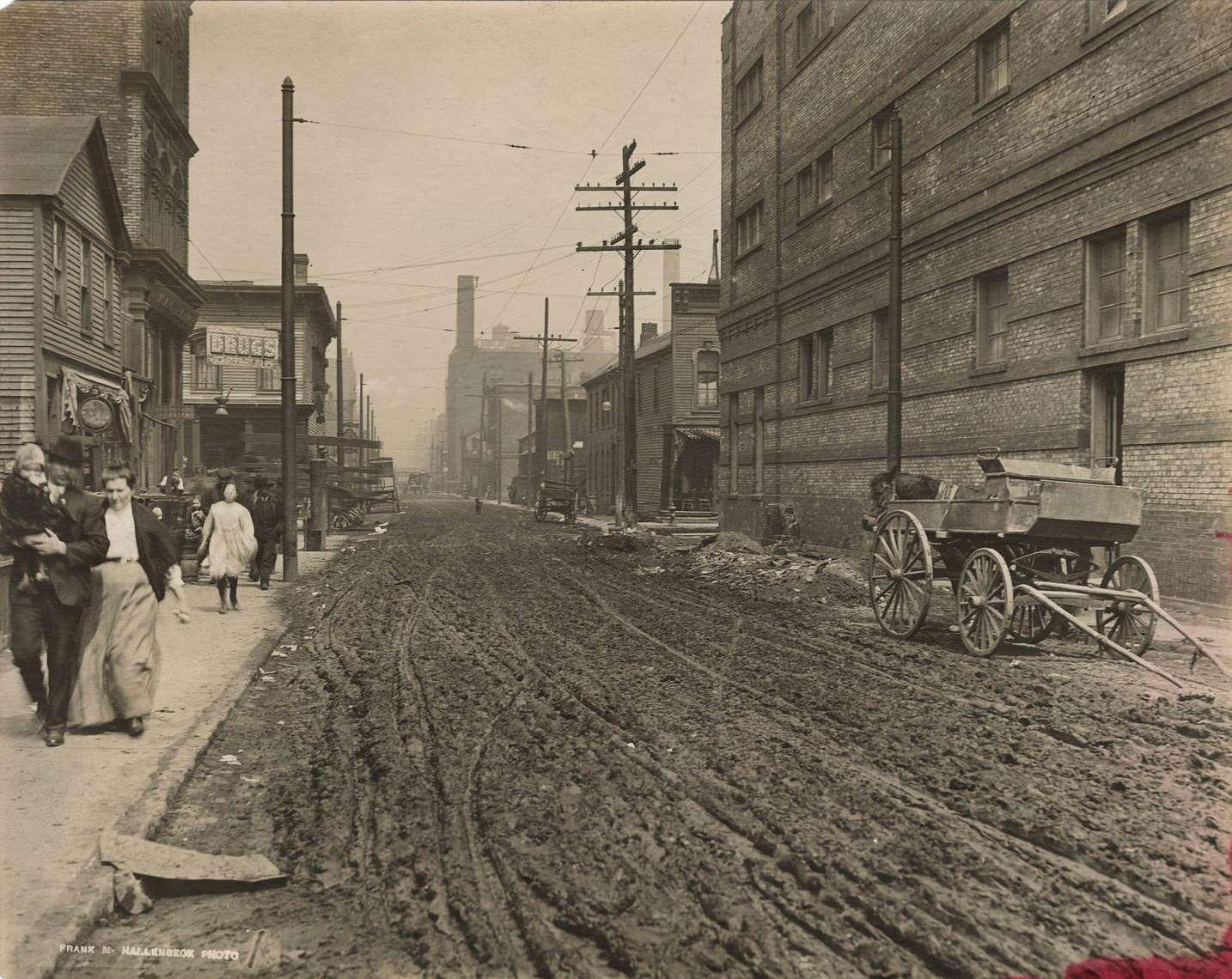
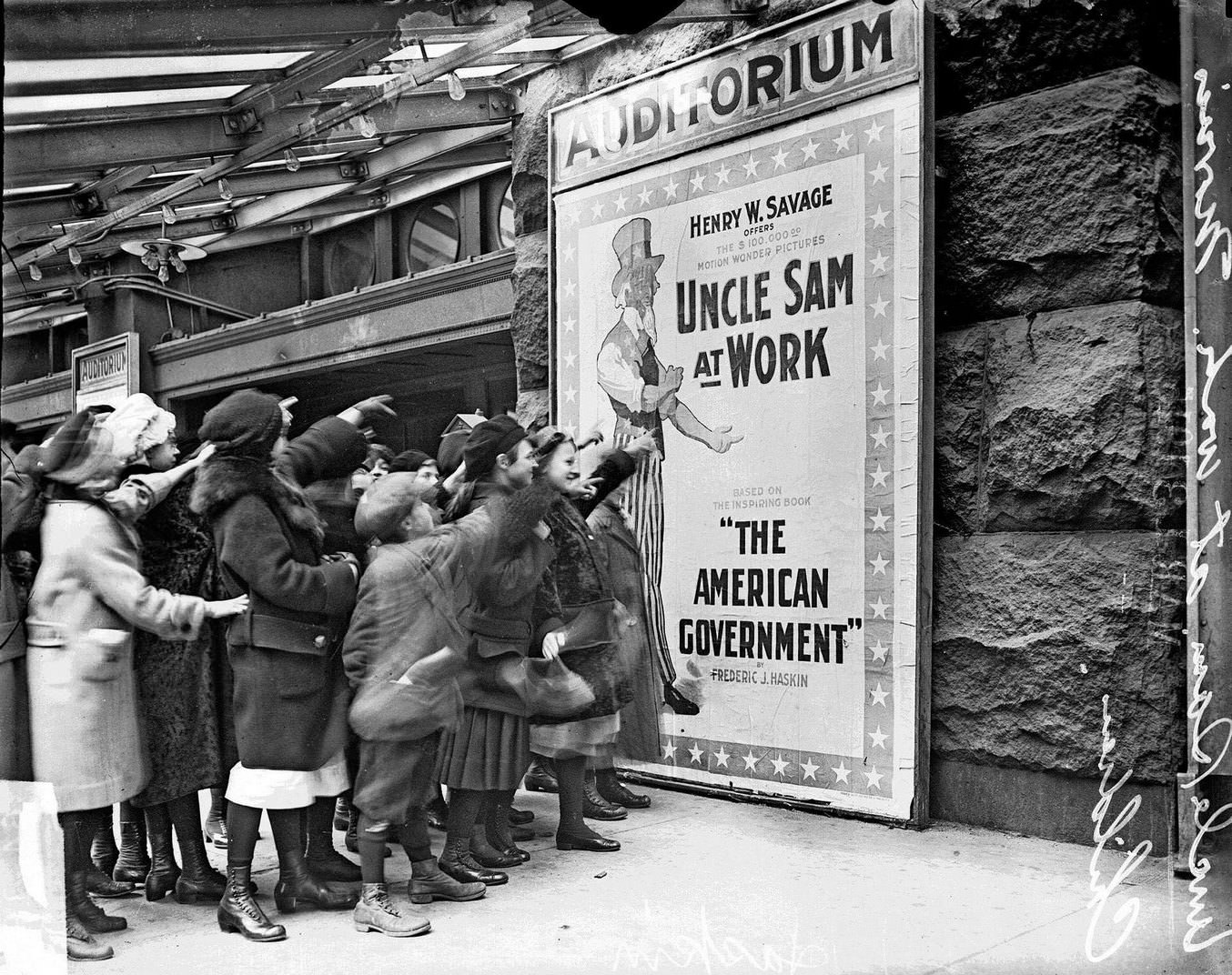
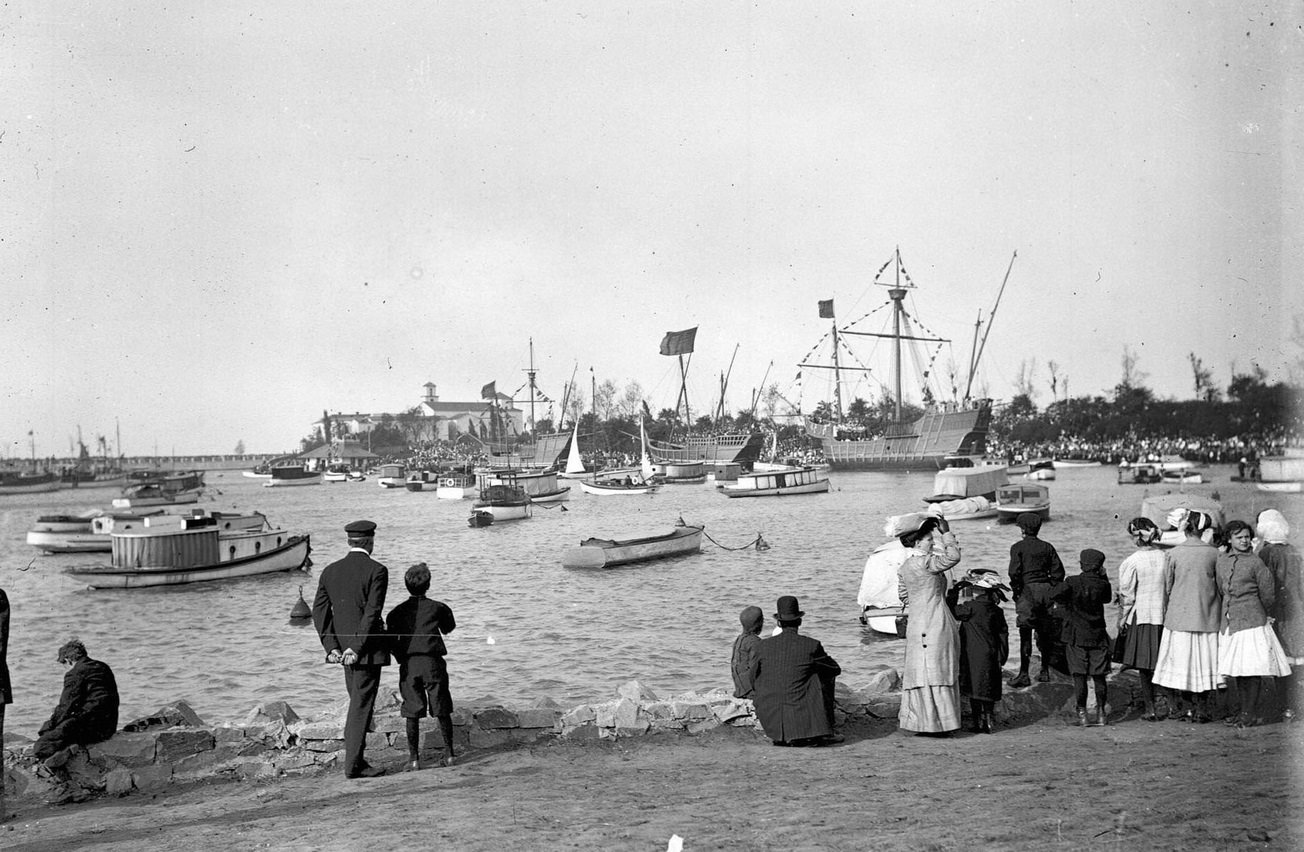
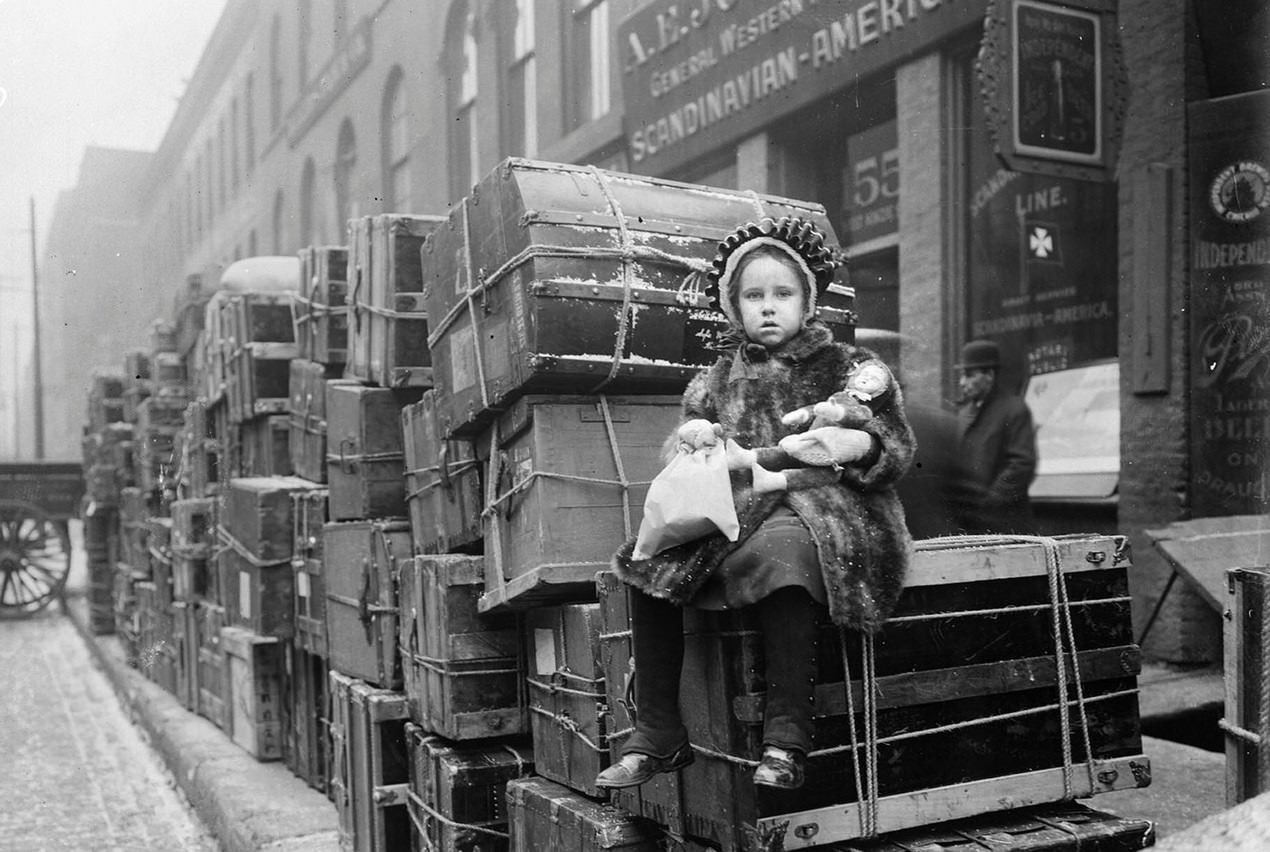
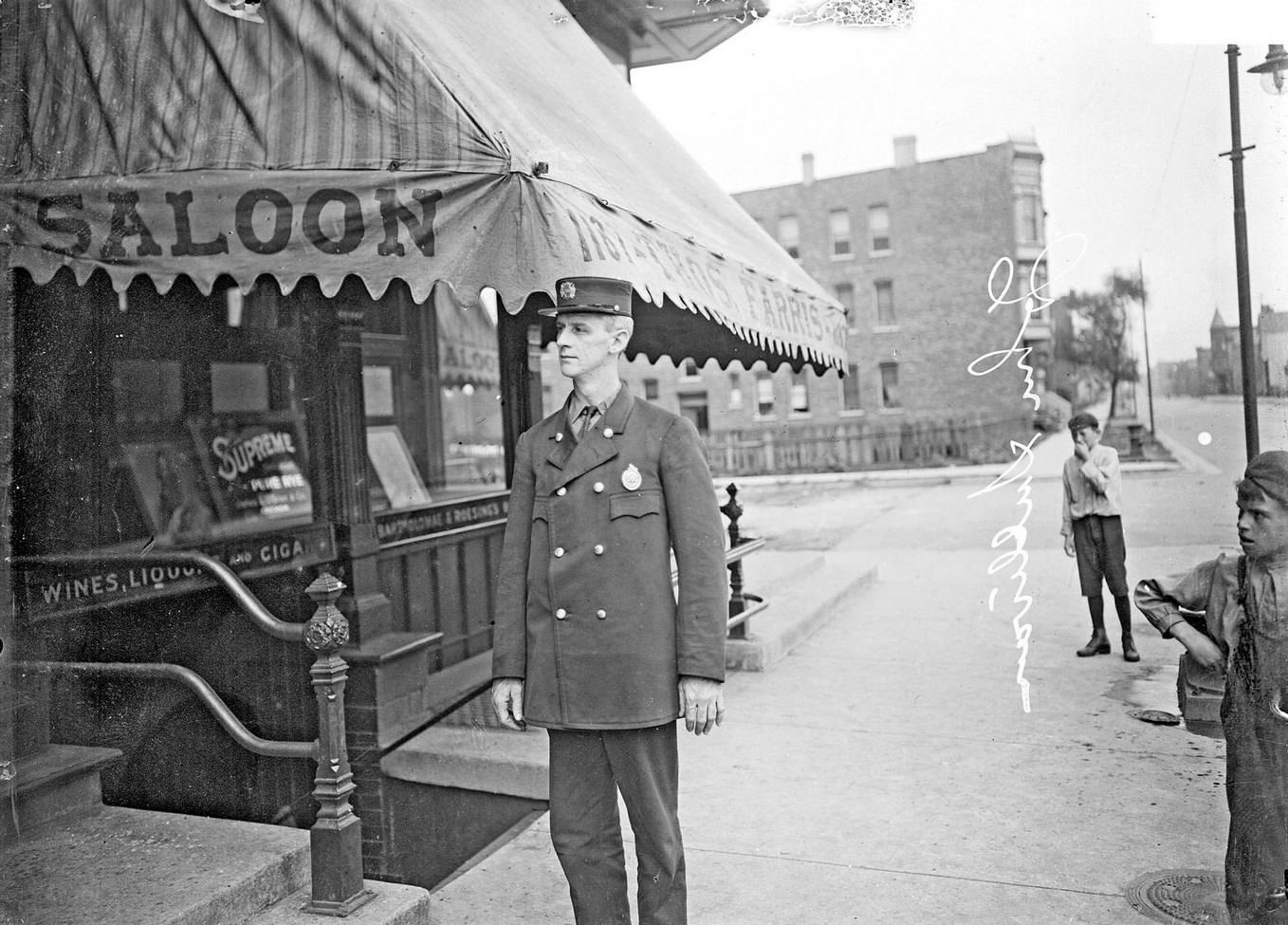
Three war dogs and two soldiers holding their leashes running outside at the war show in Grant Park, Chicago, Illinois, 1918.Field Museum of Natural History in Jackson Park, Chicago, Illinois, 1915.West Madison Street looking from North Wells Street, with Vogelsang’s Restaurant at 173-181 West Madison visible on the extreme right, during a snowstorm in the Loop community, Chicago, Illinois, 1918.View of the intersection of Madison Street and Clinton Street, Chicago, Illinois, 1917.View of the southeast corner of Clark Street and Randolph Street, Chicago, Illinois, 1910s.The northeast corner of Jackson Boulevard and LaSalle Street, Chicago, Illinois, 1910s.The northwest corner of Dearborn Street and Washington Street, Chicago, Illinois, 1910s.Busy Street Scene, View of State Street North from Madison Street, Chicago, 1910sBusy Street Scene, View of State Street North from Madison Street, Chicago, 1910sFirst street car to run after strike in the Loop community area, Chicago, Illinois, 1910s.Man holding an umbrella and riding a bicycle in the rain on an empty street, with visible streetcar tracks, during a streetcar strike, Chicago, Illinois, June 15, 1915.Men dressed in Colonial costumes, marching south and playing drums and a fife on Market Street in the Loop community area, Chicago, Illinois, 1910s.Knights Templar parade, Chicago, Illinois, August 9, 1910.Blind children standing on a sidewalk, one is sitting on the back of a kneeling elephant from the Ringling Brothers Circus, Chicago, Illinois, April 20, 1917.Elsie Tannenbaum, Iris Stewart and Harriet Ryan, wearing costumes and posing for a children’s play at Municipal Pier (Navy Pier), Chicago, Illinois, 1917.A horse attached to a covered cart, drinking from a trough in front of the Belden Avenue Baptist Church in the Lincoln Park community area, Chicago, Illinois, August 31, 1916.Municipal Pier (Navy Pier), Chicago, Illinois, 1916.The steamer Mackinaw at Municipal Pier (Navy Pier), Chicago, Illinois, 1916.Activity on the east end of Municipal Pier, Chicago, Illinois, 1916Municipal Pier (now called Navy Pier) under construction, seen from across a dirt field in front of it, in the Near North Side community area, Chicago, Illinois, 1910s.Municipal Pier (also known as Navy Pier), with the recreation center and steamboat landing area visible, Chicago, Illinois, 1910s.Maxwell Street market on Sunday morning, Chicago, Illinois, August 1915.Maxwell Street market on Sunday morning, Chicago, August 1915.Merchants and shoppers gathering along Maxwell Street, Chicago, Illinois, 1917.Man and two children feeding ducks that are swimming in a pond in Lincoln Park, Chicago, Illinois, March 13, 1915.A woman pushing a child in a stroller, with two children walking to the side and a child riding a tricycle in front of them in Lincoln Park in spring, Chicago, Illinois, 1910s.Children standing in alley in Chicago, Illinois, 1915.Alley north of Taylor Street, west from Jefferson Street, Chicago, Illinois, April 28, 1910sJefferson Street north from Ewing Street, Chicago, Illinois, April 28, 1910s.Children pointing at a movie poster for Uncle Sam at Work at the Auditorium Theater, Chicago, Illinois, February 20, 1915.People standing in Jackson Park on the shore of Lake Michigan looking at caravels in the harbor near the La Rabida, Chicago, Illinois, 1910s.Girl sitting on stacked trunks belonging to Norwegians going home to Norway, Chicago, Illinois, 1910s.John Sullivan, a fireman, standing on a Chicago sidewalk, outside the Thomas Farris saloon, at 2200 West 13th Street in the Near West Side community area, 1910s.
It’s fascinating to see how comprehensive the streetcar grid was back then when looking at old photos like this.
It’s interesting to see how urban planning and infrastructure have evolved over time. Some cities have managed to maintain their historical infrastructure while others have faced challenges and changes that have led to a loss of their historic character.
While streetcars may not be considered more advanced than buses, it is interesting to see how comprehensive the streetcar system was in many cities over 100 years ago. However, consider drawbacks, such as streetcars getting stuck in snow and ice. Buses today offer more flexibility and the ability to reroute as needed, which is a definite advantage. While it would be great to see light rail on major Chicago streets, the lack of designated bus lanes was a failure in our pursuit of better public transportation.
I can see your point about the advantages of trams over buses, such as stability and the potential for development. However, I also agree that the flexibility of buses can be an advantage, particularly when it comes to rerouting and diverting resources. That being said, the lack of designated bus lanes has been a failure in many cities.
Designing roads and creating designated lanes can greatly improve the efficiency of both trams and buses. However, traffic remains a major obstacle to consistency. Providing breathing space for buses is important, but Mayor Daley’s parking meter deal and the width of streets make it difficult to achieve without completely removing cars, which is unlikely to be popular among most Chicagoans. Another alternative is a catastrophic event like the Great Chicago Fire, but hopefully there are more feasible solutions to improving transportation in the city.
There isn’t parking on LSD lol. Dayley sure did fuck the city but that doesn’t mean we can’t get out of. Many European cities have successfully reversed past errors and implemented separated tram systems without issue.
I see your point about the parking meter deal and the challenges it poses for implementing designated bus lanes on many city streets. However, it’s not all streets are affected and that there are examples of cities, especially in Europe, successfully implementing separated tram lanes. Additionally, the decision to sign such a long-term contract for a relatively small amount of money was a mistake and a disservice to the city, and the Daley family should be held accountable for their actions.
It’s crazy to see the city without so many cars. I always get sad seeing every city block literally filled with metal.
It’s a 5,000 lb purse
These photos always remind me the pollution and unpleasant odors that were present in the city during that time. However, due to the city’s relatively recent reconstruction after the Chicago Fire, it was still cleaner than many other major cities in the world at that time.
So much was always going on Chicago though. These photos make that very clear.
Really fun stuff here. I had never heard of the Eastland disaster before. Thanks for sharing.






It’s fascinating to see how comprehensive the streetcar grid was back then when looking at old photos like this.
It’s interesting to see how urban planning and infrastructure have evolved over time. Some cities have managed to maintain their historical infrastructure while others have faced challenges and changes that have led to a loss of their historic character.
While streetcars may not be considered more advanced than buses, it is interesting to see how comprehensive the streetcar system was in many cities over 100 years ago. However, consider drawbacks, such as streetcars getting stuck in snow and ice. Buses today offer more flexibility and the ability to reroute as needed, which is a definite advantage. While it would be great to see light rail on major Chicago streets, the lack of designated bus lanes was a failure in our pursuit of better public transportation.
I can see your point about the advantages of trams over buses, such as stability and the potential for development. However, I also agree that the flexibility of buses can be an advantage, particularly when it comes to rerouting and diverting resources. That being said, the lack of designated bus lanes has been a failure in many cities.
Designing roads and creating designated lanes can greatly improve the efficiency of both trams and buses. However, traffic remains a major obstacle to consistency. Providing breathing space for buses is important, but Mayor Daley’s parking meter deal and the width of streets make it difficult to achieve without completely removing cars, which is unlikely to be popular among most Chicagoans. Another alternative is a catastrophic event like the Great Chicago Fire, but hopefully there are more feasible solutions to improving transportation in the city.
There isn’t parking on LSD lol. Dayley sure did fuck the city but that doesn’t mean we can’t get out of. Many European cities have successfully reversed past errors and implemented separated tram systems without issue.
I see your point about the parking meter deal and the challenges it poses for implementing designated bus lanes on many city streets. However, it’s not all streets are affected and that there are examples of cities, especially in Europe, successfully implementing separated tram lanes. Additionally, the decision to sign such a long-term contract for a relatively small amount of money was a mistake and a disservice to the city, and the Daley family should be held accountable for their actions.
It’s crazy to see the city without so many cars. I always get sad seeing every city block literally filled with metal.
It’s a 5,000 lb purse
These photos always remind me the pollution and unpleasant odors that were present in the city during that time. However, due to the city’s relatively recent reconstruction after the Chicago Fire, it was still cleaner than many other major cities in the world at that time.
So much was always going on Chicago though. These photos make that very clear.
Really fun stuff here. I had never heard of the Eastland disaster before. Thanks for sharing.