Adolf Hitler’s suicide on April 30, 1945, brought the Nazi regime to its end and closed one of the darkest chapters in modern history. In the final days before his death, as Soviet forces closed in on Berlin, a photograph was taken that would become one of the most studied images of the entire war. Captured on April 28, 1945 — just two days before he died — it is widely regarded as the last known photo of Hitler alive. In it, he stands outside the bombed-out Reich Chancellery alongside his adjutant, Julius Schaub, surveying the wreckage of the regime he had built.
By late April 1945, Berlin was collapsing. Allied bombing raids had pounded the German capital for months, and the Reich Chancellery — once the symbolic heart of Nazi power — had been reduced to rubble. Hitler had retreated to the Führerbunker, a reinforced underground complex beneath the Chancellery garden, where he spent his final days issuing orders to armies that barely existed. The photograph captures a rare moment above ground, where the physical destruction of the city mirrored the total collapse of everything Hitler had sought to build.
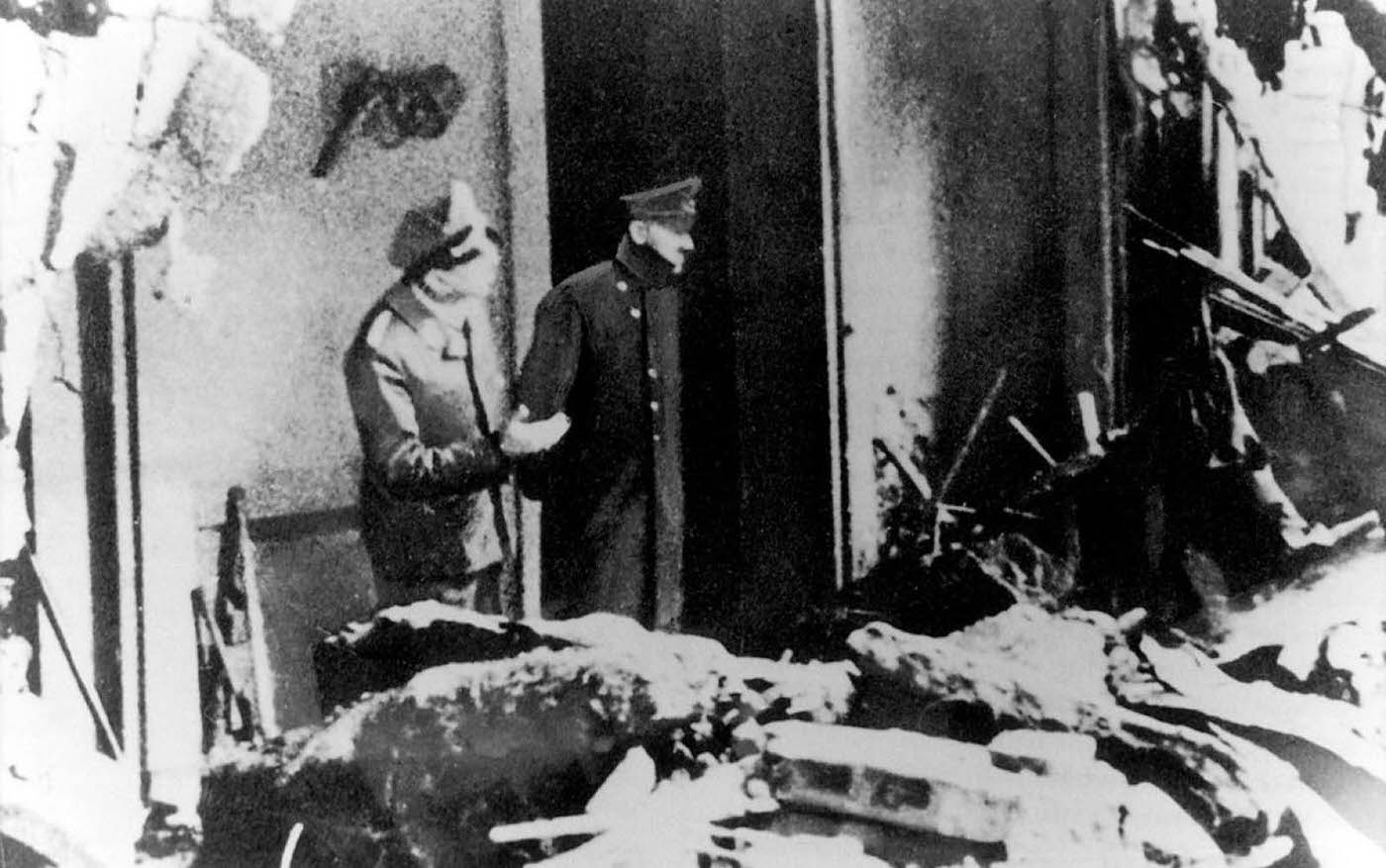
In the image, Hitler stands to the right, his gaze fixed on the ruins spread out before him. He is wearing his black coat, a familiar piece of his wardrobe in the war’s final months. Julius Schaub, dressed in a grey uniform with a red armband, stands beside him, his eyes also directed toward the destruction. Neither man appears to be speaking. The atmosphere is still, almost heavy, against the backdrop of shattered stone and gutted walls.
Schaub was one of Hitler’s longest-serving personal aides, having been with him since the early days of the Nazi movement in the 1920s. His presence in this final photograph is fitting — he was part of the inner circle that had accompanied Hitler through the rise and fall of the Third Reich. Within days of this photo being taken, Schaub would be ordered by Hitler to destroy personal documents and files stored at the Berchtesgaden retreat and in Munich, erasing records before the war’s end.
Hitler’s physical decline by this point was severe and visible. Those who encountered him in the bunker during April 1945 described a man who had aged dramatically. He suffered from tremors in his left hand and arm, walked with a shuffle, and appeared exhausted. His personal physician, Dr. Theodor Morell, had been injecting him with a wide range of drugs throughout the war, and by its end, Hitler’s health had deteriorated significantly. Though the photograph does not show his full condition clearly, accounts from those around him during these final days paint a picture of a man physically broken even before his death.
On April 29, 1945 — the day after this photo was taken — Hitler married Eva Braun in a brief civil ceremony inside the bunker. He also dictated his final political testament, blaming the Jews for the war and urging Germany’s future leaders to continue racial struggle. The following afternoon, on April 30, Hitler shot himself in his private study. Eva Braun died alongside him, having taken cyanide. Their bodies were carried to the Chancellery garden above the bunker, doused in petrol, and burned, in accordance with Hitler’s instructions.
Since the photograph surfaced, historians have examined its authenticity carefully. Some have questioned whether it was staged or altered, and a small number of conspiracy theorists have used it to fuel claims that Hitler survived the war and escaped. Mainstream historical research has firmly rejected those claims. Documents, eyewitness testimony from bunker staff, Soviet forensic investigations, and later DNA analysis of skull fragments all support the conclusion that Hitler died in Berlin on April 30, 1945. The photograph is accepted by the majority of historians as genuine.
The debate around the image also extends to how it should be treated as a historical object. Some have argued that photographs of Hitler should be restricted because they risk being used for glorification. Others, including archivists and historians, maintain that suppressing historical documents — even deeply uncomfortable ones — does more harm than good. Removing evidence does not erase what happened; it only makes it harder to understand. The photograph belongs to the historical record of World War II, and its value lies precisely in what it documents: the final hours of a dictator standing amid the ruins his regime created.
The Reich Chancellery itself did not survive long after the war. Soviet forces took control of Berlin in early May 1945, and the already-damaged building was demolished in stages over the following years. The marble and stone from the Chancellery were later used in the construction of Soviet war memorials in Berlin, including the Soviet War Memorial in Treptower Park. Nothing of the structure Hitler once used as his seat of power remains standing today. The photograph, taken two days before his death, is one of the last visual records of both the man and the building in the same frame.