Spy cameras have a fascinating history rooted in secrecy and the need to gather information without being detected. These devices were hidden inside everyday objects — watches, cigarette packs, books, and even rings — making them ideal tools for espionage. Their designs were often as creative as the missions they served. Each camera tells a story of its time, reflecting the ingenuity of its makers and the extraordinary lengths people went to in order to capture information covertly.
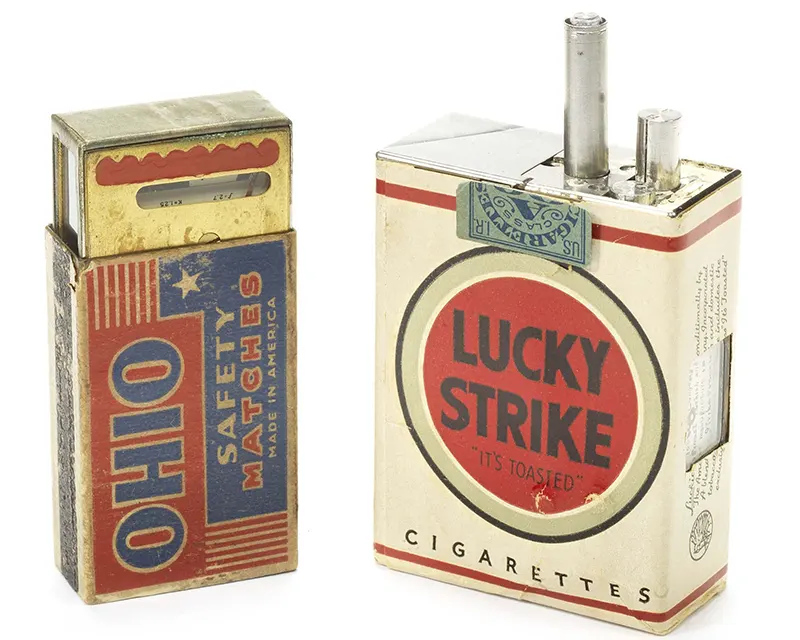
The Lucky Strike Spy Camera was developed in the late 1940s by the Mast Development Company for the U.S. Military. Disguised as a pack of Lucky Strike cigarettes, this device was designed for clandestine photography during espionage missions. Its technology was surprisingly advanced for its time. The camera used a 17.5mm f/2.7 Sonnar-type lens with a focal plane shutter, allowing for a range of shutter speeds. It could capture up to 18 exposures on a roll of 16mm film. The camera’s compact size and inconspicuous design made it ideal for covert operations, allowing agents to capture images discreetly. To aid in light metering, the camera was accompanied by a light meter disguised as a matchbox. This ensured the correct exposure for each photograph, even in challenging lighting conditions.
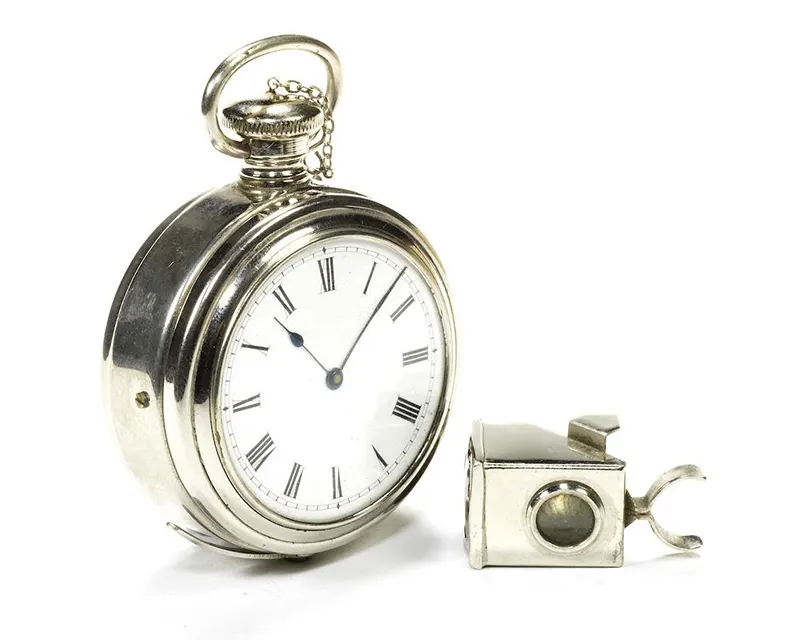
The 1904 Ticka Watch was a subminiature camera disguised as a pocket watch. Invented by Swedish designer Magnus Niéll, the Ticka was designed for discreet photography. Its technology was quite clever for its era. The lens was concealed behind the watch’s winding crown, while the film was housed within the watch’s body. The camera used a roll film and captured 25 exposures on a 17.5mm wide film strip. The user simply pointed the watch at the subject and turned the winding crown to advance the film and take a photo. The Ticka’s watch-like design allowed users to take photos unnoticed, making it an ideal tool for capturing candid moments or for covert surveillance. Its compact size and unobtrusive nature made it a popular choice for both amateur photographers and spies alike.
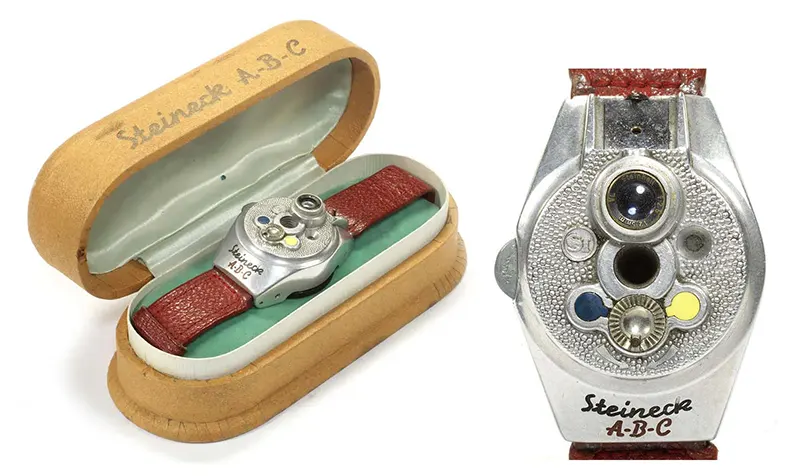
The ABC Watch Camera was produced in Germany in 1948. This device, disguised as a wristwatch, featured a hidden lens on the back of its body, allowing for covert photography. The camera’s technology, though basic by today’s standards, was quite innovative for its time. The lens, concealed behind a hinged cover, used a fixed focus and a single shutter speed. It captured 6 exposures on a small roll of film measuring 14mm wide. To take a photo, the user simply aimed the watch at their subject and pressed a small button on the side.
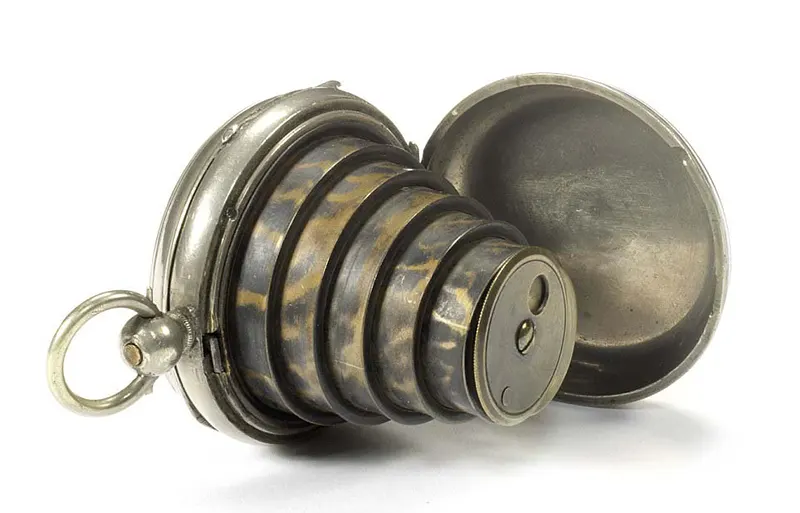
The Ladies’ Pattern Patent Watch Camera was a subminiature camera designed for female agents in 1886. Invented by J. Lancaster & Son, this covert device was crafted to resemble a fashionable pocket watch, allowing for discreet photography during covert operations. Its technology, though basic by today’s standards, was quite advanced for its time. The lens, concealed behind a hinged cover on the watch face, captured images on circular sensitized paper discs. The camera used a simple rotary shutter, operated by turning the watch’s winding crown, and required manual insertion of the paper discs for each exposure. The camera’s design made it an ideal tool for female agents, enabling them to blend into social settings while discreetly capturing images of interest. Its elegant appearance and compact size allowed for easy concealment, ensuring that the camera remained undetected during covert missions.
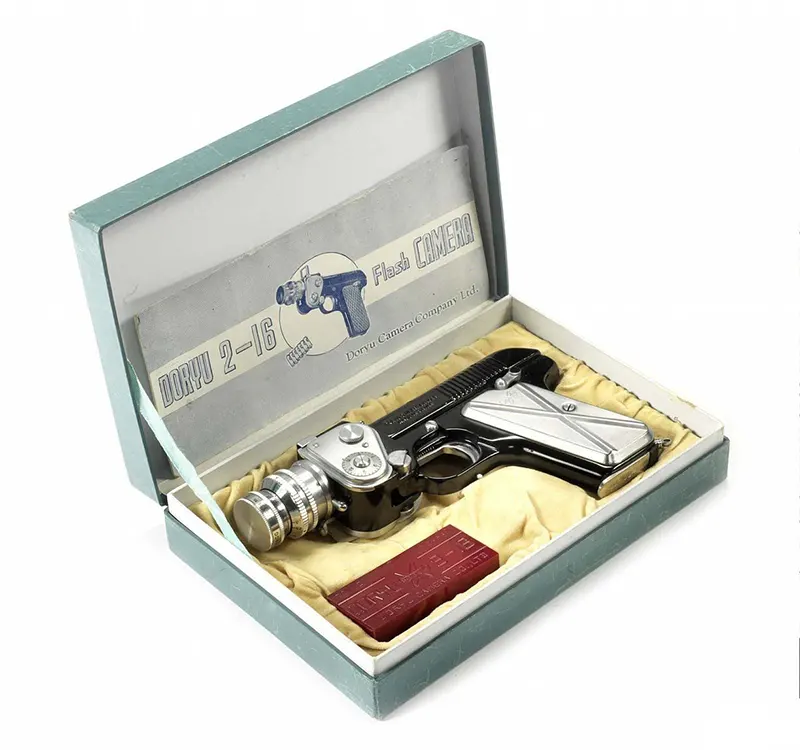
The Doryu 2-16, a gun camera developed in 1954, was designed for Japanese police forces to discreetly capture footage during public events and demonstrations. This device, shaped like a small pistol, used 16mm film to record still images. The lens was concealed within the gun’s barrel, while the film was housed in the grip. To operate the camera, the user simply aimed the “gun” at their subject and pulled the trigger, activating the shutter and advancing the film. The camera also featured a flash system, with magnesium cartridges loaded into a magazine like real bullets, providing illumination for the photographs. The gun-like design provided a discreet way to capture footage without attracting attention and also acted as a deterrent to potential troublemakers. However, the Doryu 2-16 had its limitations. The 16mm film format offered limited recording time and required frequent reloading. Additionally, the camera’s bulky size and unusual shape made it somewhat cumbersome to carry and operate.
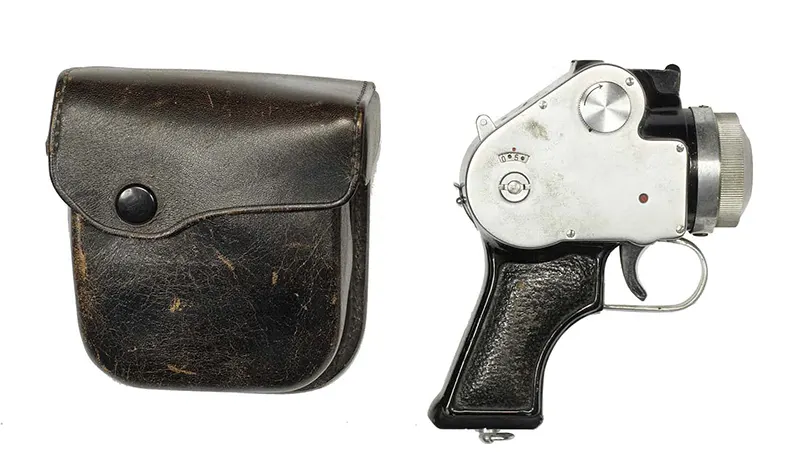
The 1952 Mamiya Pistol Camera, also known as the “Fast-Action Camera,” was a surveillance tool developed in Japan for the Japanese police force. This device, shaped like a pistol, was designed for discreet photography during demonstrations and other public events. Unlike the Doryu 2-16, which used 16mm film, the Mamiya Pistol Camera used a half-frame 35mm format. This allowed for more exposures per roll of film and made it more compact and easier to handle. The camera featured a fixed-focus 45mm lens and a simple exposure control system, with a single number scale for adjusting settings. The pistol-like design allowed for quick and intuitive aiming, as police officers were already trained in gun handling. The unusual shape also served as a deterrent, potentially causing hesitation or confusion among those being photographed. Despite its design and practicality, the Mamiya Pistol Camera had a relatively short lifespan. Only around 300 units were produced, and most were officially destroyed a few years later. This rarity has made it a sought-after collector’s item today.
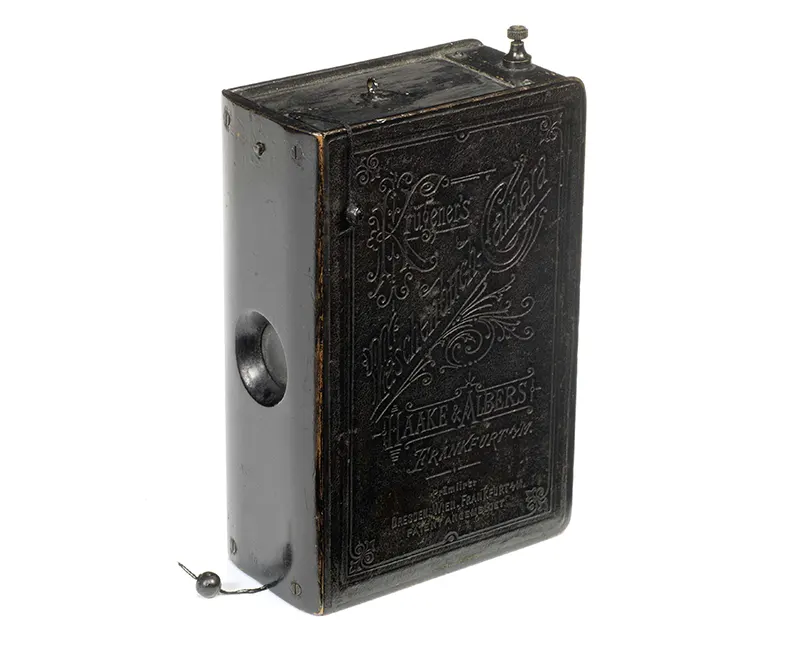
The 1888 Taschenbuch was the first commercially successful book camera. Developed by German photographer Dr. Rudolf Krugener, this device was disguised as a leather-bound book, allowing for discreet photography without arousing suspicion. The Taschenbuch used cutting-edge technology for its time. The lens was concealed within the spine of the book, while the film was housed within the body. The camera used a simple rotary shutter, operated by turning a knob on the side, and could capture up to 12 exposures on a roll of film. The user simply held the book up to their eye, aimed at their subject, and turned the knob to take a photograph. The Taschenbuch’s book-like design made it an ideal tool for covert photography. It blended into everyday environments, allowing photographers to capture candid moments and discreetly document events without attracting attention. The camera’s compact size and portability also made it a popular choice for travel photography.
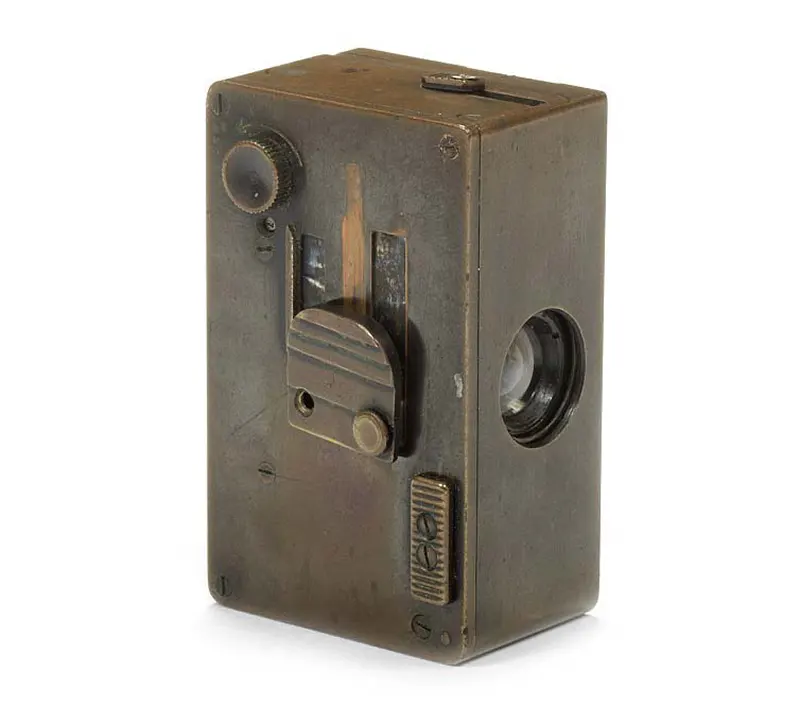
The Mast Concealable Camera, developed in the 1950s, was a discreet tool for covert photography. Manufactured by the Mast Development Company, known for their expertise in surveillance technology, this camera was designed to blend into various everyday objects, making it ideal for clandestine operations. The camera featured a subminiature format, typically using 16mm film, and was housed within ordinary objects like cigarette lighters, matchboxes, or tie clips. This allowed for inconspicuous photography without arousing suspicion. A small lever or button activated the shutter, capturing a single image. The film was then manually advanced for the next shot. Despite its simplicity, the Mast Concealable Camera produced sharp images, thanks to its high-quality optics and precise engineering.
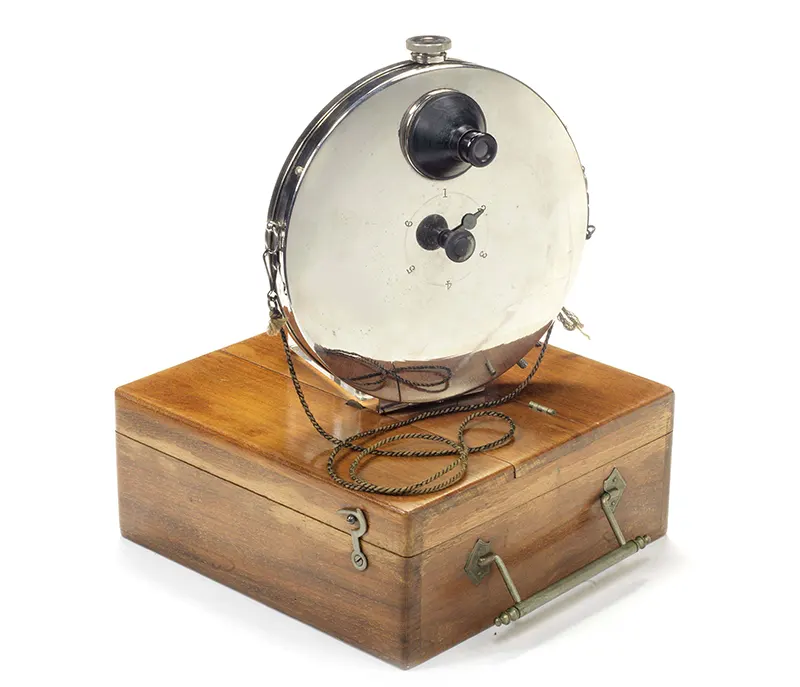
The 1886 Concealed Vest Camera was designed to be worn discreetly within a vest, with the lens poking through a buttonhole. Patented by Robert D. Gray and manufactured by Western Electric Co. in New York, this camera changed covert photography. The camera’s design allowed for clandestine image capture. The lens, disguised as a button, was connected to a circular chamber housing the photographic plate. A trigger mechanism, concealed within the vest, allowed for remote shutter release. The photographer could discreetly capture images without arousing suspicion. This camera used circular dry plates, which were state-of-the-art for the era. The plates were sensitive to light and allowed for reasonably detailed images. While not as convenient as modern film rolls, these plates enabled photographers to capture moments discreetly.
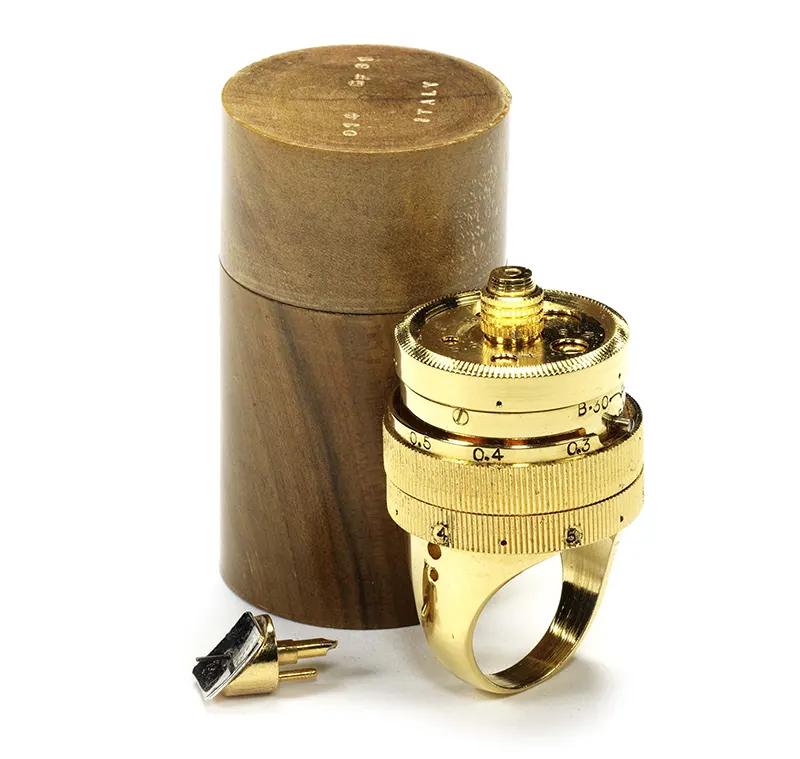
The 1981 Ring Camera was a product of Italian ingenuity during the Cold War era. This miniature camera, disguised as a fashionable ring, allowed for discreet photography without arousing suspicion. A tiny lens was concealed within the ring’s setting, while a small film compartment was hidden within the band. To take a photo, the user simply aimed their hand at the subject and pressed a small button on the ring, activating the shutter. The film was then manually advanced for the next shot.
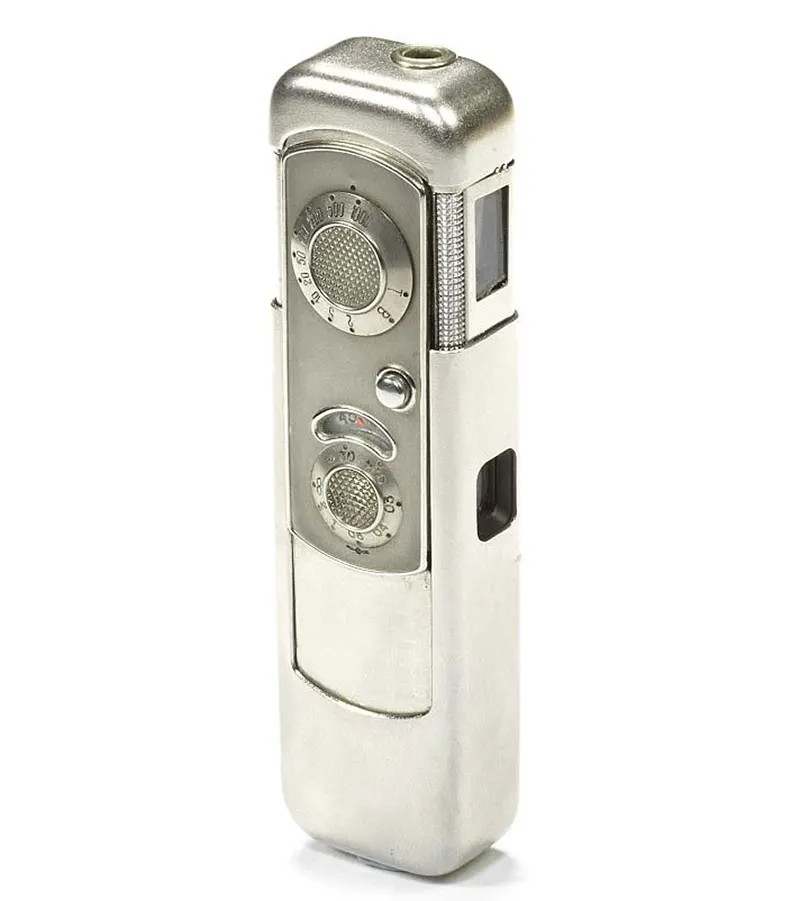
The Riga Minox was manufactured in Latvia. The Minox subminiature camera was designed to be compact and discreet, often referred to as a “spy camera,” but its primary form was a rectangular metal body with a sliding lens cover. It gained popularity for its portability and ability to capture high-quality images in a small package. However, it was not disguised as a radio. Various Minox models were produced over the years, each with its own design and features. Some models, like the Minox C, were slightly larger and included built-in light meters, while others remained more compact and relied on manual settings. However, none of the standard Minox models were designed to mimic a radio.
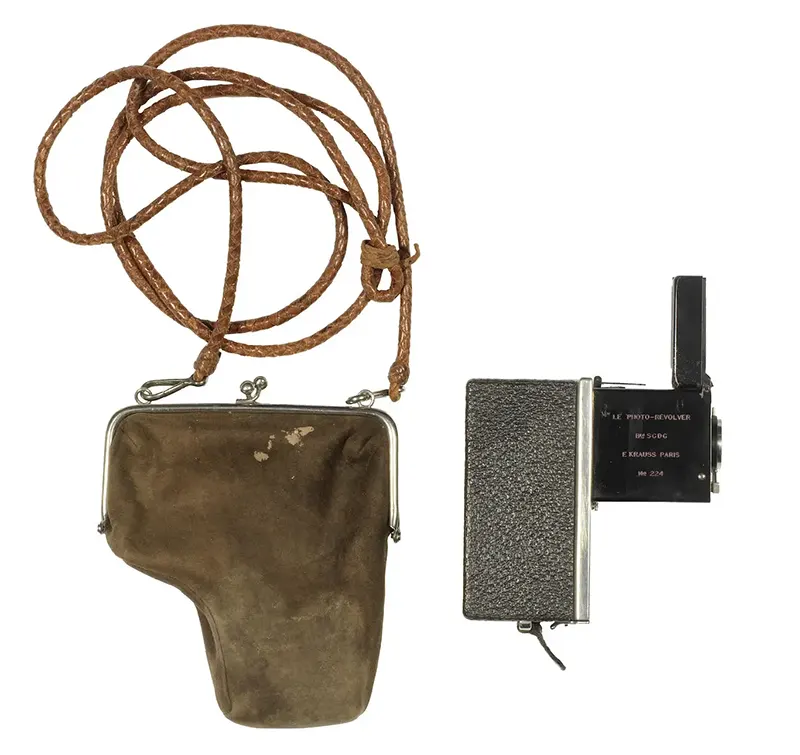
The Le Photo Revolver was a French-made camera disguised as a revolver, dating back to the early 20th century. This device was designed for covert photography, allowing users to capture images discreetly without arousing suspicion. The lens was concealed within the barrel of the revolver, while the film was housed in the cylinder. To take a photo, the user simply aimed the “revolver” at their subject and pulled the trigger, activating the shutter and advancing the film. The camera used a roll film and captured multiple exposures, depending on the model and size of the film. The revolver-like design provided a discreet way to capture footage without attracting attention and also acted as a deterrent to potential troublemakers. However, the camera’s unusual appearance often caused confusion and hesitation among those being photographed. The Le Photo Revolver had its limitations. The film format offered limited recording time and required frequent reloading. Additionally, the camera’s bulky size and unusual shape made it somewhat cumbersome to carry and operate.
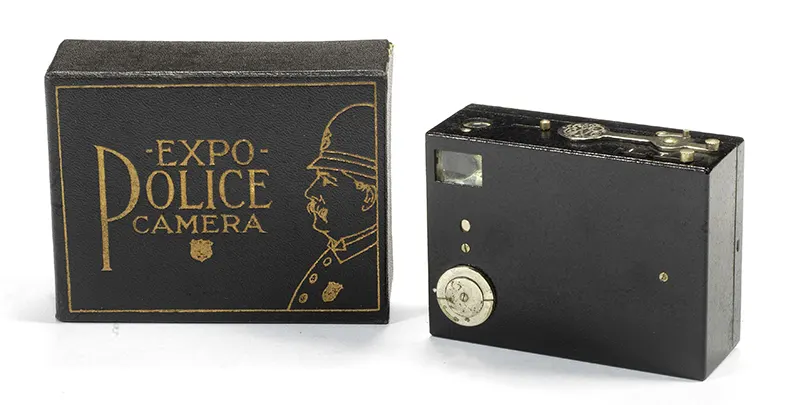
The Expo Police Camera, manufactured in New York between 1911 and 1924, was an early covert photography tool marketed specifically for law enforcement. This compact and discreet camera allowed for clandestine surveillance and evidence gathering. The camera’s technology, though basic by today’s standards, was quite innovative for its time. It featured a simple lens with a fixed focus and a focal plane shutter made of fabric. The camera used special cassettes for film, capturing 12 exposures per cassette. The film size was small, measuring only 12mm x 26mm, but it was sufficient for capturing basic details. The Expo Police Camera was designed for easy operation. It had a simple trigger mechanism for activating the shutter and a sliding plate with two apertures for controlling light exposure. The camera also featured an automatic exposure counter and a reflecting finder for framing the shot. Its compact size and discreet design made it ideal for covert operations. It could be easily concealed in a pocket or hand, allowing law enforcement officers to capture images without arousing suspicion, making it a valuable tool for documenting crimes, identifying suspects, and gathering evidence.
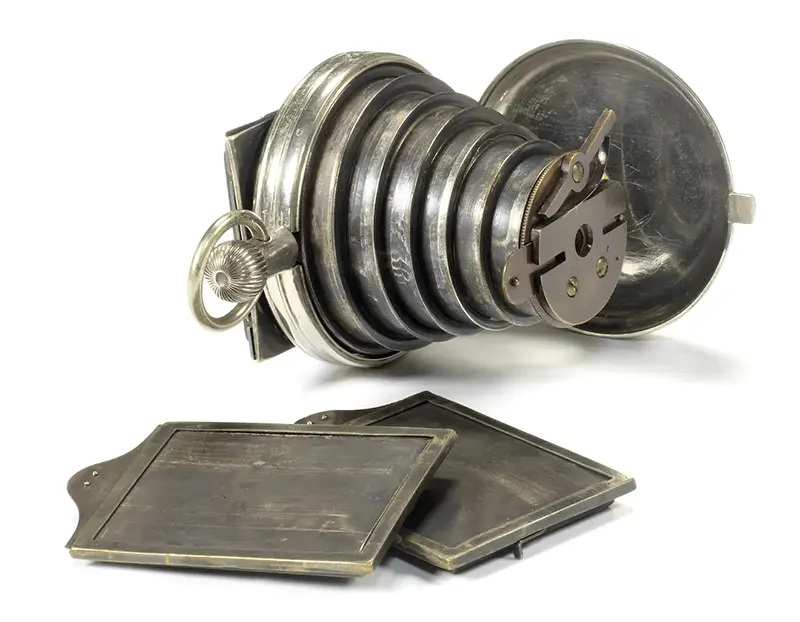
The 1886 Improved Pattern Patent Watch Camera is a rare artifact of early covert photography. It stands out for its use of photographic plates instead of film, reflecting the evolving technology of the era. The camera’s design was seamlessly built to look like a pocket watch. The lens was discreetly hidden behind the watch face, while the plates were loaded into a compartment within the watch body. The shutter mechanism, operated by turning the watch’s winding crown, exposed the plates to light, capturing a single image at a time. The use of photographic plates, while more cumbersome than modern film, allowed for high-resolution images with exceptional detail. This made the Improved Pattern Patent Watch Camera a valuable tool for surveillance and discreet photography, enabling users to capture images with a level of clarity and precision that was uncommon for the time.
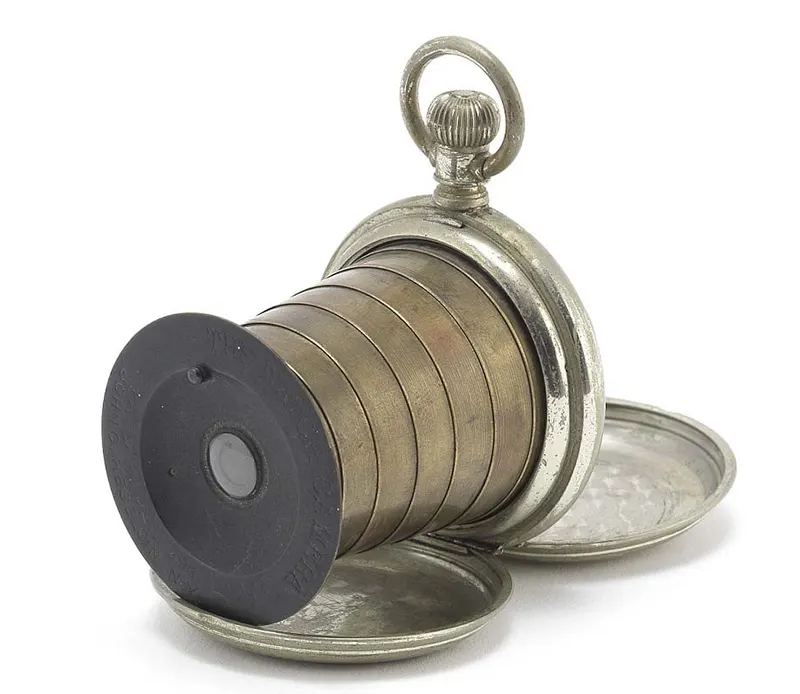
The 1894 Watch Camera was designed for discretion and swift operation, enabling users to capture secret photographs quickly and discreetly. The camera’s technology, though basic by today’s standards, was groundbreaking in its era. It featured a simple lens and shutter mechanism housed within a compact, watch-like casing. The film was typically stored on a roll or in individual plates, allowing for multiple exposures. The camera’s defining feature was its quick-draw mechanism. Users could swiftly pull out the device, aim, and capture a photo with a simple press of a button or lever. The compact size and straightforward design allowed for seamless operation, enabling users to return the camera to their pocket unseen in a matter of seconds. This covert camera found popularity among private detectives, journalists, and those seeking to document events discreetly. Its ability to capture candid moments and fleeting scenes without attracting attention made it a valuable tool for personal and professional use.
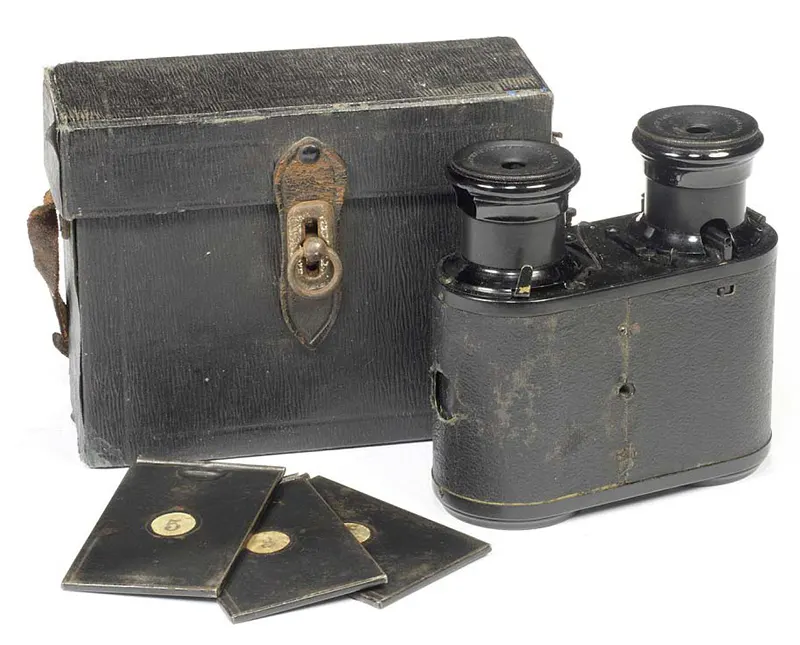
The Le Physiographe was patented in both Britain and France in 1896. This device, disguised as a pair of binoculars, allowed users to capture photographs discreetly without arousing suspicion. The Le Physiographe’s technology was remarkably advanced for its time. The camera featured two lenses, one for viewing and one for taking photographs. The film was housed within the body of the binoculars, and the shutter was activated by a button disguised as a focus knob. This allowed for seamless operation, as users could simply point the binoculars at their subject and capture an image without drawing attention. The Le Physiographe’s binocular-like design made it an ideal tool for covert photography. It blended into everyday situations, allowing photographers to capture candid moments and discreetly document events without attracting attention. The camera was particularly popular among journalists, detectives, and those seeking to capture images of people or events without their knowledge.